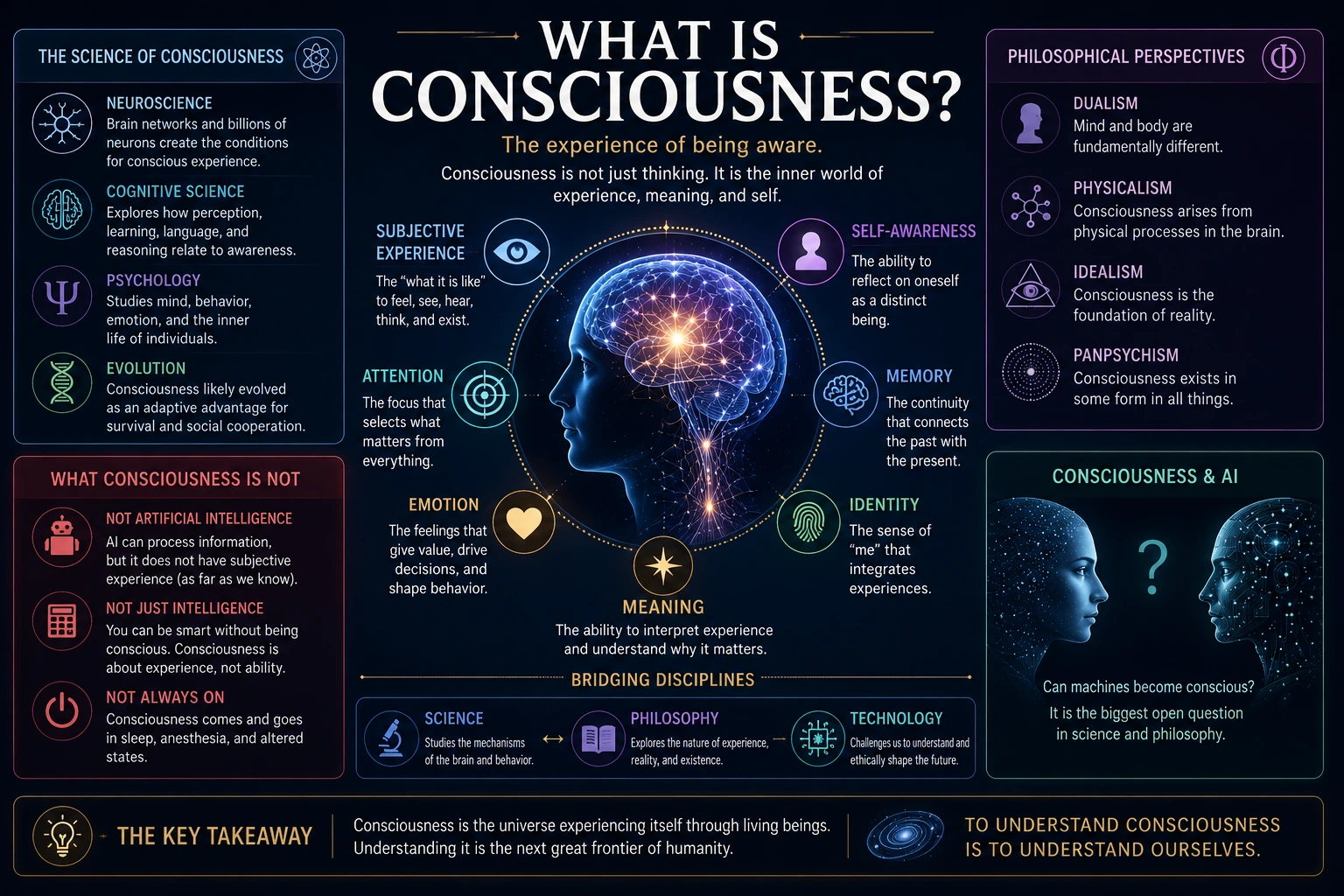
Short answer: Consciousness is the subjective experience of being aware. It includes our thoughts, sensations, emotions, memories, sense of self, and the feeling of existing as an individual experiencing the world.
Consciousness is one of the most familiar aspects of human life.
It is also one of the least understood.
You experience consciousness every moment of every day.
You see colors.
You hear sounds.
You remember your past.
You imagine your future.
You experience emotions, relationships, hopes, fears, and ambitions.
Most importantly, you experience yourself as the one having those experiences.
Consciousness is not simply information processing.
It is the experience of being the one processing the information.
Despite centuries of philosophy and decades of neuroscience research, scientists still do not fully understand why consciousness exists or how subjective experience emerges from physical processes in the brain.
This question has become increasingly important in the age of artificial intelligence.
Modern AI systems can generate text, recognize images, solve problems, and imitate human conversation.
But are they conscious?
Do they experience anything at all?
Or are they merely processing information without subjective awareness?
The question of consciousness is no longer purely philosophical.
It may become one of the defining scientific and ethical questions of the twenty-first century.
Why Consciousness Matters More Than Ever
For most of history consciousness was treated as a philosophical problem.
Today it sits at the center of multiple scientific revolutions.
- Neuroscience attempts to explain how conscious experience emerges from the brain.
- Artificial intelligence forces us to ask whether machines can ever become conscious.
- Medicine relies on understanding consciousness in anesthesia, coma, and disorders of awareness.
- Psychology explores the relationship between consciousness, attention, memory, and identity.
- Philosophy continues to investigate the nature of subjective experience itself.
Understanding consciousness may ultimately help us answer some of humanity’s oldest questions:
- What makes us human?
- What creates identity?
- Can machines become conscious?
- What happens when consciousness changes or disappears?
- What is the relationship between mind and brain?
To understand consciousness is, in many ways, to understand ourselves.
A Framework for Understanding Consciousness
Consciousness is often discussed as a single thing.
In reality, it appears to involve multiple interconnected dimensions.
The framework used in this article explores consciousness through several major components:
- Subjective experience
- Self-awareness
- Attention
- Memory
- Identity
- Emotion
- Meaning
Together these dimensions help explain why consciousness feels less like a feature and more like an entire inner world.
The first place to begin is the oldest mystery of all.
Why does experience exist at all?
The Hard Problem of Consciousness
Modern neuroscience has achieved extraordinary progress in understanding the human brain.
Scientists can identify regions involved in vision, language, memory, emotional processing, and decision making.
Researchers can observe neurons firing, map neural networks, and study how information travels through the nervous system.
Yet one question remains remarkably difficult.
Why does any of this produce subjective experience?
Why does seeing light create the experience of color?
Why does hearing sound create the experience of music?
Why does neural activity create the feeling of being you?
Why is there something it feels like to be conscious at all?
This question is known as the hard problem of consciousness.
The term was introduced by philosopher David Chalmers to distinguish between two categories of questions.
| Easy Problems | The Hard Problem |
|---|---|
| How does the brain process vision? | Why is vision experienced subjectively? |
| How does memory work? | Why does remembering feel like something? |
| How does attention function? | Why is there awareness at all? |
| How do neurons communicate? | Why does neural activity create experience? |
The so-called “easy problems” are not actually easy.
Many remain extraordinarily complex scientific challenges.
The difference is that they involve explaining mechanisms.
The hard problem asks something fundamentally different.
Why do those mechanisms produce experience in the first place?
Science can increasingly explain how the brain works.
It still struggles to explain why experience exists.
What Are Qualia?
Philosophers often use the term qualia to describe the subjective qualities of experience.
The redness of red.
The taste of coffee.
The feeling of warmth from sunlight.
The experience of grief.
The sound of your favorite song.
These experiences can be described scientifically in terms of wavelengths, neural activity, hormones, and electrical signals.
Yet descriptions do not appear identical to experiences themselves.
You can know everything about the physics of color and still not know what red looks like until you experience it.
This distinction lies at the heart of many debates about consciousness.
Why the Hard Problem Matters
The hard problem of consciousness is not simply a philosophical curiosity.
It influences some of the most important scientific and ethical questions of our time.
- Can artificial intelligence become conscious?
- How should we treat conscious non-human beings?
- What determines personal identity?
- How do anesthesia and coma affect awareness?
- Could consciousness exist in forms radically different from our own?
The answers to these questions may influence medicine, technology, law, ethics, and the future relationship between humanity and intelligent machines.
Understanding consciousness may become one of humanity’s greatest scientific achievements.
Failing to understand it may become one of our greatest blind spots.
Not surprisingly, philosophers and scientists have proposed very different explanations for consciousness.
Some argue that consciousness emerges from physical processes in the brain.
Others suggest that consciousness may be more fundamental than matter itself.
Exploring these possibilities takes us into one of the most fascinating debates in modern thought.
Theories of consciousness.
Theories of Consciousness
If consciousness remains unsolved, it is not because nobody has tried to explain it.
Philosophers and scientists have proposed many competing theories.
Some view consciousness as an emergent property of the brain.
Others argue that consciousness may be more fundamental than matter itself.
Each theory attempts to answer the same question:
Why does subjective experience exist?
Physicalism: Consciousness Emerges from the Brain
Physicalism is currently the dominant view in neuroscience.
According to this perspective, consciousness arises entirely from physical processes occurring within the brain.
Neurons interact.
Networks process information.
At some level of complexity, subjective experience emerges.
This approach fits well with modern science because it assumes that consciousness can ultimately be explained through biology, chemistry, and physics.
Brain activity does not accompany consciousness.
Brain activity creates consciousness.
The challenge for physicalism is explaining exactly how physical processes generate subjective experience.
This remains the core of the hard problem.
Dualism: Mind and Matter Are Different Things
Dualism argues that mind and matter are fundamentally different kinds of reality.
This view is often associated with philosopher René Descartes, who famously distinguished between the thinking mind and the physical body.
According to dualism, consciousness cannot be fully reduced to physical processes because it belongs to a different category of existence.
The main challenge for dualism is explaining how non-physical consciousness interacts with the physical brain.
If mind and matter are separate, how do they influence one another?
Idealism: Consciousness Comes First
Idealism reverses the traditional relationship between mind and matter.
Instead of asking how matter creates consciousness, idealism asks whether matter itself may emerge from consciousness.
From this perspective, consciousness is not produced by reality.
Consciousness is reality’s foundation.
Although this idea sounds radical to many modern readers, versions of idealism have appeared repeatedly throughout the history of philosophy.
Perhaps consciousness does not exist within the universe.
Perhaps the universe exists within consciousness.
Panpsychism: Is Consciousness Everywhere?
Panpsychism proposes another possibility.
Instead of emerging suddenly in complex brains, consciousness may exist in extremely simple forms throughout nature.
Human consciousness would then represent a highly organized form of something more fundamental and widespread.
This idea has gained renewed attention among some philosophers because it avoids certain aspects of the hard problem.
If consciousness already exists in basic forms, then perhaps the real question is not how consciousness appears, but how simple experiences combine into complex minds.
Integrated Information Theory
Integrated Information Theory (IIT) attempts to measure consciousness in terms of information integration.
According to IIT, consciousness corresponds to the amount of information a system integrates into a unified whole.
A highly integrated system possesses more consciousness than a fragmented one.
This theory is attractive because it offers a possible mathematical framework for consciousness.
Its critics argue that measuring information may not fully explain subjective experience itself.
Global Workspace Theory
Global Workspace Theory (GWT) views consciousness as a broadcasting system within the brain.
Many unconscious processes occur simultaneously.
Information becomes conscious when it enters a global workspace that makes it available to multiple cognitive systems.
In this view, consciousness acts less like a place and more like a stage illuminated by attention.
Consciousness may not be where thinking happens.
It may be where thinking becomes visible to itself.
No Consensus Yet
Despite decades of research, no theory has achieved universal acceptance.
That uncertainty is not a failure of science.
It reflects the extraordinary complexity of the question itself.
| Theory | Main Idea |
|---|---|
| Physicalism | Consciousness emerges from the brain. |
| Dualism | Mind and matter are fundamentally different. |
| Idealism | Consciousness is fundamental to reality. |
| Panpsychism | Consciousness exists in some form everywhere. |
| Integrated Information Theory | Consciousness reflects information integration. |
| Global Workspace Theory | Consciousness is information broadcast within the brain. |
Humanity may understand the universe before it fully understands consciousness.
And yet another question is becoming increasingly urgent.
If we eventually understand consciousness well enough to explain it, could we also create it?
That possibility leads directly to one of the most important debates of the modern era.
Can artificial intelligence become conscious?
Can Artificial Intelligence Become Conscious?
Artificial intelligence has become remarkably capable.
Modern systems can write essays, generate images, recognize patterns, translate languages, compose music, and solve complex problems.
Some AI models can even imitate human conversation so effectively that people occasionally attribute emotions, intentions, or understanding to them.
This naturally leads to one of the most important questions of the twenty-first century.
Can artificial intelligence become conscious?
The answer depends largely on what consciousness actually is.
Intelligence Is Not the Same as Consciousness
One of the most common misconceptions in discussions about AI is the assumption that intelligence automatically leads to consciousness.
Current scientific understanding does not support that conclusion.
An intelligent system can process information, solve problems, recognize patterns, and generate responses without necessarily having any subjective experience.
A calculator performs arithmetic.
A search engine retrieves information.
An AI model generates language.
None of these abilities automatically imply awareness.
Processing information is not necessarily the same as experiencing information.
| Intelligence | Consciousness |
|---|---|
| Processes information | Experiences information |
| Solves problems | Experiences existence |
| Generates responses | Possesses subjective awareness |
| Can be measured through performance | May only be known from within |
This distinction lies at the center of the modern AI debate.
The Problem of Other Minds
There is a deeper philosophical challenge hidden inside this question.
How do we know that anyone besides ourselves is conscious?
We assume that other humans are conscious because they behave similarly to us, communicate experiences, and possess brains that resemble our own.
Strictly speaking, however, we never directly observe another person’s consciousness.
We infer it.
This is known as the problem of other minds.
The same problem applies to artificial intelligence.
Even if an AI system one day behaves exactly like a human being, would that prove conscious experience exists?
Or would it merely demonstrate extremely sophisticated behavior?
Behavior may reveal intelligence.
It may not reveal experience.
The Turing Test and Its Limits
In 1950, Alan Turing proposed a practical approach.
If a machine could carry on a conversation indistinguishable from that of a human, perhaps the distinction no longer mattered.
This idea became known as the Turing Test.
Modern AI systems increasingly approach or surpass this benchmark in certain contexts.
Many philosophers argue that passing the Turing Test does not prove consciousness.
It demonstrates convincing behavior.
It does not necessarily demonstrate subjective experience.
The Turing Test may answer whether machines can imitate consciousness.
It does not answer whether machines possess consciousness.
Could Conscious Machines Exist?
No scientific consensus currently exists.
Several possibilities remain open:
- Consciousness may emerge automatically from sufficient complexity.
- Consciousness may require biological processes unique to living organisms.
- Consciousness may depend on specific architectures that future AI systems could eventually possess.
- Consciousness may involve principles that science has not yet discovered.
At present, there is no evidence that existing AI systems possess subjective awareness.
That statement may change in the future.
Today, however, it reflects the current scientific position.
Current AI systems demonstrate intelligence.
Whether they demonstrate consciousness remains unknown.
Why This Question Matters
If machines ever become conscious, the consequences could be profound.
- Would conscious AI possess rights?
- Would shutting down a conscious machine be ethically different from deleting software?
- Could conscious machines suffer?
- Would creating conscious AI create moral responsibilities for humanity?
Questions that once belonged entirely to science fiction are increasingly entering serious scientific and philosophical discussion.
The future of artificial intelligence may ultimately depend on how well we understand consciousness itself.
And perhaps that leads to an even deeper question.
If consciousness creates identity, what exactly makes you the same person across time?
The answer may lie in one of consciousness’s closest companions:
memory and identity.
Consciousness, Memory, and Identity: What Makes You You?
Consciousness gives us experience.
Memory gives those experiences continuity.
Together they create something we often take for granted:
our sense of self.
Most people feel as though they are the same person they were yesterday, five years ago, or twenty years ago.
The body changes.
Beliefs change.
Relationships change.
Memories fade and new ones appear.
Yet the feeling of being “me” remains surprisingly stable.
Identity may be the story consciousness tells itself across time.
The Ship of Theseus and Personal Identity
Philosophers have wrestled with this problem for centuries.
One famous thought experiment is known as the Ship of Theseus.
If every plank of a ship is gradually replaced over time, is it still the same ship?
Human beings face a similar question.
Cells are replaced.
Memories change.
Values evolve.
Experiences reshape personality.
What exactly remains constant?
If almost everything changes, what makes you the same person?
Memory as the Foundation of Identity
One influential answer comes from philosopher John Locke.
Locke argued that personal identity is closely connected to memory.
You are the same person because you remember being that person.
Memory creates continuity between past and present versions of yourself.
This idea remains highly influential today.
Neurological conditions provide striking examples of how closely identity and memory are connected.
When memory is severely disrupted, the sense of self may also become fragmented.
The relationship between memory and identity appears profound.
Memory does not simply record identity.
Memory may actively create identity.
Are You Your Memories?
And yet memory alone may not be enough.
People forget large parts of their lives.
Childhood memories disappear.
Names are forgotten.
Events become distorted over time.
Despite this, people generally continue to feel like themselves.
This suggests that identity may involve something more than memory alone.
Perhaps identity emerges from the interaction between memory, personality, values, relationships, and ongoing conscious experience.
| Possible Foundation of Identity | Main Idea |
|---|---|
| Memory | You are what you remember. |
| Body | You are your physical continuity. |
| Brain | You are your neural continuity. |
| Consciousness | You are the experiencing self. |
| Narrative Identity | You are the story you construct about yourself. |
The Digital Age Is Reopening Ancient Questions
Technological progress is forcing philosophy to become practical.
If memories could be copied, would identity be copied as well?
If consciousness could be transferred, would the transferred person still be you?
If a perfect digital simulation of your mind existed, would it possess your identity or merely imitate it?
Questions once explored only in philosophy and science fiction may eventually become technological realities.
The future may force humanity to answer questions that philosophy has debated for thousands of years.
Perhaps Identity Is a Process Rather Than a Thing
Perhaps the search for a single permanent self is misguided.
Perhaps identity is not an object hidden somewhere inside the mind.
Perhaps identity is something continuously created through memory, experience, relationships, values, and choices.
From this perspective, the self is not static.
The self is a process.
You are not the same person you were ten years ago.
You are the continuation of that person.
And perhaps this leads to an even deeper question.
If consciousness creates experience and memory creates identity, what role does consciousness play in meaning itself?
Why does subjective experience matter?
That question brings us to the final philosophical dimension of consciousness:
meaning, value, and purpose.
Consciousness, Meaning, and the Future of Humanity
Consciousness does more than allow us to experience the world.
It allows the world to matter to us.
Without consciousness there would be information.
There would be physical processes.
There would be chemical reactions and biological systems.
But there would be no joy.
No beauty.
No suffering.
No love.
No meaning.
Consciousness transforms existence into experience.
Meaning emerges from experience.
Why Meaning Requires Consciousness
A mountain exists whether anyone observes it or not.
A star continues to burn whether anyone sees it or not.
Meaning is different.
Meaning exists within conscious experience.
A song matters because someone hears it.
A memory matters because someone remembers it.
A promise matters because someone values it.
A civilization matters because conscious beings experience its successes and failures.
Consciousness may not simply observe value.
It may be the condition that allows value to exist at all.
The Moral Importance of Conscious Experience
Many ethical systems ultimately revolve around conscious experience.
Why is suffering wrong?
Because conscious beings experience suffering.
Why is compassion valuable?
Because conscious beings experience relief, safety, and connection.
Why do freedom, dignity, and justice matter?
Because they influence the quality of conscious lives.
If consciousness disappeared, morality itself would become difficult to define.
Ethics may ultimately be the study of how conscious beings affect one another’s experiences.
The Future of Consciousness
For most of history consciousness evolved slowly through biological processes.
The coming century may change that.
- Artificial intelligence may transform how humans think and create.
- Brain-computer interfaces may alter memory and communication.
- Neurotechnology may eventually influence attention, emotion, and perception.
- Digital environments may reshape social experience and identity.
Humanity is approaching the possibility of altering consciousness itself.
That possibility creates opportunities unlike anything in history.
It also creates responsibilities unlike anything in history.
The greatest technological question of the future may not be what machines can do.
It may be what happens when humans gain the ability to redesign their own minds.
Consciousness and Civilization
Civilizations are often described in terms of economies, institutions, technologies, and political systems.
Yet every civilization ultimately depends on consciousness.
Ideas exist because minds can hold them.
Culture exists because memories survive across generations.
Science exists because curiosity exists.
Ethics exists because empathy exists.
Every human system begins inside conscious experience before appearing in the external world.
Civilizations are built from infrastructure.
But they begin in consciousness.
The Question Returns
We began with a simple question.
What is consciousness?
After centuries of philosophy and decades of neuroscience, the honest answer remains surprisingly simple.
We do not yet know.
We understand more about the brain than any previous generation.
We still do not fully understand why subjective experience exists.
Perhaps consciousness emerges from complexity.
Perhaps consciousness is fundamental to reality itself.
Perhaps future discoveries will transform how we understand both mind and matter.
Humanity may one day solve the mystery of consciousness.
Until then, consciousness remains the most familiar mystery we have ever encountered.
And perhaps that mystery is precisely what makes consciousness so extraordinary.
Because the universe may contain countless stars, galaxies, and worlds.
Yet consciousness allows the universe to become aware of itself.
Through consciousness, the universe does not merely exist.
For a brief moment, it experiences its own existence.
Frequently Asked Questions About Consciousness
What is consciousness in simple terms?
Consciousness is the subjective experience of being aware. It includes thoughts, sensations, emotions, memories, and the sense of existing as an individual experiencing the world.
What is the hard problem of consciousness?
The hard problem of consciousness asks why physical processes in the brain create subjective experience at all. Science increasingly understands how the brain processes information, but explaining why those processes feel like something from the inside remains one of the biggest mysteries in science and philosophy.
Can artificial intelligence become conscious?
No scientific evidence currently demonstrates that existing AI systems possess subjective awareness or conscious experience. Whether consciousness can emerge in artificial systems remains an open scientific and philosophical question.
What is the difference between intelligence and consciousness?
Intelligence refers to the ability to process information, solve problems, and adapt to new situations. Consciousness refers to subjective experience and awareness itself. A system may potentially be intelligent without being conscious.
What are qualia?
Qualia are the subjective qualities of experience, such as the redness of red, the taste of coffee, or the feeling of warmth from sunlight. They represent the “what it feels like” aspect of consciousness.
What theory of consciousness is currently accepted?
No single theory has achieved scientific consensus. Physicalism remains dominant in neuroscience, while theories such as Integrated Information Theory, Global Workspace Theory, and panpsychism continue to attract significant attention and debate.
Is consciousness unique to humans?
Most scientists believe many animals possess some form of consciousness, although the nature and complexity of those experiences likely differ between species. The precise boundaries of consciousness remain uncertain.
Why is consciousness important?
Consciousness underlies experience, meaning, identity, morality, and subjective awareness. Understanding consciousness may ultimately help answer questions about intelligence, ethics, personhood, and the future relationship between humans and artificial intelligence.
Epilogue: The Most Familiar Mystery
Consciousness is strange.
It is the one thing every human being knows directly and yet struggles to explain.
We can observe galaxies billions of light-years away.
We can map the human genome.
We can build machines capable of extraordinary intelligence.
Yet the experience of simply being remains deeply mysterious.
Consciousness may be the closest thing we have to magic that survives scientific explanation.
Perhaps future discoveries will explain it completely.
Perhaps consciousness will eventually become as understandable as gravity, evolution, or genetics.
Or perhaps consciousness represents something fundamentally different — a phenomenon that changes not only what we know, but what knowing itself means.
For now, the mystery remains.
And perhaps that mystery is valuable.
Because curiosity has always been one of humanity’s greatest strengths.
The desire to understand ourselves created philosophy.
It created science.
It created art.
It created civilization.
Perhaps consciousness is not merely another problem to solve.
Perhaps it is the reason we seek answers in the first place.
And perhaps the most extraordinary fact of all is this:
For a brief moment in cosmic history, the universe became capable of asking questions about itself.
That moment is consciousness.