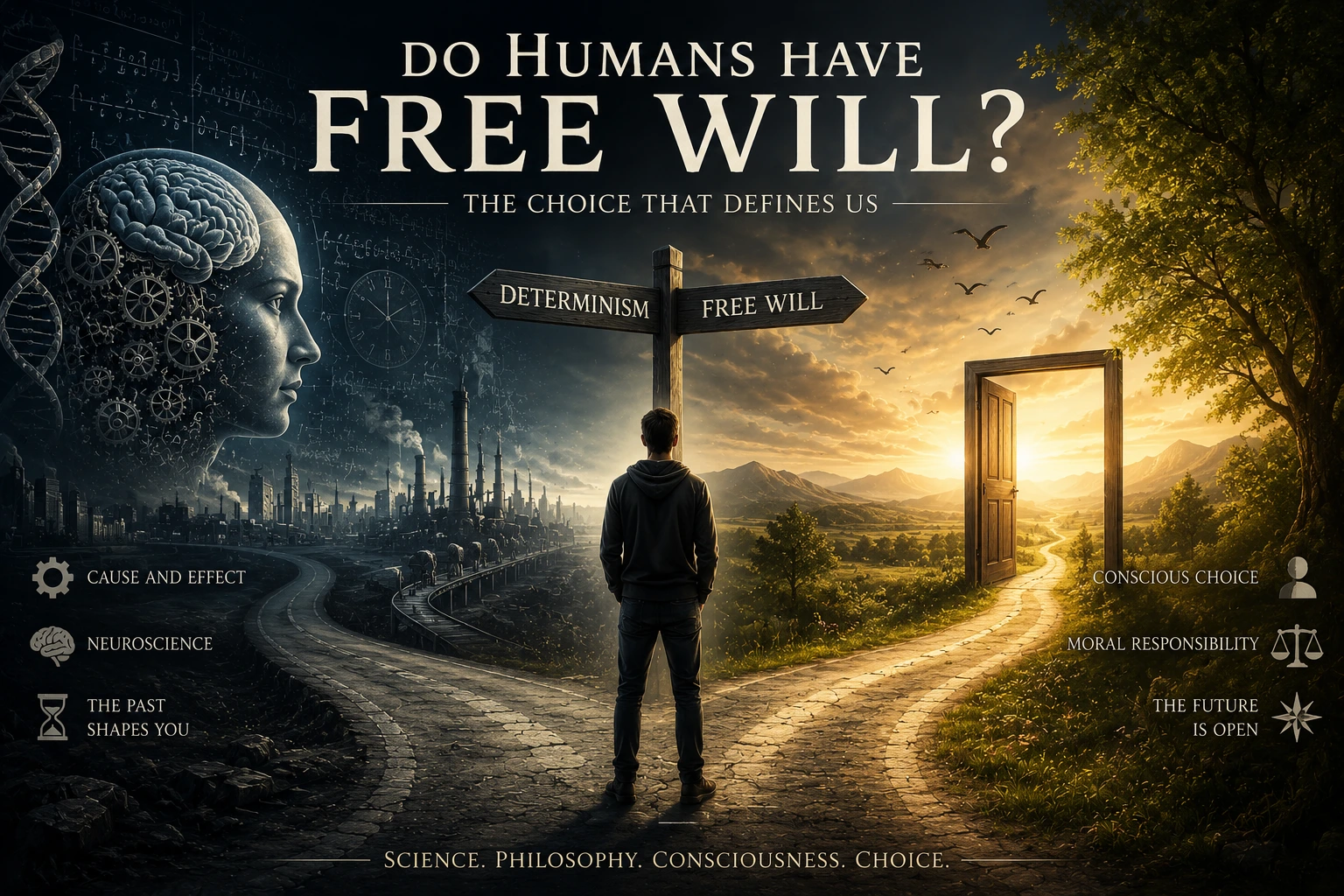
Short answer: we still do not know.
Philosophy, neuroscience and physics offer very different answers to one of humanity’s oldest questions.
Some argue that every decision you make is the inevitable result of previous causes.
Others believe human beings genuinely create new possibilities and shape the future through conscious choice.
Between these positions lies one of the deepest mysteries of human existence.
Are you choosing your future?
Or are you simply becoming aware of decisions your brain has already made?
At first glance, free will feels obvious.
You choose what to say.
You choose where to go.
You choose who to become.
Every day appears to be filled with choices.
Yet philosophy asks a disturbing question.
What if every one of those choices was already determined by events that happened long before you became aware of them?
Your genes.
Your upbringing.
Your memories.
Your biology.
Your culture.
The physical laws governing your brain.
If every event has a cause, could any decision ever have been different?
This question sits at the intersection of philosophy, neuroscience, psychology, ethics and artificial intelligence.
And surprisingly, despite thousands of years of debate, humanity still does not have a definitive answer.
Why Does Free Will Matter?
The question of free will reaches far beyond philosophy.
Modern civilization quietly assumes that free will exists.
- Law assumes people are responsible for their actions.
- Morality assumes people can choose between better and worse decisions.
- Education assumes people can change.
- Democracy assumes citizens can make meaningful choices.
- Justice assumes individuals could have acted differently.
If free will does not exist, many of our assumptions about responsibility and accountability may need to be reconsidered.
Free will may be the invisible foundation beneath morality, responsibility and civilization itself.
What Is Free Will?
In its simplest form, free will is the ability to choose between multiple possible actions.
The core question can be reduced to a single sentence.
Could you have done otherwise?
If the answer is yes, then free will may exist.
If the answer is no, then every decision may simply be the inevitable consequence of previous events.
This simple question has divided philosophers for centuries.
Determinism: Perhaps Everything Is Already Decided
Determinism argues that every event has a cause.
Your thoughts have causes.
Your desires have causes.
Your decisions have causes.
If the complete state of the universe could be known at a single moment, then in principle the future could also be predicted.
From this perspective, human beings are not outside causality.
We are part of it.
In a deterministic universe, your choice may be an effect rather than a beginning.
This does not necessarily make your decisions meaningless.
But it raises a difficult possibility.
Perhaps the feeling of choice is not the same thing as freedom.
Libertarianism: Humans Can Truly Choose
Philosophical libertarianism argues that free will genuinely exists.
According to this view, human beings are capable of choosing between multiple possible futures.
Your decision is not merely the inevitable result of previous events.
You are an active source of new causes in the universe.
This position aligns closely with ordinary human experience.
Most people feel that they genuinely could have made different choices in important moments of their lives.
Libertarianism argues that human beings do not merely react to reality.
They participate in creating it.
However, libertarian free will faces an important challenge.
If decisions are not caused by previous events, then what causes them?
If a decision is completely random, it does not appear truly free.
Freedom and randomness may not be the same thing.
This problem remains one of the biggest difficulties for libertarian theories of free will.
Compatibilism: Free Will and Determinism May Coexist
Compatibilism offers a third possibility.
Perhaps determinism and free will are not enemies after all.
Compatibilists argue that free will does not require complete independence from causes.
Instead, freedom means acting according to your own values, beliefs, intentions and understanding.
You may still be shaped by biology, memory, culture and experience.
But if your actions reflect your own reasoning rather than external coercion, they can still be considered free.
Freedom may not require escaping causality.
It may simply require becoming one of its causes.
This approach has become one of the most influential positions in modern philosophy.
Many contemporary philosophers view compatibilism as the most practical way of understanding human agency.
The Three Major Positions on Free Will
Most discussions about free will eventually lead to one of three major philosophical positions.
| Position | Core Idea |
|---|---|
| Determinism | Every decision is the result of previous causes. |
| Libertarianism | Humans can genuinely choose between possible futures. |
| Compatibilism | Free will can exist within a causal universe. |
Comparing the Three Views
| Question | Determinism | Libertarianism | Compatibilism |
|---|---|---|---|
| Do humans have free will? | No | Yes | Yes, but differently defined |
| Could we have acted differently? | No | Yes | Depends on context |
| Are we morally responsible? | Complicated | Yes | Yes |
| Does causality govern decisions? | Completely | Not entirely | Yes |
The debate about free will may not be about whether humans are free.
It may be about what freedom actually means.
For centuries, philosophy dominated this discussion.
Then neuroscience entered the conversation.
And the question became even more difficult.
What if your brain begins making decisions before you become aware of them?
This possibility would challenge one of our deepest intuitions about human freedom.
What Does Neuroscience Say About Free Will?
For centuries, the debate about free will belonged primarily to philosophy.
Then neuroscience entered the conversation.
And the results surprised almost everyone.
Some experiments suggested that the brain may begin preparing decisions before conscious awareness appears.
If true, this raises a disturbing possibility.
What if your brain decides before you do?
This idea challenges one of our deepest intuitions about human freedom.
Most people experience themselves as conscious agents making deliberate choices.
Neuroscience asks whether that experience reflects reality or merely follows it.
The Benjamin Libet Experiment
One of the most influential experiments in the history of free will research was conducted by neuroscientist Benjamin Libet in the 1980s.
Participants were asked to perform a simple action, such as moving a finger, whenever they felt the urge to do so.
At the same time, researchers monitored their brain activity.
The results were unexpected.
Brain activity associated with the movement appeared several hundred milliseconds before participants reported becoming consciously aware of their decision.
This brain signal became known as the readiness potential.
The brain appeared to prepare the action before conscious awareness of the decision emerged.
Did Libet Disprove Free Will?
Many people interpreted Libet’s experiment as proof that free will does not exist.
The conclusion seemed straightforward.
If the brain starts the decision before consciousness becomes aware of it, then perhaps consciousness is not the decision-maker at all.
Instead, consciousness may simply observe decisions after unconscious processes have already begun.
Perhaps consciousness is not the author of decisions.
Perhaps it is their narrator.
This interpretation became enormously influential in both philosophy and popular science.
The Criticism of Libet’s Findings
However, the story is far more complicated.
Libet’s experiment involved extremely simple actions.
Moving a finger is very different from:
- choosing a career,
- raising a child,
- changing political beliefs,
- keeping a promise,
- or sacrificing for another person.
Complex human decisions unfold over minutes, months and sometimes years.
Many philosophers argue that experiments involving split-second movements tell us very little about long-term human agency.
A finger movement may not be the same thing as a moral decision.
Libet’s “Veto Power”
Interestingly, Benjamin Libet himself did not believe his findings destroyed free will.
Instead, he proposed the idea of conscious veto power.
According to this view, unconscious processes may generate possible actions, but consciousness retains the ability to stop them.
The brain may say:
“Do this.”
Consciousness may still answer:
“No.”
Perhaps free will is not the power to initiate every thought.
Perhaps it is the power to refuse some of them.
The Predictive Brain
Modern neuroscience increasingly views the brain as a prediction machine.
Your brain constantly generates expectations about the future.
It predicts what you will see, hear and do.
Many decisions may emerge from interactions between:
- memory,
- emotion,
- habits,
- attention,
- goals,
- and previous experiences.
This does not necessarily eliminate free will.
But it suggests that conscious choice may be only one layer of a much larger decision-making system.
The conscious mind may be less like a king issuing orders and more like a navigator steering a moving ship.
This raises another profound question.
If consciousness is only one part of decision-making, what role does it actually play?
And if consciousness matters, could an artificial intelligence ever possess something similar?
Could Artificial Intelligence Have Free Will?
The rise of artificial intelligence has brought the question of free will into an entirely new domain.
Modern AI systems can analyze information, adapt to new situations and make decisions that appear increasingly sophisticated.
They can choose strategies.
They can optimize outcomes.
They can even appear creative.
But does any of this mean they possess free will?
An algorithm can select an option.
That does not necessarily mean it experiences itself as choosing.
Most philosophers distinguish between decision-making and agency.
A calculator makes decisions according to rules.
A thermostat makes decisions according to rules.
Neither is believed to possess free will.
The central question may not be whether a system can make decisions.
The real question may be whether it experiences itself as the one making them.
Consciousness and Free Will
Many theories of free will depend heavily on consciousness.
To make a meaningful choice, a system may need:
- self-awareness,
- an internal experience of possibilities,
- the ability to imagine future outcomes,
- the capacity for reflection,
- and a sense of personal identity over time.
Human beings appear to possess at least some of these characteristics.
Whether artificial intelligence ever will remains one of the largest open questions in science and philosophy.
Free will may require more than intelligence.
It may require subjective experience itself.
Responsibility Without Free Will
Perhaps the most practical question in the free will debate is not whether free will exists.
Perhaps the real question is what happens if it does not.
If every decision is the product of genetics, upbringing, biology and environment, can anyone truly deserve praise or blame?
If a person could not have acted differently, what becomes of punishment?
What becomes of justice?
What becomes of morality?
The free will debate may ultimately be a debate about responsibility.
The Case for Responsibility
Many philosophers argue that responsibility can survive even in a deterministic universe.
Responsibility may not exist to punish the past.
It may exist to shape the future.
Social rules influence behavior.
Consequences influence choices.
Accountability changes decision-making.
Even in a causal universe, human systems can still adapt and evolve.
Responsibility may itself be one of the causes that shapes future actions.
Can Morality Exist Without Free Will?
Traditional morality assumes choice.
We praise people because we believe they could have acted worse.
We blame people because we believe they could have acted better.
If no alternatives were ever possible, morality becomes more complicated.
Yet some philosophers argue that morality does not require metaphysical freedom.
Perhaps morality is simply a system for helping conscious beings reduce suffering and build better futures together.
Morality may not require perfect freedom.
It may only require the ability to learn, adapt and care about consequences.
Degrees of Freedom
Perhaps the debate has been framed too absolutely.
Either humans possess complete free will.
Or humans possess none at all.
Reality may be more complicated.
Some philosophers and neuroscientists suggest that freedom may exist in degrees.
| Level | Description |
|---|---|
| Reflex | Automatic reactions with little conscious involvement. |
| Habit | Behavior strongly influenced by repetition and conditioning. |
| Deliberation | Evaluation of alternatives and consequences. |
| Self-reflection | The ability to examine motives and reshape future behavior. |
Perhaps free will is not a switch that is either on or off.
Perhaps it is a capacity that can expand through awareness and reflection.
This possibility leads directly to one final question.
If freedom exists in degrees, what kind of freedom do human beings actually possess?
And what does that mean for our understanding of ourselves?
Does Quantum Physics Save Free Will?
One of the most common arguments in modern discussions about free will comes from quantum physics.
Classical physics appeared to describe a deterministic universe.
If every particle followed predictable laws, then the future might simply unfold from the past.
Quantum mechanics complicated that picture.
At the smallest scales, some events appear fundamentally probabilistic rather than fully predictable.
This led some thinkers to ask an exciting question.
If the universe is not fully deterministic, does that create room for free will?
Unfortunately, the answer is not so simple.
Randomness is not the same thing as freedom.
If your choices were determined by pure chance, they would not become more meaningful or more yours.
A random decision is not necessarily a free decision.
Quantum uncertainty may challenge determinism.
It does not automatically create free will.
What Did Famous Philosophers Believe?
The free will debate has shaped philosophy for more than two thousand years.
Many of history’s greatest thinkers reached very different conclusions.
| Thinker | Position |
|---|---|
| Aristotle | Human responsibility requires meaningful choice. |
| Baruch Spinoza | Freedom is largely an illusion created by ignorance of causes. |
| David Hume | Freedom and causality can coexist. |
| Immanuel Kant | Moral responsibility requires some form of freedom. |
| Daniel Dennett | Compatibilism provides the strongest explanation of human agency. |
| Sam Harris | Free will is an illusion produced by the brain. |
The remarkable diversity of these answers demonstrates how difficult the problem remains.
The greatest philosophers in history have not agreed on a solution.
Perhaps that tells us something important about the nature of the question itself.
So, Do Humans Have Free Will?
The most honest answer may be surprisingly simple.
We do not know.
Determinism shows that our decisions have causes.
Neuroscience shows that many mental processes begin outside conscious awareness.
Philosophy shows that freedom may not require complete independence from causality.
Perhaps human beings are neither completely free nor completely determined.
Perhaps we exist somewhere in between.
We inherit biology.
We inherit culture.
We inherit memories.
But we can also reflect upon them.
We can question them.
And sometimes, we can change them.
Perhaps free will is not freedom from causes.
Perhaps it is the ability to become one of the causes shaping the future.
Epilogue: The Universe Learning To Choose
Stars do not choose.
Planets do not choose.
Galaxies do not choose.
Yet somewhere in the history of the universe, matter became capable of reflection.
It became capable of imagination.
It became capable of asking questions about itself.
And perhaps, it became capable of choice.
Whether free will ultimately exists or not, one fact remains extraordinary.
For a brief moment in cosmic history, the universe became capable of wondering whether it was free.
That moment is consciousness.
And through consciousness, reality became capable of questioning its own future.
Frequently Asked Questions About Free Will
What is free will in simple terms?
Free will is the ability to make choices between different possible actions and influence your own future. The debate about free will asks whether humans genuinely choose or whether every decision is ultimately determined by previous causes.
Do humans actually have free will?
There is no scientific or philosophical consensus. Determinists argue that every decision is caused by previous events. Libertarians believe humans genuinely create new possibilities. Compatibilists argue that free will can exist even in a causal universe.
What is determinism?
Determinism is the idea that every event, thought and decision is caused by previous events according to the laws of nature. In a fully deterministic universe, the future may be the inevitable consequence of the past.
What did the Libet experiment show?
Benjamin Libet’s experiment showed that brain activity associated with simple movements can appear before people become consciously aware of deciding to move. This finding raised important questions about the role of consciousness in decision-making.
Did neuroscience disprove free will?
No. Neuroscience has shown that unconscious processes play an important role in decisions, but it has not demonstrated that complex human choices are entirely determined or that conscious reflection is irrelevant.
Does quantum physics prove free will exists?
No. Quantum mechanics introduces uncertainty into physics, but randomness is not the same as freedom. Quantum uncertainty may challenge strict determinism, but it does not automatically create free will.
Can artificial intelligence have free will?
Current AI systems can make decisions and optimize outcomes, but there is no evidence that they possess consciousness, subjective experience or genuine free will.
Can morality exist without free will?
Some philosophers believe morality requires genuine freedom of choice. Others argue that morality can still exist as a system for reducing suffering and improving the future, even in a deterministic universe.
What is compatibilism?
Compatibilism is the philosophical position that free will and determinism are compatible. According to this view, freedom means acting according to your own values and reasoning rather than being completely independent from causality.
Why is free will important?
Free will lies at the center of responsibility, morality, justice, law, education and personal identity. Whether it exists affects how we understand ourselves and our societies.