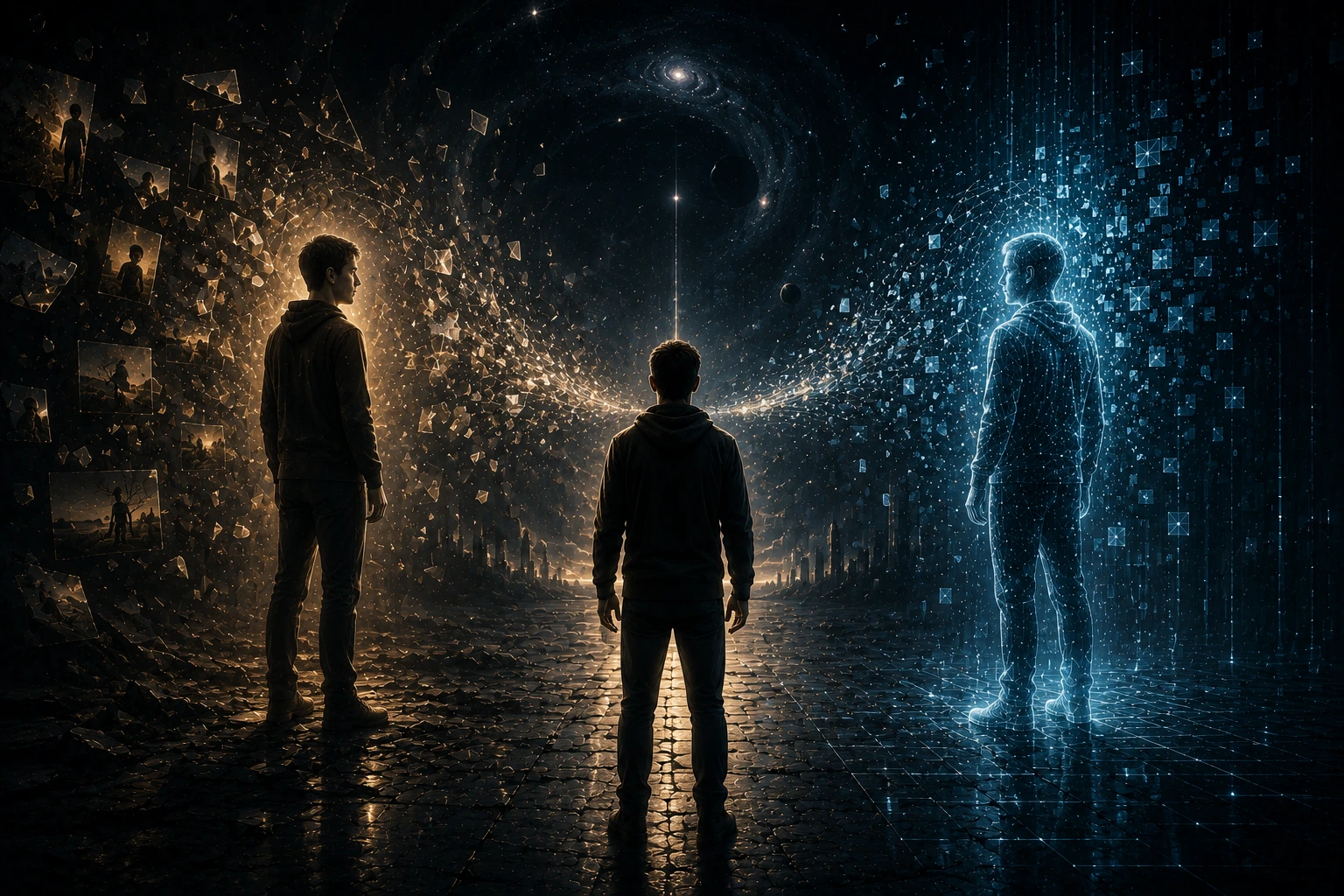
Short answer: scientists currently do not know whether consciousness can be uploaded into a computer. Future technology may be able to copy memories, behavior, personality, and decision patterns, but whether subjective experience itself can be transferred remains unknown.
The question “can consciousness be uploaded into a computer?” is not only a technological question. It is also a question about identity, memory, artificial intelligence, the soul, digital immortality, and what makes a person the same person over time.
It also sits close to the core of the Those Who Guard Eternity universe, where consciousness, memory, choice, responsibility, and eternity are not abstract ideas but living realities.
Published: July 5, 2026
Updated: July 5, 2026
Reading time: about 12 minutes
Author: Denys Kostin is the author of the Those Who Guard Eternity philosophical fantasy series, exploring consciousness, identity, memory, free will, reality, and the future of human existence through speculative fiction.
The deepest problem of mind uploading is not whether a mind can be copied. It is whether anyone actually wakes up on the other side.
Contents
- What Is Mind Uploading?
- Is Mind Uploading Possible?
- Is Consciousness the Same as Information?
- Would an Uploaded Mind Still Be You?
- What Happens If Two Copies Exist?
- Can Memories Be Uploaded?
- Can Consciousness Exist Outside the Brain?
- Can AI Become Conscious?
- The Problem of Personal Identity
- Is Mind Uploading Immortality?
- Why Philosophical Fantasy Explores Mind Uploading So Well
- Frequently Asked Questions
What Is Mind Uploading?
Mind uploading is the hypothetical process of copying or transferring a human mind into a digital system. It is sometimes called consciousness transfer, whole brain emulation, or digital immortality.
The basic idea is simple to describe but incredibly difficult to solve: if a computer could recreate the structure and activity of your brain, could it recreate you?
A mind uploading process would likely require copying:
- memories;
- personality traits;
- emotional patterns;
- beliefs and values;
- decision-making habits;
- knowledge and language;
- the structure of the brain;
- the patterns that support consciousness.
Supporters imagine mind uploading as a possible path to digital immortality. Critics argue that it may only create a copy of consciousness rather than continuing the original self.
Is Mind Uploading Possible?
At present, mind uploading is not possible. Science cannot yet scan and recreate a complete human brain at the level required to preserve memory, personality, subjective experience, and identity.
Even if future technology could map every neuron and connection, that would not automatically prove that consciousness transfer had occurred. A digital system might imitate a person perfectly without actually being conscious.
This is why the question is not only technical. It is philosophical. A machine might copy behavior, speech, and memory. But would it copy the inner experience of being you?
Is Consciousness the Same as Information?
The possibility of uploading consciousness depends on whether consciousness is the same as information processing.
If consciousness is only information arranged in the right structure, then copying that structure might preserve consciousness. In that view, the brain is like biological hardware, and the mind is like software that could theoretically run on another system.
But if consciousness is more than information, then uploading memories and behavior may not be enough. A computer could store everything about you without experiencing anything as you.
This is why the question of mind uploading connects directly to what consciousness is. Until we understand consciousness itself, we cannot know whether it can be uploaded.
Would an Uploaded Mind Still Be You?
Imagine a machine scans your brain and creates a perfect digital copy. The copy has your memories, your personality, your fears, your humor, your language, and your emotional patterns.
The digital mind wakes up and says:
I am the same person.
From the outside, it may be impossible to disagree. The uploaded mind behaves like you, remembers your life, and insists it is you.
But from the inside, the question is much harder. Did your consciousness continue into the computer? Or did you remain in the biological body while a new digital person began?
This is the core problem of mind uploading and identity.
What Happens If Two Copies Exist?
The problem becomes even harder if the original person survives the upload.
Suppose there is a biological you and a digital you. Both remember the same childhood. Both love the same people. Both claim to be the original. Both feel continuous with your past.
Which one is really you?
If both are you, then personal identity can split. If only one is you, then memory and personality are not enough. If neither answer works, then our everyday idea of identity may be incomplete.
This is why uploading consciousness is one of the strongest thought experiments in modern philosophy.
Can Memories Be Uploaded?
It may eventually become possible to copy, model, or simulate parts of memory. But uploading memories is not the same as uploading consciousness.
A computer could store every fact about your life. It could contain photographs, voice recordings, writing patterns, preferences, and behavioral data. It might even simulate how you would respond in conversation.
But memory is not necessarily experience. A stored memory is information. A lived memory is something felt from the inside.
This is why memory is central to identity, but it may not be enough to preserve a person.
Can Consciousness Exist Outside the Brain?
The question of uploading consciousness depends on another question: can consciousness exist outside the brain?
If consciousness requires biological neurons, then uploading may never create genuine subjective experience. A digital copy might imitate consciousness without having an inner life.
If consciousness depends on patterns rather than biology, then a sufficiently accurate digital system might someday support consciousness.
No one knows the answer yet. That uncertainty is what makes mind uploading so powerful as both a scientific question and a philosophical problem.
Can AI Become Conscious?
Mind uploading also connects directly to artificial consciousness. If a human mind could run on a computer, then perhaps advanced artificial intelligence could also become conscious.
Modern AI can generate language, images, plans, and arguments. But whether it experiences anything internally remains unknown.
The question can AI become conscious? is therefore central to the future of mind uploading. If machines can never be conscious, uploading a mind into a machine may create only a simulation. If machines can become conscious, then digital personhood may become one of the most important ethical problems of the future.
The Problem of Personal Identity
Mind uploading is ultimately a problem of personal identity.
What makes you the same person over time?
- your body?
- your brain?
- your memories?
- your consciousness?
- your personality?
- your soul?
- the continuity of experience?
If a digital mind has everything you remember but not your original stream of consciousness, is it you? If it has your stream of consciousness but no biological body, is it still human? If identity can be copied, can there be more than one real version of a person?
These questions show why mind uploading is not only a futurist idea. It is a direct challenge to our deepest understanding of the self.
Is Mind Uploading Immortality?
Mind uploading is often described as digital immortality. The promise is seductive: preserve the mind, escape biological death, and continue existing in another form.
But whether mind uploading is immortality depends on whether the uploaded mind is truly continuous with the original person.
If consciousness continues, uploading could be a form of survival. If only information is copied, then mind uploading may be digital preservation rather than immortality.
This connects mind uploading to books about immortality, books about eternity, and the oldest human desire: to continue beyond death.
Why Philosophical Fantasy Explores Mind Uploading So Well
Science fiction often asks whether mind uploading is technically possible. Philosophical fantasy asks what it would mean.
If consciousness can be copied, what happens to responsibility? If identity can split, what happens to love? If memory can be preserved, does guilt survive? If digital immortality becomes possible, does eternity become freedom or prison?
These are not only technological questions. They are human questions.
The Those Who Guard Eternity universe belongs to this deeper tradition. It explores consciousness, identity, memory, choice, responsibility, and eternity as forces that shape human existence.
Related Philosophical Questions
- What Is Consciousness?
- Can Consciousness Exist Outside the Brain?
- Can AI Become Conscious?
- What Is Personal Identity?
- Does the Soul Exist?
- Books About Consciousness
- Books About Memory
- Books About Immortality
- Books About Eternity
Explore the Eternity Saga
If questions about consciousness, identity, memory, immortality, and eternity fascinate you, begin with a philosophical fantasy series where these questions become part of the story.
Final Thoughts: If the Copy Wakes Up, Is It You?
Can consciousness be uploaded into a computer?
Maybe one day technology will copy the brain with extraordinary precision.
Maybe machines will recreate memory, personality, voice, emotion, and behavior.
Maybe a digital version of a person will open its eyes and insist that it is real.
But the deepest question will remain:
Did consciousness continue, or did a copy begin?
That question is why mind uploading is not only about technology. It is about what it means to be a person.
Frequently Asked Questions
Can consciousness be uploaded into a computer?
Scientists currently do not know whether consciousness can be uploaded into a computer. Future technology may copy memories and behavior, but whether subjective experience can be transferred remains unknown.
What is mind uploading?
Mind uploading is the hypothetical process of copying or transferring a human mind into a digital system, often discussed as consciousness transfer or digital immortality.
Is mind uploading possible?
Mind uploading is not currently possible. Even if the brain could be scanned in detail, it is unknown whether that would preserve consciousness or only create a copy.
Can memories be uploaded?
Parts of memory may eventually be copied or simulated, but uploading memories is not the same as uploading consciousness or preserving the same person.
Is consciousness information?
Some theories suggest consciousness may arise from information processing, while others argue that subjective experience cannot be reduced to information alone.
Would an uploaded mind still be the same person?
Philosophers disagree. If continuity of consciousness survives, it may be the same person. If only information is copied, it may be a new digital person with the same memories.
What happens if two copies exist?
If both the biological person and digital copy exist, personal identity becomes difficult to define. Both may claim continuity, but they would begin having separate experiences.
Is mind uploading the same as immortality?
Mind uploading would only be immortality if the original conscious experience continues. If it only creates a copy, it may preserve information without preserving the original self.
Can AI become conscious?
No one knows for certain. If consciousness can emerge from complex information processing, advanced AI consciousness may be possible. If consciousness requires biology, it may not be.
Is uploading consciousness science fiction?
Today, uploading consciousness remains science fiction and philosophical speculation. It is not currently a proven or available technology.