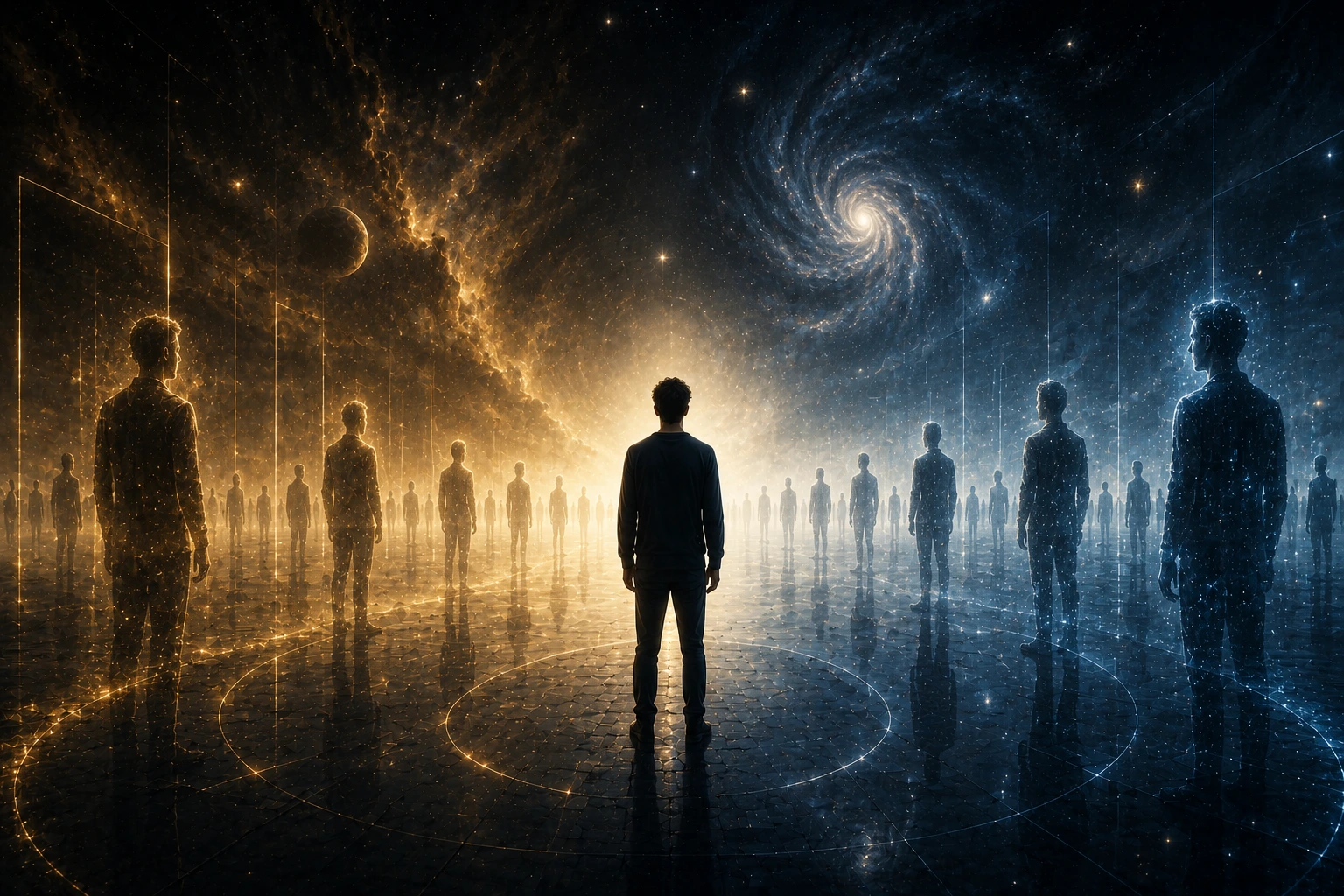
Short answer: science and philosophy currently cannot explain why subjective experience belongs to one perspective rather than another. This remains one of the deepest mysteries of consciousness and personal identity.
You experience the world through these eyes, these memories, and this life.
But why?
Why are you experiencing this person instead of someone else?
Why are you this consciousness and not another one?
Few questions feel stranger than this one:
Why am I me and not someone else?
Table of Contents
- What Is the “Why Am I Me?” Question?
- Is the Self an Illusion?
- Does Memory Make You Who You Are?
- What Makes You You?
- Could There Have Been Another You?
- Why Consciousness Makes This Difficult
- Does the Soul Explain Personal Identity?
- Could Artificial Intelligence Ask the Same Question?
- Why Philosophy and Fiction Explore This Question
- FAQ
What Is the “Why Am I Me?” Question?
The question is not about biology or genetics.
It asks why your subjective experience belongs to this particular perspective.
Every person experiences life as “I”. Every person sees reality from the inside.
But why are you experiencing this particular “I”?
Why are you not experiencing life as another person living somewhere else?
This is one of the central mysteries of the philosophy of self and consciousness.
Is the Self an Illusion?
Some neuroscientists and philosophers argue that the self may be an illusion created by the brain.
According to this idea, the feeling of being a continuous person emerges from memory, perception, and information processing.
But even if the self is an illusion, the question remains:
Why is this illusion happening here instead of somewhere else?
Does Memory Make You Who You Are?
Many theories of personal identity argue that memory creates continuity of consciousness.
You remember your childhood, experiences, decisions, and relationships.
Those memories connect your past self with your present self.
But memory alone may not explain identity.
If your memories were copied into another body, would that person become you?
If your memories disappeared, would you stop being yourself?
What Makes You You?
- Your body?
- Your brain?
- Your memories?
- Your personality?
- Your soul?
- Your subjective experience?
- Your continuity of consciousness?
Every answer solves some problems and creates new ones.
Perhaps identity emerges from many layers working together rather than a single source.
Could There Have Been Another You?
Imagine identical twins.
Imagine a perfect clone.
Imagine a future technology capable of creating an exact digital copy of your consciousness.
Which one would be you?
Could both be you?
Could neither be you?
These thought experiments reveal how strange personal identity may actually be.
Why Consciousness Makes This Difficult
The hardest part of the problem is first-person experience.
Your experiences are not simply information. They are experienced from the inside.
Even if science explained every neuron in the brain, the question might remain:
Why is this experience happening from this perspective?
This is closely related to the hard problem of consciousness.
Does the Soul Explain Personal Identity?
Many philosophical and religious traditions explain identity through the existence of the soul.
According to these views, your subjective perspective belongs to an enduring non-material self.
Others believe consciousness emerges entirely from physical processes inside the brain.
Neither explanation has fully resolved the mystery.
Could Artificial Intelligence Ask the Same Question?
If artificial intelligence ever becomes conscious, it may also experience itself as “I”.
Would a conscious AI ask:
Why am I this intelligence and not another?
The future of AI may force humanity to rethink consciousness, personhood, and identity.
Why Philosophy and Fiction Explore This Question
Science studies mechanisms.
Philosophy studies concepts.
Stories allow us to experience consequences.
What happens if memories can be transferred?
What happens if multiple versions of one person exist?
What happens if identity survives death?
These are central themes in philosophical fantasy and the Eternity Saga.
Related Questions
- What Is Consciousness?
- What Is Personal Identity?
- Does the Soul Exist?
- Can Consciousness Be Uploaded Into a Computer?
- Can AI Become Conscious?
- Books About Consciousness
- Books About Eternity
Final Thoughts
Out of billions of people who have ever existed, you are experiencing this life.
Maybe science will eventually explain why.
Maybe it never will.
But perhaps the existence of the question itself tells us something important about consciousness.
Before we understand the universe, we may first need to understand the observer looking at it.
Frequently Asked Questions
Why am I me and not someone else?
Science and philosophy currently cannot explain why subjective experience belongs to one perspective rather than another.
What is personal identity?
Personal identity refers to what makes a person the same individual across time despite change and experience.
Does memory create identity?
Memory contributes strongly to identity but may not fully explain the self.
Is the self an illusion?
Some theories suggest the self emerges from brain processes rather than existing independently.
Could another person have been me?
No current scientific theory can explain why consciousness belongs to one perspective rather than another.
Could AI ask the same question?
If artificial intelligence becomes conscious, it may eventually confront similar questions about identity and selfhood.