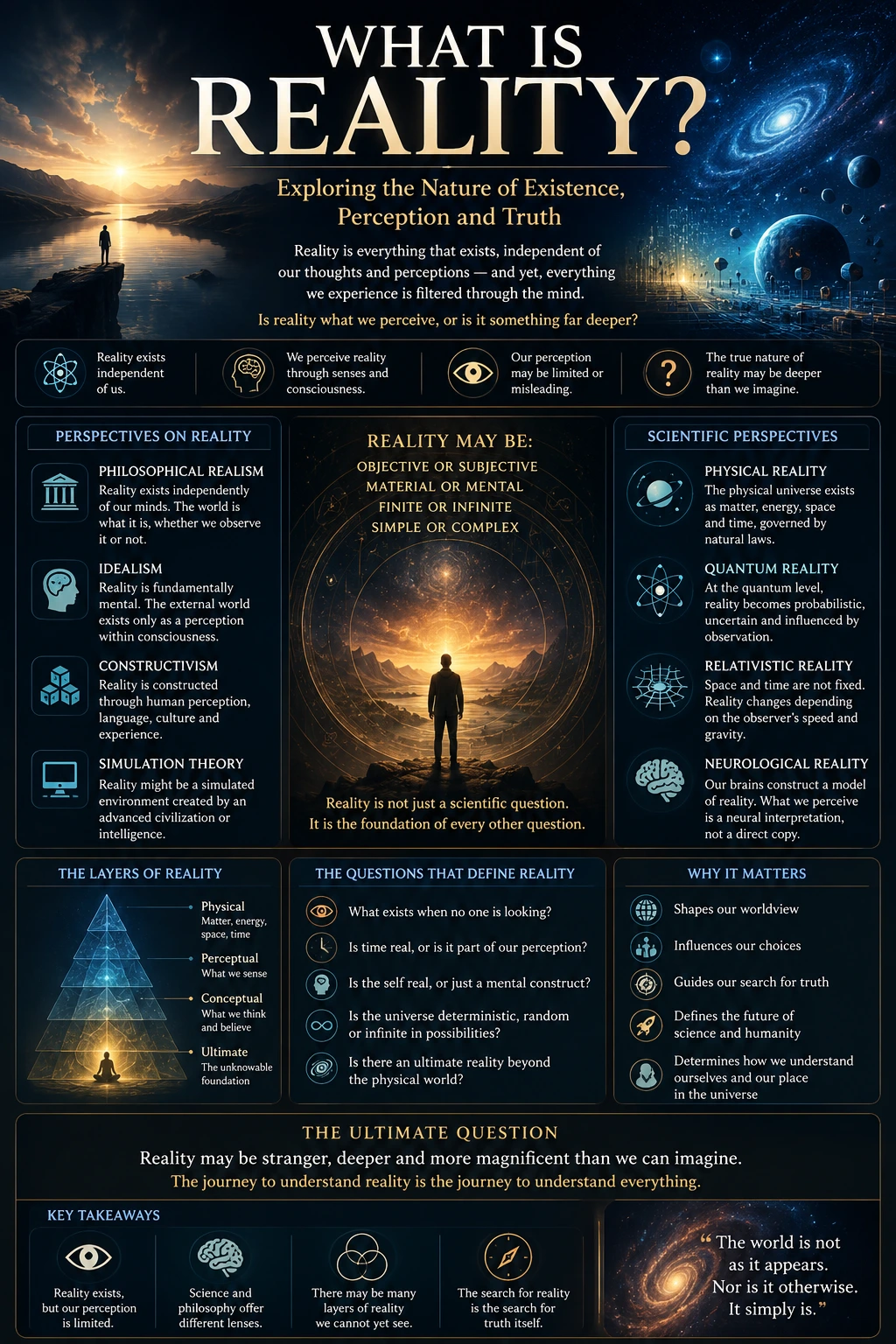
Short answer: Reality is everything that exists, whether or not we perceive it. The challenge is that human beings never experience reality directly. We experience our interpretation of reality through senses, memory, language, and consciousness.
Reality appears obvious.
The ground beneath your feet feels real.
The sky above you feels real.
Your memories feel real.
Your experiences feel real.
Yet one of philosophy’s oldest discoveries is surprisingly unsettling.
What we experience may not be reality itself.
It may be a model constructed by the brain.
Human beings do not experience reality directly.
We experience our interpretation of reality.
Modern neuroscience suggests that color, sound, taste, smell, and touch are not properties that exist exactly as we experience them.
They are experiences created by the brain in response to information from the environment.
The color red does not exist inside light itself.
Music does not exist inside air vibrations.
Reality becomes experience only when consciousness interprets information.
The world we experience may be partly discovered and partly constructed.
Why Reality Matters More Than Ever
For thousands of years, questions about reality belonged primarily to philosophy.
Today they sit at the center of multiple scientific revolutions.
- Physics challenges our understanding of space and time.
- Neuroscience studies how the brain constructs perception.
- Artificial intelligence forces us to distinguish between information and experience.
- Virtual reality technologies increasingly blur the boundary between physical and digital environments.
- Simulation theory asks whether reality itself could be artificial.
Questions once discussed only by philosophers increasingly influence science and technology.
The future may depend not only on understanding reality.
It may depend on understanding how we experience reality.
The First Question: Does Reality Exist Independently of Us?
This question sits at the center of one of philosophy’s oldest debates.
If no conscious observer existed, would reality continue to exist?
Most people instinctively answer yes.
Mountains would remain mountains.
Stars would continue to burn.
Galaxies would continue their motion through space.
This position is known as realism.
Realism argues that reality exists independently of observation.
The universe exists whether or not anyone observes it.
Reality exists independently of our beliefs about it.
Yet not every philosopher agrees.
Some argue that reality may be inseparable from observation itself.
That possibility leads to one of philosophy’s most fascinating alternatives:
idealism.
Theories of Reality
For thousands of years philosophers and scientists have attempted to answer a deceptively simple question.
What exactly exists?
The answers have produced some of humanity’s most fascinating ideas.
Some theories treat reality as entirely objective.
Others suggest that consciousness plays a fundamental role in creating the world we experience.
Some even propose that reality itself may be artificial.
The question is not merely what reality is.
The question is how much of reality exists independently of the observer.
Realism: Reality Exists Independently of Observation
Realism is perhaps the most intuitive view of reality.
According to realism, the universe exists independently of our minds.
Mountains remain mountains whether anyone sees them or not.
Stars continue to shine regardless of observation.
The physical universe follows its own laws independent of human awareness.
Reality does not depend on belief.
Reality exists whether we agree with it or not.
Most of modern science operates from this assumption.
The task of science is therefore to discover reality rather than create it.
Idealism: Consciousness Comes First
Idealism proposes something far more radical.
Perhaps consciousness is more fundamental than matter.
Instead of asking how matter creates consciousness, idealism asks whether consciousness creates the world we experience.
From this perspective, the external world may not exist independently of observation in the way realism assumes.
Perhaps consciousness exists within reality.
Or perhaps reality exists within consciousness.
Although idealism sounds unusual to modern ears, versions of it have appeared repeatedly throughout the history of philosophy.
Constructivism: Reality Is Partly Built by Minds
Constructivism occupies a position somewhere between realism and idealism.
According to this view, an external reality exists, but human beings never access it directly.
Instead, the brain constructs models of reality using:
- sensory information,
- memory,
- language,
- culture,
- expectations,
- and prior experience.
What we call reality may therefore be partly discovered and partly constructed.
Human beings may never experience reality itself.
We may only experience our model of reality.
Simulation Theory: Could Reality Be Artificial?
One of the most famous modern hypotheses suggests that reality itself may be simulated.
If sufficiently advanced civilizations can create realistic simulations containing conscious beings, then statistically it may be more likely that we exist inside such a simulation than outside one.
This idea became widely known as simulation theory.
Although often associated with science fiction, the idea has attracted serious philosophical discussion.
If reality can be simulated perfectly, how would its inhabitants know the difference?
At present there is no evidence that our universe is simulated.
There is also no known experiment capable of definitively ruling the possibility out.
Comparing Theories of Reality
| Theory | Main Idea |
|---|---|
| Realism | Reality exists independently of observers. |
| Idealism | Consciousness is fundamental to reality. |
| Constructivism | Reality is interpreted through mental models. |
| Simulation Theory | Reality may be artificially generated. |
Different theories of reality may tell us less about the universe itself and more about the assumptions we bring to it.
Yet philosophy is only one way of approaching reality.
Modern science has transformed the discussion in unexpected ways.
Especially through quantum physics, relativity, and neuroscience.
The scientific view of reality may be even stranger than philosophy imagined.
Scientific Perspectives on Reality
For much of history, reality appeared straightforward.
Objects existed.
Time moved forward.
Space remained fixed.
The universe behaved much like an enormous machine.
Modern science has challenged nearly every part of that picture.
The deeper science investigates reality, the stranger reality appears to become.
Relativity: Space and Time Are Not Absolute
For centuries people assumed that space and time were universal constants.
Everyone moved through the same time.
Everyone shared the same universe.
Modern physics revealed something unexpected.
Time can pass at different rates depending on speed and gravity.
Space itself can bend.
The geometry of the universe changes in response to matter and energy.
Space and time are not the stage on which reality happens.
They are part of reality itself.
The universe turned out to be dynamic rather than fixed.
Quantum Physics: Probability and Uncertainty
If relativity challenged our understanding of time and space, quantum physics challenged our understanding of matter itself.
At extremely small scales, particles do not always behave like tiny objects moving through space.
Instead, many quantum events appear fundamentally probabilistic.
Particles can exist in states that defy ordinary intuition until interactions produce measurable outcomes.
This does not mean reality disappears when nobody looks at it.
It does mean that the microscopic world behaves differently from everyday experience.
The universe at its smallest scales may be governed by probabilities rather than certainties.
Quantum physics remains one of the most successful scientific theories ever developed.
It is also one of the most difficult to interpret philosophically.
Neuroscience: The Brain Builds Experience
Perhaps the most profound challenge to common sense comes not from physics but from neuroscience.
Your brain does not passively record the world.
It actively constructs experience.
Light enters the eyes as electromagnetic information.
Air pressure changes reach the ears as vibrations.
Chemical molecules stimulate taste and smell receptors.
The brain transforms these signals into color, sound, flavor, texture, and meaning.
The world you experience is not raw reality.
It is reality translated into experience by the brain.
Perception Is Not a Camera
Many people imagine perception as similar to a camera recording reality.
Modern neuroscience suggests something closer to prediction.
The brain constantly generates expectations about the world and updates them using incoming information.
Perception may therefore involve a continuous negotiation between external signals and internal models.
This helps explain:
- optical illusions,
- misheard words,
- false memories,
- perceptual biases,
- and differences in interpretation between individuals.
We do not merely see the world.
We continuously predict it.
Objective Reality and Subjective Experience
Science increasingly suggests that two forms of reality may coexist.
| Objective Reality | Subjective Experience |
|---|---|
| The external world exists independently of us. | The world as experienced by conscious minds. |
| Measured by instruments and experiments. | Experienced through perception and awareness. |
| Shared across observers. | Unique to each observer. |
| Described by science. | Described by experience. |
Neither perspective appears sufficient on its own.
Science explains the structure of reality.
Consciousness explains how reality becomes experience.
Reality may consist not only of what exists, but also of what can be experienced.
This leads directly to one of the most fascinating possibilities in modern philosophy and science.
If our experience of reality is constructed, could reality itself be constructed as well?
Simulation theory attempts to answer exactly that question.
Simulation Theory: Are We Living in a Simulation?
Few ideas about reality have captured public imagination as strongly as simulation theory.
The hypothesis is deceptively simple.
If civilizations become technologically advanced enough, they may eventually create simulations containing conscious beings.
If such simulations become common, then statistically there may be far more simulated minds than biological ones.
If that is true, some philosophers argue that it could be more likely that we live inside a simulation than outside one.
If simulated realities become common, being simulated may become the most probable reality.
The Simulation Argument
The modern version of this argument was most famously developed by philosopher Nick Bostrom.
The argument proposes that at least one of three statements must be true:
- Technological civilizations never reach the capability to create realistic simulations.
- Advanced civilizations choose not to create such simulations.
- We are probably living inside one.
The argument does not claim that reality is definitely simulated.
It argues that if future civilizations create vast numbers of simulated worlds, simulated observers could eventually outnumber original observers.
The simulation argument is ultimately a statistical argument rather than a technological one.
Could We Detect a Simulation?
If reality were simulated, could its inhabitants discover the truth?
This question creates an unusual problem.
Any evidence discovered inside the simulation would itself be part of the simulation.
Detecting the boundaries of reality from within reality may be impossible.
Some researchers have speculated about possible clues:
- computational limits,
- fundamental discreteness in physics,
- unexpected patterns in physical constants,
- or limitations resembling rendering constraints in computer graphics.
At present, none of these ideas provide evidence for simulation theory.
They remain speculative possibilities rather than scientific findings.
A perfect simulation may be indistinguishable from reality itself.
Would a Simulated Reality Be Less Real?
Perhaps the most interesting question is not whether reality is simulated.
Perhaps the more important question is whether it would matter.
If your experiences are real to you, are they any less meaningful because they occur inside a simulation?
If relationships, memories, achievements, and emotions are experienced consciously, does their origin change their value?
Reality may be defined less by its substrate and more by the experiences that occur within it.
A dream can produce genuine fear.
A novel can produce genuine grief.
A virtual world can produce genuine friendships.
Experience itself may be what gives reality significance.
Simulation Theory and Consciousness
Simulation theory also reconnects us to the problem of consciousness.
If conscious beings can exist inside simulations, then consciousness may not depend entirely on biology.
If consciousness requires biological processes, simulated minds may never become truly conscious regardless of their intelligence.
The debate about reality therefore becomes inseparable from the debate about consciousness itself.
To understand reality we may need to understand consciousness.
To understand consciousness we may need to understand reality.
The Deeper Question
Simulation theory forces us to confront a deeper philosophical possibility.
Perhaps reality is not defined by whether it is physical or simulated.
Perhaps reality is defined by consistency, experience, and causality.
If experiences have consequences, if choices matter, and if conscious beings exist within a world, that world may possess its own reality regardless of its origin.
A simulated world experienced consciously may still be a real world to those living inside it.
This naturally leads to another question.
If reality is partly constructed and perception is limited, how much of what we believe about the world is shaped by the mind itself?
The relationship between perception and reality may be even more important than reality itself.
Perception and Reality: Do We Ever See the World as It Truly Is?
Most people experience perception as passive.
The eyes see.
The ears hear.
The brain records reality.
Modern neuroscience suggests something very different.
Perception is not passive observation.
It is active construction.
The brain does not simply receive reality.
It continuously builds the reality you experience.
The Brain as a Prediction Machine
One influential theory in neuroscience suggests that the brain operates primarily as a prediction engine.
Rather than waiting for information to arrive, the brain constantly predicts what the world should look like and compares those predictions against incoming sensory signals.
Reality, as experienced consciously, may emerge from the interaction between:
- sensory input,
- memory,
- expectations,
- attention,
- and prior experience.
This process allows humans to navigate the world efficiently.
It also means perception can be wrong.
We often experience not the world as it is, but the world our brain expected to find.
Optical Illusions Reveal the Construction Process
Optical illusions are powerful demonstrations of this principle.
When two lines appear different lengths despite being identical, reality itself has not changed.
The brain’s interpretation has changed.
The same principle applies far beyond visual perception.
- People mishear words.
- Memories become distorted over time.
- Expectations influence interpretation.
- Context changes perception.
- Attention determines what enters awareness.
Reality and interpretation are often inseparable in everyday experience.
Illusions do not prove that reality is false.
They prove that perception is constructed.
Memory Changes Reality
Many people think of memory as a recording.
Research increasingly suggests memory behaves more like reconstruction.
Each time a memory is recalled, it may be updated, reshaped, and integrated with new information.
The remembered past is therefore not identical to the experienced past.
This creates an extraordinary implication.
Your experience of reality includes memories that are themselves continually changing.
Language Shapes Experience
Language does more than describe reality.
It influences how reality is organized in the mind.
Categories affect attention.
Labels affect interpretation.
Concepts influence what becomes visible in experience.
Two people can observe the same event and experience profoundly different realities because they interpret it through different conceptual frameworks.
Reality may be shared.
Experience rarely is.
The Interface Theory of Perception
Some researchers have proposed that perception evolved not to reveal objective reality but to support survival.
Just as computer icons hide the complexity of computer hardware, perception may hide the deeper structure of reality behind useful representations.
The colors, sounds, and objects we experience may function more like an interface than a direct window into reality itself.
Evolution may favor useful perceptions rather than perfectly accurate ones.
The Observer and the Observed
Perhaps the deepest lesson from neuroscience and philosophy is that observers are never entirely separate from what they observe.
Attention changes experience.
Expectations change interpretation.
Memory changes meaning.
Consciousness itself participates in constructing the world it experiences.
Reality may not simply be something we discover.
Part of reality may emerge in the interaction between the world and the mind experiencing it.
This leads naturally to one of philosophy’s oldest and most important questions.
If our experience of reality is filtered through perception, memory, and interpretation, can we ever know reality as it truly is?
That question lies at the center of epistemology — the study of knowledge itself.
Can We Ever Know Reality as It Truly Is?
This question lies at the heart of epistemology — the philosophical study of knowledge.
For thousands of years philosophers have debated whether human beings can ever know reality directly or whether all knowledge is filtered through perception and interpretation.
The challenge is simple to state but difficult to escape.
Every attempt to observe reality uses tools that are themselves part of reality.
We use eyes to observe light.
Brains to interpret signals.
Language to describe experience.
Reason to organize conclusions.
Each layer introduces interpretation.
The observer can never completely step outside the system being observed.
The Map and the Territory
A useful analogy comes from cartography.
A map can represent a city.
It can become extraordinarily detailed.
Yet no map becomes the city itself.
The same may be true of human understanding.
Scientific models describe reality.
Mathematics describes reality.
Language describes reality.
Descriptions are not identical to the thing being described.
The map is not the territory.
This does not make maps useless.
It means every model captures some aspects of reality while leaving others behind.
Kant’s Distinction: The World and the World as Experienced
Philosopher Immanuel Kant proposed one of the most influential solutions to this problem.
He suggested that reality may exist in two forms.
| Concept | Description |
|---|---|
| Noumenon | Reality as it exists independently of observation. |
| Phenomenon | Reality as it appears to conscious observers. |
According to this view, humans never experience reality in its pure form.
We experience reality after it has been processed through perception, cognition, and consciousness.
We may know reality as it appears to us without ever fully knowing reality as it is in itself.
Science as Approximation
Modern science often embraces this limitation rather than resisting it.
Scientific theories are not usually considered final truths.
They are increasingly accurate models that explain observations and make predictions.
Newton’s laws described motion extremely well.
Relativity expanded that understanding.
Quantum physics expanded it further.
The process continues.
Science may not reveal absolute reality.
It may continuously improve our models of it.
Certainty May Be Impossible
Human beings often seek certainty.
Philosophy repeatedly encounters limits.
Science repeatedly encounters uncertainty.
Reality itself may place boundaries on what minds embedded within reality can know.
Perhaps some mysteries are temporary.
Perhaps some are permanent.
The limits of knowledge may be as important as knowledge itself.
Does Uncertainty Make Reality Less Real?
Not necessarily.
The fact that maps are imperfect does not mean cities do not exist.
The fact that perception is filtered does not mean reality is an illusion.
It simply means that understanding reality may be an ongoing process rather than a final destination.
Reality may be larger than any model we create of it.
And perhaps that is exactly what makes the search worthwhile.
The desire to understand reality has driven philosophy, science, mathematics, and exploration for thousands of years.
Perhaps the search itself is one of humanity’s defining characteristics.
The universe may be mysterious.
The desire to understand it may be one of the most human things about us.
This leads naturally to the final question.
If reality, perception, and knowledge are all connected to consciousness, what role does consciousness play in giving reality meaning?
The relationship between reality and consciousness may ultimately become the relationship between existence and meaning itself.
Reality, Consciousness, and Meaning
Reality exists.
Consciousness experiences.
Meaning emerges from the interaction between them.
A universe without conscious observers may contain matter, energy, stars, and galaxies.
It may contain extraordinary complexity.
Whether it contains meaning is a different question.
Reality provides existence.
Consciousness provides experience.
Meaning emerges from their meeting.
Why Meaning Requires Experience
A mountain exists whether anyone observes it or not.
A star burns whether anyone notices it or not.
Meaning is different.
A song matters because someone hears it.
A memory matters because someone remembers it.
A promise matters because someone values it.
Beauty, grief, love, hope, and wonder all depend on conscious experience.
The universe may exist independently of observers.
Meaning may not.
Reality and Civilization
Civilizations are often described through technology, institutions, and economies.
Yet every civilization begins somewhere else.
Inside minds.
Ideas become conversations.
Conversations become culture.
Culture becomes institutions.
Institutions shape history.
Every civilization begins as a pattern inside consciousness before becoming a structure in reality.
The Human Search for Reality
Perhaps the search for reality is one of humanity’s oldest shared projects.
Philosophy asked questions.
Science built methods.
Mathematics built models.
Art explored experiences that resisted description.
Each discipline approached reality from a different direction.
Each discovered something valuable.
None discovered the entire picture.
The search for reality may be larger than any single field of knowledge.
Perhaps Reality Is a Relationship
For centuries reality was often imagined as something external and fixed.
Modern science and philosophy increasingly suggest a more complex picture.
Reality exists independently.
Experience interprets it.
Meaning emerges from interaction.
Perhaps reality is not merely a place where observers exist.
Perhaps reality is partly the relationship between the observer and the observed.
The universe may not simply contain conscious beings.
Conscious beings may be one of the ways the universe experiences itself.
The Question Returns
We began with a simple question.
What is reality?
After thousands of years of philosophy and centuries of science, the honest answer remains surprisingly humble.
We do not fully know.
We know more than any generation before us.
We also understand more clearly how much remains uncertain.
Perhaps reality is objective.
Perhaps consciousness plays a deeper role than we currently understand.
Perhaps future discoveries will transform both science and philosophy once again.
The mystery of reality may not be a failure of understanding.
It may be an invitation to continue exploring.
And perhaps the most extraordinary fact is this:
For a brief moment in cosmic history, reality became capable of asking questions about itself.
That moment is consciousness.
And through consciousness, reality does not merely exist.
For a moment, reality understands that it exists at all.
Frequently Asked Questions About Reality
What is reality in simple terms?
Reality is everything that exists, whether it is perceived or not. Philosophers, scientists, and neuroscientists continue to debate whether humans experience reality directly or through mental models created by perception and consciousness.
What is the difference between objective and subjective reality?
Objective reality refers to the external world that exists independently of observers. Subjective reality refers to an individual’s personal experience and interpretation of that world through perception, memory, emotions, and consciousness.
Is reality objective or subjective?
Many philosophers and scientists argue that reality contains both objective and subjective components. An external world may exist independently of observers, while individual experiences of that world remain subjective and shaped by perception.
What is simulation theory?
Simulation theory is the hypothesis that reality could be an artificial simulation created by a sufficiently advanced civilization. While widely discussed in philosophy and popular culture, there is currently no evidence proving that our universe is simulated.
Are we living in a simulation?
There is currently no scientific evidence that humanity lives in a simulation. The idea remains a philosophical hypothesis rather than an established scientific theory.
Does quantum physics prove that reality depends on observation?
No. Quantum physics demonstrates that measurement plays an important role in physical systems at microscopic scales, but it does not show that human consciousness creates reality or that the universe disappears when unobserved.
Can humans perceive reality directly?
Neuroscience suggests that humans experience reality through sensory systems and brain processes that construct conscious experience. Many researchers argue that perception provides useful models of reality rather than direct access to reality itself.
What did Immanuel Kant believe about reality?
Kant argued that humans experience phenomena — reality as it appears to us — while the noumenal world, or reality as it exists independently of observation, may remain inaccessible to direct experience.
Why does reality matter in philosophy?
The nature of reality influences questions about knowledge, consciousness, identity, free will, science, ethics, and meaning. Understanding reality affects how humanity understands itself and its place in the universe.
What is the relationship between reality and consciousness?
Consciousness provides subjective experience of reality, while reality provides the environment in which consciousness exists. The precise relationship between consciousness and reality remains one of philosophy’s greatest unresolved questions.
Epilogue: The Universe Looking Back at Itself
Reality existed long before humanity appeared.
Stars formed.
Galaxies collided.
Planets emerged.
Life evolved.
Eventually, somewhere in that vast history, matter became capable of awareness.
Atoms became cells.
Cells became organisms.
Organisms became minds capable of asking questions about existence itself.
Perhaps the most extraordinary feature of reality is not that it exists.
Perhaps it is that reality became capable of wondering why it exists at all.
The search for reality created philosophy.
It created science.
It created mathematics.
It created stories, myths, and civilizations.
Every generation inherited questions from those who came before.
Every generation added new answers and new mysteries.
The history of humanity may partly be the history of reality attempting to understand itself.
Perhaps we will eventually understand consciousness.
Perhaps we will understand reality.
Perhaps some mysteries will remain forever beyond our reach.
Regardless of the answer, the search itself may be one of humanity’s greatest achievements.
Reality may be the greatest mystery we inhabit.
The desire to understand it may be the greatest mystery within us.
And perhaps that is enough.
Because for a brief moment in cosmic history, the universe became capable of asking questions.
Those questions are asked through us.
And through those questions, reality does not merely exist.
For a moment, reality understands that it exists at all.