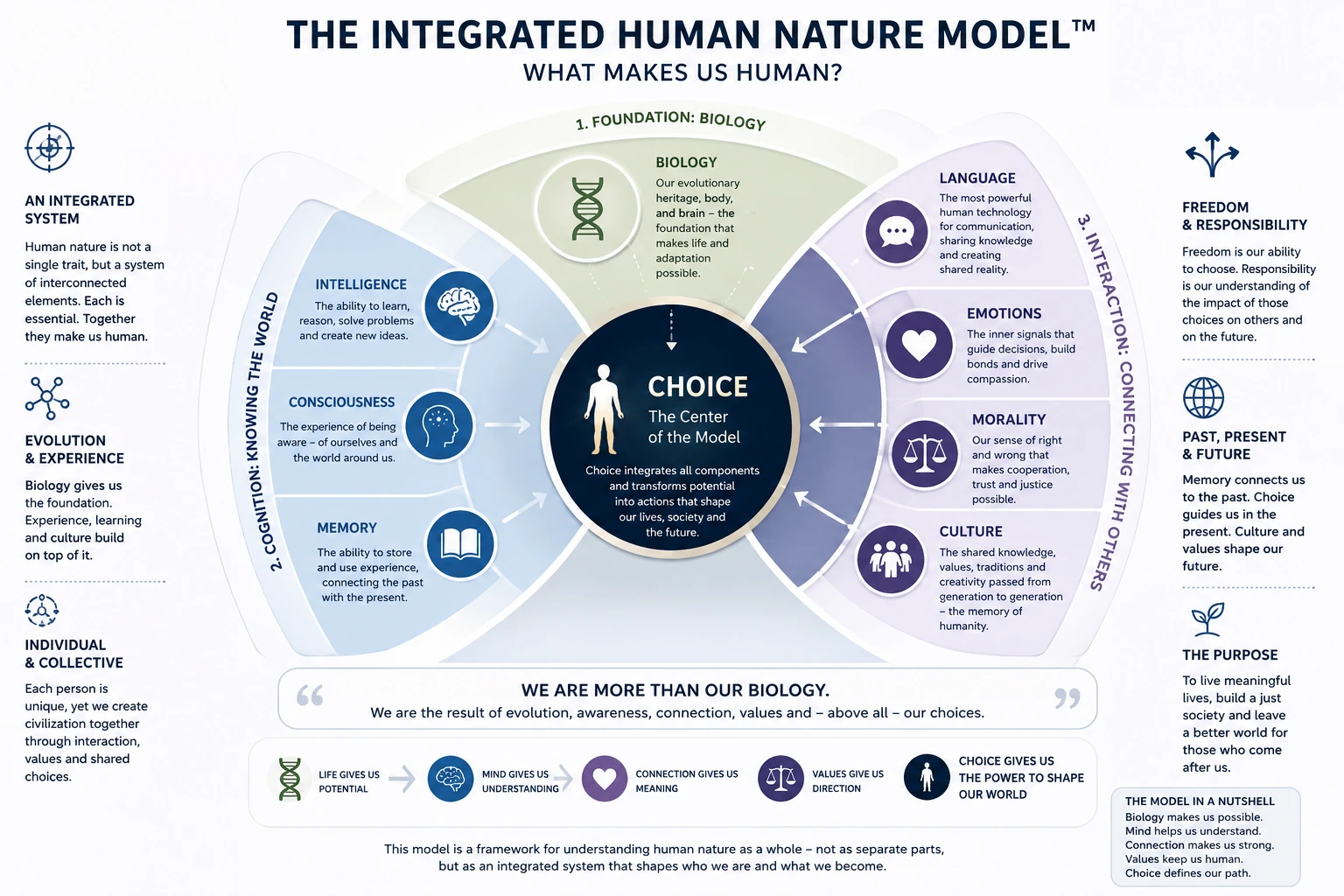
Short answer: Human beings are not defined by a single trait. What makes us human is the interaction between biology, intelligence, consciousness, memory, language, emotions, morality, culture, and our ability to make choices. Choice connects all of these elements and ultimately determines who we become.
Few questions have followed humanity for as long as this one.
What makes us human?
Philosophers debated it in ancient Greece. Religious traditions built entire worldviews around it. Scientists approached it through evolution, psychology, neuroscience, and cognitive science. Writers explored it through stories, myths, and speculative futures.
And yet the question remains surprisingly difficult to answer.
For centuries the discussion seemed mostly philosophical.
Today it has become something else entirely.
Artificial intelligence writes essays, generates images, analyzes data, and solves problems once thought to require uniquely human intelligence.
Neuroscience reveals new insights into the brain every year.
Biotechnology is beginning to alter the building blocks of life itself.
For the first time in history, humanity is approaching the ability not only to change the world around us, but potentially to redesign aspects of ourselves.
If technology can transform almost everything, what remains fundamentally human?
Many people instinctively search for a single answer.
Some point to intelligence.
Others point to consciousness.
Some believe language separates us from other species.
Others emphasize empathy, morality, or culture.
Each of these explanations captures an important piece of the puzzle.
None of them fully explains the whole picture.
The problem may not be that we lack answers.
The problem may be that we are searching for one defining characteristic when human nature functions as an integrated system.
Humanity does not emerge from a single ability.
It emerges from the interaction between many abilities working together.
This article explores that idea through a framework called the Integrated Human Nature Model™.
Rather than asking which single trait defines humanity, the model explores how biology, cognition, connection, values, and choice interact to shape who we are — and who we become.
Why This Question Matters More Than Ever
For most of history humanity defined itself by comparing itself to other animals.
Today we increasingly define ourselves by comparing ourselves to the technologies we create.
If machines can outperform us in analysis, is intelligence still enough?
If algorithms can generate art and music, is creativity enough?
If future technologies alter memory, cognition, and emotion, what exactly remains constant about being human?
These are no longer science fiction questions.
They are becoming practical questions for education, ethics, law, medicine, leadership, and the future of civilization itself.
Understanding technology requires understanding machines.
Understanding the future requires understanding ourselves.
The Integrated Human Nature Model™
Most attempts to explain human nature make the same assumption.
They search for a single defining trait.
Some place intelligence at the center.
Others point to consciousness.
Some argue that language defines humanity.
Others focus on morality, empathy, creativity, or culture.
Each perspective captures something important.
The difficulty is that human beings do not function as isolated traits.
Human nature behaves more like an ecosystem than a checklist.
Remove biology and nothing else can exist.
Remove memory and experience disappears.
Remove language and civilization becomes impossible.
Remove morality and trust collapses.
Remove choice and all remaining abilities become directionless tools.
Humanity emerges not from a single capability, but from the interaction between capabilities.
Understanding the Four Layers of Human Nature
The model organizes human nature into four interconnected layers.
Each layer builds upon the previous one.
Together they create the system we call a human being.
| Layer | Purpose | Core Question |
|---|---|---|
| Foundation | Biology | How is human life possible? |
| Cognition | Intelligence, Consciousness, Memory | How do we understand reality? |
| Connection | Language, Emotions, Morality, Culture | How do we live together? |
| Choice | Decision and responsibility | Who do we choose to become? |
1. Foundation: Biology
Biology provides the physical foundation that makes every other layer possible.
Evolution shaped the human body, nervous system, and brain through millions of years of adaptation.
Without biology there is no cognition, no culture, and no civilization.
Biology explains how human beings became possible.
It does not explain what we choose to do with that possibility.
2. Cognition: Understanding Reality
Intelligence helps us analyze the world.
Consciousness allows us to become aware of ourselves.
Memory connects experiences across time.
Together they form the human capacity for understanding.
They explain how we learn, imagine, create, and adapt.
Yet understanding alone does not determine how knowledge will be used.
3. Connection: Building Civilization
Human beings survive not only because we think, but because we cooperate.
Language allows knowledge to travel across generations.
Emotions create trust and attachment.
Morality allows large societies to function.
Culture preserves collective memory.
This layer transforms individuals into civilizations.
4. Choice: The Center of the Model
The final layer is not another ability.
It is the force that connects all other abilities together.
Choice determines how intelligence is used.
Choice determines whether knowledge serves creation or destruction.
Choice determines how values become actions.
Human potential comes from our abilities.
Human identity comes from our choices.
This is why choice sits at the center of the Integrated Human Nature Model™.
It transforms possibility into reality.
Foundation: Biology — The Conditions That Made Humanity Possible
Every attempt to understand human nature must begin with biology.
Before there was language, morality, philosophy, or civilization, there was evolution.
Millions of years of adaptation shaped the human body, nervous system, and brain into one of the most complex biological systems known to exist.
Without this biological foundation, none of the other layers of human nature would be possible.
There would be no memory.
No consciousness.
No language.
No culture.
No civilization.
Biology created the possibility of humanity.
It did not determine what humanity would become.
Evolution Built More Than Survival
Evolution is often described as a competition for survival.
That description is only partially true.
Human evolution was equally shaped by cooperation.
Our ancestors survived not because they were the fastest or strongest species on Earth, but because they learned to work together, share information, divide responsibilities, and pass knowledge across generations.
Cooperation became one of humanity’s greatest evolutionary advantages.
Empathy, communication, trust, and social learning were not accidents.
They became survival strategies.
Human civilization began as an evolutionary strategy.
The Human Brain: Evolution’s Most Complex Tool
The human brain is often described as the most complex structure currently known in the observable universe.
Containing roughly eighty-six billion neurons connected through trillions of synapses, it provides the physical infrastructure for thought, imagination, memory, planning, language, and self-awareness.
Everything we experience as human beings emerges through this biological system.
Yet even here an important distinction appears.
A brain is not the same thing as a mind.
And intelligence is not the same thing as wisdom.
Biology provides capability.
Capability alone does not determine purpose.
Evolution gave us the ability to think.
It did not decide what we should think about.
Why Biology Alone Cannot Explain Humanity
Biology explains where we came from.
It explains our physiology, our instincts, and many aspects of behavior.
But biology struggles to answer questions that humans care deeply about.
Why do people sacrifice themselves for strangers?
Why do individuals choose principles over survival?
Why do humans create art, philosophy, and mathematics?
Why do we search for meaning even when survival is no longer at stake?
These questions do not reject biology.
They simply point beyond it.
| Biology Explains | Biology Does Not Fully Explain |
|---|---|
| Evolutionary origins | Moral responsibility |
| The nervous system | Meaning and purpose |
| Instincts and survival | Personal values |
| Cognitive capacity | Wisdom |
| Adaptation | The choices we make |
Biology answers an essential question:
How did human beings become possible?
But it leaves another question unanswered.
What do human beings choose to become?
To answer that question, the model must move beyond biology and into the next layer of human nature:
Cognition.
Because having a brain and understanding reality are not the same thing.
Cognition: How Human Beings Understand Reality
Biology gave humanity a brain.
Cognition transformed that brain into a way of understanding reality.
Human beings do not simply react to the world around them.
We observe patterns.
Build models.
Create explanations.
Imagine alternatives.
Predict futures that do not yet exist.
This ability to understand, imagine, and adapt became one of humanity’s greatest evolutionary advantages.
Biology made thought possible.
Cognition made civilization possible.
The Integrated Human Nature Model™ divides cognition into three interconnected elements:
- Intelligence helps us understand the world.
- Consciousness helps us understand ourselves.
- Memory allows understanding to survive across time.
Together they form the human system of understanding.
Intelligence: Why Being Smart Is Not Enough
If intelligence alone defined humanity, then the question would already be solved.
Human intelligence has transformed the planet.
It created mathematics, engineering, medicine, science, and modern technology.
It sent spacecraft beyond the Solar System and decoded the human genome.
Few abilities have shaped history more profoundly.
And yet intelligence creates a paradox.
The same intelligence that developed antibiotics also developed chemical weapons.
The same scientific understanding that improved life expectancy also made industrial warfare possible.
The same algorithms that help diagnose diseases can also be used for manipulation and surveillance.
History repeatedly demonstrates the same lesson:
Intelligence increases capability.
It does not determine direction.
Intelligence answers the question:
“How can this be done?”
Human values answer a different question:
“Should this be done?”
| Intelligence Enables | Intelligence Does Not Guarantee |
|---|---|
| Innovation | Wisdom |
| Technology | Responsibility |
| Analysis | Empathy |
| Problem solving | Ethics |
| Prediction | Good judgment |
This distinction becomes even more important in the age of artificial intelligence.
Machines are becoming increasingly capable of performing intellectual tasks.
If intelligence alone defines humanity, then humanity may eventually lose its uniqueness.
The Integrated Human Nature Model™ suggests a different conclusion.
Intelligence is essential.
It is not sufficient.
To understand human nature, we must move beyond intelligence and ask a more difficult question.
Who is the one experiencing intelligence?
That question leads directly to one of the deepest mysteries in science and philosophy:
Consciousness.
Consciousness: The Mystery of Subjective Experience
Intelligence helps us understand the world.
Consciousness allows us to experience it.
This difference may appear subtle.
It changes everything.
A calculator can process numbers.
A search engine can retrieve information.
An artificial intelligence model can generate text.
But human beings do something more.
We experience being ourselves.
We do not merely detect light.
We experience color.
We do not merely process sound.
We experience music.
We do not merely recognize danger.
We experience fear.
We do not merely identify other people.
We experience love, friendship, grief, loyalty, and hope.
Consciousness transforms information into experience.
The Hard Problem of Consciousness
Modern neuroscience has made extraordinary progress in understanding the brain.
Researchers can identify neural activity associated with memory, language, decision making, and emotional processing.
Yet one question remains remarkably difficult.
Why does any of this produce subjective experience at all?
Why is there something it feels like to be you?
This question is often called the hard problem of consciousness.
It remains one of the most important unresolved questions in philosophy, neuroscience, and cognitive science.
We understand more about the brain than at any point in history.
We still do not fully understand why experience exists.
Consciousness and Artificial Intelligence
The rise of artificial intelligence has made this question increasingly important.
Modern AI systems can analyze information, solve problems, and generate human-like responses.
None of these capabilities automatically imply conscious experience.
Current scientific evidence does not demonstrate that artificial intelligence systems possess subjective awareness or inner experience.
They may process information.
Whether they experience information remains an open question.
| Intelligence | Consciousness |
|---|---|
| Processes information | Experiences information |
| Solves problems | Experiences existence |
| Analyzes reality | Lives reality |
| Can potentially be simulated | May involve subjective experience |
Consciousness may not be the entire answer to human nature.
But it appears to be one of its deepest dimensions.
Memory: The Architecture of Identity
If consciousness allows us to experience the present, memory allows us to connect experiences across time.
Without memory, every moment would exist in isolation.
There would be no learning.
No personal history.
No sense of identity.
Memory creates continuity.
It allows us to recognize ourselves as the same person across years and decades of change.
Our memories become the raw material from which we build meaning, values, relationships, and identity.
Memory transforms experience into identity.
Individual Memory and Civilizational Memory
Memory exists on more than one level.
Individuals possess memories.
Civilizations do as well.
Books, language, art, science, traditions, and institutions all function as forms of collective memory.
Every generation inherits knowledge accumulated by countless generations before it.
Without this transfer of memory, civilization would repeatedly restart from the beginning.
Personal memory creates identity.
Collective memory creates civilization.
At this point the model reaches an important transition.
Human beings do not simply think.
Human beings think together.
And that requires the next layer of human nature:
Connection.
Connection: How Humans Build Civilization
A single human being can achieve remarkable things.
A civilization can achieve something far greater.
Every scientific discovery, legal system, university, city, and technological breakthrough emerged not from isolated intelligence, but from cooperation across generations.
Human beings evolved not only to think.
We evolved to communicate, cooperate, teach, trust, and organize ourselves into systems larger than any individual could create alone.
Intelligence created ideas.
Connection transformed ideas into civilization.
The Integrated Human Nature Model™ describes this layer through four interconnected elements:
- Language transfers knowledge.
- Emotions create trust and relationships.
- Morality enables cooperation at scale.
- Culture preserves civilization across generations.
Language: Humanity’s First Great Technology
When people think about transformative technologies, they often mention fire, the wheel, electricity, computers, or artificial intelligence.
Yet none of those technologies would exist without an earlier one.
Language.
Language allowed human beings to transfer knowledge across time and distance.
It allowed people to coordinate action, share experiences, explain ideas, and imagine futures that did not yet exist.
Most importantly, language allowed knowledge to accumulate rather than disappear with each generation.
Every scientific breakthrough rests upon thousands of previous conversations.
Language turned individual experience into collective intelligence.
Without language there would be no science.
No law.
No education.
No civilization.
Emotions: The Invisible Infrastructure of Human Cooperation
For centuries emotions were often treated as obstacles to rational thinking.
Modern neuroscience tells a different story.
Human decision making depends deeply on emotional processes.
Patients with damage to emotional centers of the brain frequently struggle to make even simple decisions despite maintaining high levels of intelligence.
Emotions help us prioritize, evaluate risk, and understand what matters.
They also make social life possible.
Trust enables cooperation.
Empathy enables compassion.
Attachment enables families.
Loyalty enables communities.
Without emotions, civilization would become a collection of transactions rather than relationships.
Emotions do not make us less rational.
They help us decide what is worth being rational about.
Morality: The Operating System of Civilization
Language allows communication.
Emotions create relationships.
Neither is sufficient to build large societies.
Human beings also require shared expectations about acceptable behavior.
This is the role of morality.
Morality answers questions that intelligence alone cannot solve.
What is fair?
What is just?
What responsibilities do we owe to others?
Different cultures answer these questions differently.
Yet almost every successful civilization develops systems that reward cooperation, punish betrayal, and encourage trust.
Intelligence asks: “What can we do?”
Morality asks: “What should we do?”
The difference between those two questions may determine the future of humanity.
Culture: Civilization’s Memory System
If memory creates personal identity, culture creates civilizational identity.
Culture stores the lessons of previous generations in stories, books, institutions, rituals, traditions, scientific knowledge, and shared values.
Without culture, every generation would start over.
The history of civilization would become a series of disconnected beginnings.
Instead, culture allows humanity to accumulate knowledge across centuries and millennia.
| Connection Layer | Primary Function |
|---|---|
| Language | Transfers knowledge |
| Emotions | Creates trust |
| Morality | Enables cooperation |
| Culture | Preserves civilization |
Biology created humans.
Connection created humanity.
Yet even this is not the center of the model.
Knowledge, consciousness, emotions, morality, and culture all create possibility.
Something still determines how those possibilities are used.
That final layer is not another ability.
It is choice.
Choice: The Center of Human Nature
At this point the pattern becomes impossible to ignore.
Biology gives us the capacity to exist.
Intelligence gives us the ability to understand.
Consciousness gives us awareness.
Memory gives us continuity.
Language allows us to communicate.
Emotions allow us to connect.
Morality gives us principles.
Culture gives us inheritance.
Each layer contributes something essential.
None of them determines who we become.
Human beings are shaped by many forces.
Human identity emerges through choice.
This is why choice occupies the center of the Integrated Human Nature Model™.
Choice is not simply another human ability.
It is the mechanism that transforms possibility into action.
The same intelligence can create medicine or weapons.
The same technology can expand freedom or increase control.
The same knowledge can build civilizations or destroy them.
Capabilities create options.
Choices determine outcomes.
Abilities determine what is possible.
Choices determine what becomes real.
The Responsibility of Choice
Choice introduces something that does not exist in biology alone.
Responsibility.
If our actions were entirely determined by genetics, instinct, or circumstance, responsibility would have little meaning.
Human societies operate on a different assumption.
We hold people accountable because we believe choices matter.
Responsibility becomes the bridge between freedom and consequence.
Every civilization, legal system, and ethical tradition ultimately depends on this principle.
Freedom without responsibility becomes chaos.
Responsibility without freedom becomes control.
Civilization depends on balancing both.
The Age of Artificial Intelligence Makes Choice More Important, Not Less
Artificial intelligence is rapidly increasing humanity’s capabilities.
Automation expands productivity.
Algorithms improve prediction.
Machines perform intellectual tasks that once required years of human expertise.
These developments do not reduce the importance of human choice.
They increase it.
The more powerful our technologies become, the more important it becomes to decide how they should be used.
Technology changes what humanity can do.
Choice determines what humanity will do.
The greatest challenge of the twenty-first century may not be whether machines become more intelligent.
It may be whether humans become wise enough to guide them.
The Question Every Generation Must Answer
Every generation inherits technologies, institutions, knowledge, and values created by previous generations.
Every generation also faces the same responsibility.
To decide what happens next.
The question “What makes us human?” is therefore not merely descriptive.
It is also a question about the future.
Because humanity is not only something we inherit.
Humanity is something we continually create.
We become human not once, but repeatedly, through the choices we make.
That may be the closest thing we have to an answer.
Not intelligence alone.
Not consciousness alone.
Not biology, morality, language, or culture alone.
Humanity emerges from all of them together.
And choice determines what that humanity becomes.
What Does the Integrated Human Nature Model™ Mean in Practice?
Frameworks are useful only if they improve how we understand reality and make decisions.
The Integrated Human Nature Model™ is not intended to be merely philosophical.
It is intended to provide a practical lens through which we can better understand ourselves, other people, and the future we are creating together.
Human beings are rarely limited by a lack of information.
More often, we struggle because we misunderstand the system we are operating within.
1. Better Decisions Require More Than Intelligence
Modern education systems often focus heavily on intellectual development.
Intelligence matters enormously.
Yet many of the most important decisions in life involve much more than analytical ability.
Career decisions involve identity.
Relationships involve emotions.
Leadership involves trust.
Ethics involve values.
The model reminds us that good decisions emerge when multiple dimensions of human nature are integrated rather than ignored.
Human beings do not make decisions using intelligence alone.
We decide using our entire humanity.
2. Education Should Develop Human Beings, Not Just Skills
Many educational systems were designed for industrial economies that valued standardization and specialization.
The future may require something different.
As artificial intelligence increasingly performs analytical and routine tasks, uniquely human capabilities may become more important rather than less.
Critical thinking.
Ethical reasoning.
Creativity.
Empathy.
Judgment under uncertainty.
These are not secondary skills.
They may become the defining capabilities of the next century.
The goal of education is not simply to produce capable workers.
It is to develop capable human beings.
3. Leadership Is Applied Human Nature
Organizations often fail because they treat people as purely rational actors.
Human systems do not operate that way.
Successful leaders understand incentives, emotions, trust, identity, values, and shared narratives.
Leadership is therefore not simply a management discipline.
It is an applied understanding of human nature.
| If you only optimize for… | You may lose… |
|---|---|
| Efficiency | Trust |
| Intelligence | Wisdom |
| Productivity | Meaning |
| Compliance | Commitment |
| Performance | Humanity |
4. The Future of Humanity Will Depend on Human Choices
The coming decades may become one of the most important periods in human history.
Artificial intelligence.
Genetic engineering.
Brain-computer interfaces.
Autonomous systems.
Each of these technologies carries extraordinary promise.
Each also carries extraordinary responsibility.
The central question of the twenty-first century may therefore not be technological.
It may be profoundly human.
Technology changes what humanity can do.
Human nature determines what humanity chooses to do.
The Question Returns
At the beginning of this article we asked a simple question.
What makes us human?
After exploring biology, intelligence, consciousness, memory, language, emotions, morality, culture, and choice, the answer appears both simpler and more complex than expected.
Humanity is not a single trait.
It is an integrated system.
And perhaps that is why no single discipline has ever fully explained it.
We are biological beings capable of intelligence.
Conscious minds shaped by memory.
Social creatures connected through language and emotion.
Moral agents living within culture.
And ultimately, beings defined by choice.
Perhaps the question was never simply:
“What makes us human?”
Perhaps the deeper question has always been:
“What kind of humans do we choose to become?”
Frequently Asked Questions
What makes humans different from animals?
Humans share many characteristics with other species, including intelligence, emotions, communication, and social behavior. What appears unique is not a single trait but the combination of biology, consciousness, memory, language, morality, culture, and the ability to make complex choices across generations.
What makes humans different from artificial intelligence?
Modern artificial intelligence can process information, recognize patterns, and solve increasingly complex problems. Human beings combine these abilities with subjective experience, emotional meaning, moral responsibility, cultural inheritance, and personal identity. Whether future AI systems will possess any form of consciousness remains an open scientific question.
Is intelligence enough to define humanity?
No. Intelligence explains how humans solve problems and understand the world, but intelligence alone does not explain empathy, morality, meaning, responsibility, or identity. The Integrated Human Nature Model™ treats intelligence as one essential component within a larger system.
What is the Integrated Human Nature Model™?
The Integrated Human Nature Model™ is a framework that views human nature as an interaction between four layers: Foundation (biology), Cognition (intelligence, consciousness, memory), Connection (language, emotions, morality, culture), and Choice, which sits at the center and determines how all other capabilities are used.
Why is this question becoming more important today?
Artificial intelligence, biotechnology, and neurotechnology are changing what humanity can do faster than ever before. As our capabilities grow, understanding human values, responsibility, and decision-making becomes increasingly important.
Epilogue: A Question Every Generation Must Answer
We began this article with a simple question.
What makes us human?
We explored biology, intelligence, consciousness, memory, language, emotions, morality, culture, and choice.
Each revealed part of the answer.
None provided the whole answer alone.
Perhaps that is exactly the point.
Human beings are not defined by a single characteristic.
Humanity emerges from the interaction between many dimensions of existence.
Biology gives us life.
Intelligence gives us understanding.
Consciousness gives us experience.
Memory gives us continuity.
Language gives us connection.
Morality gives us responsibility.
Culture gives us inheritance.
Choice gives us direction.
Humanity is not a possession.
It is a continual act of becoming.
Every generation receives knowledge, technologies, and institutions from those who came before.
Every generation must decide what to do with them.
The same tools can heal or destroy.
The same intelligence can create freedom or control.
The same technologies can strengthen humanity or weaken it.
The future therefore depends not only on innovation.
It depends on wisdom.
The defining question of the twenty-first century may not be whether machines become more human.
It may be whether humans remain fully human while becoming more powerful than ever before.
Perhaps that is why the question that opened this article will never disappear.
Because every generation must answer it again.
And every individual answers it through the choices they make.
What makes us human?
Perhaps, in the end, it is the kind of future we choose to build together.
Continue Exploring Human Nature
Some questions are too important to have a final answer.
The themes explored in this article — consciousness, memory, responsibility, identity, artificial intelligence, and the future of civilization — also form the foundation of the Eternity Saga.
Through philosophical fiction, the series explores what happens when humanity gains the power to alter memory, reshape civilization, and influence the future of consciousness itself.
If this article left you with more questions than answers, that may be the best possible place to begin the next journey.