The mind is the living system through which a human being perceives the world, constructs an internal model of reality, anticipates what may happen, evaluates possibilities, chooses actions, and learns from experience. The brain is the biological organ that makes these processes possible; the mind is the organized activity, capacity, and lived perspective that emerge through them.
This definition sounds simple until we try to use it. The word mind can refer to thought, awareness, memory, imagination, emotion, intelligence, personality, attention, intention, judgment, or the private world of experience. We say that someone has “changed their mind,” “lost their mind,” “made up their mind,” or has “a brilliant mind.” In each case, the same word points toward a different aspect of one of the most complex realities we know.
The difficulty is not merely linguistic. The mind is unusual because it is both the object we are trying to understand and the instrument through which understanding occurs. A telescope does not need to understand itself in order to reveal a distant galaxy. The mind, however, must use its own powers of perception, memory, abstraction, and reasoning to investigate those very powers. It studies itself from within.
That creates a fundamental philosophical problem. We can observe brains from the outside, measure neural activity, compare behaviour, test memory, study attention, and model decision-making. Yet thought, pain, meaning, imagination, and the felt presence of a world are known most directly from the first-person point of view. Any serious account of mind must therefore connect two perspectives that are difficult to reduce to one another: the mind as an observable system and the mind as lived experience.
Why the Mind Is So Difficult to Define
Most familiar things can be identified by pointing to them. A stone has a location, weight, shape, and material composition. A tree can be observed as a biological organism. A computer can be described through its hardware, software, inputs, outputs, and operations. The mind cannot be isolated so easily.
We can point to the brain, but not to a thought in the same way. We can observe a facial expression, but not directly inspect the meaning behind it. We can measure changes in attention, but not fully capture what an experience feels like from within. Even when two people receive the same sensory input, they may interpret it differently because they bring different memories, expectations, languages, values, emotional states, and histories.
The mind is therefore not a single object among other objects. It is a dynamic organization of processes that transforms contact with the world into significance. It does not merely receive information. It selects, filters, organizes, compares, predicts, imagines, evaluates, and acts.
This is why definitions that reduce the mind to only one function are incomplete. The mind is not merely thought, because emotion and perception may occur before deliberate thinking. It is not merely consciousness, because many mental processes operate outside awareness. It is not merely memory, because a mind also anticipates, judges, and acts. It is not merely intelligence, because intelligence describes certain capacities within a broader mental life.
What Is the Mind? A Clear Definition
The mind is the organized system of cognitive, emotional, perceptual, imaginative, and volitional processes through which an organism constructs a workable model of reality and uses that model to guide experience and action.
This definition emphasizes five essential features.
- The mind is organized. Its functions interact. Perception affects memory; memory affects expectation; emotion affects attention; language affects interpretation; decisions reshape future experience.
- The mind is dynamic. It is not a fixed storehouse of thoughts. It continuously changes as new experience modifies existing patterns.
- The mind constructs models. It does not contain the world itself. It forms internal representations that are selective, incomplete, and shaped by context.
- The mind predicts. It uses past learning and present signals to anticipate what is likely to happen next.
- The mind guides action. Its models matter because they influence what an organism notices, values, avoids, chooses, and becomes.
The phrase workable model of reality is important. A mind does not need a perfect representation of everything that exists. It needs a model accurate enough to support orientation, survival, learning, cooperation, planning, and meaning. Human knowledge can become extraordinarily sophisticated, but every act of understanding still begins within a limited perspective.
This is where the question of mind connects with the wider Cokos knowledge architecture. To ask what reality is is to ask what exists beyond any one model of it. To ask what consciousness is is to ask how part of mental life becomes present in experience. To ask about personal identity is to ask how a changing mental system preserves a sense of being the same person across time.
Mind and Brain: What Is the Difference?
The brain and the mind are inseparable in ordinary human life, but they are not identical concepts.
| Brain | Mind |
|---|---|
| A biological organ | The organized processes and capacities associated with cognition and experience |
| Composed of cells, tissues, chemicals, and electrical activity | Includes perception, thought, memory, emotion, imagination, intention, and judgment |
| Can be examined physically | Must be studied through behaviour, reports, experience, and functional models |
| Has anatomical structures | Has patterns, contents, abilities, perspectives, and meanings |
| Makes mental life possible | Describes what that organized activity does and how it is lived |
A useful analogy is the relationship between music and an orchestra. Music cannot exist without a physical process: instruments vibrate, air moves, bodies coordinate, and sounds reach a listener. Yet music is not adequately described by listing wood, metal, air pressure, and muscle movement. Melody, rhythm, tension, harmony, and meaning belong to the organized pattern produced through the physical system.
The analogy is imperfect, but it clarifies the distinction. The mind is not a separate ghost operating a biological machine. Nor is it simply another name for brain tissue. It is a way of describing the organized capacities, processes, representations, and experiences made possible by the living brain in relation to a body and world.
This distinction also explains why changes to the brain can alter the mind. Injury, sleep, illness, development, medication, stress, learning, and aging can influence attention, emotion, memory, perception, and personality. The dependence is profound. But dependence does not make two descriptions interchangeable. A map of neural activity and an account of what a person believes may refer to the same event at different explanatory levels.
The COKOS Model of Mind™
The central model of this article begins with a simple proposition: the mind is not a passive container into which reality is copied. It is an active system that transforms signals into a model, uses the model to predict, evaluates possible outcomes, selects action, and updates itself through feedback.
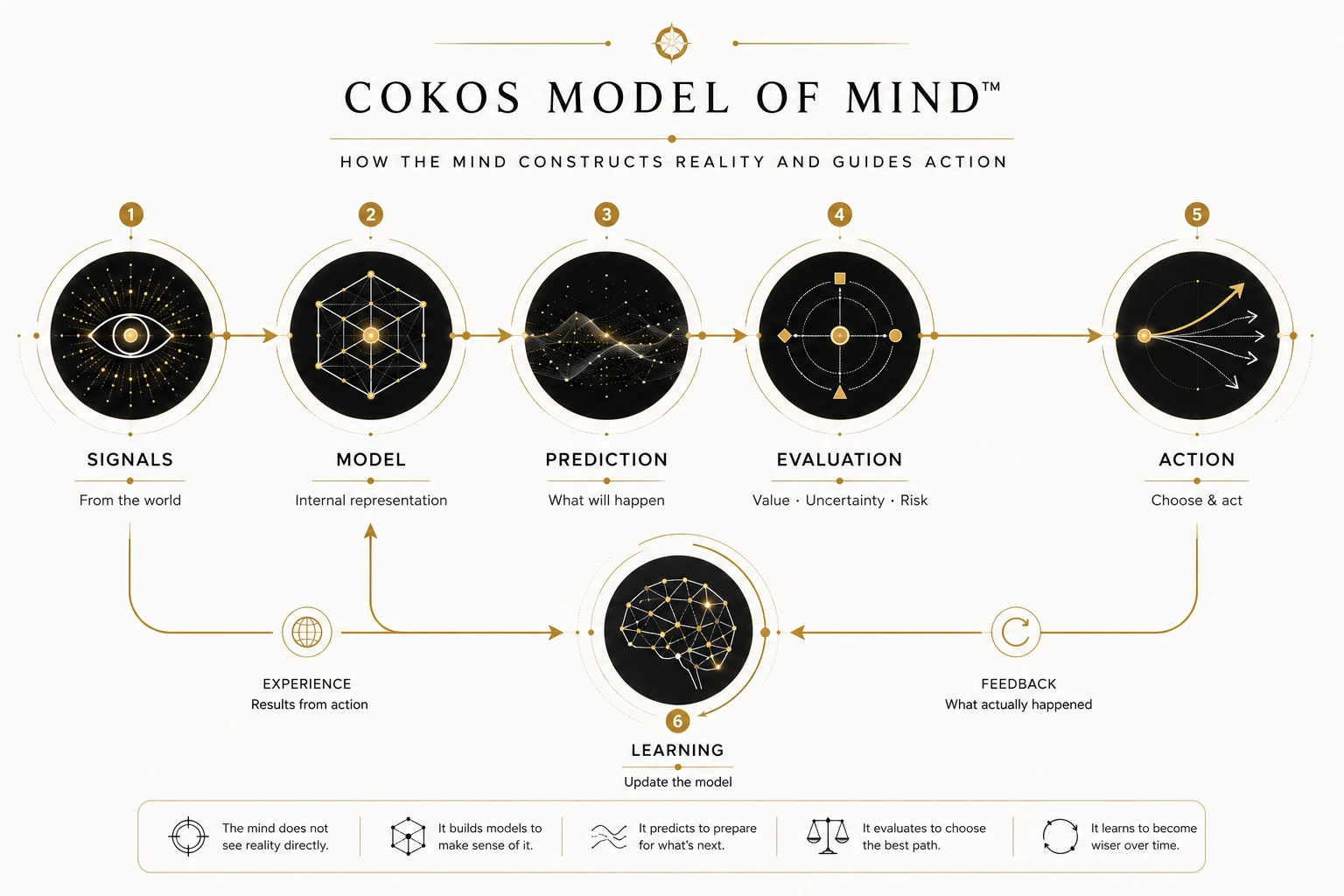
The model contains six primary stages:
- Signals: changes from the world and body become available through sensory and internal channels.
- Model: the mind organizes those signals into a structured representation of what may be happening.
- Prediction: the model generates expectations about what is likely to happen next.
- Evaluation: possible outcomes are assessed in relation to value, uncertainty, risk, need, and purpose.
- Action: the system selects or inhibits behaviour.
- Learning: the results of action become feedback that updates the model.
These stages should not be imagined as rigid boxes operating one after another. In living cognition, they overlap and influence one another continuously. Attention changes what becomes a signal. Existing beliefs shape how signals are interpreted. Emotion changes evaluation. Action changes the environment. New experience modifies memory. The updated model then generates different predictions.
The mind is therefore best understood as a loop rather than a line. It is a process of ongoing adjustment between an organism and its world.
What Does the Mind Actually Do?
The mind performs many functions, but most can be understood as parts of a larger task: reducing uncertainty enough to support meaningful action.
- Perception organizes sensory signals into objects, events, boundaries, patterns, and situations.
- Attention selects a small portion of available information for deeper processing.
- Memory preserves patterns from the past and makes them available to the present.
- Emotion marks relevance, value, urgency, attraction, threat, loss, and possibility.
- Imagination allows the system to simulate what is absent, possible, or not yet real.
- Reasoning compares claims, identifies relations, draws conclusions, and examines consistency.
- Language stabilizes concepts, communicates models, and enables shared reflection.
- Prediction prepares the organism for likely events before they fully unfold.
- Decision-making selects among possible actions under conditions of incomplete knowledge.
- Learning revises internal models when experience exposes error or reveals a better pattern.
No single function is the mind by itself. The mind is the coordinated whole through which these capacities become mutually informative. A memory can become a prediction. A prediction can produce fear. Fear can narrow attention. Narrowed attention can distort interpretation. Interpretation can guide action. Action can confirm or challenge the original belief.
Understanding the mind therefore requires more than naming its parts. It requires explaining the architecture that connects them.
Perception: The Mind Does Not Simply Record Reality
Perception often feels immediate. We open our eyes and a world appears: surfaces, distances, movement, faces, objects, dangers, opportunities. Because the result is so effortless, it is tempting to imagine that the senses deliver reality directly to the mind, as though the brain were a camera and consciousness a screen.
That picture is misleading. The senses do not provide a complete copy of the world. They register limited forms of energy within narrow biological ranges. The visual system responds to particular wavelengths of light. The auditory system responds to particular patterns of vibration. Touch, balance, temperature, pain, smell, taste, and signals from within the body each contribute only a partial stream of information.
From these incomplete signals, the mind must construct a coherent situation. It separates figure from background, groups fragments into objects, infers depth, recognizes continuity, identifies causes, detects agency, and assigns meaning. Much of what appears to be simply “given” is already the result of interpretation.
This does not mean that the external world is imaginary. It means that the world as experienced is mediated by a living system with particular capacities, limitations, needs, and expectations. The distinction matters. Reality is not identical to any one organism’s representation of it.
Perception is not the passive reception of a finished world. It is the active construction of a usable world from limited signals.
The mind fills gaps before we notice them
Every perceptual system operates under uncertainty. Signals may be weak, ambiguous, incomplete, delayed, or noisy. Yet action cannot wait for perfect information. The mind therefore relies on prior learning to interpret what is probably happening.
A partially hidden shape is experienced as a whole object. A familiar word can be recognized despite missing letters. A face is identified under changing light, angle, distance, and expression. A sound is interpreted differently depending on the sentence around it. In each case, perception depends on more than incoming data. It depends on a model of what the data most likely means.
This constructive capacity is indispensable. Without it, experience would remain a flood of disconnected variations. But the same capacity also creates the possibility of error. The mind can complete a pattern incorrectly, mistake expectation for evidence, or preserve an outdated interpretation because it remains internally coherent.
The Mind’s Interpretive Process™
The second framework in the Cokos model explains how raw sensory contact becomes meaningful experience. The process can be summarized as:
Signals → Filtering → Internal Model → Meaning
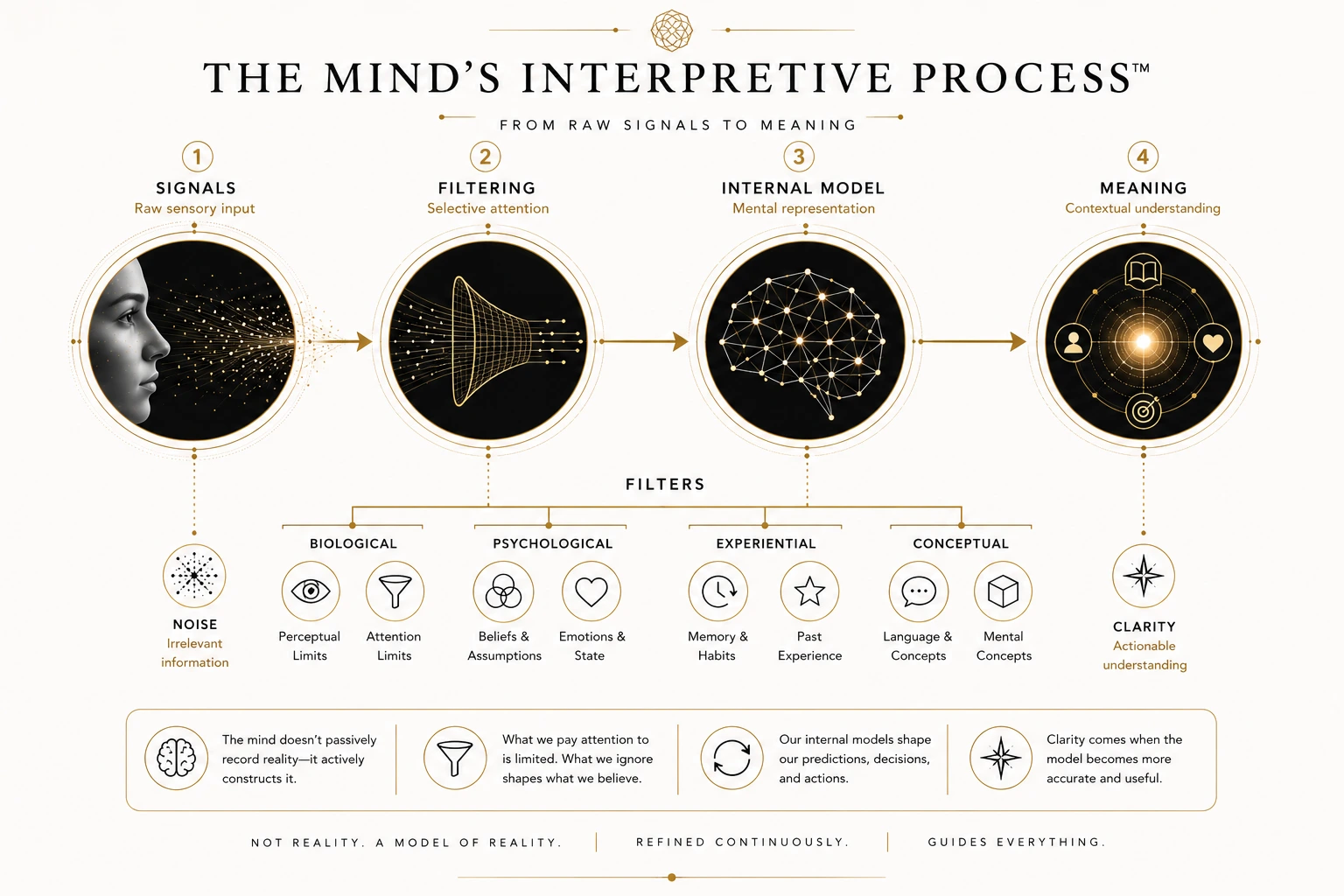
The diagram should not be read as if meaning appears only at the end. Meaning influences every stage. What a person already values affects attention. Existing concepts affect recognition. Past experience changes what seems familiar or threatening. The process is circular: prior meaning shapes interpretation, and new interpretation modifies future meaning.
Attention: The Gateway of the Mind
At any moment, far more information is available than the mind can process in detail. The pressure of clothing against the body, distant sounds, peripheral movement, internal sensations, memories, goals, and possible actions all compete for limited resources. Attention regulates this competition.
Attention is not merely concentration. It is the broader process through which some information is amplified while other information is reduced, delayed, or ignored. It determines what becomes cognitively available, what enters working memory, what receives interpretation, and what can influence deliberate action.
This makes attention one of the most consequential functions of mind. What is not noticed cannot be evaluated in the same way as what is noticed. A person can stand in the same room, participate in the same conversation, or witness the same event as another person and leave with a different model because attention selected a different subset of the available evidence.
Attention is selective, not neutral
Selection is shaped by several forces:
- Salience: sudden, intense, novel, or contrasting signals attract attention.
- Goals: what we are trying to accomplish changes what we notice.
- Emotion: fear, desire, grief, anger, and hope prioritize different information.
- Habit: repeated patterns become easier to detect and harder to ignore.
- Expectation: the mind looks for evidence that fits its current model.
- Identity: information related to the self receives special weight.
- Culture and language: learned categories influence what appears significant.
Because attention is selective, every experienced world contains absences. What is ignored may be irrelevant, but it may also be exactly what would challenge the current interpretation. The mind’s efficiency and its vulnerability arise from the same fact: it cannot process everything equally.
The Four Layers of Mental Filtering
The interpretive diagram groups the major filters into four layers. These layers overlap, but the distinction helps explain why different minds can derive different meanings from similar situations.
1. Biological filters
Every mind operates through a particular body. Sensory range, development, fatigue, stress, pain, sleep, hormones, neural organization, and physical condition all influence what can be detected and how strongly it is processed.
A hungry organism notices food-related signals. A sleep-deprived person may interpret ambiguity more negatively. A frightened nervous system may prioritize possible threats over subtle opportunities. The body is not a container beneath the mind; it is part of the system through which a world becomes available.
2. Psychological filters
Beliefs, assumptions, moods, expectations, fears, desires, and motives influence interpretation. The same feedback may be heard as useful guidance, humiliation, rejection, or proof of growth depending on the model already active.
These filters do not always operate consciously. A person may sincerely believe they are evaluating evidence objectively while their attention and interpretation are being guided by an unexamined need to protect status, identity, certainty, or belonging.
3. Experiential filters
Past experience provides the patterns through which present events are recognized. Memory allows rapid interpretation because the mind does not need to begin from nothing. It can compare the present with previous situations, infer likely causes, and prepare a response.
But memory is not a perfect archive. It is selective, reconstructive, and influenced by later understanding. The past affects the present not as a complete record, but as a set of retained patterns, emotional associations, learned expectations, and stories about what happened.
4. Conceptual filters
Language and concepts divide experience into recognizable forms. They allow the mind to distinguish, compare, remember, explain, and communicate. A concept such as justice, probability, loyalty, trauma, system, or identity makes patterns visible that might otherwise remain undifferentiated.
Concepts increase understanding, but they also constrain it. Once an event is placed inside a familiar category, alternative descriptions may receive less attention. The word becomes a lens. Good concepts reveal structure; poor concepts hide it.
This is one reason knowledge is more than the accumulation of information. Knowledge depends on whether the concepts and models used to organize information correspond well enough to the patterns of the world.
From Representation to Meaning
An internal representation becomes meaningful when it is placed within a larger network of relations. A sound becomes a word because it belongs to a language. A facial expression becomes reassuring or threatening because it is connected to context, memory, expectation, and social knowledge. A choice becomes important because it is linked to values, identity, and imagined consequences.
Meaning is therefore not an extra label added after perception. It is the relational structure through which something matters. To understand a signal is to locate it within a model that connects it to causes, purposes, possibilities, and consequences.
This also explains why meaning can change without the external event changing. New information can reorganize the model. A memory can acquire a different significance. A failure can later be understood as protection, instruction, or redirection. The event remains part of history, but its place within the person’s internal world changes.
Perception and Conscious Experience
Not every stage of interpretation becomes conscious. The mind performs vast amounts of selection, integration, comparison, and preparation outside awareness. Conscious experience presents only a limited result: the object seen, the thought that appears, the emotion felt, the decision under consideration.
This is why mind and consciousness should not be treated as synonyms. The mind includes conscious experience, but also the processes that shape experience before it becomes available. The deeper question of why any of these processes are accompanied by subjective presence belongs to the study of consciousness.
For the present argument, the essential point is simpler: what appears in consciousness is already organized. We do not first receive pure reality and then interpret it. Interpretation is part of the process through which a coherent world appears at all.
The First Discipline of Understanding
If the mind constructs experience through filters and models, then clarity begins with a disciplined question:
What am I observing, and what is my mind adding?
The question does not require distrusting every perception. It requires distinguishing signal from interpretation, event from expectation, observation from explanation, and reality from the current model of reality.
This distinction is foundational for science, self-knowledge, dialogue, and wisdom. A mind becomes more accurate not by abandoning models—which is impossible—but by becoming capable of examining, testing, and revising them.
Internal Models: The Mind’s Working Version of Reality
The mind does not contain reality itself. It contains a working model of reality: a structured, continuously revised representation of the world, the body, other people, possible futures, and the self.
This model is not a single image hidden somewhere inside the brain. It is a distributed organization of expectations, concepts, memories, emotional associations, habits, skills, relationships, and predictions. It allows a person to recognize what is happening, infer what cannot be directly observed, and decide what to do next.
Without such a model, every moment would be cognitively new. A person would have no stable sense of objects, causes, identities, meanings, or possibilities. The mind would receive signals but would not know how to place them within a world.
An internal model is the mind’s best current answer to the question: What kind of world am I in, what is happening within it, and what can I do?
The word best does not mean perfect. It means the model that has survived previous experience, remains coherent enough to guide action, and has not yet been replaced by a better alternative.
Building Internal Models™
The fourth Cokos framework shows how experience is transformed into a working model of reality. The process is cumulative. Signals are processed, integrated with prior knowledge, organized into structure, used for simulation, and stabilized into patterns that guide action.
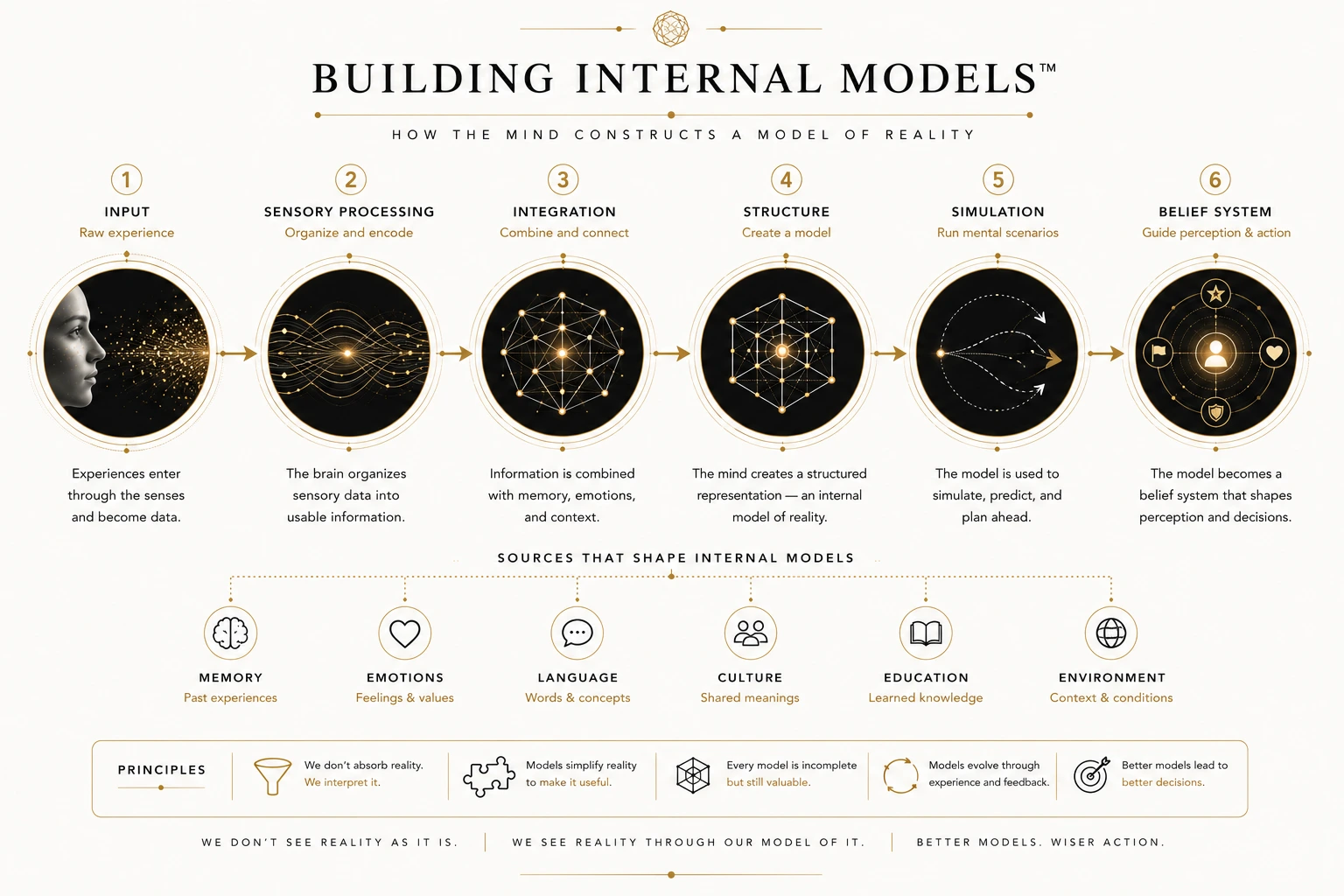
The diagram presents a linear sequence for clarity, but the actual process is recursive. A current model shapes how new input is processed. The resulting interpretation either reinforces the model or creates tension within it. Over time, the model becomes more detailed, more efficient, more rigid, or more accurate depending on how learning occurs.
Memory: The Structure of the Past Within the Present
Memory is often imagined as storage: the mind records an event, places it somewhere, and later retrieves it. This metaphor is useful but incomplete.
Memory is not only a record of what happened. It is one of the main structures through which the present becomes intelligible. A person recognizes a face because prior encounters have formed a pattern. A situation feels familiar because the current configuration resembles something already experienced. A decision appears dangerous because memory has connected similar circumstances with loss.
Memory therefore functions less like a static archive and more like an active system of pattern retention. It preserves regularities that can be applied to new situations.
Different forms of memory support different parts of mind
- Working memory holds a limited amount of information available for immediate thought and action.
- Episodic memory preserves events as part of a personal history.
- Semantic memory retains concepts, facts, and general knowledge.
- Procedural memory supports skills and learned actions that may not require conscious explanation.
- Emotional memory connects situations with patterns of attraction, fear, safety, shame, or significance.
These forms interact. A remembered failure can shape present emotion. A learned skill can guide action without deliberate thought. A concept can reorganize the meaning of a personal memory. The model of reality is built from the interaction of all these systems, not from one uniform storehouse.
Memory is reconstructive
Remembering is not always the recovery of an untouched original. It is often a reconstruction shaped by present context, current beliefs, later information, and the purpose for which the memory is being recalled.
This makes memory adaptive. It allows old experience to be reorganized in light of new understanding. But it also makes memory vulnerable to distortion. A coherent story may feel true because it fits the current model, even when important details have been omitted or altered.
The relationship between memory and personal identity is especially important. A person experiences continuity partly because memories, habits, commitments, and self-descriptions are organized into a narrative of being the same individual across time. Yet that continuity is constructed within change.
Emotion: The Mind’s System of Relevance
Emotion is sometimes treated as the opposite of reason, as though the mind had a rational core repeatedly disrupted by feeling. This is another misleading picture.
Emotion is one of the systems through which the mind marks importance. It signals that something matters in relation to need, threat, attachment, loss, status, purpose, possibility, or value.
Without emotion, the mind could represent many facts but would struggle to prioritize among them. A decision requires more than knowing what options exist. It requires some way of distinguishing what is desirable, dangerous, urgent, meaningful, or worth preserving.
Emotion changes the model
Fear increases the visibility of possible threat. Grief reorganizes the world around absence. Anger highlights violation and obstruction. Curiosity draws attention toward uncertainty. Hope makes future possibilities more cognitively available.
Emotion does not merely follow perception. It influences what is perceived, remembered, expected, and imagined. A person in danger inhabits a different practical world from a person at ease, even when the physical environment is similar.
Emotions can be informative without being infallible. They reveal how the current model evaluates a situation, but the evaluation may depend on outdated learning, incomplete evidence, or a mistaken interpretation. Emotional wisdom therefore does not mean obeying every feeling. It means learning to understand what a feeling is signalling, what model produced it, and whether that model remains adequate.
Imagination: The Mind’s Ability to Leave the Present
Imagination allows the mind to represent what is not currently present. It can reconstruct the past, simulate the future, explore alternatives, combine unfamiliar elements, and test possible actions before committing to them.
This capacity transforms cognition. A mind that can only respond to what is immediately present remains bound to the current moment. A mind that can imagine can plan, design, rehearse, invent, fear, hope, and create.
Imagination is therefore not a decorative addition to rational thought. It is one of the foundations of prediction and decision-making.
The same capacity supports creativity and anxiety
The ability to simulate possibilities has no built-in guarantee of accuracy. It can generate insight, art, strategy, scientific hypotheses, and empathy. It can also generate catastrophic futures, false memories, impossible standards, and narratives that feel persuasive despite weak evidence.
The value of imagination depends on how simulation is connected to reality-testing. Possibility must eventually meet observation. Otherwise, a model may become internally rich while drifting away from the world it is meant to explain.
Language: The Architecture of Shared Thought
Language does more than communicate thoughts that already exist. It gives mental life structure. Words stabilize distinctions, preserve abstractions, connect experiences across time, and make models shareable.
A person who learns a new concept does not merely acquire a label. They may gain the ability to notice a pattern that had previously remained invisible. Concepts such as probability, feedback, identity, bias, emergence, legitimacy, or trauma reorganize experience by creating new relations among events.
Language also allows minds to coordinate. One person’s internal model can be expressed, criticized, revised, and inherited by others. Culture becomes possible because models no longer need to be learned only through direct individual experience.
This collective advantage is enormous. Human beings can transmit knowledge across generations, build institutions, preserve discoveries, and construct systems of meaning far beyond the capacity of a single lifetime.
Language also creates limits
Every vocabulary emphasizes some distinctions and neglects others. A familiar phrase can replace observation. A category can become so rigid that evidence is forced to fit it. A name can make a complex person appear to be only one thing.
The mind needs concepts, but it must not confuse concepts with the totality of what they describe. A model becomes dangerous when it is treated as reality rather than as an instrument for engaging with reality.
Culture, Education, and Environment
No human mind develops in isolation. From the beginning, perception and interpretation are shaped within relationships, practices, languages, institutions, technologies, and inherited stories.
Culture supplies categories of value and significance. Education introduces formal models of the world. Environment determines which problems, opportunities, and risks are repeatedly encountered. Social feedback teaches what is rewarded, punished, admired, or ignored.
These influences become part of the mind’s internal architecture. They affect not only what a person believes, but what appears obvious, natural, possible, or unthinkable.
This is one reason the study of mind cannot be reduced entirely to the individual brain. Human cognition is embodied, relational, cultural, and historical. The mind is shaped through interaction with systems larger than itself.
The Self as an Internal Model
Among the mind’s many models, one is especially important: the model of the self.
The self-model organizes information about the body, agency, memory, social identity, values, roles, abilities, and continuity over time. It helps answer questions such as:
- What is happening to me?
- What can I control?
- What kind of person am I?
- What belongs to my history?
- What should I protect?
- What future is possible for me?
The self-model is necessary for coherent action, but it is not identical to the whole person. It is a representation built from experience and social feedback. It can become more accurate, more compassionate, more rigid, or more distorted.
Because the self-model shapes attention and interpretation, it can become self-reinforcing. Someone who believes they are incapable may notice failure more quickly than improvement. Someone who believes disagreement means rejection may interpret neutral tension as personal threat. The model influences experience, and experience appears to confirm the model.
To understand the mind is therefore also to understand how identity is maintained through models that can be revised without dissolving continuity.
When Internal Models Become Too Rigid
A useful model must be stable enough to guide action but flexible enough to change. If it changes with every new signal, the world becomes chaotic. If it refuses to change at all, the mind becomes unable to learn.
Rigidity appears when preserving coherence becomes more important than responding to evidence. Contradictory information may be ignored, reinterpreted, or treated as a threat. The model protects itself by filtering out what would require revision.
This can occur in personal identity, ideology, relationships, institutions, and entire cultures. The mechanism is similar: a stable interpretation reduces uncertainty, and uncertainty can feel dangerous. The cost is that the model becomes less capable of representing change.
The healthier alternative is not permanent doubt. It is calibrated openness: enough confidence to act, enough humility to update.
Better Models, Not No Models
Because perception is mediated, some people conclude that truth is inaccessible or that every interpretation is equally valid. That does not follow.
Models can be compared. Some predict more accurately. Some explain more with fewer assumptions. Some integrate wider evidence. Some survive testing across contexts. Some allow people to detect error and revise themselves.
The fact that the mind uses models does not imprison it inside pure subjectivity. It creates the need for methods that improve correspondence between model and world: observation, dialogue, measurement, criticism, experiment, reflection, and the disciplined search for truth.
Wisdom does not begin when the mind stops modelling reality. It begins when the mind recognizes that its model can be improved.
The Predictive Mind
The mind does not wait passively for the future to arrive. It continuously anticipates what is likely to happen next.
Every act of perception depends partly on expectation. Every movement depends on a forecast of what the body and environment will do. Every decision depends on imagined outcomes. Even the simplest action requires the mind to prepare for consequences that do not yet exist.
This predictive capacity is not an optional higher function added to perception. It is woven into the structure of cognition itself. The mind uses prior experience to generate expectations, compares those expectations with incoming observation, detects mismatch, and updates its model.
The mind is not only a system for representing what is. It is a system for anticipating what may happen next.
The Predictive Mind™
The predictive cycle can be summarized as:
Prediction → Observation → Comparison → Prediction Error → Model Update
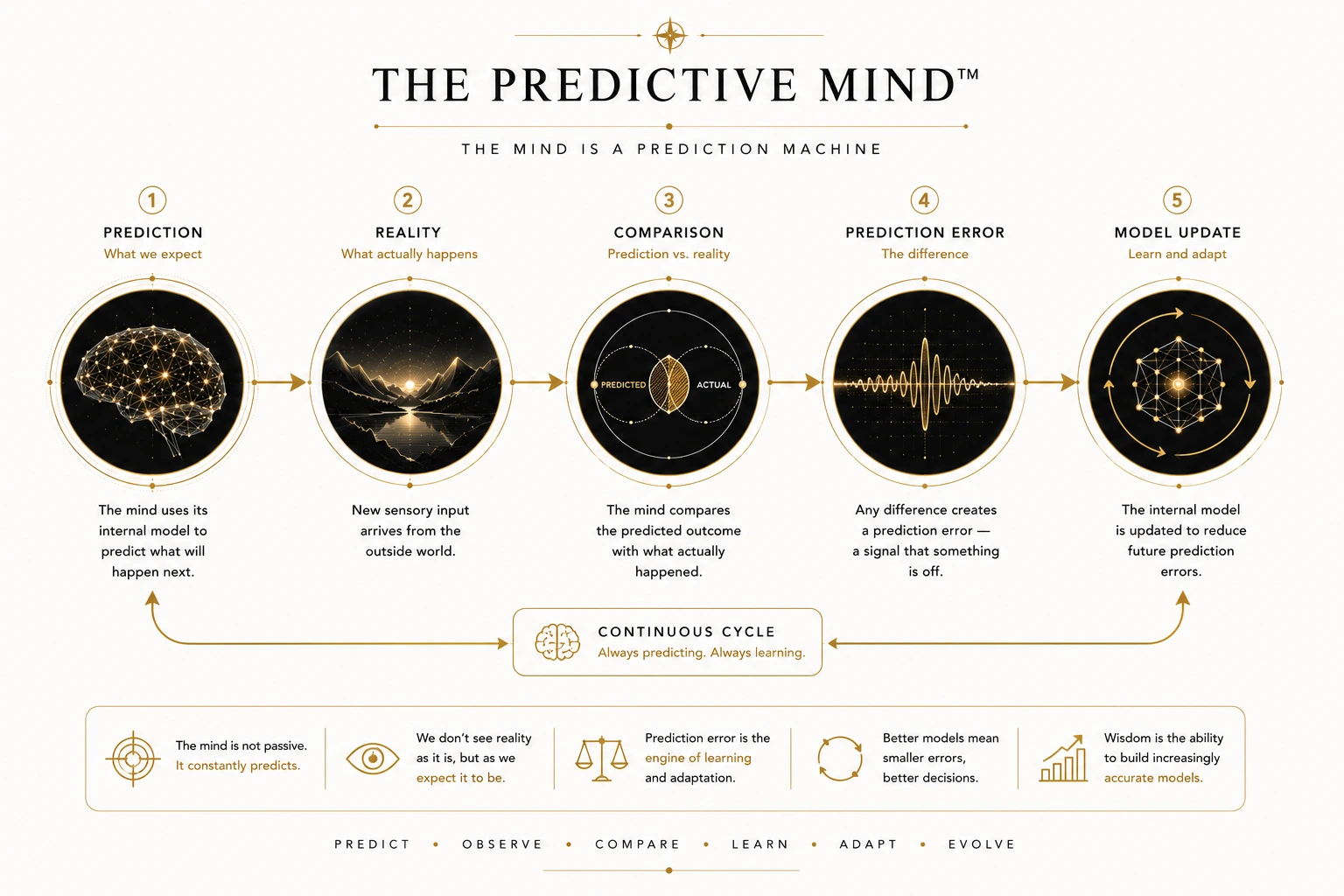
The loop operates at multiple levels. Some predictions are immediate and bodily: where the next step will land, how much force is needed to lift an object, or whether a sound is likely to continue. Others are social: how someone may respond, whether a promise will be kept, or how a group will interpret an action. Still others are conceptual and long-term: whether a theory will explain new evidence, whether a plan will succeed, or whether a life decision will lead toward a valued future.
Why Prediction Is Necessary
Action takes time. Signals take time to reach the brain. Interpretation takes time. If the mind reacted only after events were fully known, it would often be too late.
Prediction allows the organism to compensate for delay. The mind prepares the body, allocates attention, and narrows possible interpretations before all evidence is available. In a stable environment, this is efficient. It allows rapid recognition and coordinated action.
Prediction also reduces cognitive burden. The world contains too much detail to process from the beginning each time. Existing models provide a starting point. Instead of reconstructing everything, the mind asks, in effect: Does the current situation match what I expected?
When the match is close, the model continues with little revision. When the mismatch is important, attention increases and learning may occur.
Expectation Shapes Perception
Because the mind predicts, perception is influenced by what is expected. Ambiguous input is more likely to be interpreted in a familiar way. A person expecting danger notices possible threat. A person expecting rejection may interpret hesitation as disapproval. A skilled expert sees meaningful structure where a beginner sees unrelated detail.
Expectation can improve perception by making relevant patterns easier to detect. It can also distort perception when the model is too strong, too rigid, or based on incomplete learning.
This creates a central tension within cognition:
- Without prior expectation, interpretation would be slow and unstable.
- With too much expectation, the mind may see only what its model permits.
A capable mind must therefore balance prior knowledge with openness to new evidence.
What Is Prediction Error?
Prediction error is the difference between what the mind expected and what observation provided.
The term does not necessarily mean a conscious mistake. It refers more broadly to mismatch. A predicted sound does not occur. An object is heavier than expected. A familiar person responds in an unfamiliar way. A plan produces the opposite of the intended result.
Mismatch is one of the most important signals in learning because it reveals where the current model is incomplete, inaccurate, or insufficiently precise.
Prediction error is the point at which reality resists the mind’s current model.
Not every mismatch produces learning
A prediction error may be ignored, explained away, forgotten, or treated as noise. Learning depends on whether the system assigns enough importance to the mismatch and whether an alternative model is available.
Several factors influence this process:
- Magnitude: large mismatches attract more attention than small ones.
- Repetition: repeated error becomes harder to dismiss.
- Relevance: errors connected to survival, identity, goals, or value receive more weight.
- Confidence: highly trusted models resist revision longer.
- Alternative explanations: a model is easier to replace when a better one is available.
- Emotional cost: some truths are difficult to integrate because they threaten identity, belonging, or meaning.
Uncertainty and the Need for Control
The mind seeks patterns partly because uncertainty is costly. An uncertain environment is difficult to navigate. The organism cannot easily know what deserves attention, what action is safe, or what outcome is likely.
Models reduce this uncertainty by creating regularity. They allow the mind to act before every detail is known. But a model can reduce uncertainty psychologically even when it is inaccurate. A simple explanation may feel safer than a complex truth. A familiar story may be preferred to unresolved evidence.
This is why certainty and accuracy are not the same. The feeling of knowing may reflect model stability rather than correspondence with the world.
The mature mind learns to tolerate enough uncertainty to continue investigating. It does not abandon structure, but it refuses to treat discomfort as proof that a question has been answered.
Prediction and Action
Prediction is not limited to observing the world. The mind also acts in order to test and shape what happens.
When a person reaches for a cup, asks a question, changes strategy, or enters a new environment, action produces information. The result confirms or challenges expectation. In this sense, action is part of cognition.
The mind does not merely build a model and then act once. It moves through a continuous loop:
Model → Prediction → Action → Feedback → Updated Model
This explains why passive reflection has limits. Some uncertainties can be resolved only through contact with consequences. A person may think endlessly about whether they can perform a task, trust another person, or survive a change. At some point, reality must answer through action and feedback.
When Prediction Becomes Bias
Prediction becomes bias when prior expectation dominates observation so strongly that contrary evidence is discounted or never fully perceived.
Common examples include:
- Expecting a person to behave badly and interpreting ambiguous actions as proof.
- Believing a strategy must work and redefining every failure as temporary.
- Assuming a group possesses a trait and noticing only confirming cases.
- Expecting oneself to fail and avoiding situations that might disconfirm the belief.
- Holding a theory so tightly that contradictory evidence is treated as irrelevant.
Bias is not evidence that prediction should be eliminated. Prediction cannot be eliminated. The task is to make prediction corrigible—to build systems that allow expectation to be challenged by observation.
The Difference Between Surprise and Learning
Surprise is the immediate experience of violated expectation. Learning is the deeper revision that may follow.
A person can be surprised repeatedly without changing. The event may be treated as an exception. The model may remain intact because revising it would require too much cognitive or emotional reorganization.
Learning occurs when the mismatch changes what the system expects next time. The old prediction becomes less dominant, a new relation is formed, or a wider model replaces the previous one.
Therefore the real evidence of learning is not that a person has encountered new information. It is that future perception, prediction, or action has changed.
Prediction, Free Will, and Choice
The predictive nature of mind raises a deeper question: if choices emerge from prior models, habits, values, and expectations, in what sense are they free?
The existence of prediction does not settle the problem of free will. But it clarifies the conditions under which meaningful choice becomes more possible.
A mind governed by a narrow model may experience only a few apparent options. A mind capable of imagining alternatives, examining assumptions, and learning from prediction error can expand the space of action.
Freedom may therefore depend less on acting without causes and more on increasing the system’s capacity to represent alternatives, understand consequences, and revise the models from which action emerges.
The Predictive Mind in Everyday Life
The predictive model becomes easier to recognize in ordinary experience.
- Conversation: we anticipate how a sentence will end and notice when it turns unexpectedly.
- Movement: the body prepares for weight, distance, and balance before contact is complete.
- Relationships: we expect familiar patterns and may react to what we predict rather than what is happening now.
- Work: plans are predictions about how resources, people, and events will interact.
- Anxiety: the mind simulates threatening outcomes and treats possibility as preparation.
- Expertise: trained models detect patterns and likely outcomes more quickly.
- Creativity: the mind generates unusual predictions and combinations beyond established patterns.
In every case, the quality of action depends partly on the quality of prediction.
A Better Relationship with Error
If prediction error drives learning, then error is not merely failure. It is information about the boundary of the current model.
This does not make every mistake desirable. Errors can be costly. But a system that cannot detect or tolerate error becomes unable to improve.
The goal is not to eliminate error completely. It is to create a mind—and a culture—that can extract information from error without collapsing into denial, shame, or repetition.
A mind becomes more intelligent not when it never predicts incorrectly, but when it updates well.
Learning: How the Mind Improves Itself
Learning is the process through which the mind changes its internal model in response to experience. Every useful correction makes future perception, prediction, and action more accurate. In this sense, learning is not the accumulation of isolated facts but the continuous refinement of the structures that organize those facts.
The purpose of learning is not to remember more. It is to build better models.
The most important driver of learning is the gap between expectation and experience. When reality consistently differs from prediction, the mind has an opportunity to improve. Whether it actually does so depends on openness, attention, feedback, and the willingness to revise existing assumptions.
Learning Through Prediction Error™
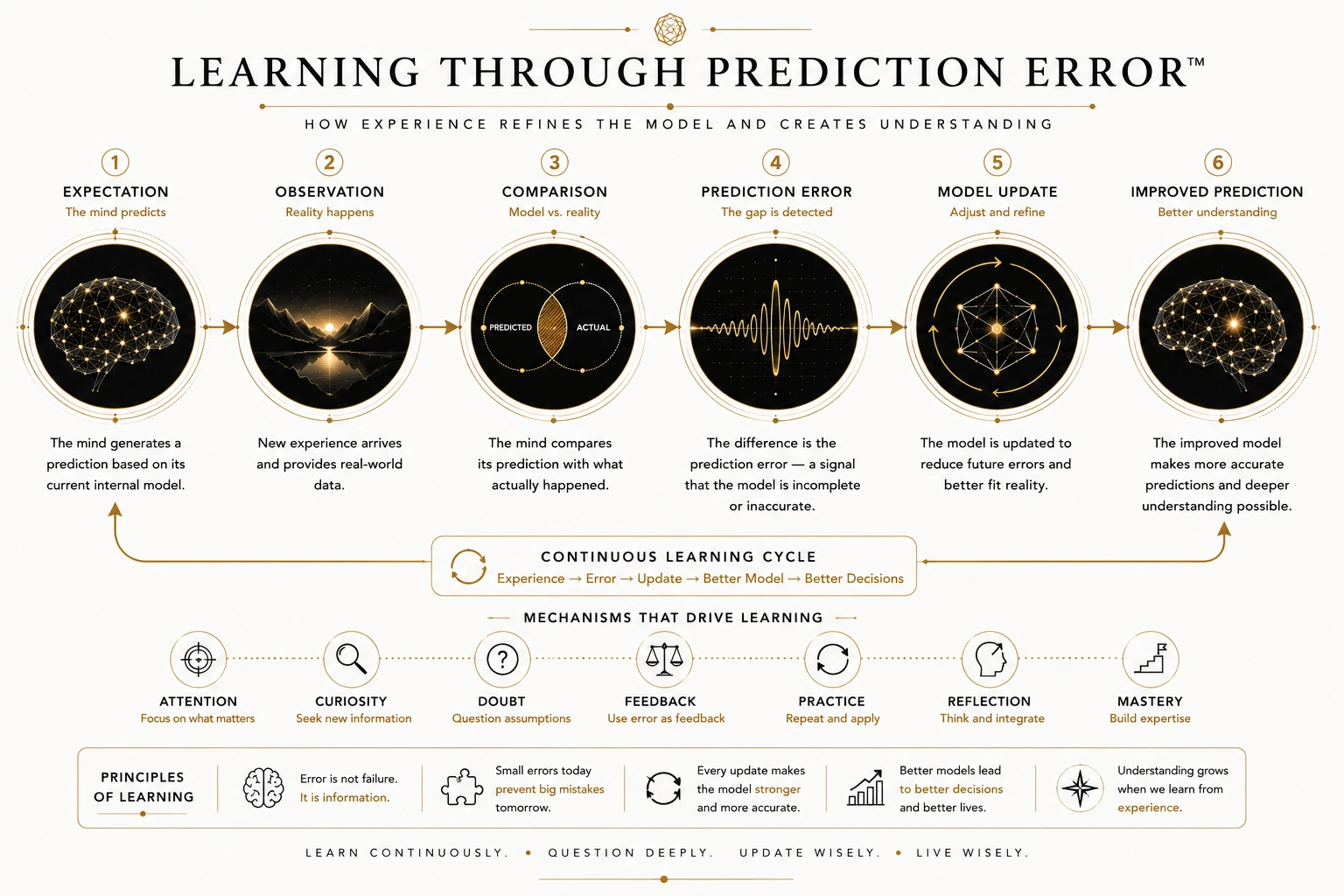
The learning cycle follows a recurring pattern:
- An expectation is formed.
- The world provides experience.
- The result is compared with expectation.
- A prediction error is detected.
- The internal model is revised.
- Future expectations become more accurate.
Every discipline—from science and engineering to parenting, leadership, and philosophy—depends on this same principle. Progress is possible because models are corrigible.
Understanding Is More Than Information
Information answers isolated questions. Understanding connects answers into a coherent explanatory structure. Two people may know the same facts while possessing very different levels of understanding because one has organized those facts into a richer model.
Understanding therefore reduces uncertainty not by eliminating complexity but by explaining it. A strong explanatory model allows many observations to become intelligible at once.
Understanding is the reduction of uncertainty through increasingly accurate models of reality.
Intelligence and the Quality of Models
Intelligence is often measured through problem-solving ability, abstraction, learning speed, or adaptation. These capacities are important, but they share a deeper foundation: the ability to construct, compare, and improve internal models.
A highly intelligent mind is not one that never makes mistakes. It is one that can recognize error, integrate new evidence, and reorganize its models without losing coherence.
This explains why intelligence includes both analytical and creative capacities. Analysis tests models against evidence. Creativity generates alternative models when existing ones become inadequate.
Reasoning and Intuition
Reasoning and intuition are frequently presented as opposites. In practice they are complementary.
- Reasoning deliberately evaluates relationships, evidence, and logical consistency.
- Intuition rapidly recognizes patterns formed through previous learning.
Reasoning is usually slower and explicit. Intuition is faster and often implicit. Both depend on the quality of the internal model. Poor models produce poor intuition and weak reasoning alike.
The healthiest mind allows intuitive judgments to generate hypotheses while reasoning evaluates whether those hypotheses correspond to reality.
Wisdom
Knowledge answers questions. Understanding explains relationships. Wisdom guides action.
Wisdom emerges when increasingly accurate models are integrated with judgment, values, humility, and long-term consequences. A wise mind recognizes both what it knows and the limits of its knowledge.
This is why wisdom often grows alongside intellectual humility. The larger the model becomes, the more clearly its remaining uncertainties can be seen.
The Architecture of Understanding™
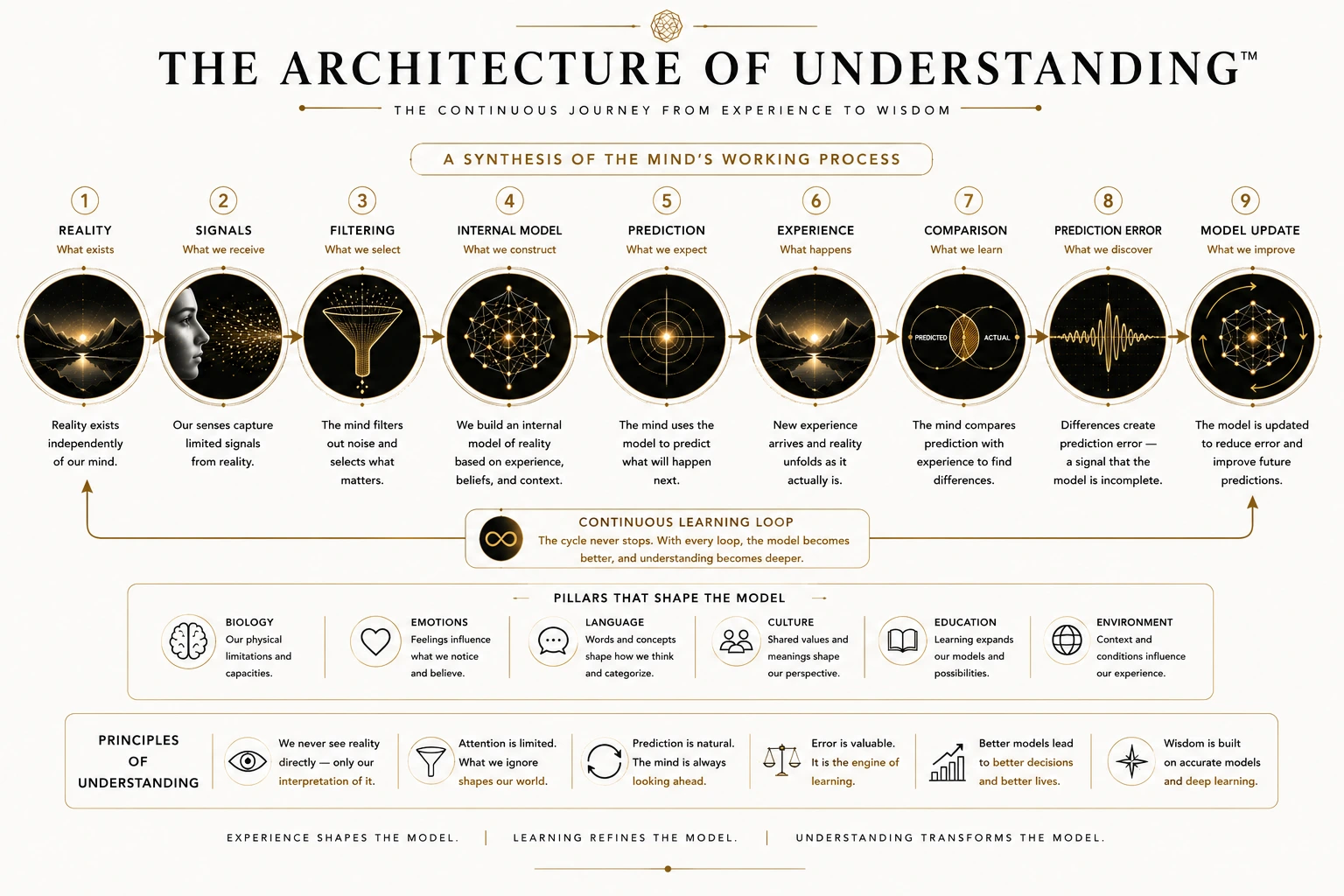
The six COKOS frameworks presented throughout this article converge into one architecture:
- The world provides signals.
- The mind filters those signals.
- An internal model organizes them.
- The model predicts future states.
- Experience tests those predictions.
- Prediction errors reveal limitations.
- Learning updates the model.
- Understanding increases.
- Better understanding enables wiser decisions.
This sequence explains why the mind should not be viewed as a container of thoughts but as a living adaptive system. It continually reorganizes itself through interaction with the world.
Toward a Better Theory of Mind
The question “What is mind?” cannot be answered by identifying one faculty such as consciousness, intelligence, memory, or emotion. The mind is the integrated system through which these capacities cooperate to reduce uncertainty, generate meaning, and guide action.
The more accurate its internal models become, the more capable it becomes of understanding reality, navigating complexity, and acting wisely.
The Philosophy of Mind
The philosophy of mind asks what mental life is, how it relates to the body, why experience exists, and whether thought can be explained entirely through physical processes. These questions have shaped philosophy for centuries because every theory of knowledge, identity, freedom, morality, and meaning eventually depends on an account of the mind.
No single historical theory has resolved every difficulty. Each captures part of the problem and exposes limits in the others. The major traditions are best understood not as a list of obsolete positions, but as competing explanatory models.
Dualism: mind and matter as different kinds of reality
Dualist theories distinguish the mind from the physical body. In their strongest form, they propose that mental reality and material reality are fundamentally different kinds of existence.
The attraction of dualism is easy to understand. Thoughts do not appear to have weight or shape. Pain is known as an experience, not merely as neural activity. Meaning and intention seem different from physical motion. Dualism preserves this difference rather than explaining it away.
Its central difficulty is interaction. If mind and matter are fundamentally separate, how does a thought cause a bodily action? How does physical injury produce conscious pain? A theory that separates the two must still explain their constant coordination.
Physicalism: the mind as a physical process
Physicalism holds that mental life depends entirely on physical reality. On this view, there is no separate mental substance. Thoughts, emotions, memories, and conscious states arise from the organization and activity of the brain and body.
This position aligns closely with modern neuroscience. Changes in the brain can alter memory, personality, perception, mood, language, and judgment. Mental life appears deeply dependent on biological processes.
The unresolved challenge is explanatory completeness. Even a perfect description of neural activity may not seem to explain why that activity is accompanied by subjective experience—why pain hurts, why red looks the way it does, or why a thought is present to someone from the inside.
Functionalism: the mind as organized activity
Functionalism defines mental states by what they do rather than by what they are made of. A belief, memory, or intention is identified through its role within a larger system of inputs, internal states, and actions.
This approach fits the Cokos model particularly well. The mind is understood as an architecture of perception, modelling, prediction, evaluation, action, and learning. What matters is the organization of these functions and their relationships.
Functionalism also opens the possibility that different physical systems could realize similar mental functions. That possibility becomes important when considering artificial intelligence.
Emergentism: mind as a higher-order pattern
Emergentist theories propose that mental properties arise when physical systems reach a certain form of complexity and organization. The mind is not independent of the brain, but neither is it adequately described at the level of individual cells or molecules.
A single neuron does not possess a worldview, identity, or intention. Yet a coordinated living system may generate capacities that do not meaningfully exist at the level of its individual parts. The mind can therefore be real as an emergent pattern even if it depends entirely on physical processes.
Enactive and embodied views
Embodied and enactive theories reject the idea that the mind is confined to abstract computation inside the skull. Cognition emerges through the interaction of brain, body, action, and environment.
On this view, perception is not merely internal representation. It is an active relationship with a world. The body shapes available experience, and action helps determine what can be known.
This perspective strengthens the central argument of this article: the mind is not a detached spectator. It is a living system engaged in continuous exchange with reality.
Mind, Consciousness, and Intelligence
These three concepts are closely related, but they should not be treated as interchangeable.
| Concept | Core question | Main function |
|---|---|---|
| Mind | What system perceives, models, predicts, evaluates, and acts? | Organizes cognitive, emotional, and behavioural life |
| Consciousness | Why and how is experience present from the first-person point of view? | Makes some mental contents subjectively available |
| Intelligence | How effectively can a system learn, solve problems, adapt, and construct useful models? | Improves performance across changing conditions |
The mind includes conscious and nonconscious processes. Intelligence is one capacity of mind, but a mind also includes emotion, memory, motivation, identity, and meaning. Consciousness is part of mental life, but many operations that shape consciousness occur outside awareness.
This distinction matters because theories often answer one question while appearing to answer all three. A model may explain intelligent behaviour without explaining consciousness. It may describe conscious experience without explaining learning. It may explain brain function without fully explaining personal identity.
Readers interested in the first-person dimension should continue with What Is Consciousness?. The present article focuses on the broader architecture within which conscious experience appears.
Can Artificial Intelligence Have a Mind?
Artificial intelligence has made the question of mind newly urgent. Modern systems can recognize patterns, generate language, solve problems, predict outcomes, and adapt to feedback. These abilities resemble some functions of human cognition.
But resemblance in function does not automatically establish the presence of a mind in the full human sense.
To evaluate whether an artificial system has a mind, several distinct questions must be separated:
- Can it construct and update internal models?
- Can it integrate perception, memory, goals, and action?
- Can it operate autonomously across changing environments?
- Does it possess a persistent self-model?
- Does it understand meaning or only reproduce patterns?
- Does it have subjective experience?
- Can it value outcomes rather than merely optimize assigned objectives?
A system may satisfy some of these conditions without satisfying all of them. It may demonstrate intelligence without consciousness, prediction without lived experience, or language without a stable self.
Functionalist theories leave open the possibility that a nonbiological system could possess a mind if it reproduced the necessary organization. Biological theories may argue that living embodiment is essential. The evidence remains incomplete.
The question is not whether AI can imitate one mental ability. It is whether those abilities become integrated into a persistent, adaptive, experiencing system.
At present, claims about machine consciousness should be treated with caution. Behaviour can provide evidence of function, but subjective experience is not directly observable even in other humans. The problem becomes more difficult when the system differs radically from biological life.
Common Misconceptions About the Mind
“The mind is just the brain”
The mind depends on the brain, but the terms describe different explanatory levels. Brain refers to biological structure and activity. Mind refers to the organized capacities, processes, models, and experiences made possible through that activity.
“The mind is the same as consciousness”
Consciousness is one dimension of mental life. Attention, pattern recognition, emotional preparation, memory integration, and action selection can occur without entering conscious awareness.
“The mind is only rational thought”
The mind includes reason, but also perception, emotion, embodiment, habit, imagination, intuition, and motivation. Rational thought is one part of a larger adaptive system.
“Emotion prevents clear thinking”
Emotion can distort judgment, but it also supplies value, urgency, and relevance. Without emotional evaluation, the mind would struggle to prioritize among possibilities.
“Memory stores exact copies of the past”
Memory is reconstructive. It preserves patterns and significance, but recall can be shaped by present context, later knowledge, and the current self-model.
“A strong mind never changes”
Rigidity is not strength. A capable mind preserves stable knowledge while remaining able to revise models when evidence demands it.
Why Understanding the Mind Matters
The concept of mind is not merely theoretical. It affects how people understand responsibility, education, conflict, mental health, leadership, technology, and civilization.
It improves self-knowledge
Recognizing that experience is shaped by models helps a person separate observation from interpretation. Thoughts and emotions can be examined as outputs of a system rather than treated as complete descriptions of reality.
It improves learning
Learning becomes more effective when it is understood as model revision. Facts matter most when they reorganize prediction, judgment, or action.
It improves dialogue
Disagreement often involves competing internal models, not merely different isolated opinions. Productive dialogue requires identifying the assumptions, experiences, and values that make each model coherent from within.
It improves decision-making
Decisions improve when predictions, values, uncertainty, and feedback are made explicit. A person can ask not only, “What do I want?” but also, “What model produces this expectation, and how could it be tested?”
It improves institutions
Organizations and societies also operate through shared models. Policies, cultures, strategies, and ideologies are collective predictions about how the world works. Institutions become wiser when they can detect error and update without losing coherence.
It improves the search for truth
The mind is the instrument through which evidence is interpreted. Understanding its biases, limits, and adaptive strengths is therefore essential to the search for truth.
Frequently Asked Questions About the Mind
What is the mind in simple terms?
The mind is the system through which a person perceives, remembers, feels, imagines, thinks, predicts, decides, and learns. It uses signals from the world and body to construct an internal model that guides action.
What is the difference between mind and brain?
The brain is a biological organ. The mind is the organized set of cognitive, emotional, perceptual, and experiential processes made possible by the brain, body, and interaction with the world.
Is the mind the same as consciousness?
No. Consciousness is the subjective presence of experience. The mind is broader and includes both conscious and nonconscious processes such as memory integration, prediction, emotional preparation, and automatic action.
Where is the mind located?
The mind depends strongly on brain activity, but it is not best understood as a single object located in one place. It is an organized process involving the brain, body, and interaction with the environment.
Can the mind exist without the brain?
There is no established scientific evidence that ordinary human mental life continues independently of the brain. Philosophical and religious traditions offer different views, but the observed dependence of mind on brain function is profound.
What creates thoughts?
Thoughts emerge from the interaction of perception, memory, emotion, language, goals, prediction, and neural activity. They are not produced by a single mental location or one isolated process.
Does the mind create reality?
The mind does not create external reality, but it constructs the experienced model through which reality is interpreted. That model can correspond more or less accurately to the world.
Can artificial intelligence have a mind?
AI can perform functions associated with mind, including prediction, language generation, and problem-solving. Whether such systems possess integrated mental life or subjective experience remains an open philosophical and scientific question.
Can a person change their mind at a deep level?
Yes. Internal models can change through learning, reflection, relationships, education, action, and repeated prediction error. Deep change is difficult when a model is tied to identity or safety, but mental systems remain capable of revision.
What makes a healthy mind?
A healthy mind is not one that never experiences uncertainty or distress. It is one that can remain coherent while adapting, integrate emotion with reason, distinguish models from reality, learn from feedback, and preserve enough flexibility to revise itself.
What the Mind Ultimately Is
The mind is not a thing hidden behind experience. It is the organized living activity through which experience becomes possible, structured, meaningful, and actionable.
It receives signals but never receives the whole world. It filters what is available. It integrates what remains with memory, emotion, language, and culture. It constructs an internal model. It uses that model to predict. It acts. Reality answers through consequence. Error exposes the limits of the model. Learning revises it.
This process continues throughout life.
The mind is a self-updating architecture of meaning: a living system that turns signals into models, models into predictions, predictions into action, and experience into understanding.
Its greatness does not lie in perfect certainty. No finite mind contains reality in full. Its greatness lies in the capacity to recognize error, expand perspective, build better models, and act with increasing wisdom.
To understand the mind is therefore to understand both human power and human limitation. We do not encounter the world without mediation. Yet we are not trapped forever inside our first interpretation. Through observation, dialogue, knowledge, criticism, imagination, and disciplined learning, the mind can move closer to reality.
That movement—from signal to model, from model to error, and from error to deeper understanding—is one of the central processes through which humanity grows.
Continue Exploring the Cokos Knowledge System
- What Is Consciousness? — explore why experience is present from the first-person point of view.
- What Is Reality? — examine the world that mental models attempt to represent.
- What Is Truth? — understand how claims and models can correspond to reality.
- What Is Knowledge? — explore how information becomes justified understanding.
- What Is Personal Identity? — investigate the self-model and continuity through time.
- What Is Free Will? — examine agency, causation, choice, and responsibility.
- What Is Human Nature? — place the mind within the wider structure of human life.
Canonical Cokos definition: The mind is the organized, embodied, and adaptive system through which signals are filtered into internal models, models generate predictions and evaluations, actions produce feedback, and learning increases understanding.