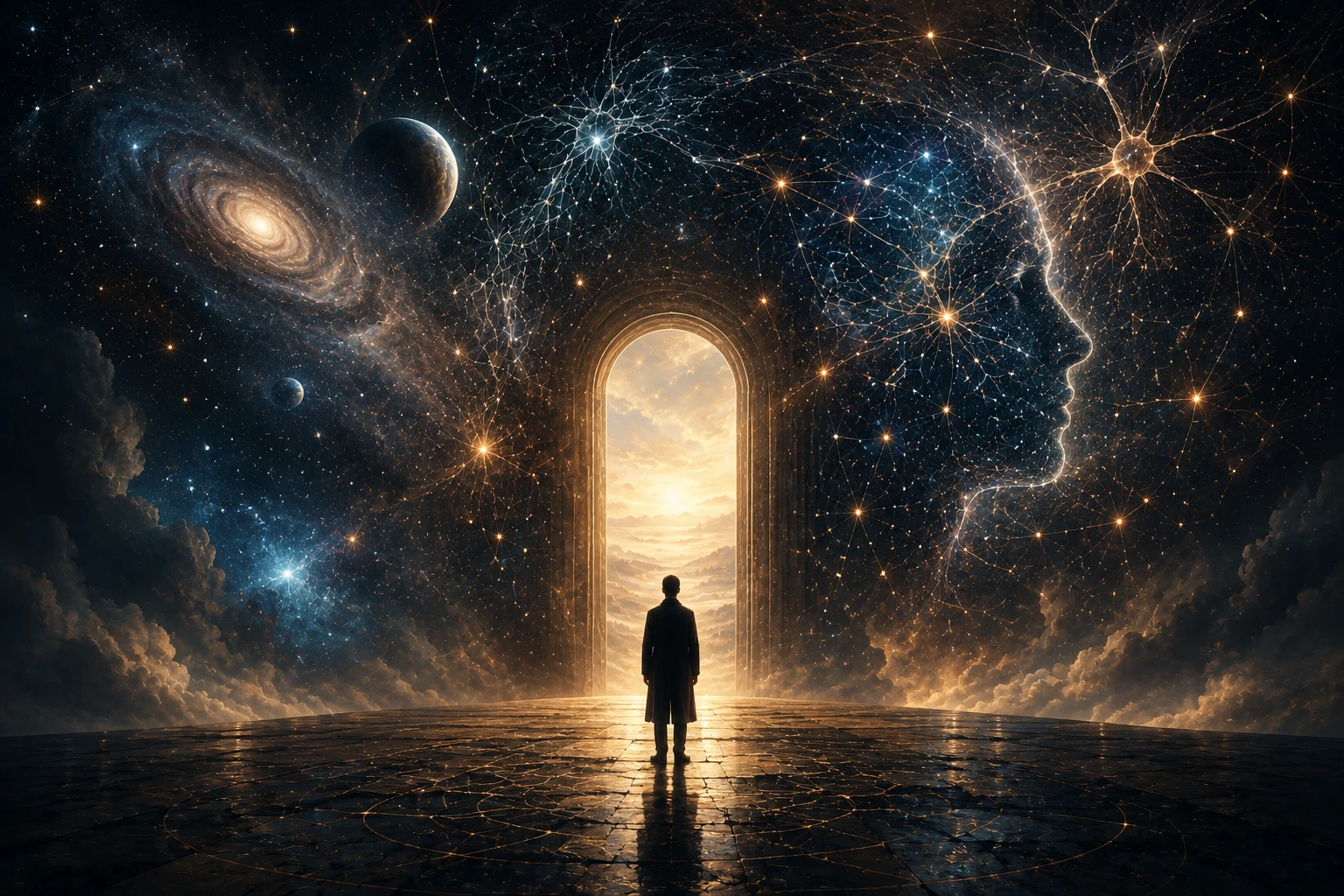
Can consciousness exist outside the brain? This question stands at the edge of neuroscience, philosophy, artificial intelligence, and speculative fiction. If consciousness is only brain activity, then human awareness ends with biology. If consciousness can exist beyond the brain, then identity, memory, death, immortality, and reality may be far stranger than we imagine.
This is also one of the central questions behind the Eternity saga: a philosophical fantasy series about consciousness, time, memory, choice, responsibility, and what remains human when existence itself begins to change.
Written by Denys Kostin, author of the Eternity saga and philosophical fantasy writer exploring consciousness, identity, reality, and the future of humanity through speculative fiction.
What Is Consciousness and Where Does It Come From?
Before asking whether consciousness can exist outside the brain, we need to ask a simpler question: what is consciousness?
Consciousness is not the same as intelligence. A calculator can process numbers without being aware. A chess engine can defeat a human without experiencing victory. A machine can generate language without necessarily knowing what words feel like from the inside.
Consciousness is subjective experience.
It is the feeling of being someone. It is the inner presence behind perception. It is not only seeing light, but experiencing brightness. It is not only hearing sound, but experiencing music. It is not only storing memory, but feeling that a memory belongs to you.
This is why consciousness remains one of the hardest problems in philosophy and science. We can describe brain activity, but we still do not fully understand why physical processes should produce experience at all.
For readers who want a deeper philosophical foundation, the Stanford Encyclopedia of Philosophy entry on consciousness is one of the strongest external references on the topic.
Can the Brain Create Consciousness?
The dominant scientific view is that consciousness depends on the brain.
This view has strong reasons behind it. Brain injuries can alter personality. Chemicals can change perception. Sleep, anesthesia, trauma, and disease can affect awareness. These facts show that consciousness and the brain are deeply connected.
But connection is not always the same as creation.
A broken radio may stop playing music, but that does not mean the radio created the broadcast. A damaged screen may distort an image, but that does not mean the screen created the entire world behind the signal.
This does not prove that consciousness exists beyond the brain. But it leaves open an important philosophical possibility: the brain may not simply generate consciousness. It may organize, filter, or access it.
Is the Brain an Interface for Consciousness?
One way to think about consciousness is to imagine the brain as an interface.
An interface does not have to create everything it displays. A computer does not contain the entire internet inside itself. A phone does not contain every conversation happening through it. These devices translate larger systems into usable experience.
The brain may work in a similar way.
It could filter overwhelming reality into a stable human world. It could turn raw information into perception. It could bind memory, emotion, body sensation, and attention into the feeling of a continuous self.
If this view is correct, consciousness may not be trapped inside the brain. The brain may be the biological structure that allows consciousness to appear in human form.
This idea remains controversial. But it is powerful because it opens the door to deeper questions about reality, identity, and the limits of human existence.
Can Consciousness Survive Without the Brain?
The honest answer is that no one knows.
There is no confirmed scientific proof that consciousness survives without the brain. At the same time, science has not fully solved how physical brain activity becomes inner experience.
This creates a philosophical opening. Consciousness may be produced by the brain. It may be organized by the brain. Or it may be a deeper feature of reality that the brain temporarily shapes into human experience.
That possibility is one reason consciousness is often linked with questions about death, identity, immortality, and eternity.
Could AI Become Conscious?
The question of consciousness outside the brain becomes even more urgent when we think about artificial intelligence.
Can AI become conscious? If consciousness requires biological neurons, then even the most advanced machine may only imitate awareness. It may speak like a person, reason like a person, and respond emotionally without experiencing anything inside.
But if consciousness depends on patterns of information rather than biological matter, the answer changes.
In that case, consciousness might be substrate-independent. It might not matter whether awareness is supported by neurons, silicon, or something humanity has not yet invented.
One influential modern theory, Integrated Information Theory, argues that consciousness is connected to integrated information within a system. Readers interested in that direction can explore the Integrated Information Theory overview from the Center for Sleep and Consciousness.
This possibility leads to enormous questions:
- Could an artificial mind truly experience the world?
- Could a digital person have rights?
- Could consciousness survive outside a biological body?
- Could civilization continue through minds no longer made of flesh?
Can Consciousness Be Transferred or Uploaded?
Mind uploading is one of the most famous ideas in science fiction and futurism.
The idea is simple to describe and almost impossible to solve: if every memory, neural connection, and personality pattern in a brain could be copied into a digital system, would the result be you?
Or would it only be a copy that believes it is you?
This is where the question becomes more than technical. It becomes existential.
If your mind were copied, the copy might speak like you. It might remember your childhood. It might love the same people. It might fear death. It might insist that it is continuous with you.
But would your inner experience continue there?
Or would your original consciousness end, leaving behind only a perfect imitation?
This problem connects directly to personal identity. What makes you the same person over time? Your body changes. Your memories change. Your beliefs change. Yet you still feel like one continuous self.
Consciousness, Memory, and Identity
Memory feels central to identity, but memory alone may not be enough.
If another being had all your memories, would that being be you? If your memories were erased, would you stop being yourself? If your consciousness woke up in another body, would identity follow the body, the memory, or the awareness?
These questions matter because they show that consciousness is not only a biological puzzle. It is also a story problem.
Humans understand themselves through continuity. We do not merely exist from moment to moment. We carry a narrative of who we were, who we are, and who we are becoming.
This is why consciousness appears so often in philosophical fantasy books. Stories can explore questions that science cannot yet answer. They can ask what happens when memory, time, identity, and reality begin to separate.
Can Consciousness Survive Death?
If consciousness can exist outside the brain, then immortality becomes more than a myth.
But immortality is not a simple blessing.
Books about immortality often reveal that eternal life creates new problems rather than solving old ones. Would endless consciousness preserve meaning, or slowly destroy it? Would memory become a gift or a burden? Would a person remain human after centuries of change?
Immortality also raises moral questions.
If consciousness could survive death, who would control that survival? Would only the powerful have access to continuity? Would identity become property? Would eternal life become freedom, prison, or responsibility?
These are not small questions. They are civilization-level questions.
That is why books about eternity often become stories about power, memory, sacrifice, and responsibility.
Related Philosophical Questions
The question of whether consciousness can exist outside the brain connects to several larger philosophical questions:
- What is consciousness?
- What is reality?
- What is personal identity?
- Do humans have free will?
- What are the best books about consciousness?
Together, these questions form one of the strongest philosophical clusters on Cokos: consciousness, reality, identity, free will, and eternity.
Why Philosophical Fantasy Explores Consciousness So Well
Scientific articles can explain theories of consciousness. Philosophy can define the problem. But fiction can place a human being inside the question.
That is why philosophical fantasy about consciousness can be so powerful. It does not only ask whether consciousness can exist outside the brain. It asks what that would feel like. It asks what people would protect, destroy, or sacrifice if the boundary between mind and reality changed.
For readers searching for books about consciousness, fiction about mind uploading, books about immortality and identity, or stories about reality and free will, the strongest works are rarely only about ideas. They are about the cost of those ideas when they become real.
The Eternity saga belongs to that tradition. It uses philosophical fantasy to explore consciousness, choice, memory, responsibility, and the danger of treating eternity as something humans can control.
Final Thoughts: The Mind May Be Larger Than the Brain
Can consciousness exist outside the brain?
Maybe.
Maybe not.
But the question itself changes how we see ourselves.
If consciousness is only produced by the brain, then every moment of awareness is fragile, temporary, and precious. Life matters because it happens once.
If consciousness can exist beyond the brain, then human identity may be only one form of a much larger reality. Life matters because it may be part of something deeper than biology.
Either answer is profound.
The search for consciousness is not only a scientific search. It is the search for what a human being truly is.
And perhaps, somewhere beyond memory, matter, and time, consciousness has always been larger than we imagined.
Read More from Cokos
Explore the Eternity Saga
If questions about consciousness, identity, reality, immortality, and eternity fascinate you, explore the philosophical fantasy series that turns these questions into story.
Frequently Asked Questions
Can consciousness exist outside the brain?
No one knows for certain. The brain is clearly connected to consciousness, but philosophy and science have not fully explained whether the brain creates consciousness or acts as an interface for it.
Is consciousness located in the brain?
Consciousness is strongly connected to brain activity, but whether it is fully located in the brain or only expressed through the brain remains an open philosophical question.
Can consciousness survive death?
There is no confirmed scientific proof that consciousness survives death. However, the question remains important because science has not yet fully explained how subjective experience arises from matter.
Is consciousness energy?
Consciousness is sometimes described metaphorically as energy, but scientifically it is not proven to be a physical energy field. It is better understood as subjective experience or awareness.
Is consciousness fundamental to the universe?
Some philosophical views suggest consciousness may be fundamental to reality, while others argue that consciousness emerges from physical systems such as the brain. The question remains unresolved.
Can consciousness be transferred?
Consciousness transfer remains theoretical. Even if memories and personality patterns could be copied, it is unclear whether subjective awareness would continue in the new system.
Is consciousness the same as intelligence?
No. Intelligence is the ability to process information, solve problems, or adapt. Consciousness is subjective experience — the feeling of being aware.
Could artificial intelligence become conscious?
It depends on what consciousness is. If consciousness requires biological neurons, AI may never be truly conscious. If consciousness depends on information patterns, advanced AI consciousness may be possible.
What are the best books about consciousness and identity?
The best books about consciousness and identity are usually stories that explore memory, selfhood, reality, death, immortality, and what makes a person remain the same across time.
Why does consciousness matter in philosophical fantasy?
Consciousness matters because it connects identity, memory, reality, death, immortality, and meaning. Philosophical fantasy can explore these questions through story, not only abstract theory.