Spoiler-light reading guide
Novels about reliving a life, carrying memory across time, changing history, questioning identity, and discovering that a second chance can become a moral responsibility.
Published: August 5, 2026Written and reviewed by Denys KostinEstimated reading time: 24–28 minutes
What readers are really looking for after Harry August
Readers rarely finish The First Fifteen Lives of Harry August wanting only another story with a clever time device. The deeper attraction is the relationship between repetition and awareness. Harry does not simply begin again. He carries knowledge from one life into the next, and that continuity changes what freedom, intimacy, ambition, guilt, and responsibility mean.
A second life initially sounds like wish fulfilment. A person could avoid old mistakes, find lost opportunities, become rich through advance knowledge, or protect people they once failed. But repeated-life fiction becomes more interesting when it refuses the fantasy of perfect control. Knowledge can create new errors. Correcting one future can damage another. Relationships become unequal when one person remembers a shared past that the other person never lived.
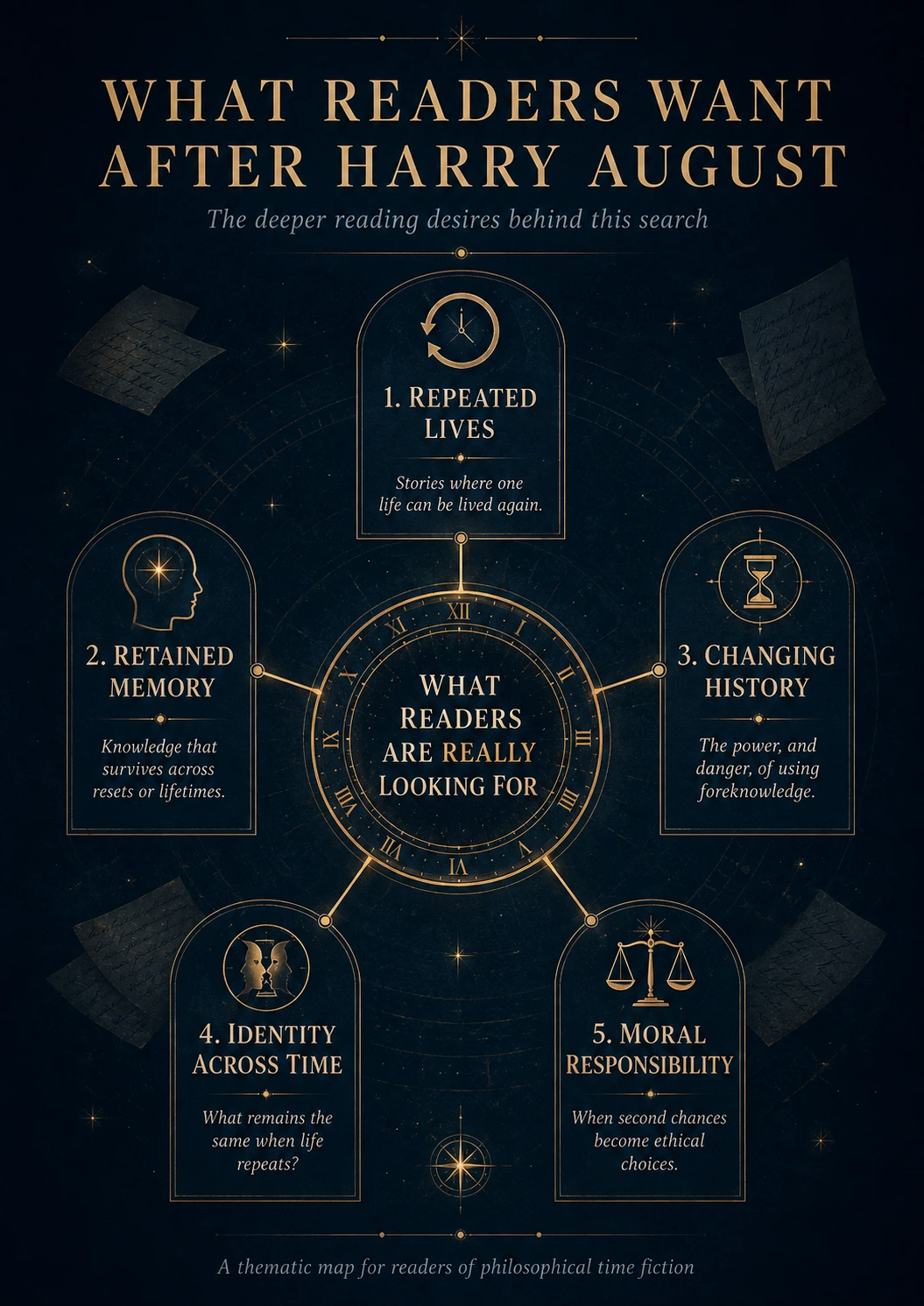
That is why the best books similar to Harry August tend to explore five linked desires:
- Repeated lives: the chance to live an entire existence again rather than repeat only a single day.
- Retained memory: knowledge, fragments, intuition, or emotional residue that survives a reset.
- Changing history: the temptation to use foreknowledge to alter private lives or public events.
- Identity across time: the question of whether the same self remains when bodies, ages, circumstances, or histories change.
- Moral responsibility: the burden created when one person knows more than everyone around them.
Some recommendations below reproduce Harry’s exact life-recurrence structure. Others continue one of its central questions through immortality, historical intervention, nonlinear time, body-hopping, or institutional control of history. The guide explains both the connection and the difference so you can choose according to what actually stayed with you.
Readers who want to explore these themes beyond one recommendation list can continue through the Cokos guides to books about memory, books about alternate realities, books about immortality, and books like The Midnight Library.
How these books were selected
Every recommendation was chosen for meaningful structural or thematic overlap, not merely because the story contains time travel. A novel can involve clocks, portals, or alternate timelines and still offer little of what makes Harry August distinctive. The strongest matches combine a speculative mechanism with questions about memory, personal continuity, history, and obligation.
Each book was evaluated across six dimensions:
- Life structure: whole-life recurrence, closed loop, nonlinear chronology, longevity, or historical travel.
- Continuity of experience: whether memories, intuition, identity, or knowledge survive the temporal disruption.
- Agency: how much the protagonist can intentionally change.
- Scale: whether the consequences remain personal or expand across history and civilization.
- Philosophical depth: how seriously the novel examines identity, mortality, freedom, truth, or responsibility.
- Reading experience: literary, emotional, mysterious, romantic, philosophical, or thriller-driven.
The guide remains spoiler-light. It explains the premise and thematic relationship of each book without revealing late twists, solutions, or endings.
The best books like The First Fifteen Lives of Harry August at a glance
| Book | Best for | Shared element | Time mechanism | Main difference |
|---|---|---|---|---|
| Replay | Closest overall match | Whole lives repeated with memory intact | Full-life recurrence | More intimate and relationship-focused |
| Life After Life | Literary and historical depth | One life begins again under altered circumstances | Repeated lives with partial awareness | Memory is fragmentary rather than fully explicit |
| The 7½ Deaths of Evelyn Hardcastle | Identity puzzle and mystery | A recurring period, accumulating knowledge, hidden rules | Closed loop with changing bodies | Shorter loop and murder-mystery structure |
| Recursion | Fast conceptual thriller | Memory reshapes lived reality | Rewritten timelines | More science-fictional and urgent |
| 11/22/63 | Historical intervention | Foreknowledge, moral choice, unintended consequences | Portal to the past | One major mission rather than repeated birth |
| Oona Out of Order | Identity across nonlinear time | Memory and selfhood separated from chronological age | Adult years experienced out of order | Lighter, more intimate, and more contemporary |
| How to Stop Time | Longevity and belonging | Accumulated memory across centuries | Extreme slow aging | One continuous life rather than resets |
| Touch | Consciousness and embodiment | Identity persists beyond one ordinary body | Consciousness moves between bodies | Body-hopping thriller rather than life recurrence |
| The Bone Clocks | Literary epic and hidden conflict | People experience mortality and time differently | Long-lived and recurring consciousness | Multi-voice, multi-decade fantasy saga |
| The Invisible Life of Addie LaRue | Immortality and being remembered | A life extended beyond normal human time | Faustian immortality | More romantic and mythic |
| The End of Eternity | Ideas about controlling history | Knowledge of timelines becomes institutional power | Systematic alteration of history | Focuses on an organization rather than one repeating life |
| Those Who Guard Eternity | Deeper philosophical fantasy | Time, hidden reality, memory, choice, responsibility | Time as a living structure | Broader fantasy world and connected saga |
12 novels to read after The First Fifteen Lives of Harry August
1. Replay by Ken Grimwood
Closest overall match
For readers seeking the nearest equivalent to Harry August’s repeated-life experience, Replay is the natural first choice. Jeff Winston dies in middle age and returns to his younger self with his memories intact. The premise immediately produces familiar temptations: correct the mistakes, use knowledge of the future, build a different career, recover lost love, and design a life that avoids regret.
What makes the novel endure is its refusal to treat foreknowledge as a simple advantage. Jeff can change events, but control does not guarantee fulfilment. Even success becomes strange when it rests on a future no one else can remember. As the pattern continues, the question changes from “How can I perfect my life?” to “What makes any version of a life meaningful?”
Replay feels more intimate and romantic than Harry August. Its scale is generally closer to personal identity, love, loss, and the emotional consequences of beginning again. Yet the two books share the same essential engine: an adult mind repeatedly entering an earlier life and discovering that knowledge creates possibilities without eliminating uncertainty.
- Why it feels similar: whole-life recurrence, full memory, future knowledge, altered choices.
- How it differs: a more personal and relationship-centered story with less emphasis on secret temporal institutions.
- Best for: readers who want the closest match and are most interested in what they would do with another life.
2. Life After Life by Kate Atkinson
Best literary repeated-life novel
Kate Atkinson’s Life After Life follows Ursula Todd through lives that begin, end, and begin again against the pressures of twentieth-century history. The recurrence is recognizable, but the experience of memory is different. Ursula does not move through each life with Harry’s consistently explicit archive of previous knowledge. Awareness arrives through fragments, impulses, dread, familiarity, and instinct.
That difference makes the novel less like a strategic experiment and more like a literary exploration of contingency. A small alteration can change a family, a relationship, or an encounter with history. Atkinson uses repetition to show how exposed a life is to accidents, timing, violence, social expectations, and the decisions of other people.
Readers who admired the historical reach of Harry August may find this especially rewarding. The book moves through personal and public catastrophe while remaining close to the texture of one woman’s existence. It asks whether a better outcome comes from deliberate knowledge, unconscious learning, chance, or a growing ability to sense danger before it fully arrives.
- Why it feels similar: one life unfolds repeatedly against changing historical circumstances.
- How it differs: memory survives as fragments and intuition rather than complete conscious recall.
- Best for: readers who want literary style, emotional depth, and history rather than a conventional thriller.
3. The 7½ Deaths of Evelyn Hardcastle by Stuart Turton
Best time-loop identity mystery
This novel compresses recurrence into a closed setting and combines it with an elaborate murder mystery. Aiden Bishop must solve Evelyn Hardcastle’s death while experiencing the same day through different hosts. Knowledge accumulates, but every body changes what he can notice, how others respond to him, and how he behaves.
The closest connection to Harry August is not the length of the loop but the problem of continuity. If consciousness moves through different embodiments, what remains stable? How much of a decision belongs to the continuing self, and how much is shaped by the body and personality currently carrying it? The mystery gives those questions immediate stakes because every partial perspective reveals something another perspective hides.
Choose this when the secret rules and hidden structures of Harry August mattered more to you than its full historical span. Turton’s book is more puzzle-driven, claustrophobic, and deliberately disorienting. It rewards readers who enjoy assembling a system while the protagonist is trapped inside it.
- Why it feels similar: repetition, accumulating knowledge, concealed rules, and unstable identity.
- How it differs: a recurring day, multiple hosts, and a locked-room-style mystery.
- Best for: readers who want a clever, complicated plot with a strong identity question.
4. Recursion by Blake Crouch
Best memory-and-reality thriller
Recursion begins from a different mechanism but arrives at one of the same disturbing possibilities: memory may be more than a private record of what happened. It may become powerful enough to restructure the reality in which people live. Blake Crouch turns that premise into a fast thriller in which private grief, scientific ambition, and competing versions of the past escalate toward consequences no one can contain.
Where Harry carries memories from life to life, Crouch asks what happens when remembered experience can force entire timelines to change. The result is less meditative and more urgent. Characters are not only trying to recover a better past; they must confront the instability created when more than one past claims to be real.
The thematic overlap is strongest around responsibility. Once someone has the means to correct tragedy, refusing to use it can feel immoral. Using it can create a larger disaster. Recursion is therefore an excellent next read for anyone who liked the moment when Harry’s private condition became a problem involving the future of everyone else.
- Why it feels similar: memory becomes power, timelines can be revised, and correction produces unintended consequences.
- How it differs: a contemporary science-fiction thriller rather than a repeated-life historical novel.
- Best for: readers who want high speed, conceptual twists, and large-scale stakes.
5. 11/22/63 by Stephen King
Best historical intervention novel
Stephen King’s novel follows a teacher who gains access to the past and accepts a mission to prevent the assassination of John F. Kennedy. The similarity to Harry August lies less in repeated birth than in the moral pressure of foreknowledge. Knowing that a tragedy will happen makes nonintervention feel like a choice rather than neutrality.
The novel spends time on the practical and emotional reality of living inside another era. History is not a board on which one event can be moved without touching anything else. It is a dense network of people, relationships, violence, love, accident, and consequence. Attempting to rescue the future therefore changes the person performing the rescue.
Readers who valued the long historical horizon of Harry August will appreciate the scale and patience here. The book is more grounded in one specific mission and one specific period, but it shares the suspicion that a “better” timeline cannot be identified from one person’s limited perspective.
- Why it feels similar: foreknowledge, changing history, personal sacrifice, and unforeseen consequences.
- How it differs: one journey into a historical period rather than a cycle of complete lives.
- Best for: readers who want an expansive historical story with emotional weight.
6. Oona Out of Order by Margarita Montimore
Best for nonlinear identity
Oona Lockhart experiences her adult years out of chronological order, moving into a different age at the beginning of each new year. Her consciousness continues, but body, circumstances, relationships, and social context no longer arrive in the sequence that usually gives a life its narrative shape.
The novel makes identity feel both continuous and unstable. Oona may remember the years she has personally experienced, yet she repeatedly enters a life already influenced by versions of herself she has not become. Notes, possessions, friendships, and other people’s expectations turn her own future into an inheritance from an unknown self.
This is a warmer and more intimate recommendation than several others on the list. It replaces civilizational danger with the everyday difficulty of loving people in the wrong order and learning to value a present that refuses to explain itself. Readers drawn to the relationship between memory, age, and selfhood may find it especially resonant.
- Why it feels similar: consciousness and memory continue while the ordinary structure of a life breaks apart.
- How it differs: one life is lived out of sequence rather than repeated from the beginning.
- Best for: readers who prefer emotional, accessible, and character-centered speculative fiction.
7. How to Stop Time by Matt Haig
Best for immortality, loneliness, and belonging
Tom Hazard does not restart his life. He ages so slowly that one continuous existence stretches across centuries. That difference removes the opportunity to reset mistakes while preserving another central feature of Harry August: one person carries an impossible amount of remembered experience through a world that repeatedly replaces everyone around him.
Longevity creates knowledge, but it also creates distance. Tom must conceal what he is, survive changing historical conditions, and endure the repeated loss of people who live at an ordinary pace. The novel asks whether more time expands a life or makes genuine attachment harder because every relationship is shadowed by departure.
Choose How to Stop Time when the Cronus Club and the existence of people outside normal human temporality interested you most. Its tone is more accessible, romantic, and reflective, but it shares the theme of a hidden community trying to regulate how unusually long-lived people interact with the ordinary world.
- Why it feels similar: accumulated memory, concealed longevity, historical movement, and a hidden organization.
- How it differs: one uninterrupted life rather than death followed by rebirth.
- Best for: readers interested in belonging, grief, love, and the emotional cost of surviving centuries.
8. Touch by Claire North
Best next book by Claire North
Readers who want another Claire North novel should consider Touch, which continues her interest in identities that exceed an ordinary human lifespan. Its consciousness can move between bodies, creating a life that persists through embodiment rather than returning to the same childhood again and again.
The novel’s most compelling connection is the pressure it places on personal identity. If memory continues but the body changes, what makes the traveler one person? Is the self located in a history, a pattern of desire, a moral commitment, or simply the uninterrupted awareness that claims to be the same “I”?
Touch is more immediately thriller-like than Harry August, and its relationship to gender, physicality, possession, and consent gives the identity question a different intensity. Yet the prose, conceptual ambition, and fascination with people who move through time in abnormal ways make it an obvious continuation for readers who respond to North’s voice.
- Why it feels similar: a continuing consciousness, hidden long-lived beings, and identity beyond ordinary biology.
- How it differs: consciousness changes bodies instead of reliving the same biological life.
- Best for: readers who want more Claire North and a darker exploration of embodiment.
9. The Bone Clocks by David Mitchell
Best literary epic about hidden temporal conflict
David Mitchell’s The Bone Clocks follows lives across decades while gradually revealing a conflict involving people whose relationship to mortality is radically different from that of ordinary humans. The novel moves through multiple voices, locations, genres, and periods, allowing the hidden war to emerge behind recognizable human lives.
The overlap with Harry August lies in the coexistence of two scales. There is the intimate scale of family, ambition, love, aging, and regret. Behind it stands a larger structure involving continuity beyond one lifespan and groups whose actions extend through generations. Individual people may understand only fragments of a struggle that has shaped their reality for far longer than they know.
This is not a direct repeated-life match. It is a broader, denser, and more structurally adventurous novel. Choose it when the secret-community dimension and the collision between ordinary life and long temporal conflict were more compelling than the mechanics of Harry’s rebirth.
- Why it feels similar: hidden groups, long time horizons, recurring consciousness, and consequences across generations.
- How it differs: a multi-narrator literary epic rather than one protagonist repeating the same life.
- Best for: readers who want ambitious form, worldbuilding, and a larger metaphysical conflict.
10. The Invisible Life of Addie LaRue by V. E. Schwab
Best for immortality and being remembered
Addie LaRue gains freedom from an ordinary lifespan at a devastating price: other people cannot remember her. She carries her own experience across centuries, but every relationship is threatened by erasure. The result is a fantasy about identity, art, loneliness, and the human need to leave a trace in another person’s memory.
The connection to Harry August is not recurrence but asymmetry. Both protagonists remember more than the people around them, and that imbalance changes intimacy. A shared moment cannot create a shared history when only one participant can carry it forward. Time becomes less a source of opportunity than a test of whether a self can remain meaningful without recognition.
This novel is more romantic, mythic, and emotionally centered than North’s book. Choose it when immortality, memory, isolation, and the desire to matter were the themes that stayed with you.
- Why it feels similar: centuries of remembered experience, isolation, concealed identity, and unequal memory.
- How it differs: immortality produced by a bargain, with others forgetting the protagonist.
- Best for: readers who want lyrical fantasy, romance, art, and the emotional cost of being unremembered.
11. The End of Eternity by Isaac Asimov
Best classic about managing history
Isaac Asimov expands the ethics of temporal intervention from an individual problem into an institutional one. In The End of Eternity, an organization operates outside ordinary time and alters history in the name of improving human outcomes. Its members possess access to possibilities that the people living inside history cannot see.
This is the logical recommendation for readers fascinated by the Cronus Club, the transmission of knowledge across eras, and the danger of people deciding which future everyone else should inhabit. The central tension is not simply whether history can be improved, but who has the authority to define improvement and what humanity may lose when risk is systematically removed.
The prose and characterization reflect a different period of science fiction, and the novel is more idea-driven than emotionally expansive. Yet its conceptual relationship to Harry August is powerful: knowledge of time creates a governing class, and benevolent control can become another form of imprisonment.
- Why it feels similar: secret temporal organization, institutional knowledge, altered history, and moral authority.
- How it differs: the focus is a system that edits timelines rather than a person reliving one life.
- Best for: readers who want classic science fiction built around ideas, institutions, and historical control.
12. Those Who Guard Eternity by Denys Kostin
Best for deeper philosophical fantasy
Those Who Guard Eternity begins with a young man questioning the reality he once accepted. As that certainty fractures, time becomes more than a sequence measured by clocks. It becomes a deeper structure connected to memory, perception, freedom, choice, and possible futures.
The novel shares Harry August’s interest in time as a source of moral pressure. Knowledge is never neutral. To discover a hidden structure is to acquire choices other people do not have, and those choices create responsibility. Both stories ask whether seeing more clearly makes a person freer—or places them inside a larger conflict they can no longer ignore.
The difference is substantial and important. Those Who Guard Eternity is not a repeated-life novel and should not be read as an imitation of Claire North’s premise. It moves from one unusual temporal condition toward a broader philosophical fantasy world involving hidden reality, consciousness, truth, and the structures that shape the future. It is also the first book in a connected saga rather than a self-contained time-loop story.
- Why it feels similar: time as an active structure, memory, hidden knowledge, choice, and responsibility.
- How it differs: a larger philosophical fantasy world without Harry’s exact full-life recurrence mechanism.
- Best for: readers who want to move from time-loop fiction into deeper questions about reality and consciousness.
Five ways fiction breaks time—and why the difference matters
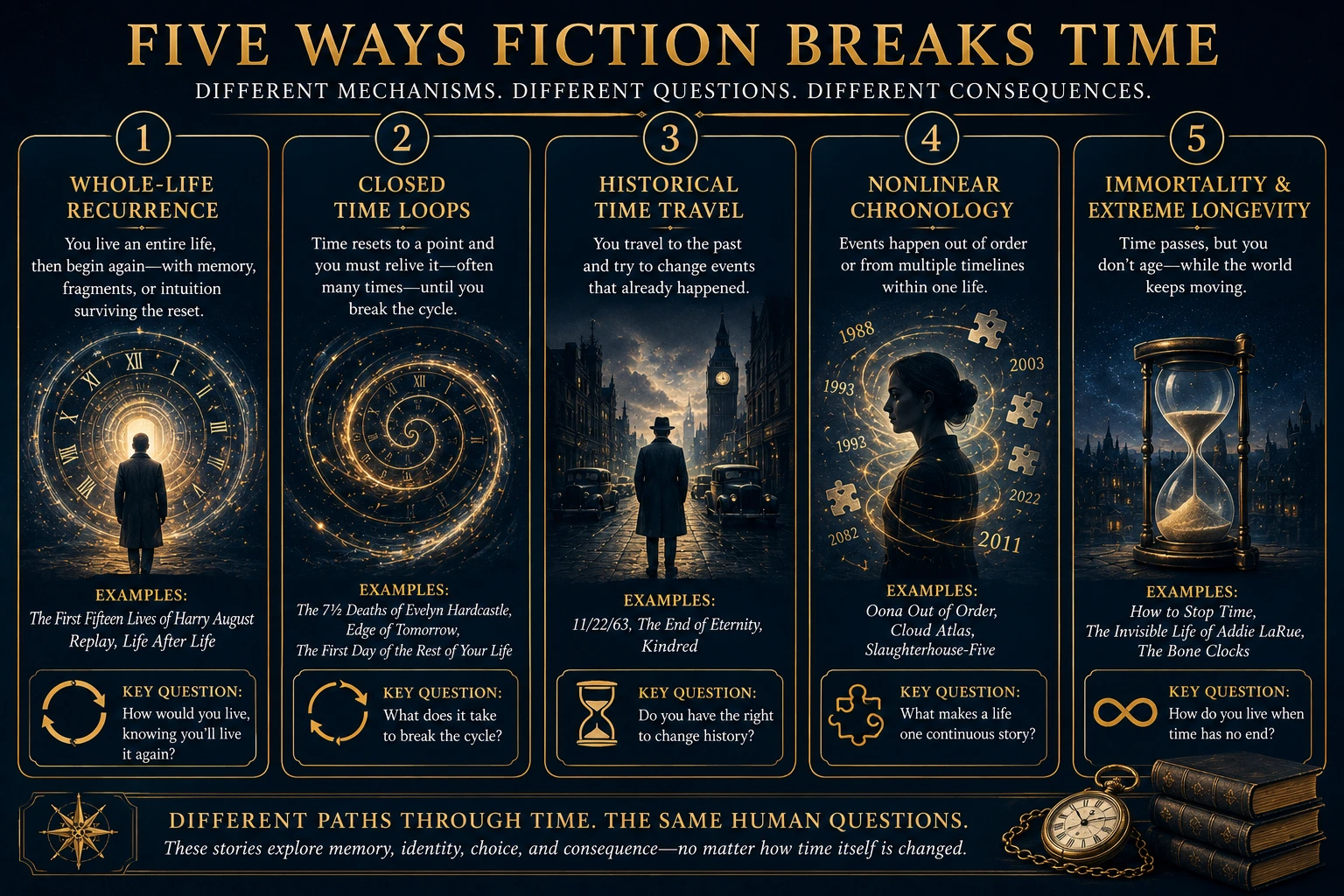
“Time-travel book” is often too broad to describe what a reader actually wants. Two novels may both violate chronology while producing completely different emotional and philosophical experiences. A closed loop traps a person inside repetition. Whole-life recurrence offers decades of agency. Immortality removes the reset but preserves accumulated memory and loss.
1. Whole-life recurrence
A character lives an entire life, dies, and begins again. The defining question is what survives the reset. Complete memory turns the next life into a deliberate experiment, as in Harry August and Replay. Fragmentary awareness makes recurrence feel more like instinct, haunting, or unconscious learning, as in Life After Life.
2. Closed time loops
A limited period repeats until a condition is met or a system is escaped. These stories emphasize pattern recognition, constrained agency, and the psychological effect of reliving the same events. The 7½ Deaths of Evelyn Hardcastle adds unstable embodiment, making the loop a test of both memory and identity.
3. Historical time travel
The character enters an earlier period and tries to alter events that already belong to recorded history. The moral question is whether foreknowledge grants the right to intervene. 11/22/63 treats the past as resistant and interconnected; The End of Eternity turns intervention into an institutional practice.
4. Nonlinear chronology
One life continues, but its events are experienced in the wrong order or across multiple temporal perspectives. In Oona Out of Order, the body and the observing self move through adulthood differently. The mechanism reveals how much ordinary identity depends on sequence: first learning, then choosing, then living with the consequences.
5. Immortality or extreme longevity
Time continues normally while one character does not age at an ordinary human rate. The advantage of extended experience is inseparable from repeated loss, secrecy, and isolation. How to Stop Time and The Invisible Life of Addie LaRue ask whether endless duration creates meaning or makes belonging increasingly difficult.
The practical lesson for choosing your next book is simple: readers who say they want “more time travel” may actually want memory plus another chance, identity under temporal pressure, or the ethics of knowing what comes next.
How the recommendations compare
The strongest similarity to Harry August can be understood through two questions. First, how much continuity of remembered experience survives across resets, bodies, or centuries? Second, how far do the consequences extend—from one private life to societies, history, or civilization?
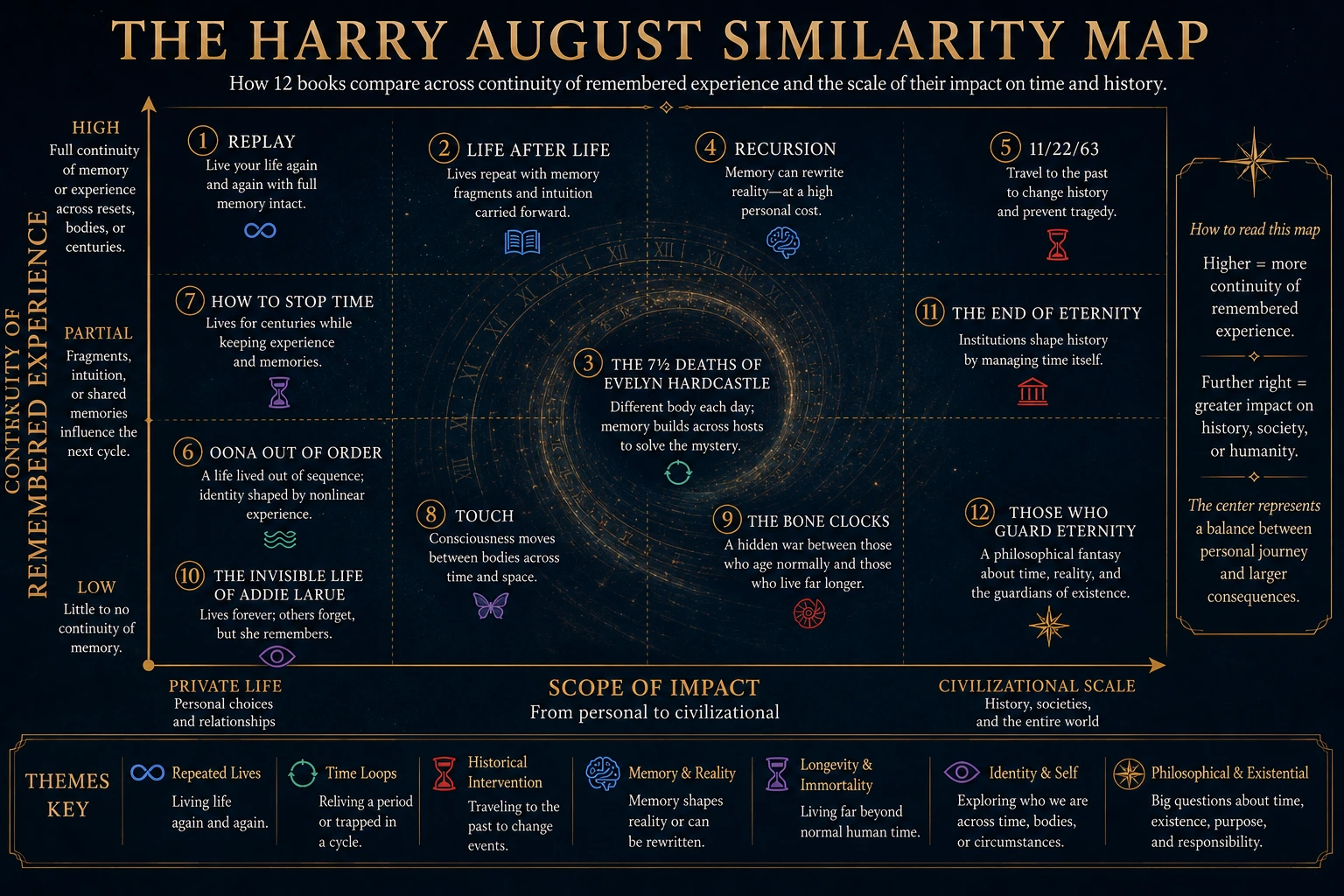
No placement can capture every dimension of a complex novel. The map is a reading tool, not a scientific score. Its purpose is to show why two books may feel similar for entirely different reasons: one reproduces complete memory, another reproduces the moral scale, and another reproduces the hidden systems surrounding people who experience time differently.
Why repeated lives create a moral problem
The fantasy of beginning again seems personal at first. A person imagines correcting a mistake, choosing another relationship, avoiding a loss, or becoming the version of themselves they failed to become. But retained memory changes the ethical structure of the new life. The protagonist is no longer simply another person making decisions under uncertainty.
The progression looks like this:
Memory → knowledge → power → intervention → unintended consequence → responsibility.
Memory becomes knowledge because the protagonist can anticipate events. Knowledge becomes power because anticipation creates options unavailable to everyone else. Power invites intervention. Intervention changes not only the protagonist’s life but the lives of people who cannot consent to the experiment. Once consequences spread, responsibility can no longer be treated as a private matter.
Does knowing the future create an obligation to change it?
If a person knows that preventable suffering will occur, doing nothing may feel morally impossible. Yet future knowledge is never complete. The repeating character remembers one version of events, not every consequence of preventing it. 11/22/63, Recursion, and The End of Eternity all expose the danger of confusing knowledge of one timeline with knowledge of what is best.
Is an erased action still morally real?
A reset may remove an event from the surviving timeline, but it does not necessarily remove it from the consciousness of the person who caused or witnessed it. Repeated-life fiction therefore separates public reality from private moral memory. An action can cease to have external consequences while remaining part of the actor’s identity.
Does repetition improve character—or only strategy?
A person may become more effective without becoming wiser. Foreknowledge can produce wealth, influence, and technical mastery while leaving fear, pride, resentment, or loneliness untouched. The best recurrence novels distinguish optimisation from transformation. A perfected plan is not the same as a meaningful life.
Does more time create more meaning?
Longevity stories complicate the assumption that a longer life is automatically a richer one. Meaning depends on attachment, vulnerability, and the reality that choices exclude other choices. When time becomes effectively unlimited, urgency may weaken while loss accumulates. How to Stop Time and Addie LaRue make duration feel both miraculous and isolating.
Who has the right to choose history?
The problem becomes political when temporal knowledge is organized. A secret group can protect continuity, reduce catastrophe, or preserve civilization—but it can also become unaccountable. People living inside a timeline cannot evaluate futures erased before they experience them. This is why stories about temporal institutions are ultimately stories about governance, legitimacy, and the danger of benevolent control.
These questions connect naturally to broader Cokos explorations of personal identity, what makes you the same person throughout life, and whether humans have free will.
Choose your next book
The best next read depends less on which premise is most similar and more on which part of Harry August you want to continue.
For a gentler guide focused on alternate choices and emotional second chances, continue to 12 books like The Midnight Library. For a larger thematic collection, explore books about eternity, books about destiny, or books about reality.
Frequently asked questions
What should I read after The First Fifteen Lives of Harry August?
Read Replay first for the closest match: an adult repeatedly returns to an earlier life with memories intact. Choose Life After Life for a more literary historical novel, Recursion for a faster thriller, or 11/22/63 for the consequences of changing history.
What book is most similar to Harry August?
Replay by Ken Grimwood is the closest overall because it combines whole-life recurrence, retained memory, foreknowledge, altered choices, and the discovery that another chance does not create perfect control.
Are there books about reliving an entire life with memories intact?
Replay is the clearest recommendation. Life After Life also repeats a full life, although awareness tends to survive as fragments or intuition rather than complete explicit memory.
Is The First Fifteen Lives of Harry August a time-loop novel?
It can be described as a whole-life recurrence novel. Unlike a closed loop that repeats one day or short period, Harry repeatedly lives an entire lifespan from childhood while carrying memories from previous lives.
Which books combine immortality with memory?
How to Stop Time, The Invisible Life of Addie LaRue, and The Bone Clocks all connect extended existence with memory, identity, secrecy, and loss. They use longevity rather than Harry’s exact death-and-rebirth mechanism.
Which similar book is the most philosophical?
The End of Eternity is especially strong on the ethics of controlling history. Those Who Guard Eternity is the best choice for readers who want a broader philosophical fantasy about time, reality, consciousness, truth, and responsibility.
Which books involve secret societies connected to time?
How to Stop Time includes an organization for people who age unusually slowly. The End of Eternity centers on an institution that alters history. The Bone Clocks reveals hidden groups whose conflicts extend across ordinary lifetimes.
Sources and editorial standards
Premise and publication details were checked against official author or publisher pages. Interpretive comparisons are editorial judgments based on the themes and mechanisms explained in this guide.
- The First Fifteen Lives of Harry August — Hachette Book Group
- Replay — HarperCollins
- Life After Life — Kate Atkinson official site
- The 7½ Deaths of Evelyn Hardcastle — Sourcebooks
- Recursion — Penguin Random House
- 11/22/63 — Stephen King official site
- Oona Out of Order — Margarita Montimore official site
- How to Stop Time — Penguin Random House
- Touch — Hachette Book Group
- The Bone Clocks — Penguin Random House
- The Invisible Life of Addie LaRue — Macmillan
- The End of Eternity — Penguin Random House
- Those Who Guard Eternity — Cokos
No affiliate links are used.