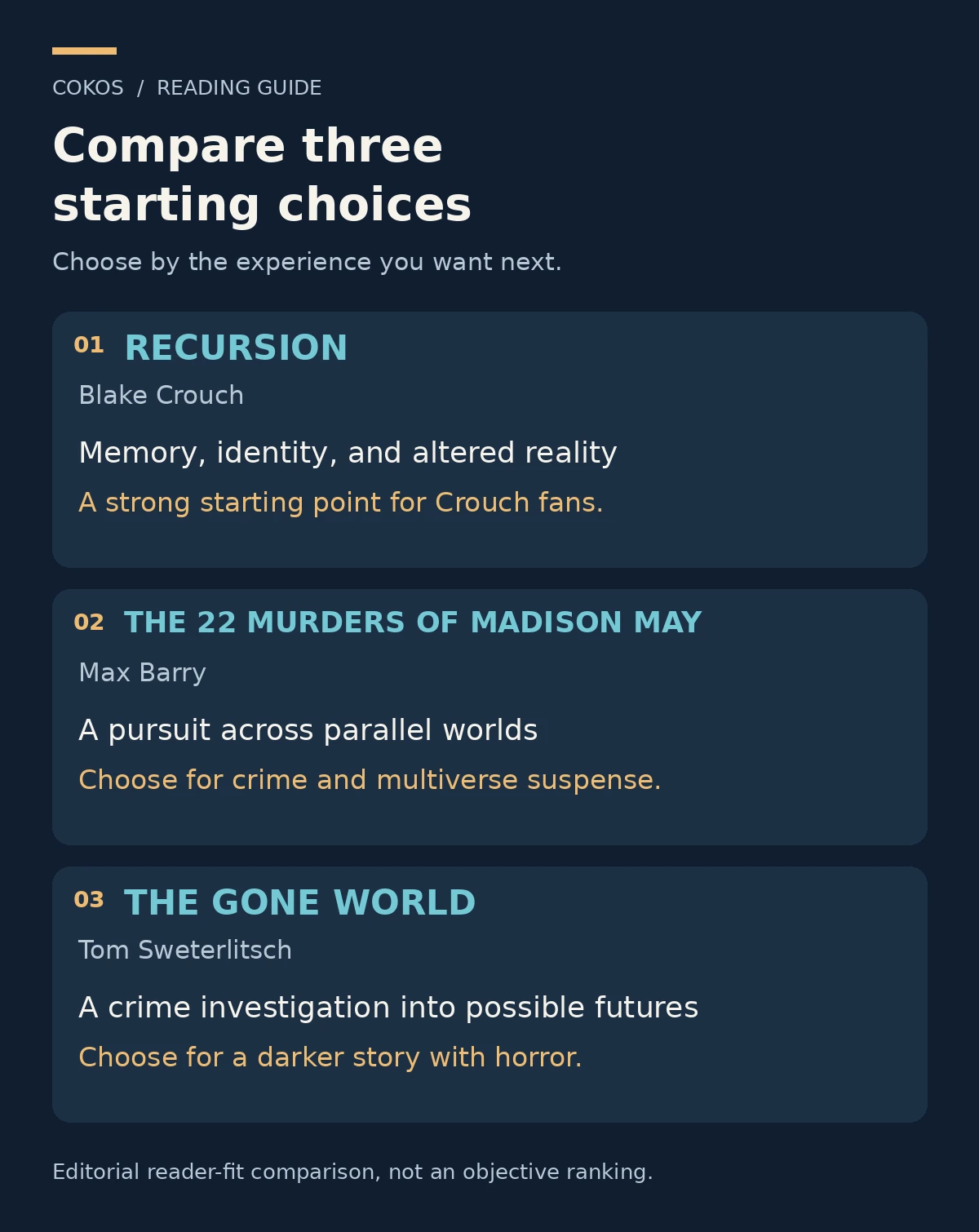
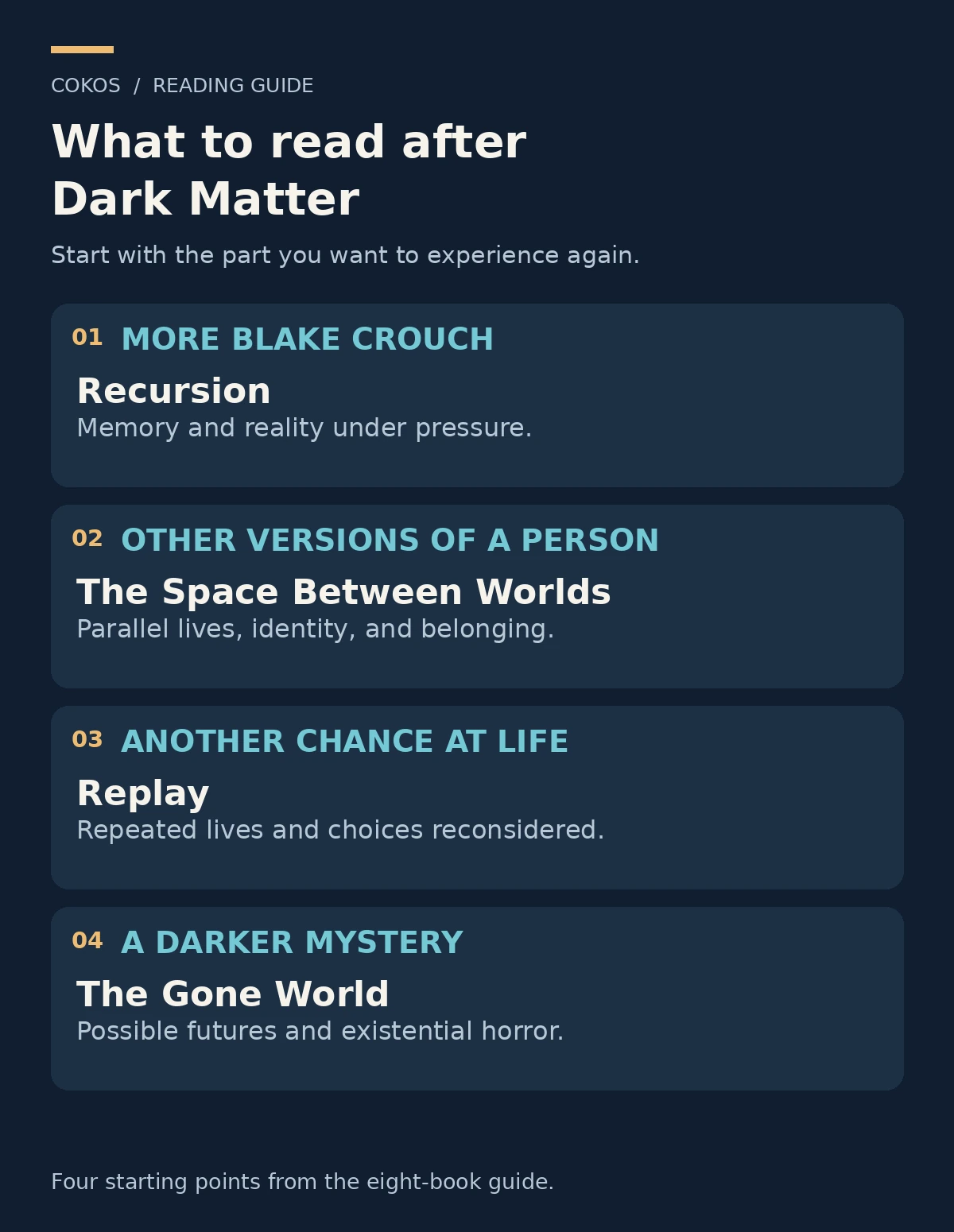
The best books like Dark Matter by Blake Crouch depend on what you want to experience again. Start with Recursion for another Crouch thriller about memory and reality, The 22 Murders of Madison May for a pursuit across parallel worlds, or The Gone World for a much darker investigation into possible futures.
If the emotional question stayed with you—what would another version of your life mean?—consider Replay or The Space Between Worlds. They explore that territory through different kinds of stories, rather than reproducing Crouch’s exact formula.
This guide compares eight novels by shared appeal, pace, and the differences that matter before you choose. It refers to Blake Crouch’s Dark Matter, not other novels with the same title. Premises are discussed, but central twists and endings are left intact.

Books like Dark Matter at a glance
These are editorial judgments about reader fit, not numerical ratings or promises that every reader will react alike. “Pace” describes the general reading experience; it does not measure prose quality. A repeated-life story can share Dark Matter’s concern with choice without using parallel universes.
| Book | Choose it for | Pace | Biggest difference |
|---|---|---|---|
| Recursion | Memory and unstable reality | Propulsive | Memory and time drive the premise |
| The 22 Murders of Madison May | A chase between alternate worlds | Brisk | Crime and obsessive violence take the foreground |
| The Fold | An experiment with unsettling consequences | Investigative, then accelerating | More scientific mystery and horror |
| The Gone World | Possible futures and an urgent investigation | Tense and layered | Bleaker, with disturbing violence and horror |
| The Space Between Worlds | Parallel selves and identity | Worldbuilding with bursts of action | More emphasis on inequality and belonging |
| The Paradox Hotel | A mystery complicated by time | Busy and puzzle-driven | Grief, dark humor, and a hotel setting |
| The First Fifteen Lives of Harry August | Memory across repeated lives | Gradual, then increasingly urgent | A longer historical and personal perspective |
| Replay | Second chances and lives not lived | Reflective, with suspense | More emphasis on relationships and regret |
8 books to read after Dark Matter
1. Recursion by Blake Crouch
The closest starting point for another Crouch thriller
A detective encounters people haunted by memories of lives they have not lived. A neuroscientist’s work opens a second route into the mystery. Their stories bring memory, identity, and the stability of reality into direct conflict.
Why it may appeal: The connection is the way an enormous speculative idea becomes an immediate personal problem. Relationships and grief give the premise emotional weight, while the investigation keeps demanding that the characters act before they fully understand what is happening.
What is different: Recursion centers on memory and time rather than repeating Dark Matter’s journey through alternate versions of a life. Its scope also expands beyond the initial mystery. Choose it if you want more of Crouch’s blend of accessible concepts, urgency, and painful choices.
It is a separate novel, not a sequel to Dark Matter; you do not need a reading order between them.
2. The 22 Murders of Madison May by Max Barry
For a pursuit across parallel worlds
Journalist Felicity Staples investigates the murder of Madison May. Following the suspect draws her into a version of the world where familiar details have changed, and the case becomes a pursuit that crosses realities.
Why it may appeal: This is a strong option if you enjoyed the disorientation of recognizing a world that is almost your own. Small changes become evidence that something much larger has happened. The desire to return to a familiar life gives the speculative premise a concrete emotional cost.
What is different: The story is more explicitly a crime thriller. Obsession and repeated violence against a woman are central to its premise, so it is a different kind of tension from a primarily family-centered adventure. Choose it when you want the multiverse to complicate a pursuit.
Expect murder and stalking themes; this is not a gentle exploration of alternate lives.
3. The Fold by Peter Clines
For a scientific mystery that becomes increasingly dangerous
Mike Erikson is asked to assess a secretive research project involving an apparently extraordinary way of crossing distance. The technology seems to work, but the people and evidence around it suggest that its explanation is incomplete.
Why it may appeal: Like Dark Matter, The Fold makes a scientific breakthrough the doorway into a more disturbing reality. Its appeal lies in noticing inconsistencies, questioning the experiment, and discovering that technical success may not mean anyone understands the consequences.
What is different: The focus is less on recovering one particular life and more on investigating a system that should not be trusted at face value. It also moves toward horror. Choose it if the laboratory mystery and mounting uncertainty were your favorite parts of Crouch’s novel.
The comparison here stays with the setup: discovering what is wrong with the experiment is part of the pleasure.
4. The Gone World by Tom Sweterlitsch
For a darker mystery involving possible futures
Shannon Moss investigates a brutal crime connected to a missing astronaut. Her work allows her to explore possible futures for evidence, linking an intimate investigation to a threat with consequences far beyond one family.
Why it may appeal: It shares the pressure of trying to make decisions when reality is stranger than the evidence initially suggests. Both stories make speculative possibilities matter to people with attachments, losses, and limited time. Here, however, the investigation is tangled with a much more oppressive sense of danger.
What is different: The Gone World is bleaker and more structurally demanding. Crime, horror, and large-scale existential threat coexist, and disturbing violence is part of the experience. Choose it if you want the next book to feel more unsettling rather than simply faster.
If you want a comparatively comforting next read, this would not be my first recommendation.
5. The Space Between Worlds by Micaiah Johnson
For parallel selves, identity, and belonging
Cara travels between parallel worlds under a restrictive rule: a traveler cannot enter a world in which their counterpart is still alive. Her unusual suitability for the work draws her into secrets that connect personal survival with power across the multiverse.
Why it may appeal: The connection to Dark Matter is especially strong when you care about what makes someone the same person across different circumstances. Another version of a life is not just a curiosity; it can expose how safety, opportunity, and relationships shape who a person becomes.
What is different: Johnson gives greater attention to social inequality, exclusion, and belonging. Expect to learn the world’s rules and institutions alongside following the mystery. Choose it if alternate selves interest you at least as much as the mechanics of escaping danger.
It is a thematic match for identity and parallel worlds, rather than a promise of identical thriller pacing.
6. The Paradox Hotel by Rob Hart
For an impossible crime in a time-travel setting
January Cole runs security at a hotel serving wealthy time travelers. A body that only she appears able to see complicates an already unstable environment, while a struggle over the future of time-travel technology raises the stakes.
Why it may appeal: The shared appeal is the experience of trying to solve a concrete problem while the normal rules of time and perception refuse to cooperate. Personal history is also difficult to separate from the mystery. The speculative setting supplies obstacles, not just scenery.
What is different: The hotel gives the story a distinctive ensemble and enclosed setting. Grief, dark humor, and temporal confusion are more prominent than in a straightforward pursuit through alternate worlds. Choose it if you want a puzzle with an emotionally complicated investigator.
Its central reading pleasure is an investigation distorted by time, rather than another version of Dark Matter’s premise.
7. The First Fifteen Lives of Harry August by Claire North
For memory and responsibility across repeated lives
Whenever Harry August dies, he returns to childhood with the memories of his previous lives. A message delivered near the end of one life turns that private pattern into a problem involving a future he cannot ignore.
Why it may appeal: The connection is the burden of knowing that a life could be different. Memory changes the significance of ordinary decisions, and knowledge becomes both an advantage and a responsibility. The story expands the question of second chances beyond personal wish fulfillment.
What is different: This is a repeated-life narrative with a wider historical sweep, not a continuous chase through parallel worlds. It takes more time to establish its patterns and relationships. Choose it if you want the consequences of altered lives to accumulate over decades.
Choose The First Fifteen Lives of Harry August over Replay when you want strategic conflict: retained knowledge becomes a source of power, and responsibility extends across successive lives and generations. Its appeal lies in what people do with that advantage, not only in whether they can improve their own lives.
8. Replay by Ken Grimwood
For second chances, relationships, and regret
Jeff Winston dies in middle age and wakes in his younger body with his memories intact. The opportunity to live again appears to offer a way to correct mistakes, but repeated experience makes the idea of a perfect life increasingly complicated.
Why it may appeal: If Dark Matter left you thinking about the roads you did not take, Replay follows that emotional question closely. Knowledge of what came before can change choices without removing uncertainty about what will actually make a life meaningful.
What is different: Its rhythm is more reflective, with relationships and life decisions carrying much of the weight. Choose Replay over The First Fifteen Lives of Harry August when your main interest is personal: lost relationships, regret, and whether another chance would bring a more fulfilling life. It offers less of a strategic contest over the future and more attention to what makes a life worth living.
For another route into that theme, explore books like The Midnight Library, including stories with gentler approaches to regret and possibility.
Choose by what you loved in Dark Matter
A shared premise is only part of a good recommendation. Decide whether you want the same pace, the same emotional question, or a similar kind of speculative puzzle. That choice often matters more than whether a description mentions “quantum” or “multiverse.”
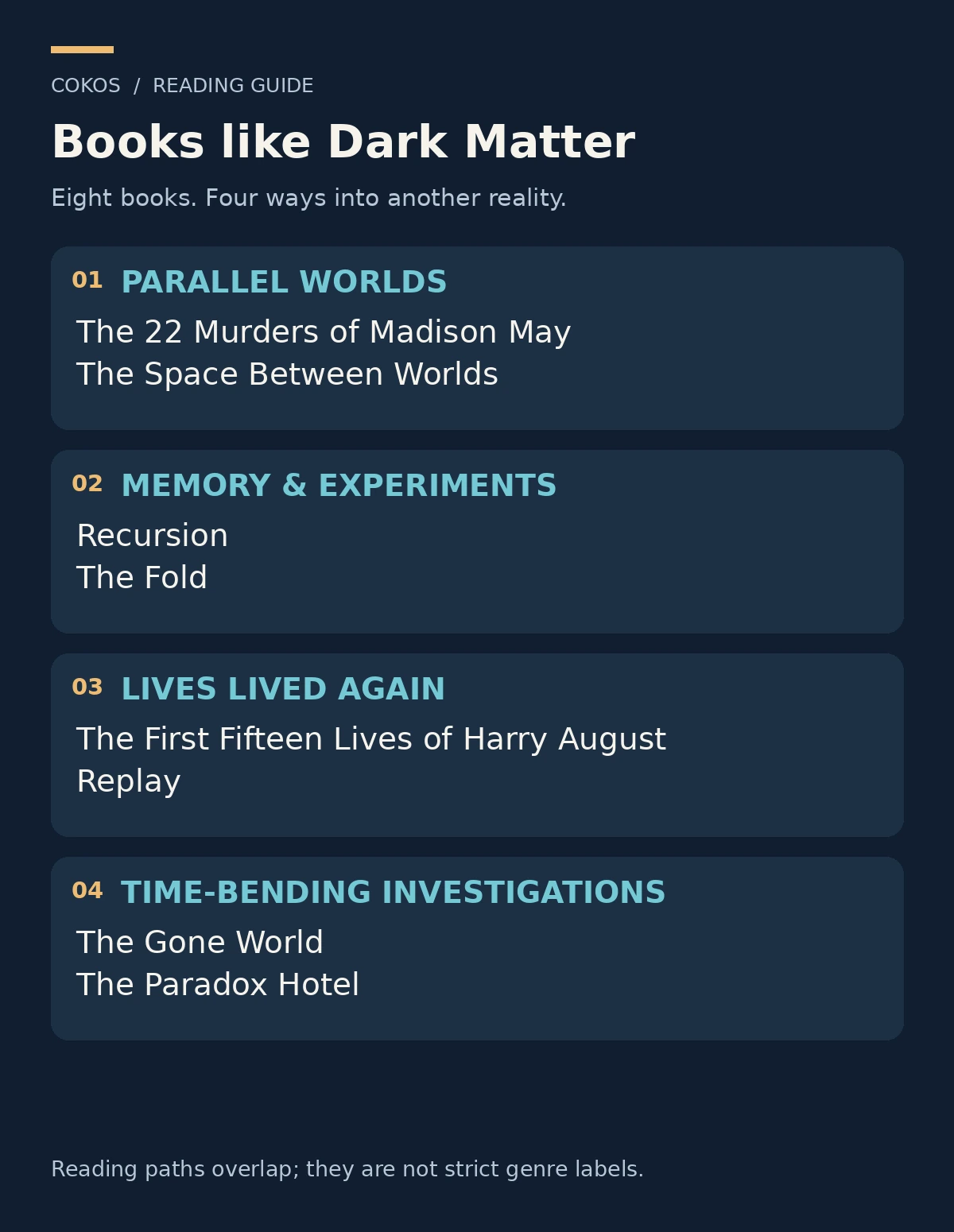
- More Crouch: start with Recursion.
- A pursuit across worlds: choose The 22 Murders of Madison May.
- An experiment with hidden consequences: choose The Fold.
- A darker investigation: choose The Gone World.
- Parallel selves and belonging: choose The Space Between Worlds.
- A time-distorted murder mystery: choose The Paradox Hotel.
- Long-term consequences of retained knowledge: choose The First Fifteen Lives of Harry August.
- Another chance to live differently: choose Replay.
For a wider exploration of identity and recollection, continue with books about memory. If you want to move toward alien civilizations, scientific mysteries, and much larger scales, our books like The Three-Body Problem guide follows that different reading path.
Dark Matter vs Recursion: which should you read next?
If you have finished Dark Matter and want another Blake Crouch novel, Recursion is the clearest starting point in this selection. Both connect destabilized reality with personal relationships, but their organizing ideas differ.
Dark Matter asks what it means to find your way back to a particular life when other versions are possible. Recursion makes memory and time central to its mystery. It offers familiar emotional urgency without functioning as a continuation of Jason Dessen’s story.
Choose Recursion for another Crouch thriller. Choose The 22 Murders of Madison May if crossing realities is your main interest, or Replay if you want to linger over second chances. Neither the existence of a speculative scientific explanation nor the use of technical language makes these novels guides to established physics.
For a philosophical reading path: Those Who Guard Eternity
Frequently asked questions
What is the closest book to Dark Matter by Blake Crouch?
Recursion is my first suggestion for readers who want another Crouch thriller combining personal stakes with a reality-altering premise. For a pursuit specifically involving parallel worlds, consider The 22 Murders of Madison May instead.
Is Recursion a sequel to Dark Matter?
No. They are separate novels with different characters and central premises. You can read them in either order.
Which books on this list involve parallel worlds?
The 22 Murders of Madison May and The Space Between Worlds make travel across alternate worlds central to their published premises. Replay and The First Fifteen Lives of Harry August are better approached as repeated-life stories. The distinction helps set expectations without revealing twists.
What should I read if I liked the emotional side of Dark Matter?
Choose Replay for second chances and relationships, or The Space Between Worlds for identity and belonging across different circumstances. Choose Recursion if you also want strong thriller momentum.
Which recommendation is darker than Dark Matter?
The Gone World is the clearest choice here for a bleaker mixture of speculative investigation, horror, and disturbing violence. The 22 Murders of Madison May also centers on murder and stalking; neither should be mistaken for a comforting alternate-life story.
Are all these books hard science fiction?
No. They combine speculative science, thrillers, crime, horror, and philosophical questions in different ways. Their imagined mechanisms should not be confused with demonstrated scientific possibilities. Choose by the reading experience you want rather than a claim that every premise is scientifically established.
Selection notes and sources
The selection prioritizes meaningful connections to Dark Matter: reality made unstable, personal stakes, alternate selves, memory, or second chances. Publisher descriptions support the premises; comparisons of pace, tone, and reader fit are editorial assessments. The author’s own novel is disclosed separately.
- Dark Matter: publisher description
- Recursion: publisher description
- The 22 Murders of Madison May: publisher description
- The Fold: publisher description
- The Gone World: publisher description
- The Space Between Worlds: publisher description
- The Paradox Hotel: publisher description
- The First Fifteen Lives of Harry August: publisher description
- Replay: publisher description