The best books like The Three-Body Problem depend on what you want to experience again. Choose Blindsight for unsettling first contact, Children of Time for nonhuman civilizations, Revelation Space for cosmic danger, or Spin for a large scientific mystery told through close human relationships.
This spoiler-light guide compares 11 novels by other authors. The trilogy’s own sequels have a separate reading-order section, and Cokos author Denys Kostin’s books appear in a disclosed recommendation after the main list.
Quick comparison: which book should you read next?
These are editorial judgments about reader fit, not objective rankings. A book can share Liu’s scale or intellectual ambition while offering a very different tone.
| Book | Choose it for | What to expect |
|---|---|---|
| Blindsight | First contact and consciousness | Dense, unsettling, conceptually demanding |
| Solaris | Alien intelligence that resists explanation | Psychological and ambiguous |
| Hyperion | A vast future through individual lives | Multiple narrators; the story continues in The Fall of Hyperion |
| Children of Time | Nonhuman civilization over generations | Evolution and communication |
| Diaspora | Posthuman minds and cosmic scale | Very demanding mathematics and ideas |
| Anathem | Knowledge, science, and reality | Slow introduction and invented terminology |
| Revelation Space | Cosmic danger and vanished civilizations | Dark interstellar mystery |
| A Deepness in the Sky | First contact and competing societies | Politics, power, and patient plotting |
| The Dispossessed | Political systems and scientific responsibility | Social philosophy rather than cosmic threat |
| Permutation City | Digital consciousness and simulated reality | Abstract and intellectually demanding |
| Spin | Cosmic mystery with a human center | A relatively approachable starting point |
Read The Dark Forest and Death’s End if you have only finished book one
The Three-Body Problem is the first novel in Cixin Liu’s Remembrance of Earth’s Past trilogy. The reading order is:
- The Three-Body Problem
- The Dark Forest — the direct sequel, expanding the story’s strategic and civilizational questions.
- Death’s End — the trilogy’s conclusion, extending its scope across much larger scales of time and consequence.
If you have finished all three, use the recommendations below to find another author. The sequels are not counted among the 11 alternatives.
11 books like The Three-Body Problem by other authors
1. Blindsight by Peter Watts
Closest match for consciousness and first contact
Overview: A crew travels to investigate an alien presence, but the central question is not whether the aliens are friendly. It is whether human beings understand intelligence at all. The novel explores the possibility that advanced cognition may operate without the kind of self-awareness humans value.
Why it may appeal to Three-Body readers: Like Liu’s trilogy, Blindsight begins with a scientific problem and follows it into existential territory. The alien is not simply culturally different. It threatens human assumptions about consciousness itself.
Major similarity: Hard science, first contact, strategic uncertainty, and a radical challenge to human exceptionalism.
Biggest difference: It is psychologically denser and much more concentrated on cognition than on civilization-wide history.
Reading difficulty: High. The prose and concepts demand attention.
Continue the theme with What Is Consciousness? and Can Consciousness Exist Outside the Brain?
2. Solaris by Stanisław Lem
Best for truly alien intelligence
Overview: Researchers study the ocean-covered world of Solaris, where the boundary between observation and interaction becomes impossible to define. The intelligence they encounter does not fit familiar categories of language, motive, personality, or civilization.
Why it may appeal to Three-Body readers: The book treats first contact as a limit of knowledge rather than a problem that can be solved through translation and diplomacy.
Major similarity: Human beings confront a reality that resists their intellectual tools.
Biggest difference: The scale is intimate and psychological rather than civilizational.
Reading difficulty: Moderate, but emotionally and philosophically demanding.
3. Hyperion by Dan Simmons
Best for cosmic civilization and literary scope
Overview: Several travelers journey toward the mysterious Shrike, each carrying a story that reveals another layer of a far-future civilization. Religion, artificial intelligence, political power, time, war, and personal grief converge.
Why it may appeal to Three-Body readers: The novel makes civilization feel old, layered, and structurally complex. Technology is embedded in culture, power, and history.
Major similarity: Civilization is treated as a dynamic system rather than a painted background.
Biggest difference: Hyperion is more literary, mythic, and character-centered.
Reading difficulty: Moderate.
4. Children of Time by Adrian Tchaikovsky
Best for nonhuman evolution
Overview: The novel follows the development of a nonhuman intelligence across generations while another branch of humanity struggles with decline, memory, and survival.
Why it may appeal to Three-Body readers: It thinks at evolutionary and civilizational scale. It also asks how communication might work between species whose bodies, instincts, and social structures differ radically.
Major similarity: Long timescales, civilization-building, existential risk, and contact between unlike forms of intelligence.
Biggest difference: The emotional center is mutual understanding rather than deterrence.
Reading difficulty: Accessible to moderate.
5. Diaspora by Greg Egan
Best for posthuman identity
Overview: Humanity has diverged into multiple forms, including digital minds and radically altered beings. The novel explores existence beyond biological limits and pushes questions of identity, embodiment, physics, and survival into unfamiliar territory.
Why it may appeal to Three-Body readers: It repeatedly enlarges the conceptual scale of the story. Scientific possibility becomes a challenge to what counts as a person, a world, or a future.
Major similarity: Extreme scientific speculation produces civilization-level consequences.
Biggest difference: The book is more abstract, more posthuman, and less grounded in contemporary human society.
Reading difficulty: High.
Pair it with What Is Personal Identity? and Can Consciousness Be Uploaded into a Computer?
6. Anathem by Neal Stephenson
Best for philosophy of knowledge
Overview: In a world where communities of thinkers live apart from ordinary society, knowledge becomes both a civilizational resource and a source of tension. A growing mystery eventually forces intellectual traditions to confront a reality larger than their own categories.
Why it may appeal to Three-Body readers: The novel makes ideas part of the plot’s machinery. Mathematics, philosophy, language, and institutions determine how characters interpret danger.
Major similarity: Knowledge itself becomes a survival problem.
Biggest difference: It is more concerned with epistemology and intellectual institutions than with direct cosmic conflict.
Reading difficulty: High at the beginning, rewarding later.
7. Revelation Space by Alastair Reynolds
Best for ancient cosmic mystery
Overview: The remains of a vanished civilization point toward a larger pattern: intelligent species may not disappear by accident. Archaeology, advanced technology, and hidden danger converge across interstellar distances.
Why it may appeal to Three-Body readers: It treats the universe as a place shaped by old threats and incomplete evidence. The mystery is tied directly to whether new civilizations can survive long enough to understand what happened to earlier ones.
Major similarity: Cosmic silence becomes evidence of danger rather than emptiness.
Biggest difference: The book leans more toward space opera and technological archaeology.
Reading difficulty: Moderate.
8. A Deepness in the Sky by Vernor Vinge
Best for strategic contact between civilizations
Overview: Multiple human groups converge around a newly discovered civilization. Curiosity, trade, political control, exploitation, and survival become inseparable.
Why it may appeal to Three-Body readers: Contact is treated as a systems problem. The outcome depends on institutions, technology, strategic deception, and the internal structure of competing societies.
Major similarity: Civilizations must reason about one another under uncertainty.
Biggest difference: It focuses more on governance, control, and social organization.
Reading difficulty: Moderate to high.
9. The Dispossessed by Ursula K. Le Guin
Best for political philosophy
Overview: A physicist moves between two contrasting societies, each defined by its own ideals, limitations, freedoms, and forms of pressure.
Why it may appeal to Three-Body readers: It uses speculative fiction to test civilization itself. The central question is not which system is perfect, but how ideals become institutions and how institutions reshape the people who live within them.
Major similarity: Civilization is treated as a structure with consequences.
Biggest difference: The stakes are political and ethical rather than extraterrestrial.
Reading difficulty: Moderate.
10. Permutation City by Greg Egan
Best for simulated reality
Overview: Digital copies of human minds exist inside computational environments, forcing the novel to ask what makes a person continuous and what gives a world reality.
Why it may appeal to Three-Body readers: It takes a difficult premise seriously and follows it beyond comfortable intuition.
Major similarity: A scientific concept becomes a philosophical crisis.
Biggest difference: Its central universe is computational rather than astronomical.
Reading difficulty: High.
Continue with What Is Reality?
11. Spin by Robert Charles Wilson
Best for emotional cosmic mystery
Overview: The stars disappear, Earth becomes enclosed by an unknown phenomenon, and humanity must understand both the physical event and what it means for the future.
Why it may appeal to Three-Body readers: A cosmic intervention forces civilization to reorganize its expectations, institutions, and sense of time.
Major similarity: The unknown event is both scientific and existential.
Biggest difference: The story remains close to a small group of characters and gives more space to emotional continuity.
Reading difficulty: Accessible.
Choose by what you liked most
- First contact with a radically different mind: Solaris, Blindsight, or Children of Time.
- Cosmic danger and the fate of civilizations: Revelation Space, Diaspora, or A Deepness in the Sky.
- A scientific mystery with emotional continuity: Spin.
- Digital minds and the nature of reality: Permutation City or Diaspora.
- Philosophy, institutions, and difficult choices: Anathem or The Dispossessed.
- A sprawling future with several contrasting human stories: Hyperion.
For a gentler entry into this selection, I would start with Spin or Children of Time. Readers who enjoy dense conceptual fiction may prefer Blindsight, Diaspora, or Permutation City.
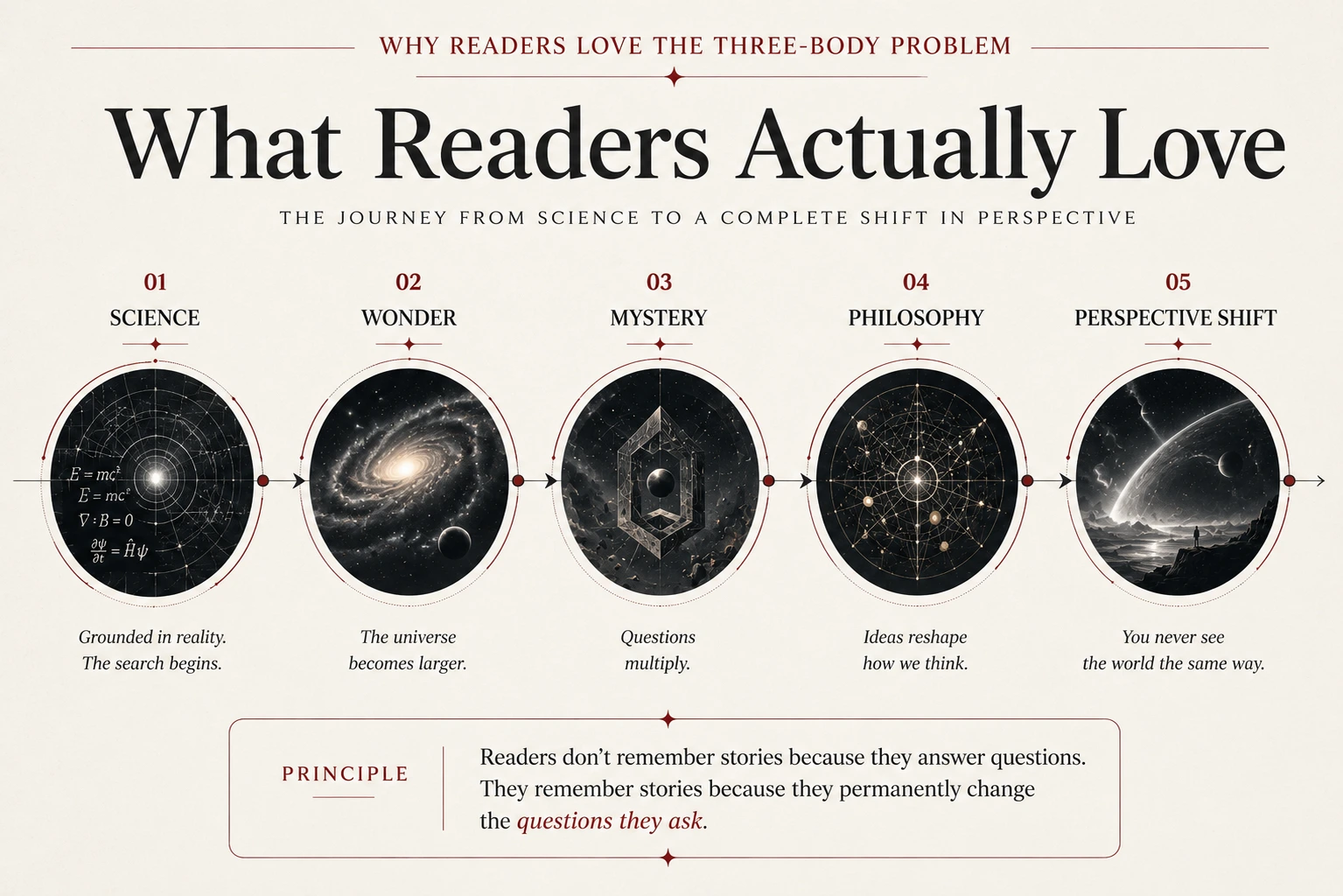
How these recommendations were selected
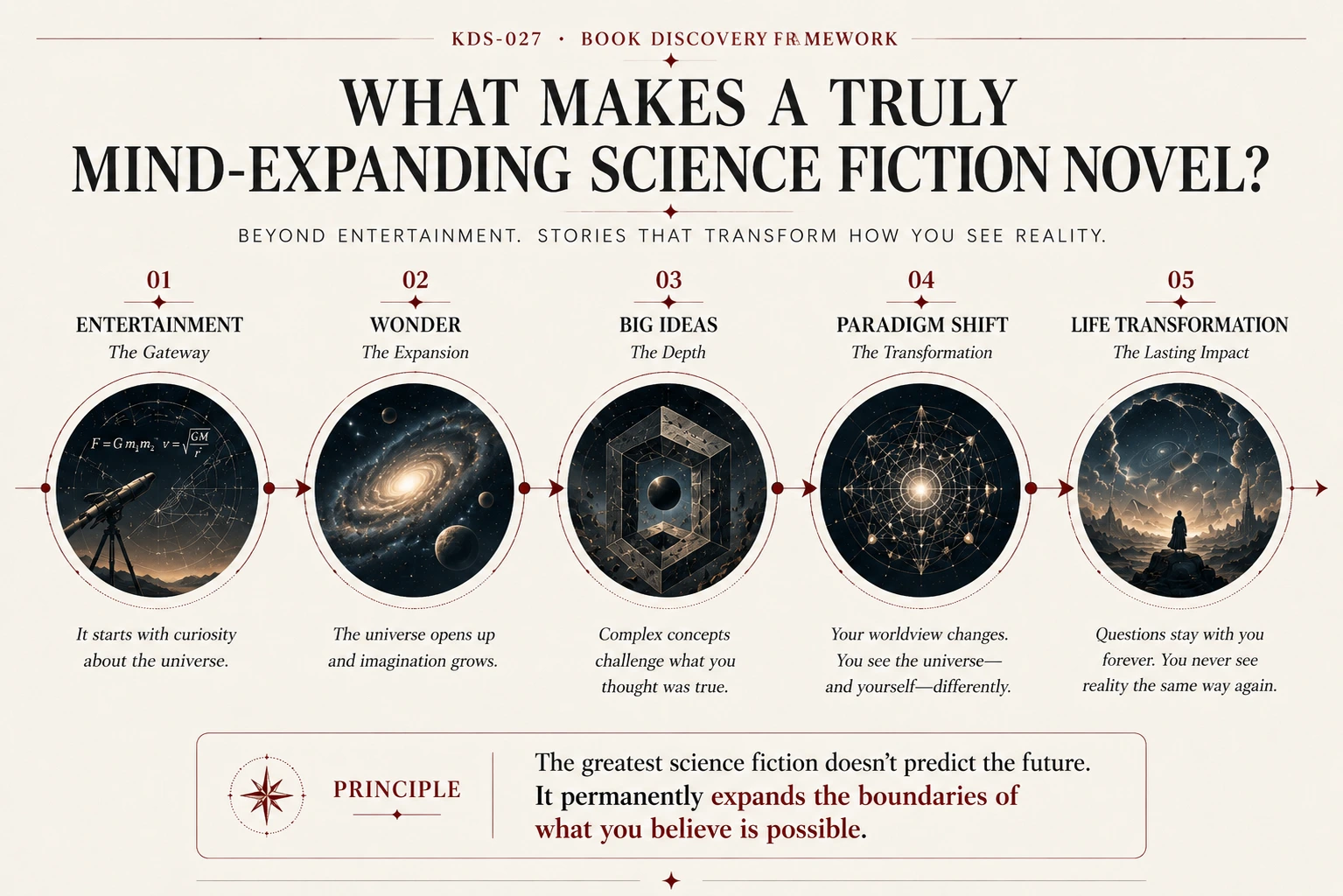
The comparisons consider scientific ideas, philosophical questions, civilizational scale, the treatment of mystery, and the way a story challenges familiar assumptions. Not every recommendation is hard science fiction, and no single novel reproduces every aspect of Liu’s trilogy.
Each entry explains both the shared appeal and the main difference. Reading difficulty is an editorial estimate: familiarity with scientific concepts, narrative structure, and an author’s style can change your experience.
For a broader reading path, explore philosophical fantasy books or existential fantasy books about meaning, identity, and mortality.
A disclosed author recommendation: Those Who Guard Eternity
Disclosure: I am Denys Kostin, the author of the Eternity Saga, which Cokos publishes. The following is an introduction to my own fiction, separate from the 11 recommendations above.
Those Who Guard Eternity may suit readers drawn to questions about consciousness, time, identity, and humanity’s responsibility within a larger reality. Its emphasis is philosophical and metaphysical rather than the physics-centered first-contact approach of The Three-Body Problem.
If you primarily want rigorous scientific speculation or another version of Dark Forest strategy, start with the main list. If the lasting appeal was the sense that human assumptions are too small for the world they describe, the Eternity Saga offers a different direction.
Start reading Those Who Guard Eternity online →
Those Who Shape Eternity continues the series’ concerns with agency and responsibility. It is the third book, so begin with Those Who Guard Eternity, then read Those Who Destroy Eternity before moving on to Those Who Shape Eternity.
Follow the question that stayed with you
A useful follow-up does not need the same plot. It can develop the question you kept thinking about after the last page: whether intelligence needs consciousness, whether civilizations can trust each other, or whether human experience is a reliable guide to reality.
Continue with Cokos guides to books about consciousness and books that make you question reality.
Prefer a more accessible next read built around scientific problem-solving? Explore our books like Project Hail Mary guide for stories driven by discovery, ingenuity, and communication.
Prefer practical survival challenges to civilization-scale threats? Our books like The Martian guide focuses on scientific problem-solving, space missions, and human ingenuity.
Frequently asked questions
What should I read after finishing the Three-Body trilogy?
Choose Children of Time for nonhuman civilizations, Blindsight for first contact and consciousness, Revelation Space for cosmic danger, or Spin for an emotionally grounded scientific mystery.
What should I read after the first Three-Body Problem book?
Continue with The Dark Forest, then Death’s End. They complete the original trilogy. The 11 novels in this guide are alternatives for readers seeking another author.
Which books are easier to read than The Three-Body Problem?
Spin is my first suggestion for a more intimate narrative with a major cosmic premise. Children of Time is another option if evolutionary storytelling appeals to you. Difficulty is subjective; neither book is free of challenging ideas.
Which recommendations are closest to Dark Forest themes?
Revelation Space shares an interest in cosmic danger and the fate of civilizations. A Deepness in the Sky explores contact, power, and competing societies. Neither is a retelling of Liu’s theory.
Which books explore intelligence and consciousness?
Blindsight questions the relationship between cognition and conscious experience. Permutation City and Diaspora explore digital minds and identity. For the underlying concepts, see what consciousness means.
Are all of these books hard science fiction?
No. The list also includes space opera and philosophical science fiction. The Dispossessed, for example, is included for its social and ethical questions rather than a matching cosmic-threat plot. The comparison table makes those differences explicit.
Can I read all the recommended books free on Cokos?
No. This page recommends books by other authors; it does not host their full texts. Cokos provides access to its own Eternity Saga, beginning with Those Who Guard Eternity.