The best books like The Martian depend on what you want to experience again. Choose Project Hail Mary for another Andy Weir scientific mystery, Mars Crossing for a stranded crew’s struggle on Mars, or Delta-v for a dangerous space expedition shaped by practical constraints. If Watney’s humour mattered most, consider We Are Legion (We Are Bob).
A Mars setting alone does not recreate the pleasure of watching someone turn an impossible situation into a series of solvable problems. This spoiler-light guide compares seven novels by the parts of The Martian they share: survival, technical reasoning, humour, and the challenge of living beyond Earth. Each recommendation also explains what changes.

Quick comparison: which book should you read next?
Start with the experience you want, rather than treating every space novel as equally similar. The descriptions below are editorial comparisons, not scientific accuracy scores. On a small screen, scroll the table sideways.
| Book | Best for | Science and survival | Humour and reading feel | Main difference |
|---|---|---|---|---|
| Project Hail Mary | Closest overall starting point | Experiments; a mission to save Earth | Humorous, puzzle-driven | More speculative; interstellar scope |
| Mars Crossing | Survival on Mars | A stranded expedition; hostile terrain | More serious; crew-focused | A group’s journey rather than solitary survival |
| Delta-v | Space operations | Mining, mission risk, technical constraints | A technology thriller | Commercial ambitions shape the danger |
| Artemis | More Andy Weir | Lunar infrastructure; technical obstacles | Sarcastic, crime-focused | A heist, not a castaway story |
| We Are Legion (We Are Bob) | Humour and exploration | Engineering ideas with speculative AI | Playful; conceptually accessible | A digital protagonist |
| Seveneves | A larger survival epic | Extensive technical detail; collective survival | Demanding; less comedy-led | A much broader scale and time span |
| Red Mars | Mars settlement | Terraforming and long-term habitation | Expansive; politically engaged | Building a society rather than arranging a rescue |
7 books like The Martian, with the differences explained
1. Project Hail Mary — Andy Weir
Choose it for: scientific deduction, resourcefulness, and another protagonist facing an extraordinary mission.
Ryland Grace wakes aboard a spacecraft without understanding who he is or why he is there. Recovering the purpose of his mission becomes part of a larger scientific mystery. The book keeps returning to a satisfying pattern: observe something unexpected, form an explanation, test it, and deal with what the result changes.
That makes it the clearest first recommendation for readers who enjoyed the thinking in The Martian as much as the danger. The important difference is scope. Weir moves beyond a Mars rescue into more speculative territory and a threat to Earth itself. Choose it for a familiar pleasure in problem-solving, while expecting different scientific assumptions and a different emotional journey.
Reading commitment: a standalone novel. If you have already read it, use our books like Project Hail Mary guide for further options.
2. Mars Crossing — Geoffrey A. Landis
Choose it for: the closest setting-and-survival match on this list.
A failed landing leaves an expedition facing an immense journey across Mars. Landis makes the environment central to the predicament: distance, equipment, and the limits of human endurance determine what is possible. Readers who kept asking how Watney would reach the next workable solution have a strong reason to look here.
The change is from an isolated survivor to a crew with its own histories and pressures. Human relationships occupy more of the survival problem, and the tone should not be mistaken for another version of Watney’s comic narration. The publisher’s description emphasizes both the physical journey and what the crisis reveals about the people undertaking it.
Reading commitment: a standalone novel. Pick this before a grand space opera if the part you most want back is people trying to stay alive on an unforgiving planet.
3. Delta-v — Daniel Suarez
Choose it for: a technically minded space mission with commercial stakes.
A billionaire recruits a team for a pioneering deep-space mining operation. The attraction for a Martian reader is the operational question: what does it take to make an ambitious mission work when humans, machinery, and limited resources must function together far from home?
The shift from rescue to enterprise matters. Profit, ownership, and the people directing an expedition become part of the reading experience. This is a useful next step when you want technical challenges embedded in a thriller rather than another lone astronaut making a survival log. Its place here rests on that shared interest in constrained problem-solving, not on a promise of the same humour or narrative voice.
Reading commitment: the opening novel in the Delta-v series. Start here rather than with its sequel, Critical Mass.
4. Artemis — Andy Weir
Choose it for: Weir’s interest in how an off-world settlement actually functions.
Jazz Bashara lives in a lunar city and becomes involved in a dangerous heist. The change of setting creates a different use for scientific detail: infrastructure and engineering help shape a crime story. Instead of asking how to bring one astronaut home, the novel asks what a risky plan looks like in a place where the surrounding environment is already hazardous.
This is a good option if you enjoy technical obstacles and a sarcastic voice, but the same author does not mean the same kind of story. Jazz has different motives from Watney, and social conflict occupies space that solitary survival filled in The Martian. Choose it when the lunar-city premise appeals in its own right.
Reading commitment: a standalone novel. You do not need to read Weir’s other books first.
5. We Are Legion (We Are Bob) — Dennis E. Taylor
Choose it for: humour, inventive thinking, and an unusual perspective on space exploration.
After his death and cryonic preservation, Bob Johansson’s story takes a turn into digital existence. The premise opens up questions that Watney never has to face: how does exploration change when the explorer’s relationship with a human body is no longer ordinary?
The appeal is the combination of curiosity and an entertaining voice. However, readers should expect speculative artificial intelligence rather than the specific biological pressures of being stranded on Mars. If food, air, and bodily vulnerability were the essential ingredients for you, Mars Crossing is a closer fit. If you mainly want a clever perspective meeting unfamiliar problems with humour, Bob is the more promising direction.
Reading commitment: book one of the Bobiverse. Treat it as an entry into an ongoing series rather than choosing it solely for a standalone reading experience.
6. Seveneves — Neal Stephenson
Choose it for: a substantial hard-science-fiction survival epic.
The Moon breaks apart at the beginning of Seveneves, turning survival into a collective engineering crisis. Orbital debris and the danger of cascading collisions make space itself part of the problem. Stephenson describes the space-debris problem as the starting point for the novel, and deliberately keeps its technological ambitions within the solar system rather than relying on faster-than-light travel.
For a Martian reader, the connection is the need to reason within physical limits: how can people protect themselves when the environment around their machinery becomes increasingly dangerous? The difference is scale. Watney’s immediate survival problem becomes a much broader struggle involving technical decisions and their consequences for humanity.
The trade-off is reading effort. A broad survival epic asks you to follow more than one immediate problem, and its ambitions reach across a long time span. Choose it when you want to settle into a demanding novel, rather than when you need the closest match for Watney’s compact, humorous predicament. Similarity in technical interest does not imply similarity in pace or structure.
Reading commitment: a long standalone novel. Its size and changing scope make it a deliberate next-read choice.
7. Red Mars — Kim Stanley Robinson
Choose it for: Mars itself, especially the challenge of making a world habitable.
One hundred colonists arrive with a mission to transform Mars. Robinson takes the setting in a direction very different from a rescue: what would it mean to establish a lasting human presence, and what decisions would shape the world being built?
This is the right branch of the list if Watney’s attempts to grow food and adapt his surroundings left you wondering about settlement. The focus widens from immediate necessity to competing visions of a planet’s future. Expect a more expansive, political reading experience. It is not the first choice for someone whose main requirement is another funny astronaut escaping a crisis.
Reading commitment: the first novel in the Mars trilogy, followed by Green Mars and Blue Mars.
Choose by what you loved about The Martian
Two readers can enjoy the same novel for different reasons. One wants the next improvised repair; another wants an optimistic voice; a third wants to imagine life on Mars. Use those preferences to narrow the list.
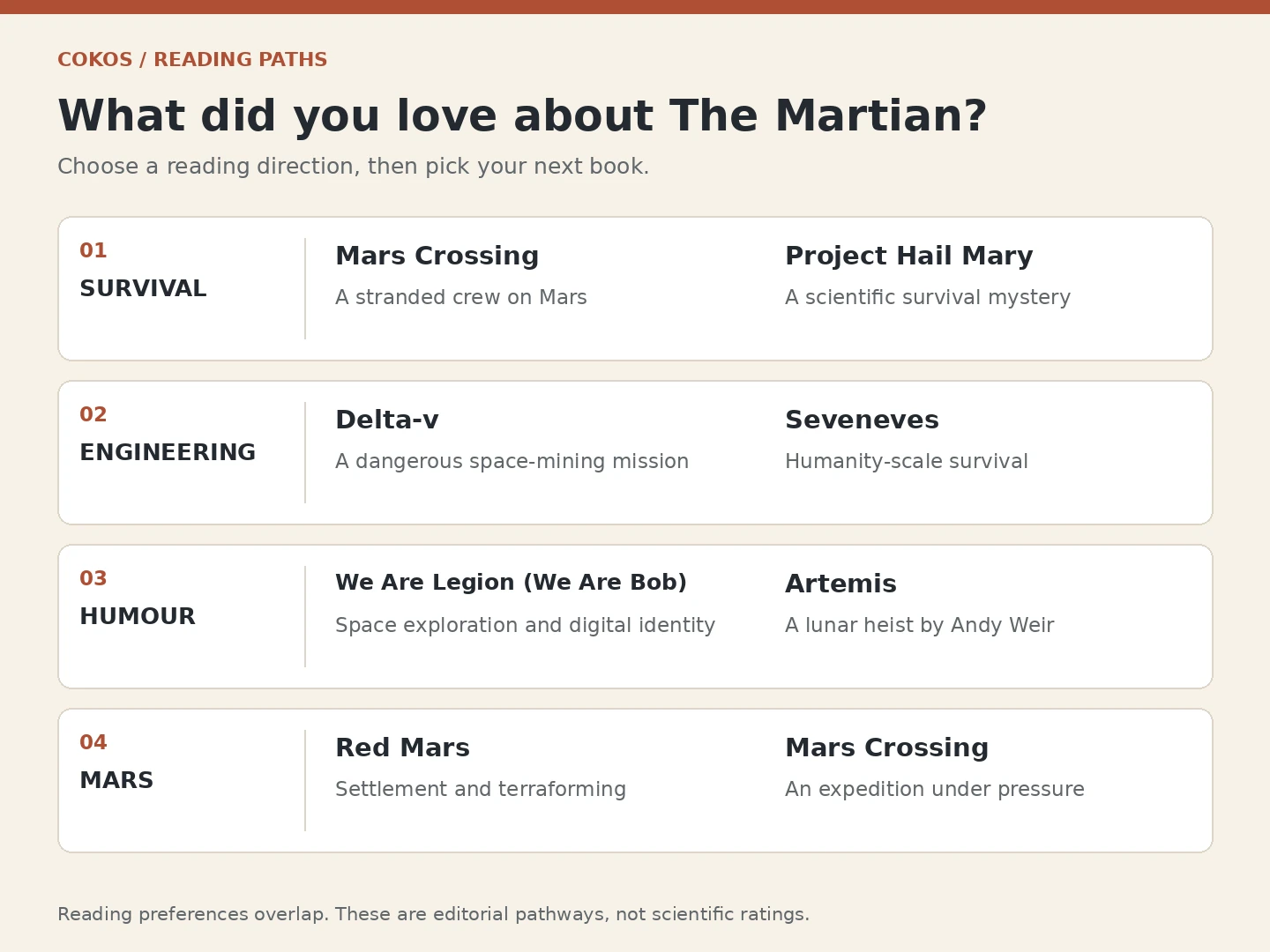
- Survival: start with Mars Crossing for a Mars expedition or Project Hail Mary for scientific discovery under pressure.
- Engineering: choose Delta-v for mission operations or Seveneves for a much larger survival effort.
- Humour: consider We Are Legion (We Are Bob) for a digital explorer, or Artemis if a lunar heist appeals.
- Mars: choose Red Mars for long-term settlement and Mars Crossing for an expedition in trouble.
If your interest has shifted toward alien civilizations and larger cosmic questions, our books like The Three-Body Problem guide explores that direction.
Already read Project Hail Mary? Start here
You do not need another recommendation that stops at “read Andy Weir’s other bestseller.” Decide what you want to retain and what you are willing to change. Keep the physical survival problem with Mars Crossing. Keep practical space operations with Delta-v. Keep humour while changing the kind of protagonist with We Are Legion (We Are Bob).
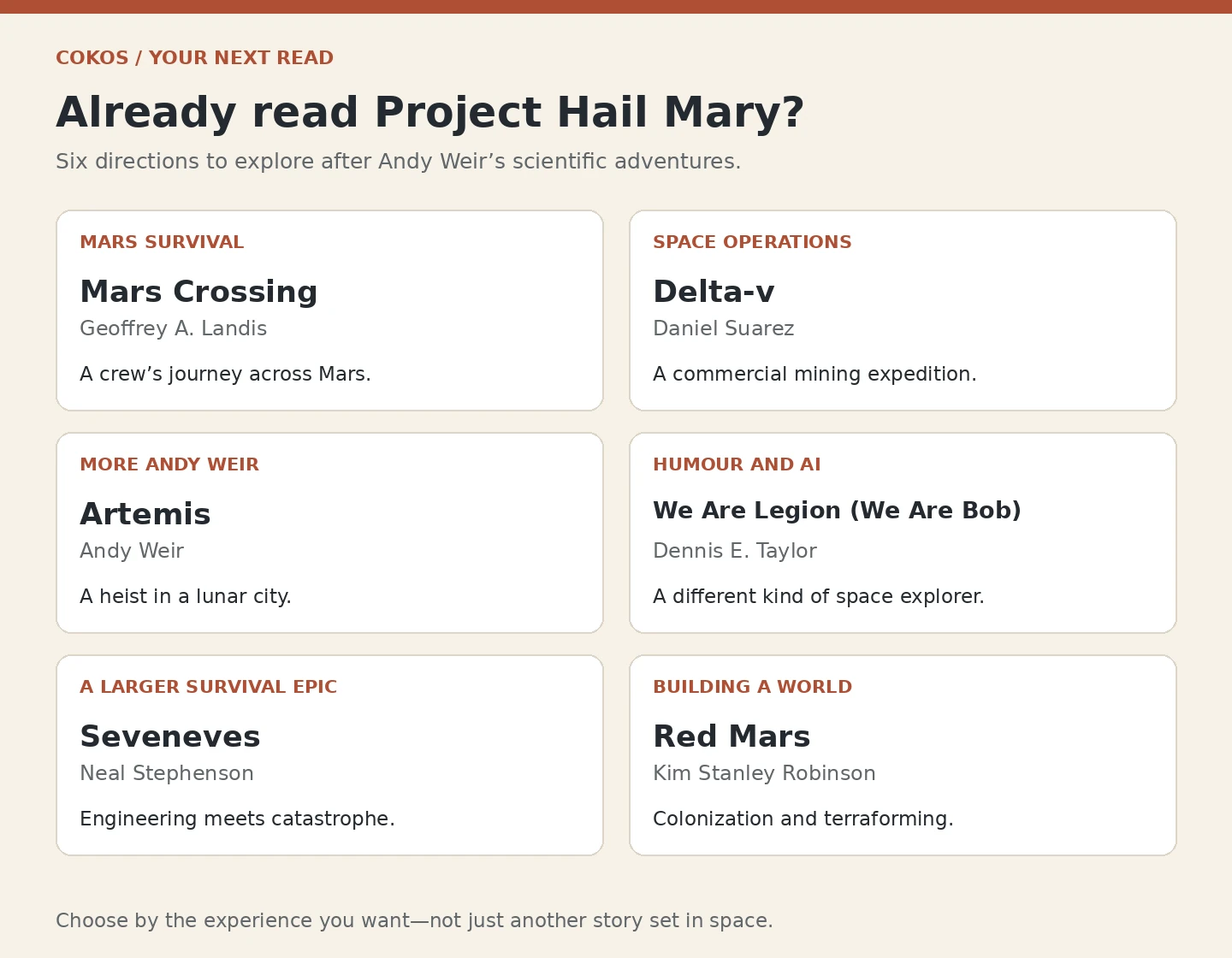
For the least abrupt change in subject, choose Mars Crossing. For a different author and a different mission, choose Delta-v. Save Seveneves and Red Mars for when you actively want a broader, more demanding reading project.
How these recommendations were selected
Books were selected for meaningful overlap with scientific problem-solving, survival constraints, humour, or Mars as a setting. Publisher descriptions support the factual premises and bibliographic details. The comparisons, reading pathways, and suitability judgments are editorial interpretations rather than measured rankings.
Shared setting was not enough on its own: each entry identifies a specific reason to choose the book and a difference that might change your decision. This is a recommendation guide, not a scientific audit of every fictional technology.
Frequently asked questions
What should I read after The Martian?
Project Hail Mary is the strongest starting recommendation if you want another Andy Weir story driven by scientific questions and ingenuity. Choose Mars Crossing instead if survival on Mars matters more than the author’s voice, or Delta-v for a new space mission by a different writer.
What should I read if I have already read Project Hail Mary?
Choose Mars Crossing for survival, Delta-v for space operations, or We Are Legion (We Are Bob) for humour and exploration. Artemis offers more Andy Weir, while Seveneves and Red Mars suit readers seeking greater scale.
Which books on this list are set on Mars?
Mars Crossing and Red Mars make Mars central to their stories. The first follows a threatened expedition; the second begins a larger account of colonization and terraforming. Artemis is set in a lunar city, not on Mars.
Is Artemis similar to The Martian?
It shares Andy Weir’s interest in science, technical obstacles, and humour. Its central situation is different: a heist in a lunar settlement rather than an astronaut’s struggle to survive alone. Choose it for that premise rather than expecting a sequel to Watney’s story.
Are all these books hard science fiction?
They engage with science or technology in different ways and to different degrees. Some emphasize practical constraints; others use more speculative premises, including digital minds. The comparison table identifies those differences without treating “hard science fiction” as a guarantee that every imagined mechanism is scientifically established.
Can I read all seven books free on Cokos?
No. This page recommends books by other authors; it does not host their full texts. Check a library or an authorized bookseller for access. The separately disclosed Those Who Guard Eternity recommendation is available to read on Cokos.
Publisher and author sources
The following sources support the book premises and publication details used in this guide. They are not endorsements of the editorial ordering.
- Penguin Random House: Project Hail Mary.
- Tor/Macmillan: Mars Crossing catalogue entry (PDF, printed page 10).
- Penguin Random House: Delta-v.
- Penguin Random House: Artemis.
- Simon & Schuster: We Are Legion (We Are Bob).
- HarperCollins: Seveneves; Neal Stephenson on the novel’s scientific premise; the author’s opening excerpt.
- Penguin Random House: Red Mars.