The best existential fantasy books use impossible worlds to ask deeply human questions: Why are we here? What makes us the same person over time? Are our choices truly free? What happens to meaning when death, memory, identity, or reality itself can no longer be taken for granted?
That is what separates existential fantasy from fantasy that is concerned mainly with adventure, magic systems, or worldbuilding. The fantastical premise becomes a philosophical pressure test. Immortality forces a character to confront the value of a finite life. Repeated lives turn choice into a problem. Memory loss destabilizes identity. Prophecy pits freedom against fate. An unreliable world makes perception itself part of the story.
If that is the kind of fiction you are looking for, the books below offer very different ways into the same territory. Some are intimate and reflective. Others are strange, dark, comic, epic, or metaphysical. What connects them is that the fantasy is not merely scenery. It changes the conditions under which a person must answer the question: how should I exist?
Quick picks: which existential fantasy book should you read?
| Book | Author | Best for | Central question |
|---|---|---|---|
| Piranesi | Susanna Clarke | Identity and reality | Who are you when your memories and world cannot be trusted? |
| A Wizard of Earthsea | Ursula K. Le Guin | Selfhood and mortality | What must we face within ourselves to become whole? |
| The Buried Giant | Kazuo Ishiguro | Memory and love | Can identity or peace survive without memory? |
| The Midnight Library | Matt Haig | Regret and unlived lives | Would another life actually make us whole? |
| The Invisible Life of Addie LaRue | V. E. Schwab | Immortality and remembrance | Does a life matter if nobody remembers it? |
| Small Gods | Terry Pratchett | Belief and morality | What makes belief ethical rather than merely powerful? |
| Vita Nostra | Marina & Sergey Dyachenko | Consciousness and transformation | What happens when becoming more means becoming less recognizably human? |
How we chose these existential fantasy books
This list is editorially curated around one criterion: the fantastical or speculative premise must materially create an existential problem. A book was included because its story directly pressures questions of meaning, identity, mortality, freedom, responsibility, consciousness, memory, or reality—not simply because it is serious, literary, or philosophically interesting.
The selections also aim for variety in tone and approach, from comic and mythic fantasy to literary, dark, and metaphysical fiction. They are not ranked as an objective hierarchy; each title is recommended for a different existential question. Because cokos.org/ publishes the Eternity Saga, our own fiction is excluded from the 15-book list and disclosed separately below rather than presented as an independent recommendation.
What is existential fantasy?
Existential fantasy is fantasy in which questions of existence become central to the story: meaning, identity, freedom, mortality, responsibility, alienation, consciousness, and the nature of reality. The fantastic element does not simply make the plot unusual; it changes the conditions under which the characters understand themselves.
Existential fantasy is best understood as a descriptive reading category rather than a rigid publishing genre. Many books on this list also belong to literary fantasy, philosophical fantasy, speculative fiction, or adjacent traditions. The useful distinction is not the bookstore label but whether the story makes existence itself part of the dramatic problem.
That makes it closely related to philosophical fantasy, but the two are not identical. Philosophical fantasy can explore almost any large idea: justice, truth, ethics, society, power, knowledge, religion, or human nature. Existential fantasy is narrower. It repeatedly returns to what it means to be a person who must choose, suffer, change, remember, die, or search for meaning.
The boundaries are naturally fuzzy. A novel can be philosophical, existential, and metaphysical at once. What matters is not the label printed on a bookstore shelf. What matters is the work the fantastical premise is doing.
Existential fantasy vs philosophical fantasy vs metaphysical fantasy
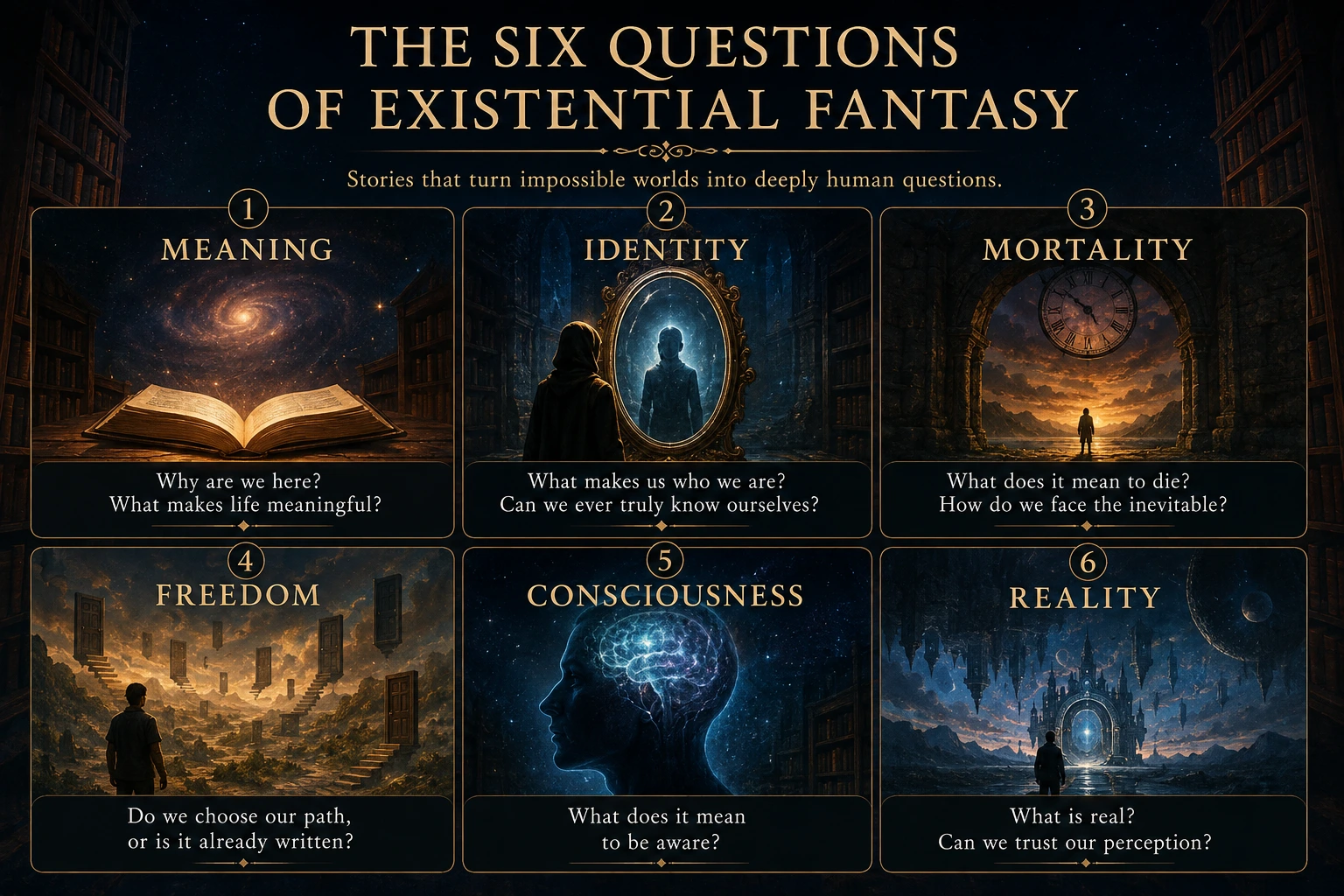
The three categories overlap, but their center of gravity is different.
- Philosophical fantasy asks broad questions about truth, ethics, society, knowledge, morality, power, and human nature.
- Existential fantasy puts the human condition at the center: meaning, identity, mortality, freedom, alienation, choice, and responsibility.
- Metaphysical fantasy pushes hardest on the nature of reality itself: being, consciousness, time, causality, existence, illusion, and what can ultimately be considered real.
A story about a magical kingdom can be philosophical if it investigates justice. It becomes existential when the protagonist’s choices raise questions about responsibility or the meaning of a life. It becomes metaphysical when the kingdom itself may be an illusion, a dream, a construct of consciousness, or one layer of reality among many.
15 existential fantasy books worth reading
1. Piranesi — Susanna Clarke
Piranesi is one of the clearest modern examples of fantasy turning architecture, memory, and perception into questions about the self. Its protagonist inhabits an apparently endless House of halls, statues, tides, and mysteries. The world feels complete to him even as the reader begins to suspect that his understanding of it is incomplete.
What makes the novel existential is not simply the strangeness of the setting. It is the gradual destabilization of identity. If your memories can be altered, your history hidden, and your world misdescribed, what remains genuinely yours? Clarke turns wonder into an inquiry about knowledge, trust, solitude, and the continuity of the person. Readers interested in the boundary between mind and world may also enjoy Cokos’s guide to how we know what is real.
2. A Wizard of Earthsea — Ursula K. Le Guin
Le Guin’s first Earthsea novel begins like a coming-of-age fantasy about talent and power, but its deeper movement is inward. Ged’s attempt to prove himself unleashes something he cannot simply defeat with greater skill. His journey becomes a confrontation with fear, pride, death, and the parts of the self we try to push away.
The existential force of the story comes from integration rather than conquest. What if the enemy cannot be separated from the self? What does maturity require when power cannot protect you from mortality? Le Guin’s spare fantasy becomes a meditation on accepting limits and becoming whole.
3. The Buried Giant — Kazuo Ishiguro
In The Buried Giant, a mist of forgetting hangs over post-Arthurian Britain. An elderly couple travels through that landscape while trying to recover what has been lost from individual and collective memory. The premise makes forgetting feel almost merciful—until the cost of that mercy becomes impossible to ignore.
The novel asks whether love, identity, reconciliation, and peace can exist without an honest relationship to the past. If memory returns, pain may return with it. If memory remains buried, the self may be partly buried too. That tension makes the book especially relevant to readers drawn to fantasy about memory and personal continuity.
4. The Midnight Library — Matt Haig
The Midnight Library transforms regret into a fantastical system. Between life and death, Nora Seed encounters a library of lives she might have lived had she made different choices. Each book offers another possibility: another career, relationship, place, identity, or version of success.
The existential question is immediate: if you could try the lives you did not choose, would any of them finally feel right? The novel explores possibility, regret, meaning, and the danger of imagining that fulfillment always exists in some alternate path. Cokos has a separate guide to books like The Midnight Library for readers who want more stories built around alternate lives and consequential choices.
5. The First Fifteen Lives of Harry August — Claire North
Harry August repeatedly lives the same life, carrying memory from one cycle into the next. That premise turns reincarnation into a problem of responsibility. If death is not final for you, does any single choice still matter? If you can revise your decisions, can you ever escape the consequences of what you know?
The novel gradually expands from personal repetition into moral responsibility across time. Its most interesting tension comes from the collision between freedom and inevitability: the broad shape of history may repeat, but knowledge changes what a person can choose within it. Readers interested in similar narrative structures can explore Cokos’s guide to books like The First Fifteen Lives of Harry August.
6. The Invisible Life of Addie LaRue — V. E. Schwab
Addie LaRue makes a bargain for freedom and receives a form of immortality—but with a devastating condition: nobody can remember her after she leaves their presence. The fantasy premise isolates two things we usually take for granted, duration and recognition, and asks whether either is enough to make a life meaningful.
Addie can survive, travel, experience, and change, yet she struggles to leave a stable trace in other people’s lives. The result is an existential fantasy about memory, identity, loneliness, freedom, and the human desire to matter beyond the boundaries of the self. If immortality is the question that most interests you, see Cokos’s guide to books about immortality and eternal life.
7. Small Gods — Terry Pratchett
Pratchett uses comedy to ask serious questions about belief, institutions, morality, and what happens when a religious system becomes more concerned with itself than with the truths it claims to serve. The god Om finds himself reduced to a powerless tortoise while discovering that genuine belief is far rarer than institutional obedience.
The existential element lies in the relationship between belief and responsibility. Is morality meaningful when it rests only on authority? What does faith become when certainty collapses? And what should a person do when the institution that defines reality for everyone around them proves morally hollow?
8. The Last Unicorn — Peter S. Beagle
A unicorn leaves the safety of immortality to discover what happened to the rest of her kind. The story is dreamlike and deceptively simple, yet its emotional center is mortality. When an immortal being encounters human limitation, love, regret, and change, permanence stops looking uncomplicated.
The book asks whether finitude is only a loss or whether it is also what allows experience to acquire urgency and meaning. Its fantasy becomes existential precisely because immortality is not treated as an uncomplicated prize.
9. The Neverending Story — Michael Ende
Ende’s novel begins as a story about a boy reading a fantasy book and gradually dissolves the boundary between reader, story, identity, and world. Fantastica is threatened by the Nothing, but the deeper danger emerges when desire itself begins reshaping who Bastian is.
The novel explores imagination as both creative freedom and existential risk. What happens when you can become almost anything? Which desires reveal the self, and which ones erase it? Beneath the adventure lies a powerful question about identity: to return to yourself, you may first have to discover what cannot simply be wished into existence.
10. Vita Nostra — Marina & Sergey Dyachenko
Vita Nostra takes the familiar idea of a magical school and makes it radically unsettling. Sasha is forced into an education whose purpose she cannot understand, studying material that changes not merely what she knows but what she is capable of being.
The book’s central anxiety is transformation. Education, language, consciousness, and identity blur together until the question is no longer “What will I learn?” but “What will learning make me?” That makes it a strong choice for readers interested in books about consciousness or fiction in which the structure of mind itself becomes unstable.
11. The Saint of Bright Doors — Vajra Chandrasekera
This novel uses a surreal city, religious power, inherited destiny, and strange social institutions to question the stories people are given about who they are supposed to become. Fetter has been raised for a purpose defined by other people, yet the world he enters refuses to conform to the meaning assigned to him.
Its existential tension lies in the conflict between inherited identity and chosen identity. How much of the self belongs to family, history, faith, society, or prophecy—and how much can genuinely be remade?
12. The Magicians — Lev Grossman
Many fantasy stories begin with the promise that discovering magic will reveal a truer and more meaningful world. The Magicians asks what happens when it does not. Quentin Coldwater gets access to the kind of hidden magical life he once imagined would solve his dissatisfaction, only to discover that wonder does not automatically produce purpose.
That reversal makes the novel particularly existential. If achieving the fantasy does not cure emptiness, where does meaning come from? Grossman treats magic as a test of the belief that the right circumstances can save us from ourselves.
13. The Just City — Jo Walton
Walton turns a philosophical thought experiment into a literal fantasy project: a city founded to embody Plato’s ideas, populated by people drawn from different historical periods and overseen by gods. The result exposes the difference between designing an ideal society and respecting the freedom of the people inside it.
The novel is philosophical in scope but strongly existential in its treatment of agency. Can a person live a good life if the structure defining “good” was chosen for them? What happens when an ideal system collides with individual desire, consent, responsibility, and the right to become someone unexpected?
14. The Curse of Chalion — Lois McMaster Bujold
Bujold’s fantasy explores divine intervention without reducing human choice to obedience. Cazaril returns from trauma and humiliation to a political world shaped by a curse, gods, duty, and forces far larger than any individual plan.
The novel’s existential power comes from the tension between fate and agency. If larger forces shape the path, what still belongs to the person walking it? Responsibility remains meaningful because destiny does not eliminate the need to choose. Readers interested in the broader problem can continue with Cokos’s article on whether humans have free will.
15. The Darkness That Comes Before — R. Scott Bakker
Bakker’s dark epic fantasy pushes questions of belief, motivation, determinism, and self-knowledge into a brutal political and religious setting. Characters act from desires and convictions they often understand only partially, while other minds learn to exploit those hidden causes.
The result is unsettling because it attacks the comfortable assumption that knowing what we want is the same as understanding why we want it. If our choices emerge from causes we cannot see, how free are we? If beliefs can be engineered, what happens to responsibility? This is the darkest recommendation on the list, but also one of the most direct for readers interested in determinism and the limits of self-knowledge.
Which existential fantasy book should you read first?
There is no single correct starting point because existential fantasy is defined less by a specific setting than by the question the story puts under pressure.
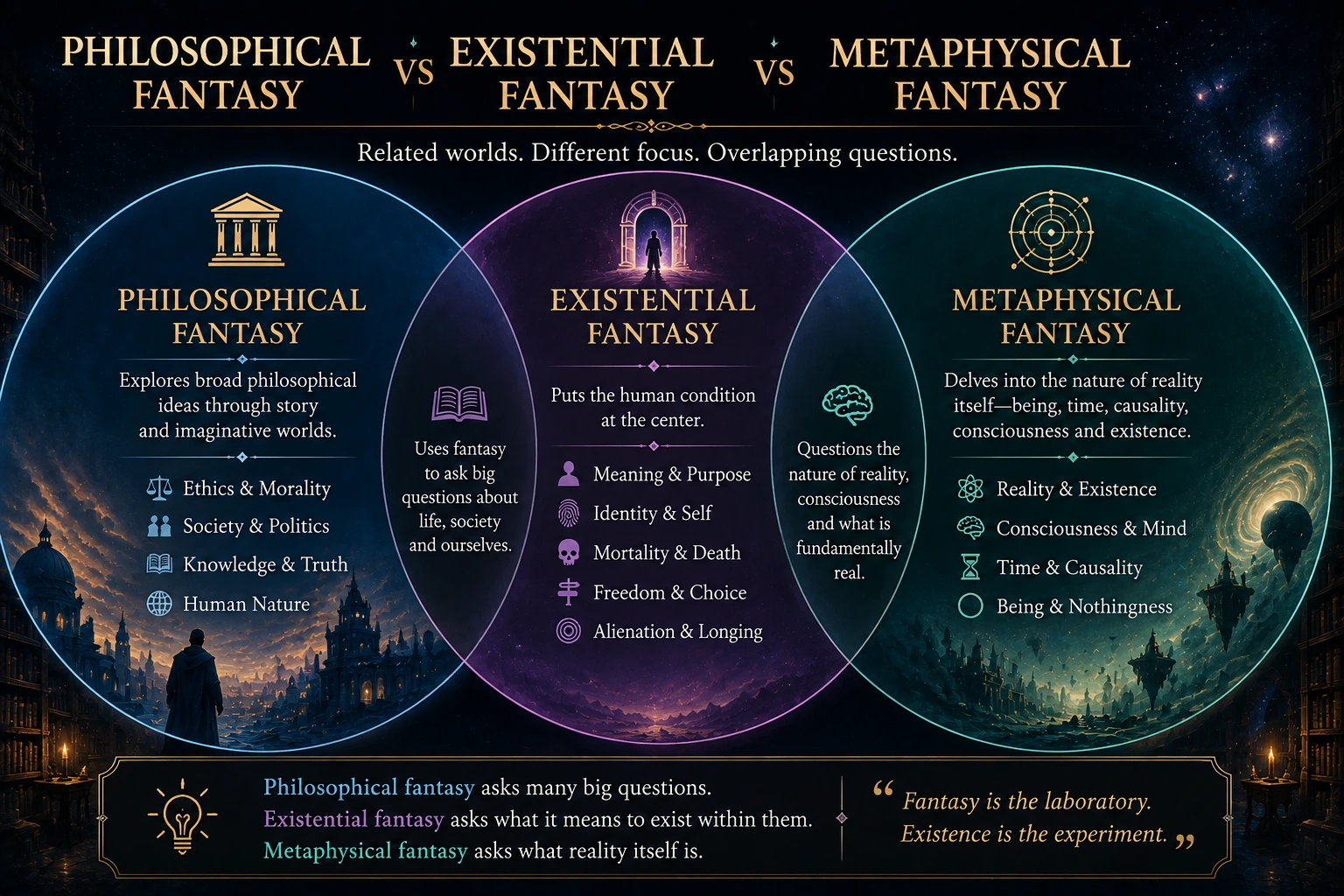
- For identity and memory: start with Piranesi.
- For mortality and accepting the self: choose A Wizard of Earthsea.
- For regret and alternate lives: read The Midnight Library.
- For immortality and remembrance: try The Invisible Life of Addie LaRue.
- For free will and destiny: choose The Curse of Chalion.
- For consciousness and transformation: read Vita Nostra.
- For belief and morality: start with Small Gods.
- For a darker investigation of determinism: try The Darkness That Comes Before.
What makes a fantasy story existential?
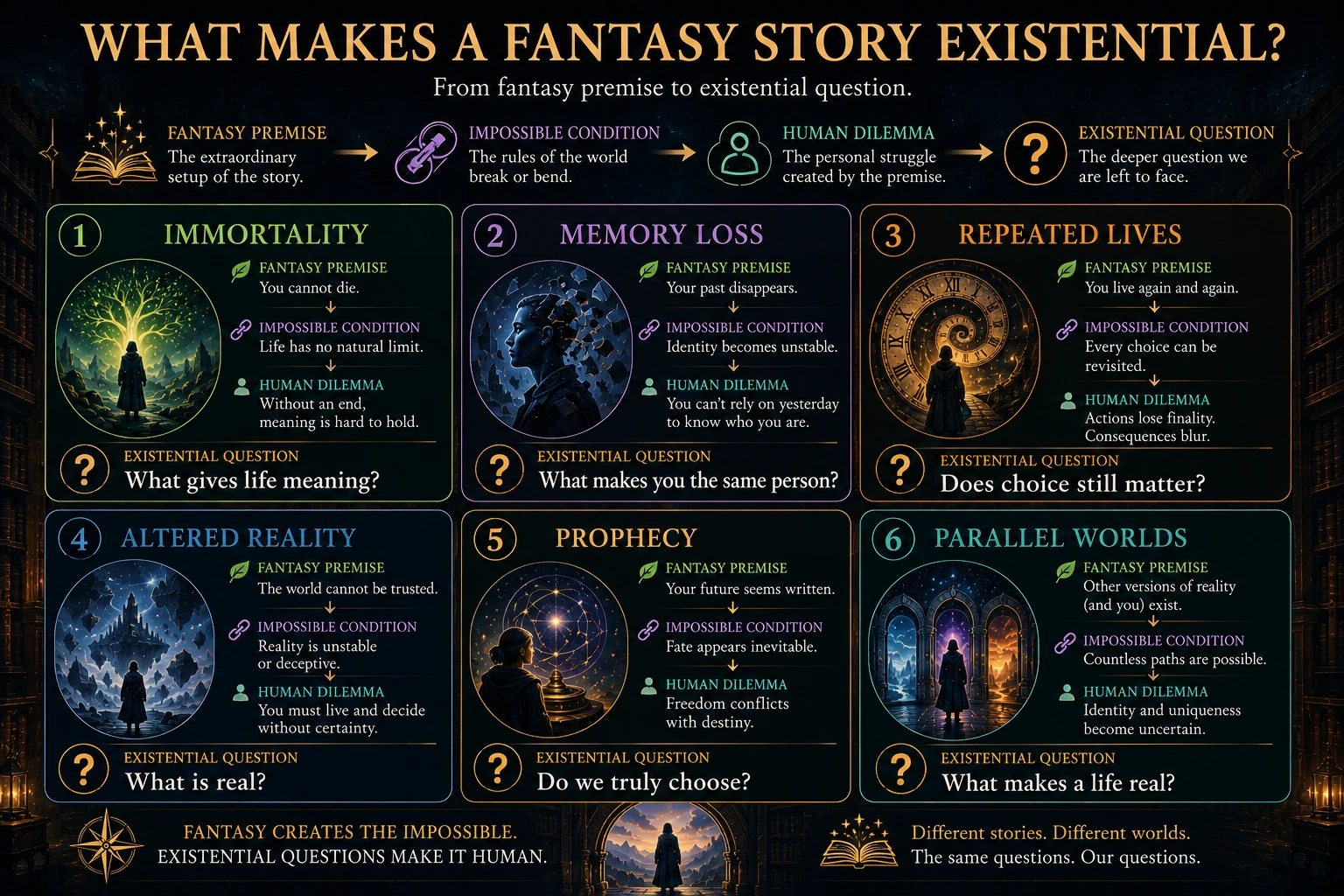
A fantasy story becomes existential when its impossible premise creates a human dilemma that cannot be solved merely by winning a battle or learning a spell. The magic changes the terms of existence.
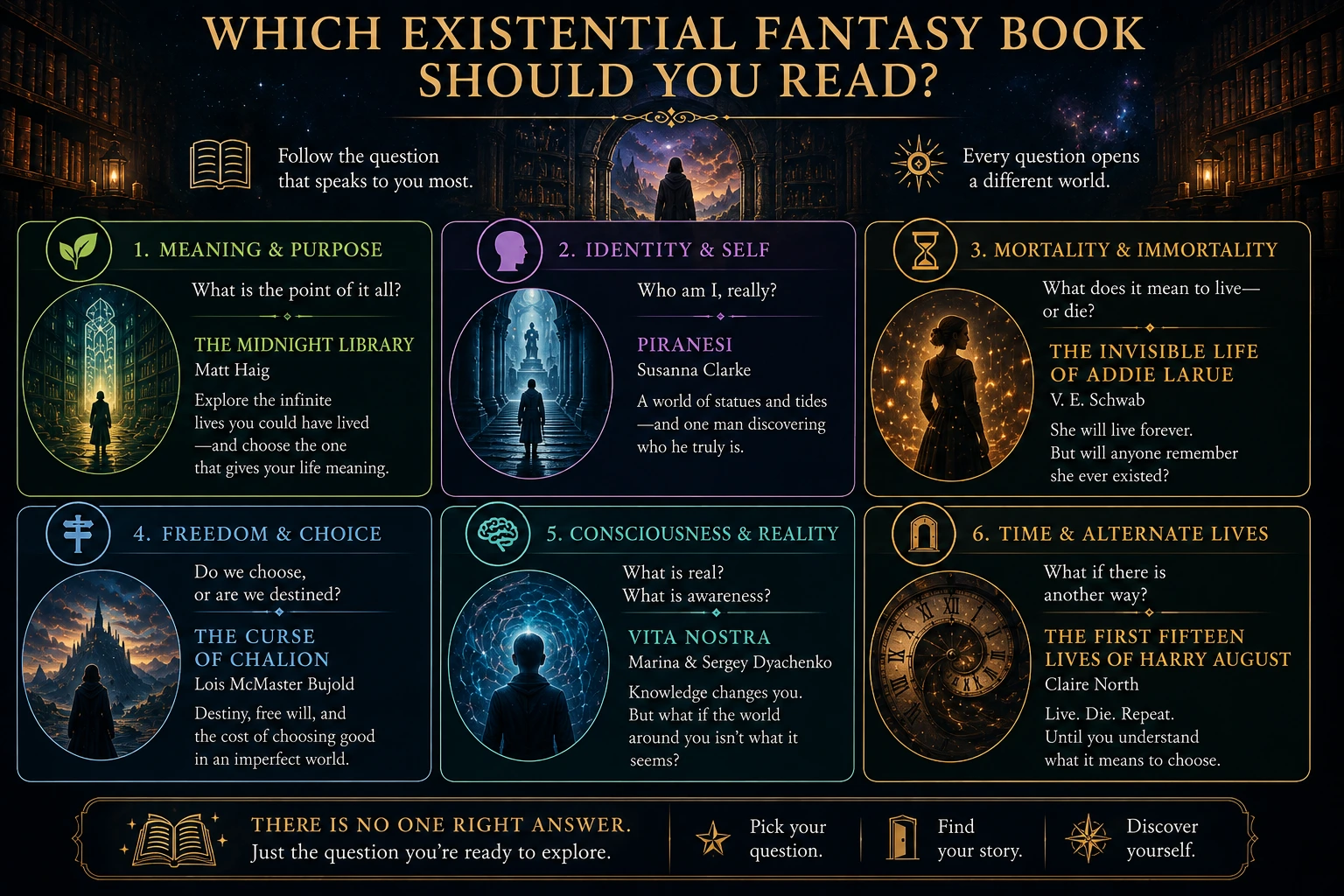
Consider six common examples:
- Immortality: you cannot die, so life loses its ordinary boundary. The question becomes: what gives life meaning?
- Memory loss: your past disappears, making identity unstable. The question becomes: what makes you the same person?
- Repeated lives: choices can be revisited. The question becomes: does choice still matter?
- Altered reality: perception becomes unreliable. The question becomes: what is real?
- Prophecy: the future seems written. The question becomes: do we truly choose?
- Parallel worlds: other versions of you exist. The question becomes: what makes any one life genuinely yours?
That transformation—from fantasy premise to existential question—is the key. The more effectively a story connects the impossible condition to the character’s identity, freedom, responsibility, or mortality, the more existential the fantasy becomes.
Why fantasy is so good at exploring existential questions
Existential questions are difficult partly because ordinary life hides them behind routine. Most of us do not wake up every morning consciously examining the metaphysics of identity or the philosophical meaning of mortality. Fantasy removes that insulation.
An immortal character cannot avoid thinking about time the way a mortal person can. A person living the same life repeatedly cannot treat choice as a one-time event. A character whose memories have been erased cannot casually assume that memory and identity are the same thing. A world whose laws can change forces both protagonist and reader to ask what counts as reality in the first place.
This is why fantasy can function like a thought experiment without feeling like an essay. Instead of asking “What would immortality do to meaning?” in the abstract, it gives us a person who has lived for centuries and still has to decide whether tomorrow matters. Instead of asking “What is personal identity?” it gives us a character whose memories, body, name, history, or world can change. Cokos explores the philosophical side of that question more directly in What Is Personal Identity?.
Fantasy also makes invisible assumptions visible. We assume time moves in one direction because ordinary experience gives us little reason not to. We assume death sets a boundary around life. We assume the world exists independently of our perception. We assume we are continuous with the person we were yesterday. Once a story breaks one assumption, all the others become easier to see.
The existential fantasy spectrum
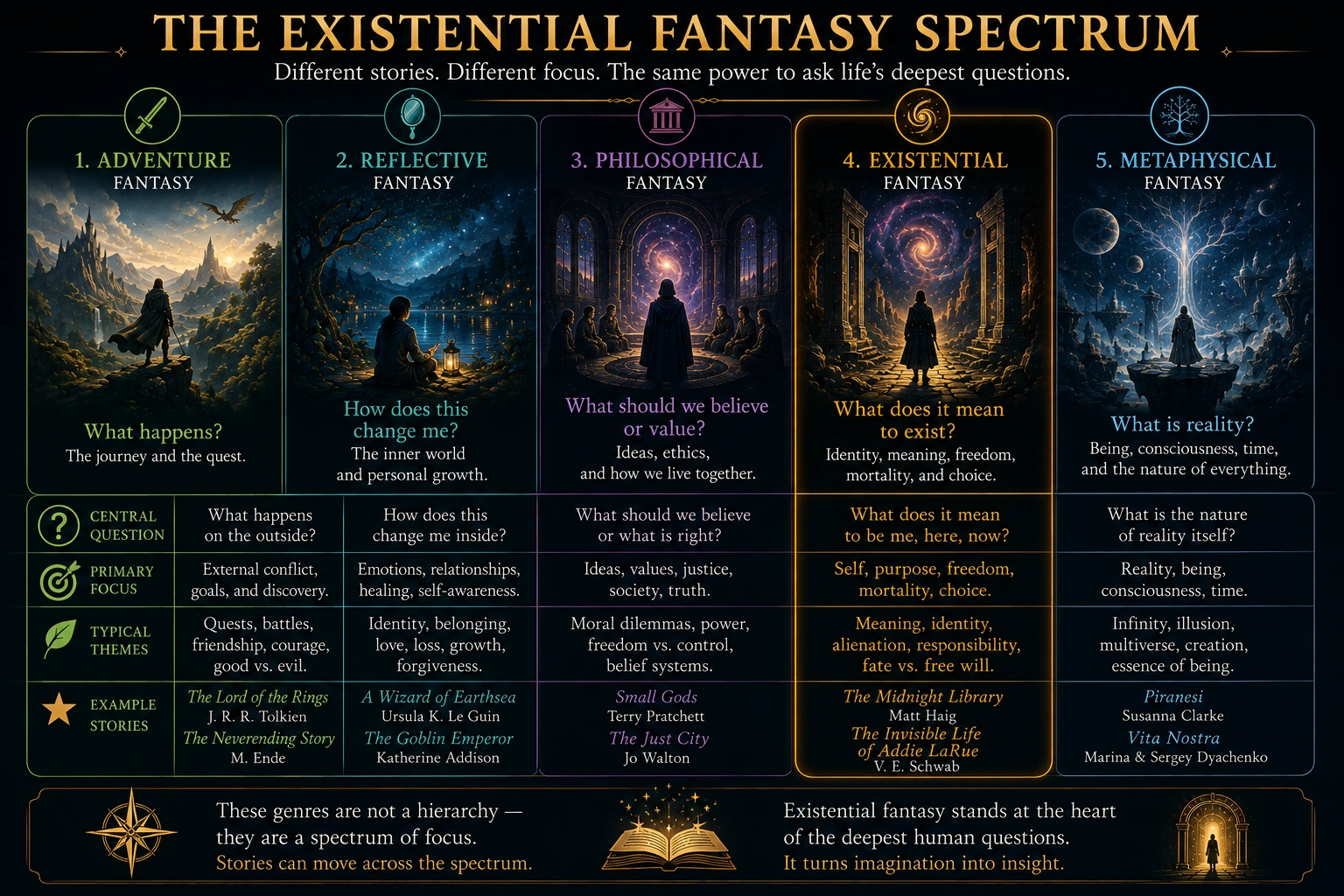
Existential fantasy is best understood as a focus, not as the top rung of a hierarchy. An adventure fantasy may contain profound ideas. A philosophical fantasy may become intensely personal. A metaphysical fantasy may ask deeply existential questions. Stories move across these modes depending on what they place at the center.
- Adventure fantasy: “What happens?” — quest, conflict, discovery.
- Reflective fantasy: “How does this change me?” — emotion, belonging, growth.
- Philosophical fantasy: “What should we believe or value?” — ethics, truth, society.
- Existential fantasy: “What does it mean to exist?” — identity, meaning, freedom, mortality.
- Metaphysical fantasy: “What is reality?” — being, consciousness, time, causality.
The most interesting books often cross several of these boundaries. Piranesi, for example, can be read as existential because it questions identity and as metaphysical because it destabilizes reality. Small Gods is philosophical in its treatment of belief and existential in its concern with individual moral responsibility.
An existential fantasy you can read free
cokos.org/ publishes the Eternity Saga, so rather than ranking our own fiction among the independent recommendations above, we are listing it separately.
Those Who Guard Eternity is for readers drawn to questions of eternity, consciousness, identity, responsibility, free will, reality, and what human beings owe to one another when the scale of existence becomes larger than an ordinary lifetime.
If the books on this list appeal to you because they use speculative worlds to test philosophical questions rather than simply decorate an adventure, this is the natural place to continue.
Read Those Who Guard Eternity free →
Related existential and philosophical reading
If you want to follow one question more deeply, Cokos has dedicated reading guides on books about consciousness, books about reality, books about eternity, and books that make you question reality. For the broader genre, see Philosophical Fantasy Books.
About the author
Denys Kostin is a Ukrainian author of philosophical fiction focused on time, choice, and reality. His work explores how human decisions influence the future and how unseen systems shape what we perceive as reality.
Frequently asked questions about existential fantasy books
What is existential fantasy?
Existential fantasy is fantasy that uses impossible worlds, magic, altered reality, immortality, memory, fate, or similar devices to explore questions about meaning, identity, freedom, mortality, responsibility, consciousness, and existence. The fantasy premise matters because it forces the characters to confront what it means to live, choose, change, or die.
What are the best existential fantasy books?
Strong starting points include Piranesi, A Wizard of Earthsea, The Buried Giant, The Midnight Library, The Invisible Life of Addie LaRue, Small Gods, and Vita Nostra. The best choice depends on whether you are most interested in identity, mortality, meaning, free will, consciousness, belief, or alternate lives.
Is existential fantasy the same as philosophical fantasy?
No. Philosophical fantasy is the broader category and can explore ethics, justice, truth, knowledge, politics, religion, or other philosophical problems. Existential fantasy is more specifically focused on the human condition: meaning, identity, freedom, mortality, alienation, responsibility, and what it means to exist.
What fantasy books explore the meaning of life?
The Midnight Library, A Wizard of Earthsea, The Last Unicorn, The Neverending Story, and The Invisible Life of Addie LaRue all explore meaning from different directions. Some focus on mortality, others on regret, identity, desire, or the value of a finite life.
What fantasy books deal with identity and reality?
Piranesi is an excellent starting point for identity and unreliable reality, while Vita Nostra explores transformation of consciousness and selfhood. The Buried Giant approaches identity through memory, and The Neverending Story explores how desire and imagination can reshape the self.
Final thought
The most memorable existential fantasy books do not give us easy answers. They change the conditions of existence and then ask us to notice what becomes important. Remove death, and meaning changes. Remove memory, and identity becomes uncertain. Repeat a life, and choice becomes strange. Make reality unstable, and knowledge becomes personal.
That is why these stories stay with us. Their worlds may be impossible, but the questions are not.