How do we know what is real? We cannot step outside consciousness and compare our experience with reality directly. Yet this does not make knowledge impossible. We become more confident that something is real when perception is supported by independent observation, reliable measurement, logical consistency, successful prediction, and repeated correction. Absolute certainty may remain beyond us, but we can build models of reality that become increasingly difficult to explain as illusion, coincidence, or error.
The answer is neither blind trust nor total skepticism. Perception can fail, but reality also constrains action, creates repeatable patterns, and exposes inaccurate expectations. We learn what is real by combining imperfect methods that correct one another.
How can an internal experience provide reliable knowledge of an external world?
You look at a mountain and assume that it is there. The experience feels immediate, yet consciousness does not receive the mountain itself. Light reaches the eyes, neural systems organize limited signals, and memory, attention, and expectation help the mind construct a coherent scene.
Table of Contents
- Three questions that should not be confused
- Why we never encounter reality without mediation
- Can we trust our senses?
- The main sources of knowledge
- Why one piece of evidence is rarely enough
- Evidence versus confirmation
- How science approaches reality
- Could everything still be an illusion?
- Certainty is not the same as knowledge
- Do different people experience different realities?
- How technology complicates reality
- The Cokos Reality Verification Framework
- Can we know reality exactly as it is?
- Experience the question through philosophical fiction
- Final answer
- Sources and further reading
- Frequently asked questions
Three Questions That Should Not Be Confused
Questions about reality, truth, and knowledge often appear to ask the same thing. They are closely connected, but each has a different focus. Keeping them separate prevents philosophical confusion and helps us decide what kind of evidence an answer requires.
1. What exists?
This is primarily an ontological question. It asks what belongs to reality: physical objects, minds, numbers, possibilities, values, time, consciousness, or something else. The Cokos article What Is Reality? examines this larger question.
2. What is true?
Truth concerns whether a statement, belief, or model accurately represents what is the case. “The mountain exists” is a claim. Its truth depends on the relationship between that claim and reality, not merely on how sincerely someone believes it. Continue with What Is Truth? for a fuller account of correspondence, coherence, practical success, and rational agreement.
3. What are we justified in believing?
This is the central question of epistemology. It asks how beliefs become responsible, supported, and reliable enough to count as knowledge. The question is not only whether a belief happens to be true. A lucky guess may be true without being knowledge because the person had no reliable way to reach it.
The broader foundations of justification are explored in What Is Knowledge?. The present article owns a narrower problem:
How can a limited human mind evaluate whether its experiences and beliefs correspond reliably to reality?
Cokos principle: Reality, truth, and knowledge are connected, but they are not the same question.
Why We Never Encounter Reality Without Mediation
Perception is often imagined as a transparent window through which the world simply enters the mind. In practice, external events produce physical signals; the senses detect only part of them; neural systems select and organize the input; and attention, memory, expectations, and learned categories shape the resulting experience.
The result is not a complete copy of reality. It is a usable internal model constructed from limited information.
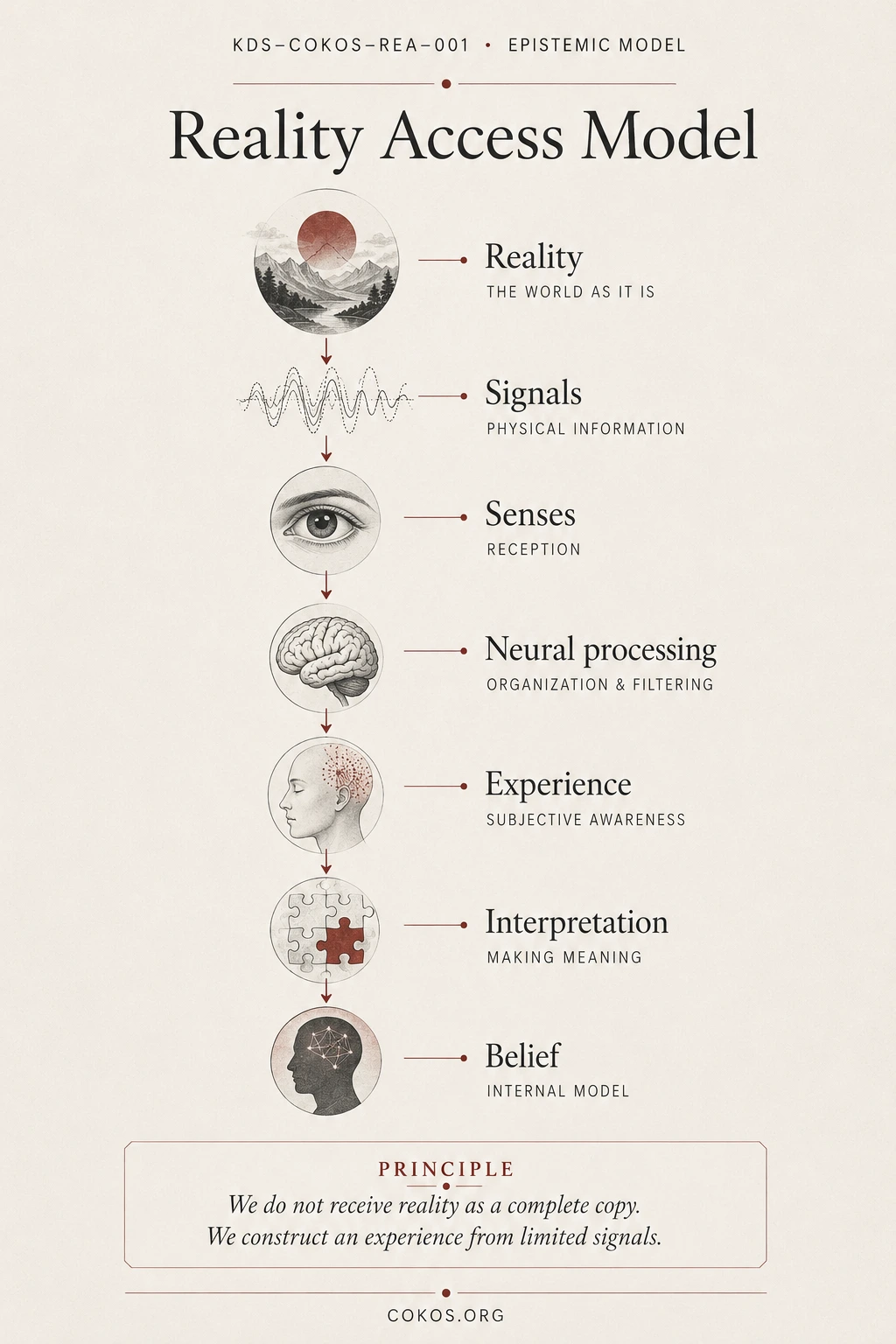
A map is not the territory, but it can still represent the territory well enough to guide action. In the same way, experience can be incomplete without being false. Research on predictive processing models of perception and on how expectations shape perception examines how incoming signals interact with prior models. These approaches remain active areas of research rather than one settled theory.
Mediation therefore explains both perceptual power and perceptual error. The world still limits which actions succeed, which predictions survive, and which experiences can be reproduced. For the subjective side of this process, see What Is Experience?; for the nature of conscious awareness itself, see What Is Consciousness?.
Mediated access does not mean imaginary access.
Can We Trust Our Senses?
We should trust perception neither absolutely nor dismissively. The senses are generally useful because organisms that consistently failed to detect important features of their environment would struggle to act successfully. Perception allows us to navigate, coordinate, avoid obstacles, recognize people, use tools, and learn from consequences.
But useful does not mean infallible.
Why perception is usually reliable enough
Perception is embedded in action. When you see a doorway and walk through it, the predicted space is confirmed by movement. When several people observe the same storm, instruments register falling pressure, and rain follows, different forms of information support one another. The external world creates stable patterns across time and across observers.
Perception becomes especially reliable when:
- conditions are clear rather than ambiguous;
- the senses are functioning normally;
- attention is directed toward the relevant feature;
- the observation can be repeated;
- other methods can check the result;
- the belief produces successful predictions and action.
Why perception sometimes fails
Illusions reveal that the mind does not merely record input. It interprets patterns using assumptions that are usually helpful. Ambiguous shapes may be read according to surrounding context. A sound can appear to come from the wrong location. A familiar word may be “seen” even when a letter is missing. Attention can be so focused on one task that an unexpected event goes unnoticed.
Dreams and hallucinations present a deeper challenge because an experience can feel vivid even when its apparent object is absent. Memory can also reshape earlier perception: what a person later expects, learns, or hears may influence how the original event is remembered.
What perceptual errors actually prove
They prove that perception is selective, constructive, and revisable. They do not prove that all experience is false or that nothing exists outside the mind.
In fact, identifying an illusion already depends on comparison. We discover that an appearance was misleading because another observation, measurement, perspective, or later consequence reveals the difference. Error becomes recognizable only within a larger system of correction.
Perception can mislead us, but the discovery of perceptual error also shows that better and worse descriptions of reality are possible.
The Main Sources of Knowledge
No single source gives us everything we know. Human understanding depends on several channels that extend and correct one another.
Perception
Perception provides immediate access to objects, events, and bodily states. Its weakness is perspective: one observer occupies one location, has limited senses, and may misinterpret ambiguous input.
Memory
Memory connects observations across time, but it is reconstructive rather than a perfect recording. Research on remembering and reconstruction shows why later knowledge and context can influence what is recalled.
Reason
Reason identifies contradiction, compares explanations, and connects evidence with conclusions. Valid reasoning still depends on the quality of its premises.
Testimony
Most human knowledge relies on other people. Testimony becomes stronger when a source has relevant access, competence, transparency, independence, and a record of correction. Repetition alone does not create independent confirmation.
Measurement and recorded evidence
Instruments extend perception and preserve observations for comparison. Measurements still require suitable tools, calibration, and interpretation.
Why the sources must work together
Perception supplies contact, memory connects events, reason organizes claims, testimony expands individual access, and measurement tests impressions. Knowledge becomes stronger when these sources expose one another’s weaknesses rather than operating in isolation.
Why One Piece of Evidence Is Rarely Enough
Suppose you see a distant light moving across the sky. Several explanations are possible: an aircraft, a satellite, a drone, a reflection, an astronomical object, or a visual error. The observation is genuine as an experience, but the explanation remains uncertain.
Confidence increases when independent lines of evidence converge:
- another observer reports the same motion;
- a camera records the path;
- timing and direction match a known satellite pass;
- the object appears where the explanation predicted;
- the observation can be repeated on another night.
No individual method must be perfect. What matters is that different methods have different weaknesses. Agreement becomes more meaningful when one source is not simply copying another and when the same error is unlikely to explain every result.
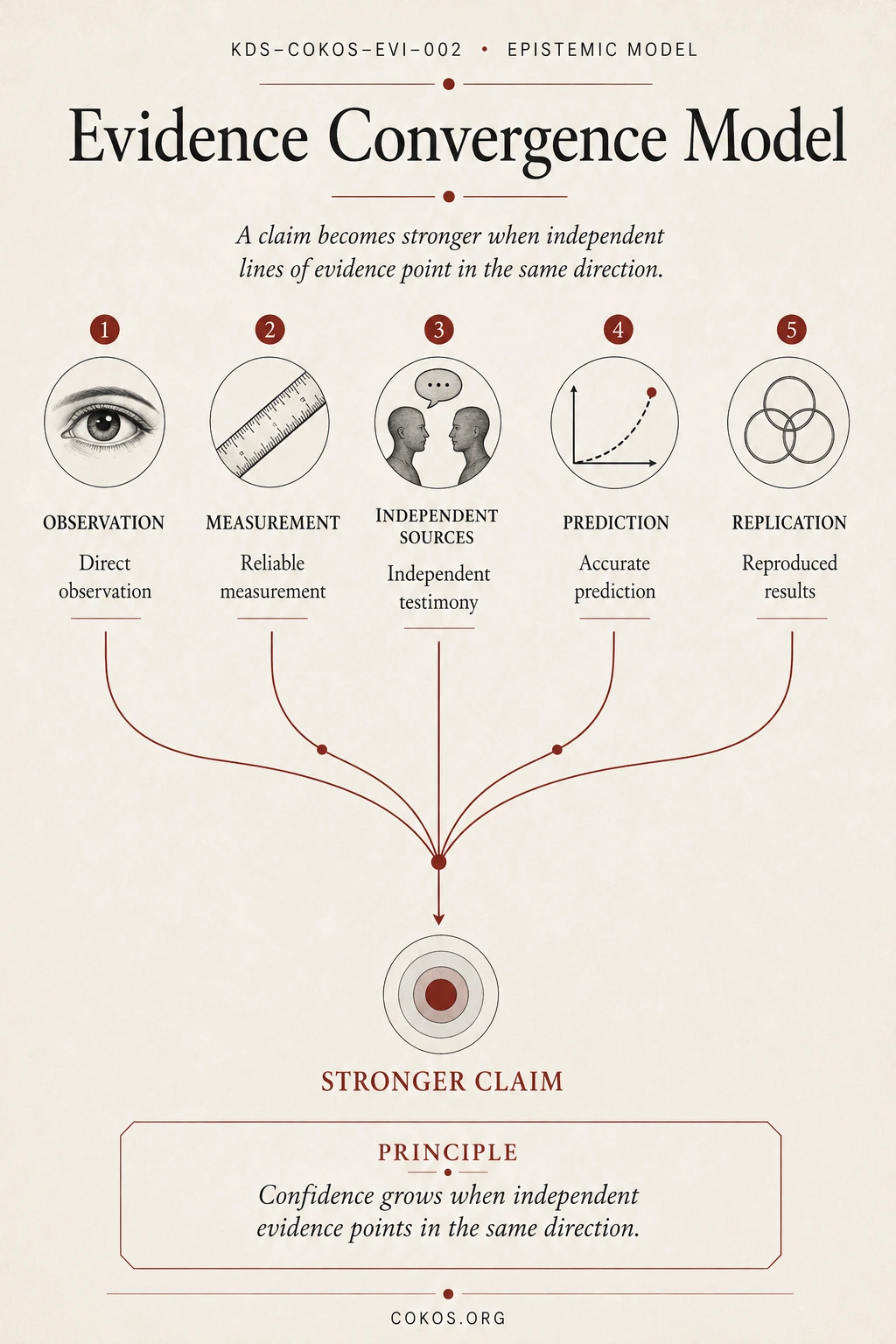
Observation
Did someone directly encounter the event? Under what conditions? Was the relevant feature actually visible or measurable?
Measurement
Can a reliable tool provide quantitative information? Was it calibrated and used appropriately?
Independent sources
Do observers or datasets agree without depending on one original report? Five websites repeating the same unverified claim are not five independent sources.
Prediction
Does the explanation tell us what should happen next? A model that predicts future observations is more informative than one invented only after every result is known.
Replication
Can the result be obtained again under specified conditions? Replication does not guarantee final truth, but it helps separate stable patterns from accidents, hidden errors, or one-time effects.
Reliable knowledge often emerges not from one perfect observation, but from multiple imperfect methods correcting one another.
The Difference Between Evidence and Confirmation
People naturally prefer information that supports what they already believe. This creates a dangerous confusion between evidence and confirmation.
Confirmation is the feeling that new information agrees with an existing belief. Evidence is information that can responsibly change our confidence in a claim—upward or downward.
A fair test must create some risk for the belief. If every possible result is interpreted as support, the process is not genuinely testing anything.
Questions that expose weak confirmation
- What result would count against this belief?
- Were the standards chosen before the outcome was known?
- Have alternative explanations been compared?
- Is the source independent, or is it repeating the original claim?
- Is negative evidence being ignored?
- Would the same reasoning be accepted if it supported the opposite conclusion?
- Does the claim make a specific prediction that could fail?
Evidence should not be treated as a collection of favorable examples. Its value depends on relevance, quality, independence, and the alternatives it helps distinguish.
Coherence is valuable but insufficient
A belief system can be internally consistent and still fail to describe the external world. Fictional worlds can be coherent. Mathematical structures can be valid without representing a particular physical system. A theory must therefore be tested not only against itself, but against observation and consequence.
Practical success matters but is not final proof
A model that works consistently deserves confidence. Still, useful approximations can succeed within a limited range without being complete descriptions of reality. Older scientific models may remain useful for ordinary calculation even after deeper theories reveal their limits.
The central discipline is therefore not simply collecting support. It is comparing how well competing explanations account for the same evidence.
How Science Approaches Reality
Science is not merely a collection of facts. It is a public system for developing and correcting explanations. A simplified cycle is:
Observation → hypothesis → prediction → test → comparison → revision
Methods differ across fields, but several principles recur.
Methods should be public
Other people should be able to examine how evidence was obtained, which assumptions were used, and how the conclusion followed. Transparency makes criticism possible.
Measurements must be connected to the phenomenon
An instrument reading is not automatically meaningful. Researchers must justify why the tool tracks the property being studied and which conditions could distort it.
Predictions should expose a model to failure
A model gains credibility when it successfully anticipates results rather than merely explaining them afterward. Persistent predictive failure demands investigation or revision.
Results should survive independent examination
Replication, reanalysis, peer criticism, and comparison with other datasets reduce dependence on one observer or method.
Scientific knowledge remains provisional
Provisional does not mean unreliable. It means confidence is proportional to evidence and open to improvement. The philosophy of scientific method and the study of theory and observation examine how evidence, models, and background assumptions interact.
Science is powerful not because scientists never make mistakes, but because its methods make mistakes easier to discover.
This dependence on representation and correction also connects to What Is Mind?.
Could Everything Still Be an Illusion?
Radical skepticism asks whether ordinary experience could be systematically misleading. Dreams, simulated worlds, and the brain-in-a-vat thought experiment all challenge the assumption that vivid experience guarantees an external object.
The dream problem
Dreams can feel real while they occur. Waking life, however, usually displays greater continuity, shared accessibility, stable memory, and responsiveness to deliberate testing. These features do not create absolute proof, but they provide practical grounds for distinguishing ordinary waking experience from most dreams.
The brain-in-a-vat problem
A perfectly stimulated brain might experience a world that was not externally present. The thought experiment reveals that evidence available within an experience may be unable to eliminate every logically possible alternative. Philosophers disagree about whether knowledge requires ruling out such scenarios. The brain-in-a-vat problem remains useful because it clarifies the limits of certainty.
The simulation possibility
A simulation is a possibility, not evidence. To become more than speculation, the hypothesis would need distinctive predictions or explanatory advantages. A claim compatible with every possible result may be impossible to test.
Why radical skepticism has limits
Even when certainty is unavailable, explanations can still be compared. We can ask which account requires fewer unsupported assumptions, explains more observations, survives independent testing, and predicts future results more accurately.
Ordinary realism explains the continuity, resistance, shared structure, and predictive regularity of experience without adding an undetectable mechanism that changes none of the expected observations.
The inability to eliminate every imaginable possibility does not make all explanations equally justified.
Certainty Is Not the Same as Knowledge
Many discussions collapse into a false choice:
- Either we possess absolute certainty.
- Or we know nothing.
Human knowledge usually exists between these extremes. Confidence can be graded according to evidence, reliability, independent agreement, explanatory power, and resistance to criticism.
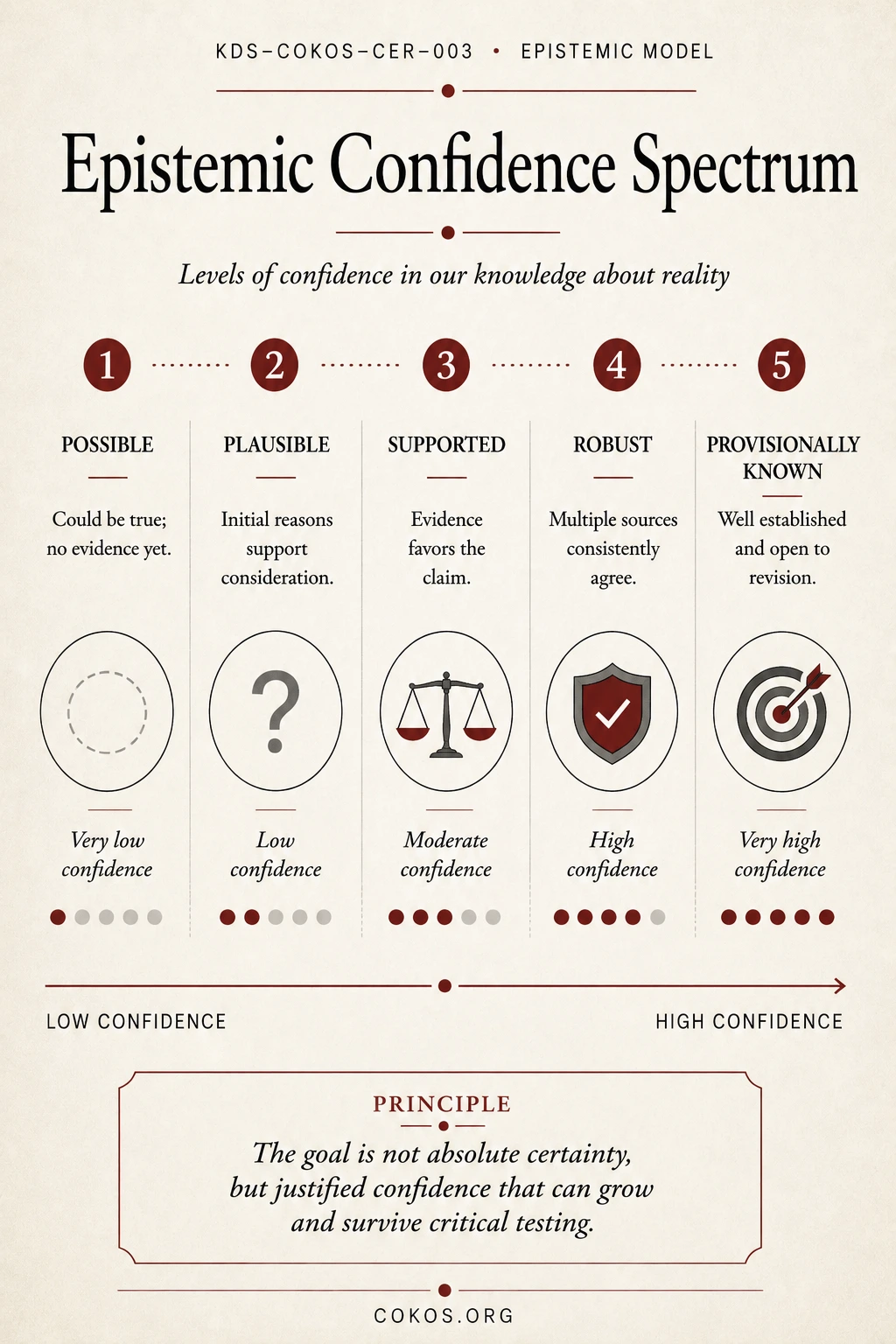
Possible
The claim could be true, but there is not yet supporting evidence. Logical possibility alone establishes very little because many incompatible claims may all be possible.
Plausible
The claim fits some background knowledge or has initial reasons in its favor. Plausibility justifies investigation, not acceptance.
Supported
Relevant evidence favors the claim over at least some alternatives. Confidence should rise, although important uncertainty remains.
Robust
Multiple independent sources and methods agree. The claim explains the evidence, survives serious challenges, and makes successful predictions.
Provisionally known
The claim is well established for present purposes. It may reasonably guide explanation, action, or further inquiry while remaining open to revision if stronger evidence appears.
This spectrum is an original Cokos educational model, not a universal scientific classification. Its purpose is to replace the language of total certainty with a more disciplined question:
How much confidence does the available evidence justify?
The article What Is Knowledge? explores why justification, truth, and reliable belief matter. The central insight here is simpler: the opposite of certainty is not necessarily ignorance.
Do Different People Experience Different Realities?
Two people can observe the same event and later describe it differently. They may focus on different details, interpret intentions differently, remember different sequences, or attach different emotional meanings. This is evidence that experience is perspectival. It does not automatically show that there were two external events or that every interpretation is equally accurate.
| Level | Core question | What can vary? |
|---|---|---|
| External event | What occurred? | The event itself may have objective features and constraints. |
| Perception | What was detected? | Position, sensory ability, attention, and visibility. |
| Experience | What was it like? | Emotion, bodily state, personal history, and salience. |
| Interpretation | What did it mean? | Expectations, beliefs, language, goals, and culture. |
| Claim | What is being asserted? | Precision, honesty, memory, and chosen wording. |
| Evidence | What can be checked? | Records, measurements, other observers, and consequences. |
Respecting subjective experience does not require abandoning standards of accuracy. A person can be completely sincere about what an event felt like while being mistaken about its cause. Another person may accurately identify a measurable fact while failing to understand its emotional significance.
Good inquiry therefore asks two separate questions:
- What was the experience like for this person?
- What explanation best fits the publicly available evidence?
Perspective explains disagreement, but perspective alone does not make every claim equally reliable.
This distinction also matters for personal identity. The observer is not a neutral camera. Every experience is integrated into a continuing model of self, memory, and world.
How Modern Technology Complicates Reality
Digital technology expands knowledge while making appearances easier to manufacture. A convincing image may depict an event that never occurred. A short video may omit the context that changes its meaning. A repeated claim may feel widely confirmed even when thousands of posts trace back to one unreliable source. Artificial intelligence can generate fluent explanations without independently verifying whether every claim is true.
The older rule “seeing is believing” is therefore insufficient.
Vividness is not evidence
Emotional intensity, visual realism, confidence, and detail can make content persuasive. None of these qualities proves that it accurately represents reality.
Repetition is not independence
Algorithmic systems can reproduce the same claim across many channels. Apparent consensus may be one source multiplied by distribution.
Source provenance matters
Ask where an item originated, whether the original is available, when it was created, who modified it, and whether independent records confirm its context.
Verification should match the importance of the claim
Not every statement requires an investigation. But claims that could significantly alter decisions, reputations, health, safety, public understanding, or financial choices deserve stronger verification.
A practical digital verification habit includes:
- locating the earliest available source;
- checking the full context rather than a cropped excerpt;
- distinguishing evidence from commentary;
- looking for independent reporting or primary records;
- checking whether dates, places, and identities are consistent;
- remaining cautious when content seems designed primarily to provoke immediate reaction.
For a broader examination of the relationship between statements and reality, continue with What Is Truth?.
The Cokos Reality Verification Framework
The following framework turns the philosophical problem into a repeatable practice. It is an original educational synthesis designed for evaluating claims, interpretations, and explanations. It is not presented as a universally accepted philosophical or scientific taxonomy.
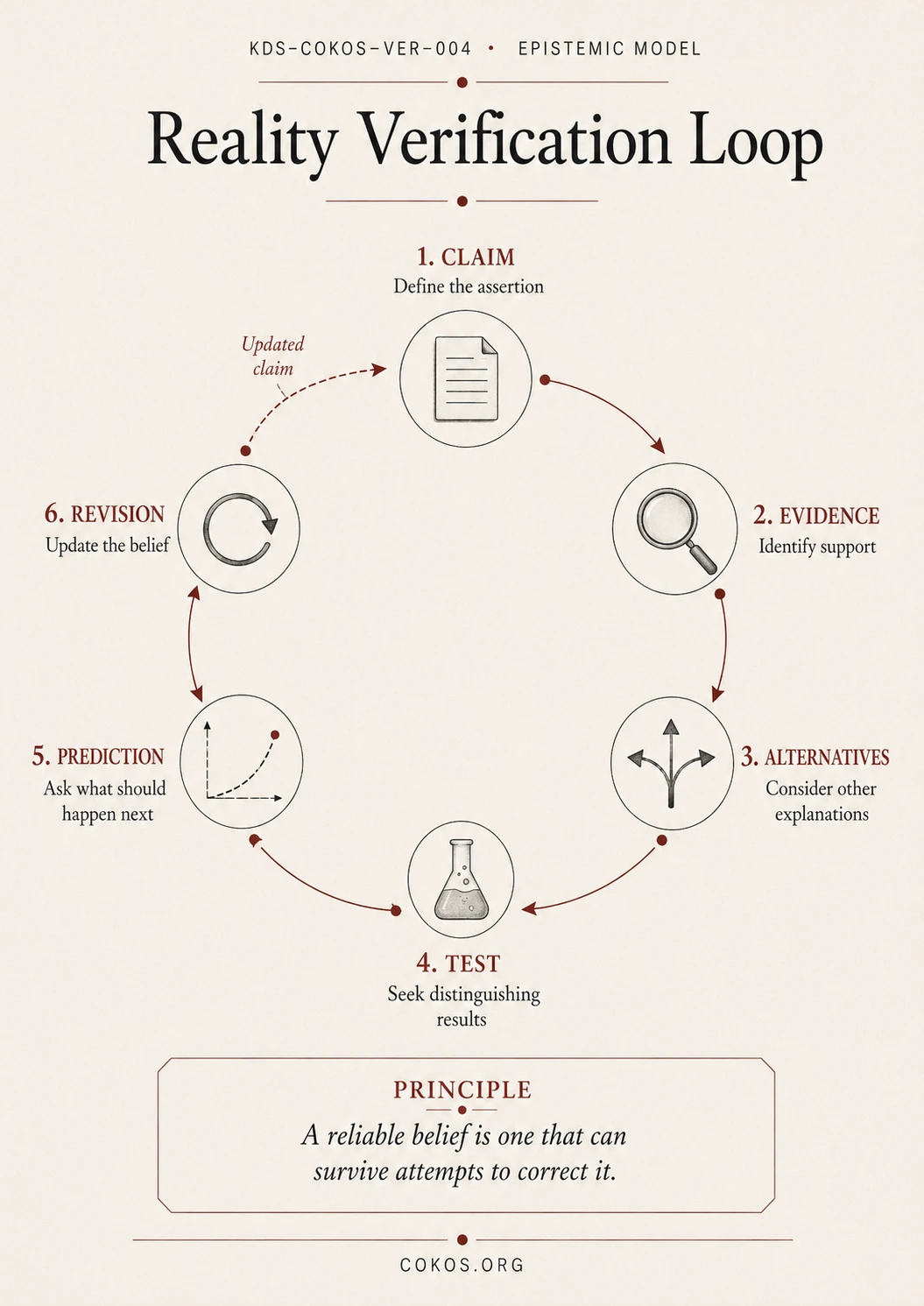
Step 1: Define the claim
State exactly what is being asserted. Vague claims can shift whenever evidence becomes inconvenient. Replace “something strange happened” with a description that identifies the event, time, location, object, relationship, or predicted outcome.
Ask:
- Is this a claim about an observation, a cause, an intention, or a future event?
- Which terms need definition?
- What would count as the claim being true?
Step 2: Separate observation from interpretation
Describe what was directly observed before explaining what it meant. “The light moved from left to right for ten seconds” is an observation. “It was an unknown spacecraft” is an interpretation.
This distinction does not make interpretation unnecessary. It makes the inferential step visible.
Step 3: Identify the evidence
List what supports the claim and evaluate the quality of each item. Consider directness, reliability, relevance, independence, and possible distortion.
Ask whether the evidence is:
- first-hand or repeated from another source;
- recorded or remembered;
- measured or estimated;
- independent or derived from the same origin;
- capable of supporting more than one explanation.
Step 4: Generate alternative explanations
A favored explanation should be compared with realistic alternatives. This reduces the risk of accepting the first story that fits.
Alternatives may include:
- measurement error;
- misperception;
- coincidence;
- selection bias;
- an unrecognized background factor;
- a different causal sequence;
- incomplete or misleading testimony.
Step 5: Seek distinguishing tests
A useful test produces different expected results for competing explanations. Repeating an observation under identical ambiguity may add little. The better question is: what evidence would be likely under one explanation but unlikely under another?
Step 6: Test predictive power
Ask what should happen next if the claim is correct. Prediction forces an explanation to face information it was not designed merely to fit after the fact.
Predictions should be specific enough that failure matters. A statement such as “something significant will happen eventually” can absorb almost any outcome and therefore provides little evidence.
Step 7: Look for possible falsification
Identify evidence that would weaken the claim. A person who cannot name any possible counterevidence may be protecting an identity or commitment rather than testing an explanation.
Step 8: Assign a confidence level
Use calibrated language:
- Possible: not ruled out;
- Plausible: worth considering;
- Supported: evidence favors it;
- Robust: independent methods consistently agree;
- Provisionally known: reliable enough to guide present understanding while remaining revisable.
Step 9: Revise the belief
Revision is not failure. It is the mechanism through which knowledge improves. A reliable belief should become stronger, weaker, narrower, or more precise as evidence changes.
A reliable belief is one that can survive attempts to correct it.
Can We Ever Know Reality Exactly as It Is?
Probably not in a complete, final, observer-independent way. Every investigation begins from a location, uses particular instruments and concepts, and operates within limited time. Models select features; measurements have resolution; language divides reality into categories; and new evidence can expose hidden assumptions.
Yet limited access does not make every model equally limited. A map that places a river on the wrong continent is worse than one accurate to within a few meters. A theory that predicts an eclipse is stronger than one that explains it only after the event.
Reality creates constraints:
- some actions succeed and others fail;
- some predictions are accurate and others are not;
- some observations can be reproduced;
- some measurements agree across instruments;
- some explanations survive criticism while others collapse.
Models can therefore improve without becoming final. Progress may mean greater precision, broader scope, better prediction, fewer unexplained exceptions, or stronger integration with other knowledge.
Intellectual humility is not indecision. It means matching confidence to evidence and remaining capable of revision.
We may not know reality completely, but we can know it better.
Experience the Question Through Philosophical Fiction
Philosophy can explain why certainty is difficult. Fiction can place a person inside that difficulty.
A character may discover that familiar reality rests on a hidden structure. Memory may preserve truth or conceal it. An apparently safe world may depend on assumptions no one is willing to question. The character must still choose and act before every uncertainty has been resolved.
Those Who Guard Eternity, the first novel in The Eternity Saga, explores time, reality, consciousness, truth, and human choice through philosophical fantasy. Its central conflict begins when the ordinary understanding of reality starts to fracture and the choice between truth and safety can no longer be avoided.
This makes fiction more than an illustration. It becomes a simulation of epistemic responsibility: what should a person do when evidence is incomplete, inherited explanations no longer hold, and refusing to choose is itself a choice?
Readers who want more stories about perception, memory, time, and unstable worlds can explore books that make you question reality.
Read Those Who Guard Eternity online for free →
Final Answer: How Do We Know What Is Real?
We know what is real not by escaping perception, but by correcting it.
A single experience can mislead. A memory can change. A source can be mistaken. An instrument can fail. A theory can protect itself from criticism. But independent observation, reliable measurement, logical analysis, competing explanations, predictive success, replication, and continued revision create a stronger connection between belief and reality.
We should therefore avoid two extremes:
- naive certainty, which assumes that appearance is always reality;
- total skepticism, which assumes that imperfect access makes knowledge impossible.
The more responsible position is calibrated realism. An external world appears to constrain experience, produce shared patterns, and reward accurate models. Our access to that world is mediated and incomplete, but it can improve.
Absolute certainty may remain beyond us. Justified confidence does not.
The deepest test of a belief is not whether it feels obvious, comforting, popular, or vivid. It is whether the belief continues to explain reality after serious attempts have been made to correct it.
Sources and Further Reading
The philosophical and scientific distinctions in this article were developed with reference to the following academic resources:
- Stanford Encyclopedia of Philosophy — Epistemological Problems of Perception
- Stanford Encyclopedia of Philosophy — Epistemology
- Stanford Encyclopedia of Philosophy — Theory and Observation in Science
- Stanford Encyclopedia of Philosophy — Scientific Method
- Stanford Encyclopedia of Philosophy — Epistemological Problems of Testimony
- Stanford Encyclopedia of Philosophy — Brains in a Vat
- PubMed — An Introduction to Predictive Processing Models of Perception and Decision-Making
- PubMed — How Do Expectations Shape Perception?
- PubMed — From Remembering to Reconstruction
The Reality Access Model, Evidence Convergence Model, Epistemic Confidence Spectrum, and Reality Verification Loop are original Cokos educational syntheses. They organize established ideas for explanation and practical reflection; they are not presented as universally accepted scientific taxonomies.
Frequently Asked Questions
How do we know what is real?
We increase confidence that something is real when perception is supported by independent observation, reliable measurement, logical consistency, successful prediction, and repeated testing. No single experience guarantees truth, but different methods can correct one another and weaken competing explanations.
Can we trust our senses?
Our senses are useful but not infallible. They provide essential access to the environment while remaining vulnerable to illusion, limited attention, expectation, and ambiguous input. Perception is most trustworthy when observations can be repeated and checked through other people, instruments, or consequences.
What is the difference between reality and perception?
Reality refers to what exists or occurs. Perception is the process through which an organism detects and interprets signals related to it. Perception may represent the world accurately, incompletely, or mistakenly; it is access to reality, not necessarily a complete copy.
How do we know that we are not dreaming?
Absolute proof may be unavailable, but waking experience usually has greater continuity, shared accessibility, stable causal structure, and responsiveness to testing. These features give practical grounds for distinguishing ordinary waking life from most dreams.
Can two people experience different realities?
People can have different perceptions, emotions, memories, and interpretations of the same event. Their subjective experiences may differ substantially. This does not automatically mean that two external events occurred or that every factual interpretation is equally well supported.
Does evidence prove something with certainty?
Evidence usually changes the justified level of confidence rather than creating absolute certainty. A claim becomes robust when independent sources converge, predictions succeed, and serious alternatives weaken. Even strong knowledge remains open to revision if better evidence appears.
How does science determine what is real?
Science develops testable explanations, connects measurements to observable phenomena, compares predictions with results, exposes methods to criticism, and revises models when they fail. Conclusions become stronger when independent researchers and methods produce consistent evidence.
Could we be living in a simulation?
A simulation is philosophically possible, but possibility is not evidence. The claim would need distinctive predictions or explanatory advantages to gain empirical support. A hypothesis compatible with every possible result may remain untestable speculation.
Can humans know reality exactly as it is?
Human knowledge is limited by perspective, senses, instruments, concepts, and evidence. A complete observer-independent description may be unreachable. Nevertheless, models can become more accurate, precise, predictive, and integrated.
What is the Cokos Reality Verification Framework?
It is an educational process for evaluating claims: define the assertion, separate observation from interpretation, identify evidence, generate alternatives, seek distinguishing tests, evaluate predictions, identify possible falsification, assign confidence, and revise the belief when evidence changes.