The best books like Piranesi depend on what you want to carry out of the House. Start with The Starless Sea for hidden spaces and lyrical wonder, The Memory Police for memory and identity, or I Who Have Never Known Men for a solitary voice trying to understand an unexplained world. For more of Susanna Clarke’s writing, choose Jonathan Strange & Mr Norrell—with time set aside for a much longer journey.
None recreates the exact combination of mystery, tenderness, and strangeness that makes Piranesi distinctive. These twelve recommendations each share a particular part of its appeal. The comparisons below explain that connection and the difference that could determine whether a book works for you.
Spoiler note: this guide discusses premises and reading experience without revealing Piranesi’s central revelations or the endings of the recommended books.
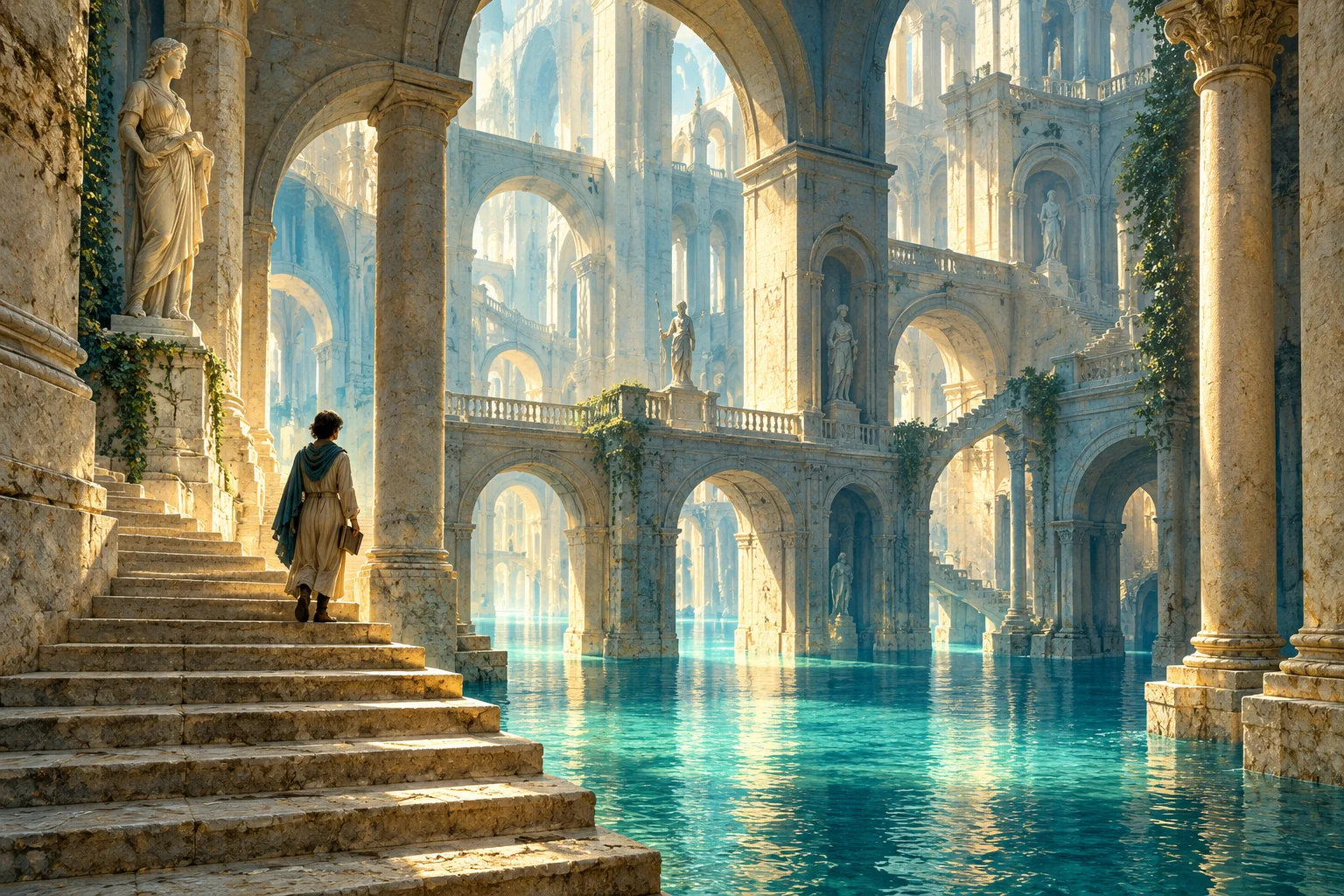
Books like Piranesi at a glance
The table is a guide to fit, not a ranking of literary quality. “Reading commitment” describes structure and emotional intensity as well as length. A short book can be the more demanding choice.
| Book and author | Shared appeal | Tone | Reading commitment |
|---|---|---|---|
| The Starless Sea Erin Morgenstern | Hidden worlds and lyrical wonder | Romantic, expansive | Layered stories; a longer read |
| The Memory Police Yōko Ogawa | Memory and a fragile sense of self | Quiet, oppressive | Clear prose; sustained unease |
| I Who Have Never Known Men Jacqueline Harpman | Isolation in an unexplained world | Austere, deeply bleak | Direct prose; emotionally demanding |
| A Short Stay in Hell Steven L. Peck | Vast architecture and existential solitude | Bleak, disorienting | Short novella; disturbing implications |
| The Ten Thousand Doors of January Alix E. Harrow | Doorways, discovery, and belonging | Adventurous, emotionally warmer | More conventional narrative momentum |
| The Buried Giant Kazuo Ishiguro | Memory, love, and the cost of knowing | Melancholy, morally unsettling | Slow journey; reflective dialogue |
| Invisible Cities Italo Calvino | Imagined places and attentive observation | Contemplative, dreamlike | Brief pieces; little conventional plot |
| The Third Policeman Flann O’Brien | Unfamiliar rules and unstable explanations | Darkly comic, absurd | Deliberate contradictions and digressions |
| Annihilation Jeff VanderMeer | Observation inside an unknowable place | Eerie, threatening | Compact; deliberately unresolved questions |
| House of Leaves Mark Z. Danielewski | Impossible architecture and layered evidence | Intense, claustrophobic horror | Long; experimental page design |
| The Lathe of Heaven Ursula K. Le Guin | Unstable reality and the ethics of control | Philosophical, unsettling | Relatively concise; idea-driven |
| Jonathan Strange & Mr Norrell Susanna Clarke | Clarke’s prose and elusive magic | Witty, expansive, sometimes dark | Very long historical fantasy |
What did you love most about Piranesi?
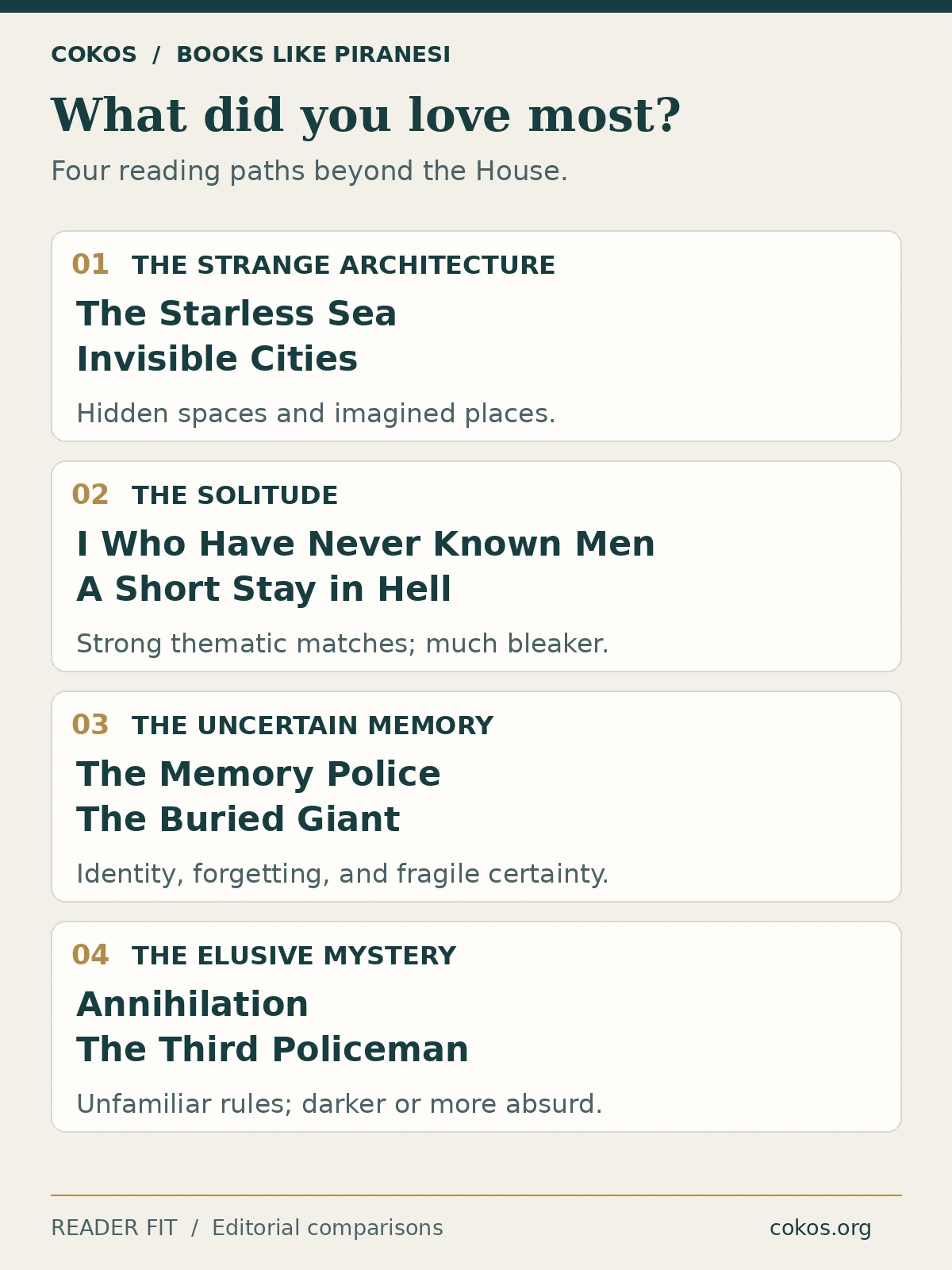
A useful recommendation begins with a specific memory of reading the book. Was it the space itself, the narrator’s attention, or the growing sense that your understanding could be wrong?
- The House and its architecture: try The Starless Sea for a hidden world or Invisible Cities for places that become ideas. Choose House of Leaves only if you also want horror.
- Solitude and an unfamiliar life: try I Who Have Never Known Men. For enormous spaces and existential dread in a shorter form, choose A Short Stay in Hell.
- Memory and identity: try The Memory Police or The Buried Giant. Both make forgetting an intimate problem with consequences beyond one person.
- A mystery governed by unfamiliar rules: try Annihilation for unsettling observation or The Third Policeman for dark absurdity.
If it was mainly the tenderness you want to preserve, be cautious about following architectural similarity alone. A beautiful impossible place and a frightening impossible place can produce very different reading experiences.
12 books to read after Piranesi
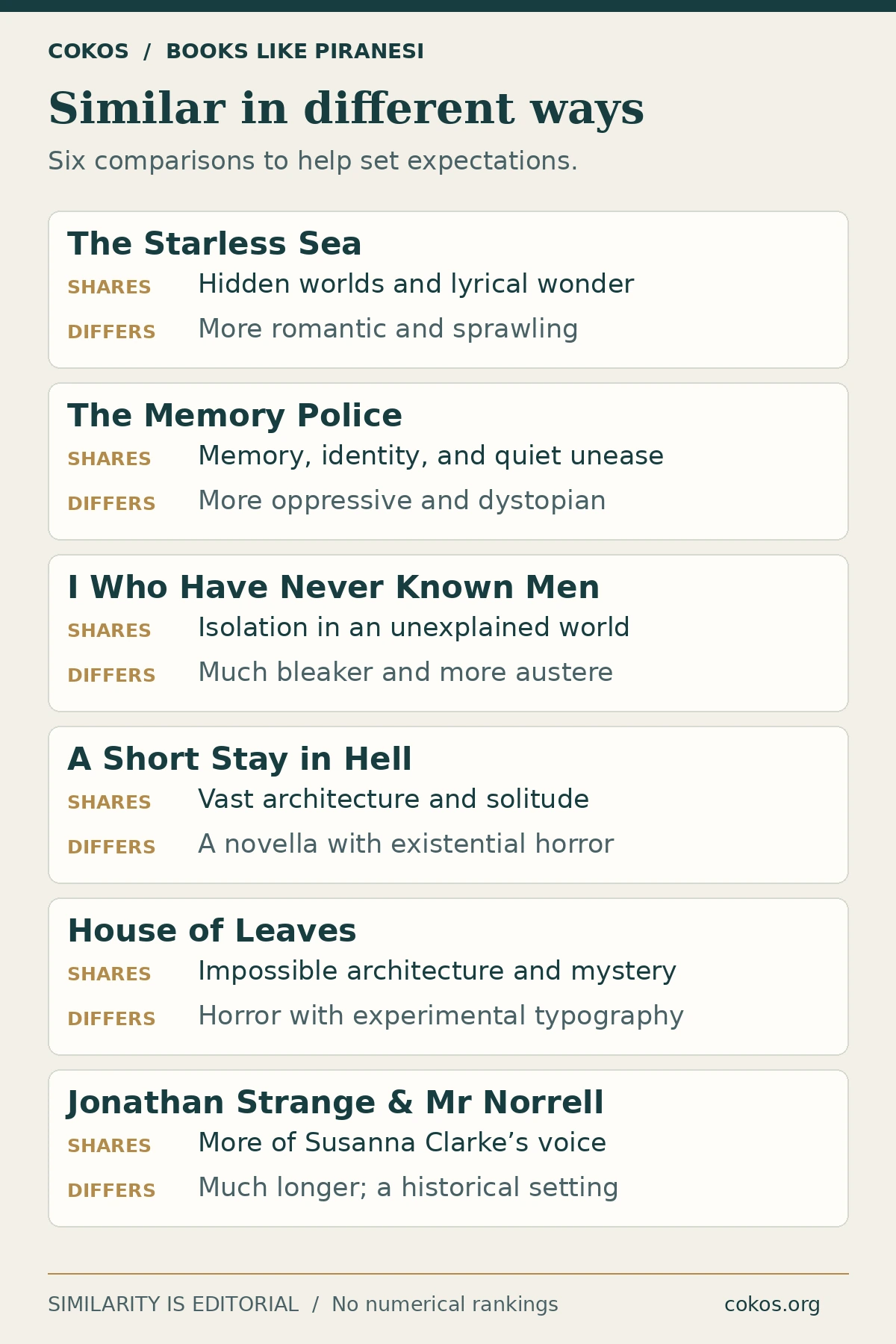
These selections cross literary fantasy, speculative fiction, science fiction, and horror. Similarity judgments are editorial interpretations. Linked publisher and author pages support the premises and book details; they do not imply an endorsement of these comparisons. For a wider exploration of the genre, see our philosophical fantasy reading guide.
1. The Starless Sea — Erin Morgenstern
Best for: hidden worlds and lyrical wonder.
Zachary Ezra Rawlins discovers a book that appears to contain a scene from his own childhood. Following its clues draws him toward a hidden underground library and a world in which stories are more than records of things that happened.
The strongest connection to Piranesi is the pleasure of inhabiting an extraordinary place. Rooms, passages, objects, and symbols invite attention before their significance becomes clear. Choose this if the House made you want to wander slowly, looking closely at everything.
The difference is scale and emotional emphasis. Morgenstern offers a more romantic, crowded, elaborately interwoven experience. If you loved Clarke’s spare focus on one voice, the abundance of nested tales may feel like a detour. If you wanted more doors to open, it is part of the attraction.
Book details: The Starless Sea — publisher’s page.
2. The Memory Police — Yōko Ogawa
Best for: memory and a fragile sense of self.
On an island, objects disappear and most people lose their memories of them. Those who can still remember become targets of the Memory Police. A novelist attempts to protect someone whose memory puts him at risk. The English translation is by Stephen Snyder.
This is a strong choice if Piranesi left you thinking about the relationship between memory and identity. Both books make gaps in understanding emotionally significant: what you cannot remember affects whom you trust and what you believe is possible.
Expect a different kind of atmosphere. Ogawa’s world feels increasingly constrained, with institutional power pressing against private life. It offers less of the House’s spacious beauty. Choose it for the intimacy of resistance and the disturbing possibility that people can adapt to losses they can no longer name.
Book details: The Memory Police — publisher’s page.
3. I Who Have Never Known Men — Jacqueline Harpman
Best for: isolation in an unexplained world.
A young girl lives imprisoned underground with thirty-nine women, watched by guards whose intentions remain unclear. Her understanding of life is shaped by this confinement and by the older women’s fragments of experience. The English translation is by Ros Schwartz.
The connection to Piranesi lies in a consciousness formed under extraordinary conditions. Ordinary assumptions cannot simply be borrowed from the reader’s world. Knowledge must be assembled through observation, conversation, and the difficult work of continuing to live.
This is one of the strongest thematic matches here, but a poor choice if you mainly want reassurance. Harpman’s emotional landscape is much harsher. Read it for questions about human connection and meaning when explanations are unavailable; do not approach it as a puzzle that promises to account neatly for every strange detail.
Book details: I Who Have Never Known Men — publisher’s page.
4. A Short Stay in Hell — Steven L. Peck
Best for: vast architecture and existential solitude.
After death, Soren Johansson finds himself in an immense library. Escape depends on finding the book that records his life. The premise is easy to grasp; the implications of the space and the task are harder to live with.
If the scale of the House fascinated you, this novella explores how architecture can change the meaning of a human life. Distance and duration stop being background measurements and become the central pressure of existence. It is a compact way to pursue the question of what a person does inside a world that exceeds comprehension.
The crucial difference is emotional. Piranesi allows beauty and care to coexist with uncertainty. Peck leans toward existential horror. Its brevity makes it a quick reading commitment, but not necessarily a gentle experience afterward.
Book details: A Short Stay in Hell — publisher’s page.
5. The Ten Thousand Doors of January — Alix E. Harrow
Best for: doorways, discovery, and belonging.
January Scaller grows up in the household of a wealthy collector. Finding a mysterious book begins to change her understanding of her own history and of the doors that may connect different worlds.
Choose this if your favorite part of Piranesi was the sense that reality might contain places no accepted map can show. It also suits readers drawn to questions of belonging: who gets to describe your life, which stories you inherit, and whether you can step outside the role someone else has assigned you.
Harrow provides more outward adventure and a more recognizable coming-of-age movement than Clarke’s intimate mystery. There is danger and cruelty, but the reading experience is less austere than the bleaker selections here. It is a useful next choice when you want discovery and emotional connection to carry the story forward.
Book details: The Ten Thousand Doors of January — publisher’s page.
6. The Buried Giant — Kazuo Ishiguro
Best for: memory, love, and the cost of knowing.
In a post-Arthurian Britain affected by a mist of forgetting, an elderly couple, Axl and Beatrice, set out to find their son. Their uncertain memories place even familiar relationships on unstable ground.
The link to Piranesi is the emotional weight of incomplete knowledge. Remembering is not merely a way to solve a mystery; it can alter the life that seemed possible before the missing information returned. Ishiguro extends that concern from individuals to communities and their histories.
This is a better fit for readers who want tenderness entangled with difficult questions than for those seeking another architectural labyrinth. Its pace is measured, its conversations deliberately restrained, and its fantasy elements serve a sustained inquiry into love, grievance, and forgetting. Choose it when you are willing to sit with competing moral claims.
Book details: The Buried Giant — publisher’s page.
7. Invisible Cities — Italo Calvino
Best for: imagined places and attentive observation.
Marco Polo describes imagined cities to Kublai Khan. These short accounts turn architecture, habits, desires, and memories into ways of thinking about human experience. The English translation is by William Weaver.
If you loved pausing over the House’s spaces more than following the mystery, Invisible Cities may be the most rewarding departure on this list. It invites the same habit of looking at a place until it becomes more than a setting. A city can become a question about longing, perception, or what people choose to preserve.
The major difference is structure. There is no equivalent of Clarke’s steadily developing central investigation. Read a few pieces at a time and allow their connections to accumulate. Choose this for the pleasure of imaginative attention, rather than for a protagonist whose fate pulls you through every chapter.
Book details: Invisible Cities — publisher’s page.
8. The Third Policeman — Flann O’Brien
Best for: unfamiliar rules and unstable explanations.
A narrator involved in a violent crime encounters policemen, bizarre theories, and a world whose apparent logic grows stranger under examination. Even the explanations can make the situation less comprehensible.
This is a useful recommendation for the part of Piranesi that makes you question your initial interpretation of events. Both invite the reader to notice the distance between a narrator’s account and a secure understanding of the world. O’Brien, however, turns that uncertainty toward philosophical comedy and menace.
Do not expect a close match for Piranesi’s generosity or the House’s beauty. The appeal is the friction between confident reasoning and increasingly impossible conclusions. Choose it if you enjoy being wrong-footed by a book and can let an absurd proposition remain funny and disturbing at the same time. Avoid detailed plot summaries before reading.
Book details: The Third Policeman — publisher’s page.
9. Annihilation — Jeff VanderMeer
Best for: observation inside an unknowable place.
A biologist joins an expedition into Area X, a region that resists ordinary explanation. Recording what she observes does not guarantee that she understands it, or that the language available to her is adequate to describe it.
The strongest connection to Piranesi is the experience of learning a strange environment through a limited first-person perspective. Attention matters, yet close observation can reveal how little the observer knows. The setting feels like an active challenge to the assumptions brought into it.
VanderMeer’s emphasis is ecological and unsettling, with bodily threat and horror taking the place of much of Clarke’s gentleness. Choose it for the beautiful-uncanny boundary, not for comfort. It is the first book in the Southern Reach series, so readers who want to pursue the wider mystery have further books to explore.
Book details: Annihilation — publisher’s page.
10. House of Leaves — Mark Z. Danielewski
Best for: impossible architecture and layered evidence.
A house proves to be larger inside than its exterior permits. Accounts of its impossible spaces arrive through layers of commentary, documents, and unstable testimony. The physical arrangement of the text becomes part of the reading experience.
The architectural connection to Piranesi is immediate: a building cannot be reduced to a reliable floor plan. Both books can make the act of measuring or recording feel inadequate. Here, however, the reader must also navigate the book’s own formal complications.
This is the largest tonal and structural jump among the obvious House-related recommendations. It is horror, and its typography, footnotes, and interruptions demand patience. Choose it if you want an arduous labyrinth on the page. If Clarke’s clarity and warmth were essential to your enjoyment, start with another book on this list.
Book details: House of Leaves — publisher’s page.
11. The Lathe of Heaven — Ursula K. Le Guin
Best for: unstable reality and the ethics of control.
George Orr’s dreams can alter reality. When another person attempts to direct that power, the question becomes larger than whether the world can be changed: who should decide what counts as an improvement?
This belongs on a list of books like Piranesi for readers interested in perception, vulnerability, and the danger of treating another person as a means to an end. The connection is ethical as much as atmospheric. Knowledge and power do not automatically produce wisdom.
Expect a more explicit science-fiction premise and a more direct examination of intervention and unintended consequences. There is no equivalent of the House’s sustained architectural wonder. Choose it if the uncertainty in Piranesi made you think about who gets to define reality, and whether accepting limits can sometimes be more humane than imposing a grand design.
Book details: The Lathe of Heaven — author’s website.
12. Jonathan Strange & Mr Norrell — Susanna Clarke
Best for: Clarke’s prose and elusive magic.
In an alternative nineteenth-century England, practical magic returns through two very different magicians. Their ambitions unfold against a broad historical and social background, with magic carrying consequences beyond what its practitioners intend.
This is the obvious next step if the attraction was Susanna Clarke’s writing itself: her precise control of tone, her dry humor, and the feeling that magic has a history larger than any one character can master. It offers much more time inside her imaginative world.
It is also important to reset expectations. This is a sprawling historical fantasy with a large cast and extensive footnotes, rather than another short, tightly focused novel. Choose it when you want immersion over many reading sessions. If you only want another book with Piranesi’s pace and structure, shared authorship is not enough to make it the closest match.
Book details: Jonathan Strange & Mr Norrell — publisher’s page.
Which one should you read next?
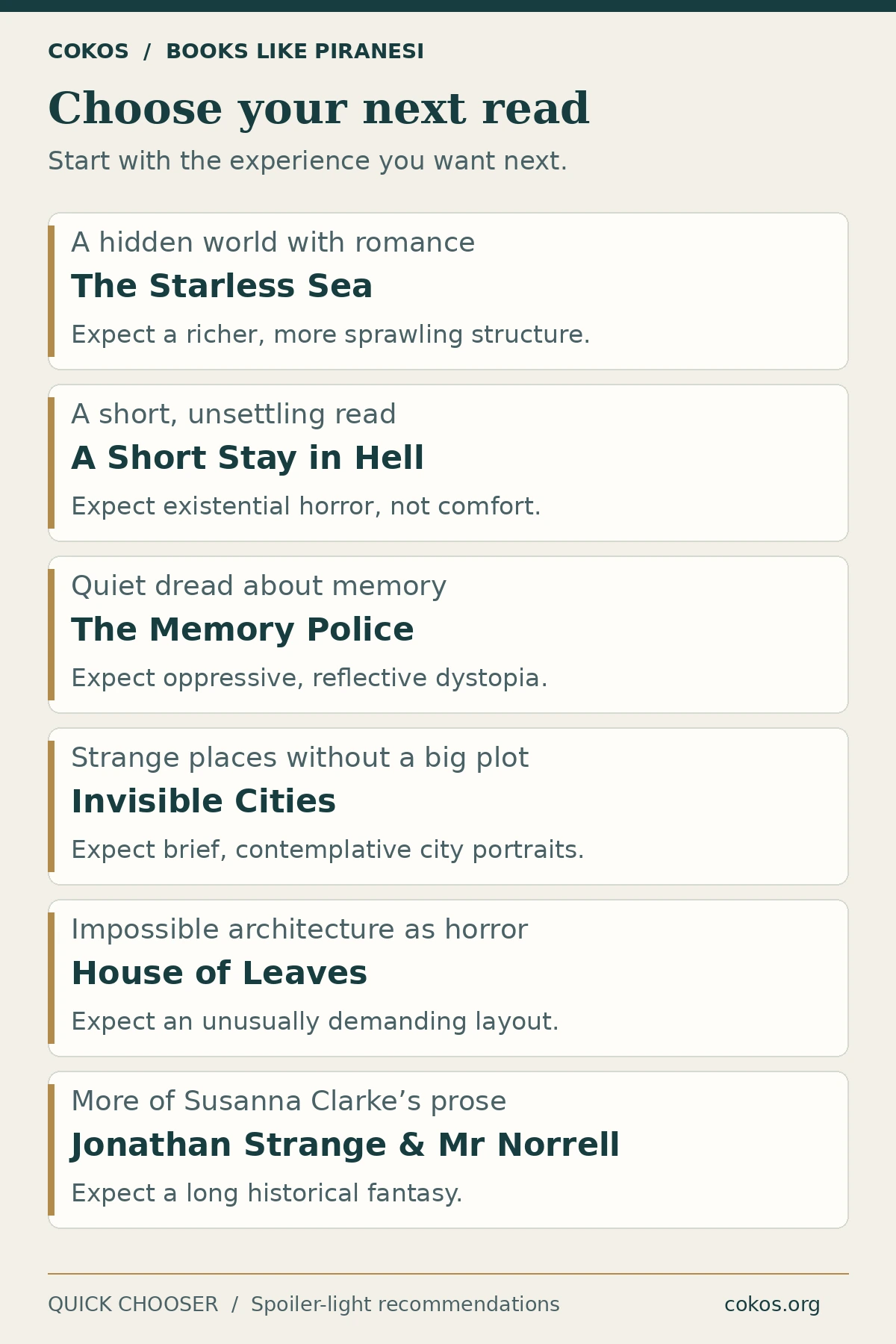
If you are still deciding, start by ruling out the experience you do not want right now. That is often more useful than searching for the single “closest” book.
- Want wonder with a stronger romantic thread? Start with The Starless Sea. Give its interwoven stories room to develop.
- Want a concise book that will unsettle you? Choose A Short Stay in Hell. Its short form does not soften its implications.
- Want an intimate story about memory? Choose The Memory Police. Choose The Buried Giant instead if love and collective forgetting interest you more.
- Want beautiful strange places without a large plot? Read Invisible Cities slowly, a few pieces at a time.
- Want a more accessible adventure through hidden worlds? Try The Ten Thousand Doors of January.
- Want an ambitious, demanding horror experience? Choose House of Leaves when you have the attention for its unusual form.
Readers drawn most strongly to unstable perception can continue with our books that make you question reality. For the questions of isolation and meaning, explore existential fantasy books. If forgetting is the thread you want to follow, see books about memory.
What should you read next by Susanna Clarke?
Jonathan Strange & Mr Norrell is the substantial next step: a different structure and setting, with much more room for Clarke’s historical imagination. You do not need to read it to understand Piranesi.
For a much smaller commitment, The Wood at Midwinter is an illustrated short story, with illustrations by Victoria Sawdon. It follows a young woman who can speak with animals and trees. Choose it for a brief encounter with Clarke’s sense of enchantment, rather than expecting another full-length novel. It is a bonus suggestion, separate from the twelve books above.
Frequently asked questions
What is the closest book to Piranesi?
There is no single match across setting, voice, mystery, and tone. The Starless Sea is a strong starting point for hidden spaces and wonder; I Who Have Never Known Men is closer to the experience of understanding an unfamiliar world through an isolated narrator. The latter is much bleaker.
Which books like Piranesi are less focused on horror?
Try The Ten Thousand Doors of January for adventure and belonging, The Starless Sea for romantic fantasy, or Invisible Cities for contemplation. None is a promise of an entirely gentle story, but they are better starting points than House of Leaves, Annihilation, or A Short Stay in Hell if horror is not what you want.
What should I read if I loved the House in Piranesi?
Choose Invisible Cities if you loved observing extraordinary spaces, The Starless Sea if you want to explore a hidden world, or House of Leaves if the impossible architecture mattered most and you welcome horror. These are three distinct ways to follow the same fascination.
Is A Short Stay in Hell a good choice after Piranesi?
Yes, if enormous spaces, solitude, and philosophical questions are the attraction. It is a novella built around a vast library and an overwhelming task. Its emotional effect is closer to existential horror than to the tenderness many readers value in Piranesi.
Do I need to read Jonathan Strange & Mr Norrell before Piranesi?
No. Piranesi can be read independently. Choose Jonathan Strange & Mr Norrell afterward if you want more of Clarke’s writing and are ready for a much longer historical fantasy, rather than expecting a continuation of the House’s story.