Reading guide · Memory, time & identity
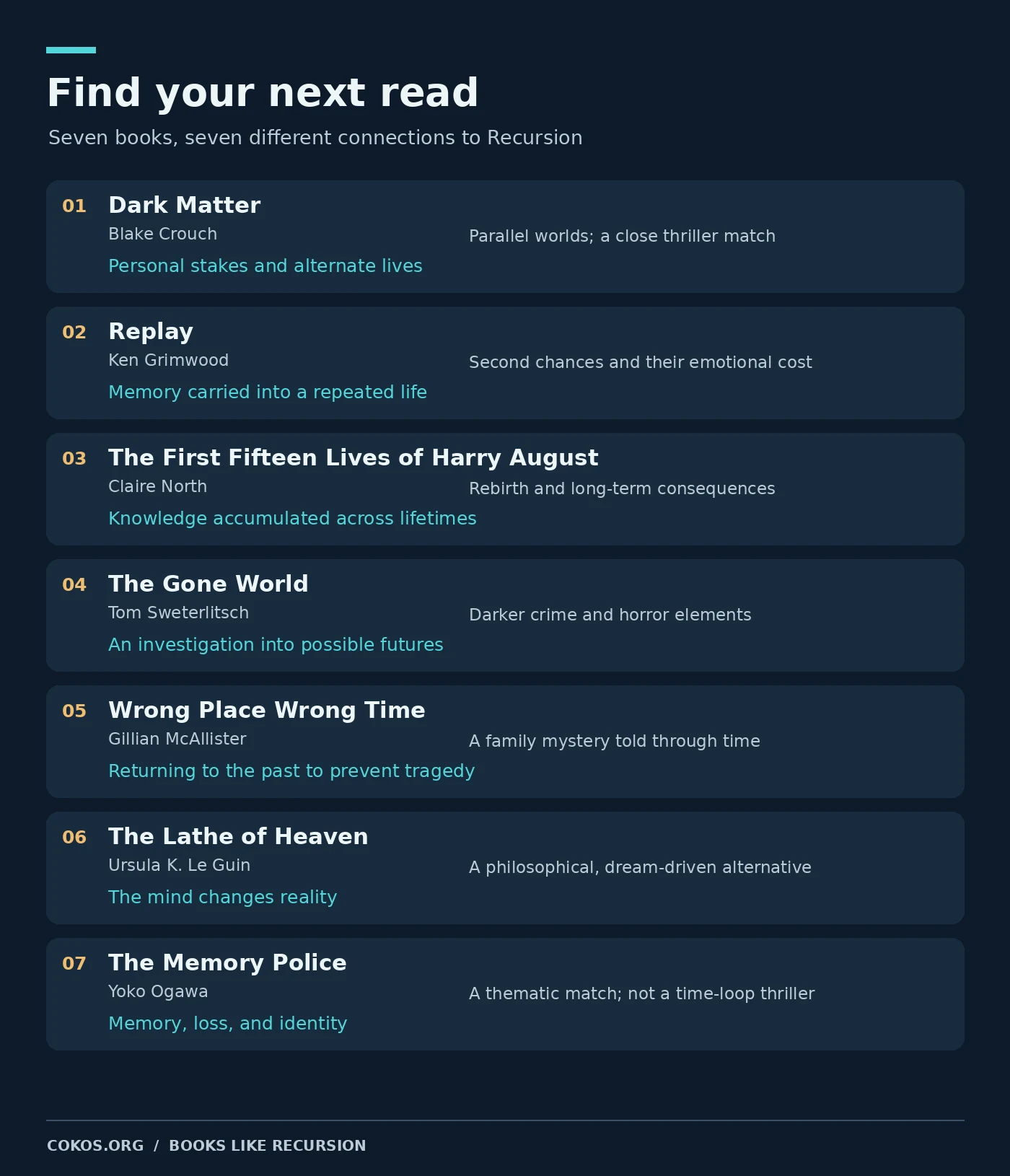
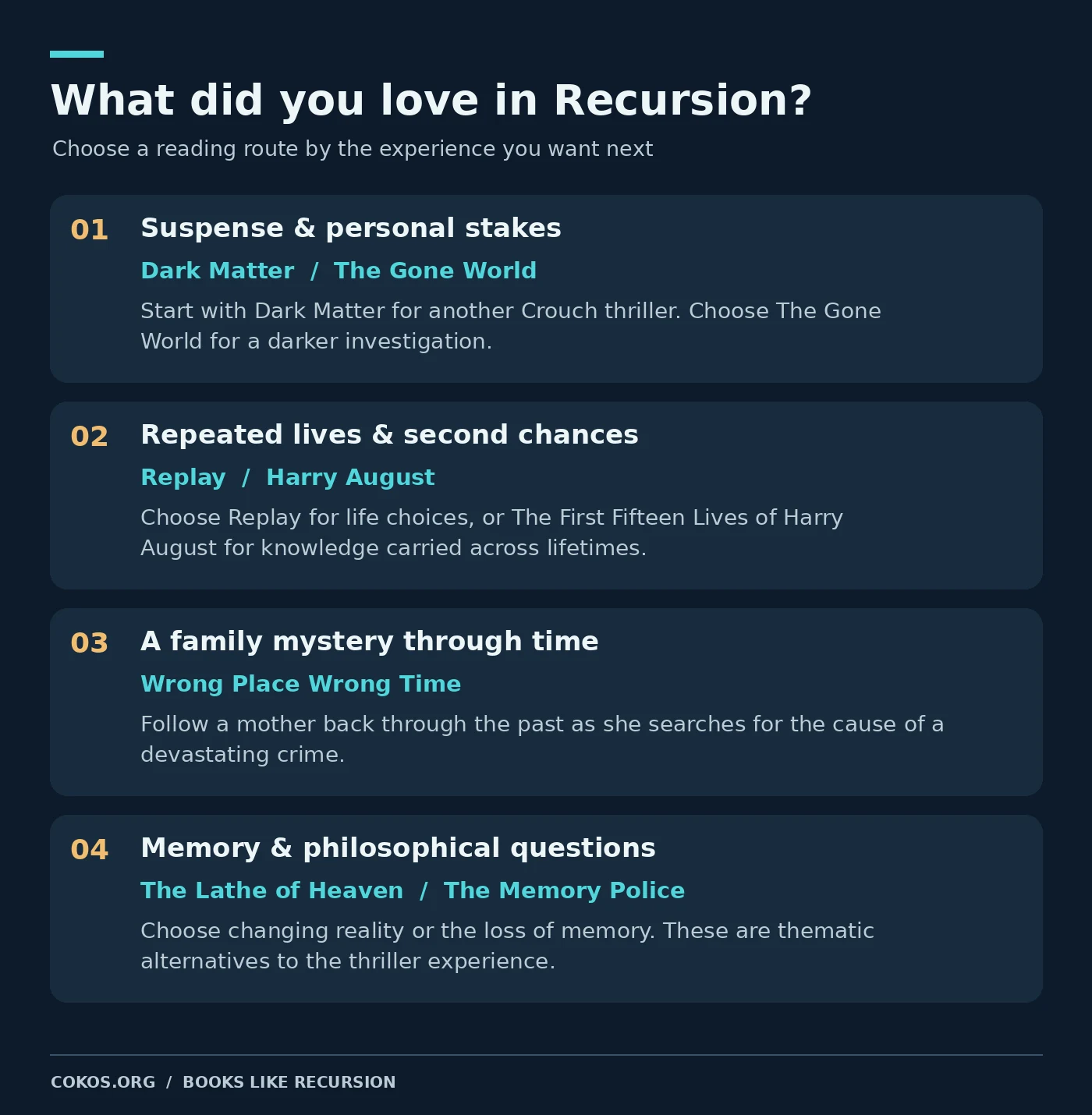
The best books like Recursion depend on what you want to experience again. Start with Dark Matter for another Blake Crouch thriller, Replay for the emotional consequences of reliving a life, or The First Fifteen Lives of Harry August for knowledge carried across repeated lifetimes. If you want a darker investigation into possible futures, choose The Gone World.
What makes Recursion memorable is the connection between its enormous premise and its intimate stakes: a different past can mean a different relationship, a different identity, or a different world. This guide compares seven novels by that connection, while explaining where each reading experience changes.

Spoiler note: the comparisons discuss opening premises and broad themes. They do not reveal endings or explain Recursion’s central discovery.
Books like Recursion: a quick comparison
Compare the strongest connection and the main difference before choosing. The order is not a ranking of literary quality.
| Book and author | Strongest connection | Main difference |
|---|---|---|
| Dark Matter — Blake Crouch | Personal stakes in a radically different life | Parallel worlds rather than Recursion’s memory-and-time mystery |
| Replay — Ken Grimwood | Remembering a life while living it again | Greater emphasis on second chances and personal choices |
| The First Fifteen Lives of Harry August — Claire North | Knowledge accumulating across lifetimes | Rebirth and consequences unfolding over many lives |
| The Gone World — Tom Sweterlitsch | Investigation and dangerous possible futures | A darker blend of crime, science fiction, and horror |
| Wrong Place Wrong Time — Gillian McAllister | Searching the past to prevent a personal tragedy | A family-centered mystery with a speculative premise |
| The Lathe of Heaven — Ursula K. Le Guin | The mind’s power to change reality | Dreams, ethics, and philosophical speculation |
| The Memory Police — Yoko Ogawa | Memory, identity, and loss | A literary dystopia, not a time-loop thriller |
What makes a book similar to Recursion?
A time-travel premise alone is not enough. This selection considers three connections: memory and personal identity, the consequences of changing events, and emotional stakes that make an abstract idea matter. A strong match may reproduce one of these especially well without sharing the others.
The recommendations are editorial judgments, not numerical similarity scores. Publisher and author descriptions are linked in the source notes so you can check each premise. No claim that a book reproduces Crouch’s exact reading experience is intended.
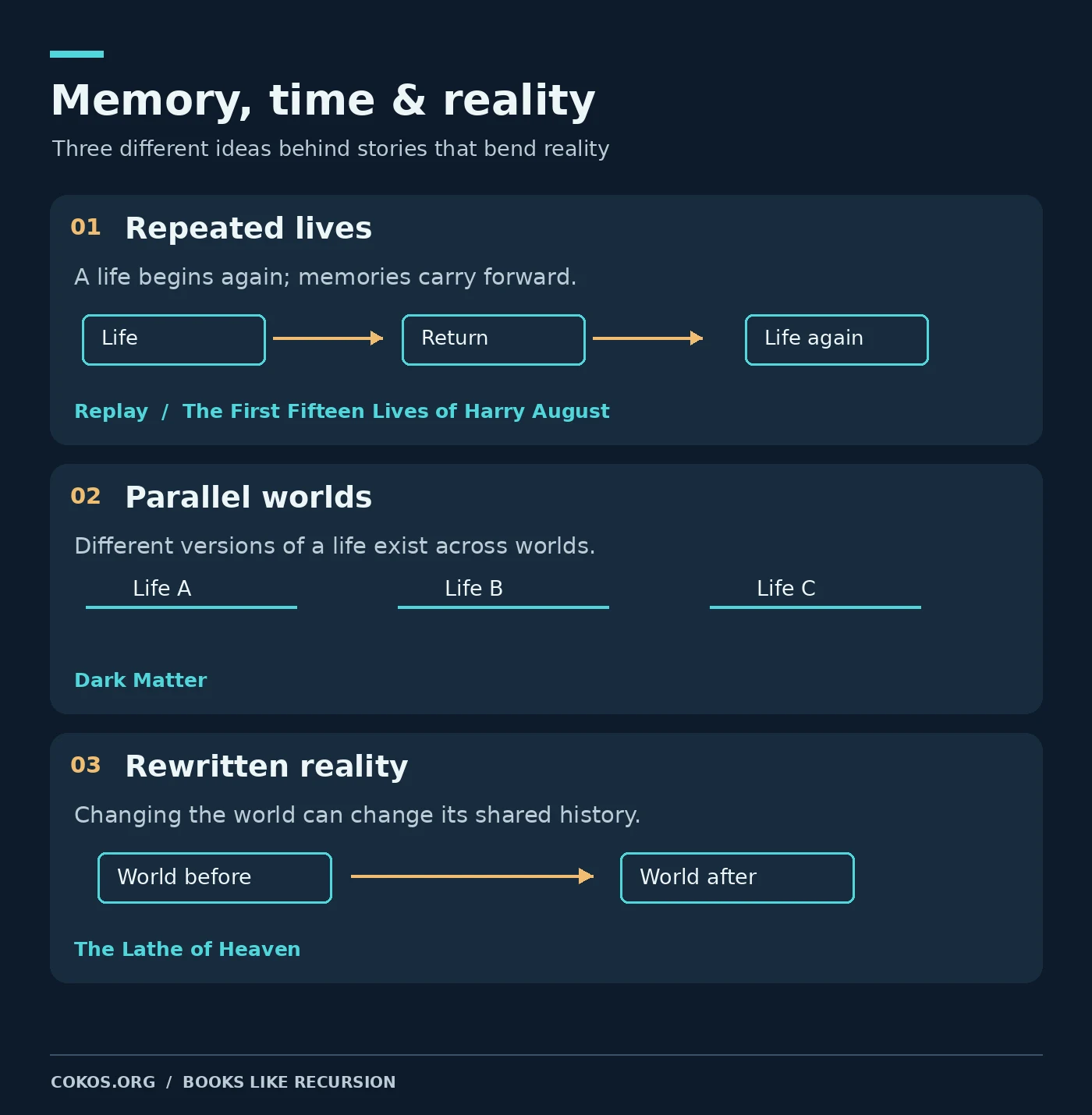
It also helps to distinguish three devices. In a repeated-life story, a character starts again while retaining knowledge. In a parallel-world story, different versions of a life may coexist. In a rewritten-reality story, an intervention changes the world people understand as real. These categories can overlap, but they create different kinds of uncertainty.
1. Dark Matter by Blake Crouch
Choose it for: another thriller in which the desire to recover an ordinary life becomes an extraordinary problem.
Jason Dessen wakes in a world where his professional success and family life have taken different paths. The question of how to get home makes the premise immediately personal: an impressive alternative life is not necessarily the life he wants.
The connection to Recursion is the way an altered reality threatens relationships and a sense of self. Both invite a particularly uncomfortable question: if circumstances change everything around you, what still makes a life yours? That gives the speculative idea something more urgent than intellectual novelty.
The difference: Dark Matter centers on parallel possibilities. Choose it for Crouch’s combination of suspense and emotional stakes, rather than expecting another version of Recursion’s mechanism. It is the most straightforward starting point here if you want another book by the same author.
Already read both? Our guide to books like Dark Matter follows the parallel-world and alternate-life side of that interest.
2. Replay by Ken Grimwood
Choose it for: the possibility of starting again without forgetting the life you have lost.
Jeff Winston dies in middle age and wakes in his younger body with his memories intact. Knowledge that once arrived too late now seems like an advantage. The premise opens a tempting question: what would you fix if you already knew how things had turned out?
The deeper appeal for a Recursion reader is what that opportunity does to the meaning of a life. A relationship can matter intensely even when the circumstances that created it no longer exist. Remembering more than the people around you can be a burden as well as a source of power.
The difference: this is a strong choice for the emotional and philosophical side of repetition. Its appeal does not depend on reproducing a contemporary science-thriller investigation. Choose it when second chances, regret, and the limits of foresight interest you more than finding another technological mystery.
3. The First Fifteen Lives of Harry August by Claire North
Choose it for: knowledge and responsibility accumulated across repeated lifetimes.
Harry August returns to the beginning of his life after death, carrying what he has learned into the next one. A message delivered near the end of one lifetime changes his relationship to that recurring pattern.
Here the connection to Recursion is the mismatch between a person’s remembered experience and the time everyone else inhabits. Knowledge does not merely help a character make better private decisions; it raises questions about intervention, responsibility, and how much one person should try to change.
The difference: rebirth provides the structure, with consequences stretching across many lives. This makes it a useful choice if you want the premise to develop beyond one attempt to correct a mistake. Compared with choosing another Crouch novel, you are choosing a different narrative voice and a broader view of accumulated experience.
Pick this before Replay if the implications of carrying knowledge through history attract you most. Pick Replay first if your main interest is the personal meaning of living again.
4. The Gone World by Tom Sweterlitsch
Choose it for: a troubling investigation whose implications extend far beyond the original crime.
Investigator Shannon Moss works on a murder case connected to a missing serviceman and a vanished girl. Her ability to explore possible futures becomes part of her search for evidence, while a much larger threat complicates what she finds.
This is a strong match for readers drawn to the detective side of Recursion: an apparently bounded mystery opens onto a disturbing problem involving time. A future is not just a destination to visit. It can be evidence, a warning, or a possibility whose relationship to the present needs to be questioned.
The difference: the darker crime and horror elements are central to the recommendation. Choose it when you want dread alongside conceptual complexity. It is less suitable if the part you most want to recover is an emotionally reassuring second-chance story.
Content note: expect disturbing violence and horror imagery. The thematic connection to Crouch should not be mistaken for an identical tone.
5. Wrong Place Wrong Time by Gillian McAllister
Choose it for: an urgent family question investigated by moving into the past.
Jen witnesses her son commit a murder. Then she wakes before it happened, and subsequent awakenings take her further into the past. She has to understand what led to the crime if she is to prevent it.
For a Recursion reader, the appeal lies in the connection between love, knowledge, and causality. Wanting a different outcome does not tell you which earlier moment matters. Familiar events and relationships become clues that must be interpreted again.
The difference: the main attraction is a psychological and family mystery. The speculative premise changes how the investigation works, but this is not a recommendation for someone primarily seeking detailed scientific machinery or cosmic scale.
Choose it if you want another story in which changing time matters because someone you love is at risk. It offers a different route into that emotional pressure from either parallel-world exploration or reliving an entire lifetime.
6. The Lathe of Heaven by Ursula K. Le Guin
Choose it for: the ethical problem of changing reality, even with apparently good intentions.
George Orr’s dreams alter the world. When a psychiatrist recognizes that power and tries to direct it, the possibility of improving reality becomes inseparable from the danger of controlling it.
The connection to Recursion is strongest at the level of consequences. An intervention intended to solve one problem can alter the conditions of many other lives. Who gets to decide which world is preferable? What happens to consent when people cannot compare the world they inhabit with the one that came before?
The difference: dreams drive the premise, and philosophical uncertainty is a major part of the appeal. Choose this for questions about power and unintended outcomes rather than another thriller built around laboratory discovery. Its value here is the different angle it brings to a similar ethical pressure.
If that distinction interests you, explore the broader range of books about alternate realities.
7. The Memory Police by Yoko Ogawa
Choose it for: a quieter exploration of what memory preserves, and what disappears when it is lost.
On an island, objects disappear from ordinary life and most people lose their connection to them. Those who retain memories are threatened by the Memory Police. A writer’s attempt to protect her editor gives that abstract loss a personal form. The English translation is by Stephen Snyder.
This is a thematic recommendation for readers who leave Recursion thinking about identity. What does it mean to preserve an experience when the surrounding world no longer recognizes it? The book approaches memory through absence, vulnerability, and preservation rather than the opportunity to act on foreknowledge.
The difference: it is a literary dystopia, not a time-loop thriller. Choose it for the memory question, not for Crouch-like pacing or a matching scientific explanation. It is the deliberate change of direction on this list.
For more of this theme, see our guide to books about memory.
What should you read after Recursion?
For a longer reading journey, pair books that approach a shared question differently:
- From suspense to dread: read Dark Matter, then The Gone World. Compare how each makes a large speculative problem personal, while allowing for the second book’s darker tone.
- From a second chance to long-term responsibility: pair Replay with The First Fifteen Lives of Harry August. Ask whether greater knowledge necessarily leads to better decisions.
- From recovering the past to preserving it: begin with Wrong Place Wrong Time, then change pace with The Memory Police. One makes the past a mystery to investigate; the other asks what happens when its traces disappear.
- From changing your life to changing everyone’s world: follow Replay with The Lathe of Heaven. Notice how the ethical stakes change when an intervention affects people beyond the person making it.
A free philosophical-fantasy option: Those Who Guard Eternity
Author disclosure: Those Who Guard Eternity is my own novel, the first book in the Eternity Saga. It is presented separately from the seven recommendations above.
If your interest in Recursion leads toward questions about time, perception, and choice, this offers a fantasy route into those themes. Antem begins to question the reality he has accepted and the hidden structure of time. The central tension concerns the cost of pursuing truth when familiar certainty offers safety.
This is philosophical fantasy rather than a promise of Crouch’s thriller style. You can read it free on cokos.org/, with chapters listed in order and no registration required.
Start reading Those Who Guard Eternity
Frequently asked questions
Which book is closest to Recursion?
Dark Matter is the most direct choice for another Blake Crouch thriller with intimate stakes and a reality-changing premise. Replay is a stronger choice if your priority is memory carried into another chance at life. “Closest” depends on whether you mean pace, premise, or emotional effect.
Are all these books time-loop novels?
No. Replay and Harry August involve repeated lives. Dark Matter explores parallel worlds; The Lathe of Heaven changes reality through dreams. The Memory Police is included for its treatment of memory and loss, not a time-loop mechanism.
Which recommendation focuses most on memory rather than action?
The Memory Police is the clearest thematic choice if you want to reflect on loss, identity, and preserving the past. If you want retained memories to influence new decisions, choose Replay or The First Fifteen Lives of Harry August.
Can I read these books free on cokos.org/?
The seven recommended novels by other authors are not hosted on this site. Check your library or preferred bookseller for available editions. The separately introduced Those Who Guard Eternity is available to read free on cokos.org/.
Sources and selection notes
Book premises were checked against the following publisher and author descriptions. The comparisons and suggested reading routes are editorial interpretation. Sources contain fuller plot descriptions than this guide.
- Recursion — Penguin Random House
- Dark Matter — Penguin Random House
- Replay — Hachette Australia
- The First Fifteen Lives of Harry August — Hachette
- The Gone World — Penguin Random House
- Wrong Place Wrong Time — Gillian McAllister
- The Lathe of Heaven — Simon & Schuster
- The Memory Police — Penguin Random House