
Do objective moral facts exist? The debate over moral realism vs anti-realism asks whether claims such as “cruelty is wrong” can be true independently of what any person or society happens to approve. Moral realists answer that at least some moral claims are true. Moral anti-realists challenge either the existence of stance-independent moral facts, the factual role of moral language, or both.
The short answer is that philosophy has not produced a universally accepted proof for either side. Realism explains why moral criticism, moral error, and moral progress seem possible. Anti-realist theories explain why moral facts are difficult to locate, why disagreement persists, and why moral judgment is so closely connected to culture, emotion, motivation, and human practices. The best way to understand the dispute is not to ask only whether morality “exists,” but to separate four different questions.
What the moral realism debate is really about
This article is not primarily asking what morality means. Cokos already has a separate introduction to what morality is, including norms, values, duties, and moral judgment. The present question is narrower and more metaphysical: when we make a moral judgment, are we describing something that can be true independently of our approval?
Consider the claim “deliberately causing suffering for amusement is wrong.” It may be interpreted in several ways:
- It reports an objective moral fact.
- It reports a fact relative to a culture, framework, or idealized standpoint.
- It expresses condemnation and a commitment not to permit such conduct.
- It tries to report an objective fact, but no fact of that kind exists.
Those interpretations are not minor variations. They disagree about meaning, truth, knowledge, and authority. That is why the phrase “morality is subjective” often creates more confusion than clarity: it can refer to personal preference, social convention, framework-relative truth, or skepticism about moral knowledge. A useful analysis must say which claim it is making.
Four questions about moral claims
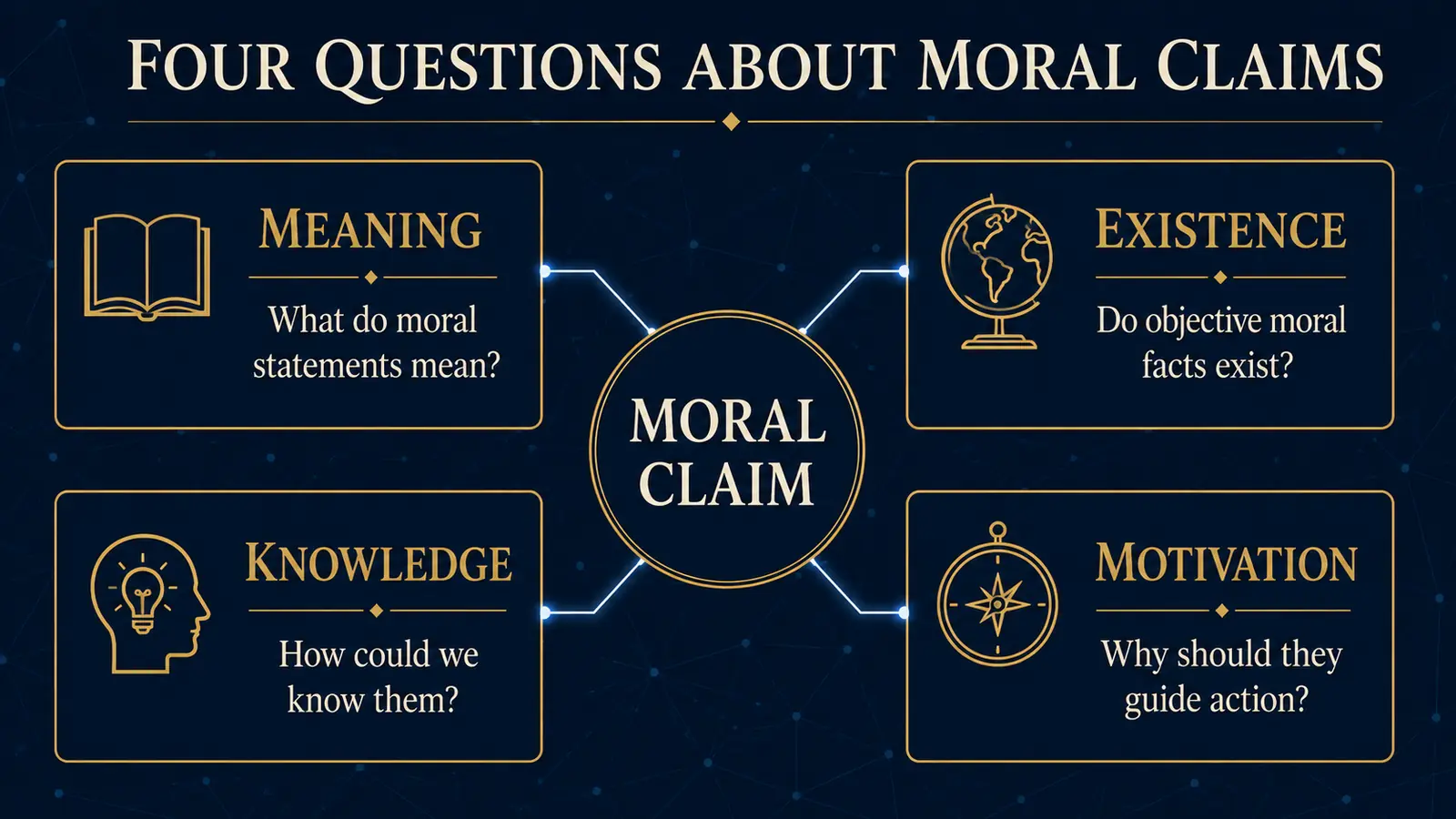
1. Meaning: what do moral statements mean?
When someone says “you ought to keep your promise,” are they asserting a proposition that can be true or false? Cognitivists say moral judgments express beliefs or truth-apt claims. Non-cognitivists argue that moral language primarily expresses attitudes, commitments, prescriptions, or plans. The disagreement is about what moral speech is doing before we even ask whether it is correct.
2. Existence: do objective moral facts exist?
This is the central metaphysical question. A robust realist holds that at least some moral truths do not depend on an individual or community accepting them. If an entire society approved of cruelty, the society could still be wrong. Anti-realists question whether the world contains facts capable of making such stance-independent judgments true.
3. Knowledge: how could we know moral truths?
Even if moral facts exist, moral knowledge requires an account of how human beings can identify them. Observation alone does not seem to reveal an “ought.” Realists appeal to reason, reflection, experience, natural facts about flourishing or harm, reliable intuition, or some combination of these. Skeptics ask how we could distinguish genuine moral insight from upbringing, emotion, self-interest, or evolutionary influence. This question belongs beside the broader problem of what knowledge is.
4. Motivation: why should moral judgments guide action?
Moral claims do not feel like neutral descriptions. To judge an action wrong normally seems connected to a reason not to perform it. Expressivists use this connection to argue that moral judgment is partly practical rather than merely descriptive. Realists may reply that true moral facts provide reasons for action even when an agent remains indifferent, weak-willed, or cruel.
Moral realism vs anti-realism: the core difference
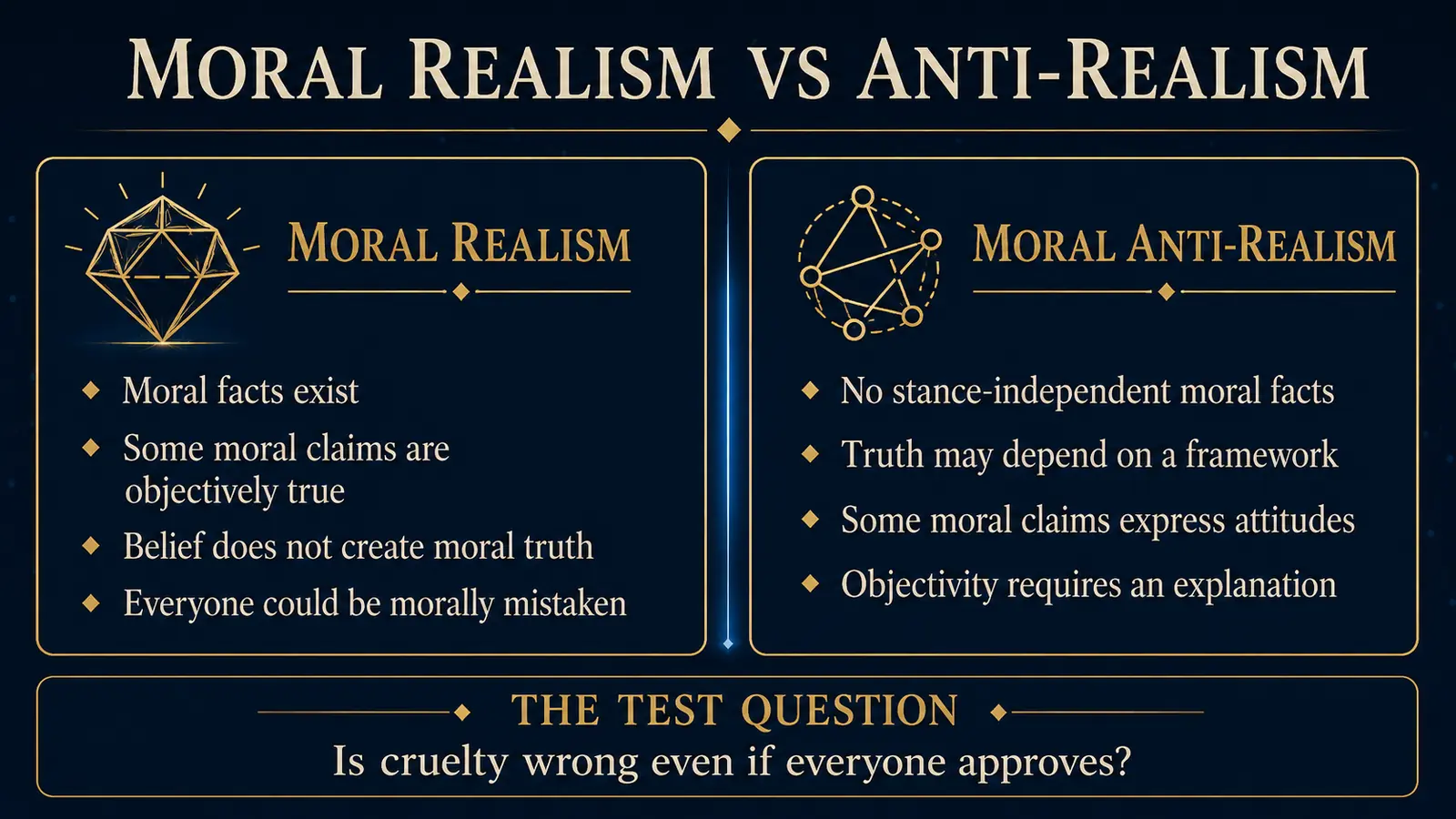
| Question | Moral realism | Moral anti-realism |
|---|---|---|
| Can moral claims be true or false? | Yes, and at least some are true. | Views differ: error theorists say claims are truth-apt but systematically false; non-cognitivists reject a straightforward factual reading. |
| Does approval determine truth? | No. A person or society can approve of what is objectively wrong. | Some views make truth framework-dependent; others replace factual truth with attitudes or commitments. |
| Can everyone be morally mistaken? | Yes. Consensus does not create truth. | Error theory says ordinary objective claims may all be mistaken; relativist answers depend on the relevant framework. |
| What explains moral authority? | Moral facts or reasons apply regardless of mere preference. | Authority may arise from attitudes, social practices, rational procedures, or practical commitments. |
The cleanest test is this: would cruelty remain wrong if every observer approved of it? A robust moral realist says yes. Approval can be corrupt, uninformed, coerced, or mistaken. An individual subjectivist may tie moral truth to personal attitudes. A cultural relativist may tie it to a social framework. An error theorist says the claim aims at objective truth but fails because there are no such facts. An expressivist analyzes the statement primarily as condemnation, commitment, or guidance rather than a report of an independent property.
This distinction also matters for the meaning of truth. To say that a moral judgment is sincerely held is not yet to say that it is true. Sincerity describes the believer; truth concerns whether the belief gets its subject right.
Moral anti-realism is a family of theories
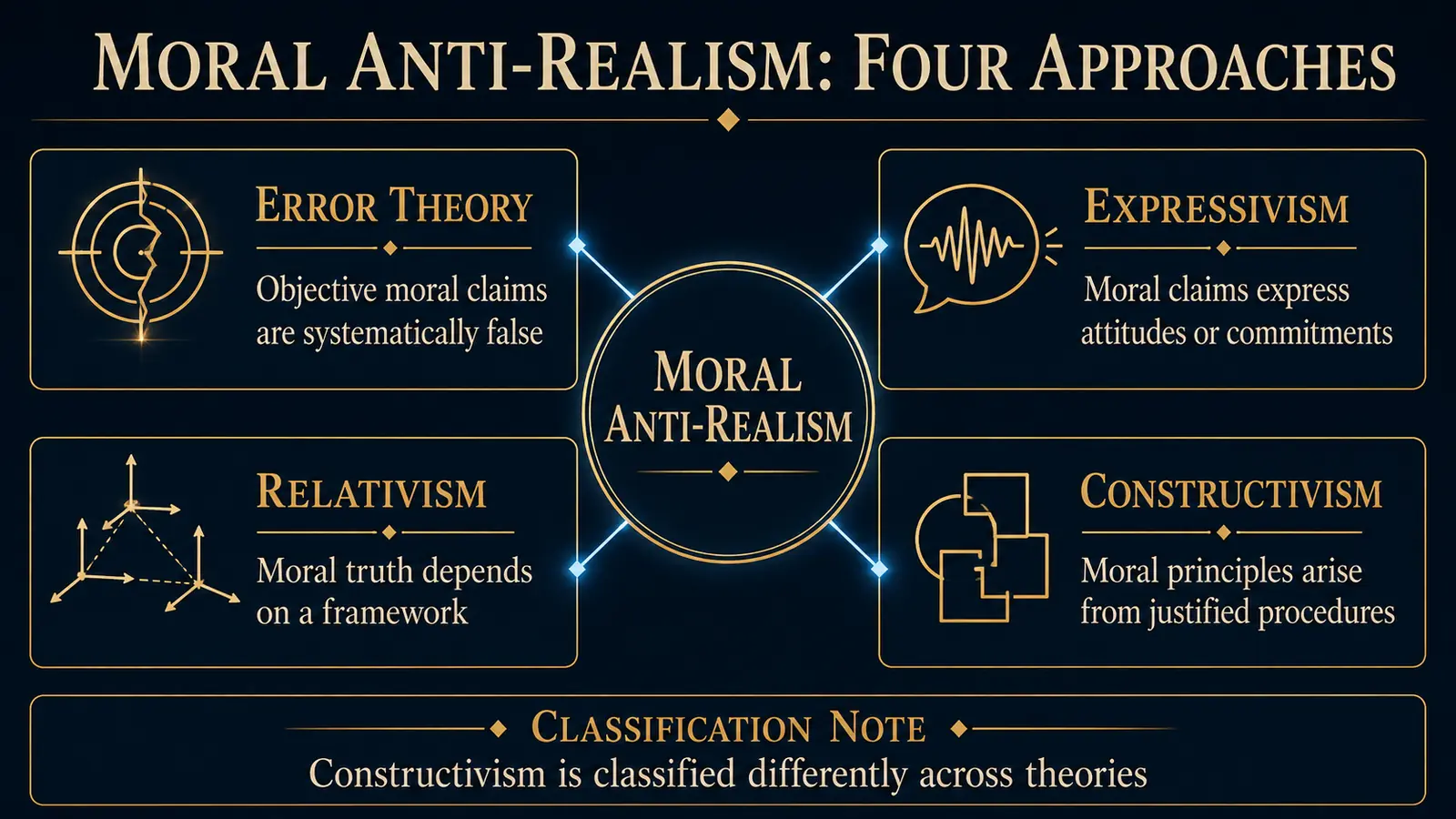
Error theory
Error theory accepts that ordinary moral claims present themselves as objective assertions. It then argues that they are systematically false because the properties or facts they presuppose do not exist. On this view, saying “cruelty is objectively wrong” resembles making a factual claim whose required truth-maker is missing.
Expressivism
Expressivism interprets moral judgments as expressions of attitudes, plans, approvals, disapprovals, or practical commitments. “Cruelty is wrong” functions more like condemning cruelty and committing against it than detecting a special moral object. Sophisticated expressivist theories still explain logical consistency, disagreement, and moral reasoning; they are not merely the claim that moral language is emotional noise.
Relativism
Relativism holds that the truth or justification of a moral judgment depends on a framework, such as a culture or set of standards. It does not automatically follow that “anything goes.” A framework can contain demanding rules, and people can violate them. The deeper problem is whether one framework can be judged better than another without appealing to a standard beyond both.
Constructivism
Constructivists hold that moral principles arise through an appropriate procedure of rational construction—for example, from what suitably informed, free, equal, or impartial agents would endorse. This can preserve demanding standards without treating moral facts as wholly independent objects waiting to be discovered. Classification is contested: some philosophers treat constructivism as anti-realist, while others regard certain forms as compatible with realism.
These theories should not be collapsed into one slogan. Error theory says ordinary moral assertions fail. Expressivism gives them a different function. Relativism makes standards framework-dependent. Constructivism grounds them in justified procedures. Each solves one problem while inheriting another.
The strongest arguments for and against moral realism
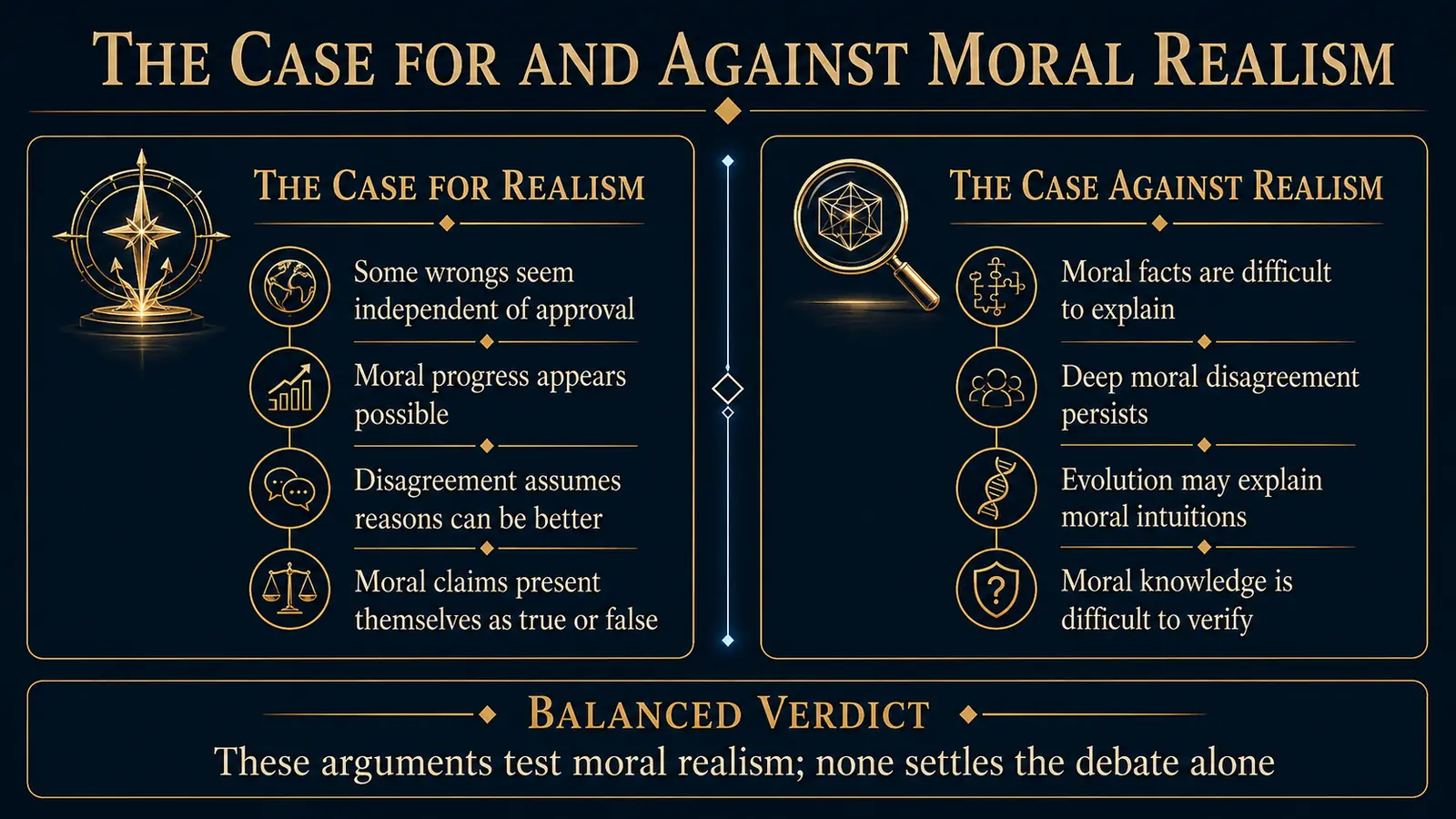
The case for moral realism
Some wrongs seem independent of approval
If a society normalizes slavery, torture, or persecution, it seems natural to say that the society is wrong—not merely different from us. Realism explains that judgment directly: approval does not transform injustice into justice. The realist argues that anti-realist translations often weaken what moral criticism actually means.
Moral progress appears possible
Progress is more than change. To call the abolition of an abusive practice progress is to say that a later judgment is better, not simply newer. Realism supplies a standard against which both past and present can be assessed. Anti-realists can describe progress through improved coherence, reduced suffering, widened concern, or commitments we now endorse, but the realist asks whether those measures are themselves objectively better.
Disagreement assumes that reasons can be better or worse
Moral arguments are usually conducted as if evidence, consistency, relevance, and impartiality matter. Participants do not merely announce preferences; they challenge false assumptions and expose contradictions. Realists argue that this practice makes most sense if people are trying—however imperfectly—to get something right.
Moral language presents itself as truth-apt
“Exploitation is wrong” has the grammar of an assertion. We can negate it, infer from it, ask for evidence, and accuse someone of inconsistency. Realism takes this surface structure seriously. Anti-realists must explain why moral language behaves so much like factual discourse even if it does not report stance-independent facts.
The case against moral realism
Moral facts are difficult to explain
What kind of fact is wrongness? How does it relate to natural properties such as pain, intention, coercion, or flourishing? If moral facts are non-natural, their place in the world can seem mysterious. If they are natural, the realist must explain why a moral property is not simply reducible to whatever a person already values.
Deep moral disagreement persists
People disagree across eras and cultures, sometimes after careful reflection. Anti-realists argue that this pattern is easier to explain if moral standards arise from different attitudes, practices, or forms of life. Realists answer that disagreement can be produced by ignorance, incentives, bias, conceptual confusion, or unequal access to relevant facts.
Evolution may explain moral intuitions
Cooperation, kin protection, reciprocity, hierarchy, and punishment can affect survival and social cohesion. If evolutionary and cultural processes explain why certain judgments feel compelling, do we still need moral facts? The realist response is that explaining the origin of a belief does not prove it false. Evolution also shaped capacities used in mathematics and empirical reasoning; the remaining task is to show when those capacities are reliable.
Moral knowledge is difficult to verify
Scientific claims can often be tested through observation and prediction. Moral claims do not have one agreed experimental method. Intuition may be biased, while reasoning can rationalize prior commitments. Realists need an epistemology that explains not only how moral knowledge is possible but how error can be detected.
The dispute therefore turns on explanatory balance. Realism must account for metaphysics and knowledge. Anti-realism must account for moral error, criticism, progress, and the apparent authority of reasons. A theory that solves only one side of that ledger is incomplete.
What moral disagreement can—and cannot—show
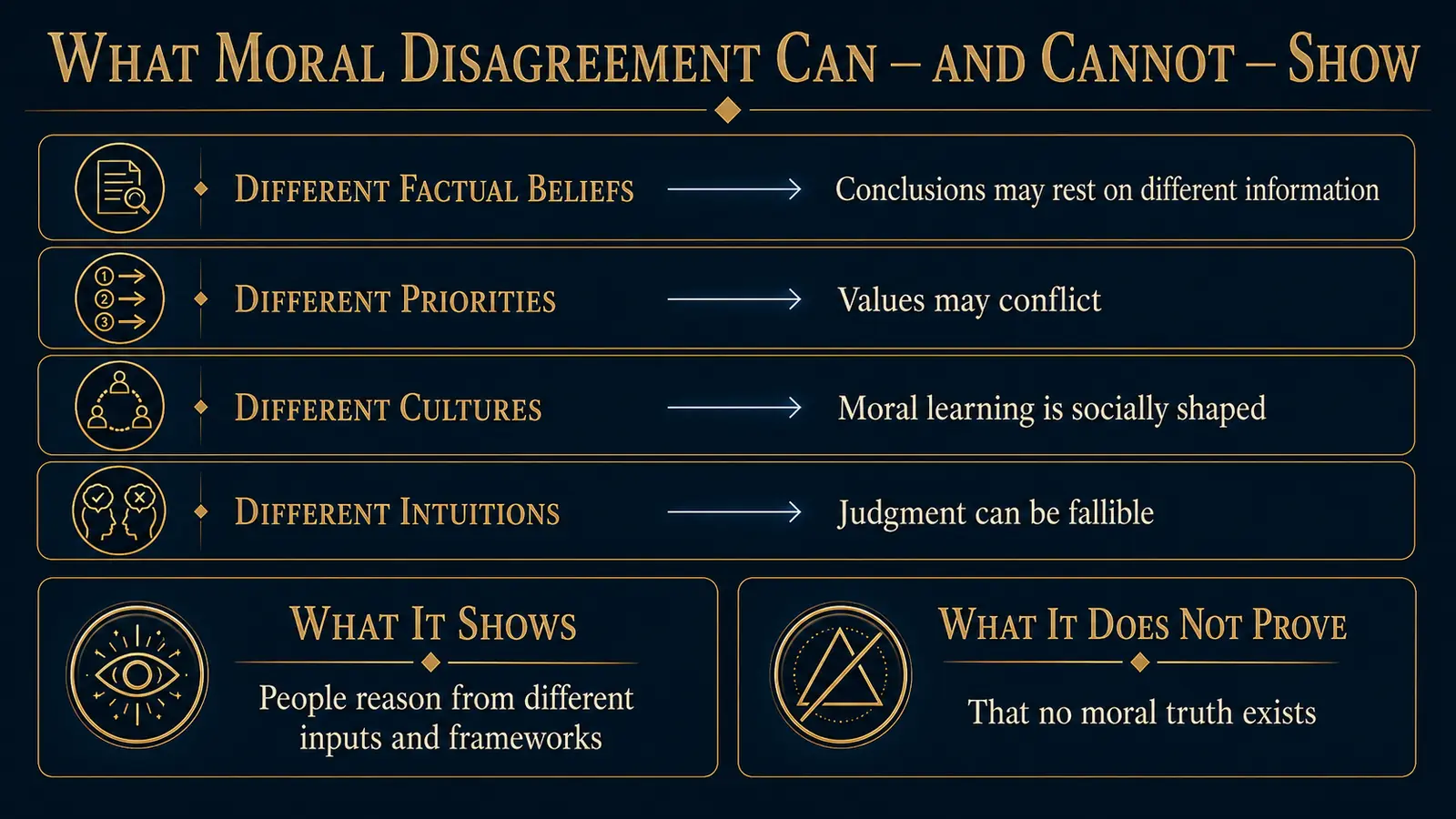
Disagreement is evidence that requires explanation, not an automatic disproof of truth. People disagree about history, medicine, and physics, yet disagreement alone does not show that those subjects lack facts. The philosophical question is whether moral disagreement is unusually deep, persistent, and resistant to correction.
Different factual beliefs
Two people may share a moral principle but disagree about the consequences of a policy, the intentions of an agent, or who bears a risk. Their conclusion changes when the non-moral facts change. The dispute is partly empirical rather than fundamentally moral.
Different priorities
People may value liberty, security, equality, loyalty, welfare, or desert differently. Even if they recognize all of these considerations, they may assign them different weights. This is a harder case because more factual information may not remove the conflict.
Different cultures
Moral learning is socially shaped. Communities teach different roles, virtues, prohibitions, and expectations. Cultural influence explains variation, but it does not logically establish that every cultural rule is equally justified. A causal explanation of belief is not yet a verdict on its truth.
Different intuitions
People can react differently to the same case, especially when harm, intention, fairness, or loyalty pull in opposite directions. Intuitions are useful data, not infallible verdicts. Their reliability should be tested against bias, consistency, relevant facts, and considered judgment.
The strongest disagreement-based challenge would show that fully informed, sincere, rational, and impartial thinkers continue to disagree at a fundamental level—and that anti-realism explains this better than realism does. Actual human disagreement rarely satisfies all those conditions. Its evidential force is therefore real but limited.
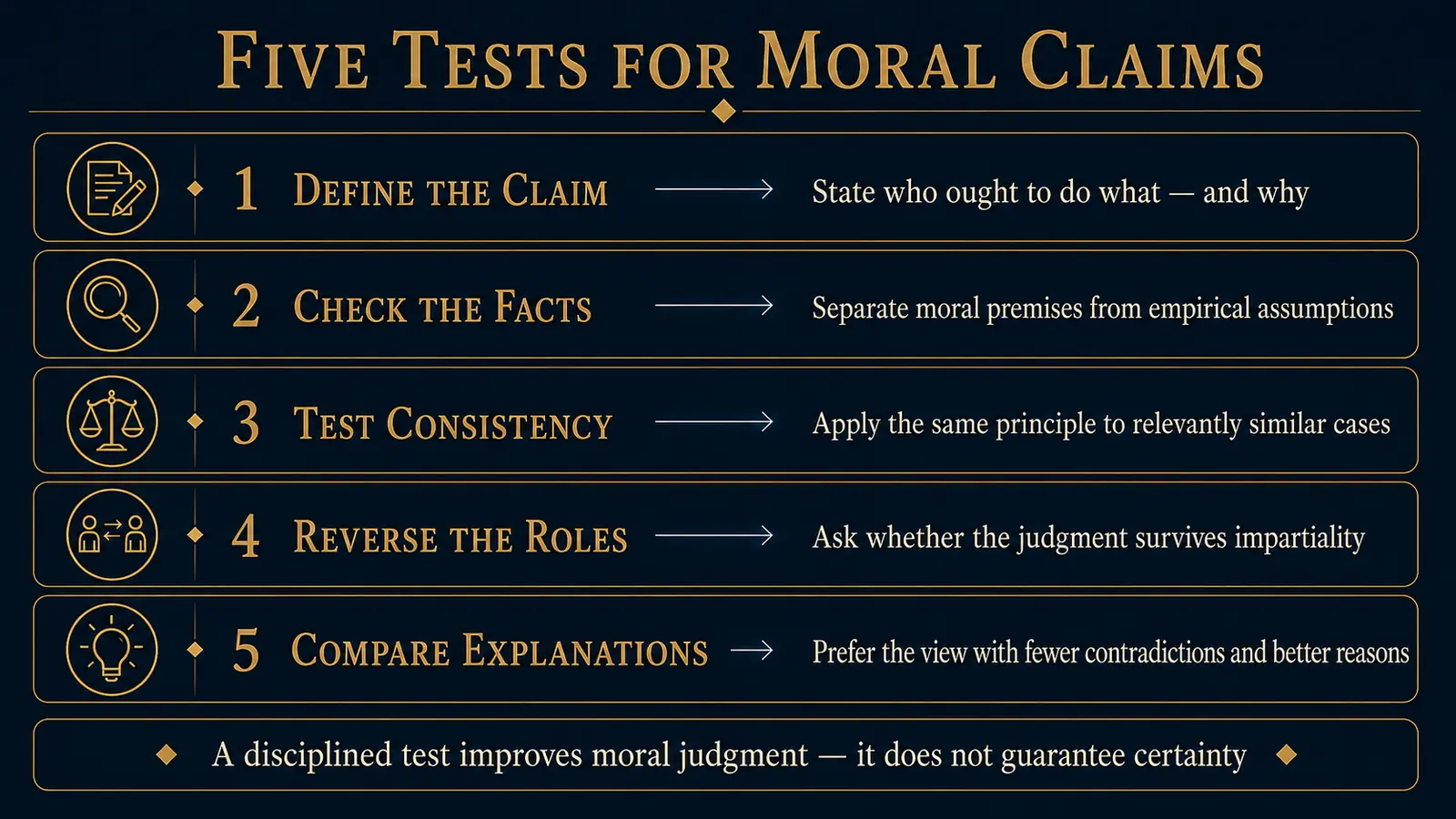
Five tests for evaluating a moral claim
-
Define the claim. State who ought to do what, under which conditions, and for what reason. Replace vague labels such as “bad” or “unfair” with a claim precise enough to examine.
-
Check the facts. Separate the moral premise from empirical assumptions. Ask what happened, what alternatives existed, who was affected, what the agent knew, and which consequences are reasonably predictable.
-
Test consistency. Apply the same principle to relevantly similar cases. If the rule changes whenever it disadvantages your group, the judgment may be rationalization rather than principle.
-
Reverse the roles. Imagine occupying the position of each affected person without knowing which role will be yours. A judgment that survives role reversal has a stronger claim to impartiality.
-
Compare explanations. Ask which account explains the case with fewer contradictions, fewer arbitrary exceptions, and better reasons. Include rival principles rather than testing only the conclusion you already prefer.
These tests do not assume that realism is true. A realist may see them as fallible ways of approaching moral truth. A constructivist may see them as part of a justified procedure. An expressivist may use them to make commitments coherent and shareable. Their value is that they turn a slogan into an assessable judgment.
Worked example: “Lying is always wrong”
Start with a familiar absolute claim: lying is always wrong.
- Define it: Does “lying” mean every intentional false statement, including one used to protect a victim from an attacker?
- Check the facts: Who is asking, what will truthful disclosure cause, and are silence or refusal possible?
- Test consistency: Would the same rule apply to deception by an aggressor, a victim, a doctor, a child, and a government?
- Reverse the roles: Would you endorse mandatory truthfulness if you could be the vulnerable person whose location is demanded?
- Compare explanations: An absolute rule protects trust and blocks convenient exceptions. A qualified rule may better explain why deception for exploitation differs from deception used to prevent unjust harm.
The test does not mechanically produce one answer. It exposes the assumptions and competing values that a responsible verdict must address. It also shows why questions about morality connect with questions about human nature and human freedom and responsibility.
Does morality exist? A balanced verdict
If “morality” means human practices of praise, blame, obligation, and justification, then morality clearly exists as part of social and psychological life. If the question is whether objective moral facts exist independently of all attitudes and frameworks, the answer remains philosophically contested.
Moral realism has a powerful starting point: some acts appear wrong regardless of who approves, and people seem capable of moral error and progress. Anti-realism has a powerful challenge: it asks what moral facts are, how we could know them, and why cultural and evolutionary explanations are not sufficient.
A reasonable conclusion is neither “objective morality has been proved” nor “anything is permitted.” The debate remains open, but moral claims can still be compared by their facts, coherence, impartiality, consequences, and ability to survive criticism. Certainty is not a prerequisite for responsibility.
That unresolved space—between truth, choice, responsibility, and the worlds our judgments create—is also central to philosophical fiction. Readers who want to explore those questions through narrative can continue with Those Who Guard Eternity.
Peck’s library can also be read as an existential fable. If an hour spent with another person brings Soren no closer to finding his book, what makes that hour worth spending?
Frequently asked questions
What is moral realism in simple terms?
Moral realism is the view that moral claims can be true or false and that at least some are true. Robust versions add that their truth does not depend on what any individual or society happens to believe.
What is moral anti-realism?
Moral anti-realism is a family of views that denies stance-independent moral facts or rejects a straightforward factual interpretation of moral language. It includes error theory, non-cognitivist theories such as expressivism, and—under some classifications—relativist or constructivist views.
Is morality objective or subjective?
That is the disputed question, not a settled premise. Realists defend at least some objective moral truths. Subjectivists make moral truth depend on attitudes. Relativists connect it to frameworks, while expressivists interpret moral judgments primarily as practical attitudes or commitments.
Does moral disagreement prove that morality is subjective?
No. Disagreement may result from different facts, priorities, cultures, interests, or intuitions. It challenges realism only if anti-realism explains the pattern better than realist accounts of ignorance, bias, complexity, and error.
Does anti-realism mean that nothing matters?
No. An anti-realist can care deeply about suffering, fairness, freedom, loyalty, or human flourishing. The theory concerns the status and meaning of moral claims, not whether people have commitments or reasons to act.
Can a whole society be morally wrong?
A robust realist says yes: consensus does not create moral truth. An error theorist may say the society’s objective moral claims are false along with everyone else’s. A relativist answer depends on whether the judgment is made within the society’s framework or from another standard.
What is the strongest argument for moral realism?
One strong argument is that realism best explains moral error, criticism, and progress: practices can be wrong even when widely accepted. Whether this outweighs metaphysical and epistemic objections remains disputed.
What is the strongest argument against moral realism?
One strong challenge combines explanation and knowledge: if culture, psychology, and evolution explain our moral beliefs, what additional work do objective moral facts perform, and how could we reliably know them? Realists respond that explaining a belief’s origin does not determine whether it is true.
Further reading and sources
- Stanford Encyclopedia of Philosophy: Moral Realism
- Stanford Encyclopedia of Philosophy: Moral Anti-Realism
- Stanford Encyclopedia of Philosophy: Moral Relativism
- Stanford Encyclopedia of Philosophy: Disagreement
- Cokos: What Is Reality?
This article is an accessible map of a live philosophical debate, not a claim that one school has conclusively won. Learn more about the project on the author page.