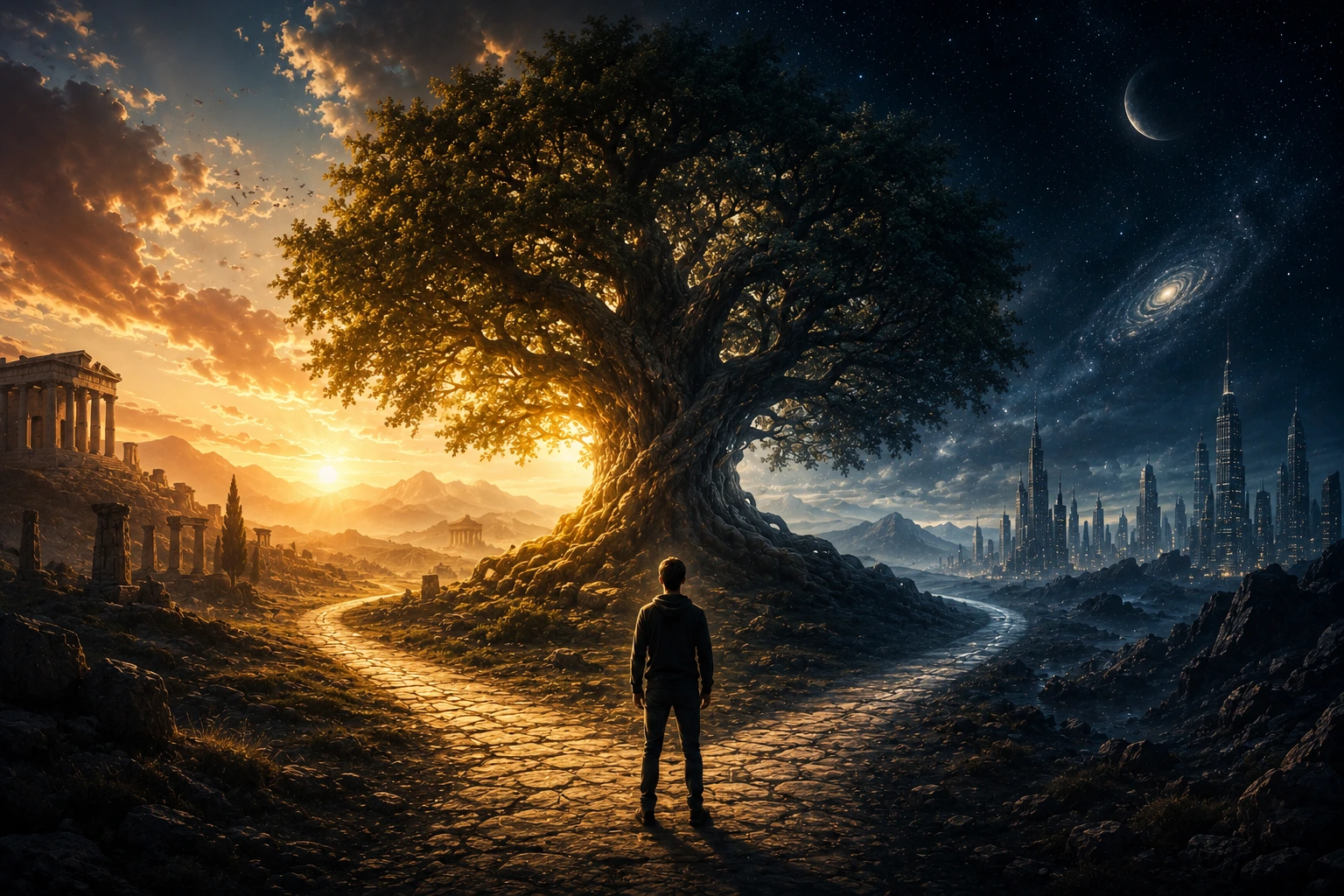
Few questions have accompanied humanity as faithfully as this one.
What is the meaning of life?
Children ask it with curiosity.
Philosophers dedicate entire careers to it.
Scientists approach it from the perspective of evolution and consciousness.
Religions place it at the center of their teachings.
Writers build entire worlds around it.
And sooner or later, almost every person asks it in silence.
Sometimes after achieving everything they once dreamed of.
Sometimes after losing someone they loved.
Sometimes while standing at a crossroads where no obvious answer exists.
Unlike most philosophical questions, this one refuses to disappear.
Every generation believes it will finally solve the mystery.
Yet every generation discovers that the question is deeper than it first appeared.
Does life possess an objective purpose that exists independently of us?
Or do human beings create meaning through their choices?
Can science answer this question?
Does religion provide the only possible solution?
Will artificial intelligence eventually ask the same question?
And perhaps the most unsettling possibility of all:
What if meaning is not something we discover—but something we gradually become?
In this comprehensive guide, we will explore more than two thousand years of philosophy, psychology, neuroscience, religion, and modern science to examine one of humanity’s oldest questions.
Rather than searching for a simplistic answer, we will examine how different civilizations understood meaning, why modern science has transformed the discussion, and why this question remains as important today as it was in ancient Greece.
Quick Summary
- The meaning of life has no universally accepted answer.
- Some philosophies argue that meaning exists objectively.
- Others believe meaning is created through human freedom and responsibility.
- Religion, philosophy, psychology, and science each approach the question differently.
- Modern neuroscience explains many aspects of the human mind but does not fully explain purpose.
- The search for meaning is closely connected to consciousness, personal identity, free will, mortality, and eternity.
Why This Question Never Disappears
Many philosophical questions remain inside universities.
The meaning of life never does.
People who have never opened a philosophy book still ask it.
Executives ask it after successful careers.
Parents ask it after the birth of a child.
Scientists ask it while studying the universe.
Artists ask it while creating beauty.
Soldiers ask it during war.
Patients ask it during illness.
Older people often ask it while looking back on their lives.
Unlike questions that seek information, this question seeks orientation.
It asks not merely how the world works, but how we should live within it.
That is why it naturally connects with other fundamental questions explored throughout Cokos:
- What is consciousness?
- What is reality?
- What makes us human?
- What makes you the same person throughout your life?
- Does free will exist?
- Can consciousness survive death?
Together these questions form a map of human existence rather than isolated philosophical puzzles.
Before Looking for the Answer, We Need to Understand the Question
One of the biggest reasons people disagree about the meaning of life is that they are often asking different questions without realizing it.
For some people, meaning means happiness.
For others, it means purpose.
Others associate it with morality.
Some connect it with God.
Others think about legacy, creativity, family, knowledge, or love.
Because of this, philosophy eventually separated the discussion into two fundamentally different questions.
- Does objective meaning exist independently of human beings?
- Or do human beings create meaning through their own lives?
Nearly every major philosophical tradition can be understood as attempting to answer one—or both—of these questions.
To understand how these ideas developed, we need to travel back more than two thousand years to the birthplace of Western philosophy.
The First Answers: Ancient Greece Begins the Search for Meaning
Long before neuroscience, psychology, or modern science, the ancient Greeks asked a deceptively simple question.
What makes a human life worth living?
Unlike mythological traditions that explained the world through divine stories, Greek philosophers attempted something revolutionary.
They believed human reason itself could investigate reality.
This transformation gave birth to philosophy as we know it today.
More importantly, it introduced an entirely new way of approaching the meaning of life—not through inherited tradition alone, but through questioning, dialogue, observation, and rational thought.
Remarkably, many of the questions debated in Athens more than two millennia ago remain central to modern discussions about consciousness, ethics, psychology, and human purpose.
Socrates: A Meaningful Life Begins with Self-Examination
Few philosophers influenced Western civilization as profoundly as Socrates.
Unlike many thinkers before him, Socrates cared less about explaining the physical universe and more about understanding the human being living within it.
For him, the search for meaning began with a simple but demanding principle.
“The unexamined life is not worth living.”
This famous statement does not suggest that ordinary life lacks value.
Rather, it argues that genuine human flourishing requires reflection.
A meaningful life is not simply experienced—it is questioned.
For Socrates, wealth, political power, and public recognition could never substitute for wisdom and moral integrity.
His legacy established one of philosophy’s enduring assumptions:
The search for meaning begins not by changing the world, but by understanding oneself.
Plato: Meaning Exists Beyond the Material World
Plato expanded his teacher’s ideas into one of the most influential philosophical systems in history.
According to Plato, the physical world is constantly changing.
Everything visible eventually ages, transforms, or disappears.
Because of this, ultimate meaning cannot depend entirely on material reality.
Instead, Plato proposed that behind the changing world exists a timeless realm of perfect Forms—or Ideas.
Truth.
Justice.
Beauty.
Goodness.
Human life acquires meaning by moving closer to these eternal realities.
Whether or not one accepts Plato’s metaphysics, his influence cannot be overstated.
Much of Western philosophy, theology, and political thought developed in dialogue with his ideas.
His perspective also connects naturally to another fundamental philosophical question explored on Cokos:
If there is a deeper reality beyond appearances, then understanding what reality actually is becomes essential before we can understand the meaning of life.
Aristotle: Human Flourishing Is the Purpose of Life
Aristotle disagreed with his teacher on many important issues.
Rather than placing ultimate meaning in a separate realm of eternal Forms, Aristotle focused on the world we actually inhabit.
He argued that every living thing possesses a natural function.
The purpose of an acorn is to become an oak.
The purpose of a seed is to grow into the organism it has the potential to become.
Likewise, human beings possess their own distinctive potential.
Aristotle described its fulfillment with the Greek word eudaimonia.
Although often translated as “happiness,” the term means something much richer.
It refers to flourishing.
Living well.
Developing one’s capacities fully.
Practicing virtue consistently.
According to Aristotle, meaning is not discovered through mystical insight alone.
It emerges through the lifelong cultivation of wisdom, character, courage, justice, and practical reason.
The Stoics: Meaning Cannot Depend on Circumstances
The Stoics approached the problem from a remarkably practical perspective.
Empires collapse.
People die.
Fortunes disappear.
Illness strikes without warning.
If meaning depends entirely on external success, then it can vanish overnight.
For the Stoics, genuine meaning must therefore come from something no external event can fully destroy.
We cannot control everything that happens to us, but we can always influence how we respond.
This insight remains surprisingly modern.
Today it influences psychotherapy, leadership, military training, sports psychology, and resilience research.
The Stoics did not promise an easy life.
They argued for something more durable:
A meaningful life rooted in character rather than circumstance.
What United Ancient Philosophy?
Although Socrates, Plato, Aristotle, and the Stoics disagreed about many important issues, they shared one fundamental conviction.
The meaning of life could never be reduced to pleasure alone.
Money alone.
Power alone.
Or success alone.
Each believed that human beings possess a deeper potential that deserves cultivation.
Yet the arrival of the world’s great religions transformed the discussion in a profound new direction.
Instead of asking whether meaning can be discovered through reason alone, religious traditions began asking an even larger question.
What if the meaning of life comes from beyond humanity itself?
Religion: Does Life Have a Meaning That Exists Beyond Humanity?
Ancient philosophy relied primarily on human reason.
The world’s major religions introduced a fundamentally different perspective.
Rather than asking people to invent meaning, they proposed that meaning already exists.
Human beings do not create the ultimate purpose of life.
Instead, they gradually discover it through their relationship with a reality greater than themselves.
Although Christianity, Islam, Judaism, Hinduism, Buddhism, and other traditions differ in important ways, most share one fundamental assumption.
Human life matters because human beings are not accidents.
This single idea has shaped civilizations, legal systems, moral philosophy, education, art, and concepts of human dignity for thousands of years.
Christianity: Meaning Through Relationship with God
Within Christianity, life is understood as part of a much larger story.
Human existence is neither random nor self-contained.
Each person possesses inherent value because every individual is intentionally created.
From this perspective, life’s ultimate purpose cannot be reduced to pleasure, achievement, or personal success.
Instead, meaning is found through love, moral transformation, service, and communion with God.
This also explains why Christianity views suffering differently from many secular philosophies.
Suffering itself is not considered good.
Yet it can acquire meaning when it becomes part of spiritual growth, compassion, forgiveness, and hope.
This understanding naturally raises another profound question explored throughout philosophy:
If human beings possess an immortal soul, then earthly life cannot represent the whole story of human existence.
Buddhism: Meaning Through Awakening Rather Than Achievement
Buddhism approaches the question from a remarkably different direction.
Rather than beginning with the existence of a creator, it begins with the reality of suffering.
According to Buddhist thought, much of human suffering originates from attachment.
People cling to things that are, by their nature, constantly changing.
Possessions.
Status.
Relationships.
Even personal identity itself.
The purpose of life therefore becomes awakening—seeing reality as it truly is rather than through the distortions created by desire and illusion.
Interestingly, aspects of this perspective resonate with modern psychology and contemporary studies of attention, mindfulness, and cognitive bias.
Does Objective Meaning Really Exist?
At this point, philosophy reaches one of its greatest divides.
Those who defend objective meaning argue that purpose exists independently of human opinion.
Just as gravity operates whether we believe in it or not, meaning exists whether or not we recognize it.
Others reject this conclusion.
According to them, the universe itself remains indifferent.
Meaning does not exist “out there.”
Human beings gradually construct it through relationships, creativity, responsibility, and choice.
This disagreement has shaped nearly every major philosophical movement during the past two centuries.
Friedrich Nietzsche: What Happens When Old Meanings Collapse?
Few philosophers transformed modern thought as dramatically as Friedrich Nietzsche.
He observed that traditional religious and moral frameworks were gradually losing their authority in European society.
His famous declaration that “God is dead” was not a literal theological argument.
Instead, it described a cultural transformation.
For centuries, people inherited meaning from established traditions.
But what happens when those traditions no longer provide convincing answers?
Nietzsche believed humanity would eventually face a profound crisis.
Without inherited meaning, people would either create new values—or fall into nihilism.
His work profoundly influenced existentialism, psychology, literature, and modern philosophy.
Existentialism: Meaning Is Created Through Choice
The devastation of two world wars forced many philosophers to reconsider humanity’s place in the universe.
Existentialism emerged from this historical context.
Jean-Paul Sartre proposed one of the twentieth century’s most influential philosophical ideas.
Existence precedes essence.
In other words, human beings are not born with a predetermined purpose.
They first exist.
Then, through countless choices, responsibilities, failures, and commitments, they gradually shape the people they become.
Meaning is therefore not discovered like buried treasure.
It is constructed through living.
This philosophy naturally connects to another essential question explored throughout Cokos:
If genuine freedom does not exist, can human beings truly create meaning—or are all choices simply inevitable consequences of prior causes?
Albert Camus: Can Life Be Meaningful in an Indifferent Universe?
Albert Camus pushed the discussion even further.
Rather than asking whether life possesses meaning, he asked a more unsettling question.
Is life worth living if the universe offers no final answers?
Camus described the tension between humanity’s desire for meaning and the apparent silence of the universe as the absurd.
Yet he rejected despair.
Instead, he argued that people remain capable of creating dignity, beauty, compassion, creativity, and responsibility even without absolute certainty.
This idea would later inspire one of the most influential psychological approaches to meaning ever developed.
Viktor Frankl: Meaning Can Be Found Even in Suffering
Few thinkers possessed greater authority to speak about the meaning of life than Viktor Frankl.
An Austrian psychiatrist, Frankl survived several Nazi concentration camps during the Second World War.
He lost most of his family.
He witnessed unimaginable suffering.
Yet from these experiences emerged one of the twentieth century’s most influential psychological theories.
Frankl observed that people facing the same horrific conditions often responded very differently.
Some surrendered to despair.
Others somehow maintained hope.
His central question became one of psychology’s most enduring mysteries.
What enables human beings to continue living when almost everything has been taken away?
His answer became the foundation of logotherapy, a school of psychotherapy based on the idea that the search for meaning is one of humanity’s deepest psychological motivations.
Frankl did not argue that suffering is inherently valuable.
Rather, he suggested that when suffering cannot be avoided, human beings still retain the freedom to determine their response.
Meaning, therefore, is not merely discovered during pleasant moments.
Sometimes it is forged under the greatest imaginable pressure.
Can Meaning Be Measured?
Modern psychology has transformed the discussion from pure philosophy into empirical research.
Today psychologists study meaning using validated psychological scales that evaluate:
- purpose in life;
- long-term goals;
- psychological coherence;
- personal values;
- life satisfaction;
- existential fulfillment.
Across many studies, individuals reporting a stronger sense of meaning also tend to demonstrate:
- greater psychological resilience;
- lower levels of hopelessness;
- better recovery following adversity;
- higher subjective well-being;
- greater long-term motivation.
These findings do not prove that objective meaning exists.
They do suggest something equally important.
The human experience of meaning has measurable consequences for mental health, decision-making, and quality of life.
What Does Evolutionary Biology Say?
Evolutionary biology approaches the question from an entirely different perspective.
Natural selection does not possess intentions.
Species evolve because certain traits increase reproductive success.
From this viewpoint, life’s apparent “purpose” may simply be survival and reproduction.
This explanation successfully accounts for countless biological processes.
Yet many philosophers argue that it remains incomplete.
Human beings compose symphonies.
Create mathematics.
Explore distant galaxies.
Sacrifice themselves for strangers.
Search for truth even when doing so provides no obvious evolutionary advantage.
Biology explains how humans emerged.
It does not necessarily explain why people experience purpose, beauty, morality, or transcendence.
Can Science Answer the Meaning of Life?
This question often creates unnecessary conflict between science and philosophy.
Science excels at explaining mechanisms.
It reveals how stars form.
How brains process information.
How memories develop.
How evolution operates.
How consciousness correlates with neural activity.
Yet the meaning of life belongs to a different category of inquiry.
Science describes how things work.
Meaning asks why they matter.
These are complementary rather than competing questions.
This is why discussions about life’s purpose inevitably intersect with broader philosophical questions concerning consciousness, personal identity, reality, and free will.
Artificial Intelligence Changes the Conversation
For thousands of years, the meaning of life appeared to be an exclusively human concern.
Artificial intelligence challenges that assumption.
If future AI systems eventually become conscious—a possibility that remains highly debated—would they also begin asking why they exist?
Could an artificial mind experience existential anxiety?
Would purpose emerge naturally from consciousness itself?
Or is the search for meaning inseparable from specifically human experiences such as mortality, emotion, embodiment, and personal identity?
These questions increasingly move beyond speculative science fiction into serious discussions within philosophy of mind, ethics, artificial intelligence, and cognitive science.
They also lead directly to another profound question.
If death were no longer inevitable, would life still possess meaning?
Would Immortality Make Life Meaningless?
Many people assume that immortality would automatically solve humanity’s greatest problems.
If death disappeared, wouldn’t life become infinitely better?
Philosophy, however, asks a far more difficult question.
If time became unlimited, would every individual moment lose its significance?
Imagine having an infinite future.
You could always travel next century.
You could always write the book tomorrow.
You could always postpone difficult decisions.
Would urgency disappear?
Would responsibility weaken?
Would purpose slowly dissolve?
Some philosophers argue that mortality gives human life its unique intensity.
Because time is limited, every decision excludes countless alternatives.
Choice creates value.
Others disagree.
They argue that meaning is independent of duration.
A meaningful life remains meaningful whether it lasts eighty years—or eight thousand.
This debate lies at the heart of contemporary discussions about life extension, transhumanism, digital immortality, and the future of civilization.
It is also explored throughout Cokos’ philosophical fiction, where eternity is presented not simply as endless time, but as a profound challenge to identity, responsibility, and human purpose. XML Sitemap pages cokos .pdf
Can We Create Meaning Rather Than Discover It?
Perhaps the most influential modern answer is surprisingly simple.
Meaning is not hidden somewhere in the universe waiting to be uncovered.
Instead, it gradually emerges through the way we live.
Every decision contributes something.
Every promise kept.
Every act of courage.
Every moment of compassion.
Every difficult truth accepted.
Meaning may therefore resemble a work of art more than a mathematical equation.
It is shaped over time.
Not by one extraordinary event.
But by thousands of ordinary choices.
Meaning and Free Will
This immediately raises another philosophical problem.
If every human decision is completely determined by prior physical causes, can people genuinely create meaning?
Or would every purpose simply be another inevitable consequence of chemistry and physics?
This is why discussions about meaning inevitably intersect with debates concerning free will.
If genuine freedom exists, then human beings may truly shape their own lives.
If it does not, the concepts of responsibility, morality, and personal purpose must all be reconsidered.
Rather than being separate philosophical puzzles, meaning, identity, consciousness, and free will form one interconnected system of questions.
Why the Meaning of Life Is Never Only Personal
It is tempting to think that the meaning of life concerns only individual happiness.
History suggests otherwise.
Civilizations themselves are built upon shared ideas about purpose.
These assumptions influence:
- education;
- law;
- science;
- economics;
- culture;
- politics;
- art;
- family structures;
- ethical systems.
If human life possesses intrinsic value, societies develop one kind of civilization.
If human beings are viewed merely as instruments, civilization evolves very differently.
The meaning of life therefore influences not only individuals but entire cultures.
Why Philosophical Fiction Explores Meaning Differently
Philosophy develops arguments.
Science develops evidence.
Stories allow us to experience ideas.
A philosophical novel does something unique.
Instead of merely asking abstract questions, it allows readers to live through impossible situations.
What would happen if human beings truly became immortal?
Could identity survive thousands of years?
Would freedom remain meaningful if every possible future could eventually be experienced?
Can eternity exist without purpose?
These are precisely the kinds of philosophical questions explored throughout the Those Who Guard Eternity series, where speculative fiction becomes a laboratory for examining consciousness, personal identity, free will, mortality, and meaning. XML Sitemap pages cokos .pdf
Before drawing conclusions, however, it helps to compare the major philosophical answers that humanity has developed over more than two thousand years of debate.
Comparing the Major Philosophical Views on the Meaning of Life
After more than two thousand years of philosophical inquiry, no single answer has achieved universal acceptance. Yet each tradition has illuminated an important aspect of the human search for meaning.
Perspective Where Does Meaning Come From? Strengths Central Question Socrates Self-examination and wisdom. Emphasizes lifelong personal growth. Can a meaningful life exist without self-knowledge? Plato Participation in eternal truth, beauty, and goodness. Provides objective moral foundations. Do timeless realities truly exist? Aristotle Human flourishing through virtue. Balances ethics with practical living. What does it mean to fully realize human potential? Stoicism Living according to reason and virtue. Builds resilience regardless of circumstances. Can inner character outweigh external events? Religious Traditions Purpose given by a transcendent reality. Offers objective meaning beyond the individual. Does ultimate purpose originate outside humanity? Existentialism Meaning created through freedom and responsibility. Places human choice at the center. Can subjective meaning be enough? Logotherapy Finding purpose even during suffering. Practical psychological application. Can every experience become meaningful? Scientific Naturalism No inherent cosmic purpose is assumed. Explains biological and physical mechanisms. Can science answer questions of purpose? How Humanity’s Understanding of Meaning Has Changed
Historical Period Primary Question Dominant View Ancient Greece How should a human being live? Virtue, wisdom, and human flourishing. Middle Ages Why were human beings created? Life receives meaning through God. Scientific Revolution Can reason explain reality? Knowledge becomes central to understanding existence. 19th Century What happens after traditional certainty collapses? Meaning must be reconsidered. 20th Century Can individuals create their own purpose? Freedom, responsibility, and personal meaning. 21st Century How do AI and emerging technologies reshape meaning? The discussion expands beyond humanity itself. Conclusion
Throughout history, civilizations have risen and fallen.
Scientific revolutions have transformed our understanding of the universe.
Religious traditions have inspired billions.
Technology has changed nearly every aspect of human life.
Yet one question has remained remarkably constant.
Why are we here?
Perhaps humanity has never reached a universally accepted answer because the question itself cannot be reduced to a single discipline.
Biology explains life.
Psychology explores experience.
Neuroscience investigates the brain.
Philosophy examines meaning.
Religion explores transcendence.
Literature allows us to experience possibilities beyond ordinary life.
Together, they form a conversation that has continued across cultures and centuries.
Perhaps the meaning of life is not a destination waiting to be discovered.
Perhaps it is an ongoing process.
A continual act of becoming.
Every decision shapes character.
Every relationship shapes identity.
Every act of compassion reshapes the world around us.
Every search for truth expands humanity’s understanding of itself.
This is why the meaning of life cannot be separated from other fundamental philosophical questions explored throughout Cokos, including consciousness, personal identity, reality, free will, the soul, immortality, and eternity. Together, these questions form a single philosophical landscape rather than isolated subjects. XML Sitemap pages cokos .pdf
Perhaps the greatest meaning of life is not that humanity will one day discover the final answer—but that we never stop searching for it.
For as long as human beings continue asking this question, they continue reaching beyond survival toward wisdom, understanding, responsibility, and hope.
Frequently Asked Questions About the Meaning of Life
1. What is the meaning of life?
The meaning of life refers to the purpose, significance, or value of human existence. Philosophers, religions, scientists, and psychologists have proposed different answers, and no single explanation has achieved universal agreement.
2. Does life have an objective meaning?
Some philosophical and religious traditions argue that meaning exists independently of human opinion. Others believe that meaning is created through personal choices, relationships, and responsibility.
3. What did Aristotle believe about the meaning of life?
Aristotle argued that the purpose of human life is eudaimonia, often translated as flourishing. Rather than simple happiness, it describes living virtuously while fully developing one’s intellectual and moral potential.
4. What is the difference between happiness and meaning?
Happiness describes an emotional experience, while meaning concerns long-term purpose and significance. A person may experience hardship while still believing their life has deep meaning.
5. Why do people search for meaning?
The search for meaning helps people make decisions, overcome adversity, establish priorities, build relationships, and understand their place within the world.
6. Can science explain the meaning of life?
Science explains how the universe and living organisms function. Questions about purpose and meaning generally belong to philosophy, ethics, religion, and personal worldview.
7. What does existentialism say about meaning?
Existentialist philosophers argue that human beings are not born with predetermined purpose. Instead, meaning develops through freedom, responsibility, and the choices people make throughout their lives.
8. What did Albert Camus believe?
Camus believed that even if the universe provides no ultimate answers, human beings can still create dignity, beauty, compassion, and purpose through the way they choose to live.
9. What is Viktor Frankl’s theory of meaning?
Frankl proposed that the search for meaning is one of humanity’s primary psychological motivations. His theory of logotherapy emphasizes that people can discover purpose even during suffering.
10. Is the meaning of life connected to free will?
Many philosophers believe these questions are closely related. If genuine freedom exists, people may actively shape meaningful lives. If every action is predetermined, meaning must be understood differently.
11. Can everyone create their own meaning?
Many contemporary philosophers argue that meaning emerges gradually through relationships, creativity, responsibility, learning, compassion, and personal growth rather than being discovered all at once.
12. Does religion provide the only answer?
Religion offers one influential approach, but philosophy, psychology, literature, and science all contribute valuable perspectives to humanity’s understanding of meaning.
13. Why is the meaning of life still debated?
Because the question combines philosophy, psychology, neuroscience, ethics, theology, and personal experience. No single discipline can completely resolve it.
14. Would immortality change the meaning of life?
Possibly. Some philosophers believe mortality gives life urgency and value. Others argue that meaning depends on how we live rather than how long we live.
15. Can artificial intelligence have a meaning of life?
Current AI systems do not possess verified consciousness or subjective experience. Whether future conscious AI could develop its own sense of purpose remains an open philosophical question.
16. How is meaning connected to personal identity?
Our goals, values, memories, and decisions gradually shape who we become. Understanding personal identity is therefore closely connected to understanding life’s purpose.
17. Can someone live happily without meaning?
Temporary happiness is certainly possible. However, psychological research suggests that long-term well-being is often associated with experiencing life as meaningful.
18. Why does suffering often trigger questions about meaning?
Difficult experiences challenge existing assumptions about life. During periods of loss, uncertainty, or crisis, people naturally begin reflecting on purpose and personal values.
19. Which books explore the meaning of life?
Classic works by Plato, Aristotle, Marcus Aurelius, Friedrich Nietzsche, Albert Camus, and Viktor Frankl remain influential. Modern philosophical fiction also explores these questions through imaginative narratives.
20. What is the most important unanswered question?
Perhaps the deepest question remains this: Do we discover the meaning of life—or do we create it? Much of philosophy can be understood as different attempts to answer that single question.
What to Read Next
The meaning of life cannot be understood in isolation. It is deeply connected to consciousness, personal identity, reality, free will, the soul, immortality, and eternity. Continue exploring these fundamental questions through the following articles and books:
- What Is Consciousness? — Explore one of the greatest mysteries in science and philosophy.
- What Is Reality? — Can we truly know the world as it is?
- What Is Personal Identity? — What makes you the same person throughout your life?
- Do Humans Have Free Will? — Are our choices genuinely our own?
- Does the Soul Exist? — Philosophical, scientific, and religious perspectives on one of humanity’s oldest questions.
- Can Consciousness Exist Outside the Brain? — Is the mind more than neural activity?
- Can Consciousness Be Uploaded into a Computer? — Would a digital copy still be you?
- Can AI Become Conscious? — Could artificial intelligence ever experience awareness?
- Why Am I Me and Not Someone Else? — A deeper exploration of selfhood and subjective experience.
- Books About Immortality — Stories that examine eternal life, identity, and the consequences of living forever.
- Books About Eternity — Philosophical fantasy exploring time, existence, and humanity’s relationship with eternity.
- Books About Consciousness — Fiction that explores awareness, perception, and the human mind.
Continue the Eternity Saga
If you would like to experience these philosophical questions through fiction rather than theory, continue with The Eternity Saga:
Together, these articles and novels form an interconnected philosophical journey through consciousness, identity, reality, free will, morality, mortality, and eternity—inviting readers not only to ask humanity’s oldest questions, but also to experience them through ideas, stories, and imagination.