Philosophy of mind · Personal identity · Consciousness
What makes you you—and how can one life remain yours while almost everything within it changes?
The self is the organized first-person structure through which a person experiences a body and a world, recognizes thoughts and memories as their own, forms a story about their life, relates to other people, and acts toward a future.
This does not prove that a permanent object called “the self” is hidden inside the brain. The self may instead be a layered and continuing pattern—embodied, experiential, reflective, social, narrative and agentic. Philosophical traditions disagree about whether that pattern is grounded in a soul, a living organism, a stream of experience, an evolving process or a model created by the mind.
What Does “Self” Mean?
The word self is used so often that it can appear to name one obvious thing. In reality, it gathers several different questions into one word.
Sometimes the self means the subject of experience: the “someone” for whom sights, sounds, thoughts and feelings appear. Sometimes it means a person’s self-concept: the beliefs and descriptions through which they understand who they are. At other times it refers to an enduring individual, a living body, a life story, a moral agent or a supposed soul.
These meanings overlap, but they are not identical. A person can lose confidence in their self-concept without ceasing to be conscious. They can revise their life story without becoming a numerically different human being. They can undergo major bodily change while still feeling that experiences belong to the same “I.” The difficulty begins when we assume that all these forms of selfhood must be explained by one simple thing.
A useful working definition is therefore:
The self is the integrated organization of embodiment, first-person experience, reflection, memory, relationships, values and agency through which a life is experienced as mine.
This definition does not settle the metaphysical debate. It does not prove that the self is a substance, an illusion or a process. It identifies the functions and forms of organization that any adequate theory of selfhood must explain.
To understand why this matters, compare the question “What is the self?” with two nearby questions. What is consciousness? asks how experience exists at all. What is personal identity? asks what makes a person the same individual rather than another. The self sits between them: it concerns the organization and ownership of experience as the life of a particular subject.
The Self Is Not the Same as the Ego
In everyday speech, ego often means pride, self-importance or an inflated opinion of oneself. In some psychological traditions, however, ego has a more technical meaning: it refers to capacities that organize perception, decision-making and action. In philosophy, the term may be used differently again.
Because of this ambiguity, the ego should not be treated as a synonym for the whole self. Pride is only one possible attitude a person can have toward themselves. A person may have a fragile ego, a modest self-image or very little concern with status while still possessing embodiment, conscious experience, memory, relationships and agency.
The self is therefore broader. It includes not only how highly or poorly a person evaluates themselves, but the entire structure through which experience is felt as belonging to a life.
The Five Layers of the Self
The self is easiest to understand not as one hidden object, but as several layers that work together. The following framework is a Cokos synthesis designed to clarify distinct dimensions of selfhood without pretending that they are fully separate.
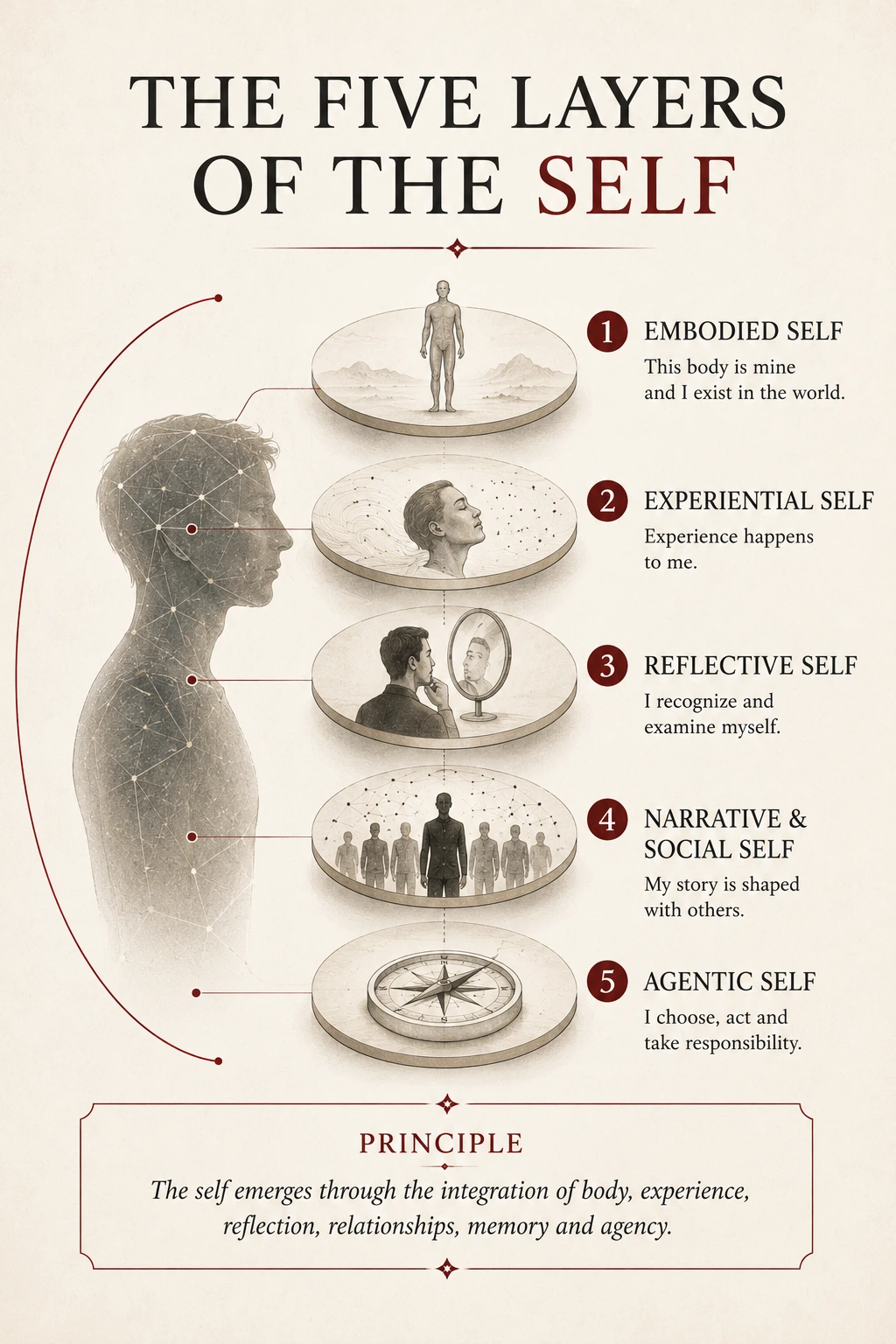
1. The Embodied Self
The embodied self is the basic sense that this body is mine and that experience occurs from its location. You do not normally experience vision as floating nowhere. You see from a perspective. You do not merely register pressure; you feel that your hand is touching something. The body gives the self orientation, vulnerability, capability and a boundary between organism and environment.
Embodiment also means that the self is not only an abstract story. Hunger, fatigue, posture, pain, movement and biological regulation shape the possibilities of attention and action. Even the most reflective account of identity must begin from the fact that human experience is lived through a body.
Experimental work on the rubber hand illusion shows that synchronized visual and tactile signals can shift the felt ownership and perceived location of a hand. The result does not explain the whole self, but it demonstrates that bodily ownership is actively constructed through multisensory integration rather than simply read from appearance.
2. The Experiential Self
The experiential self is the immediate first-person character of consciousness: the sense that sensations, thoughts and emotions are happening to me or for me. Before a person explains who they are, experience already has a perspective.
This layer should not be confused with a detailed personality or biography. A moment of pain can feel mine even when I am not thinking about my name, social role or life story. The experiential self is thinner and more immediate: it is the lived centre from which a world appears.
3. The Reflective Self
The reflective self appears when a subject can turn attention toward themselves. A person can ask: What am I feeling? What do I believe? Why did I act that way? What kind of person am I becoming?
The Stanford Encyclopedia of Philosophy’s account of self-consciousness emphasizes that self-awareness involves being aware of oneself as oneself, not merely encountering something that happens to be oneself. Reflection allows experience to become an object of interpretation, judgment and revision.
This layer supports self-knowledge, but it is not infallible. People can misunderstand their motives, overlook contradictions or adopt descriptions shaped by fear, habit or social expectation. Reflection expands the self while also creating the possibility of self-deception.
4. The Narrative and Social Self
The narrative self is the story through which a person connects events into a life: where I came from, what happened to me, what mattered, what changed and what I am trying to do next. The social self is formed through names, languages, roles, relationships, recognition and shared meanings.
These two dimensions belong together because no human life story is written in complete isolation. Families, communities, friendships and institutions provide categories through which a person interprets themselves. The APA Dictionary of Psychology defines the social self in part through aspects of identity and self-concept that are important to or influenced by relationships and other people’s reactions.
A story can create coherence, but it can also oversimplify. People often turn a complicated history into a rigid sentence: “I am the one who always fails,” “I am the responsible one,” or “I am not the kind of person who changes.” A narrative helps organize the self, yet it remains open to reinterpretation.
5. The Agentic Self
The agentic self is the self as chooser, planner and participant in consequences. It forms intentions, acts, responds to reasons and takes responsibility. Agency connects selfhood to ethics because the word “I” does not only identify the experiencer of events; it can also identify the person who decides what to do.
Agency is never unlimited. Bodies, environments, histories and social structures constrain what a person can do. Yet the ability to orient action toward a future remains central to selfhood. A self is not only a record of what has happened. It is also a centre of possible response.
These five layers are distinguishable, but they do not function independently. The body shapes experience. Experience becomes available to reflection. Memory and relationships shape narrative. Values orient agency. Action produces new experiences that can change the story.
How the Self Emerges
If the self is layered, what makes the layers feel like one life rather than a collection of disconnected systems?
The most cautious answer is integration. Body, experience, memory, relationships, values and agency continuously constrain and update one another. The self emerges from this coordination. It is not simply the sum of six independent ingredients, because changing one dimension can reorganize the meaning of the others.
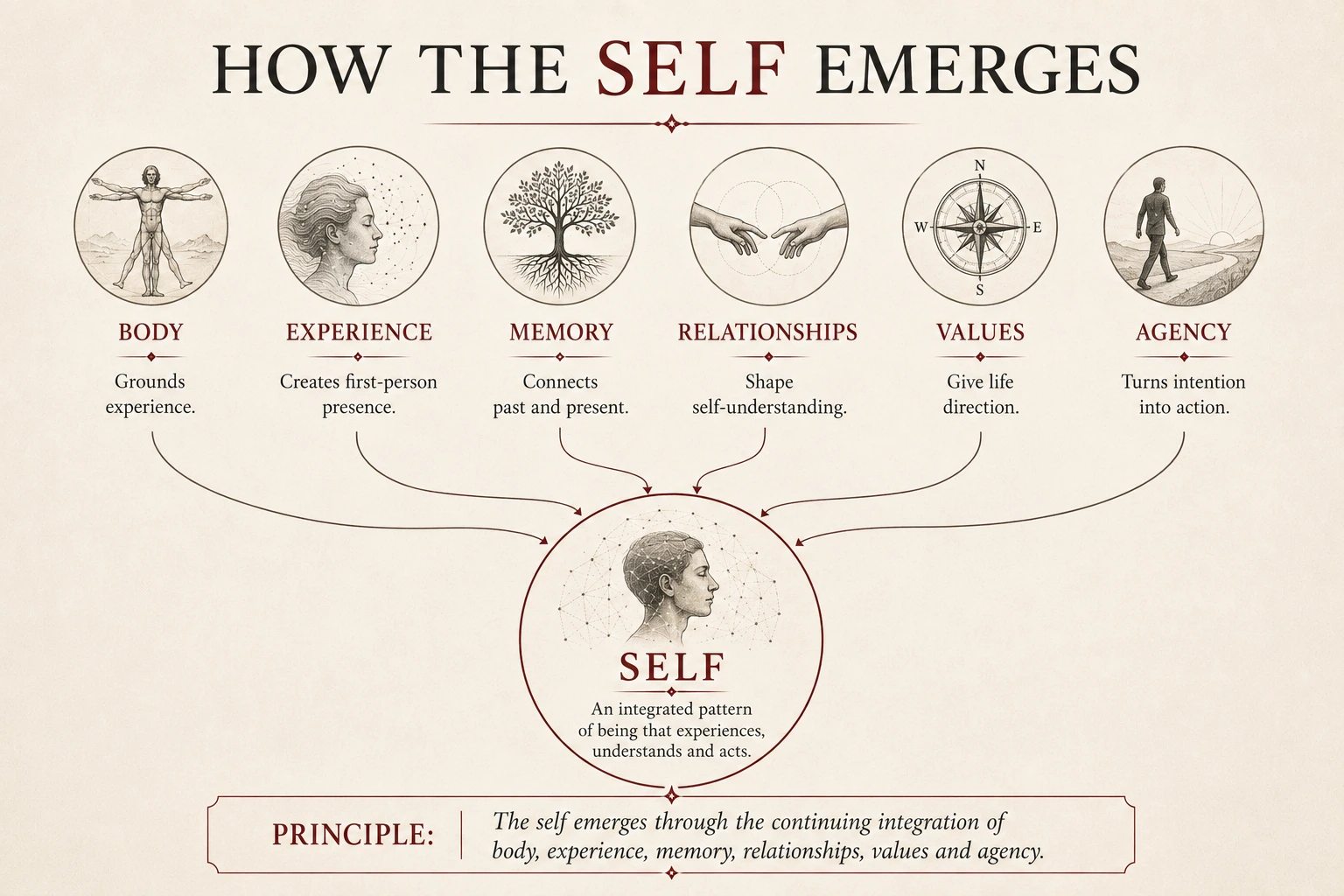
Consider a simple example. A person receives criticism. The body reacts with tension. The experience carries emotion. Memory links the moment with earlier situations. Relationships affect how the criticism is interpreted. Values determine whether the person prioritizes approval, truth, loyalty or improvement. Agency shapes the response: withdraw, attack, listen, question or change.
No single element is “the self” in isolation. The self is the organized pattern through which these elements become one situated response.
This is why attempts to locate the self in one precise mental compartment are misleading. Studies of self-referential processing report activity across medial prefrontal, parietal, premotor and other regions, and task-dependent changes in coupling within the default-mode network. One fMRI study of self-encoded information and another study of default-mode coupling support a distributed account of self-related processing. They do not, by themselves, settle the philosophical nature of the self.
Is the Self the Same as Consciousness or Personal Identity?
No. The concepts are closely related, but they answer different questions.
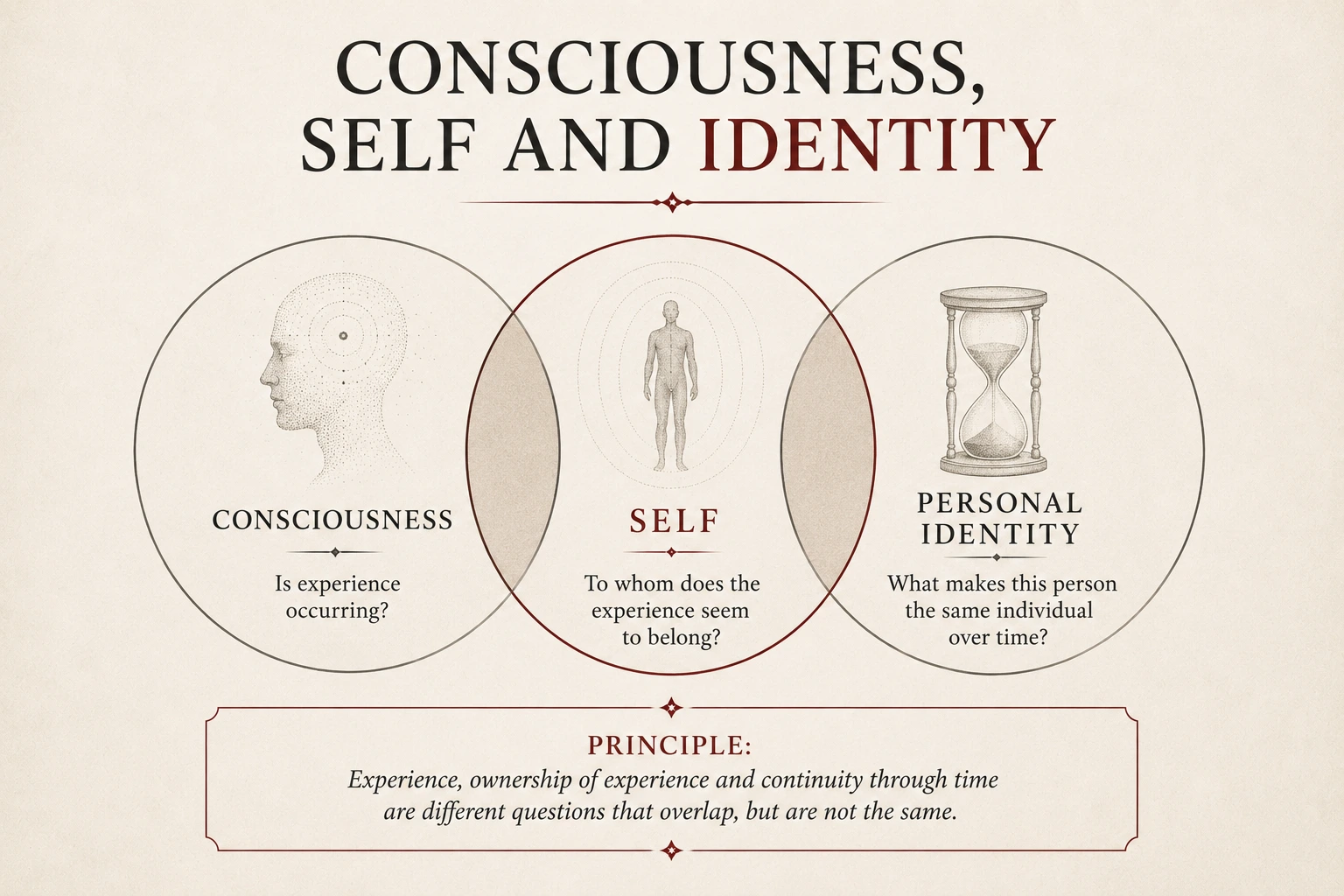
| Concept | Central question | What it explains |
|---|---|---|
| Consciousness | Is experience occurring? | The existence and qualities of subjective experience. |
| Self | To whom does experience seem to belong? | The organization of experience around an embodied, reflective, social and agentic subject. |
| Self-consciousness | Can the subject recognize itself as itself? | Awareness of one’s own body, activity or mental life as one’s own. |
| Personal identity | What makes this person the same individual over time? | Persistence, numerical identity and continuity across change. |
| Self-concept | What does the person believe about themselves? | Traits, roles, values and descriptions included in self-understanding. |
Consciousness without a rich self
It is possible to imagine conscious experience with only a minimal form of selfhood: sensations occur from a perspective, but there is little reflection, autobiography or social identity. The question is not whether experience exists, but how much organization is required before it becomes the experience of a developed self.
A self without unbroken reflection
A person does not cease to have a self whenever reflective thought stops. During absorption, routine action or dreamless sleep, explicit self-awareness may be absent or reduced. Yet bodily continuity, dispositions, relationships and the capacity to resume a life remain.
Personal identity as a different problem
Personal identity asks what makes a person at one time the same person at another. Is it the same organism, the same consciousness, memory, psychological continuity, a soul or some other relation? That debate is explored more fully in what makes you the same person throughout your life and in the dedicated guide to personal identity.
The distinction prevents cannibalization between questions. “What is the self?” concerns the present organization of being “me.” “What preserves personal identity?” concerns persistence across time and transformation. “Why am I me?” concerns the deeper first-person mystery of why experience occurs from this particular perspective rather than another. That final question is explored in Why Am I Me and Not Someone Else?
Does Memory Create the Self?
Memory is one of the strongest sources of continuity. It allows the present subject to access earlier experiences, recognize patterns, preserve commitments and anticipate consequences. Without memory, a life would lose much of its autobiographical structure.
Yet memory alone cannot be the entire self.
First, memory is selective: no person remembers every experience, and much of life influences behavior without becoming explicit recollection. Second, memories can be incomplete, reconstructed or reinterpreted. Research on the misinformation effect shows that later misleading information can alter reports of past events. Third, a person can forget events while retaining bodily continuity, skills, relationships, values and characteristic ways of responding. Fourth, a copied memory would not automatically prove that two beings are one and the same person.
Evidence from amnesia also complicates the idea that episodic memory is the whole self. In a study of people with medial temporal lobe amnesia, participants could still support parts of their self-concept using personal semantic knowledge, even when detailed episodic recollection was severely impaired. That finding suggests that different kinds of memory contribute differently to self-understanding. Read the study.
Memory therefore performs at least three different roles:
- Access: it makes parts of the past available to the present.
- Meaning: it allows past events to be interpreted as belonging to a life.
- Orientation: it informs present judgment and future intention.
Memory is best treated as a bridge between experience, narrative and continuity—not as the sole substance of the self. This is why stories about amnesia, false memories or copied minds are philosophically powerful: they separate elements that usually appear together.
For readers interested in fiction that explores this tension, Cokos also curates books about memory and books about consciousness.
Is the Self Real or Constructed?
The question often presents a false choice. Something can be constructed and still be real. A language, institution or promise depends on human activity, yet it can shape lives and produce consequences. Likewise, the self might be biologically, psychologically and socially constructed without being a meaningless illusion.
Philosophers have proposed several major models. Each captures something important, and each leaves difficult questions unanswered.
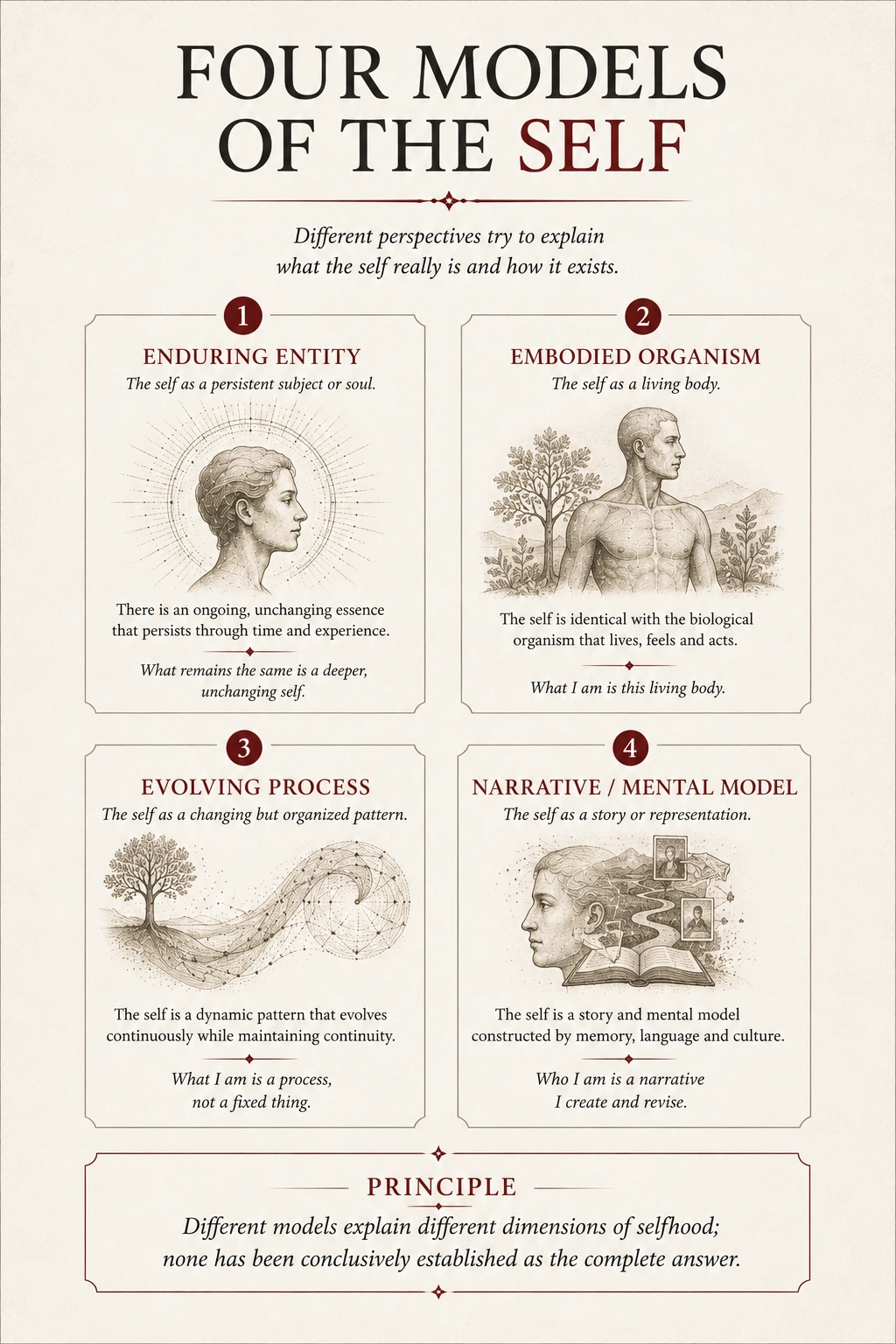
1. The Self as an Enduring Entity
On this view, the self is a persistent subject, substance or soul that remains through changing experiences. Thoughts, emotions and bodily states belong to it, but are not identical with it.
The model explains why experience appears unified and why people often feel that there is a deeper “me” beneath changing traits. It also fits many religious and metaphysical traditions. Its difficulty is evidential: what is this enduring entity, how does it relate to the body, and how could its persistence be established?
2. The Self as an Embodied Organism
On the embodied-organism model, the self is fundamentally the living human being. The subject is not a separate passenger inside the body; it is the organism that perceives, remembers, communicates and acts.
This view gives biological continuity a central role and avoids separating mind from life. Its challenge is explaining why psychological continuity seems so important. If memories, personality and agency changed radically while the organism remained alive, would the self remain entirely unchanged?
3. The Self as an Evolving Process
The process model treats the self as a changing but organized pattern. It is real in the way a living system, conversation or melody is real: not because every component stays fixed, but because relations and continuity are maintained through change.
This model explains development, adaptation and transformation without requiring an unchanging essence. Its challenge is determining when change becomes discontinuity. If the pattern is altered enough, what justifies calling it the same self?
4. The Self as a Narrative or Mental Model
On this account, the mind organizes bodily signals, memories, social roles and expectations into a model of “me.” A narrative gives events coherence and makes planning possible. The self is not discovered as a simple object; it is continuously represented and revised.
This view explains why identity depends on language, memory and culture. It also explains how self-understanding can be mistaken. Its danger is reduction: the self cannot be only a verbal story if bodily ownership and first-person experience exist before a developed autobiography.
Hume and the absence of a simple self
David Hume famously argued that introspection does not reveal a single, simple and unchanging impression of the self. Instead, he found changing perceptions. The Internet Encyclopedia of Philosophy’s overview of Hume explains both his skeptical claim and the problem of accounting for the idea of personal identity despite the flux of perceptions.
Hume’s challenge remains powerful: when you look inward, do you encounter a self itself, or only thoughts, sensations, emotions and memories? But the absence of a simple inner object does not by itself prove that no organized subject exists. It may show that the self is not the kind of thing introspection was expected to find.
Is There a Self Before Reflection?
Imagine reaching for a glass without thinking, “I am now experiencing myself as the agent of this movement.” The action is still organized around a body and perspective. The experience may already carry a sense of ownership before explicit reflection begins.
Phenomenological approaches call this prereflective self-consciousness. The idea is that experience can be given in a first-personal way before the subject examines it or tells a story about it. The Stanford Encyclopedia of Philosophy’s overview of phenomenological approaches distinguishes this immediate first-person givenness from later introspection, mirror recognition and self-narrative.
This distinction prevents two opposite errors.
The first error is to assume that the self must always be a fully articulated concept. Infants, animals or absorbed adults may possess forms of embodied perspective without constructing an elaborate identity story.
The second error is to assume that immediate perspective explains the whole self. A prereflective “for-me-ness” does not by itself explain autobiographical identity, social role, moral responsibility or long-term agency. It is a foundation, not the complete structure.
Can the Self Change Without Disappearing?
Yes. Change is not automatically the destruction of selfhood. In ordinary life, people revise beliefs, develop new abilities, lose roles, enter relationships, abandon ambitions, recover forgotten parts of themselves and reinterpret the past. These changes can be profound while still belonging to one continuing life.
The mistake is to imagine only two options: perfect sameness or complete replacement. Continuity can persist through transformation when enough relations remain between past experience, accessible memory, present interpretation and future intention.
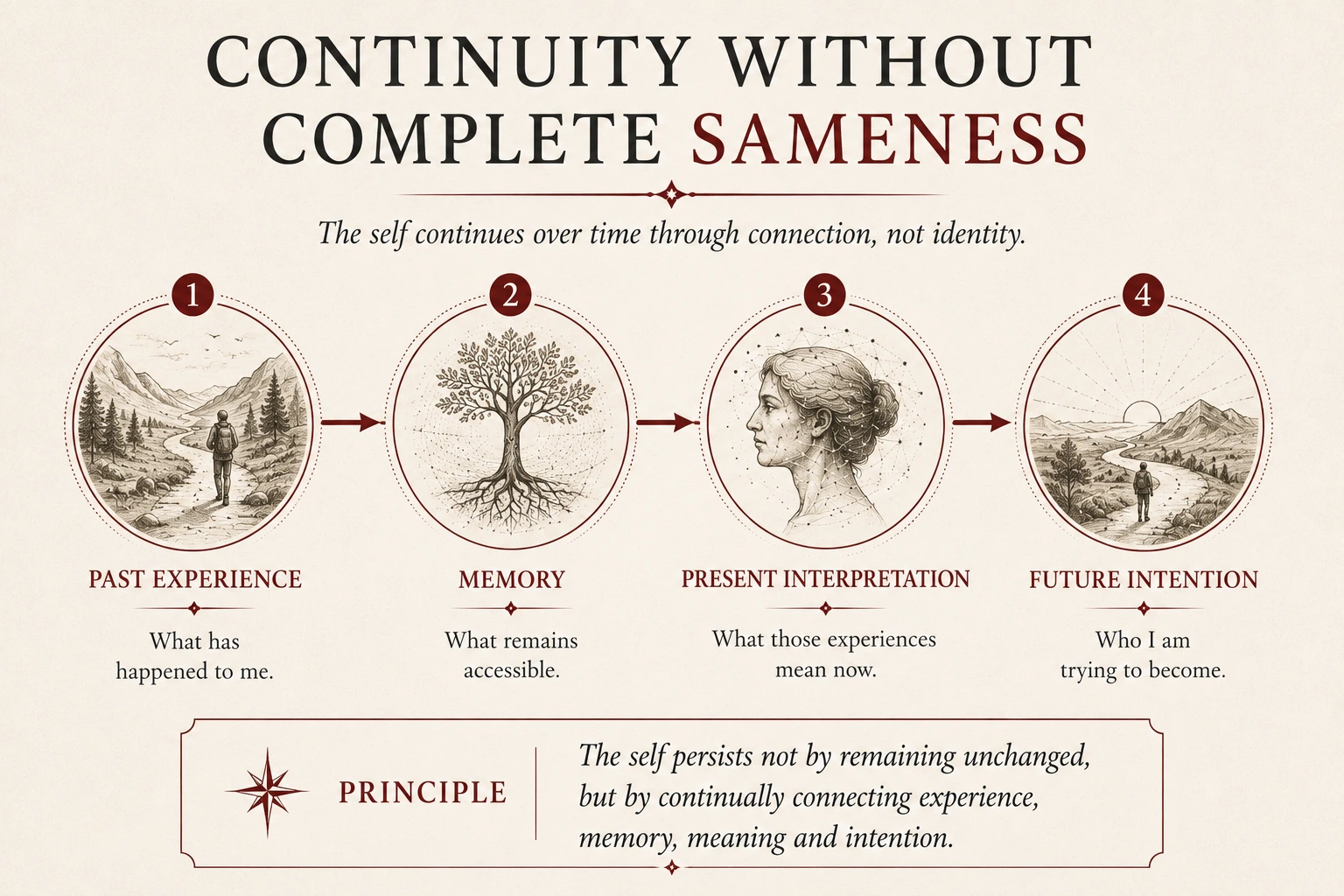
Past experience
What happened cannot be made identical to what is happening now. Yet past events shape capacities, expectations and vulnerabilities. They become part of the self when they are integrated rather than merely endured.
Memory
Memory carries portions of the past forward. It does not reproduce the past perfectly, but it creates access and relation.
Present interpretation
The meaning of an experience is not frozen at the moment it occurred. A failure can later become evidence of incapacity, a lesson, an injustice, a turning point or a source of compassion. Interpretation reorganizes the self without changing the historical event.
Future intention
A person is partly constituted by what they are trying to become. Intention projects identity forward. It transforms the self from a record of causes into a participant in possibility.
This account avoids claiming that continuity is guaranteed. Severe disruption may create difficult cases. It also avoids claiming that a person must remain psychologically unchanged to remain themselves. A living self can preserve connection precisely by changing.
Could the Self Exist Outside the Body?
This question appears in religious traditions, philosophy of mind, artificial-intelligence debates and speculative fiction. It can mean several different things:
- Could a soul continue after biological death?
- Could consciousness exist independently of a brain?
- Could memories and personality be transferred into another substrate?
- Could a digital copy possess a self?
- Would that copy be you or only someone psychologically similar?
These questions should not be collapsed into one. A system might copy information without transferring first-person experience. It might reproduce memories without preserving numerical identity. It might display a coherent self-model without being conscious. Or it might be conscious in a way humans fail to recognize.
The embodied model predicts that a human self cannot simply be separated from the living organism. The enduring-entity model allows the possibility of persistence beyond the body. The process model asks whether the relevant pattern can continue in a new medium. The narrative-model approach asks whether continuity of memory, values and self-representation would be enough.
Cokos explores these questions separately in Can Consciousness Exist Outside the Brain?, Can Consciousness Be Uploaded into a Computer?, Can AI Become Conscious? and Does the Soul Exist?
No current philosophical definition alone can settle these scenarios. They expose what each theory assumes is essential: body, consciousness, memory, continuity, agency, soul or organization.
What Makes You You?
You are not merely your body, memories, personality, social roles or present thoughts. Each can change, and none alone explains why a changing life is still experienced as yours.
A fuller answer is that you are the continuing organization of embodiment, perspective, memory, relationships, values and agency through which one life is experienced, interpreted and directed.
This means the self can be real without being fixed. It is partly received—through body, history and relationships—and partly enacted through interpretation, commitment and choice. It is also future-facing: promises, plans and intentions allow the person you are becoming to shape the person you are now.
The Self in Philosophical Fantasy
Philosophy can distinguish theories of the self. Fiction can place a person inside their consequences.
What happens when two people inherit the same memories? Can an immortal remain the same self after centuries of transformation? If realities divide, which version owns the past? Can someone preserve a civilization while losing the person they once believed themselves to be? Does responsibility survive when identity is altered?
These questions become more than thought experiments when they are embodied in choices, relationships and irreversible consequences.
Conclusion: The Self as a Living Unity
What is the self? It is the organized unity through which a body becomes a lived body, experience becomes my experience, memory becomes my past, relationships become part of who I am, and intention becomes action.
Whether that unity is grounded in an enduring entity, a biological organism, an evolving process or a mental model remains disputed. Each theory explains part of the phenomenon and leaves another part unresolved.
The word “I” feels singular because a life must be lived from somewhere. The enduring mystery is not only that experience exists, but that experience, memory, meaning and agency become organized into someone.
Frequently Asked Questions About the Self
What is the self in simple terms?
The self is the organized sense and structure of being “me.” It connects bodily perspective, conscious experience, reflection, memory, relationships, values and action so that changing events can be experienced as belonging to one life.
Is the self the same as consciousness?
No. Consciousness is the existence of subjective experience. The self is the way experience is organized around a particular subject and integrated with a body, memories, relationships and agency. The two overlap, but they answer different questions.
What is the difference between self and personal identity?
The self concerns the organization and experience of being “me.” Personal identity concerns what makes a person the same individual over time. A theory may explain the present structure of selfhood without fully solving persistence through radical change.
Does memory make you who you are?
Memory is central because it connects past and present and supports a life narrative. But it is not the whole self. Embodiment, skills, relationships, values, personality and agency can continue even when particular memories are lost or changed.
Is the self real or an illusion?
Philosophers disagree. The self may be an enduring subject, a living organism, an evolving process or a model created by the mind. Even if it is constructed, it can still be real as an organized pattern with consequences for experience and action.
Can the self change over time?
Yes. Beliefs, personality, roles, memories and values can change without automatically creating a completely different person. Continuity may persist through connections among past experience, present interpretation and future intention rather than through perfect sameness.
Is the self located in one part of the brain?
No single location explains every dimension of selfhood. Bodily ownership, autobiographical memory, self-reflection, emotion, social understanding and agency involve partly different processes. Neuroimaging studies of self-referential tasks also report distributed activity and changing network interactions rather than one isolated “self center.” The philosophical concept of self therefore spans biological, experiential, psychological and social levels.
Could a digital copy have the same self?
A digital copy might reproduce memories, personality or behavior, but that would not by itself prove that the original first-person subject had transferred. The answer depends on whether selfhood requires the same organism, consciousness, causal continuity, psychological pattern or something else.
What is the difference between self and ego?
In everyday language, ego often means pride or self-importance. The self is much broader: it includes bodily experience, self-awareness, memory, identity, relationships, values and agency. Ego is one concept within some accounts of psychological functioning, not the whole person.
What makes you you?
You are the continuing organization of embodiment, perspective, memory, relationships, values and agency through which your life is experienced, understood and directed. None of these elements alone is sufficient, but together they create the pattern experienced as “me.”
Sources and Further Reading
Philosophy and Reference
- Stanford Encyclopedia of Philosophy: Self-Consciousness
- Stanford Encyclopedia of Philosophy: Phenomenological Approaches to Self-Consciousness
- Stanford Encyclopedia of Philosophy: Personal Identity
- Stanford Encyclopedia of Philosophy: Consciousness
- Internet Encyclopedia of Philosophy: David Hume
- Internet Encyclopedia of Philosophy: Self-Consciousness
- APA Dictionary of Psychology: Social Self
Empirical Research
- Tsakiris & Haggard (2005): The Rubber Hand Illusion Revisited
- Fossati et al. (2004): Neural Correlates of Retrieving Self-Encoded Information
- van Buuren et al. (2010): Default-Mode Network Coupling During Self-Referential Processing
- Loftus (2005): Planting Misinformation in the Human Mind
- Grilli & Verfaellie (2015): Supporting the Self-Concept with Memory—Insight from Amnesia
How Other People Help Create the Self
The self is experienced from the first person, but it is not formed in total isolation.
Other people name us before we can name ourselves. They respond to our actions, confirm or challenge our interpretations, remember parts of our history, assign roles and provide languages for emotion, duty, achievement, failure, belonging and difference.
This does not mean that the self is nothing more than public opinion. A person can resist social expectations, reject an inherited identity and preserve private commitments. But even resistance usually uses concepts learned in a social world.
Relationships contribute to selfhood in at least four ways:
The social self can become restrictive when a person is reduced to one role or one old story. Yet it can also expand identity. A relationship can make a new form of courage, responsibility or creativity possible by recognizing capacities that the person has not yet integrated into their own narrative.