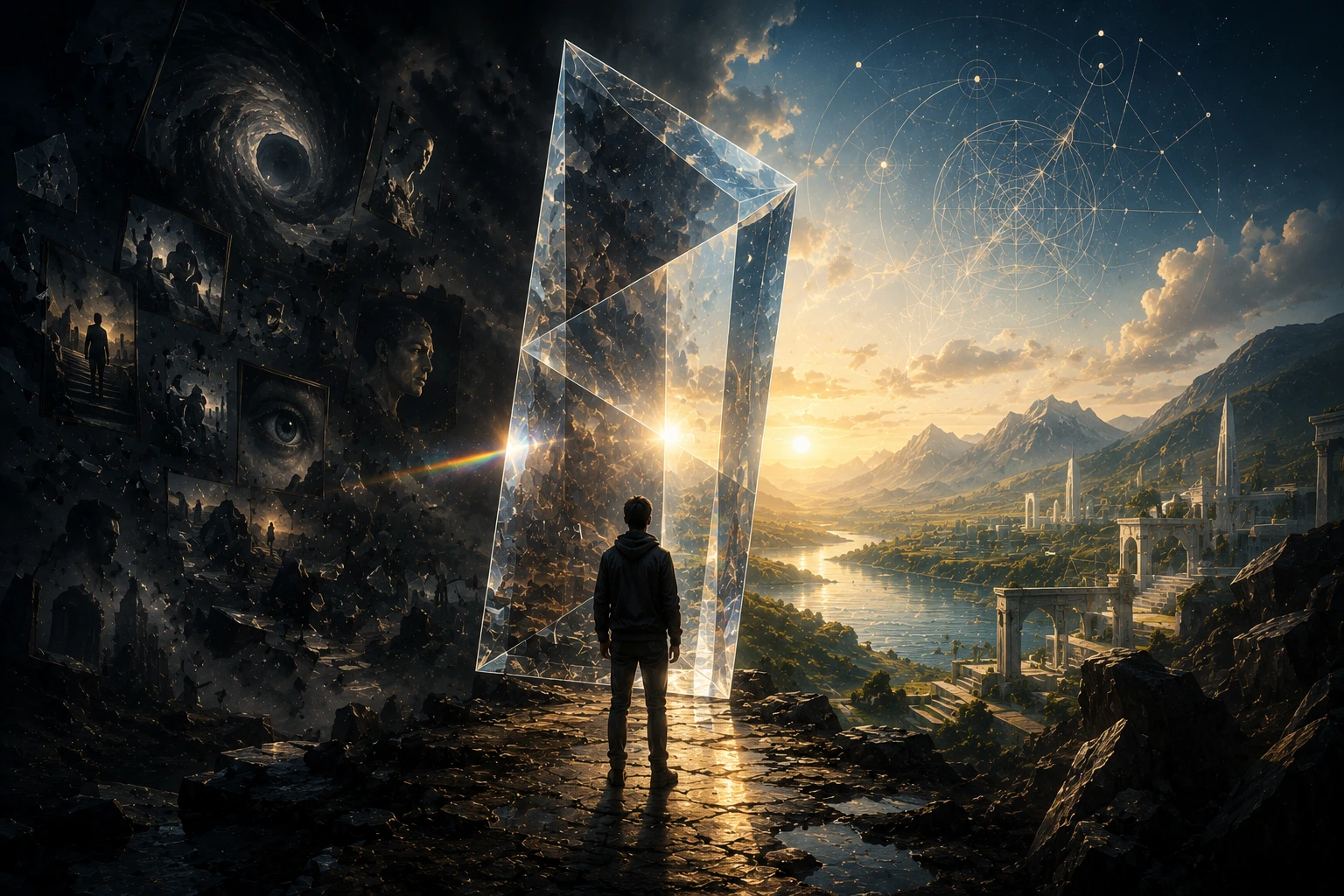
Estimated reading time: 32–38 minutes
Every scientific discovery.
Every courtroom verdict.
Every historical account.
Every meaningful conversation.
Every decision you make.
Each depends on a single invisible assumption:
that it is possible to distinguish what is true from what is false.
At first glance, truth appears obvious.
The sky is blue.
Fire is hot.
Water freezes under specific conditions.
Yet the deeper we investigate, the more mysterious truth becomes.
Can our senses be trusted?
Can memories change?
Does objective truth exist independently of human belief?
Or does every person construct reality differently?
For more than two thousand years these questions have shaped philosophy, science, mathematics, psychology, law, and religion.
They inspired Socrates to question certainty, Plato to search for eternal realities, Aristotle to ground knowledge in observation, René Descartes to doubt everything, Immanuel Kant to rethink perception itself, and modern scientists to develop methods capable of correcting human error.
Today, these questions have become even more urgent.
Artificial intelligence can generate convincing essays.
Deepfakes can fabricate events that never occurred.
Social media spreads both knowledge and misinformation at extraordinary speed.
Never before has humanity possessed so much information—or faced such difficulty determining which information deserves trust.
This guide explores one of philosophy’s oldest and most important questions from every major perspective.
You will discover how philosophers define truth, why science remains humanity’s most reliable method for reducing error, how psychology explains false beliefs, why perception can deceive us, what neuroscience reveals about the brain, and whether artificial intelligence can genuinely understand reality.
Along the way, we will see that truth is far more than an abstract philosophical concept.
It is the foundation of knowledge, justice, science, morality, civilization, and every meaningful attempt to understand ourselves and the universe we inhabit.
Quick Answer
- Truth generally refers to beliefs or statements that accurately correspond to reality.
- Philosophers have proposed several major theories of truth, including Correspondence, Coherence, Pragmatic, and Consensus theories.
- Epistemology studies how human beings acquire knowledge and determine whether beliefs are justified.
- Perception, memory, and reasoning are powerful but imperfect, making critical thinking essential.
- Science does not claim absolute certainty but continually improves our understanding through evidence and self-correction.
- Modern neuroscience shows that the brain actively constructs our experience of reality.
- Artificial intelligence processes information but does not currently demonstrate conscious understanding or subjective knowledge.
- The search for truth remains one of humanity’s greatest philosophical, scientific, and moral pursuits.
Key Takeaways
- Truth is different from opinion.
- Belief alone does not guarantee knowledge.
- Objective reality may exist independently of our interpretations.
- Reliable knowledge requires evidence, reasoning, and continual verification.
- Science advances by correcting mistakes rather than defending certainty.
- Intellectual humility is one of the most important tools in the search for truth.
Truth, Knowledge, Belief, and Opinion: Understanding the Difference
| Concept | Definition | Depends on Reality? |
|---|---|---|
| Truth | What accurately corresponds to reality. | Yes |
| Knowledge | A justified understanding supported by sufficient evidence. | Yes |
| Belief | Something accepted as true by an individual. | Not necessarily |
| Opinion | A personal judgment or preference. | May or may not |
These concepts are often confused in everyday conversation.
Someone may sincerely believe something that is false.
An opinion may be reasonable without being objectively correct.
Knowledge requires more than confidence.
It requires justification.
This distinction has shaped philosophy since ancient Greece and remains central to science, law, journalism, and everyday decision-making.
The Journey Toward Truth
Reality
      ↓
Perception
      ↓
Interpretation
      ↓
Belief
      ↓
Evidence
      ↓
Knowledge
      ↓
Wisdom
Human understanding rarely appears all at once.
Instead, it develops through a continuous process.
We first experience the world through perception.
We interpret what we perceive.
Those interpretations become beliefs.
Evidence confirms, modifies, or rejects those beliefs.
Reliable beliefs gradually become knowledge.
Wisdom emerges when knowledge is combined with experience, judgment, humility, and the willingness to continue learning.
The pursuit of truth is not the search for certainty. It is the continual refinement of our understanding of reality.
This simple progression forms the foundation of philosophy, science, and every serious attempt to understand the universe.
To understand truth itself, however, we must begin with a deceptively simple question that has challenged philosophers for more than two millennia.
What exactly do we mean when we say that something is “true”?
What Is Truth?
At first glance, the answer appears almost effortless.
Truth is simply what is true.
Yet this seemingly obvious definition immediately raises a deeper question.
What makes something true?
Is truth nothing more than an accurate description of reality?
Does it depend upon human agreement?
Can truth exist even if nobody believes it?
Or does every person construct their own version of reality?
These questions have shaped philosophy for more than two thousand years because nearly every other branch of human knowledge depends upon their answers.
Science seeks truthful explanations of nature.
History seeks truthful accounts of the past.
Courts seek truthful testimony.
Journalism seeks truthful reporting.
Even our closest relationships depend upon trust that what people say corresponds to reality.
Without some concept of truth, meaningful communication itself begins to collapse.
Truth is the bridge between our beliefs and reality.
Whenever that bridge becomes unreliable, confusion replaces understanding.
For this reason, philosophers have never treated truth as merely another abstract concept.
They have regarded it as the foundation upon which all knowledge ultimately rests.
Why Truth Matters
Imagine living in a world where nothing could be trusted.
Every scientific discovery might be false.
Every memory might be fabricated.
Every news report could be manipulated.
Every conversation might conceal deception.
Planning for the future would become impossible because reliable knowledge about the present would disappear.
This thought experiment reveals why truth is far more than a philosophical curiosity.
Truth makes prediction possible.
Prediction makes planning possible.
Planning makes civilization possible.
Every bridge, airplane, hospital, legal system, university, and scientific laboratory depends upon the assumption that reality behaves in consistent ways that human beings can gradually understand.
The search for truth therefore became one of civilization’s greatest collective projects.
It naturally connects with What Is Reality?, because before we can decide whether a belief is true, we must first ask what kind of reality exists independently of our beliefs.
The Origins of Humanity’s Search for Truth
Long before philosophy emerged in ancient Greece, every civilization attempted to explain reality.
Early cultures relied primarily on mythology.
Creation stories explained the origin of the universe.
Legends explained natural disasters.
Religious traditions established moral order.
These narratives did far more than entertain.
They organized knowledge, preserved cultural memory, and helped societies make sense of an unpredictable world.
Yet around the sixth century BCE, something remarkable happened in ancient Greece.
Instead of asking only Which story explains the world?, philosophers began asking a radically different question:
How can we determine whether any explanation is actually true?
This shift transformed humanity’s intellectual history.
Reason gradually joined tradition.
Observation challenged authority.
Arguments increasingly depended upon evidence rather than reputation.
From this revolution emerged philosophy, science, and eventually the modern methods through which humanity continues to investigate reality.
Socrates: The Beginning of Critical Inquiry
No figure shaped the philosophical search for truth more profoundly than Socrates.
Unlike many teachers of his time, Socrates rarely claimed to possess final answers.
Instead, he asked questions.
Simple questions.
Uncomfortable questions.
Questions that exposed contradictions hidden beneath confident opinions.
His famous declaration remains one of philosophy’s defining principles.
“I know that I know nothing.”
This was not a rejection of knowledge.
It was a rejection of false certainty.
Socrates believed genuine wisdom begins when people recognize the limits of their understanding.
Only then do they become willing to investigate reality honestly rather than defending comfortable assumptions.
His method—now called the Socratic Method—continues to influence education, law, philosophy, and scientific thinking.
Every serious search for truth begins with the same willingness to ask:
How do I know that what I believe is actually true?
That simple question became the foundation upon which nearly all later philosophy was built.
Socrates’ student, Plato, would take the next extraordinary step by arguing that truth itself might exist independently of the changing physical world.
Plato: Does Truth Exist Beyond the Physical World?
If Socrates taught humanity to question its assumptions, Plato asked an even more ambitious question.
What if truth exists independently of everything we see?
According to Plato, the world revealed by our senses is constantly changing.
People grow older.
Empires rise and fall.
Mountains erode.
Stars are born and eventually disappear.
If everything changes, Plato wondered, how can genuine knowledge ever remain stable?
His answer became one of the most influential ideas in Western philosophy.
Behind the changing physical world exists an eternal realm of perfect realities that never change.
These perfect realities—or Forms—represent the true nature of things.
Every beautiful object participates imperfectly in the perfect Form of Beauty.
Every just action reflects the perfect Form of Justice.
Every truthful statement derives its reliability from the eternal reality of Truth itself.
For Plato, truth is not created by human beings. It is discovered.
Whether or not one accepts Plato’s metaphysics today, his central insight continues to shape philosophical thinking.
If truth changes whenever opinions change, can it still be called truth?
This question remains as relevant in the age of artificial intelligence as it was in ancient Athens.
The Allegory of the Cave
To explain why human beings so often mistake appearance for reality, Plato presented one of the most famous thought experiments in the history of philosophy.
Imagine prisoners who have spent their entire lives chained inside a cave.
Unable to turn around, they see only shadows projected onto a wall.
Because they have never experienced anything else, the prisoners believe the shadows are reality itself.
Now imagine that one prisoner escapes.
Outside the cave, he encounters sunlight, colors, landscapes, and living people for the first time.
He realizes that the shadows were merely imperfect reflections of a far richer world.
When he returns to tell the others, they refuse to believe him.
His new understanding contradicts everything they have ever known.
The Allegory of the Cave remains powerful because it illustrates a timeless philosophical challenge.
People often mistake familiarity for truth.
What feels obvious may simply be what we have always experienced.
The search for truth therefore requires the courage to question appearances—even when doing so is uncomfortable.
The greatest obstacle to truth is not ignorance. It is the illusion that we already possess it.
Aristotle: Bringing Truth Back to Earth
Although Aristotle studied under Plato for nearly twenty years, he eventually reached a different conclusion.
Instead of locating truth in a separate realm of perfect Forms, Aristotle believed truth should begin with careful observation of the world around us.
Reality itself—not an invisible realm beyond it—became the starting point for knowledge.
This shift profoundly influenced science.
Aristotle carefully studied animals, plants, politics, ethics, logic, and astronomy.
He believed understanding grows by investigating how the natural world actually behaves.
One of Aristotle’s most influential ideas became the foundation of what philosophers later called the Correspondence Theory of Truth.
To say of what is that it is, and of what is not that it is not, is true.
Although expressed in ancient language, the principle remains surprisingly modern.
A statement is true when it accurately describes reality.
If snow is white, then the statement “Snow is white” is true because it corresponds with the world as it actually exists.
This seemingly simple insight became the philosophical foundation upon which much of modern science would later be built.
Truth as Correspondence with Reality
The Correspondence Theory remains the most intuitive understanding of truth.
It assumes that reality exists independently of human opinion.
Our beliefs do not create mountains.
They do not alter the laws of gravity.
They do not determine whether historical events occurred.
Instead, reality provides the standard against which beliefs are measured.
This idea appears almost self-evident.
Yet it immediately raises another philosophical challenge.
If our senses are imperfect…
If memories can change…
If perception itself is filtered through the brain…
How can we ever know whether our beliefs truly correspond to reality?
This question would occupy philosophers for centuries.
It ultimately gave rise to several competing theories, each attempting to explain what makes a belief genuinely true.
Some emphasized correspondence.
Others emphasized logical consistency.
Still others argued that truth should be judged by practical consequences or rational agreement.
Together, these perspectives form the foundation of modern philosophical discussions about truth.
To understand why philosophers continue to disagree after more than two thousand years, we must now examine each of these major theories in turn.
The Major Theories of Truth
Throughout the history of philosophy, no single explanation of truth has achieved universal agreement.
Instead, philosophers gradually developed several influential theories, each attempting to answer one deceptively simple question:
What makes a belief true rather than merely convincing?
At first glance, these theories may appear to compete with one another.
In reality, many philosophers view them as emphasizing different dimensions of truth.
Some focus on reality itself.
Others emphasize logic.
Some ask whether ideas successfully explain experience.
Others examine how rational communities evaluate evidence.
Together, these approaches reveal why truth remains one of philosophy’s richest and most enduring questions.
1. Correspondence Theory: Truth Matches Reality
The Correspondence Theory remains the most widely recognized explanation of truth.
Its central principle is elegantly simple.
A belief is true if it accurately corresponds to reality.
If snow is white, then the statement “Snow is white” is true because reality itself confirms it.
If water freezes under particular physical conditions, that statement is true because nature consistently behaves that way.
The Correspondence Theory assumes something extremely important.
Reality exists independently of our beliefs about it.
The Earth orbited the Sun long before anyone understood astronomy.
Gravity operated long before Newton described it mathematically.
Human opinions did not create these realities.
They merely discovered them.
This perspective became the philosophical foundation of modern science.
Scientists continually compare theories against observations.
Whenever reality disagrees with prediction, theories must change.
Reality—not authority—has the final word.
Yet this seemingly straightforward theory immediately encounters a profound challenge.
If every observation passes through imperfect perception, how can we know whether our beliefs genuinely correspond to reality?
That question motivated the development of several alternative theories.
2. Coherence Theory: Truth Fits Together
Imagine receiving a newly discovered historical manuscript.
How would historians evaluate it?
They would compare it with archaeology.
They would examine language, historical records, geography, and known events.
If the document consistently fits the broader body of evidence, confidence in its authenticity increases.
This illustrates the central idea behind the Coherence Theory.
According to this view, truth depends upon consistency within an interconnected system of beliefs.
Rather than evaluating isolated statements one by one, the theory asks:
Does this belief logically fit with everything else we know?
Mathematics provides one of its strongest examples.
Mathematical truths gain reliability because every theorem must remain consistent with the logical structure of the entire system.
The strength of the Coherence Theory lies in its emphasis on logical consistency.
Its weakness is equally important.
A fictional universe may be perfectly consistent while remaining entirely fictional.
Consistency alone cannot guarantee correspondence with reality.
3. Pragmatic Theory: Truth Works
American philosophers Charles Sanders Peirce, William James, and John Dewey approached truth from a different perspective.
Instead of asking whether beliefs perfectly mirror reality, they asked a practical question.
Does this belief consistently help us understand and successfully interact with the world?
Scientific theories become valuable because they repeatedly produce successful predictions.
Engineering principles prove themselves because bridges remain standing.
Medical knowledge earns trust because treatments repeatedly improve patients’ lives.
For pragmatists, truth demonstrates itself through reliable practical consequences.
This does not mean convenience determines truth.
Rather, successful interaction with reality provides strong evidence that our understanding approximates reality well.
4. Consensus Theory: Truth Through Rational Agreement
Another influential perspective suggests that truth emerges through open, rational discussion.
If informed individuals freely exchange evidence, challenge assumptions, and criticize weak arguments, they should gradually move toward increasingly reliable conclusions.
Modern scientific peer review reflects much of this idea.
No scientist determines truth alone.
Research is continually questioned, replicated, criticized, and refined by the broader scientific community.
Consensus, however, should never be confused with truth itself.
History contains countless examples of entire societies confidently believing ideas later shown to be false.
The strength of consensus lies not in popularity but in the quality of the reasoning used to achieve agreement.
Truth is not determined by how many people believe something. It is tested by how well beliefs survive careful examination against reality.
Comparing the Major Theories of Truth
| Theory | Core Question | Primary Strength | Main Limitation |
|---|---|---|---|
| Correspondence | Does it match reality? | Supports objective knowledge and science. | Reality is experienced through imperfect perception. |
| Coherence | Is it logically consistent? | Creates internally reliable systems. | Consistency alone cannot guarantee reality. |
| Pragmatic | Does it consistently work? | Connects truth with successful prediction. | Useful ideas are not always ultimately true. |
| Consensus | Would rational investigators agree? | Encourages criticism and collaboration. | Entire communities can still be mistaken. |
Each theory captures an important part of humanity’s relationship with truth.
None completely eliminates uncertainty.
Together, however, they reveal that discovering truth requires far more than simply collecting facts.
It also requires understanding how human beings acquire knowledge in the first place.
That question leads directly to one of philosophy’s most important disciplines:
epistemology—the study of knowledge itself.
Epistemology: How Do We Know What We Know?
If truth asks what is real, epistemology asks an equally important question:
How can human beings know whether their beliefs are actually true?
This branch of philosophy investigates the nature of knowledge itself.
It asks where knowledge comes from.
How reliable are our senses?
What counts as sufficient evidence?
Can certainty ever be achieved?
Without epistemology, every discussion about truth remains incomplete.
Even if objective truth exists, human beings still require dependable methods for discovering it.
For more than two thousand years, philosophers have debated exactly how this is possible.
Knowledge Is More Than Belief
Suppose someone flips a coin.
Without looking, you confidently announce:
“It landed heads.”
Imagine that you are correct.
Did you know the answer?
Most philosophers would say no.
You possessed a true belief, but your belief resulted from luck rather than evidence.
This simple example illustrates one of philosophy’s most influential distinctions.
Knowledge requires more than accidentally being right.
Traditionally, philosophers described knowledge as justified true belief.
| Requirement | Meaning |
|---|---|
| Belief | You accept the claim as true. |
| Truth | The claim actually corresponds to reality. |
| Justification | You possess good reasons or evidence supporting the belief. |
Although modern philosophers continue refining this definition, the central insight remains enormously influential.
Being correct is not enough.
Understanding why something is correct matters just as much.
Can We Ever Be Absolutely Certain?
Once philosophers recognized how easily beliefs can be mistaken, another question naturally followed.
Can any knowledge ever be absolutely certain?
This problem reached its most famous expression in the work of the seventeenth-century philosopher René Descartes.
Descartes and Methodical Doubt
Descartes proposed an extraordinary experiment.
Instead of accepting inherited beliefs, he decided to doubt everything that could possibly be questioned.
The senses sometimes deceive us.
Dreams can feel indistinguishable from waking life.
Even mathematical reasoning might, in principle, be manipulated by an unimaginably powerful deceiver.
After stripping away every uncertain belief, Descartes searched for one truth that survived absolute skepticism.
He found it in a remarkably simple realization.
“Cogito, ergo sum.”
“I think, therefore I am.”
If he was doubting, then someone had to exist to perform the doubting.
The existence of the thinking self became, for Descartes, the first indubitable truth.
From that foundation he attempted to rebuild human knowledge.
Whether or not one accepts his conclusions, Descartes permanently changed philosophy.
He demonstrated that certainty cannot simply be assumed.
It must be earned.
Empiricism and Rationalism
As philosophy developed, two influential traditions emerged concerning the origin of knowledge.
Rationalism
Rationalists argued that reason is the primary source of genuine knowledge.
Mathematics demonstrates that certain truths can be discovered through logical thinking alone.
Because the senses may deceive us, rationalists believed reason provides the most secure path toward truth.
Empiricism
Empiricists reached the opposite conclusion.
Thinkers such as John Locke, George Berkeley, and David Hume argued that knowledge begins with experience.
Observation.
Experiment.
Evidence gathered from the world.
Without experience, they argued, reason would have nothing to reason about.
Modern science ultimately combines both traditions.
Observation supplies evidence.
Reason organizes that evidence into coherent explanations.
Evidence without reasoning produces isolated facts.
Reason without evidence produces elegant speculation.
Reliable knowledge requires both.
Immanuel Kant: Does the Mind Shape Reality?
The debate between rationalists and empiricists appeared impossible to resolve.
Then, in the eighteenth century, Immanuel Kant proposed an idea that transformed modern philosophy.
Kant agreed that knowledge begins with experience.
But he argued that experience alone is not enough.
The human mind actively organizes sensory information before we become consciously aware of it.
Space.
Time.
Cause and effect.
These, Kant suggested, are not merely discovered in reality.
They are also fundamental structures through which the mind interprets experience.
This insight changed philosophy forever.
Instead of asking only how the mind discovers reality, philosophers increasingly asked how the mind itself contributes to every experience of reality.
Modern psychology, neuroscience, and cognitive science continue investigating this profound question today.
If Kant was correct, understanding truth requires understanding not only the external world but also the remarkable organ through which every experience of reality is interpreted—the human brain.
Psychology: Why Do People Believe Things That Are Not True?
Even if objective truth exists, another question remains.
Why do intelligent, well-meaning people sometimes believe things that are demonstrably false?
This question shifts the discussion from philosophy to psychology.
Rather than asking What is truth?, psychology asks:
How does the human mind decide what it accepts as true?
Modern research shows that people rarely evaluate information as perfectly objective observers.
Instead, every new piece of information passes through memory, emotion, expectations, past experience, cultural influences, and unconscious mental shortcuts.
These processes usually help us make decisions efficiently.
Sometimes, however, they also produce systematic errors.
Confirmation Bias
One of the strongest influences on human reasoning is confirmation bias.
People naturally notice information that supports existing beliefs while overlooking evidence that challenges them.
This tendency affects everyone.
Scientists.
Politicians.
Journalists.
Teachers.
Ordinary citizens.
The more emotionally important a belief becomes, the more difficult it often becomes to evaluate contradictory evidence fairly.
This explains why factual disagreement alone rarely changes deeply held convictions.
The Availability Heuristic
Human beings often judge probability by remembering examples that come easily to mind.
If dramatic airplane crashes receive extensive media attention, people may believe flying is unusually dangerous, even though statistical evidence shows commercial aviation remains one of the safest forms of transportation.
Information that is vivid, emotional, or repeatedly encountered often feels more convincing than information that is merely accurate.
Motivated Reasoning
People do not always seek objective conclusions.
Sometimes they seek conclusions that protect existing identities, relationships, or emotional security.
This process, known as motivated reasoning, can influence how evidence is interpreted without conscious awareness.
Rather than asking, “Is this true?” the mind may quietly ask:
What conclusion allows my current worldview to remain intact?
Recognizing these tendencies does not imply that human beings are irrational.
It reminds us that the search for truth requires deliberate intellectual discipline.
Memory: Why Remembering Is Not the Same as Recording
Many people imagine memory as a video archive stored inside the brain.
Modern psychology paints a very different picture.
Memory is reconstructive.
Whenever we remember an event, the brain actively rebuilds the experience rather than replaying a perfectly preserved recording.
As a result, memories can gradually change.
New information.
Later conversations.
Strong emotions.
Even repeated retelling can subtly reshape how past events are remembered.
This does not mean memory is useless.
It means memory, like perception, should be approached with humility rather than absolute certainty.
The human mind does not simply store reality. It continually interprets it.
Neuroscience: How the Brain Constructs Reality
For centuries philosophers debated whether perception reveals reality directly.
Modern neuroscience offers a more nuanced answer.
The brain does not passively receive information from the world.
It actively interprets enormous amounts of sensory input every second.
Vision illustrates this remarkably well.
Light reaches the eyes.
Electrical signals travel to the brain.
The brain combines those signals with previous experience, expectations, attention, and context to create the conscious experience we call seeing.
In other words, perception is not a photograph of reality.
It is an extraordinarily sophisticated interpretation.
This explains why optical illusions are possible.
The eyes are not malfunctioning.
The brain is applying predictive rules that usually help us understand the world quickly but occasionally lead to systematic errors.
The Predictive Brain
One influential theory in modern neuroscience proposes that the brain functions as a prediction engine.
Rather than waiting passively for information, it constantly generates expectations about what will happen next.
Sensory information is then compared with those predictions.
Unexpected differences become opportunities for learning.
This ability allows people to recognize familiar faces almost instantly, understand speech despite background noise, and react quickly in changing environments.
At the same time, it reminds us that perception always involves interpretation.
Our experience of reality is remarkably accurate in many situations, but it is never a perfectly neutral recording.
This insight naturally raises another profound question.
If every human mind interprets reality, how has science become so extraordinarily successful at discovering reliable knowledge about the universe?
The answer lies not in perfect observers, but in a method deliberately designed to overcome the limitations of every individual observer.
Science: Humanity’s Most Reliable Method for Discovering Truth
If human perception is imperfect…
If memory can change…
If reasoning is influenced by unconscious biases…
How has humanity managed to uncover the age of the universe, decode DNA, land spacecraft on distant planets, and build technologies that function with astonishing precision?
The answer is one of civilization’s greatest intellectual achievements.
Science does not depend upon perfect observers.
It depends upon methods designed to correct the mistakes that every observer inevitably makes.
Rather than trusting intuition alone, science requires evidence.
Rather than accepting authority, it demands verification.
Rather than protecting existing beliefs, it encourages criticism.
This is what makes science remarkably powerful.
Its greatest strength is not that scientists are never wrong.
Its greatest strength is that scientific knowledge is designed to improve whenever errors are discovered.
Science is not a collection of unquestionable facts. It is humanity’s most successful system for reducing error.
The Scientific Method
Although scientific disciplines differ greatly, they generally follow the same fundamental process.
| Step | Purpose |
|---|---|
| Observation | Notice patterns or unexplained phenomena. |
| Question | Ask why the phenomenon occurs. |
| Hypothesis | Propose a testable explanation. |
| Experiment | Compare predictions with measurable evidence. |
| Analysis | Evaluate whether the evidence supports the hypothesis. |
| Replication | Allow independent researchers to repeat the investigation. |
| Revision | Improve or replace explanations when new evidence appears. |
Every stage exists for the same reason.
Human beings are imperfect observers.
The scientific method reduces the influence of individual mistakes by making evidence public, repeatable, and open to criticism.
Why Scientific Knowledge Changes
One of the most common misunderstandings about science is the belief that changing conclusions demonstrate weakness.
In reality, the opposite is true.
Scientific knowledge changes because reality continually provides new information.
When better evidence appears, responsible scientists revise previous explanations.
History provides countless examples.
- Earth was once believed to occupy the center of the universe.
- Diseases were once attributed to supernatural forces before microorganisms were discovered.
- Continents were once thought to remain permanently fixed before plate tectonics transformed geology.
- Classical physics was expanded—not discarded—by relativity and quantum mechanics.
Each advance illustrates an important principle.
Science progresses not because it refuses to change, but because it willingly changes whenever reality demands it.
The willingness to abandon a beautiful theory when evidence contradicts it is one of science’s greatest virtues.
Truth, Uncertainty, and Probability
Outside mathematics and formal logic, absolute certainty is surprisingly rare.
Instead, science often works with probabilities.
A theory becomes increasingly reliable as evidence accumulates from many independent sources.
This does not mean truth is relative.
It means human understanding gradually approaches reality through increasingly accurate models.
Consider a map.
No map contains every detail of the territory it represents.
Yet some maps describe reality far more accurately than others.
Scientific theories function in much the same way.
They are models of reality.
Better evidence produces better maps.
The territory itself remains unchanged.
Can Artificial Intelligence Discover Truth?
As artificial intelligence becomes increasingly capable, a new philosophical question has emerged.
Can a machine genuinely discover truth?
Modern AI systems can process enormous quantities of information.
They identify statistical patterns beyond the capacity of individual human beings.
They summarize research.
Generate explanations.
Translate languages.
Predict protein structures.
Assist scientific discovery.
Yet an important distinction remains.
Current artificial intelligence identifies relationships within information.
Whether this constitutes genuine understanding remains one of philosophy’s most controversial questions.
Most contemporary philosophers distinguish between:
- processing information,
- recognizing patterns,
- understanding meaning,
- possessing conscious awareness.
Today’s AI unquestionably performs the first two.
Whether it achieves the latter remains an open philosophical question.
This discussion naturally connects with What Is Consciousness? and Can Consciousness Be Uploaded into a Computer?, where we explore whether genuine understanding requires subjective experience or whether computation alone could eventually produce consciousness.
Truth in the Age of Misinformation
The digital age has transformed humanity’s relationship with information.
Never before have billions of people possessed instant access to so much knowledge.
Never before has misinformation traveled so quickly.
Deepfakes can fabricate convincing videos.
Artificial intelligence can generate persuasive but inaccurate content.
Social media algorithms often reward engagement rather than accuracy.
In this environment, the search for truth becomes not easier but more demanding.
Critical thinking, source evaluation, intellectual humility, and evidence-based reasoning are no longer merely academic skills.
They have become essential civic responsibilities.
The information age has not reduced humanity’s need for truth. It has made the disciplined search for truth more important than ever before.
Ultimately, every discussion about evidence, science, psychology, and artificial intelligence returns us to the same timeless realization.
The search for truth is not simply an intellectual exercise.
It shapes every decision we make, every society we build, and every future we hope to create.
To see this more clearly, we can now compare the major philosophical approaches side by side before drawing together everything we have learned.
Comparing the Major Philosophical Views of Truth
After more than two thousand years of philosophical inquiry, one conclusion becomes increasingly clear.
No single theory completely explains truth.
Each captures an essential part of humanity’s relationship with reality while leaving important questions unanswered.
Rather than viewing these theories as mutually exclusive, many contemporary philosophers see them as complementary perspectives that illuminate different aspects of one extraordinarily complex problem.
| Approach | Central Question | Greatest Contribution | Main Limitation |
|---|---|---|---|
| Correspondence | Does this belief match reality? | Provides the philosophical foundation of empirical science. | Reality is always experienced through human perception. |
| Coherence | Is this belief logically consistent? | Strengthens mathematics, logic, and systematic reasoning. | Consistency alone cannot prove reality. |
| Pragmatism | Does this belief reliably work? | Connects truth with prediction and successful action. | Practical usefulness does not always equal objective truth. |
| Consensus | Would informed investigators eventually agree? | Highlights criticism, dialogue, and peer review. | Entire communities can still reach mistaken conclusions. |
| Skepticism | How certain can knowledge become? | Protects against dogmatism and false certainty. | Excessive doubt can undermine confidence in genuine knowledge. |
Together these theories reveal an important insight.
Truth is not merely something we possess.
It is something we continually approach through observation, reasoning, criticism, experience, and intellectual humility.
A Brief History of Humanity’s Search for Truth
| Historical Era | Dominant Question | How Truth Was Understood |
|---|---|---|
| Ancient Mythology | How did the world begin? | Truth was preserved through sacred narratives and tradition. |
| Classical Greece | Can reason discover reality? | Truth became the object of philosophical investigation. |
| Middle Ages | How do faith and reason relate? | Truth reflected both divine revelation and rational inquiry. |
| Scientific Revolution | Can observation reveal nature? | Evidence and experimentation became central. |
| Modern Philosophy | How reliable is human knowledge? | Attention shifted toward perception, cognition, and justification. |
| Digital Age | How can truth survive information overload? | Critical thinking and verification became increasingly important. |
| Age of Artificial Intelligence | Can machines recognize truth? | The distinction between information, understanding, and consciousness became a central philosophical question. |
What the Search for Truth Reveals About Humanity
At first glance, the philosophy of truth appears to concern facts.
Closer examination reveals something much deeper.
Every theory of truth ultimately becomes a theory about human beings themselves.
If truth is objective, then humanity possesses the remarkable ability to discover realities that exist independently of individual opinion.
If perception always shapes experience, then understanding ourselves becomes inseparable from understanding reality.
If science continually improves by correcting mistakes, then intellectual humility becomes one of civilization’s greatest strengths.
The search for truth therefore transforms into something larger than philosophy.
It becomes an ongoing conversation between reality and the human mind.
Every observation.
Every experiment.
Every philosophical debate.
Every scientific breakthrough.
Each represents another step in humanity’s attempt to understand both the universe and itself.
Truth rarely asks us to become more certain. It asks us to become more honest about what we know, what we do not know, and what we are still capable of discovering.
Conclusion
The search for truth has shaped every great civilization.
It inspired philosophy long before modern science existed.
It transformed astronomy, medicine, mathematics, and physics.
It continues to guide legal systems, education, journalism, and scientific research today.
Throughout history, philosophers have disagreed about how truth should be understood.
Scientists have repeatedly revised humanity’s understanding of reality.
Psychologists have shown how easily the human mind can be deceived.
Neuroscientists have revealed that perception itself is an active construction rather than a passive recording of the external world.
Yet despite these differences, every discipline ultimately converges upon the same principle.
Reality does not become true because we believe it. Our beliefs become more reliable only when they move closer to reality.
Perhaps this explains why the search for truth never truly ends.
Every answer generates new questions.
Every discovery expands the horizon of the unknown.
Every generation inherits humanity’s understanding of reality while accepting the responsibility to improve it.
Ultimately, truth is not simply a destination reached once and for all.
It is a lifelong discipline of curiosity, evidence, intellectual courage, and humility—a commitment to allowing reality, rather than comfort or certainty, to guide our understanding of the world.
The pursuit of truth is humanity’s greatest act of intellectual courage because it requires us to value reality more than our assumptions.
Frequently Asked Questions About Truth
1. What is truth?
Truth is generally understood as a belief or statement that accurately corresponds to reality. Different philosophical theories explain this relationship in different ways, but all attempt to answer why something should be considered true rather than false.
2. What is the difference between truth and knowledge?
Truth concerns reality itself. Knowledge is a justified understanding of that reality supported by evidence and reasoning. Someone may believe something true by accident without actually possessing knowledge.
3. What is the difference between belief and truth?
A belief is something a person accepts as true. Truth depends upon whether that belief actually corresponds to reality. Beliefs may be true or false.
4. Does objective truth exist?
Many philosophers argue that objective truth exists independently of human opinion. Others believe all knowledge is shaped by language, culture, or perception. The debate remains one of philosophy’s oldest questions.
5. What is epistemology?
Epistemology is the branch of philosophy that studies knowledge, evidence, belief, justification, and how human beings determine whether something is true.
6. What is the Correspondence Theory of Truth?
The Correspondence Theory states that a belief is true when it accurately matches objective reality. It remains the dominant philosophical foundation of modern science.
7. What is the Coherence Theory?
The Coherence Theory argues that truth depends upon logical consistency within an interconnected system of beliefs rather than isolated statements alone.
8. What is Pragmatism?
Pragmatism evaluates truth according to whether ideas consistently help explain, predict, and successfully interact with reality.
9. Can our senses be trusted?
Our senses are remarkably reliable in everyday life but not infallible. Psychology and neuroscience show that perception is an active interpretation of sensory information rather than a perfect recording of reality.
10. Why do intelligent people believe false things?
Intelligence does not eliminate confirmation bias, motivated reasoning, emotional influence, or other cognitive biases. Critical thinking requires actively questioning one’s own assumptions.
11. Can memories be inaccurate?
Yes. Modern psychology shows that memory is reconstructive. Although many memories remain reliable, they can gradually change as new information and experiences are integrated.
12. Why does science change its conclusions?
Science continually improves explanations as better evidence becomes available. Revising theories reflects the strength of the scientific method rather than its weakness.
13. Is scientific truth absolute?
Scientific knowledge is always open to revision. Theories become increasingly reliable as evidence accumulates, but responsible science remains willing to improve its explanations whenever new discoveries require it.
14. Can artificial intelligence know the truth?
Current AI systems analyze information and recognize patterns but have not been shown to possess conscious understanding or subjective awareness. They can assist the search for truth without replacing human judgment.
15. Is truth the same as opinion?
No. Opinions express personal judgments or preferences. Truth concerns whether statements accurately describe reality, regardless of how popular those statements may be.
16. Can different people have different truths?
People can interpret experiences differently, but objective facts are not determined by personal preference. Distinguishing subjective perspective from objective reality remains one of philosophy’s central challenges.
17. Why is truth important?
Truth makes science, medicine, engineering, justice, education, and trustworthy relationships possible. Without reliable methods for discovering truth, cooperation and civilization become increasingly difficult.
18. Can we ever know everything?
Most philosophers and scientists believe complete knowledge is unattainable. Every major discovery reveals new questions, making the search for truth an ongoing human endeavor.
19. What is skepticism?
Skepticism encourages questioning unsupported claims and carefully evaluating evidence. Healthy skepticism strengthens the pursuit of truth by reducing false certainty.
20. Is truth connected to morality?
Yes. Honesty, justice, responsibility, and trust all depend upon truthful communication. The relationship between truth and morality has been central to philosophy since ancient Greece.
21. Can truth change?
Objective reality does not change simply because beliefs change. What changes is humanity’s understanding of reality as new evidence and better explanations emerge.
22. Why is critical thinking essential?
Critical thinking helps people evaluate evidence, recognize biases, distinguish reliable sources from misinformation, and make better decisions in an increasingly complex information environment.
23. Can philosophy and science disagree?
They investigate different aspects of understanding. Science explains how the world behaves, while philosophy examines the meaning, assumptions, and implications of that knowledge. Together they provide a richer picture of reality.
24. What is the greatest obstacle to discovering truth?
Many philosophers argue that the greatest obstacle is not ignorance itself but unwarranted certainty—the belief that further questioning is unnecessary.
25. What is the greatest lesson from the philosophy of truth?
The search for truth requires curiosity, intellectual humility, evidence, and the willingness to revise beliefs whenever reality provides stronger reasons to do so.
Continue Building Your Philosophical Map
No philosophical question exists in isolation.
The search for truth naturally leads to deeper questions about reality, consciousness, identity, morality, freedom, and the meaning of existence.
Each article below explores one essential part of that larger picture. Together they form an interconnected philosophical knowledge system, allowing every new question to build naturally upon the previous one.
-
What Is Reality?
Discover whether reality exists independently of human perception and why this question lies at the foundation of philosophy, science, and metaphysics. -
What Is Consciousness?
Explore one of philosophy’s greatest mysteries and examine how conscious awareness shapes every experience of truth. -
What Is Human Nature?
Are people naturally cooperative, competitive, rational, or emotional? Discover how human nature influences the search for knowledge. -
What Is Morality?
If truth helps us understand reality, morality asks how we should live within it. Explore the philosophical foundations of right and wrong. -
Does Free Will Exist?
Can people be responsible for their choices if every decision is shaped by biology, experience, and the laws of nature? -
What Is Personal Identity?
If our memories, beliefs, and bodies change throughout life, what makes us the same person from one moment to the next? -
Can Consciousness Exist Outside the Brain?
Examine whether consciousness depends entirely on the physical brain or whether alternative possibilities deserve philosophical consideration. -
Can Consciousness Be Uploaded into a Computer?
Could a digital copy genuinely understand truth, or would it merely simulate intelligence without subjective awareness? -
What Is the Meaning of Life?
See how truth, purpose, freedom, morality, consciousness, and human existence ultimately converge into philosophy’s oldest question. - Why Am I Me?
Explore why conscious experience is centered on this particular self rather than someone else, and how this mystery connects truth, identity, and subjective reality.
Continue the Journey Through Philosophical Fiction
Some philosophical questions can be analyzed through argument. Others become clearer when experienced through story.
The Eternity novel series explores truth, consciousness, morality, freedom, identity, responsibility, civilization, and humanity’s future through interconnected philosophical fiction. Rather than presenting abstract theories alone, the novels ask what these ideas mean when real people must live with their consequences.
-
Those Who Guard Eternity
Begin the philosophical journey where questions about truth, responsibility, and civilization first emerge. -
Those Who Destroy Eternity
When competing visions of reality and morality collide, every decision reshapes the future. -
Those Who Shape Eternity
Discover how knowledge, leadership, and values determine the destiny of entire civilizations. -
Those Who See Clearly
A philosophical exploration of perception, wisdom, truth, and the courage to see reality without illusion.
Final Reflection
Truth is not merely one topic among many.
It is the thread that connects every enduring human question.
What is real?
What can we know?
Who are we?
How should we live?
Every one of these questions depends, in some way, upon our willingness to seek reality rather than comfort, evidence rather than assumption, and understanding rather than certainty.
The articles throughout Cokos are designed to be read not as isolated essays but as connected steps in that journey. Each answers one fundamental philosophical question while opening the door to the next, gradually building a coherent understanding of humanity, consciousness, morality, freedom, and existence itself.
The search for truth is ultimately the search for reality—and in understanding reality, we come closer to understanding ourselves.