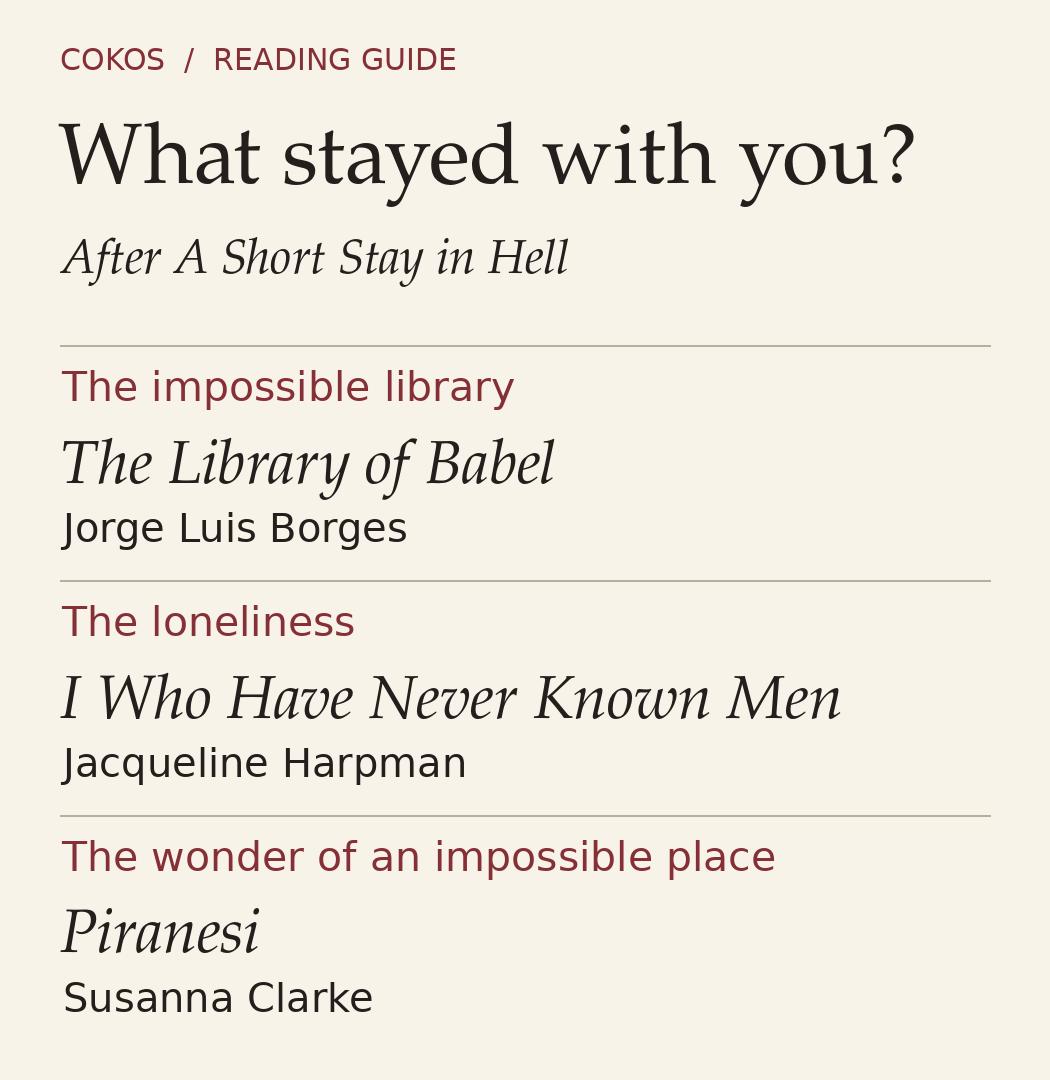
If the library itself stayed with you after Steven L. Peck’s A Short Stay in Hell, read Jorge Luis Borges’s “The Library of Babel.” If what hurt was the thought of living among people who might never learn why they’re there, choose Jacqueline Harpman’s I Who Have Never Known Men. And if you’d like to wander another impossible building with someone who loves the place, start with Susanna Clarke’s Piranesi.
The seven recommendations below include two stories you can read in an evening. Each starts from a different detail in Peck: a shelf full of useless books, the loss of someone familiar, the years that slip away while a person is busy doing exactly what they were told. Only the opening premises are discussed.

Books like A Short Stay in Hell at a glance
| Read next | Choose it for | Format |
|---|---|---|
| “The Library of Babel” | The impossible search | Short story |
| I Who Have Never Known Men | Loneliness and companionship | Short novel |
| Piranesi | An immense, mysterious building | Novel |
| “Hell Is the Absence of God” | The fairness of an afterlife | Novelette |
| The Stronghold | A lifetime spent waiting | Novel |
| The Invention of Morel | The appeal of living forever | Short novel |
| Sum | Afterlives with peculiar rules | 40 brief vignettes |
7 books and stories to read after A Short Stay in Hell
1. “The Library of Babel” by Jorge Luis Borges
What would count as a useful book in a library containing every book its alphabet and format permit? Somewhere on the shelves there must be a catalogue with the location of the volume you want. There must also be another catalogue, identical except for one wrong shelf number. Borges lets that small difficulty spread until it touches everything the librarians believe.
Read this first if you caught yourself devising a better search strategy for Soren. It is a compact story, collected in Ficciones, and the pleasure is partly in discovering why each promising idea raises another problem. A reader looking for the intimacy of Peck’s relationships will find more of it in Harpman. Borges gives his few pages to the habits, hopes, and superstitions of a whole society of searchers.
2. I Who Have Never Known Men by Jacqueline Harpman
Forty women live together under guard in an underground cage. The youngest has grown up there. When the older women speak of the lives they remember, she has to assemble an idea of ordinary existence from words that mean something different to everyone else. Even among the people closest to her, she is alone in a way they can barely imagine.
This is my closest emotional match for Peck. Both writers understand how much of a world two people can make simply by remembering something together. Harpman adds an especially painful complication: the person telling the story lacks the memories that would let her join in. Choose it if the passages in Peck you keep returning to involve an ordinary conversation or an attempt at friendship. Approach the mystery of the cage with some patience for unanswered questions.
3. Piranesi by Susanna Clarke
Piranesi keeps records of the tides that sweep through the lower halls of the House. He knows its statues well enough to give directions by them. That practical knowledge changes how it feels to follow him: where a visitor might see a bewildering succession of rooms, he can tell you where it is safe to stand and which way to look.
Peck’s library makes it easy to imagine that any shelf could exchange places with any other. In Clarke, individual places acquire histories because someone has taken the trouble to notice them. Choose this one if you want the architectural strangeness of Peck with room for affection, birds, and light on water. There is danger in the House, but its resident is a generous guide. For another book in that mood, explore these books like Piranesi.
4. “Hell Is the Absence of God” by Ted Chiang
An angelic visitation kills Neil Fisk’s wife. In the world of Chiang’s story, a visitation can have witnesses and casualties. Nobody needs to persuade Neil that angels exist. What he has to work out, in grief, is whether he can love God and what such love would mean if his dearest wish is to see his wife again.
Choose this novelette if the most unsettling part of Peck was Soren’s introduction to the rules. Being told exactly how an afterlife works offers surprisingly little comfort when the rules strike you as unjust. Chiang gives several people the same publicly observable evidence and lets their experiences carry them toward different conclusions. It is a concentrated, emotionally demanding read. Look for it in Stories of Your Life and Others.
5. The Stronghold by Dino Buzzati
An officer named Giovanni Drogo takes up a posting at a remote fortress. The garrison keeps watch for an enemy whose arrival might make an officer’s career. Tomorrow, staying another day might prove to have been the right decision. The same reasoning will still be available to him tomorrow night.
Of all seven recommendations, this is the one I would give to a reader who says the library barely mattered to them. Buzzati understands the peculiar ease of spending one more day on something you would hesitate to give your whole life to. It takes work to recognize the connection with Peck because the fortress is staffed, orderly, and perfectly plausible. Its officers have good reasons to get up every morning. Those reasons are what make the book frightening. English editions appear under both The Stronghold and The Tartar Steppe.
6. The Invention of Morel by Adolfo Bioy Casares
A fugitive arrives on an island where he hopes to escape notice. When other people appear, he watches from a distance, particularly a woman he sees at sunset. Before long it becomes difficult to tell which details in his account are clues and which belong to a lonely man’s hopes.
Here the question to carry over from Peck is a personal one. If a moment with another person meant enough to you, what would you give to preserve it? Bioy Casares approaches that question through a mystery short enough to hold in your head as you read. Pick it for the mixture of longing and intellectual puzzle. Skip introductions that discuss the invention until you finish: the order in which the fugitive notices things is part of the experience.
7. Sum by David Eagleman
Sum: Forty Tales from the Afterlives offers forty small experiments in what could happen after death. In the title piece, the activities of a lifetime are gathered by kind. Imagine discovering how much of your allotted existence went into things you can scarcely remember doing once. It takes only a few pages for the rearrangement of an ordinary life to make that life look strange.
Read this if you liked working through Peck’s rules and would welcome an occasional laugh. Each vignette starts the experiment afresh, so you can close the book after one and spend the rest of the evening testing its implications against your own day. If sustained companionship with a single narrator is important to you, save Eagleman for later and begin with Harpman.
Why does “The Library of Babel” feel so different from A Short Stay in Hell?
Imagine taking down a book that describes your childhood kitchen perfectly. You recognize the chipped cup, the mark on the door, the chair nobody liked. Then you turn the page and discover that, according to this book, you had a sister you never had. For a reader of Borges, that is a satisfying consequence of the premise: a library containing every arrangement of letters has room for this almost-true life. For Soren, the same discovery means putting the book back and starting again.
That kitchen is an invented example, but it gets at the difference between the works. Borges can make the reader feel wonder and suspicion in the same instant. Peck gives his searcher a body, a history, and people whose company he can lose. A wrong book costs an actual stretch of someone’s life. If you read the stories together, pay attention to the first time you want a searcher to put a volume down and go spend the day with somebody. It is a revealing point at which to notice whose library you are in.
Frequently asked questions
Which recommendation can I finish in one evening?
Start with Borges’s “The Library of Babel” in Ficciones. It is the shortest direct route back to the library premise. Chiang’s “Hell Is the Absence of God,” in Stories of Your Life and Others, is a longer one-evening choice. Both titles name individual works within collections.
Which book feels gentler after Peck?
Choose Piranesi if you want to stay inside an impossible building. Its narrator takes genuine pleasure in the House and cares for what he finds there. If you would prefer to step away from enclosed spaces altogether, dip into Sum; its mood changes with each new afterlife.
What should I read for existential dread without an afterlife setting?
Choose The Stronghold if wasted time frightens you, or I Who Have Never Known Men if the deeper fear is losing the people who make your world intelligible. For a wider selection built around questions of identity, freedom, and meaning, see the Cokos guide to existential fantasy books.