An existential fable is a story that uses a simple, revealing situation to explore a question about being human. A character has to wait, choose, search, or keep living under unusual conditions. What that person does gives the reader a way to think about freedom, responsibility, or what makes a life meaningful.
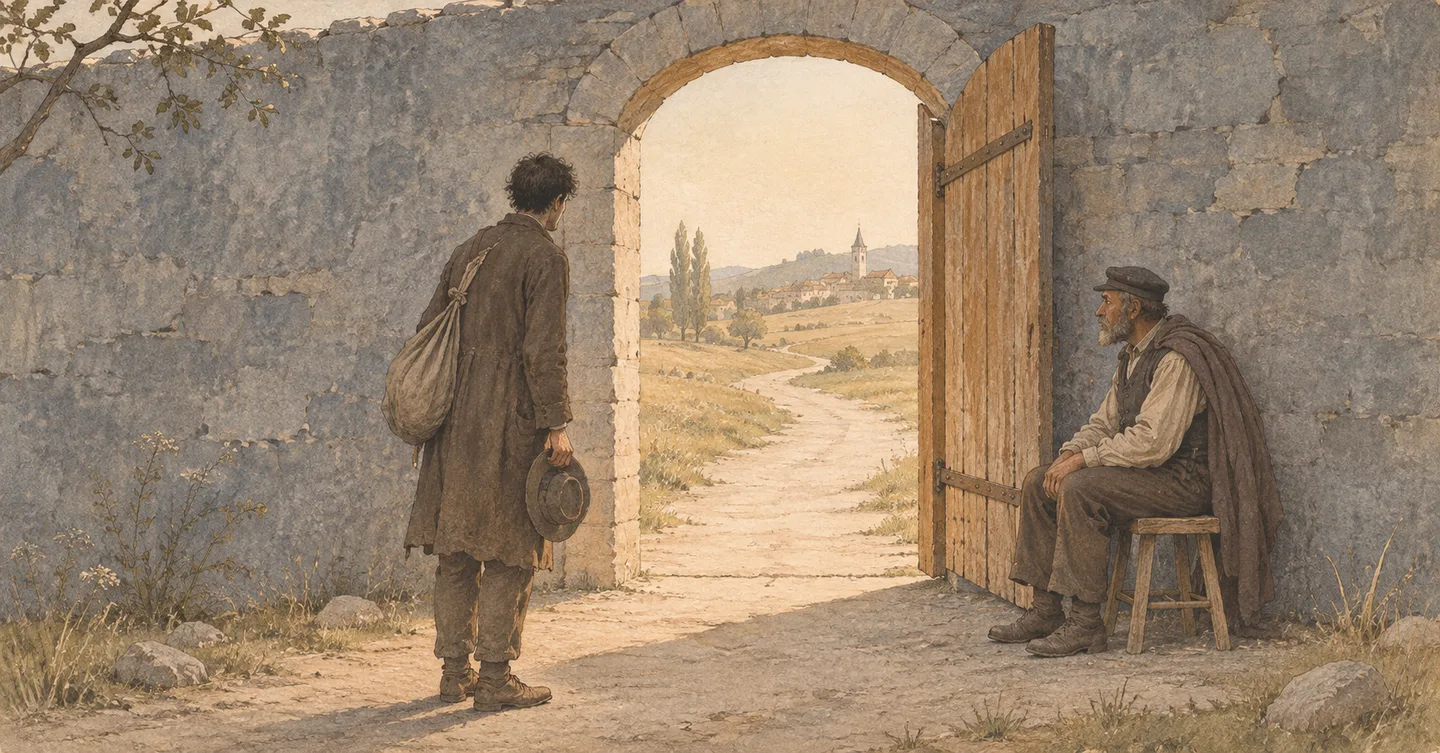
In Franz Kafka’s “Before the Law,” a man asks permission to enter. The gate stands open. The gatekeeper tells him he cannot go in yet, so the man settles down to wait. A practical question quietly becomes a philosophical one. At what point does waiting for permission become a decision about how to spend a life?
What does “existential fable” mean in literature?
Imagine finding the phrase on a book jacket. Fable invites you to read a particular situation as a model of something larger. A gate can be a perfectly real obstruction in a story and also give shape to the experience of depending on someone else’s permission. Existential tells you which part of that experience deserves attention. What freedom does a person have here? What must they take responsibility for? What will happen to the time they spend deciding?
The phrase works as a critical description. For example, the publisher’s description of Marek Hłasko’s All Backs Were Turned calls a hardboiled novel of betrayal an “existential fable.” A story can earn that description through ordinary human conduct. Talking animals, an enchanted setting, and an explicit moral are all optional.
Consider the difference a single sentence makes. “The traveler waited because the official told him to” explains an action. “The traveler kept waiting because tomorrow might finally bring permission” explains how a defensible choice today could absorb every tomorrow. The second sentence gives an existential reading somewhere to begin.
Kafka’s “Before the Law” and the choice to wait
Kafka gives the man good reasons to hesitate. The gatekeeper is physically imposing. He warns of other gatekeepers farther inside, each more powerful than the last. He also leaves open the possibility of admission later. Walking through the doorway would take courage, but treating the threat as a bluff might be foolish. You can see why a sensible person would wait one afternoon.
Then the afternoons accumulate. The man studies the gatekeeper so closely that he notices the fleas in his fur collar. It is an almost comic detail until you consider the investment of attention it implies. The man came to learn something about the Law. Years later, what he knows best is the coat of the person who stands in his way. Read Kafka’s “Before the Law” in Ian Johnston’s translation.
One reader might see a failure of nerve. Another might see how effectively an institution can govern someone by postponing a decision. Each reading has to account for both the open door and the credible threat. That tension makes the story worth returning to. Advice as tidy as “be brave” would leave half the scene unexplained.
Two modern novels you can read as existential fables
The following are spoiler-light readings of two novels. Each begins with an extraordinary place. The difference lies in what the person living there learns to do with an ordinary day.
A Short Stay in Hell by Steven L. Peck
In Peck’s novella, Soren finds himself in a vast library. To escape, he must locate the book containing the story of his own life. The assignment sounds almost reassuring: there is a correct volume, and he knows whose story to look for. Then the scale of the library gives that promise a different meaning. Read the publisher’s description of A Short Stay in Hell.
Suppose Soren spends an hour with another person. Measured against his assignment, that hour might look wasted. Measured as part of his life, it might be the hour most worth having. The shelves make those two ways of counting time painfully easy to grasp. If that tension stayed with you, the Cokos guide to books like A Short Stay in Hell offers several directions to read next.
Piranesi by Susanna Clarke
Piranesi keeps notebooks about the House where he lives. He records its statues, halls, and tides. Knowing how the water moves helps him live there, yet his careful descriptions also convey pleasure in things that have little immediate use. He can give an unfamiliar place his attention long before he knows its full history. Read Bloomsbury’s introduction to Piranesi.
Read beside Peck, Clarke offers a gentler question. If you cannot explain the world you inhabit, what can you still learn to care for in it? The notebooks give one possible answer in the form of a daily practice. Readers drawn to that quality of attention can explore what to read after Piranesi.
How do fable, parable, and existential fantasy differ?
These terms can describe different aspects of the same work. A parable invites you to carry a concrete situation into another part of life. Kafka’s gatekeeper, for instance, might come to mind the next time an official tells you to come back tomorrow. Calling the story an existential fable draws attention to the lifetime on the other side of that appointment.
Existential fantasy is a broader description for fiction that uses an imagined world to explore questions such as identity, mortality, or freedom. An expansive fantasy can develop those questions across a whole society. A fable-like reading usually starts much smaller, with a single situation you can hold in mind. In Piranesi, try beginning with one person writing down the tides. For a wider range of imagined worlds, see these existential fantasy books.
How can you recognize an existential fable?
Choose one scene and ask three questions. Kafka’s traveler makes a good test case.
- What rule does the character believe they must follow? The traveler believes he needs permission. Notice how much of the story depends on his continuing to accept that condition.
- What choice is still available? He can wait another day, leave, or risk the gatekeeper’s response. Each choice asks him to give something up, including the hope that tomorrow will make the decision easier.
- What does the choice cost? A day of waiting costs almost nothing in isolation. The cost only comes fully into view when the reader sees those days as one person’s life.
Try the same exercise with Peck’s shelves or Clarke’s notebooks. If you can point to the moment when a practical decision reveals what someone believes a life is for, you have found the heart of an existential reading.
Author’s reading note. If the question of what gives a life meaning against eternity stayed with you, you can read my novel Those Who Guard Eternity free on Cokos.