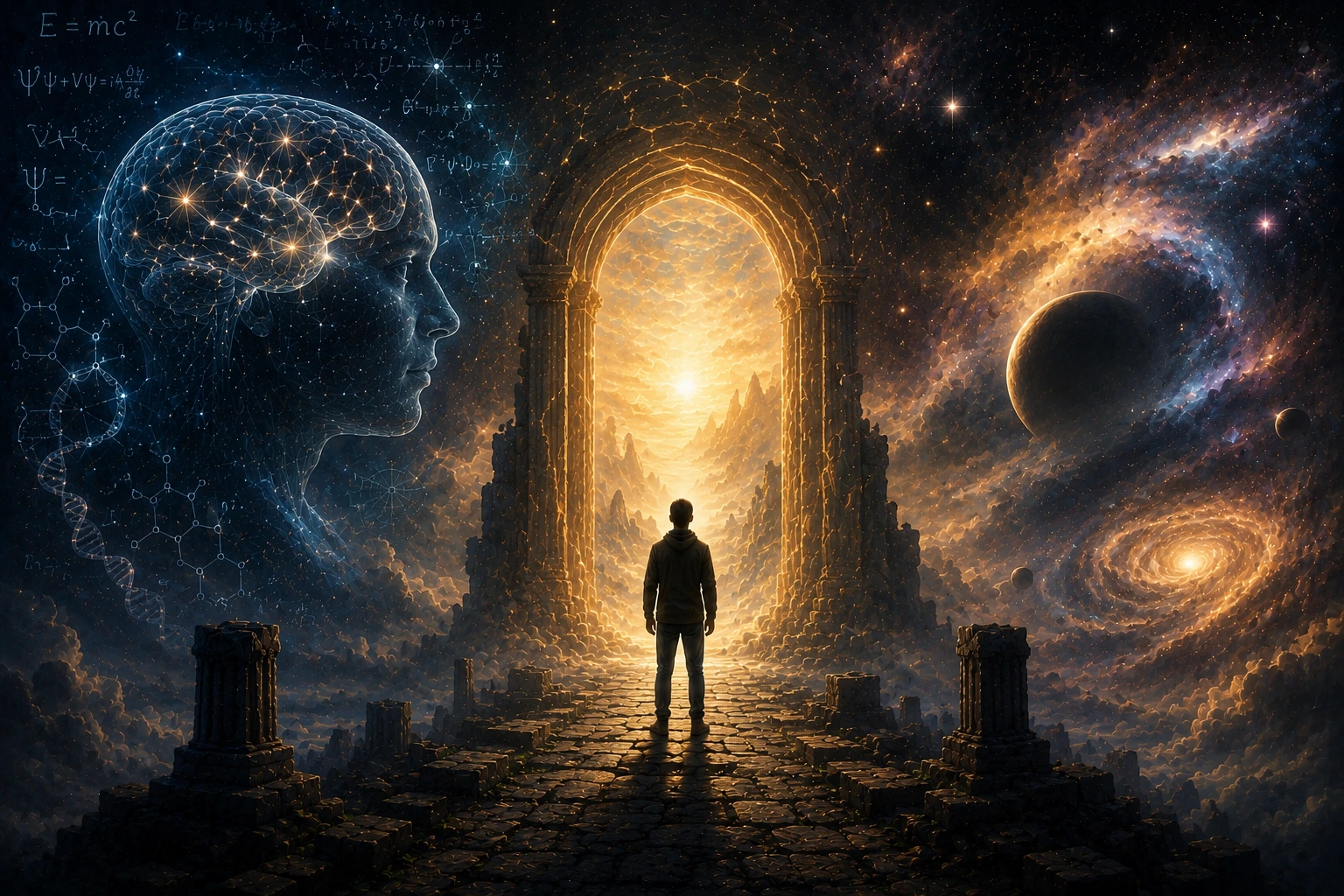
Short answer: science has not proven the existence of the soul as an independent entity. However, science also has not fully explained consciousness, subjective experience, personal identity, or why physical processes in the brain produce the feeling of being a self. That is why the question “does the soul exist?” remains open in philosophy, cognitive science, religion, and speculative fiction.
For thousands of years, humans have asked whether there is something within us that is more than biology. Does every human have a soul? Does the soul survive death? Is the soul the same as consciousness? Where is the soul located? Could artificial intelligence ever have a soul?
These questions sit at the center of human existence. They also shape the world of Those Who Guard Eternity, a philosophical fantasy series about consciousness, memory, free will, responsibility, identity, and what remains human when existence itself begins to change.
Published: July 3, 2026
Updated: July 3, 2026
Reading time: about 11 minutes
Author: Denys Kostin is the author of the Those Who Guard Eternity philosophical fantasy series, exploring consciousness, identity, memory, free will, reality, and the nature of human existence through speculative fiction.
Maybe the question of the soul is not only about what survives death. Maybe it is about what makes a human being more than matter, memory, and reaction.
Contents
- What Is the Soul?
- Has Science Proven the Soul Exists?
- Does Every Human Have a Soul?
- Is the Soul the Same as Consciousness?
- Where Is the Soul Located?
- Does the Soul Survive Death?
- Can a Soul Be Uploaded Into a Computer?
- Can Artificial Intelligence Have a Soul?
- What Makes Humans Different From Machines?
- Why Philosophical Fantasy Explores the Soul So Well
- Frequently Asked Questions
What Is the Soul?
The soul is one of the oldest ideas in human culture. Across different civilizations, it has been described as the inner self, the immortal essence of a person, the source of moral responsibility, or the part of us that may survive death.
There is no single definition of the soul. Depending on the worldview, the soul may mean:
- an immortal essence;
- the deepest self;
- consciousness;
- personal identity;
- memory and character;
- moral awareness;
- the part of a person that may continue after death.
That is why the question of the soul cannot be separated from the question of consciousness. If consciousness is only brain activity, the soul may be a poetic name for human experience. If consciousness is something deeper, the soul becomes one of the most important questions humans can ask.
Has Science Proven the Soul Exists?
No. Science has not proven that the soul exists as a separate object, substance, force, or measurable form of energy.
Science can study the brain. It can observe neural activity, memory formation, emotion, perception, and behavior. But it still has not fully explained why physical processes give rise to subjective experience.
This unresolved problem is one reason the question of the soul remains powerful. The absence of scientific proof does not automatically prove that the soul does not exist. But it does mean that claims about the soul should be treated carefully.
The honest answer is this: science has not proven the soul, but science has also not fully explained consciousness, identity, or the inner experience that humans have historically described with the word “soul.”
Does Every Human Have a Soul?
Whether every human has a soul depends on what we mean by “soul.”
If the soul means an immortal, non-physical essence, then the answer depends on religious belief or philosophical commitment. If the soul means inner life, moral awareness, memory, love, grief, responsibility, and the sense of being someone, then the concept points toward something deeply human.
In this second sense, asking whether humans have souls is close to asking what makes us human. Are we only biological systems, or is human existence defined by meaning, responsibility, and self-awareness?
Is the Soul the Same as Consciousness?
The soul and consciousness are related, but they are not always the same thing.
Consciousness usually means subjective experience: the feeling that you exist and experience the world from the inside. The soul often means something broader: identity, moral responsibility, memory, continuity, meaning, and possible existence beyond death.
In simple terms:
- Consciousness asks: is there experience?
- The soul asks: what is the deepest part of a person?
This is why the soul connects naturally to questions about personal identity, memory, free will, and immortality.
Where Is the Soul Located?
If the soul is understood as a physical object, no location has been found. Science has not identified a place in the body where the soul exists as a measurable thing.
If the soul is understood as consciousness, identity, and inner life, then it is closely connected to the brain, body, memory, relationships, and lived experience.
But the question may be more complicated than location. Where is a person’s identity? In the brain? In memory? In choices? In relationships? In the entire story of a life?
That is why the soul may not be something that can be placed on a map. It may be a way of naming the depth of human existence.
Does the Soul Survive Death?
The question of whether the soul survives death is one of humanity’s oldest and most emotionally powerful questions.
If the soul exists independently from the body, then death may be a transition rather than an ending. If consciousness depends entirely on the brain, then individual experience may end when brain activity ends.
Science currently has no confirmed evidence that personal consciousness or a soul continues after death. Yet the question remains central because it touches grief, love, memory, hope, and the fear of nonexistence.
This is why the soul is closely connected to books about immortality, books about eternity, and stories about the meaning of human life.
Can a Soul Be Uploaded Into a Computer?
The idea of uploading a soul into a computer belongs mostly to science fiction, but it raises a serious philosophical question.
Imagine a future technology that could copy every memory, habit, belief, emotion, and personality pattern from a human mind. Would that digital copy be the same person? Or would it only be a new being that believes it is the same person?
If the soul is only information, then perhaps something like uploading might be possible. But if the soul depends on continuous subjective experience, then copying a mind may not preserve the original self.
This question connects directly to books about memory, artificial intelligence, identity, and the future of human consciousness.
Can Artificial Intelligence Have a Soul?
As artificial intelligence becomes more advanced, the question becomes harder to ignore.
If the soul requires biological life, AI can never have one. It may imitate language, emotion, creativity, and moral reasoning without possessing inner experience.
If the soul is connected to consciousness, identity, or complex information structures, the question becomes less clear. A future artificial mind might force humanity to rethink what counts as life, personhood, and inner existence.
This connects the soul not only to theology and philosophy, but also to the future of technology, AI consciousness, and what humans are willing to recognize as alive.
What Makes Humans Different From Machines?
Perhaps the question of the soul is also a question about the difference between humans and machines.
A machine can process information. It may even simulate emotion. But does it care? Does it suffer? Does it hope? Does it carry moral responsibility? Does it experience meaning?
Humans are not only intelligent. They grieve. They remember. They forgive. They search for purpose. They feel guilt. They make promises. They imagine futures they may never see.
That is why the soul connects to reality, destiny, freedom, responsibility, and the search for meaning.
Why Philosophical Fantasy Explores the Soul So Well
Science can explain what has been proven. Philosophy can map the questions. But stories let us live inside the mystery.
Philosophical fantasy does not only ask whether the soul exists. It asks what would happen if the soul could be preserved, transferred, lost, corrupted, or sacrificed.
What would people protect if the soul were real? What would they destroy? What would immortality cost? What would remain human after centuries of change?
The Those Who Guard Eternity universe belongs to this tradition. It explores consciousness, memory, identity, free will, responsibility, and the danger of treating eternity as something humans can control.
Related Philosophical Questions
- Books About Consciousness
- What Is Consciousness?
- What Is Reality?
- What Is Personal Identity?
- Books About Memory
- Books About Immortality
- Books About Eternity
- Can AI Become Conscious?
- What Makes Us Human?
Explore the Eternity Saga
If questions about the soul, consciousness, memory, identity, immortality, and eternity fascinate you, begin with a philosophical fantasy series where these questions become part of the story.
Final Thoughts: Does the Soul Exist?
Does the soul exist?
Maybe.
Maybe not.
But the question matters even without a final answer. It forces us to ask what a human being really is, whether consciousness can be reduced to matter, whether memory creates identity, and whether meaning ends where biology ends.
Perhaps the soul is not something easy to prove. Perhaps it is the word humanity created for the deepest part of itself: memory, love, responsibility, longing, grief, hope, and the refusal to believe that existence is only mechanism.
Frequently Asked Questions
Does the soul exist?
Science has not proven that the soul exists as a separate entity, but the question remains open in philosophy, religion, and consciousness studies.
Has science proven the soul exists?
No. There is currently no scientific evidence proving the soul exists as a measurable object, substance, or form of energy.
Does every human have a soul?
That depends on the definition of the soul. If the soul means inner life, moral awareness, memory, and deep identity, then the concept describes something central to human existence.
Where is the soul located?
If the soul is treated as a physical object, no location has been found. If the soul refers to consciousness or identity, it is closely connected to the brain, body, memory, and lived experience.
Does the soul survive death?
Science has no confirmed evidence that the soul survives death. However, the question remains central to philosophy, religion, literature, and human grief.
What happens to the soul after death?
Different traditions give different answers. There is no scientifically confirmed answer, so this remains a matter of philosophy, faith, and personal worldview.
Is the soul the same as consciousness?
Not always. Consciousness usually means subjective experience, while the soul may include identity, moral responsibility, memory, meaning, and possible continuity beyond death.
Is the soul energy?
In scientific terms, the soul has not been proven to be a physical form of energy. The word is usually used as a spiritual, philosophical, or metaphorical concept.
Can a soul be uploaded into a computer?
At present, this is only a theoretical and science fiction idea. Even if memory and behavior could be copied, it is unknown whether the same subjective self would continue.
Can artificial intelligence have a soul?
That depends on what is meant by soul. If the soul requires biological life, AI cannot have one. If the soul is linked to consciousness or complex personhood, the question remains open.