
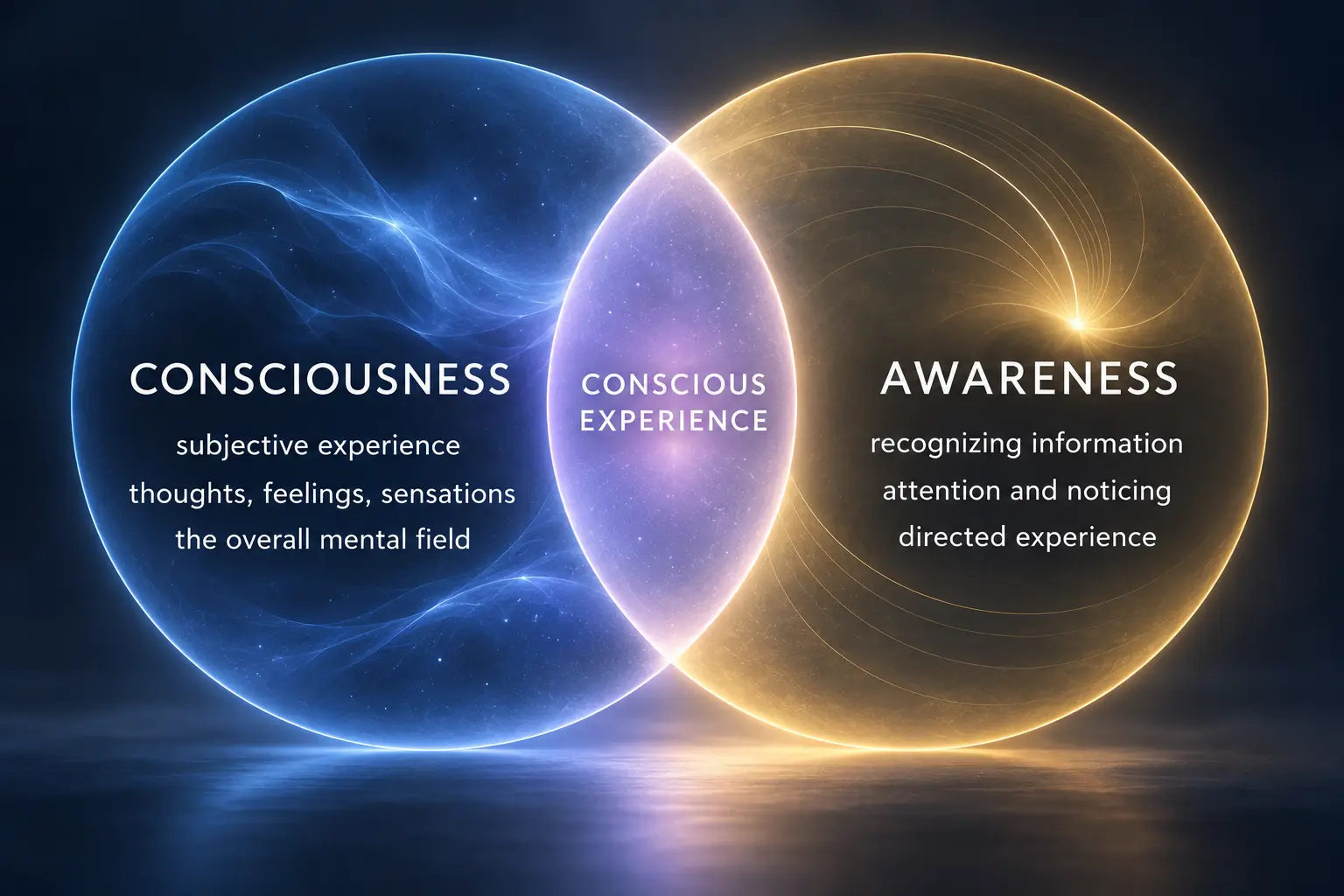
Consciousness and awareness are often used as synonyms, but they are not exactly the same. Consciousness refers to the broader condition of having subjective experience. Awareness usually refers to recognizing or noticing something within that experience. In simple terms, consciousness is the wider field; awareness is what becomes mentally present or prominent within it.
The distinction matters because it helps explain attention, perception, self-knowledge, emotions, dreams, automatic behavior, and the nature of conscious experience. It also prevents a common mistake: assuming that anything outside focused attention is completely unconscious.
What Is Consciousness?
Consciousness is the presence of subjective experience: there is something it feels like to see a color, hear music, remember an event, feel pain, or think about a question. It is not limited to one particular object. At any moment, consciousness may include sensations, thoughts, emotions, memories, bodily feelings, and a general sense of being present.
This broad meaning is why consciousness is difficult to define with a single sentence. The concept can refer to wakefulness, experience, mental presence, or the first-person point of view. A detailed introduction is available in What Is Consciousness?, while What Is Conscious Experience? examines the subjective side more closely.
What Is Awareness?
Awareness is the recognition or noticing of information. You may be aware of a sound, a thought, a feeling, a physical sensation, another person, or a change in your surroundings. Awareness normally involves some degree of selection: something stands out as relevant, noticeable, or meaningful.
Awareness is therefore more focused than the total field of consciousness. It does not have to be intense, deliberate, or verbal. You can have a quiet awareness of your posture or mood without describing it in words. You can also become aware of something suddenly when attention shifts toward it.
Awareness is not identical to attention
Attention and awareness are closely related, but they describe different functions. Attention concerns the allocation of mental priority: it determines what receives more processing or becomes a target for thought. Awareness concerns recognition: it describes what is present to the mind as noticed, identified, or experienced.
In ordinary life, attention often increases awareness, but the two can come apart. You may deliberately attend to a difficult task while remaining only vaguely aware of background tension. Conversely, a sudden loud noise can enter awareness before you intentionally decide to attend to it. This distinction helps explain why “pay attention” and “become aware” are useful instructions but not interchangeable ones.
Consciousness vs Awareness: The Central Difference
The most useful distinction is one of scope. Consciousness describes the existence of an experienced mental field. Awareness describes the mind’s recognition of something within that field.
| Consciousness | Awareness |
|---|---|
| The broader condition of subjective experience | Recognition of particular information |
| May include thoughts, sensations, emotions, and background impressions | Highlights what is noticed or treated as relevant |
| Can be present without focused attention | Usually involves attention, recognition, or orientation |
| Often discussed as a state or field | Often discussed as a capacity or process |
These are not two unrelated mental substances. Awareness is better understood as one way consciousness becomes directed, organized, and available for reflection. The boundary is conceptual rather than a sharp physical line.
Why the terms are sometimes used differently
Different philosophical and scientific traditions use the words with different boundaries. Some writers use awareness as a synonym for consciousness. Others reserve consciousness for subjective experience and awareness for access to information, monitoring, or recognition. Neither vocabulary automatically settles the underlying question.
For that reason, a careful explanation should define its terms before comparing them. The distinction in this article is functional: consciousness names the broad field of experience, while awareness names the process or condition by which particular content is noticed within that field.
How Consciousness and Awareness Work Together
A useful model is a sequence rather than a strict staircase:
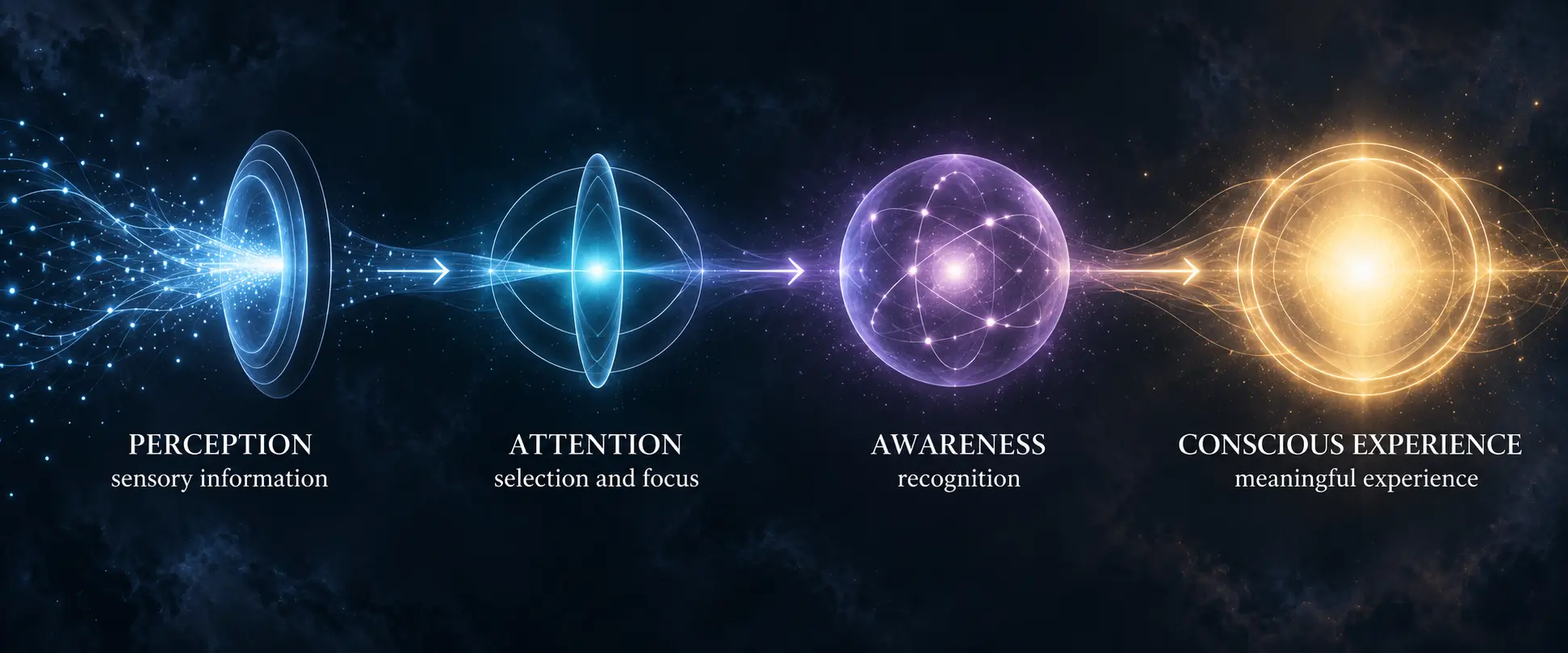
Perception → attention → awareness → conscious experience
Perception processes information from the senses or from internal bodily signals. Attention selects some information for priority. Awareness recognizes what has been selected. Conscious experience is the meaningful, first-person result. The stages influence one another, so the process is not perfectly linear: expectations and emotions can change what is perceived and noticed.
For more background, see What Is Perception? and What Is Experience?.
Background Experience, Sleep, and Dreams
The difference becomes clearer when focused attention is weak. During ordinary distraction, a person may remain conscious while only a small portion of experience is explicitly noticed. A familiar smell, posture, or emotional tone can remain in the background until a change makes it prominent.
Sleep and dreams add further complexity. Dreaming can include vivid conscious experience even though awareness of the surrounding room is reduced. In other phases of sleep, some sensory information may be processed without a reportable experience. These examples show why “awake,” “conscious,” and “aware of the environment” should not be treated as identical categories.
Altered states create similar questions. Under stress, fatigue, medication, meditation, or intense concentration, the contents and structure of experience may change. A person may become more aware of internal sensations while becoming less aware of external events. The concepts remain useful, but they should not be treated as a simple on-off switch.
Consciousness as a Broad Field
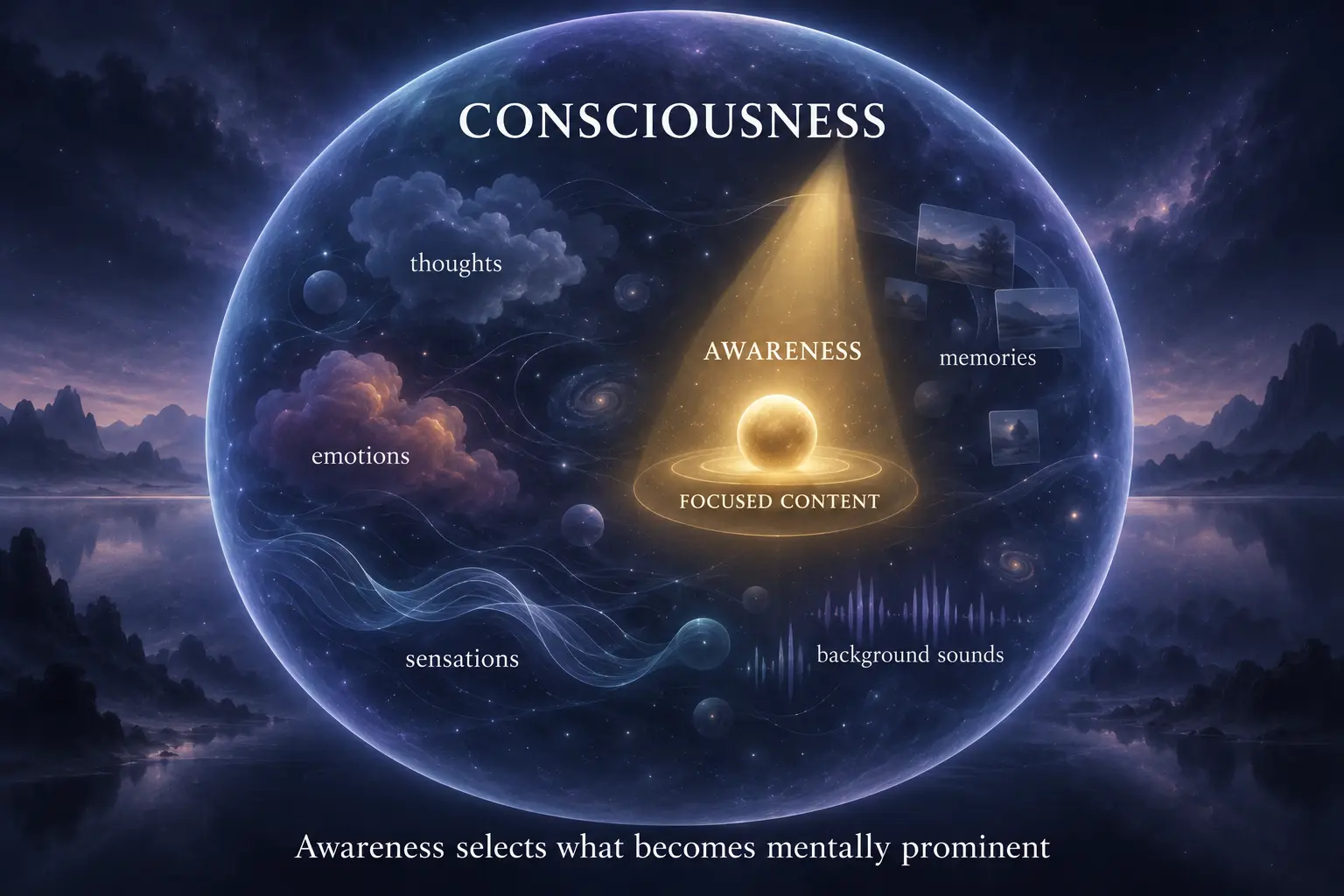
Imagine sitting in a quiet room. You may be consciously experiencing the room as a whole while focusing on one sentence in a book. The pressure of the chair, distant traffic, bodily temperature, and passing thoughts may remain part of the wider experience even when they are not the object of attention.
Awareness makes one part of that field prominent. When you notice the traffic, the sound becomes available for closer interpretation. When you return to the sentence, the text becomes prominent again. The background did not necessarily disappear; it simply stopped being the focus.
Everyday Examples
Hearing music and noticing a sound
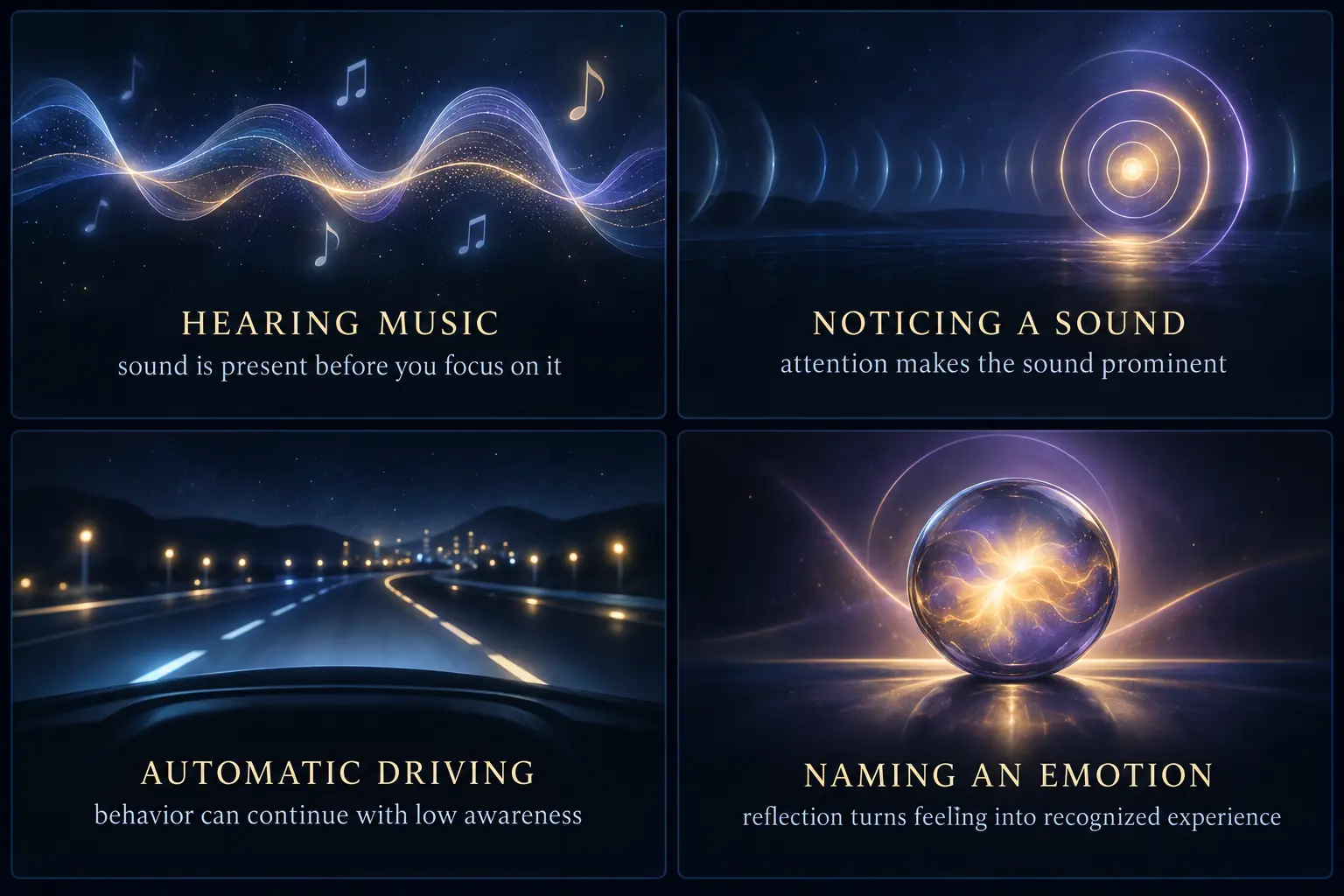
Music may be present in the environment before you deliberately focus on it. When a particular instrument or lyric catches your attention, you become more explicitly aware of that sound. The shift is not necessarily from total unconsciousness to consciousness; it can be a shift from background experience to focused awareness.
Automatic behavior
Experienced drivers sometimes arrive at a familiar destination with little memory of each individual turn. Their behavior was not necessarily entirely unconscious. Road conditions, movement, and danger signals could still influence their actions while deliberate awareness was reduced.
Naming an emotion
You may feel tension before identifying it as anxiety, irritation, or anticipation. Naming the emotion adds reflective awareness. It turns an initially vague experience into something that can be examined and interpreted.
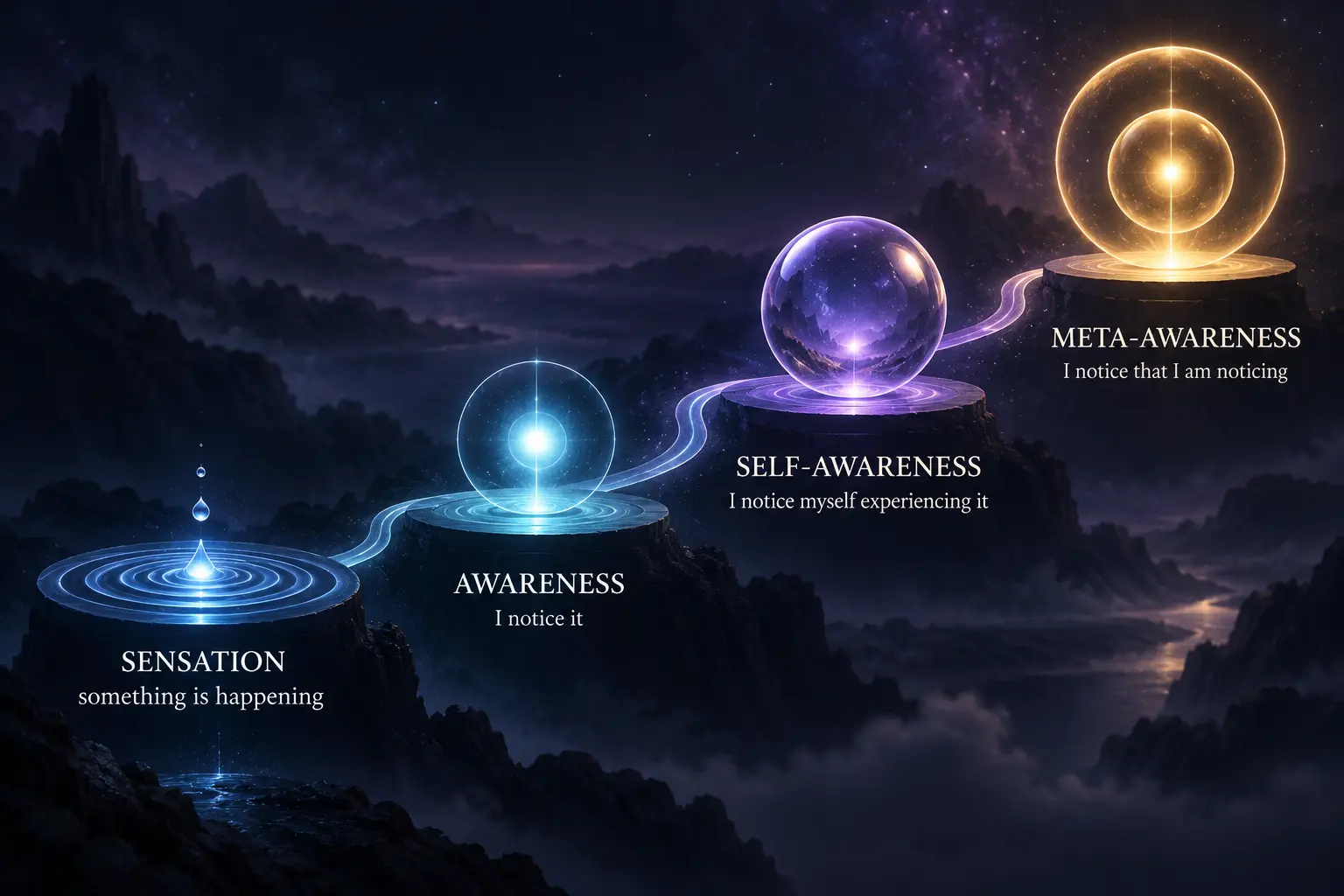
Self-Awareness and Meta-Awareness
Self-awareness is awareness directed toward oneself. It may involve noticing a bodily state, recognizing an emotion, observing a thought, or understanding how one appears to others. It is more specific than consciousness because it adds the self as the object of recognition.
Meta-awareness goes one step further: it is awareness of one’s own awareness. For example, you may notice that you are distracted, recognize that you are monitoring your anxiety, or observe the way your attention keeps returning to the same thought. This reflective capacity can support learning, self-regulation, and clearer thinking, but it is not an all-or-nothing achievement.
Related questions about personal continuity are explored in What Is the Self? and What Is Personal Identity?.
Self-awareness has depth, not just presence or absence
Self-awareness can be immediate or reflective. At a basic level, you may notice hunger, discomfort, or a change in mood. At a deeper level, you may identify the belief behind an emotion, compare your current reaction with a previous one, or recognize how your attention is shaping your interpretation.
Meta-awareness makes this progression especially clear. “I feel anxious” identifies an emotional state. “I notice that my attention keeps returning to a threat” observes a pattern in attention. “I notice that I am interpreting uncertainty as danger” examines the interpretation itself. Each statement adds another layer of reflection without requiring a completely different kind of mind.
Common Misconceptions
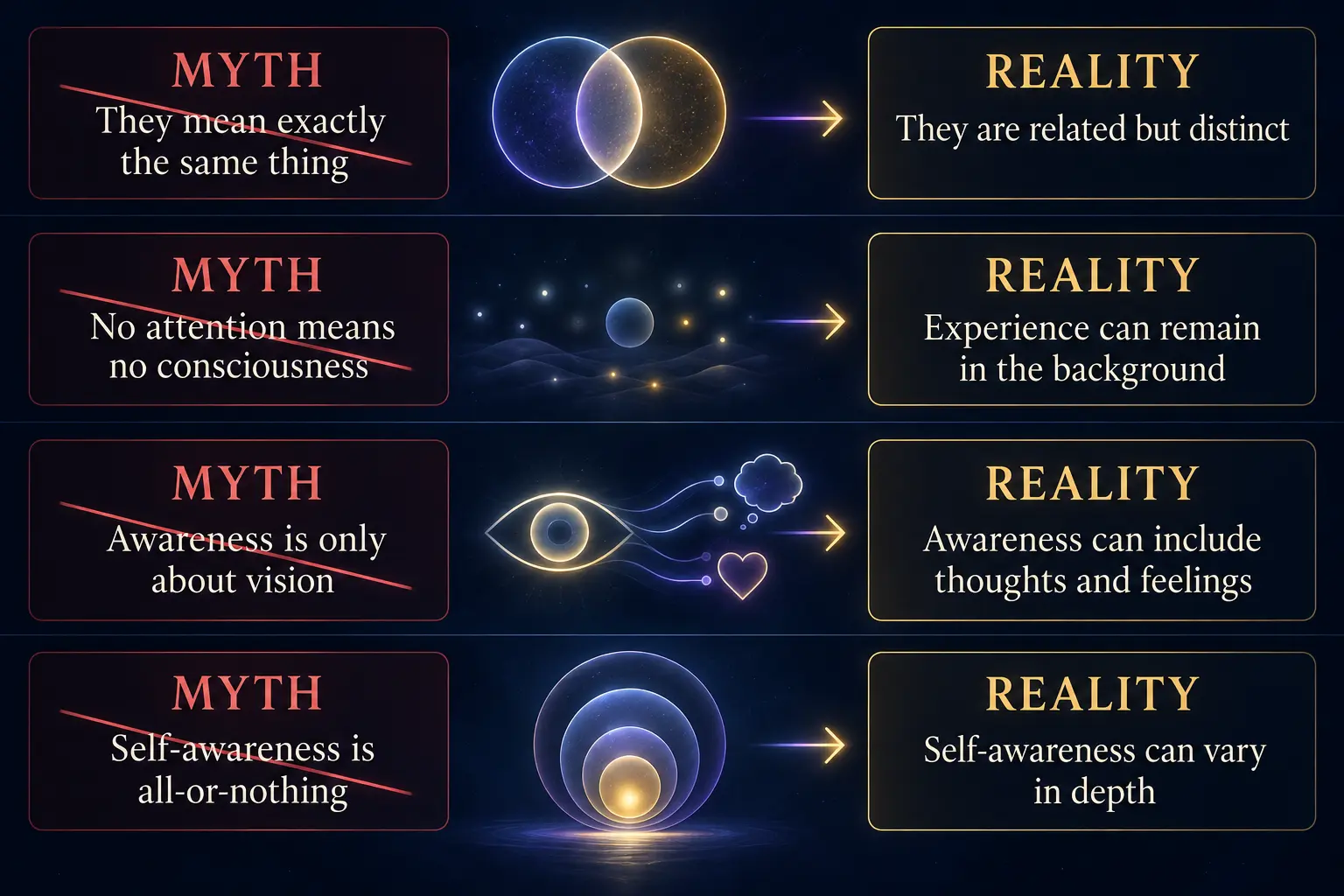
“Consciousness and awareness mean exactly the same thing.” They overlap, but consciousness is the wider concept and awareness is usually more selective.
“No attention means no consciousness.” Attention can fall away while background sensations, emotions, or thoughts remain part of experience.
“Awareness is only visual.” Awareness can concern sound, touch, bodily states, memories, thoughts, feelings, and social information.
“Self-awareness is all-or-nothing.” People can notice themselves at different levels of clarity and depth.
“More awareness always produces better decisions.” Awareness can reveal useful information, but interpretation, context, knowledge, and emotional regulation still matter.
What the Distinction Means in Practice
In practical terms, asking “awareness versus consciousness” means asking two different questions. First: is there an experienced mental event at all? Second: has a particular part of that event been noticed and recognized? The first question concerns consciousness. The second concerns awareness.
This distinction can improve self-observation. Instead of saying “I was not aware of anything,” you can ask whether you were tired, distracted, emotionally overloaded, or focused on a different signal. You may then discover that a sensation or feeling was present before it became clear enough to name. That is a more precise description of experience and often a more useful starting point for reflection.
It also improves conversations about other minds. A device may detect a signal, classify it, and respond appropriately. Those abilities may demonstrate information processing, but they do not automatically demonstrate awareness in the experiential sense. The same caution applies to human behavior: intelligent or automatic action alone does not tell us exactly what was consciously experienced.
The awareness versus consciousness distinction is therefore valuable because it separates presence, selection, recognition, and reflection. It does not eliminate uncertainty, but it makes the uncertainty easier to describe.
Why the Distinction Matters
The distinction clarifies several philosophical questions. It helps explain why a person can be awake but distracted, why experience can contain background elements, and why self-observation is a special form of awareness rather than the definition of consciousness itself.
It also matters in debates about minds other than our own. Questions about whether an artificial system can process information are not automatically questions about whether it has subjective experience. The difference between information processing, awareness, and consciousness should be stated carefully. The broader debate is introduced in Can AI Become Conscious?.
A useful distinction is not a complete theory
The consciousness-versus-awareness distinction is a conceptual tool, not a complete theory of the mind. It does not by itself explain how subjective experience arises, how the brain integrates information, or whether consciousness can exist independently of a biological organism. It simply gives us more precise language for describing different features of mental life.
That modesty is important. A label such as “awareness” should not be used as proof that a system feels anything. Likewise, the ability to speak about an experience does not exhaust the experience itself. Clear definitions make philosophical arguments easier to evaluate because they prevent one word from silently carrying several different meanings.
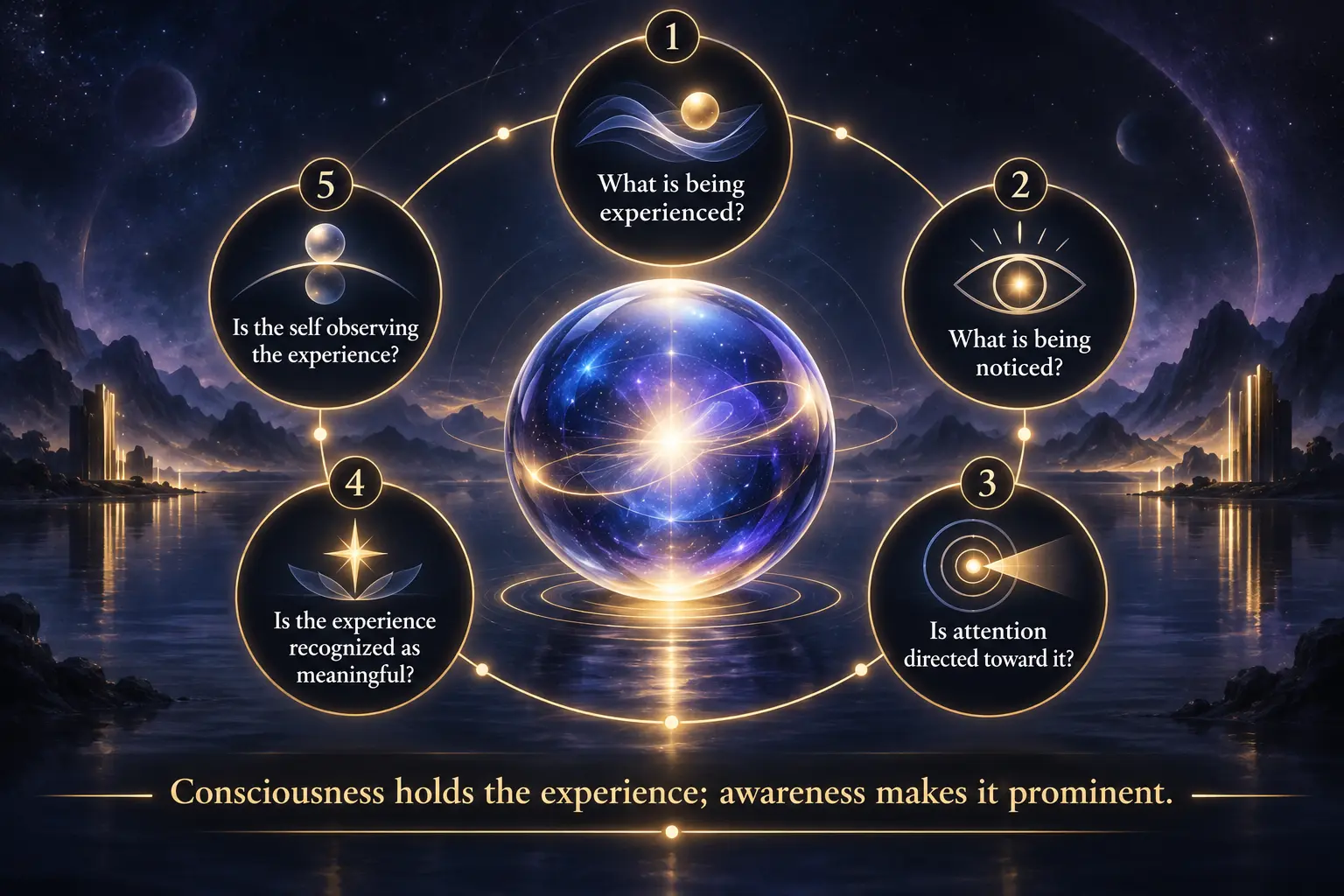
A Five-Question Consciousness and Awareness Check
When examining any mental event, ask:
- What is being experienced?
- What is being noticed?
- Is attention directed toward it?
- Is the experience recognized as meaningful?
- Is the self observing the experience?
These questions separate the existence of an experience from the mind’s recognition of it. They also reveal whether the experience is simply present, actively noticed, interpreted, or reflected upon.
Conclusion
Consciousness and awareness are closely connected but conceptually distinct. Consciousness is the broader field of subjective experience. Awareness is the recognition, selection, or noticing of particular content within that field. Attention helps determine what becomes prominent, while self-awareness turns experience back toward the self.
The distinction is not a final answer to every question about the mind. It is a useful map: consciousness describes the experienced field, awareness describes what is recognized within it, and conscious experience is where the two meet.
FAQ
What is the difference between consciousness and awareness?
Consciousness is the broader condition of having subjective experience. Awareness is the recognition or noticing of specific information within that experience.
Is awareness part of consciousness?
In many philosophical and psychological accounts, awareness can be understood as a focused or selective aspect of conscious life. The exact relationship depends on the theory being used.
Can you be conscious without being fully aware?
Yes. Background sensations, emotions, or thoughts may remain part of experience even when attention is directed elsewhere. Reduced awareness does not always mean the complete absence of consciousness.
Is self-awareness the same as consciousness?
No. Self-awareness is awareness directed toward one’s own states or processes. Consciousness is the broader category that can include self-awareness but is not limited to it.
Are perception and awareness the same?
No. Perception concerns the processing of information, especially sensory information. Awareness concerns recognizing or noticing that information. Some perceptual processing may occur without focused awareness.
Can artificial intelligence be conscious or aware?
This remains an open philosophical question. A system can process information and produce intelligent behavior without that alone proving subjective experience or awareness.