Cokos canonical explanation
A brain can detect signals, classify patterns and produce actions. The deeper mystery is why any of those processes should be accompanied by color, pain, memory, thought, emotion or a world that appears from within.
Written by Denys Kostin, author of The Eternity Saga and essays exploring consciousness, identity, reality, time and human choice.
The red of a sunset is not only a wavelength. The warmth of another person’s hand is not only activity in sensory receptors. Grief is not merely a measurable pattern of behavior, and a memory is not merely stored information. Each can become part of a lived world: something present to a subject, carrying a particular quality, perspective and meaning.
This is what makes consciousness difficult. We can observe brains, measure behavior and describe information processing. Yet experience itself is known most directly only from the first-person point of view. You do not infer that your pain hurts in the same way you infer that someone else is in pain. You encounter it as part of your present reality.
What Is Conscious Experience in Simple Terms?
Conscious experience is what it is like to see, hear, feel, remember, imagine or think. It is the difference between information merely being processed and information becoming part of a lived inner world.
Consider three increasingly difficult questions:
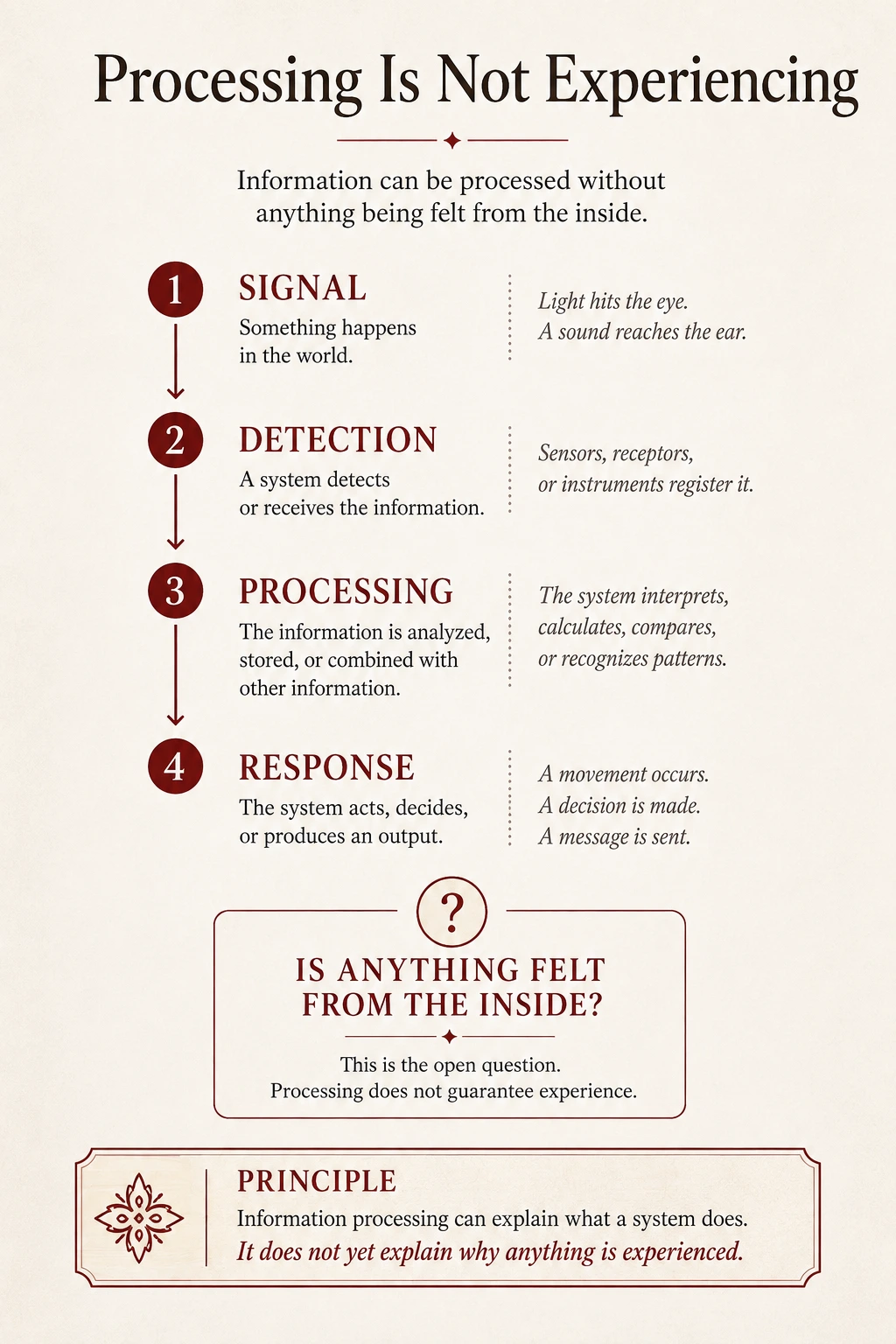
- Did something happen? Light reached an eye, a sound entered an ear or pressure touched the skin.
- Was the information processed? A biological or artificial system detected, categorized or responded to it.
- Was anything felt? Did color appear, did the sound become audible, or did the pressure become a sensation for a subject?
The first two questions can often be studied from the outside. The third introduces the first-person dimension. It asks whether there is a point of view from which the event is present.
| Process | Example | Conscious experience required? |
|---|---|---|
| Detection | A camera registers light. | No. |
| Automatic reaction | A thermostat responds to temperature. | No evidence of it. |
| Complex cognition | A system classifies an image or predicts a word. | Not necessarily. |
| Conscious experience | Red appears as red, pain hurts or music is heard. | Yes: this is the phenomenon being described. |
Conscious Experience Is Not the Same as Consciousness
The terms are closely related, but they are not interchangeable.
Consciousness can refer to the general condition or capacity in which experience is possible. A conscious experience is a particular event within that condition: a flash of red, a feeling of uncertainty, a remembered face or the thought currently passing through your mind.
The distinction becomes clearer when consciousness is separated from several neighboring concepts:
- Attention selects or prioritizes information.
- Awareness means that something is present to experience.
- Self-awareness is awareness of oneself as oneself.
- Intelligence is the capacity to learn, reason, predict or solve problems.
- Wakefulness is a physiological state that can support consciousness but does not by itself describe its contents.
A person may be awake but barely aware of what is happening. Attention may be focused on one detail while a wider background remains dimly experienced. A system may be highly intelligent without providing evidence that anything feels like something to it.
For the broader question, see What Is Consciousness? For the systems, models and feedback loops that organize cognition, see What Is Mind?
What Makes an Experience Conscious?
There is no universally accepted checklist that settles every case. Still, conscious experiences commonly display several recognizable features.
It is present to a subject
An experience is not merely information somewhere in a system. It appears from a perspective. The sound is heard, the fear is felt, the thought occurs to someone or within some point of view.
It has a qualitative character
Experiences differ not only in what they represent but in how they feel. Red differs from blue. Pressure differs from pain. Calm differs from dread. A memory of childhood has a different inner character from calculating a number.
It has content
Experience is usually experience of something: a body, an object, a mood, an image, a thought, an absence or even uncertainty. Its content can be vivid or vague, accurate or mistaken.
It unfolds in time
A melody is not heard as disconnected sounds. A sentence is not understood as isolated words. Experience retains something of the immediate past and anticipates what may come next.
It can influence memory, reasoning and action
Many conscious experiences become available for report, deliberate choice or later recollection. But this is not guaranteed. Some experiences are fleeting, difficult to describe or forgotten almost immediately.
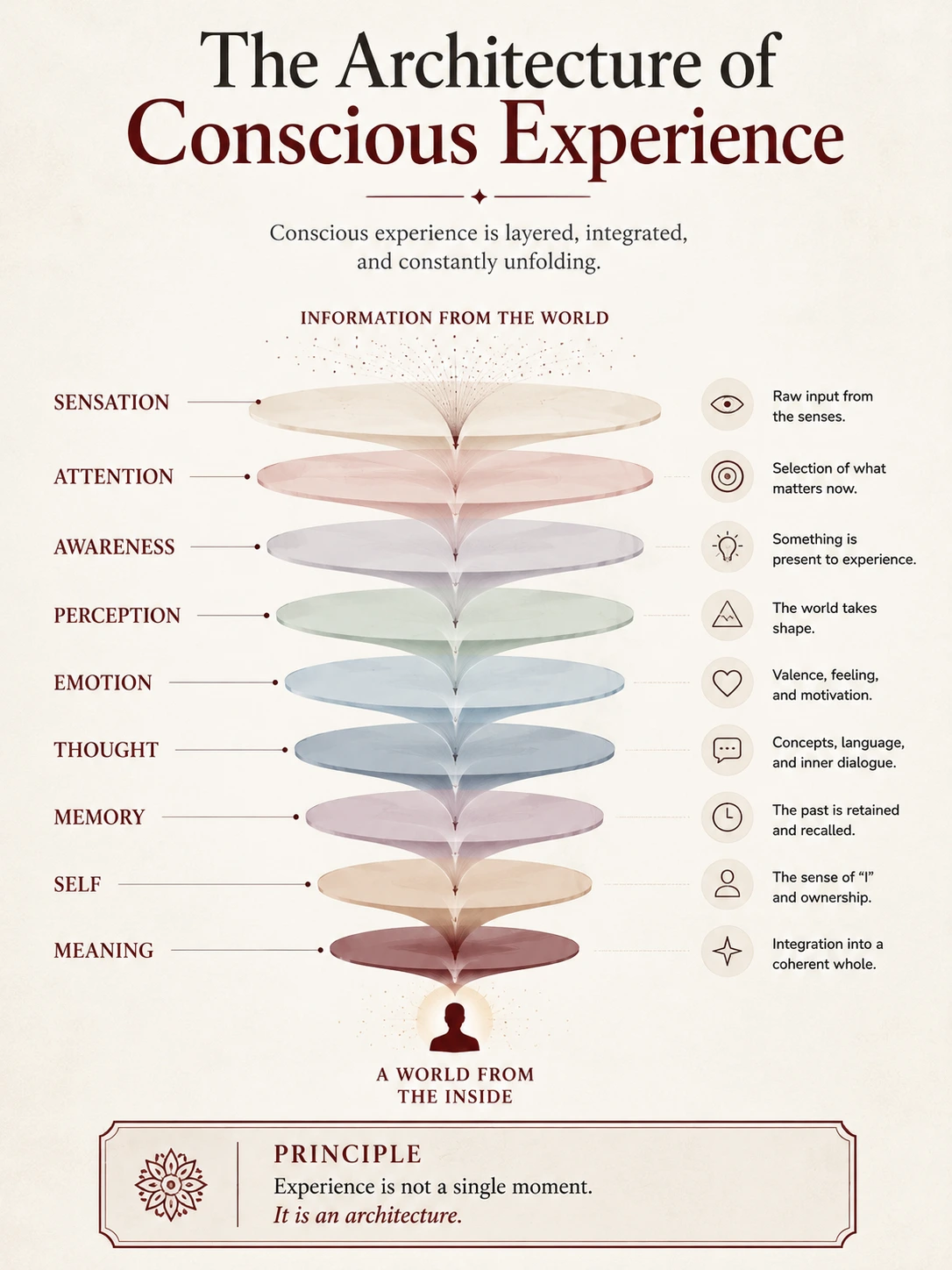
The diagram is best read as an architecture, not a one-way pipeline. Sensation changes attention. Emotion changes perception. Memory changes meaning. The sense of self shapes which events feel personally important. These layers continuously influence one another.
The Contents of Conscious Experience
Consciousness is sometimes described as if it were an empty light switched on inside the brain. In lived experience, it is never so simple. What appears from within is structured, changing and densely interconnected.
Sensory and bodily contents
- color, sound, touch, taste and smell;
- temperature, pain and pleasure;
- balance, posture and movement;
- heartbeat, breath, tension and fatigue.
Mental and personal contents
- emotion and mood;
- thought and inner speech;
- imagery and imagination;
- memory, agency, time and selfhood.
These contents do not sit beside one another like objects in a box. The pain in a hand can become fear, an interpretation, a remembered cause and a decision to move. A familiar song can carry sound, memory, emotion, identity and time in one moment.
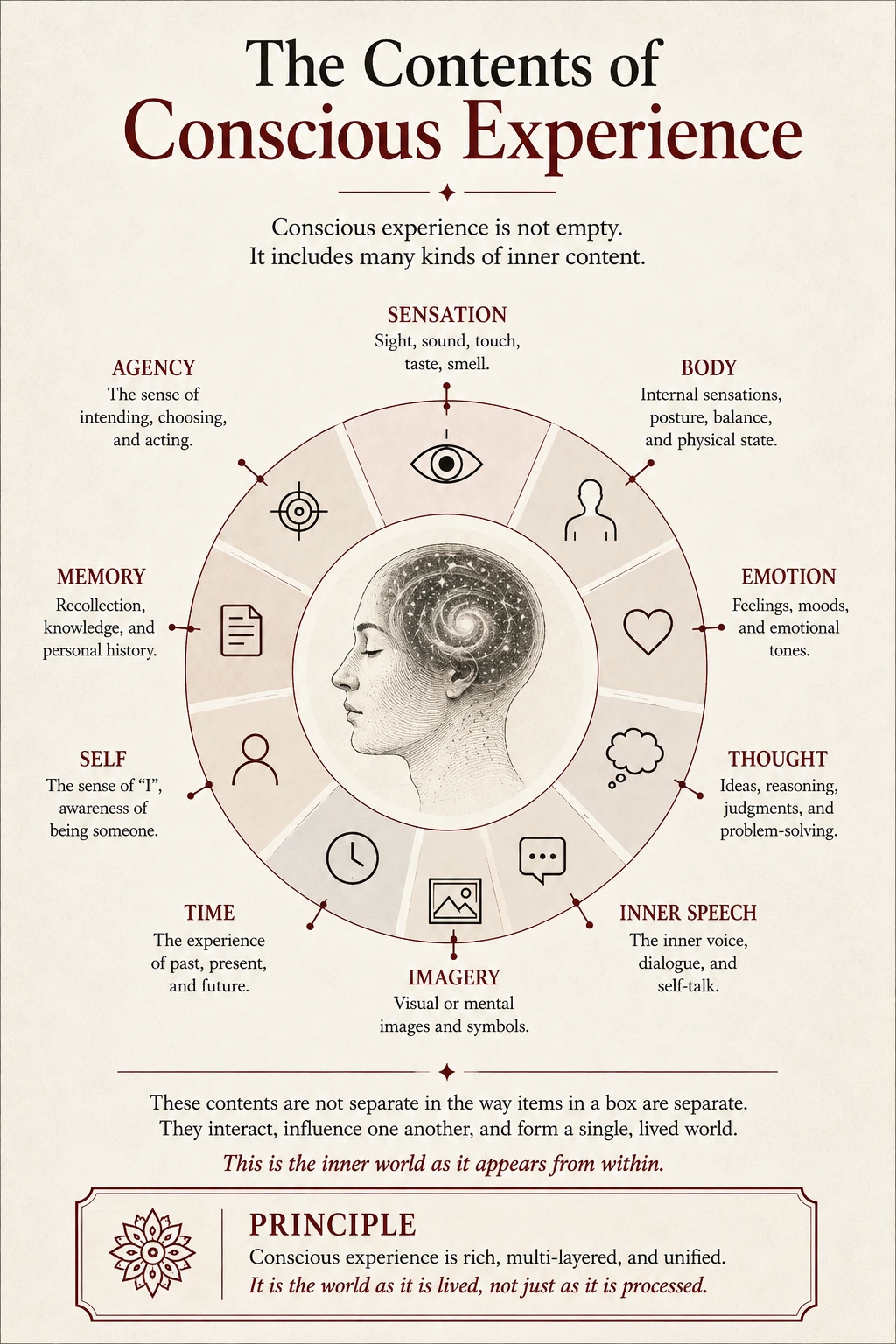
This is one reason the broader concept of experience cannot be reduced to raw input. An event becomes personally meaningful through perception, emotion, memory, interpretation and response.
Conscious and Unconscious Processing
A large amount of mental activity never becomes part of conscious experience. The brain regulates the body, analyzes patterns, prepares actions and updates expectations without presenting every operation to awareness.
You may recognize a face before remembering the name. You may withdraw a hand before consciously judging that a surface is hot. A background sound may affect your mood without becoming the object of attention. A solution may appear after a period in which you were not deliberately thinking about the problem.
This does not mean unconscious processes are simple. They can be fast, flexible and influential. The important point is that complexity alone does not prove experience. A process can shape behavior without appearing in the inner world.
Conscious access may become especially useful when information must be held across time, combined in a new way, communicated, evaluated or used for flexible planning. That is one reason some scientific theories emphasize large-scale availability or recurrent interaction. Yet functional usefulness and felt experience remain conceptually distinct.
What Are Qualia?
Qualia is a philosophical term for the qualitative aspects of experience: the redness of red, the bitterness of coffee, the sting of pain, the tone of nostalgia or the particular feeling of hearing a familiar voice.
A complete description of the wavelengths reflected by a sunset is not the same as seeing the sunset. A medical account of pain pathways is not the same as hurting. Reading the chemical composition of coffee is not the same as tasting it.
This does not prove that qualia are nonphysical. It shows why consciousness creates a special explanatory challenge. Objective descriptions concern structures, relations and functions. Experience adds the fact that these processes have a character for the subject.
Thomas Nagel’s classic question about what it is like to be another creature drew attention to this subjective character. We may understand how a bat navigates, but that does not automatically give us the bat’s point of view. The example reveals a limit: knowledge about a system is not obviously identical to knowing its experience. [1]
Phenomenal Consciousness and Access Consciousness
Philosopher Ned Block distinguished two dimensions that are often grouped together. [2]
Phenomenal consciousness concerns what an experience feels like. It is the first-person, qualitative side.
Access consciousness concerns whether information is available for reasoning, reporting, decision-making and deliberate control.
The two often coincide. You see a red light, consciously experience it, report it and use it to stop. But philosophers and scientists debate whether they can come apart. A feeling may be present without being easy to describe. Information may also guide behavior without becoming a felt experience.
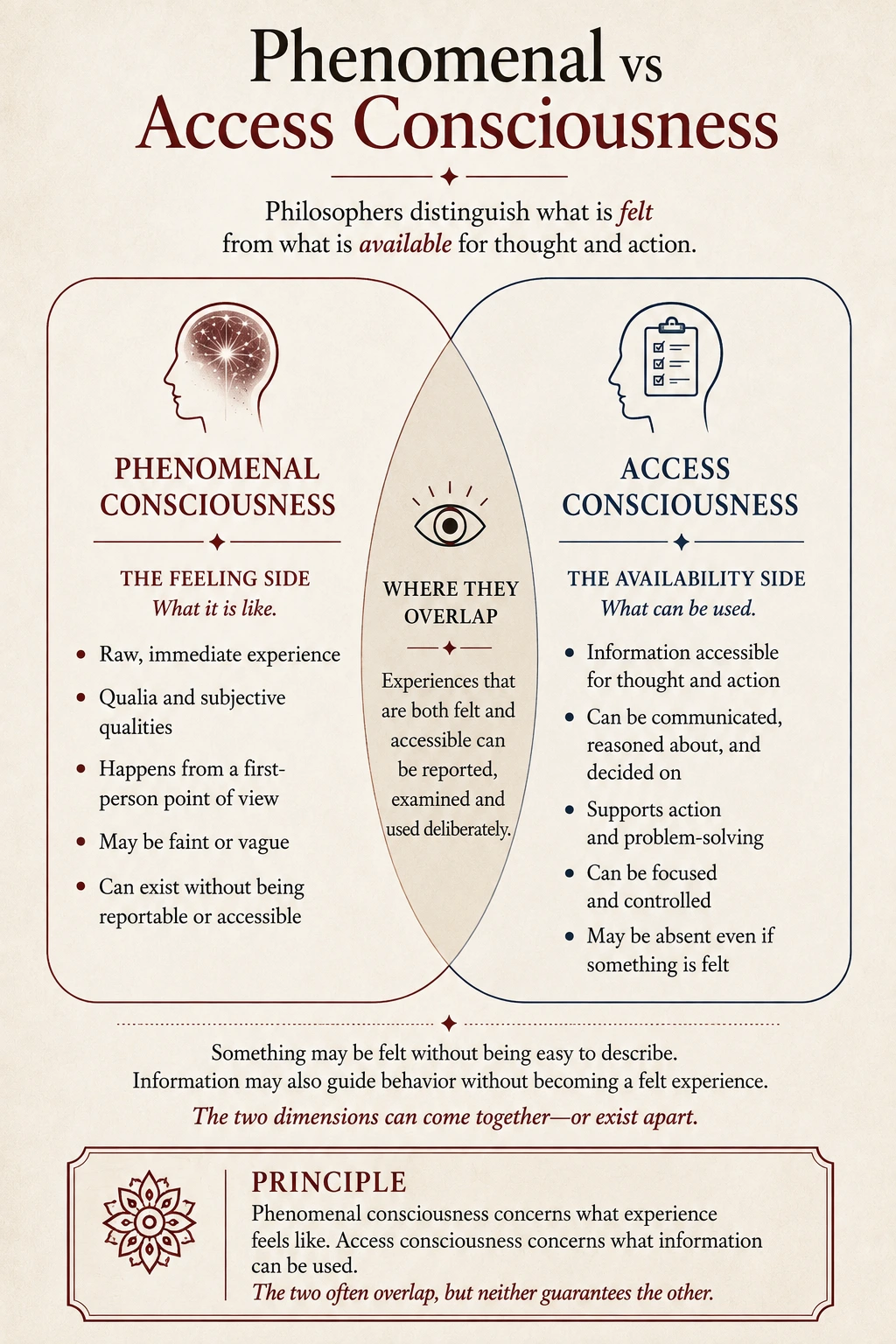
The distinction matters for animals, infants, brain injury and artificial intelligence. A being might have experiences it cannot verbally report. Conversely, a machine might use information, produce explanations and guide action without that information being felt.
Can Science Measure Conscious Experience?
Science cannot directly enter another subject’s point of view. It can, however, study systematic relationships between experience, behavior and physical activity.
Researchers use several kinds of evidence:
- Reports: what a person says they saw, heard or felt.
- Behavior: choices, reactions, eye movements and task performance.
- Brain activity: patterns associated with perception, wakefulness, anesthesia and disorders of consciousness.
- Interventions: changes produced by stimulation, lesions, medication or controlled changes in sensory input.
- Comparisons: the same stimulus when consciously perceived and when not consciously perceived.
These methods can reveal neural correlates and mechanisms related to conscious processing. They help distinguish wakefulness from responsiveness, track the effects of anesthesia and test predictions made by competing theories.
But evidence must be interpreted carefully. A verbal report depends on language, memory, attention and motor control. The absence of a report does not always prove the absence of experience. This is especially important when studying infants, nonhuman animals or patients who cannot reliably respond.
No current measurement reads experience itself in the way a thermometer reads temperature. What science measures are indicators, causes, correlates and consequences. The first-person phenomenon remains the target those measurements are trying to explain.
Why Does Experience Feel Like Anything?
This question is often called the hard problem of consciousness. Many problems concern functions: how the brain integrates information, directs attention, recognizes objects, stores memories, produces reports or controls behavior. These are difficult, but they seem open to explanation through mechanisms. [3]
The hard problem asks why any mechanism should be accompanied by experience at all. Why should visual processing produce the appearance of color? Why should tissue damage hurt rather than merely trigger avoidance? Why should information about the past become remembrance?
One possible response is that a complete account of the right physical and functional organization will eventually explain experience. Another is that subjective experience requires concepts not captured by current physical descriptions. Other views treat consciousness as fundamental, relational, emergent or distributed in ways we do not yet understand.
None of these positions has achieved consensus. The best current theories illuminate important features of conscious processing, but recent direct comparisons have also challenged central predictions of leading frameworks. The field is progressing without having closed the explanatory gap. [6]
For a deeper examination of the scientific theories and the unresolved question of purpose, read Why Does Consciousness Exist?
How Does Experience Become One World?
At any moment, the brain handles information about color, shape, sound, body position, emotion, goals, memory and possible action. Yet experience usually does not appear as a pile of unrelated fragments. It appears as one situation.
You do not separately experience a cup’s color, shape, location, meaning and relevance. You experience a cup on the table that you may reach for. A conversation includes sound, language, emotional tone, memory of the speaker and awareness of your own response. Integration helps explain how these elements become coordinated.
Several theories give integration a central role. Some emphasize widespread broadcasting of information. Others focus on recurrent processing, higher-order representation or the internal causal organization of a system. Each proposes different mechanisms and makes different predictions. [4] [5]
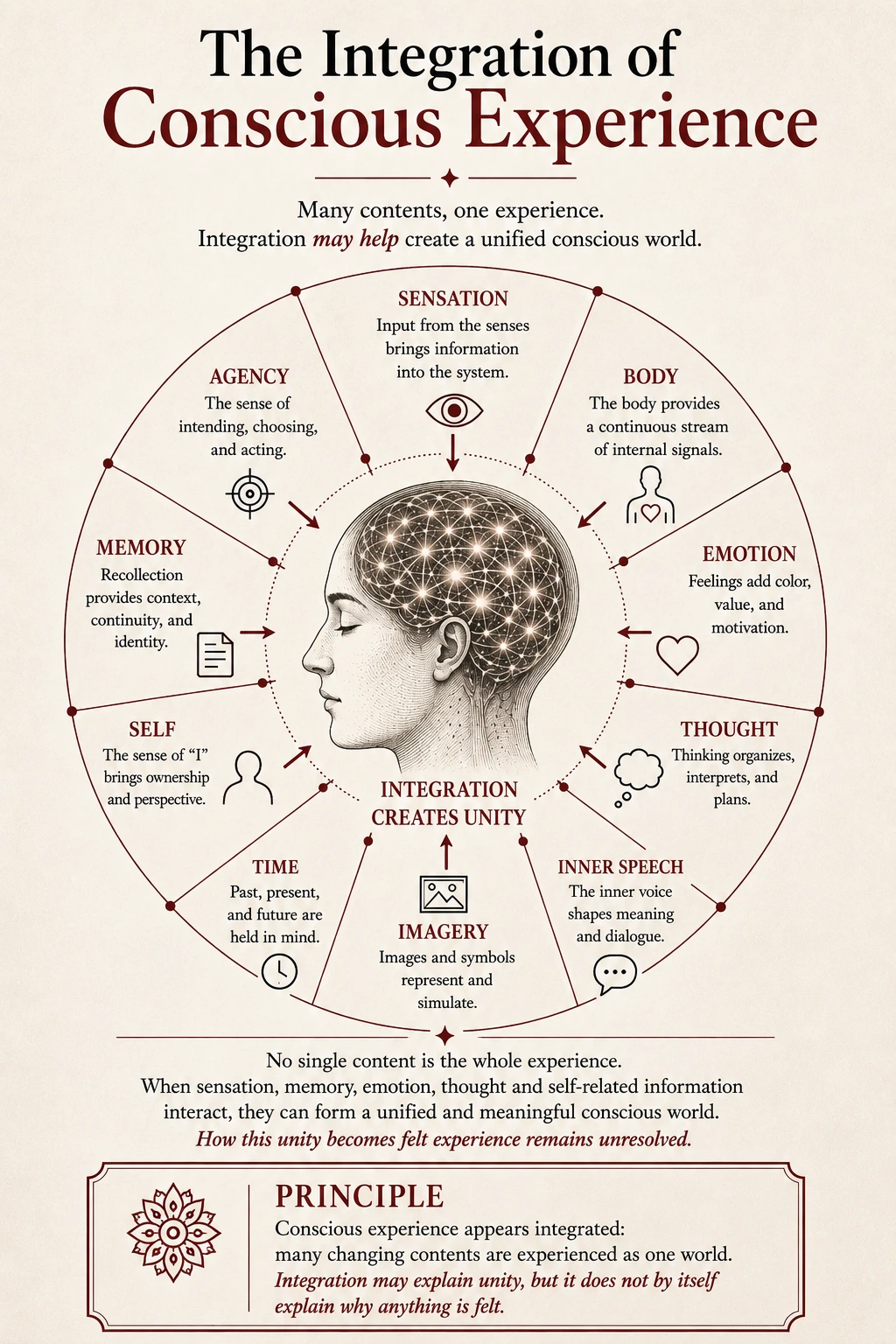
Integration should therefore be treated as part of the explanation, not as a complete answer. A system can combine information in highly sophisticated ways. The remaining question is whether the resulting unity is merely functional or also experienced.
Does Conscious Experience Require a Self?
Experience usually feels centered. Sights appear before me. Pain happens to me. Memories seem to belong to my past. Decisions appear to originate from my agency.
Yet the word self can refer to several layers:
- a minimal first-person perspective;
- a sense of bodily ownership;
- awareness of thoughts and actions as one’s own;
- a narrative identity built from memory;
- a reflective concept of who one is.
These layers can change independently. A person can be conscious without actively thinking about themselves. The narrative self can weaken while sensation and awareness remain. Body ownership can be experimentally distorted. Memory loss can disrupt identity without eliminating every present experience.
This suggests that conscious experience may require some perspective without requiring a fully developed autobiographical self. The deeper relationship remains contested: does a subject unify experience, or does the continuing organization of experience construct the subject?
Explore the distinction further in What Is the Self? and What Is Personal Identity?
How Memory and Time Shape the Inner World
Conscious experience is not a sequence of isolated snapshots. The present contains traces of what just happened and expectations about what may happen next.
You hear a melody because earlier notes remain available while later notes are anticipated. You understand a sentence because its beginning is retained as you reach its end. You recognize a friend because perception activates memory. You experience regret or hope because the present is linked to imagined alternatives across time.
Memory also gives experience personal continuity. It connects a moment to a history, a relationship, a promise or a wound. Two people can encounter the same event but experience it differently because the event enters different networks of memory and meaning.
This continuity helps create the sense that one life belongs to one person. Yet memory is reconstructive, selective and fallible. The self that appears continuous may depend on an ongoing act of integration rather than an unchanging inner object.
Questions about memory, time and identity lead naturally toward more radical possibilities: Could a pattern of consciousness continue outside the biological brain? Could it be copied or uploaded? Cokos explores those questions in Can Consciousness Exist Outside the Brain? and Can Consciousness Be Uploaded Into a Computer?
Could Artificial Intelligence Have Conscious Experiences?
Artificial intelligence makes the distinction between performance and experience impossible to ignore. A system can use language, classify images, plan actions and describe emotions. None of those abilities alone proves that anything is felt.
There are at least three separate questions:
- Can AI behave as though it is conscious? Increasingly sophisticated systems can produce convincing self-reports and adaptive behavior.
- Can artificial systems implement mechanisms associated with consciousness? In principle, future systems may reproduce some forms of recurrence, global availability, self-modeling or integration.
- Would those mechanisms create experience? This is the unresolved part, because the theories connecting mechanism to felt experience remain unsettled.
Current language models generate responses by processing patterns in data. Fluent claims about feelings are not reliable evidence that feelings exist. A responsible approach should neither assume machine consciousness nor declare it impossible without argument.
A major interdisciplinary assessment proposed evaluating AI through indicators derived from scientific theories rather than relying on conversation alone. Its authors found no strong basis for concluding that current systems are conscious, while also arguing that future systems could implement more of the relevant computational features. [7]
Read the fuller analysis in Can AI Become Conscious?
Why Conscious Experience Matters
Conscious experience is not merely a technical puzzle. It may be the point at which physical events become suffering, beauty, value and meaning.
Pain matters morally because it is felt. Pleasure matters because it is lived. A civilization is not good merely because it processes resources efficiently; it matters what life is like for the beings inside it. Medicine, animal welfare, artificial intelligence and law all depend on judgments about which systems can experience and how those experiences should count.
Consciousness also changes the meaning of reality. The world we know is not encountered without mediation. It appears through sensation, attention, expectation, memory and interpretation. This does not mean reality is invented at will. It means our access to reality is always shaped by the architecture of experience.
Finally, conscious experience makes mortality personal. The end of a body is not only the end of biological activity; it may be the end of a particular world from within. Questions about the soul, immortality, mind uploading and continuity all inherit their urgency from this fact.
Philosophical fantasy · Read online free
Enter the Question as a Story
Philosophy can define conscious experience. Science can investigate its mechanisms. Fiction can place you inside a world where consciousness, memory, time and reality become inseparable from choice.
Those Who Guard Eternity begins when Antem starts to suspect that the reality accepted by everyone around him is only one layer of something larger. Time is not merely measured. It shapes memory, perception, freedom and possible futures. Discovering the truth may offer liberation—but it may also destroy the certainty that made the old world feel safe.
The complete first novel of The Eternity Saga is available on Cokos with no registration, payment, subscription, download or locked chapters.
Read Those Who Guard Eternity Online for Free →Complete novel · Free to read · No signup · Begin with Book One
Conscious Experience Is the World as Lived
Conscious experience is the point at which existence becomes appearance, sensation, memory, fear, beauty and meaning. We can increasingly describe what the brain does when experience occurs. We can identify conditions that alter it, mechanisms that support access and patterns associated with conscious perception.
What remains unresolved is why any physical or computational process should create a world from within—or why that world should appear to someone as a life.
The mystery does not make scientific investigation impossible. It makes precision essential. Processing is not automatically experiencing. Intelligence is not automatically awareness. Integration may create unity without yet explaining feeling. The self may organize experience without being a permanent object hidden inside it.
To ask what conscious experience is, therefore, is to ask what separates a universe containing information from a universe in which something is present to someone.
A definition can explain the mystery. A story can let you inhabit it.
Start Reading Those Who Guard Eternity →Frequently Asked Questions About Conscious Experience
What is conscious experience in simple terms?
Conscious experience is what it feels like to perceive, think, remember or feel. It is the first-person side of mental life: not only that information is processed, but that color, pain, emotion, imagery or thought is present to a subject.
What is an example of a conscious experience?
Seeing the red of a sunset is a conscious experience. The eyes and brain process light, but the experience includes the red appearance itself, the scene’s emotional tone and the awareness that you are seeing it.
What is the difference between consciousness and conscious experience?
Consciousness is the general condition or capacity for experience. A conscious experience is a specific event within that condition, such as hearing music, feeling pain, recalling a memory or thinking about a problem.
What is subjective experience?
Subjective experience is reality as it appears from a particular first-person point of view. It includes qualities, perspective and personal meaning that are not directly observable by another person in the same way behavior or brain activity can be observed.
What are qualia?
Qualia are the felt qualities of experience, such as the redness of red, the painfulness of pain, the taste of coffee or the emotional character of nostalgia. The term identifies how an experience appears from within.
Is every mental process conscious?
No. Perception, memory, bodily regulation, action preparation and pattern recognition can occur without entering awareness. Conscious experience contains only part of the information being processed by the brain at any moment.
Can the brain process information without awareness?
Yes. Evidence from automatic behavior, masked perception, habits and neurological conditions shows that information can influence decisions and actions without becoming a reportable conscious experience.
Can science measure conscious experience?
Science measures reports, behavior, brain activity and responses to interventions. These provide evidence about the mechanisms and correlates of consciousness. They do not give direct third-person access to another subject’s experience exactly as it is lived.
Does conscious experience require a self?
Experience appears to require some perspective, but it may not require a fully developed narrative self. Sensation and awareness can continue even when reflective self-awareness, autobiographical memory or the usual feeling of identity is weakened.
Could artificial intelligence have conscious experiences?
It is not known. Current AI can process information and produce convincing language, but those abilities do not prove experience. Researchers are examining whether future artificial systems could implement mechanisms associated with consciousness, while the link between mechanism and feeling remains unresolved.
Selected References
- Thomas Nagel, “What Is It Like to Be a Bat?” The Philosophical Review, 1974. Oxford Academic edition.
- Ned Block, “On a Confusion about a Function of Consciousness.” Behavioral and Brain Sciences, 1995. Cambridge Core.
- David J. Chalmers, “Facing Up to the Problem of Consciousness.” Journal of Consciousness Studies, 1995. Author-hosted paper.
- George A. Mashour et al., “Conscious Processing and the Global Neuronal Workspace Hypothesis.” Neuron, 2020. PubMed.
- Giulio Tononi et al., “Integrated Information Theory: From Consciousness to Its Physical Substrate.” Nature Reviews Neuroscience, 2016. Nature.
- Cogitate Consortium, “Adversarial Testing of Global Neuronal Workspace and Integrated Information Theories of Consciousness.” Nature, 2025. Nature.
- Patrick Butlin et al., “Consciousness in Artificial Intelligence: Insights from the Science of Consciousness,” 2023. arXiv.