Short answer: consciousness exists as the first-person dimension of certain living systems. Modern neuroscience increasingly explains the mechanisms that make information globally available, integrated, recurrent, remembered, and usable for flexible action. What it does not yet explain is why any of those processes should feel like anything from the inside.
Consciousness is not merely information processing. It is the fact that some information is experienced.
This article examines the strongest scientific and philosophical explanations without pretending that the mystery has already been solved. It separates established evidence from inference, mechanism from experience, and useful theory from metaphysical speculation.
- What is well supported: human consciousness depends critically on the brain.
- What is increasingly understood: attention, integration, recurrent processing, memory, self-modeling, and global access.
- What remains open: why physical processes have a subjective side.
- What no responsible account can claim: that one current theory has definitively solved consciousness.
Contents
- What consciousness is
- Why the question is so difficult
- What neuroscience knows
- Major theories of consciousness
- Why consciousness may have evolved
- The hard problem and explanatory gap
- The Cokos integral model
- Could artificial intelligence be conscious?
- What genuine progress would require
- Frequently asked questions
What is consciousness?
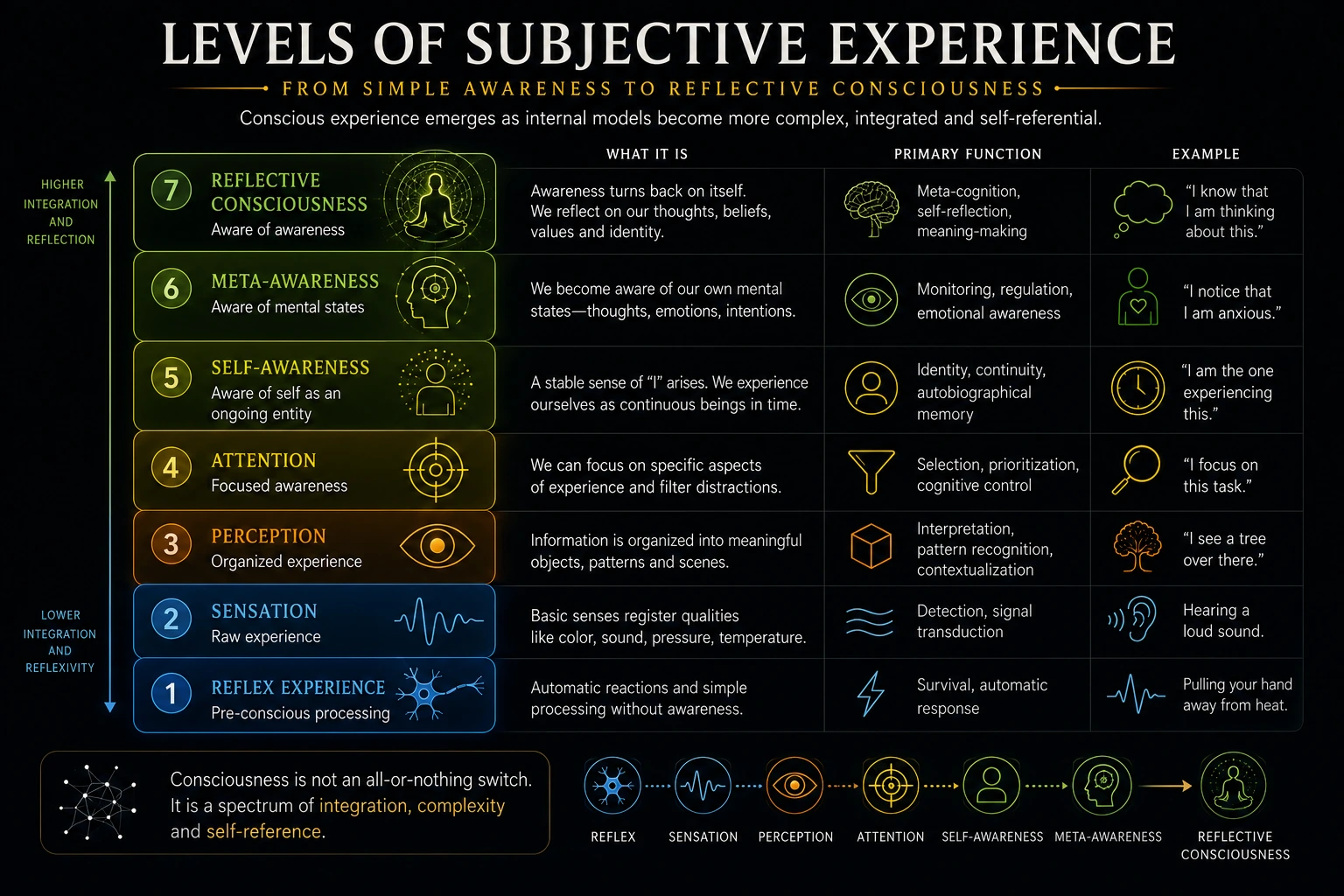
The word consciousness is used for several different things: wakefulness, attention, self-awareness, intelligence, reflective thought, moral awareness, and the ability to report an experience. These capacities overlap, but they are not identical.
Consciousness is the capacity for subjective experience: there is something it is like to be the system.
A camera can register light. A thermostat can react to temperature. A language model can transform symbols and produce complex responses. None of these abilities, by themselves, proves that a system has an inner point of view. The central question is not whether information is processed, but whether that processing is accompanied by experience.
| Concept | What it does | Why it is not identical to consciousness |
|---|---|---|
| Intelligence | Solves problems and adapts behavior | Competence does not prove experience |
| Attention | Selects information for priority processing | Selection does not explain why anything is felt |
| Memory | Stores and retrieves information | Storage alone does not create an inner world |
| Self-awareness | Represents the system as itself | It may be one advanced form of consciousness, not consciousness as such |
| Report | Communicates a state | A system might experience without being able to report |
This distinction matters because otherwise a theory may explain access, decision-making, speech, or behavior while leaving the existence of experience untouched.
Why is the existence of consciousness such a difficult question?
Most scientific explanations connect observable causes to observable effects. In consciousness research, however, the phenomenon to be explained has two aspects. From the outside there are neurons, signals, networks, behavior, and reports. From the inside there are colors, pain, meaning, emotion, presence, and the sense of being someone.
A complete theory must connect these two descriptions without quietly replacing one with the other. Explaining discrimination, memory, attention, or verbal report is important, but none of those achievements automatically explains why the relevant states are experienced.
The first-person and third-person asymmetry
You know your own consciousness directly. You know the consciousness of other people indirectly, through behavior, language, biological similarity, and shared structure. This asymmetry creates the classic problem of other minds and makes consciousness unusually difficult to measure.
Correlation is not yet explanation
Suppose a specific pattern of brain activity reliably appears whenever a person reports seeing red. That is a valuable neural correlate. But it does not yet tell us why that pattern is accompanied by the particular quality of redness rather than by no experience at all.
What modern neuroscience knows about consciousness
Neuroscience has transformed the study of consciousness from a largely philosophical subject into an experimental field. Researchers compare waking, sleep, anesthesia, coma, seizures, attention, masking, binocular rivalry, and brain injury to identify the processes associated with conscious states.
What is strongly supported
- Human consciousness depends critically on the functioning brain.
- Conscious level changes systematically during sleep, anesthesia, coma, and severe brain injury.
- Conscious contents depend on distributed cortical and thalamic activity rather than one simple “consciousness center.”
- Large amounts of perception, learning, motor control, and decision preparation occur without conscious access.
- Different components of consciousness can dissociate: wakefulness, perception, memory, selfhood, and report can be disrupted separately.
Neural correlates of consciousness
A neural correlate of consciousness is the minimal neural process reliably associated with a particular conscious state or content. NCC research is essential because it narrows the mechanisms a theory must explain. Yet a correlate can be a cause, a consequence, a prerequisite, or merely an accompaniment. Experimental design must separate these possibilities.
Integration, recurrence, and global access
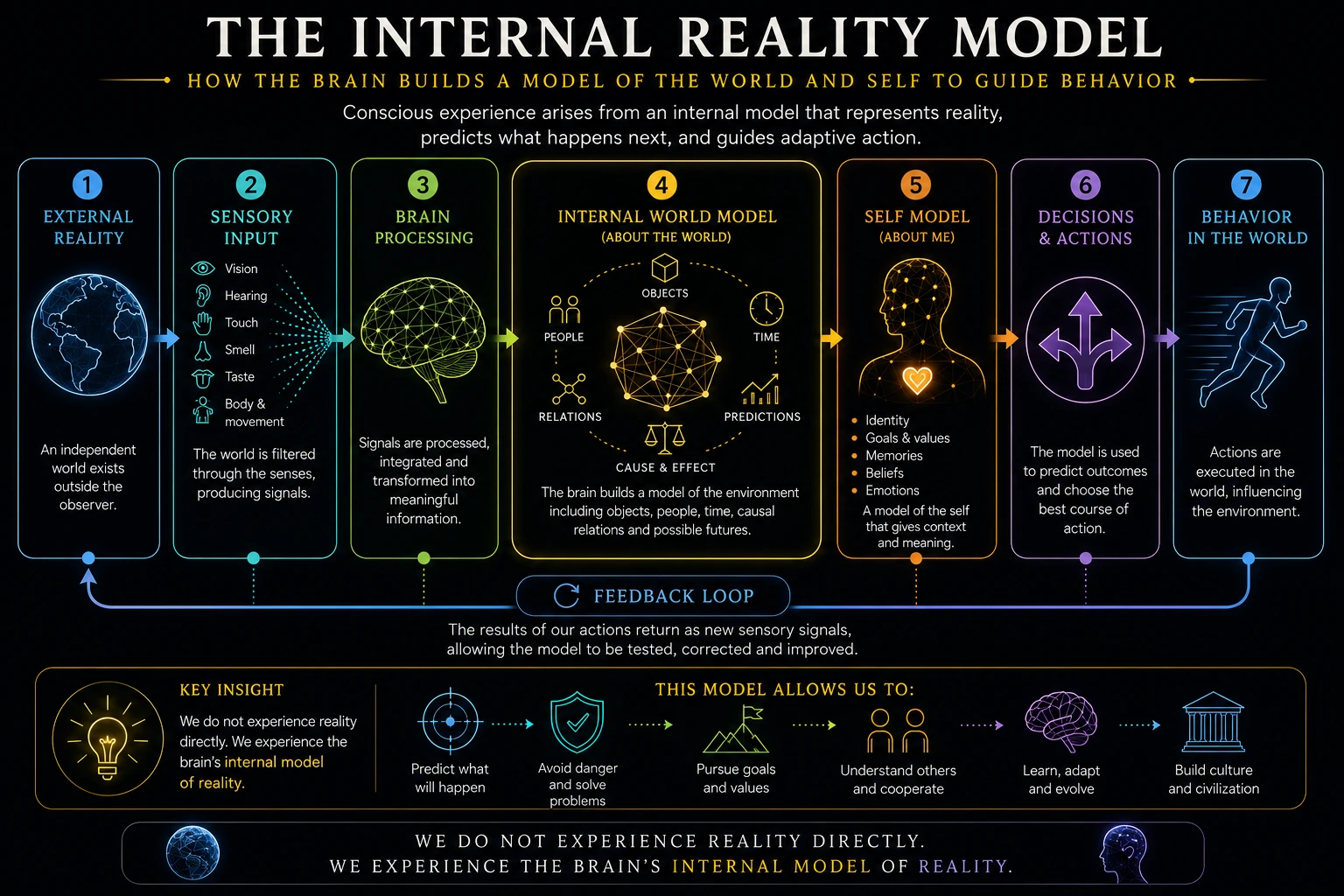
Many findings converge on three broad ideas. First, conscious information tends to be integrated across multiple systems. Second, recurrent or feedback processing appears important; information does not simply move once through a feedforward chain. Third, conscious contents often become globally available to memory, planning, verbal report, and flexible action.
These findings significantly reduce the space of plausible theories. They still do not settle whether integration, recurrence, or global availability is identical with consciousness, merely necessary for it, or one mechanism among several.
The five levels of a complete explanation
A durable explanation of consciousness must work across several levels at once. Reducing the problem to only one level produces incomplete answers.
| Level | Central question | What it can explain | What remains open |
|---|---|---|---|
| Physical | What happens in the nervous system? | Neurons, signals, networks, causal interactions | Why these processes have an inner aspect |
| Biological | Why might consciousness have evolved? | Adaptive function, learning, flexible behavior | Whether experience itself was selected |
| Cognitive | What does a conscious system do? | Access, attention, memory, self-modeling | Which functions are sufficient for experience |
| Phenomenological | How is experience structured? | Unity, temporality, embodiment, perspective | Why particular states have particular qualities |
| Ontological | What kind of reality is consciousness? | Competing metaphysical interpretations | Which interpretation is correct |
The levels are not rivals. A biological account does not replace a cognitive one; a neural mechanism does not automatically eliminate the need for phenomenology; and an ontology without testable consequences cannot substitute for science.
Major scientific theories of consciousness
No current theory has achieved decisive consensus. Each captures important evidence and each leaves significant questions unresolved. The most useful approach is to compare what each theory explains, predicts, and fails to explain.
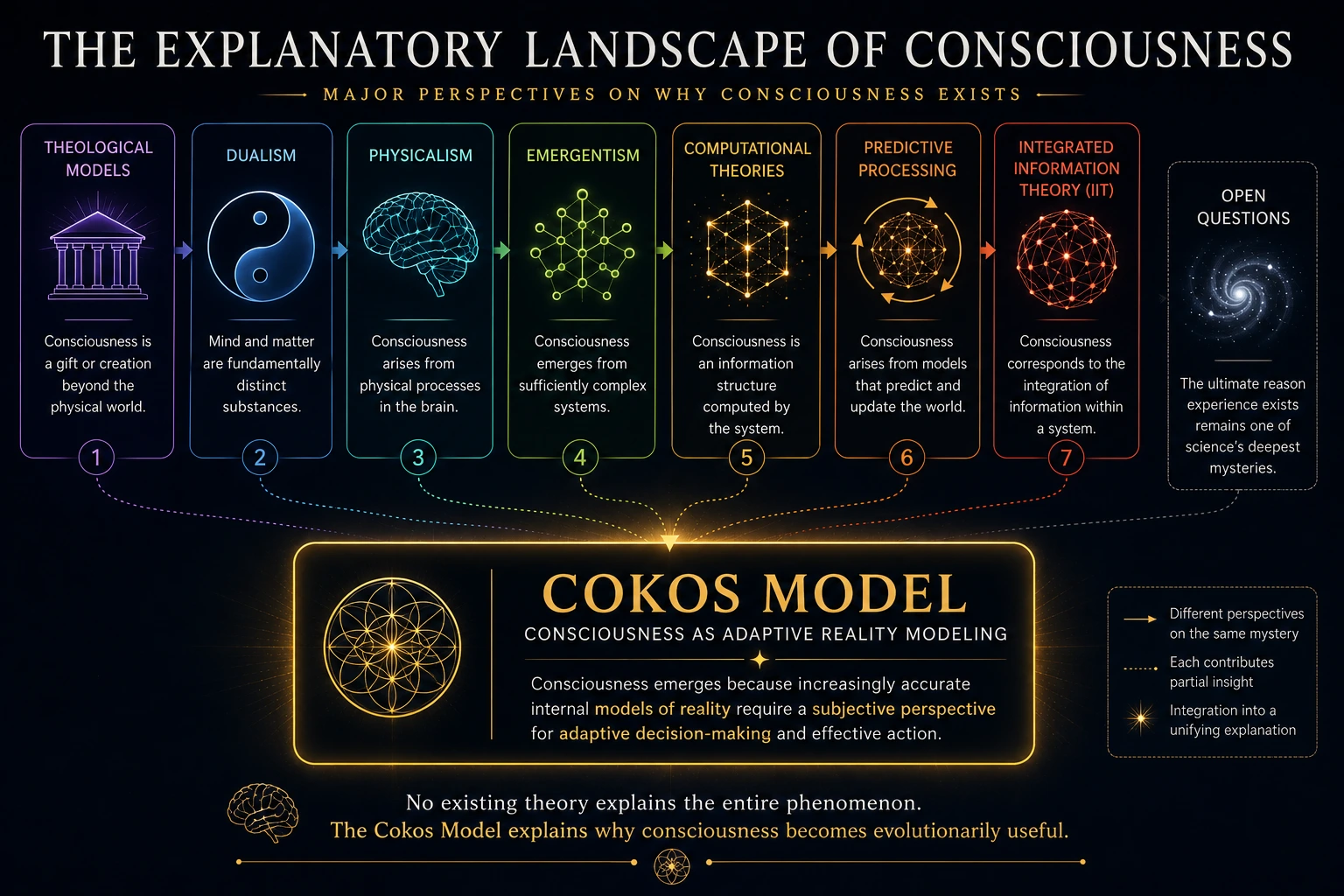
Global Workspace Theory
Global Workspace approaches propose that information becomes conscious when it is broadcast widely across the brain and made available to memory, reasoning, action, and report. The theory explains why conscious information can influence many systems at once. Its main limitation is that global availability may explain access without explaining why access is accompanied by experience.
Integrated Information Theory
Integrated Information Theory begins from structural properties of experience, such as unity and differentiation, and proposes that consciousness corresponds to a system’s irreducible causal structure. Its strength is the ambition to connect phenomenology with formal properties. Its challenges include difficult measurement, controversial implications, and uncertainty about whether integration explains experience or merely redescribes it.
Recurrent Processing Theory
Recurrent Processing Theory argues that conscious perception depends on feedback loops within sensory systems rather than on feedforward processing alone. It fits evidence that recurrent cortical interactions distinguish conscious from unconscious perception. It remains debated whether local recurrence is sufficient for consciousness or whether broader access is required.
Higher-Order theories
Higher-Order theories claim that a mental state becomes conscious when the system represents itself as being in that state. They offer a strong account of introspection and self-awareness. Critics argue that basic experience may occur without a distinct higher-order representation.
Predictive processing and active inference
Predictive approaches describe the brain as a hierarchical model that predicts sensory input and updates itself through error correction. They explain perception, attention, embodiment, and self-modeling in a unified way. Yet prediction alone does not show why model updating should be felt.
| Theory | Best explanation | Main unresolved issue |
|---|---|---|
| Global Workspace | Conscious access and flexible control | Why broadcasting is experienced |
| Integrated Information | Unity and differentiation of experience | Measurement and ontological interpretation |
| Recurrent Processing | Conscious perceptual processing | Whether local recurrence is sufficient |
| Higher-Order | Introspection and awareness of mental states | Whether all experience requires meta-representation |
| Predictive Processing | World-modeling and embodied inference | Why prediction has phenomenology |
Philosophical positions: what kind of thing is consciousness?
Scientific theories describe mechanisms and functions. Philosophical positions ask what consciousness is in the structure of reality. These questions overlap, but they should not be confused.
Physicalism
Physicalism holds that consciousness is wholly physical or fully dependent on physical reality. It fits the close dependence of mind on brain. Its challenge is to explain how objective physical descriptions entail subjective experience.
Property dualism
Property dualism accepts one physical world but argues that conscious properties are not reducible to physical properties. It preserves the reality of experience but must explain how non-reducible properties arise and interact causally.
Substance dualism
Substance dualism treats mind and matter as fundamentally different kinds of substance. It takes first-person reality seriously but faces the interaction problem and lacks strong empirical support for a separable mental substance.
Panpsychism
Panpsychism proposes that consciousness, or a primitive precursor of it, is fundamental and widespread. It avoids deriving experience from something wholly non-experiential, but it faces the combination problem: how do countless primitive experiential aspects form one unified subject?
Neutral monism
Neutral monism proposes that both mind and matter arise from a more fundamental neutral reality. It offers conceptual symmetry but remains difficult to specify and test.
Why might consciousness have evolved?
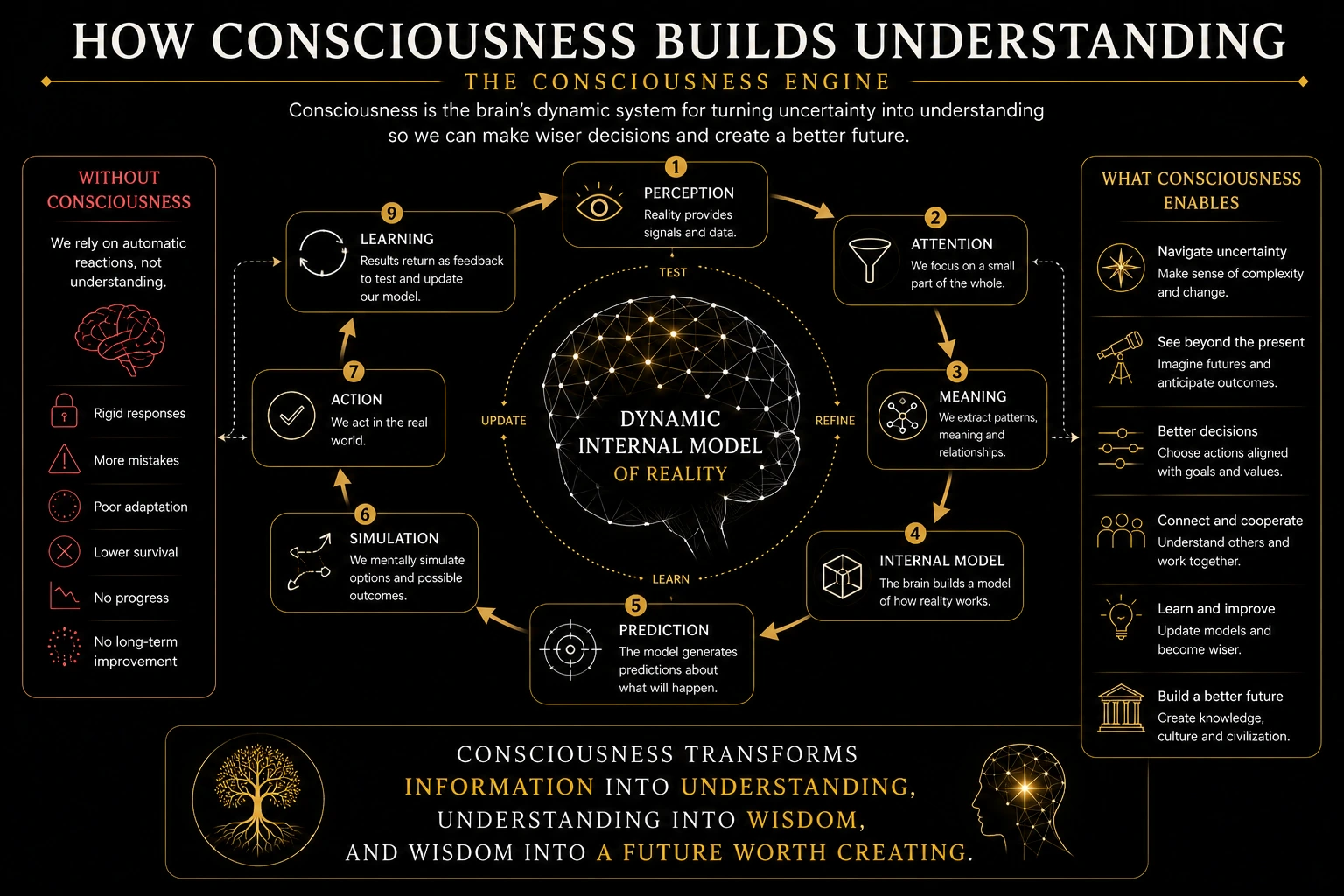
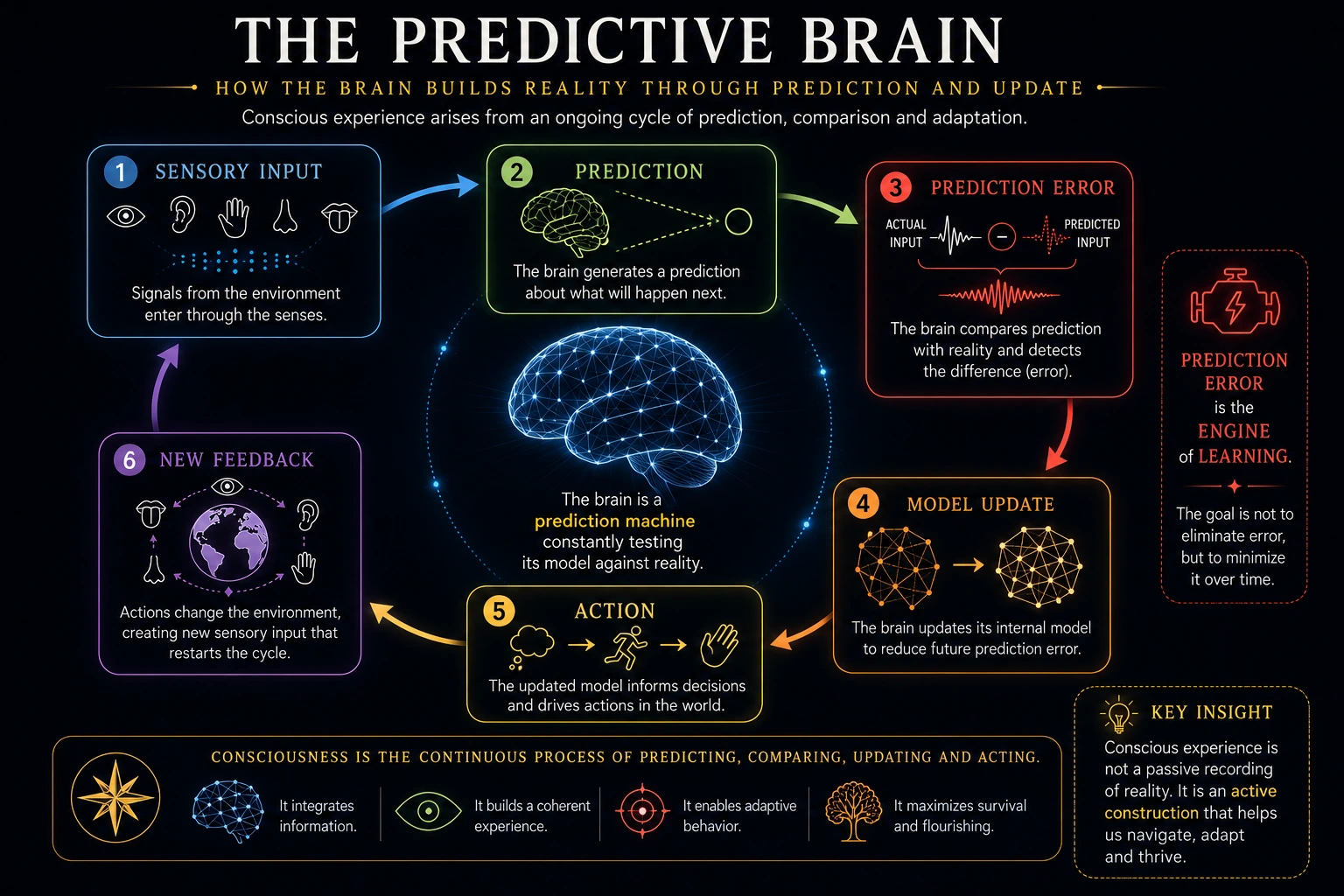
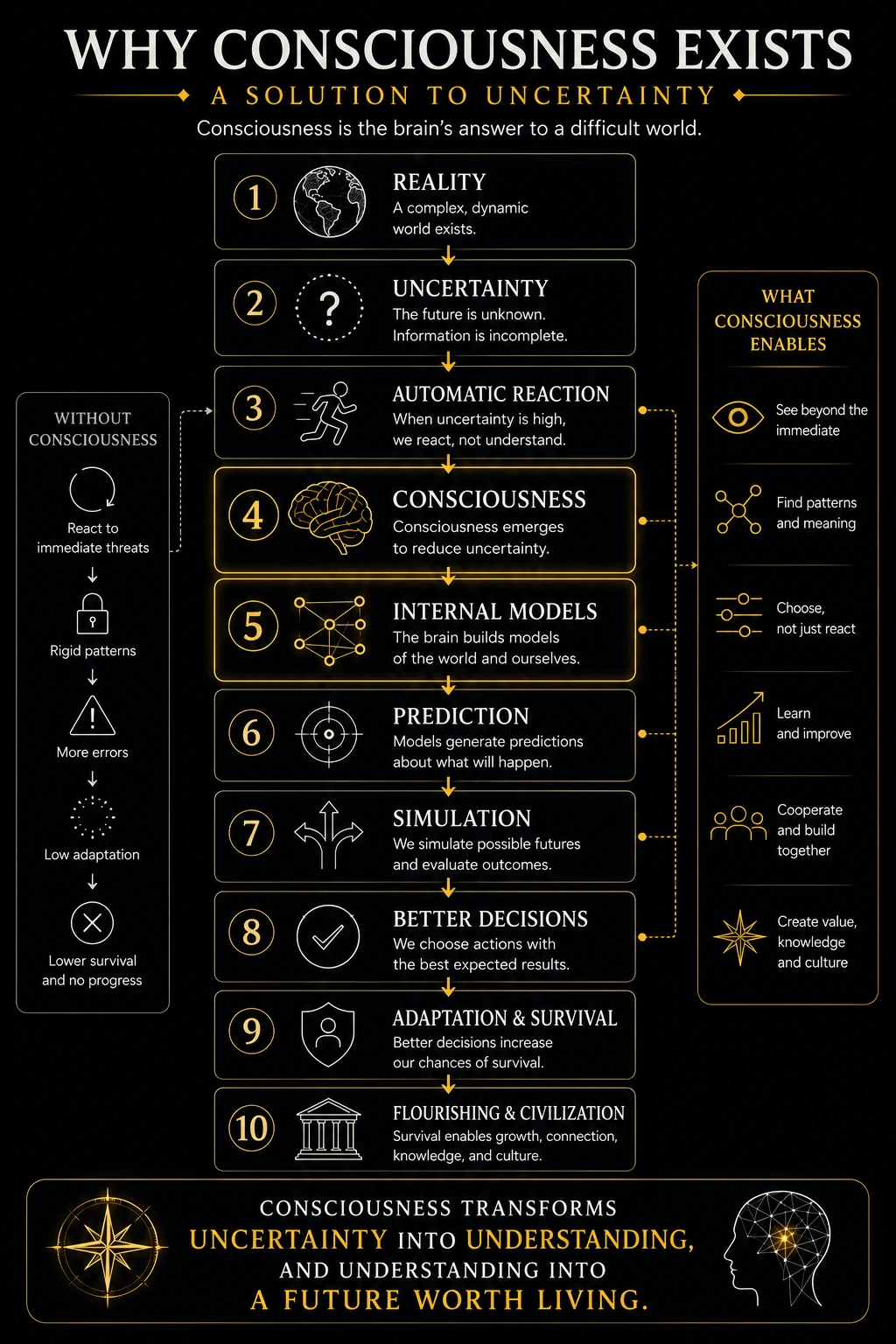
Evolution explains how nervous systems, perception, memory, learning, prediction, and social intelligence became increasingly complex. Consciousness may have supported flexible integration, planning across time, conflict resolution between competing goals, social modeling, and rapid adaptation to novel situations.
Adaptive possibilities
- Integrating information from many senses into one action-guiding model.
- Simulating possible futures before acting.
- Assigning value and urgency to signals.
- Learning from complex, context-sensitive outcomes.
- Modeling other agents and coordinating social behavior.
- Maintaining a temporally extended self-model.
Yet evolutionary usefulness does not, by itself, explain phenomenal experience. Natural selection can favor behavior and information processing. The remaining question is whether experience itself has causal value, is identical to those functions, or accompanies them as a by-product.
The hard problem and the explanatory gap
The “easy problems” of consciousness are not easy in practice. They include explaining discrimination, integration, attention, memory, report, and behavioral control. They are called easy only because they can, in principle, be addressed through mechanisms and functions.
The hard problem asks why those mechanisms and functions are accompanied by experience at all. Why does visual processing produce a visible world? Why does tissue damage hurt? Why is there a unified perspective rather than only distributed computation?
A complete physical inventory of the brain may tell us everything the system does. The unresolved question is why doing those things constitutes a world for someone.
Some philosophers argue that the hard problem reflects a real ontological gap. Others argue that it results from conceptual confusion, limits of introspection, or the brain’s self-model. A responsible account must keep these possibilities open while demanding testable progress.
The Cokos integral model of consciousness
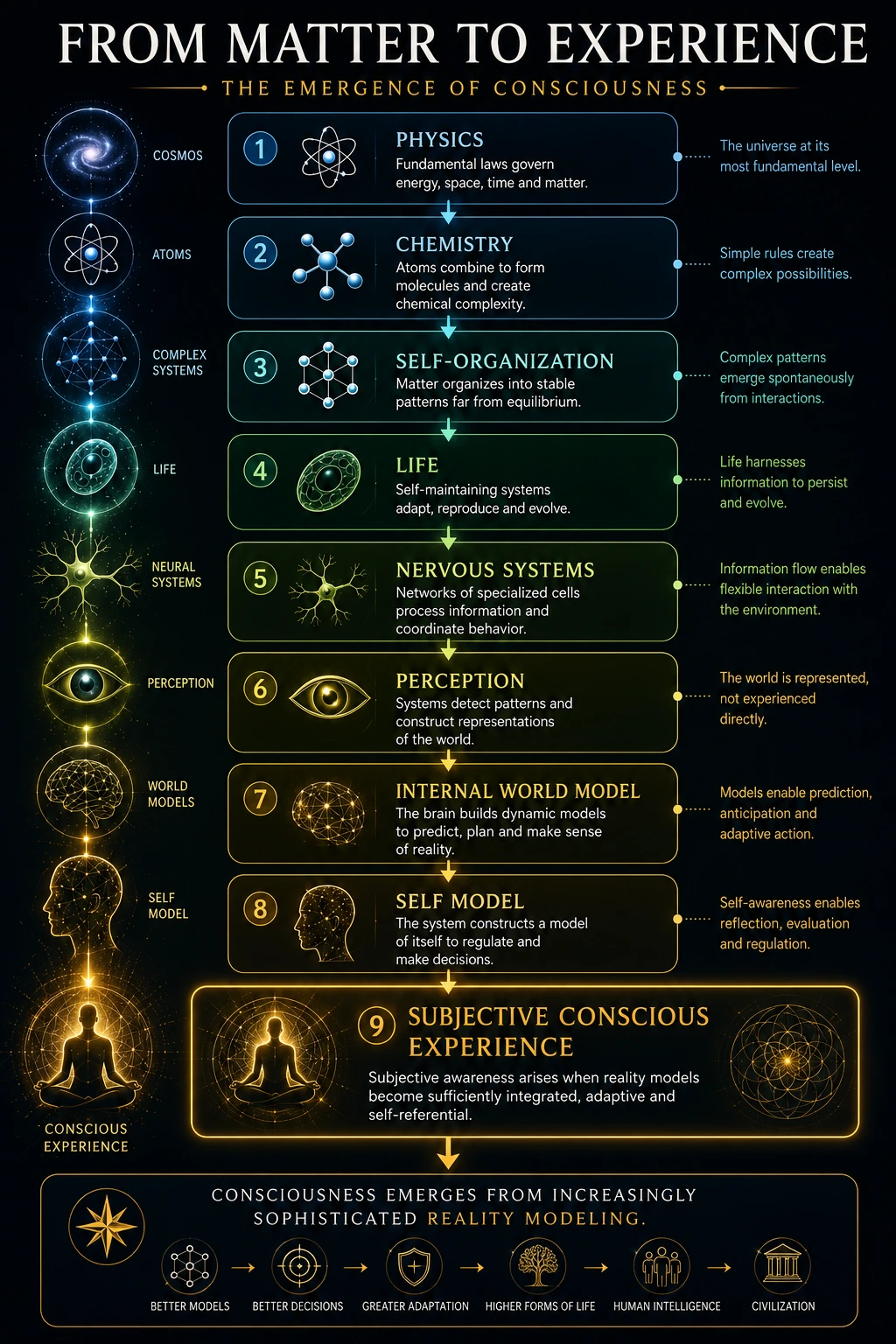
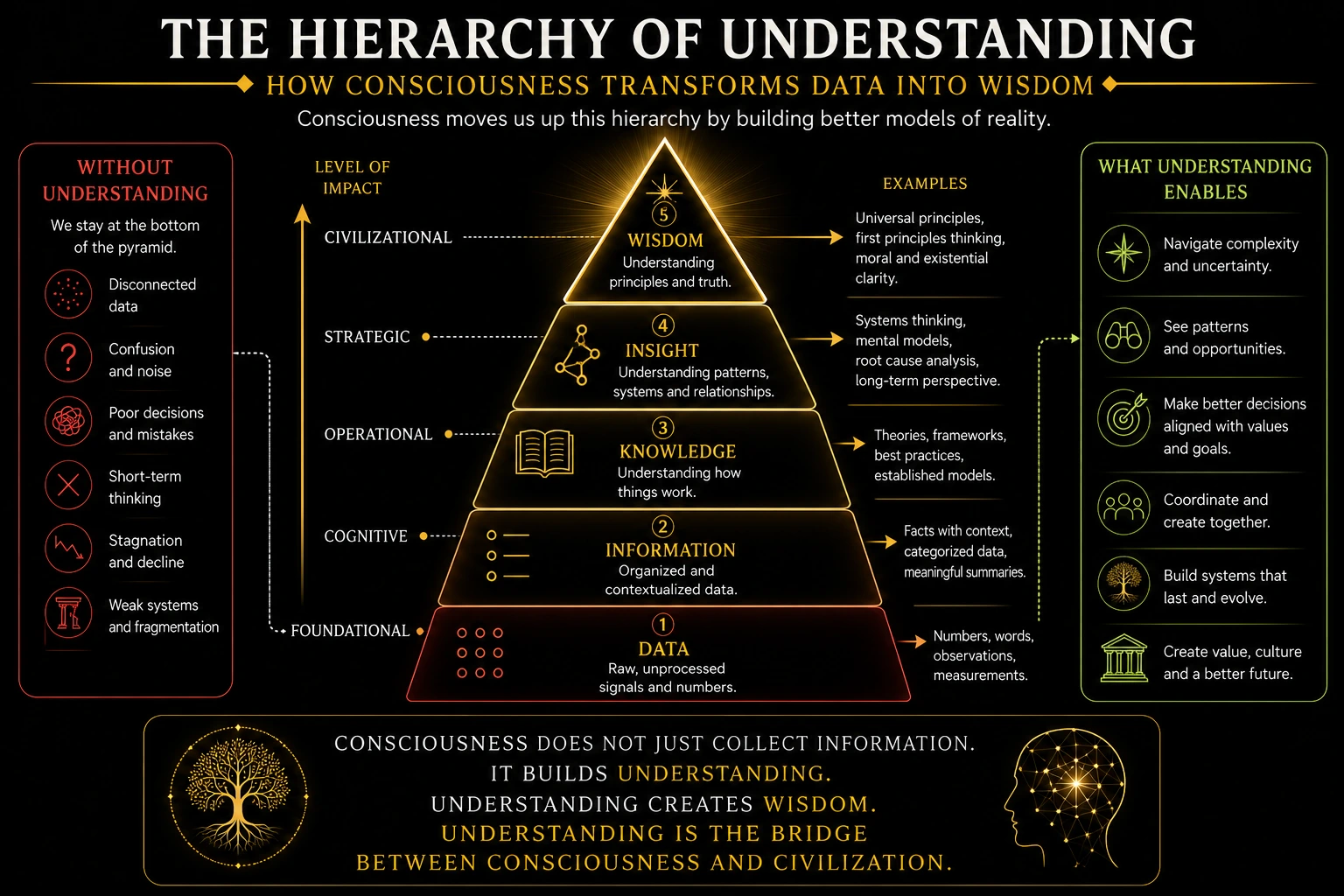
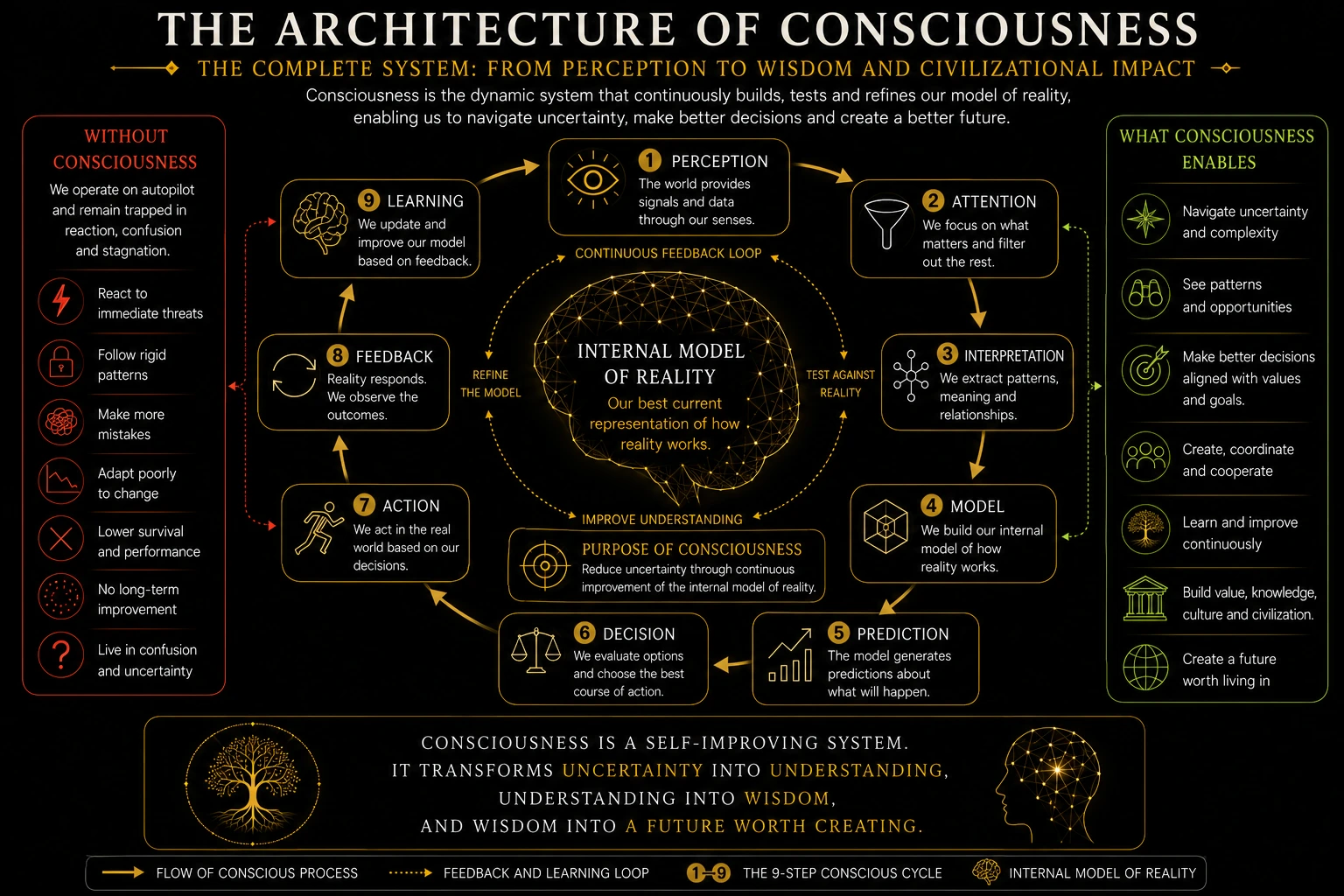
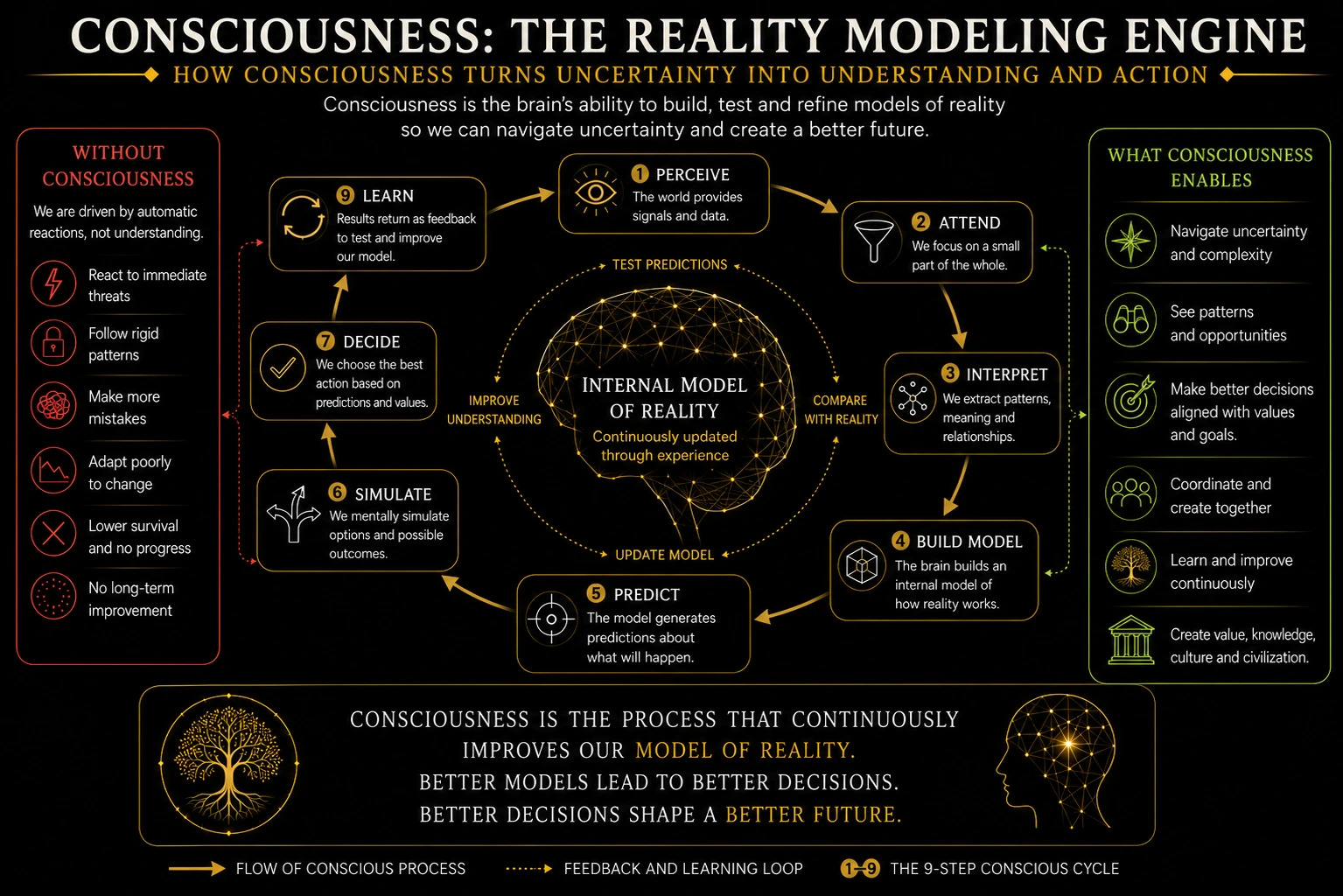
Within the Cokos Knowledge OS, consciousness is treated as the level at which reality becomes present to a system and can be organized into models. Consciousness links reality, perception, meaning, knowledge, truth, identity, and action. It is therefore not an isolated topic but a central node in the knowledge graph.
Consciousness is the interface through which reality becomes available for the construction and revision of models of reality.
This does not claim that consciousness is merely an interface in the software sense. It identifies its epistemic role: without experience there is no appearing world, no first-person evidence, and no lived distinction between signal and noise, truth and error, value and indifference.
The principle of explanatory sufficiency
Cokos treats an explanation of consciousness as sufficient only when it connects four dimensions: mechanism, function, experience, and ontology. A neural description without phenomenology is incomplete. A phenomenological description without mechanism is incomplete. A metaphysical interpretation without testable implications is incomplete.
- Mechanism: identify the causal physical processes.
- Function: explain what those processes enable the organism or system to do.
- Experience: connect the mechanism to the structure and quality of first-person awareness.
- Ontology: state what the theory implies about the place of consciousness in reality.
- Prediction: produce observations that could distinguish the theory from alternatives.
What can be claimed honestly—and what cannot
Well supported
- Human conscious states depend strongly on brain states.
- Consciousness has multiple separable dimensions.
- Integration, recurrence, and broad availability are important correlates of conscious access.
- The brain constructs active models of the world and the self.
- No single current theory explains all major evidence and all aspects of experience.
Not established
- That consciousness has been completely reduced to neural activity.
- That one theory has definitively defeated all rivals.
- That panpsychism, dualism, or any other metaphysical position has been experimentally confirmed.
- That present-day artificial intelligence is conscious.
- That consciousness can exist independently of any physical substrate.
- That scientists know the exact evolutionary moment when experience began.
Could artificial intelligence become conscious?
Behavioral sophistication is not proof of consciousness. A system can produce fluent language, solve problems, and describe emotions without necessarily feeling anything. These abilities may arise from complex information processing alone.
The possibility of machine consciousness depends on which theory is correct. If consciousness requires a certain functional organization, sufficiently advanced artificial systems might become conscious. If it depends on specific biological properties, digital systems might remain non-conscious regardless of performance. If consciousness is tied to integrated causal structure, the hardware and architecture may matter more than outward behavior.
Related Cokos articles include Can AI Become Conscious?, Can Consciousness Exist Outside the Brain?, and Can Consciousness Be Uploaded into a Computer?.
Until reliable criteria exist, claims of machine consciousness should be treated with caution. Anthropomorphic language is evidence about human interpretation, not necessarily about machine experience.
A research roadmap for consciousness
The next major advance will require more than additional data. It will require stronger links between levels of explanation and experiments designed to distinguish rival theories.
- Define operational criteria. Distinguish consciousness from intelligence, responsiveness, and report.
- Separate prerequisites, correlates, and consequences. Identify what causes experience rather than what merely follows it.
- Link neural structure to experiential structure. Explain not only whether experience occurs, but why it has a particular content and quality.
- Explain subject unity. Show how distributed processing produces one perspective.
- Integrate first-person and third-person data. Build disciplined methods for relating reports and phenomenology to objective measurement.
- Create risky predictions. A theory must be capable of being wrong.
- Compare theories directly. Use preregistered experiments that force competing models to make different predictions.
Real progress may not come from one theory eliminating every other theory. It may come from a layered model in which different theories explain different aspects and are integrated by a deeper causal framework.
The best available answer today
Why does consciousness exist? The most defensible answer is that consciousness is deeply connected to the evolution of living systems capable of integrating information, modeling their environment and themselves, assigning significance, and guiding flexible action. These capacities explain many conditions and functions of consciousness.
But this answer remains incomplete. It explains why a system might benefit from sophisticated control and world-modeling. It does not yet explain why those functions are accompanied by a first-person point of view. The existence of experience remains an open scientific and philosophical problem.
We increasingly understand what conscious systems do and how brains support those capacities. We do not yet understand why any of it is experienced.
Frequently asked questions
Why does consciousness exist?
There is no settled answer. Consciousness may be connected to the evolution of integrated information processing, world-modeling, self-modeling, and flexible behavior. Why these processes are accompanied by subjective experience remains unresolved.
Is consciousness produced by the brain?
Human consciousness depends strongly on the brain. Changes to brain function alter or eliminate conscious states. Whether consciousness is fully reducible to brain activity is still debated.
What is the hard problem of consciousness?
It is the problem of explaining why physical and computational processes are accompanied by subjective experience—why there is something it is like to see, feel, think, or be.
Is consciousness the same as intelligence?
No. Intelligence is the ability to solve problems and adapt. Consciousness is subjective experience. A system could, in principle, display intelligence without experience.
Do animals have consciousness?
Many animals probably have some form of subjective experience, supported by shared neurobiology, flexible behavior, learning, and pain responses. The richness and structure of experience likely vary across species.
Can artificial intelligence become conscious?
Possibly, but no accepted test exists. The answer depends on whether consciousness requires functional organization, integrated causal structure, biological processes, or something else.
Can consciousness exist outside the brain?
The possibility remains open in principle, but there is no conclusive evidence that human-like consciousness exists independently of a functioning physical substrate.
Will science solve consciousness?
Science can continue to identify mechanisms, compare theories, and develop better criteria. Whether this will fully close the explanatory gap is unknown.
Conclusion
Consciousness is the point at which the universe, through living systems, becomes present to itself as experience. This formulation is philosophically suggestive, not a completed scientific explanation. The disciplined conclusion is more modest: consciousness is real, brain-dependent in humans, structured, variable, and scientifically investigable. Its ultimate nature remains unresolved.
To continue through the Cokos knowledge graph, read What Is Consciousness?, What Is Reality?, Do Humans Have Free Will?, and What Is Personal Identity?.
Perhaps the most astonishing fact about the universe is that it produced beings capable of asking why they are conscious.