
What Is Epistemology? A Simple Definition
Epistemology is the branch of philosophy that studies knowledge and justified belief. It asks what knowing involves, where knowledge comes from, what makes a belief reasonable, and what limits there are to what we can know.
The word combines Greek terms associated with knowledge and an account or explanation. You can think of it as the philosophy of knowing. Its subject extends beyond collecting facts to examining the standards by which beliefs deserve acceptance. The Stanford Encyclopedia of Philosophy’s overview of epistemology introduces this broader field.
Imagine receiving a screenshot announcing that a museum is closed. You understand the sentence immediately. Whether you should believe it is another matter. Was it posted today? Is it authentic? Does it refer to the museum you plan to visit? These are small, practical versions of epistemological questions.
This guide maps the field and shows how its questions work. For a deeper examination of knowledge itself, continue with What Is Knowledge?
The Four Central Questions of Epistemology
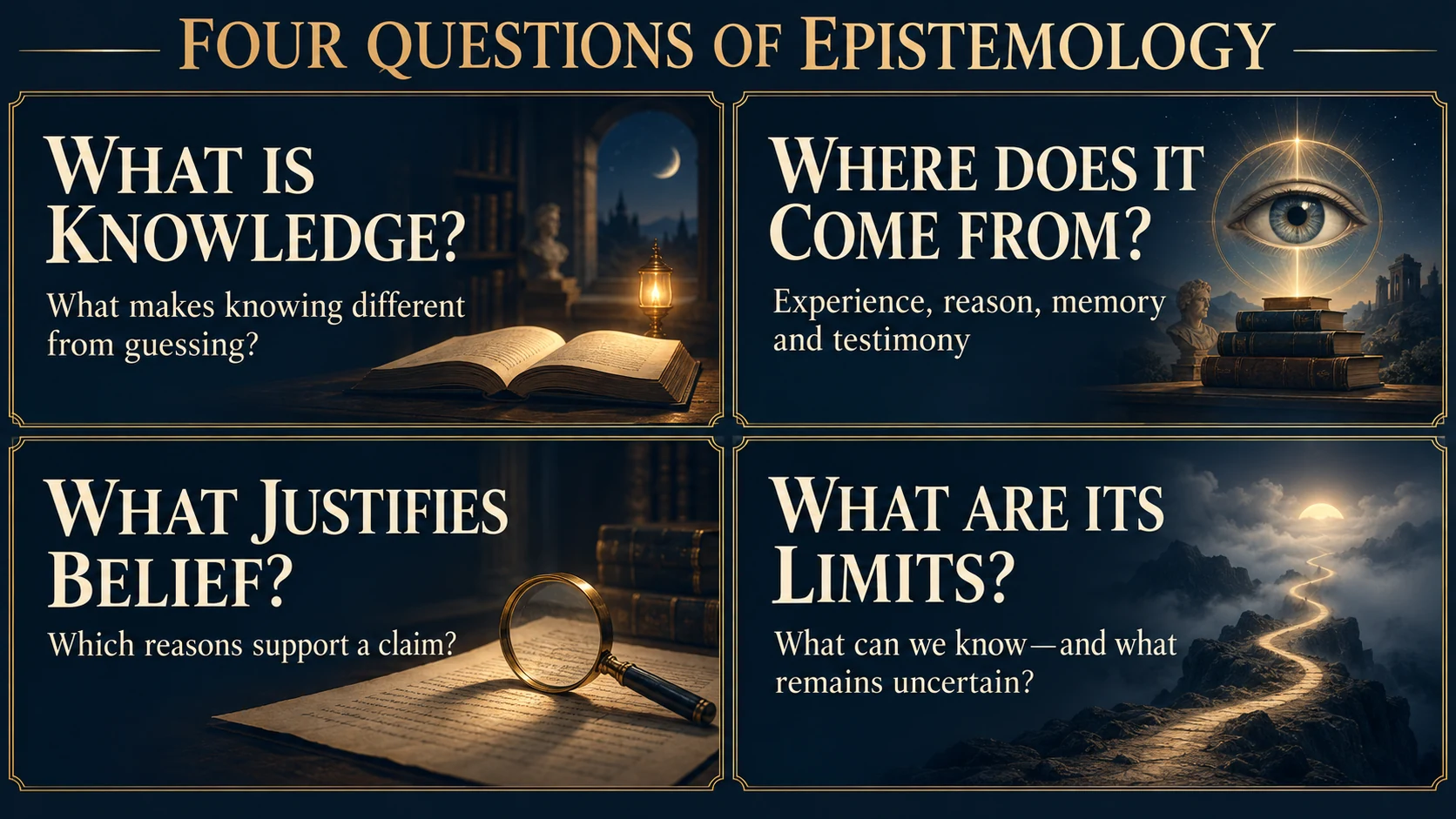
Four questions provide a useful starting map. They are connected, but an answer to one does not automatically settle the others.
- What is knowledge? What distinguishes knowing a fact from guessing correctly?
- Where does knowledge come from? How do experience, reasoning and other people contribute?
- What justifies belief? What makes accepting a particular claim reasonable?
- What are its limits? Which questions can we answer, and where should we withhold judgment?
With the museum screenshot, the source question asks where the announcement originated. The justification question asks whether that source gives you adequate grounds to believe the museum is closed. Neither is answered merely by saying that the screenshot looks convincing.
Epistemology in Everyday Life
You do not need to choose a philosophical school before asking better questions. Begin with situations where your confidence depends on a particular route to an answer.
- A remembered conversation: you recall that a friend agreed to meet on Friday. Checking the message history separates your recollection from the recorded agreement.
- An expert’s explanation: someone speaks confidently about a damaged painting. Their relevant experience and access to the painting matter more than their confidence alone.
- A calculation: you total the cost of three tickets. Correct arithmetic helps only if you entered the right prices and included the relevant charges.
Each example separates the claim from its support. Asking “Why do I believe this?” can reveal that your answer rests on a memory, an assumption, a calculation or someone else’s report. Once that dependence is visible, you can check the part most likely to fail.
Knowledge, Belief, Truth and Justification
These terms describe different aspects of knowing. They are not four mutually exclusive boxes into which every statement must fit.
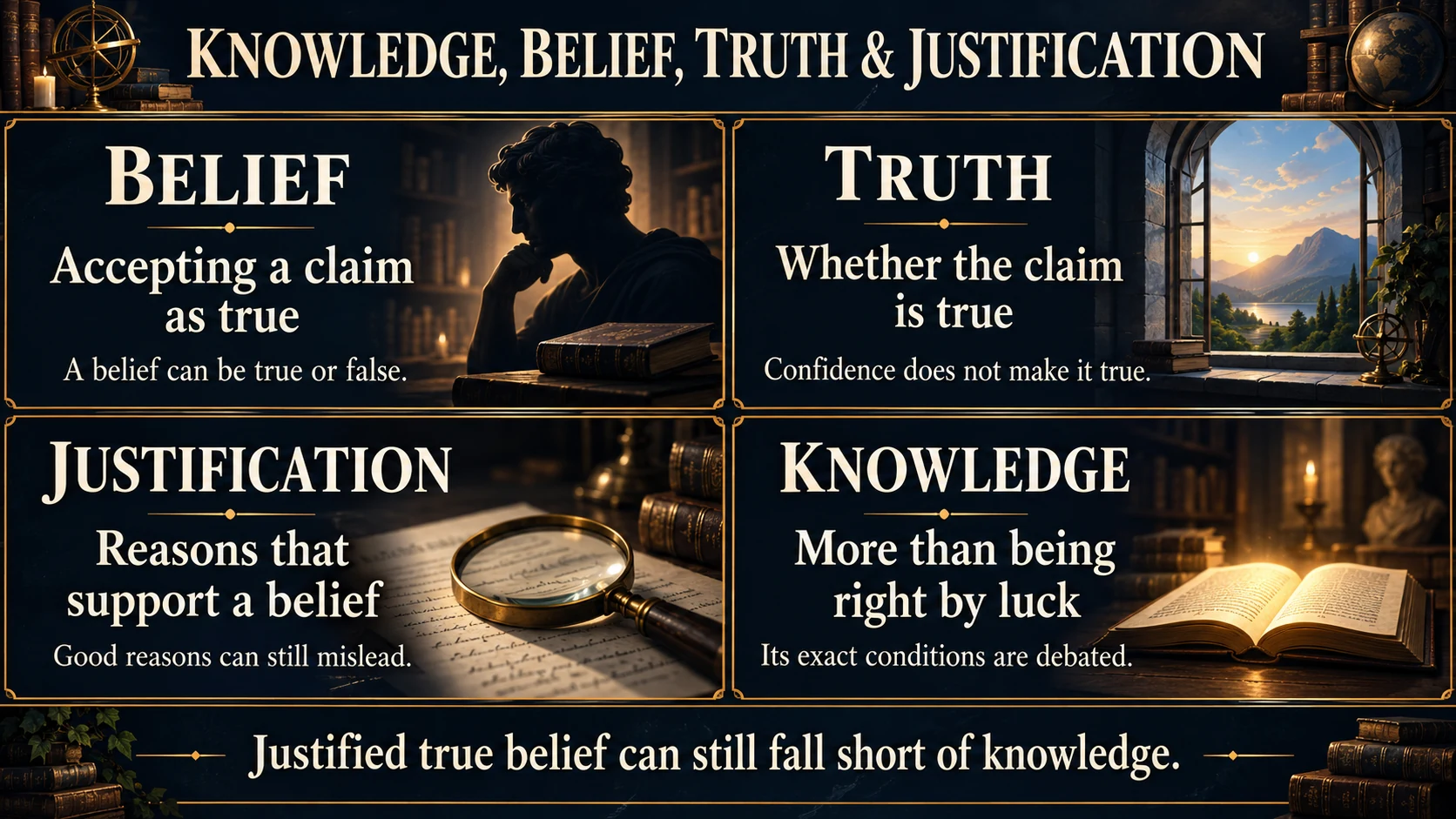
| Term | Central concern | Museum example |
|---|---|---|
| Belief | Accepting a claim as true | You believe the museum is closed today. |
| Truth | Whether the claim is actually true | The museum really is closed on the relevant date. |
| Justification | The support for accepting the claim | You checked a current, authentic closure notice. |
| Knowledge | Knowing the fact, beyond merely guessing correctly | Your correct belief appropriately depends on reliable information. |
On the standard account of factual knowledge, knowing entails believing, although believing does not entail knowing. A reasonable belief can turn out false. A true belief can result from luck. Philosophers disagree about exactly what additional conditions knowledge requires.
For the separate question of what truth consists in, see What Is Truth?
Why Justified True Belief Is Not the Whole Answer
An influential analysis describes knowledge as justified true belief: you accept a proposition, it is true, and you have justification for accepting it. Gettier-style cases challenge whether those conditions are sufficient.
Suppose you consult a clock that you reasonably take to be working. It stopped twelve hours ago, but you happen to look at exactly the moment when its hands show the correct time. Your belief is true and apparently justified, yet its correctness depends on an accident.
The point is not that clocks are useless. It is that a theory of knowledge must explain why accidental correctness differs from knowing. The SEP analysis of knowledge surveys this problem and proposed responses. Justified true belief is an important starting point, not an uncontested final definition.
Five Sources of Knowledge
A standard introductory map includes perception, memory, introspection, reason and testimony. These sources often work together; identifying them helps locate the support for a claim.
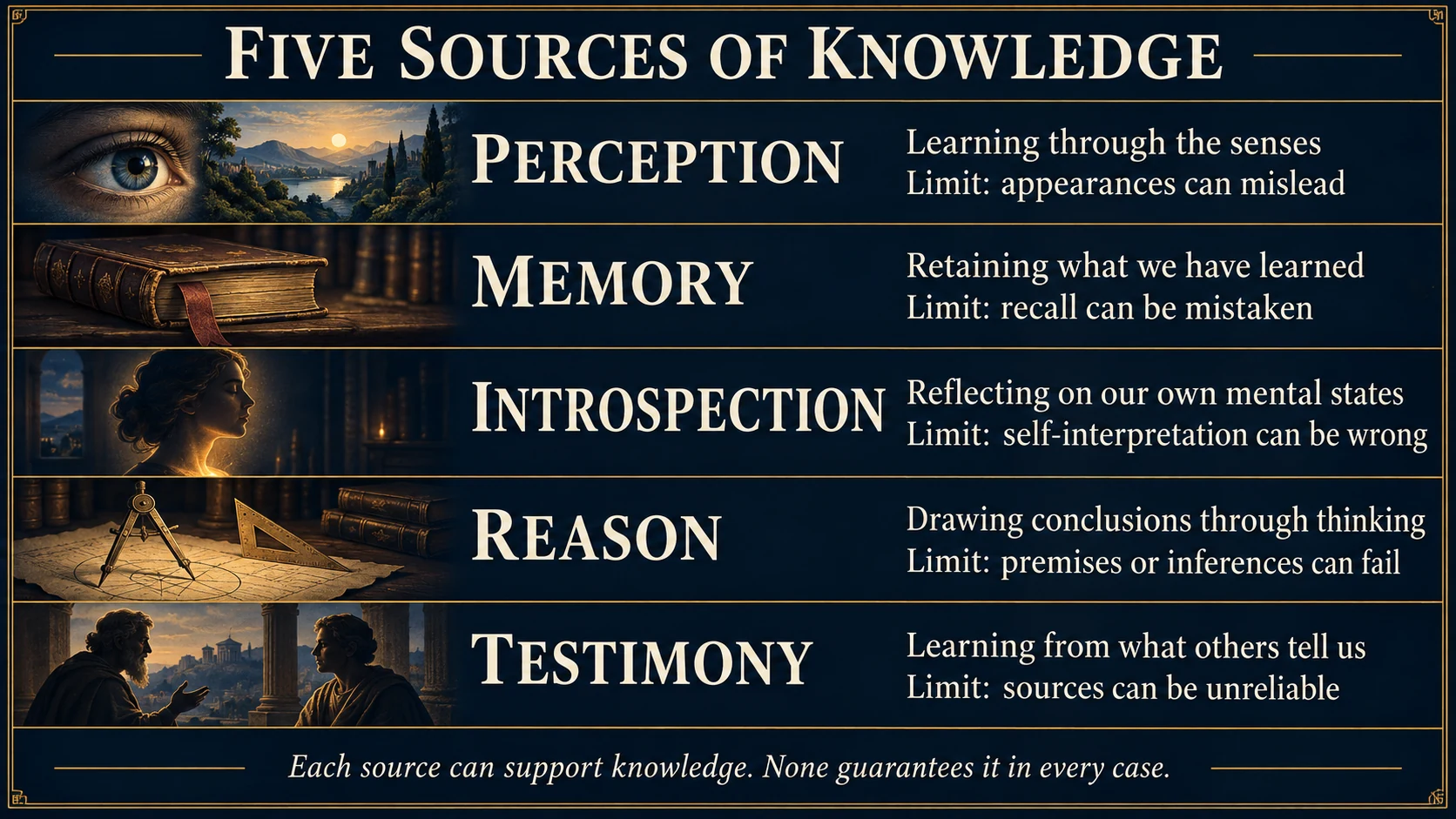
- Perception: you see a closed entrance. Check whether it is the main entrance or merely a side door.
- Memory: you remember the museum’s usual opening hours. Ask whether the schedule may have changed.
- Introspection: you notice that you are uncertain. Recognizing that uncertainty does not establish whether the museum is open.
- Reason: you infer that a closure notice covering today applies to your visit. Check the date, location and wording.
- Testimony: a staff member reports a closure. Their role and access to current information affect how much weight the report deserves.
Testimony deserves special attention because we cannot personally inspect everything we rely on. The philosophical debate asks when another person’s report can provide knowledge and what reasons a hearer needs for trusting it. See Epistemological Problems of Testimony.
Major Debates: Different Questions, Different Positions
Lists of philosophical approaches can be misleading when they mix answers to different questions. Use the question being asked to understand what a disagreement concerns.
Sources: rationalism and empiricism
Rationalism holds that at least some significant knowledge or concepts can be acquired independently of sense experience. For example, a rationalist may regard a mathematical proof as justified through reasoning rather than repeated measurements.
Empiricism treats experience as the source of knowledge or concepts in the domain under discussion. To establish whether a museum is open today, observation and current reports matter; deduction alone cannot supply its opening status. Empiricists can still use logic and mathematics.
The dispute concerns how far knowledge depends on experience and what reason can establish independently of it. These labels do not mean that one side never observes or the other never reasons. Positions can vary by subject: mathematics, the external world or morality. The SEP comparison of rationalism and empiricism explains why the division is less tidy than a simple “logic versus senses” opposition.
Structure: foundationalism and coherentism
If one belief is supported by another, where does justification stop? Foundationalist theories hold that some beliefs have justification without deriving it from other beliefs, and support further beliefs. Such starting points need not be infallible.
Coherentist theories emphasize how beliefs fit together in a supporting system. Mere absence of contradiction is not enough: a consistent invented story illustrates why coherence needs careful explanation.
Limits: skepticism and fallibilism
Philosophical skepticism challenges whether we possess knowledge or justification in a given domain; some forms are much broader. It is more demanding than the everyday advice to double-check a rumor. The SEP entry on skepticism examines these challenges.
Fallibilist approaches allow that knowledge can coexist with some possibility of error. This does not mean false claims count as knowledge. It means eliminating every conceivable error is not necessarily required for knowing. A current closure notice may give you knowledge of the museum’s status without giving you an infallible method for every future visit.
Epistemology vs Ontology vs Metaphysics
Epistemology asks about knowing; ontology asks what exists; metaphysics investigates the nature and structure of reality. Ontology is usually treated as part of metaphysics, so the three labels do not describe entirely separate fields.
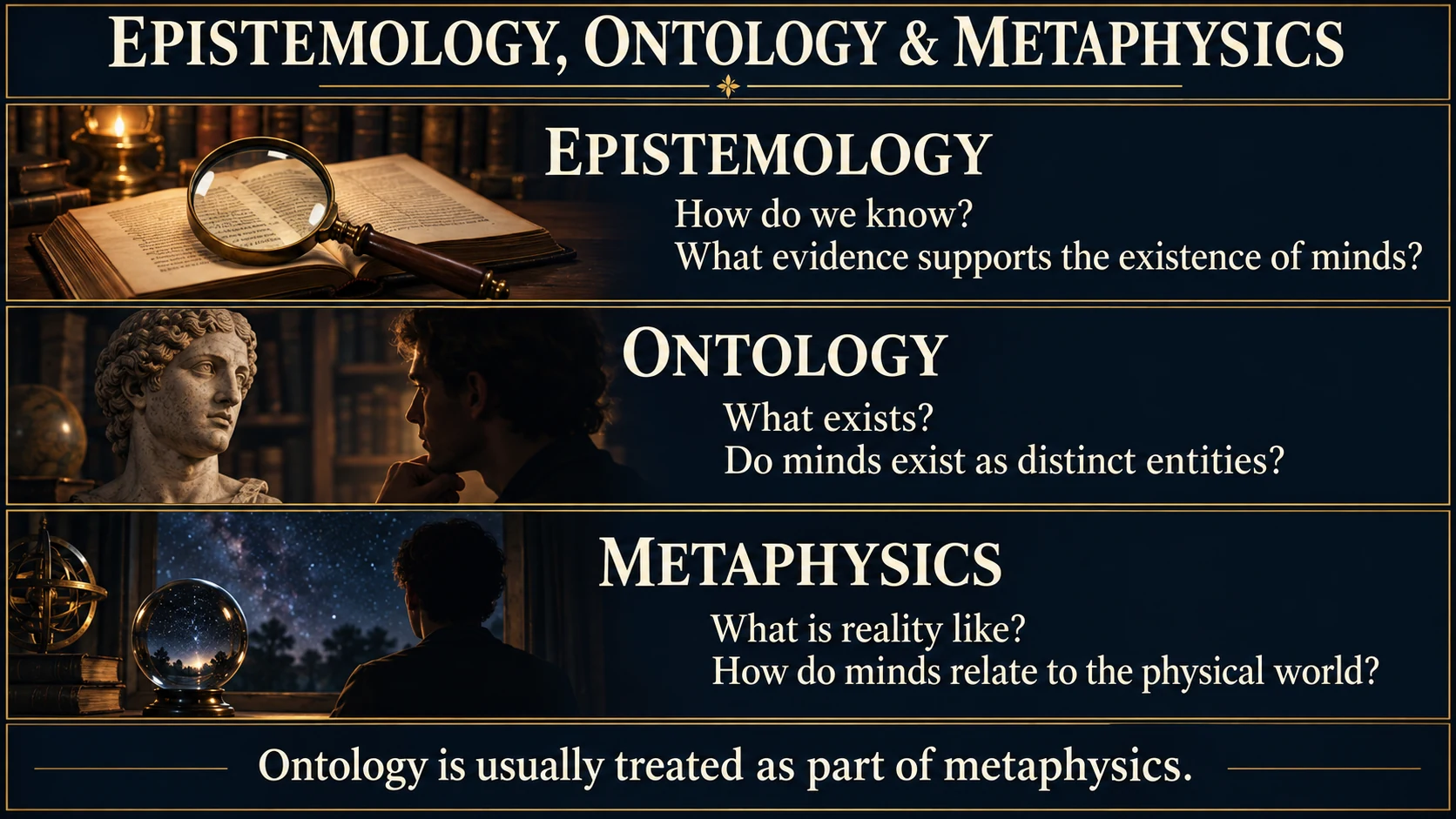
Consider minds. “What evidence supports the existence of other minds?” is an epistemological question. “Do minds exist as distinct entities?” concerns ontology. “How do minds relate to the physical world?” is a metaphysical question. The boundaries can overlap, but the change in emphasis matters.
The SEP overview of metaphysics discusses the field’s changing scope. For an applied discussion of evidence and the external world, read How Do We Know What Is Real?
Worked Example: Can You Trust This Screenshot?
Fictional scenario: a friend forwards an image saying, “The museum is closed today.” You are about to leave home. The task is to establish whether that announcement applies to your planned visit.
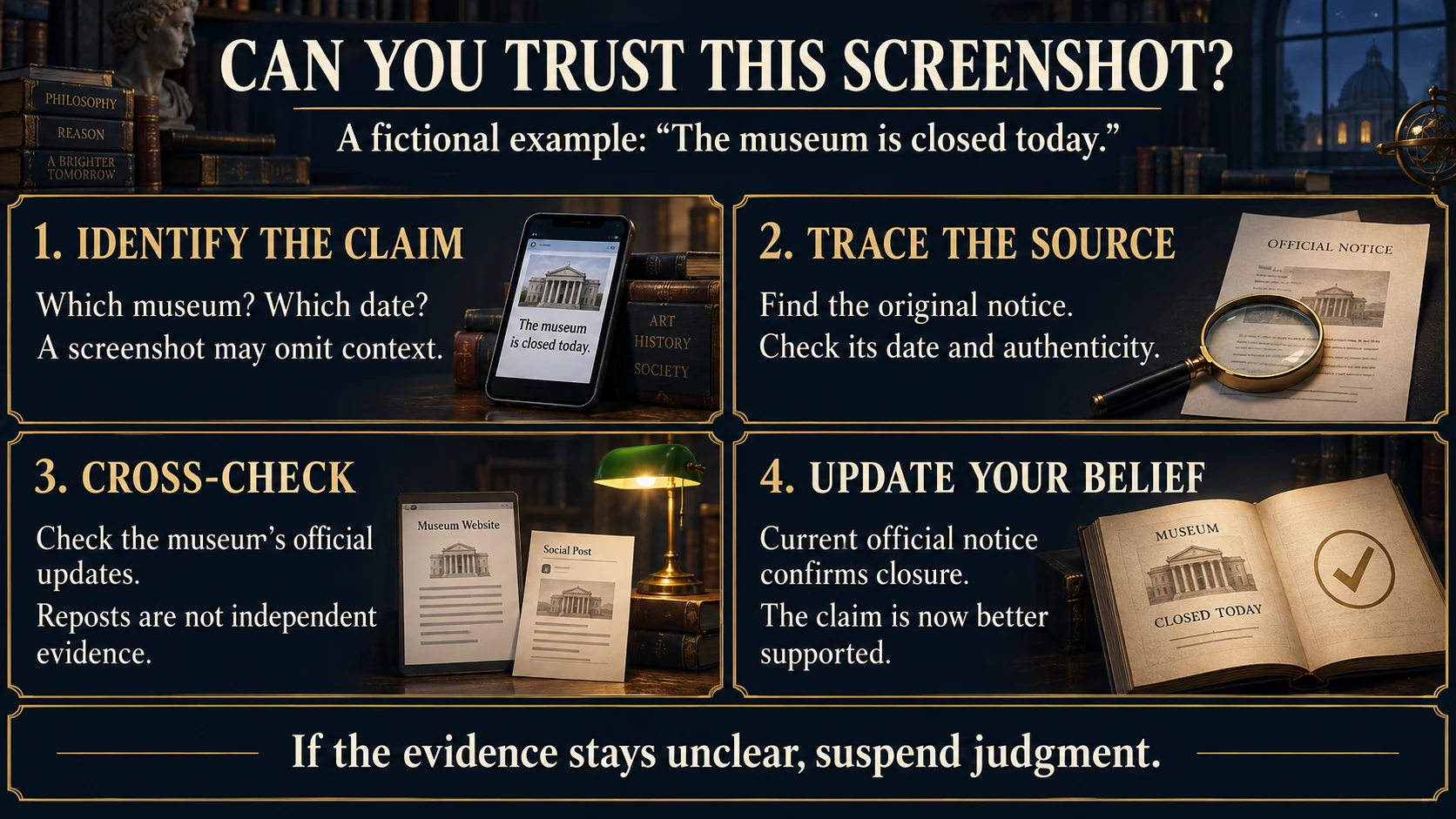
- Identify the claim. Write down the museum, location and actual date. “Today” refers to the date of the original announcement, which may differ from the date you received it.
- Trace the source. Look for the original notice. Establish whether the museum issued it and whether the screenshot preserves its wording. If the original cannot be found, authenticity remains unresolved.
- Cross-check current information. Visit the museum’s authentic website and check for newer updates. If necessary, contact staff using details from that site. Several reposts of the screenshot do not provide several independent confirmations.
- Update your belief. In this scenario, a current official notice confirms closure for your date and location, with no later reopening notice found. Your conclusion now rests on that checked information, rather than the screenshot alone.
The official website and an official social account may repeat the same underlying notice. That is useful for tracing provenance, but should not be described as independent evidence. What improved the case was establishing the notice’s authority, currency and applicability.
If the sources conflict, the appropriate conclusion is “I have not established whether it is open.” You can then call before travelling. Withholding judgment is a meaningful result; uncertainty does not force you to accept or reject a claim prematurely.
Five Questions for Evaluating a Knowledge Claim
Use this practical checklist to make your reasoning visible. It is an editorial aid, not a validated assessment or a philosophical proof that you have knowledge.
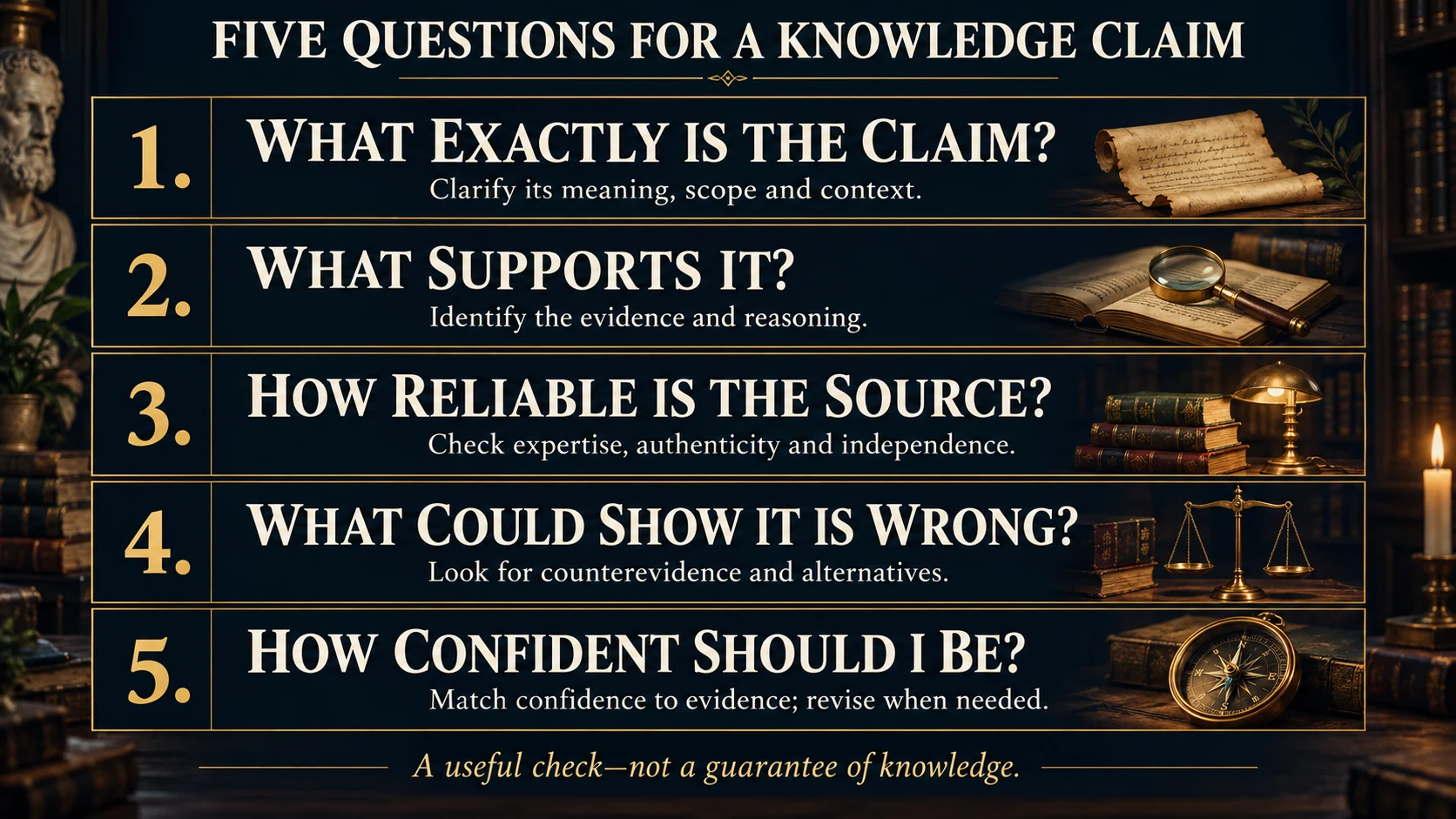
- What exactly is the claim? Replace vague wording with a specific proposition and context.
- What supports it? Separate what you observed from what you inferred or were told.
- How reliable is the source? Consider relevant expertise, access, authenticity and dependence on other reports.
- What could show it is wrong? Look for counterevidence, overlooked assumptions and alternative explanations.
- How confident should I be? State what is established, what remains open and what would change your view.
Apply the check proportionately. A routine opening-hours question rarely requires a prolonged investigation. Conflicting notices warrant another check; a clear current announcement may settle the practical question. The goal is to improve the basis of your conclusion, not to postpone every decision indefinitely.
Explore Questions of Knowledge Through Fiction
Fiction lets you examine what happens when a character must act before all the facts are available. While reading, ask: what does this person know, what are they merely assuming, and what information is being withheld?
For philosophical fiction by Denys Kostin, read Those Who Guard Eternity online. If you prefer to compare reading options first, explore books that make you question reality. A story can test the implications of an idea without serving as evidence that the idea is true.
Frequently Asked Questions
What does “epistemic” mean?
“Epistemic” means relating to knowledge or justification. An epistemic reason supports accepting a claim as true; a practical reason may instead concern what is useful to do.
Is epistemology the same as critical thinking?
No. Critical thinking includes skills for evaluating arguments and evidence. Epistemology examines deeper questions about what knowledge and justification are. The two overlap, but neither label completely replaces the other.
Does epistemology only study scientific knowledge?
No. It also examines everyday knowing, self-knowledge, reasoning and learning from others. Scientific inquiry is one important setting in which questions about evidence arise.
Are knowledge and certainty the same?
No. Feeling certain is a psychological state; it does not establish that a belief is true. Whether knowledge requires an especially strong kind of certainty is a philosophical question, and fallibilists reject a requirement of infallibility.
Where should a beginner start?
Choose one ordinary claim and explain how you arrived at it. Then identify its source, the support it has and what would make you reconsider. This gives the abstract vocabulary a concrete use.
Sources and Further Reading
This introduction distinguishes widely used terminology from disputed theories. The museum scenario and checklist are teaching examples. The following specialist references support the philosophical background:
- Epistemology — Stanford Encyclopedia of Philosophy.
- The Analysis of Knowledge — Stanford Encyclopedia of Philosophy.
- Rationalism vs. Empiricism — Stanford Encyclopedia of Philosophy.
- Foundationalist Theories of Epistemic Justification — Stanford Encyclopedia of Philosophy.
- Coherentist Theories of Epistemic Justification — Stanford Encyclopedia of Philosophy.
- Skepticism — Stanford Encyclopedia of Philosophy.
- Epistemological Problems of Testimony — Stanford Encyclopedia of Philosophy.
- Metaphysics — Stanford Encyclopedia of Philosophy.