If you’re looking for authors like Blake Crouch, ask yourself which moment in Dark Matter you wanted to last longer. If it was the moment the door opened onto another Chicago, try Max Barry’s The 22 Murders of Madison May. If it was the moment Jason looked at his family and wondered whether he could get his life back, start with Gillian McAllister’s Wrong Place Wrong Time.
Finished Recursion, Upgrade, or the Wayward Pines trilogy too? The seven picks below give you one place to start with each author, from an investigator who can visit possible futures to a newcomer who can’t quite work out what bothers her about the neighbors. All descriptions stay within the opening premise.
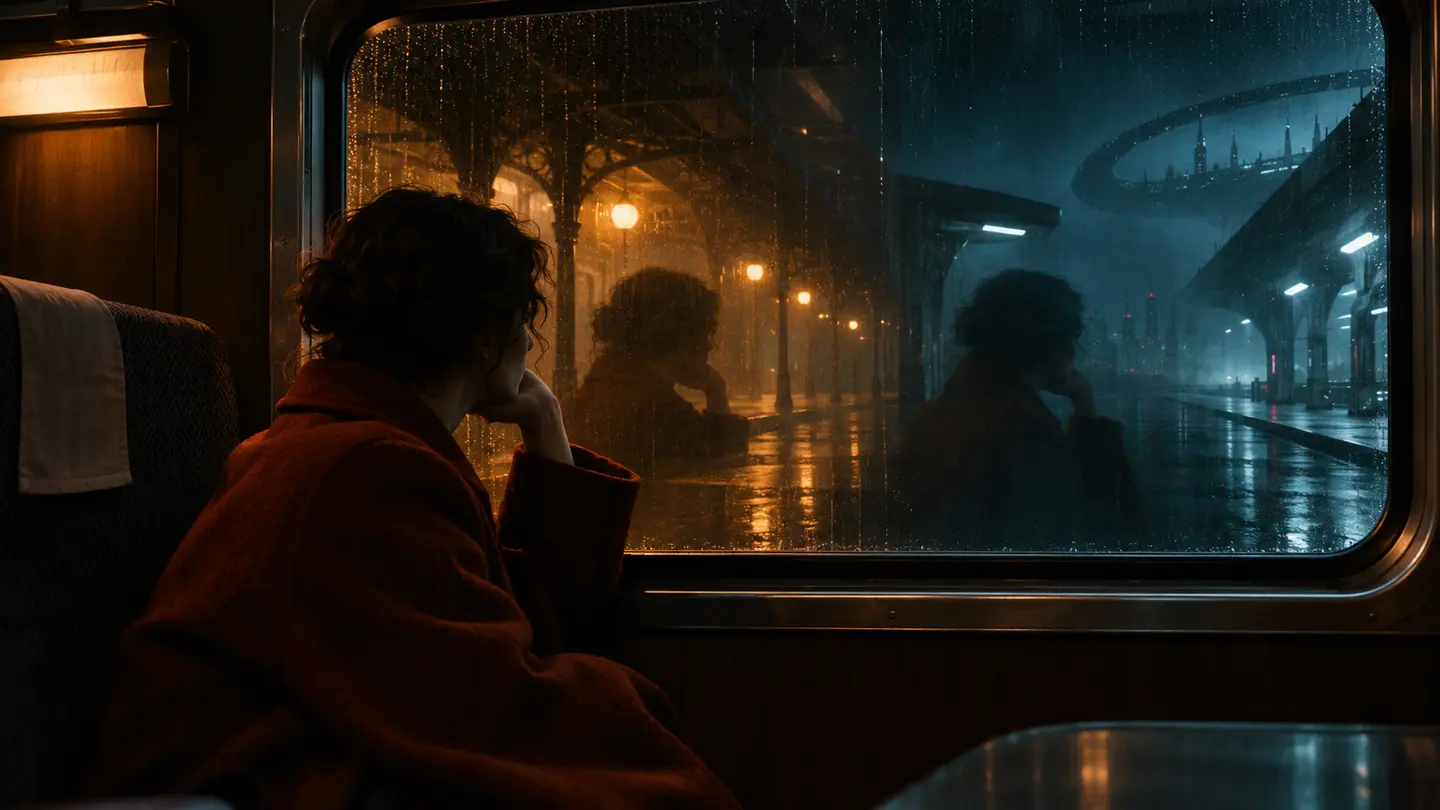
Which author should you read after Blake Crouch?
| What you want next | Author and starting book |
|---|---|
| A chase across parallel worlds | Max Barry The 22 Murders of Madison May |
| A second chance to save your family | Gillian McAllister Wrong Place Wrong Time |
| Time travel with cosmic horror | Tom Sweterlitsch The Gone World |
| Gene editing and stolen identity | Daniel Suarez Change Agent |
| A town that feels wrong | Ira Levin The Stepford Wives |
| An experiment coming apart | Michael Crichton Jurassic Park |
| A thriller series about extraordinary abilities | Marcus Sakey Brilliance |
7 authors like Blake Crouch and the best book to start with
Max Barry for a chase across parallel worlds
Start with The 22 Murders of Madison May. Reporter Felicity Staples is investigating the murder of Madison May when the facts of her own life begin to slip. The killer can reach another version of Madison. Following him means Felicity can end up in a world where even the people who know her best remember things differently.
Barry gives the multiverse a particularly nasty use. A man who refuses to accept one woman’s choice can keep looking for a version of her who will choose differently. If you enjoyed keeping track of the Chicagos in Dark Matter, the small discrepancies between Felicity’s worlds offer a similar pleasure. But consider whose eyes you want to look through. Here you follow a reporter trying to stop someone else’s obsession.
Gillian McAllister for the family story inside the time puzzle
Start with Wrong Place Wrong Time. Jen is waiting for her teenage son to come home when she sees him kill a stranger. The next morning she wakes up before the murder. Each time she sleeps, she travels further into her family’s past, away from the night she desperately wants to change.
This is my pick for the reader who put down Recursion thinking about what it would mean to remember a life nobody else remembers. McAllister finds suspense in a mother knowing both too much and too little about her son. An ordinary conversation can yield evidence because Jen hears it for the second time with years of hindsight. Choose this one if you enjoy looking for clues in things family members take for granted.
Tom Sweterlitsch for a darker turn after Recursion
Start with The Gone World. In The Gone World, investigator Shannon Moss can visit possible futures to look for evidence in a present-day case. Think about what that does to a witness interview. Someone might tell Moss something true about the life they have lived, yet that life may never come to pass in the time she returns to.
That uncertainty makes Sweterlitsch a rewarding choice if you liked piecing together the timelines in Recursion. The change in tone is considerable. A violent investigation opens onto the prospect of a catastrophe so large that solving the crime and understanding the danger become different problems. Pick it when the thought of a time-travel procedural turning into cosmic horror sounds like a good evening.
Daniel Suarez for a genetic thriller after Upgrade
Start with Change Agent. Kenneth Durand investigates illegal genetic engineering. Then someone changes his body against his will, and the physical evidence that ought to establish his identity turns against him. Change Agent makes a good follow-up to Upgrade because the opening predicament is so concrete. How do you prove who you are when the people looking for you trust the science?
Suarez also wants to know who sells this technology, who polices it, and what a criminal organization can do with it. If the wider consequences of gene editing interested you as much as the changes to Crouch’s protagonist, start here. For a story that stays close to a single household, McAllister is the better fit.
Ira Levin for the unease of Wayward Pines
Start with The Stepford Wives. Joanna Eberhart moves to Stepford with her family. The neighbors are friendly. Their houses are beautifully kept. What unsettles Joanna is how difficult it is to find another woman whose interests extend much beyond keeping things that way. The more insistently everyone treats this as ordinary, the harder it becomes for her to explain what she senses.
Read The Stepford Wives if your favorite part of Pines was the interval between arriving in town and finding out its rules. Levin gets an extraordinary amount of suspense out of politeness and domestic expectations. Even if you already know what “Stepford” has come to mean, there’s pleasure in watching Joanna notice the details that made the name endure.
Michael Crichton for the science behind a disaster
Start with Jurassic Park. In Jurassic Park, cloning a dinosaur is only the first feat of engineering. The people who run the island also have to count the animals, contain them, feed them, and keep the power on. If you know the film, the novel offers a reason to visit the park again. You have time to examine the assumptions built into its operation.
Choose Crichton if you liked watching a scientific idea escape its inventors’ control in Upgrade or Recursion. His ensemble lets you watch the same park through the eyes of people with different reasons to trust it. The tension comes from seeing how many things have to go right for an ordinary day at work to stay ordinary.
Marcus Sakey for a series after Wayward Pines
Start with Brilliance. In Brilliance, some people are born with extraordinary abilities. Federal agent Nick Cooper is one of them, and the very gift that makes him valuable to the government also ties him to the people it fears. When he pursues a gifted suspect, each professional decision carries a question of loyalty.
Sakey is a good next author if you’re ready to spend more than one book with a speculative premise. The pressure on Cooper comes from institutions and divided communities as well as the person he is chasing. Start with Brilliance, the first volume of the trilogy, if the appeal of Wayward Pines was discovering how the rules of a whole society shape what one person can do.
Still choosing between two books?
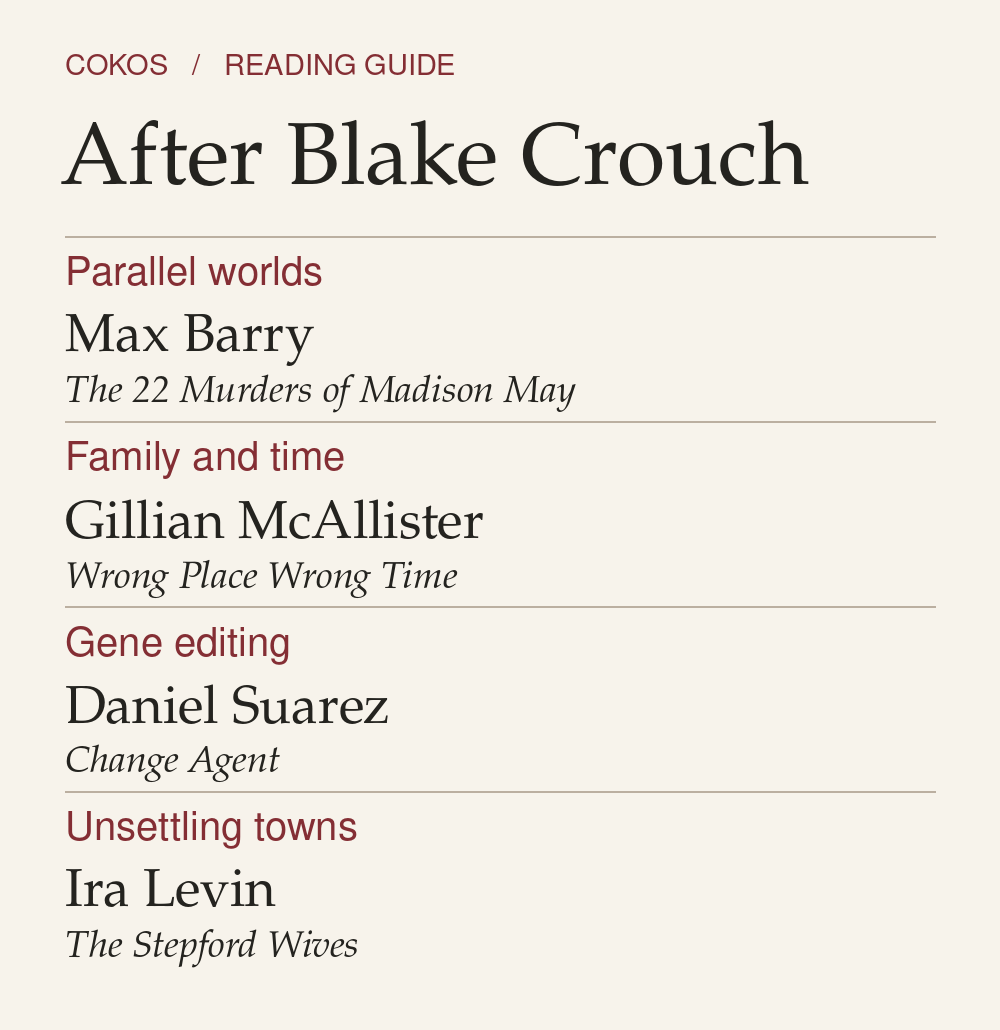
For a book club, I’d pair Wrong Place Wrong Time with Dark Matter. Ask each reader which moment they would revisit in their own family history. Then ask whether knowing what happened afterward would make them a better witness to that moment or a less reliable one. For a solo weekend read, I’d pick The 22 Murders of Madison May for the chase or The Stepford Wives for the atmosphere.
If you have one particular Crouch novel in mind, the Cokos guides to books like Dark Matter and books like Recursion compare more options for each.
A philosophical fantasy you can read on Cokos
A note from Denys Kostin, the author of this guide: I wrote Those Who Guard Eternity for readers who like to linger over a question a thriller might carry past at speed. Antem begins to doubt the reality he has always accepted and the nature of time itself. If that was the part of Crouch you wanted to stay with, you can read Those Who Guard Eternity free on Cokos.
How the books were chosen
Each book shares a specific reading experience with Crouch, such as trying to recognize a familiar person in an altered world or sensing danger before anyone will acknowledge it. The comparisons and starting picks are editorial judgments. For the original book descriptions, see the sources below.