Every civilization has searched for truth.
Long before philosophy became an academic discipline, before science developed systematic methods of investigation, and even before writing preserved humanity’s collective memory, people were already asking the same profound question:
How do we know what is real?
The search for truth is one of humanity’s oldest and most enduring journeys. It began when our ancestors first distinguished appearance from reality, memory from imagination, trustworthy testimony from rumor, and meaningful patterns from coincidence. Every generation inherited that journey, refining it through experience, reason, philosophy, science, and reflection.
This search gave birth to civilization itself.
- It inspired philosophy.
- It created science.
- It shaped systems of law.
- It transformed education.
- It guided religious reflection.
- It enabled technological progress.
- It made history possible.
Whenever human beings asked whether a belief was justified, whether a witness could be trusted, whether an explanation matched reality, or whether a moral principle should guide society, they were participating in the same ancient pursuit.
The search for truth therefore extends far beyond the philosophical question of what truth is. It asks how truth is discovered, why it is often resisted, how civilizations preserve it, why knowledge continually changes, and whether finite human beings can ever fully understand reality.
This article explores that journey across philosophy, science, psychology, history, religion, law, journalism, artificial intelligence, and civilization itself. Rather than offering a simple definition, it follows humanity’s continuing attempt to move from uncertainty toward understanding—from illusion toward reality—and from ignorance toward wisdom.
The search for truth has no final destination. Every answer uncovers deeper questions, and every discovery reveals a larger reality waiting to be understood.
Why Humans Search for Truth
The search for truth did not begin in a university, a laboratory, or a philosophical academy. It began long before civilization itself. The earliest humans who learned to distinguish a safe path from a dangerous one, edible plants from poisonous ones, trustworthy companions from deceivers, and changing seasons from random events were already engaged in truth-seeking. Their survival depended not upon possessing complete knowledge but upon building increasingly accurate understandings of reality.
This practical beginning reveals something fundamental about the human condition. We do not search for truth simply because we are curious. We search because reality has consequences. A mistaken belief about the weather can threaten survival. A false judgment about another person’s intentions can destroy trust. An incorrect understanding of disease can cost countless lives. Throughout history, the ability to recognize reality more accurately has consistently become one of humanity’s greatest evolutionary advantages.
Yet survival alone cannot explain the remarkable depth of humanity’s pursuit of truth. Once immediate needs are satisfied, people continue asking questions that seem to offer no obvious practical reward.
- Why does anything exist at all?
- What is consciousness?
- Can morality be objectively true?
- Does free will exist?
- What happens after death?
- Is mathematics discovered or invented?
- Can reality ever be fully understood?
These questions have occupied humanity for thousands of years despite producing no immediate survival advantage. They reveal that the search for truth is not merely biological. It is deeply philosophical. Human beings appear uniquely driven to understand not only how the world works but also why it exists and what their own place within it might be.
Truth as an Evolutionary Advantage
Every organism interacts with reality. Plants respond to sunlight. Animals recognize predators. Birds navigate across continents. Yet human beings differ because they continually improve the models through which they understand the world.
Instead of relying solely upon instinct, humans accumulate knowledge across generations. Fire, agriculture, writing, mathematics, medicine, engineering, and modern science all emerged because discoveries were preserved rather than forgotten. Each generation inherited truths uncovered by those before it and expanded them further.
This cumulative character of knowledge transformed the search for truth from an individual struggle into a civilizational project. A child today begins life with access to discoveries produced by millions of people over thousands of years. Civilization itself can therefore be understood as humanity’s collective memory in its continuing pursuit of reality.
The Desire to Understand
Aristotle famously observed that all human beings naturally desire to know. That observation remains remarkably persuasive. Children ask questions long before formal education begins. They seek explanations for ordinary events with extraordinary persistence. Why is the sky blue? Why do people die? Where did the universe come from? Why do we dream?
Most of these questions emerge spontaneously. They are not imposed by society. They arise because the human mind seems naturally oriented toward explanation. Curiosity appears to be one of the defining characteristics of our species.
Curiosity alone, however, is not enough. Human history demonstrates that curiosity can produce myths, superstitions, scientific revolutions, religious traditions, and philosophical systems alike. The search for truth therefore requires methods capable of distinguishing convincing stories from reliable explanations.
The Search for Order
The universe presents itself as an overwhelming complexity of events. Without patterns, human experience would become chaotic. The search for truth is therefore also a search for order.
Early civilizations found order through myth. Greek philosophers increasingly sought rational explanation. Medieval scholars united philosophical reasoning with theology. The Scientific Revolution emphasized observation and experiment. Modern science relies upon mathematics, statistics, peer review, and continual correction.
Although these methods differ profoundly, they share the same aspiration: to discover principles that explain reality more accurately than previous explanations.
Progress does not occur because every previous generation was entirely wrong. It occurs because every generation inherits partial truths and gradually extends them. The history of truth-seeking is therefore not primarily a sequence of failures but an expanding conversation across centuries.
Why Truth Is Never Merely Personal
People often speak of having “their own truth.” Personal experience certainly matters. Every individual possesses unique memories, perspectives, emotions, and interpretations. Yet civilization requires something beyond purely private experience.
Bridges remain standing because engineers rely upon publicly verifiable principles rather than individual preference. Medicine advances because treatments can be independently tested. Courts attempt to reconstruct events through shared standards of evidence. Historians compare sources rather than accepting isolated testimony without question.
The search for truth therefore becomes a cooperative enterprise. Individual insight remains valuable, but reliable knowledge grows through dialogue, criticism, replication, correction, and shared investigation.
This explains why institutions dedicated to truth—universities, libraries, laboratories, archives, and responsible journalism—have played such a central role throughout civilization. They preserve humanity’s ongoing conversation with reality.
Truth and Human Identity
The search for truth is ultimately also a search for ourselves. Questions about reality inevitably become questions about the observer. Who is asking? What limits shape human understanding? Why do perception, memory, language, and culture influence everything we believe?
These questions naturally connect with broader philosophical explorations such as What Is Consciousness?, What Is Human Nature?, and What Is Personal Identity?. Every attempt to understand reality also transforms the way humanity understands itself.
Perhaps this is why the search for truth has never ended. Every discovery answers one question while generating several new ones. Every explanation reveals deeper mysteries. Every solution expands the horizon of what remains unknown.
Humanity does not search for truth because it expects the journey to end. It searches because every step toward reality enlarges the possibilities of understanding, freedom, wisdom, and civilization itself.
The history of philosophy, science, and culture can therefore be understood as chapters within one continuous story: humanity’s endless attempt to become less mistaken about the world it inhabits and about itself.
The History of Humanity’s Search for Truth
The search for truth is older than philosophy itself. Long before people asked abstract questions about knowledge, logic, or metaphysics, they were already attempting to distinguish reality from illusion. Every successful civilization inherited this same challenge: understanding the world accurately enough to survive within it while gradually expanding the boundaries of human knowledge.
Although the methods changed dramatically across history, the underlying question remained remarkably constant:
How can human beings know what is really true?
The answers evolved from observation to myth, from myth to philosophy, from philosophy to science, and from science toward increasingly sophisticated forms of interdisciplinary inquiry. Rather than replacing one another completely, these stages often built upon what came before, preserving valuable insights while correcting earlier misunderstandings.
Before Philosophy: Learning from Survival
The earliest truth-seekers left no philosophical writings. Their discoveries were measured not in books but in survival.
Hunter-gatherers gradually learned which animals migrated seasonally, which plants healed and which poisoned, where rivers flooded, when winter approached, and how the stars could guide movement across unfamiliar landscapes. Every accurate observation increased the likelihood of survival. Every persistent mistake carried consequences.
Knowledge during this period was practical rather than theoretical. People were less concerned with defining truth than with recognizing dependable patterns within nature. Nevertheless, this represented the beginning of humanity’s lifelong effort to make belief correspond more closely with reality.
Language transformed this process forever. Once experiences could be communicated, corrected, and remembered collectively, knowledge no longer disappeared with each generation. Truth became something communities could preserve.
Myth as Humanity’s First Grand Explanation
As civilizations emerged, practical knowledge expanded into comprehensive explanations of the universe. Ancient myths attempted to answer questions that every society eventually confronts.
- Where did the world come from?
- Why do people suffer?
- Why do seasons change?
- What happens after death?
- Why should humans behave morally?
Modern readers often dismiss mythology simply because many of its factual explanations conflict with contemporary science. Yet mythology represented an extraordinary intellectual achievement. For the first time, humanity attempted to organize countless observations into coherent narratives capable of explaining both nature and human existence.
The weakness of myth was not imagination. It was verification. Stories could inspire meaning without providing reliable methods for determining whether they accurately described reality.
This limitation eventually gave rise to philosophy.
The Greek Revolution: From Story to Reason
Few moments transformed humanity’s search for truth as profoundly as the emergence of Greek philosophy.
Thinkers such as Thales, Anaximander, Heraclitus, Parmenides, Pythagoras, and Democritus increasingly asked whether nature might be understood through rational investigation rather than inherited tradition alone.
The decisive breakthrough, however, came with Socrates.
Rather than offering finished answers, Socrates developed a disciplined method of questioning. By exposing contradictions within ordinary beliefs, he demonstrated that sincere confidence could coexist with profound misunderstanding.
The search for truth therefore became inseparable from intellectual humility.
Plato expanded this insight by asking whether appearances conceal deeper realities. His famous Allegory of the Cave continues to illustrate one of philosophy’s enduring lessons: human beings may mistake familiar illusions for reality until education fundamentally transforms perception.
Aristotle shifted attention toward systematic observation, classification, logic, and careful analysis of the natural world. His approach established patterns of inquiry that continue influencing scientific reasoning more than two thousand years later.
The Medieval Search for Harmony
During the medieval period, the search for truth increasingly sought harmony between reason and faith rather than treating them as rivals.
Augustine explored memory, consciousness, and inward reflection, arguing that truth involved both intellectual understanding and spiritual transformation.
Centuries later, Thomas Aquinas drew extensively upon Aristotle while maintaining that careful reasoning and religious revelation ultimately describe one coherent reality rather than two conflicting worlds.
Although modern philosophy often emphasizes disagreement between religion and science, medieval thinkers devoted enormous effort to demonstrating that truth itself cannot contradict truth. If reality possesses genuine unity, then different paths toward understanding should eventually converge rather than permanently diverge.
The Scientific Revolution
The Renaissance and the Scientific Revolution transformed humanity’s methods of truth-seeking more dramatically than perhaps any previous period.
Copernicus challenged humanity’s place within the cosmos. Galileo combined mathematics with observation. Kepler discovered remarkable regularities within planetary motion. Newton unified terrestrial and celestial mechanics through universal laws.
The essential innovation was methodological rather than merely technological.
Truth increasingly became something that could be tested publicly.
Observation, experimentation, prediction, measurement, replication, criticism, and mathematical modeling gradually replaced appeals to unquestioned authority.
Knowledge became increasingly self-correcting.
The Enlightenment and Critical Reason
The Enlightenment expanded this commitment beyond natural science into politics, ethics, education, economics, and human rights.
Thinkers such as Descartes, Hume, Kant, and many others asked not merely what is true but how human beings become capable of knowing anything at all.
Reason itself became an object of investigation.
Could certainty ever be achieved? Are human senses reliable? What limits define knowledge? How do language, culture, and experience influence understanding?
Rather than ending philosophical disagreement, these questions deepened it. Yet they also produced increasingly sophisticated methods for evaluating evidence, identifying assumptions, and distinguishing stronger arguments from weaker ones.
Modern Truth-Seeking
Today’s search for truth extends far beyond philosophy alone.
Physicists investigate the origins of space-time. Neuroscientists study consciousness. Psychologists examine perception and memory. Historians reconstruct past civilizations. Linguists explore meaning. Artificial intelligence analyzes patterns beyond unaided human cognition.
Never before has humanity possessed so many powerful methods for exploring reality.
Yet paradoxically, never before has distinguishing truth from misinformation become so challenging.
Digital media, deepfakes, algorithmic recommendation systems, and generative artificial intelligence have created an environment where producing convincing information is easier than verifying it.
The ancient philosophical question therefore returns with renewed urgency. Humanity possesses unprecedented access to information, but information alone is not truth.
The history of civilization is not merely the accumulation of knowledge. It is the continual refinement of humanity’s methods for distinguishing reality from illusion.
This historical journey explains why the next question naturally follows. Before asking what truth is, we must first understand why discovering truth has always proven so remarkably difficult.
The Essential Answer
Truth is the condition of a statement, belief, judgment, or representation being correct about what it concerns. In its most familiar sense, a claim is true when reality is as the claim says it is. Truth is not created by confidence, popularity, authority, emotion, or desire, although human access to truth is always shaped by perception, evidence, language, memory, and interpretation.
This definition is only a beginning. It tells us that truth concerns correctness, but immediately raises further questions. Correct according to what? How can a statement be compared with reality? Can a belief be true when no one can prove it? Are truths about pain, beauty, morality, mathematics, and history true in the same way? What happens when evidence is incomplete, language is ambiguous, or the observer is part of what is being observed?
How Truth Connects to the Great Questions of Philosophy
Truth does not stand alone. It connects every major philosophical question because each asks whether human understanding can remain faithful to reality. Metaphysics asks what exists. Epistemology asks how it can be known. Philosophy of mind asks how reality appears within consciousness. Ethics asks whether judgments about good and evil can be true. Logic asks whether conclusions follow from their premises. Science tests explanations against observation. Civilization depends upon institutions capable of preserving evidence and correcting error.
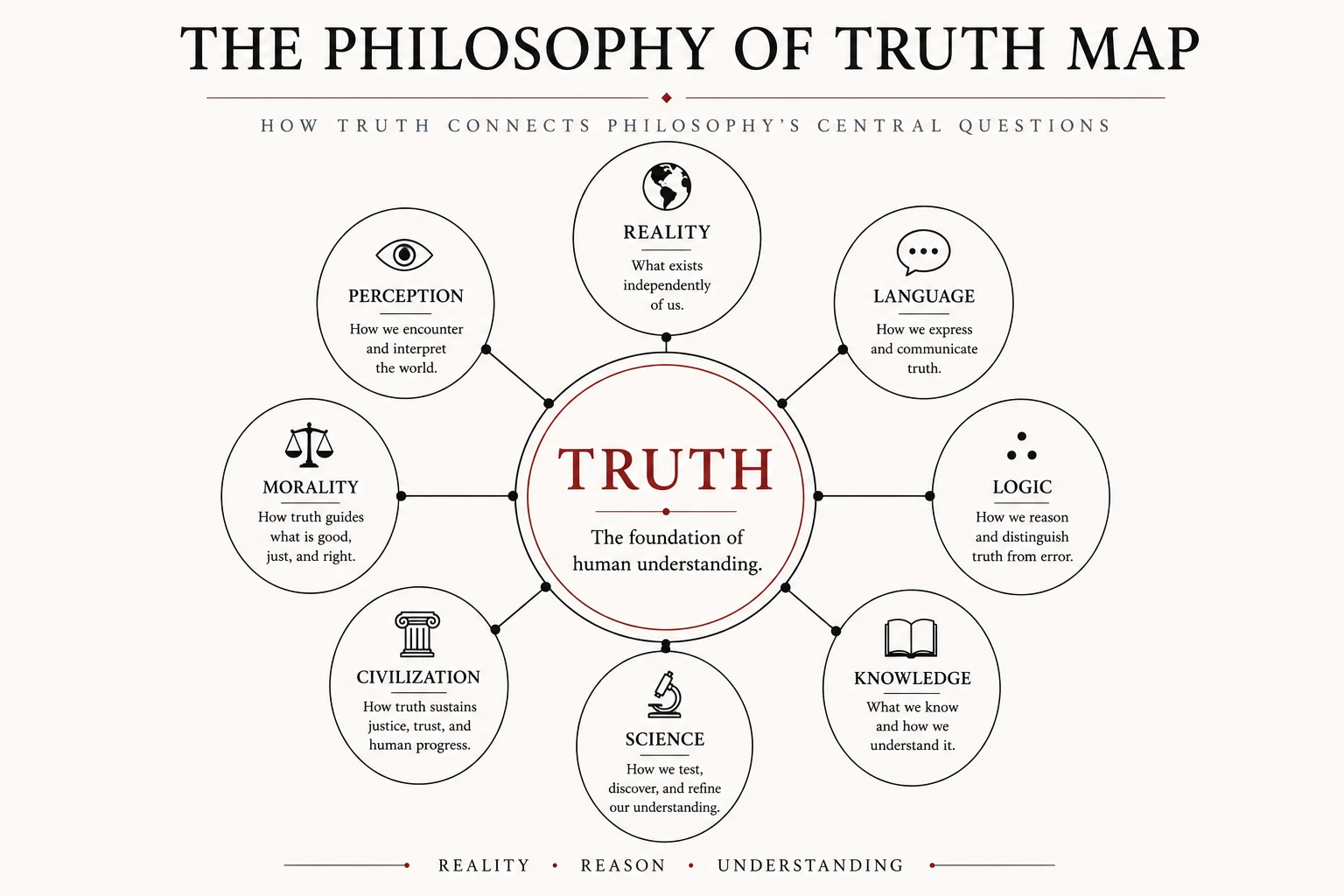
To ask what reality is is to ask what truth must answer to. To ask what consciousness is is to ask how reality becomes present to an experiencing mind. Questions of personal identity concern the subject who remembers, believes, and speaks. The study of human nature reveals why people seek truth while also resisting it.
Truth also shapes the questions of morality, free will, and the meaning of life. Moral responsibility requires truthful recognition of actions and consequences. Freedom requires enough contact with reality to choose meaningfully. A meaningful life cannot be understood without asking whether its purposes rest upon reality or illusion. Even mystery depends upon truth, because the unknown is meaningful only where a real distinction remains between what is known and what has not yet been understood.
What Is Truth? A Clear Definition
The simplest philosophical definition of truth
A statement is true when things are as the statement says they are.
If someone says, “The window is open,” the statement is true if the window is in fact open. If the window is closed, the statement is false. The truth of the claim does not depend on whether the speaker is sincere, whether the listener agrees, or whether the claim is socially convenient. It depends on how the claim relates to the condition it describes.
This basic idea is often associated with the correspondence theory of truth. It appears in classical form in Aristotle, who wrote that to say of what is that it is, and of what is not that it is not, is true. Centuries later, Thomas Aquinas described truth in terms of the adequation of intellect and thing. Despite enormous changes in philosophy, science, and language, this intuition remains powerful: reality places constraints on what may correctly be said about it.
Even simple examples contain hidden complexity. What counts as a window? At what point is it “open” rather than merely unsealed? Is the sentence about its present condition, its usual condition, or the speaker’s intention? Language does not mirror reality without interpretation. Context helps determine what a statement means before reality can determine whether it is true.
Truth therefore involves at least three elements:
- Something that is the case: an event, object, relation, experience, pattern, or state of affairs.
- A meaningful representation: a statement, belief, judgment, image, model, memory, or proposition.
- A standard of correctness: the conditions under which that representation gets its subject right.
What kinds of things can be true or false?
Truth is most naturally attributed to things that represent or assert: statements, propositions, beliefs, judgments, theories, reports, and interpretations. A mountain is not normally true or false. It exists or does not exist. But the statement “There is a mountain beyond the valley” may be true or false.
Ordinary language also speaks of a true friend, a true copy, a true emotion, a true work of art, or a person who remained true to a promise. Here truth means authenticity, fidelity, accuracy, or integrity. These meanings are related because all involve faithfulness to something: reality, an original, a commitment, or a character.
Photographs, maps, scientific models, biographies, and historical narratives can all be accurate in some respects and misleading in others. A photograph can distort through cropping. A map can omit what does not serve navigation. A model can represent one relationship while ignoring another. A biography can contain no fabricated events and still create a false impression through selection. This is why the moral problem of the half-truth matters: each stated fragment may be correct while the total representation is designed to conceal what matters most.
Does truth exist when nobody knows it?
Most philosophical realism holds that at least many truths do not depend on being believed. Before human beings knew that Earth orbited the Sun, it was already the case that Earth orbited the Sun. Before a hidden species was discovered, members of that species lived and died. Before a crime was solved, someone had committed it under particular circumstances. Discovery changes knowledge; it does not retroactively create what was discovered.
Some truths do depend on social practices. Money, citizenship, contracts, legal offices, and games exist partly because communities recognize rules. Yet once those practices exist, statements about them are not matters of private preference. Social facts depend on collective recognition, but individuals cannot make them disappear through disbelief.
Why Humanity Never Stops Searching for Truth
Truth matters because action takes place in reality, not merely inside belief. A false belief may comfort, inspire, or unite, but when action based on it encounters the world, reality eventually imposes consequences. A bridge designed according to false calculations collapses. A diagnosis based on false assumptions delays treatment. A society that falsifies its own history becomes unable to understand the forces shaping its present.
Truth makes reliable action possible
Every deliberate action contains an implicit picture of the world. We cross a street because we believe we have enough time before a vehicle arrives. We accept medicine because we believe it has a reasonable chance of helping. We trust a person because we believe their words and actions exhibit some continuity. Even hesitation rests on beliefs about risk, uncertainty, and consequence.
To act successfully, our picture need not be complete, but it must be accurate in the respects that matter. Human beings live through partial maps. Truth is what allows those maps to remain answerable to the territory.
Truth allows trust to extend beyond personal experience
No person can verify everything alone. Most of what we know depends on testimony: parents, teachers, witnesses, historians, scientists, doctors, journalists, engineers, and strangers whose reports enter systems of public knowledge. Civilization expands human understanding by allowing one person to rely on discoveries made by another.
This dependence makes truth a social good. When testimony becomes systematically unreliable, knowledge contracts. People retreat into rumor, tribal loyalty, and private suspicion. Institutions such as science, law, archives, libraries, and responsible journalism matter because they create methods for extending trust without requiring personal familiarity. Their authority is legitimate only while it remains accountable to evidence, correction, transparency, and criticism.
Truth makes responsibility possible
Responsibility depends on truthful description. Before asking who should answer for an action, we must ask what occurred, who participated, what they knew, what they intended, and what consequences followed. If these questions are replaced by convenient narratives, judgment becomes arbitrary.
An apology that does not name the injury cannot fully recognize the person harmed. Self-forgiveness that refuses factual responsibility becomes evasion. Condemnation based on an invented account becomes injustice. Moral evaluation begins with the difficult discipline of seeing what happened as clearly as available evidence permits.
A meaningful life cannot be built entirely on illusion
Human beings do not seek truth only because it is useful. We seek it because we want our lives to belong to reality. Love matters differently when it is freely given rather than staged. Achievement matters differently when it is genuine rather than fabricated. Memory matters differently when it preserves what happened rather than protecting an identity at any cost.
Truth sometimes wounds. It may reveal that a relationship has changed, an institution has failed, a memory is unreliable, or a self-image depends on omission. Yet truth can dismantle an illusion while preserving the possibility of rebuilding. Falsehood preserves an appearance only by making authentic renewal impossible.
The First Obstacle in the Search for Truth
Truth vs reality
Reality is what exists or occurs; truth is the correctness of what is said, believed, or represented about it. A tree is part of reality. “A tree stands beside the road” is a claim. The claim is true if reality contains the tree in the stated location.
Reality does not wait for human agreement. A storm may be approaching whether or not anyone believes the forecast. A person may be afraid even when others fail to notice. A political decision may have consequences that remain invisible for years. Truth is the success of a representation in answering to such realities.
Truth vs facts
A fact is something that is the case; truth is the correctness of a claim that expresses or represents what is the case. Suppose rain fell in a city at noon. The rainfall is an event. That it rained at noon is a fact about the event. The sentence “It rained in the city at noon” is true when it accurately expresses that fact.
Facts also differ from data. Data are recorded observations, measurements, or symbolic inputs. They can contain errors, depend on methods, and require interpretation. A thermometer reading is data. That the temperature had a particular value is a factual claim inferred from the reading under assumptions about calibration and conditions. Data contribute to truth-seeking, but do not interpret themselves.
Can the same reality be described in several true ways?
Yes. A single reality can support multiple true descriptions because different descriptions select different aspects, scales, purposes, or relations. A person can be described as a parent, a citizen, a musician, a collection of biological processes, and an experiencing center of consciousness. These descriptions are not automatically rivals. Each may be true within its domain.
Plurality should not be confused with the claim that all descriptions are equally true. “The building is twenty meters tall” and “The building is two hundred meters tall” cannot both be accurate under the same measurement conditions. Perspective reveals some features and obscures others; it expands truth only when it remains responsible to what it describes.
Can a true statement still mislead?
Yes. A statement can be literally true and still mislead through omission, framing, emphasis, implication, or lack of context. A report may state that a treatment helped two hundred people while omitting that ten thousand received it or that a safer alternative helped more. The deception lies not necessarily in the sentence but in the total representation constructed around it.
Truth, Belief, Knowledge, Opinion, and Certainty
Truth vs belief
Belief is what a person takes to be true; truth concerns whether the belief is actually correct. A belief is a state of mind. It may be cautious or passionate, justified or groundless. Truth is not the intensity of that state. A person can firmly believe a falsehood, reluctantly believe a truth, or fail to believe something that is nevertheless true.
Beliefs are shaped by upbringing, loyalty, fear, hope, repetition, identity, trauma, incentives, and belonging. None of these influences necessarily makes a belief false. But the origin or emotional function of a belief cannot by itself determine its truth.
Truth vs knowledge
Truth is a condition of correctness; knowledge is a human achievement in which truth is successfully grasped. The traditional analysis describes knowledge as justified true belief: the proposition is true, the person believes it, and the person has adequate justification. Modern epistemology adds complications because a belief may be true by luck rather than by knowledge.
Truth can exist without being known, but knowledge cannot exist without truth. There may be truths no one has discovered, truths everyone has forgotten, or truths available evidence cannot presently establish. Knowledge belongs to a knower; truth does not.
Truth vs opinion
An opinion is a judgment, interpretation, preference, or belief. Some opinions concern tastes and first-person experience; others make factual predictions or evaluations that can be better or worse supported. “Everyone is entitled to an opinion” is a principle of expression and dignity, not a theory that all opinions have equal evidential value.
Truth vs certainty
Truth concerns whether a claim is correct; certainty concerns the strength or absence of doubt with which it is held. A person can be certain and wrong. Conversely, a person may hold a true belief with uncertainty. Most human knowledge therefore rests not on absolute certainty but on justified confidence proportionate to evidence.
Objective, Subjective, Absolute, and Relative Truth
What is objective truth?
Objective truth is true independently of what any particular person wishes, feels, or believes. If water freezes under specified conditions, it does so regardless of preference. If a historical event occurred on a certain date, later reinterpretation does not change its occurrence. Objectivity concerns the independence of truth from individual preference, not the ease with which truth is discovered.
What is subjective truth?
Subjective truth concerns claims whose correctness depends upon an individual’s conscious experience. “I feel anxious” concerns an inner state directly available only to the person experiencing it. Others may question the interpretation or cause, but the experience itself belongs to the first-person perspective.
Subjective truth is not arbitrary. A person may be mistaken about why they feel anxious, but not necessarily about the fact that anxiety is being experienced. Feelings are real even when the beliefs attached to them are inaccurate.
What is absolute truth?
An absolute truth holds universally and does not become false because cultures, circumstances, or historical periods change. Mathematical and logical examples are often proposed, although philosophers disagree about the scope of absolute truth. An absolute truth may remain unknown; universal belief does not create it.
What is relative truth?
Relative truth concerns claims whose correctness depends upon a frame of reference, context, convention, or system. “The meeting begins early” depends on expectations. Context supplies the standard. Context dependence, however, is not the same as philosophical relativism. It specifies meaning; it does not manufacture reality.
The Major Philosophical Theories of Truth
Correspondence theory
The correspondence theory proposes that a statement is true when it corresponds to the way reality actually is. Its strength lies in realism: reality constrains belief, discovery is possible, and mistakes can be corrected. Its challenge lies in explaining precisely how propositions relate to states of affairs.
Coherence theory
Coherence theories emphasize systems of belief. A proposition gains credibility because it fits within a comprehensive, internally consistent network. Scientific theories illustrate this insight: observations become persuasive because they cohere with many other justified beliefs. Yet coherence alone cannot guarantee truth; a fictional universe may be perfectly consistent while describing no actual world.
Pragmatic theory
Pragmatic philosophers such as William James and Charles Sanders Peirce emphasize truth within ongoing inquiry. Genuine truth proves itself through sustained investigation, successful prediction, practical application, and correction of error. Pragmatism does not mean that whatever is useful is true. A comforting illusion may work temporarily while remaining false.
Semantic theory
Alfred Tarski developed a rigorous semantic account of truth, captured by the schema: “Snow is white” is true if and only if snow is white. His work clarified how truth can function in formal languages without contradiction and profoundly influenced logic, mathematics, computer science, linguistics, and analytic philosophy.
Deflationary theories
Deflationary or minimalist approaches argue that saying “It is true that snow is white” adds little beyond “Snow is white.” The word true performs useful logical and grammatical work, especially in generalizations, without necessarily naming a mysterious metaphysical property.
Constructivism and perspectivism
Constructivist approaches emphasize that human beings encounter the world through concepts, language, scientific models, and social institutions. Nietzschean perspectivism reminds us that every description highlights some features and neglects others. These insights encourage humility, but do not require complete relativism: multiple perspectives can converge upon one reality.
What Major Philosophers Said About Truth
Plato: truth beyond the shadows
Plato’s Allegory of the Cave describes prisoners who mistake shadows for reality because they know nothing else. Education is a turning away from familiar appearance toward deeper understanding, even when the transformation is painful. The allegory remains relevant wherever propaganda, ideology, manipulated media, or social conformity shape what people are able to see.
Aristotle: saying of what is that it is
Aristotle offered the classical formulation that to say of what is that it is, and of what is not that it is not, is true. His emphasis on concrete investigation, causes, and logical analysis still underlies scientific research, journalism, history, and ordinary reasoning.
Augustine and Aquinas
Augustine connected truth with inwardness, memory, consciousness, and eternal order. Aquinas later described truth as the adequation of intellect and thing, preserving the idea that the mind actively understands while reality remains the measure of whether understanding succeeds.
Descartes and Hume
Descartes used radical doubt to search for indubitable foundations, arriving at the certainty that thinking reveals the existence of a thinker. Hume, by contrast, emphasized the limits of induction and the probabilistic nature of human expectation. Together they define a central modern tension between certainty and fallibility.
Kant and Nietzsche
Kant argued that experience is shaped by forms and categories the mind brings to it, while preserving a distinction between appearances and things as they may be independently of human cognition. Nietzsche exposed the historical, metaphorical, and interpretive structure of many inherited truths, asking whose needs and powers they serve.
James, Russell, Tarski, Popper, Arendt, and Wittgenstein
William James emphasized truth as lived and tested in inquiry. Bertrand Russell clarified propositions, facts, and logical form. Alfred Tarski formalized semantic truth. Karl Popper described scientific progress as conjecture and refutation. Hannah Arendt defended factual truth against organized political lying. Wittgenstein showed how meaning depends on use within forms of life. Their differences reveal not the failure of philosophy but the depth of the problem.
Can Human Beings Know the Truth?
Human beings make mistakes. Memories change. Perception deceives. Language is ambiguous. Scientific theories evolve. Entire civilizations have accepted beliefs later abandoned. Yet limitation does not imply impossibility.
Skepticism and fallibilism
Moderate skepticism protects inquiry from premature certainty. Radical skepticism claims that knowledge itself may be impossible, but struggles to sustain the distinctions it needs between stronger and weaker reasons. Fallibilism offers a more workable position: genuine knowledge is possible even though every human belief remains open, in principle, to correction.
External reality and other minds
Thought experiments about dreams, simulations, or total deception expose hidden assumptions, but practical inquiry requires some meaningful distinction between appearance and a world capable of constraining belief. Likewise, other minds are not directly observed; they are inferred from language, behavior, embodiment, and interaction. Such knowledge is not mathematically certain, yet it grounds compassion, friendship, justice, and social life.
Truth as a horizon
Human understanding approaches reality through correction, criticism, dialogue, discovery, and experience. Truth is less like a trophy permanently secured than a horizon guiding responsible inquiry. Humility is therefore not defeat. It is loyalty to truth over loyalty to our current beliefs.
Truth and Perception
Perception is indispensable and interpretive. The brain organizes incomplete sensory information into meaningful patterns, allowing us to recognize faces, words, objects, dangers, and opportunities. This simplification makes action possible but also introduces error. Expectations influence attention; emotion alters interpretation; two honest observers may remember different details of the same event.
Illusions do not prove that all perception is false. They become recognizable only because measurement, repetition, comparison, and reasoning can correct first impressions. Human inquiry compensates for individual limitations by comparing perspectives, extending the senses through instruments, and submitting claims to public tests.
Some truths belong primarily to first-person experience: pain, grief, hope, shame, love, fear, and wonder. Others belong to the public world: the height of a building, the chemical composition of water, the orbit of a planet. Wisdom requires knowing which forms of evidence fit which questions.
Truth and Memory
Memory preserves the past, makes learning possible, sustains identity, and carries civilization across generations. Yet memory reconstructs rather than replays. Remembering is shaped by current understanding, emotion, later experience, and the context in which recollection occurs.
Sincere memories can therefore be inaccurate. Repeated storytelling changes emphasis. Conversations introduce details. Later knowledge reshapes earlier interpretation. This is why historians compare independent sources, investigators seek corroboration, and courts treat eyewitness testimony with caution. Sincerity and accuracy are different.
Memory also sustains personal identity. We regard ourselves as the same persons who made earlier choices and promises, even though we forget much and continually change. The philosophical problem is explored more deeply in What Is Personal Identity?.
Truth and Language
Language makes claims public. It allows individual experiences to become propositions that others can confirm, dispute, teach, preserve, or correct. Yet language also divides reality into categories, carries ambiguity, relies on metaphor, and can distort through euphemism, framing, omission, and repetition.
Not every truthful statement is literal. Poetry and fiction may communicate psychological, moral, or existential truths without reporting historical events. A metaphor does not become meaningless because it is not a meteorological or scientific description. Symbolic language can express dimensions of experience that literal language cannot fully contain.
Truthfulness therefore requires more than avoiding direct lies. It requires representing reality fairly, acknowledging relevant context, distinguishing evidence from speculation, and resisting manipulation through selective disclosure.
Truth, Logic, and Reason
Logic examines whether conclusions follow from premises. It does not determine whether the premises themselves are true. A valid argument built on false assumptions may reach a false conclusion with perfect consistency. Truth requires both logical structure and contact with evidence.
Deduction derives necessary conclusions from premises. Induction generalizes from observations. Abduction seeks the best explanation of evidence. Science often combines all three: it proposes hypotheses abductively, tests them inductively, and derives predictions deductively.
Reasonable people can disagree because they possess different evidence, assign different probabilities, or emphasize different values. Such disagreement does not prove truth impossible. It can improve inquiry by exposing hidden assumptions and weaknesses.
Truth in Science
Science is organized error correction. Its strength lies not in scientists never making mistakes, but in methods designed to discover mistakes: replication, independent measurement, peer criticism, alternative hypotheses, improved instruments, and public revision.
Scientific models simplify reality. Newtonian mechanics remains accurate within ordinary conditions even though relativity and quantum theory reveal broader domains. Progress often occurs through increasingly accurate approximations rather than total replacement.
Scientific consensus deserves serious weight because it reflects accumulated evidence and critical examination, but consensus does not create truth. Changing scientific conclusions show that human understanding improves; they do not prove truth is arbitrary. Reality existed before its discovery.
Truth in Mathematics
Mathematical truths are established through proof within formal systems. Conclusions follow necessarily from axioms and definitions. Yet mathematics raises philosophical questions about whether numbers and structures are discovered or invented, and why abstract mathematics describes the physical world so effectively.
Gödel’s incompleteness theorems revealed that sufficiently powerful formal systems contain truths they cannot prove from within their own axioms. The lesson is not that mathematics has failed, but that even rigorous frameworks cannot always exhaust every truth expressible within them.
Truth in History
Historical events occur once and cannot be repeated experimentally. Historians reconstruct the past through documents, inscriptions, archaeology, photographs, diaries, official records, testimony, and material remains. Reconstruction differs from invention because every responsible conclusion remains accountable to evidence.
Historical interpretation is unavoidable. Events do not explain their own causes or significance. Yet interpretation is constrained: better accounts explain more evidence with fewer distortions. Objectivity in history means willingness to let evidence correct preferred narratives.
Political power often seeks control over memory through censorship, destroyed archives, altered textbooks, and selective commemoration. Preserving historical truth protects not only the past but the future, because civilization depends on an accurate enough memory to learn across generations.
Truth in Morality
Morality asks not only what is, but what ought to be. Philosophers disagree about moral realism, anti-realism, cultural construction, rational agreement, and human flourishing. Yet moral discussion is not mere taste: it involves reasons, consequences, principles, dignity, suffering, and responsibility.
Facts alone do not automatically establish values, but moral judgment cannot ignore facts. False beliefs about people, consequences, or history produce distorted ethics. Truthfulness is itself a moral virtue because it respects the ability of others to make decisions based on reality.
Truth spoken without compassion can become cruelty; compassion detached from truth becomes manipulation. Moral maturity seeks both fidelity to reality and care for vulnerable human beings.
Truth in Religion
Religious traditions make historical, metaphysical, moral, symbolic, and experiential claims. These should not be collapsed into one category. A symbolic narrative may communicate moral or existential meaning without functioning as a literal historical report, while historical claims invite historical investigation.
Faith is a form of trust or commitment; truth concerns whether what is believed is correct. Sincerity does not guarantee truth, but neither does the absence of laboratory verification automatically render every religious claim meaningless. Philosophy examines revelation, testimony, reason, tradition, experience, and the limits of understanding.
Mystery is not the same as contradiction. It can mark the point where explanation remains incomplete while inquiry continues. The unknown is not necessarily the unknowable.
Truth in Psychology
Human beings do not merely experience reality; they construct narratives, justify choices, reinterpret memories, and often remain unaware of forces influencing belief. False beliefs can preserve identity, belonging, self-esteem, or emotional stability. This is why correction often requires more than supplying facts.
Self-deception is especially difficult because it is not always conscious lying. A person may genuinely believe a narrative constructed to protect the self. Psychological maturity therefore involves continual dialogue between identity and evidence.
Resilience depends not on denying reality but on responding to it honestly. Optimism detached from evidence and catastrophic thinking both distort. Healthy functioning seeks accurate perception combined with meaningful action.
Truth in Law and Journalism
Law reconstructs past events through evidence, testimony, documents, recordings, forensics, and procedure. Legal truth is what has been sufficiently established under a standard of proof; objective reality remains independent of a verdict. This is why appeals, cross-examination, and rules of evidence matter.
Journalism translates immediate events into public knowledge. Responsible reporting distinguishes fact from analysis, verifies sources, corrects errors transparently, and acknowledges uncertainty. Selection and framing are unavoidable, but fairness requires that they not become systematic distortion.
Both law and journalism illustrate the same principle: truth-seeking institutions are credible not because they are infallible, but because they preserve methods for correction.
Can Artificial Intelligence Help Humanity Search for Truth?
Artificial intelligence can summarize, classify, translate, predict, and identify patterns across immense datasets. Yet linguistic fluency is not the same as knowledge. Current AI systems can produce true statements and convincing falsehoods in the same confident form.
AI hallucinations reveal the difference between plausibility and truth. A system may invent sources, fabricate details, or answer beyond the evidence. When factual precision matters, outputs require grounding, citation, independent verification, and human responsibility.
AI can nevertheless become a powerful epistemic instrument. It can extend pattern recognition in medicine, astronomy, history, climate science, and engineering. Like microscopes and telescopes, it can reveal what unaided human cognition would miss. But tools do not assume moral or epistemic responsibility for how their outputs are used.
The related question of whether such systems could ever become conscious is explored in Can AI Become Conscious?. Consciousness and truth-tracking are not the same problem.
Truth in the Age of Deepfakes
Synthetic images, voices, and videos weaken the old assumption that seeing is sufficient evidence. Deepfakes can fabricate events and also allow authentic evidence to be dismissed as artificial—the liar’s dividend.
Verification therefore becomes more important than appearance. Provenance, metadata, corroboration, independent witnesses, authenticated archives, and trusted chains of custody will increasingly determine whether digital evidence deserves confidence.
Technology can assist detection, but no technical solution replaces epistemic virtue. Curiosity, patience, honesty, and willingness to revise belief remain essential because deception evolves alongside detection.
Propaganda, Misinformation, and the Manufacture of Falsehood
Misinformation is false or misleading information shared without intent to deceive. Disinformation is deliberately created or distributed to mislead. Propaganda uses selective information, emotional appeals, symbols, omission, and repetition to shape attitudes toward political or ideological goals.
The most effective propaganda rarely consists of complete lies. It highlights favorable facts, removes context, exaggerates threats, simplifies complex events, and repeats emotionally satisfying narratives. The result is not always sentence-level falsehood but whole-picture distortion.
The deeper danger is the erosion of shared reality. When facts are interpreted primarily as badges of identity, correction becomes personal attack and public discussion turns into conflict between incompatible informational worlds.
Why Human Beings Resist the Truth
Truth can threaten identity, belonging, status, comfort, and coherence. Political commitments, religious traditions, professional expertise, family narratives, and memories often become part of who a person believes they are. Accepting contrary evidence may require revising not just an opinion but a life story.
Uncertainty also produces anxiety. Simple explanations, conspiracies, and ideological certainty can feel safer than a reality containing probability, competing causes, unintended consequences, and incomplete knowledge. Truth-seeking therefore requires emotional courage as well as intellectual skill.
Social conformity matters because humans evolved in groups where belonging affected survival. People may suppress doubts to avoid rejection. Intelligence alone does not eliminate self-deception; it may simply provide more sophisticated arguments for defending what one already wants to believe.
Cognitive Biases
Confirmation bias favors evidence supporting existing beliefs. Availability bias overweights vivid or recent examples. Motivated reasoning changes standards of evidence according to desired conclusions. Anchoring gives disproportionate influence to first information. Pattern recognition discovers genuine structure but also false connections.
Bias is not primarily something possessed by other people. It belongs to ordinary human cognition. This is why communities, institutions, methods, and friendships capable of revealing blind spots are necessary. The search for truth is never entirely solitary.
How to Seek Truth
- Define the claim. Clarify what exactly is being asserted and under what conditions it could be true or false.
- Separate observation from interpretation. Record what was perceived before deciding what it means.
- Prefer primary evidence where possible. Trace summaries and quotations back to their sources.
- Compare independent sources. Agreement matters most when sources do not merely repeat one another.
- Seek disconfirming evidence. Ask what would change your mind.
- Examine incentives without reducing everything to motive. Bias can affect testimony, but motive alone does not refute evidence.
- Preserve appropriate uncertainty. Distinguish what is known, probable, possible, and unknown.
- Revise responsibly. Changing a belief in response to better evidence is success, not defeat.
- Practice intellectual humility. Confidence should match evidence.
- Allow truth to change how you live. Understanding that produces no response may remain incomplete.
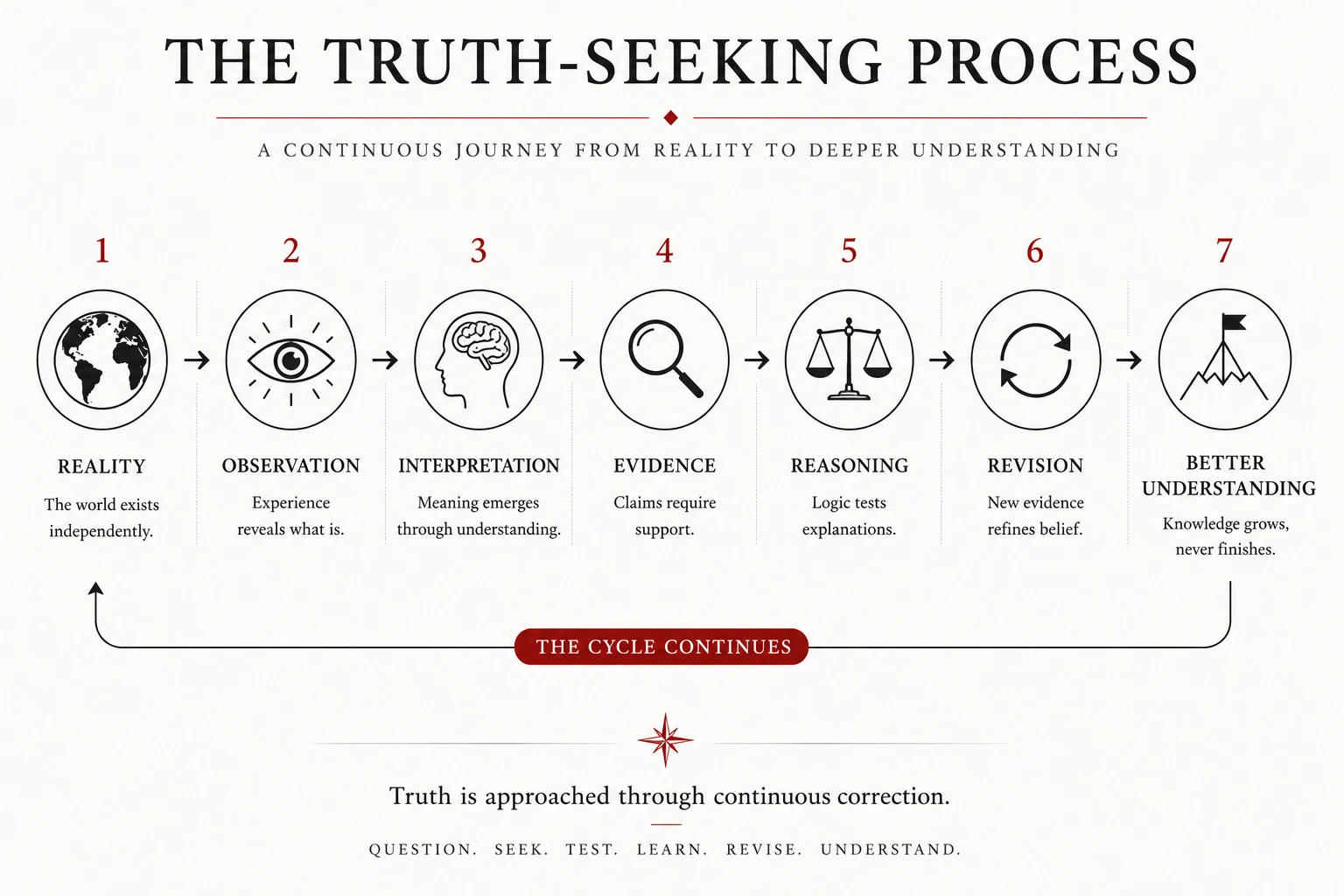
The process does not create reality. It represents the human effort to become more faithful to it. Observation may be incomplete. Interpretation may be biased. Evidence may be misleading. Reasoning may contain hidden assumptions. Revision is therefore not an admission that truth has failed; it is the means by which understanding becomes less mistaken.
Why Truth Is Essential for Civilization
Civilization depends upon truth because every institution enabling cooperation presupposes that reality matters more than convenience. Patients trust physicians. Passengers trust engineers. Citizens trust courts. Investors trust financial statements. Students trust teachers. Families trust promises.
When truthfulness becomes optional, trust disappears and verification replaces confidence. Institutions become slower, more defensive, and more expensive. Science cannot progress if data are fabricated. Markets cannot function efficiently if contracts and accounts are unreliable. Democracy cannot deliberate if citizens no longer share enough factual reality to evaluate competing policies.
Education is civilization’s memory. It transmits language, mathematics, science, literature, history, and methods of reasoning across generations. If education abandons truth for ideology or convenience, society loses cumulative knowledge and becomes vulnerable to repeating earlier errors.
Civilizations often decay gradually before they collapse visibly. Official reports become unreliable. Corruption spreads. Public promises lose credibility. Expertise becomes politicized. Cynicism replaces responsibility. Beneath functioning institutions, shared commitment to reality weakens.
Truth Throughout the History of Philosophy
The history of philosophy can be read as a continuous argument about truth. Heraclitus found order within change; Parmenides opposed unstable appearance to unchanging being. Socrates exposed false certainty through questioning. Plato looked beyond shadows toward intelligible reality. Aristotle grounded truth in saying of what is that it is.
The Stoics connected truth with living according to nature. Augustine turned inward toward memory, consciousness, and eternal truth. Aquinas united Aristotelian realism with theological reflection. Descartes rebuilt knowledge through doubt. Locke rooted understanding in experience. Hume revealed the problem of induction.
Kant examined the conditions that make experience possible. Hegel understood truth historically. Kierkegaard emphasized lived commitment. Nietzsche questioned inherited metaphors and values. James developed pragmatism. Russell and analytic philosophy pursued logical clarity. Tarski formalized semantic truth. Popper emphasized falsification. Kuhn examined paradigm shifts. Arendt defended factual truth against organized lying. Wittgenstein investigated language and use.
Contemporary philosophy continues debating realism, anti-realism, constructivism, phenomenology, epistemic injustice, social knowledge, formal semantics, and machine intelligence. The questions have changed in vocabulary, but not in urgency: how can finite beings develop beliefs that become increasingly answerable to reality?
Common Misconceptions About Truth
Everyone has their own truth
People have different experiences and interpretations, but contradictory claims about the same objective event cannot all be true in the same respect. Personal perspective matters because it reveals how reality is experienced; it does not abolish shared reality.
Science changes, so nothing is true
Scientific theories change because understanding improves. Reality does not transform because explanations become more accurate. Revision is evidence of science’s commitment to truth, not proof that truth is arbitrary.
Truth is whatever most people believe
Consensus can reflect excellent inquiry, but popularity does not determine reality. Entire populations have accepted false astronomical, medical, and political beliefs. Agreement deserves weight only because of the quality of the process that produced it.
Facts speak for themselves
Facts require context and interpretation. Scientists interpret measurements; historians interpret documents; physicians interpret symptoms. Interpretation is unavoidable, but remains constrained by evidence and can be better or worse.
Absolute certainty is necessary for truth
Many truths are known through probability and justified confidence. Requiring absolute certainty would make medicine, history, law, and much of science impossible. Rationality means calibrating confidence, not pretending uncertainty never exists.
Artificial intelligence determines truth
AI can assist inquiry but does not possess automatic authority. Statistical fluency, retrieval, and pattern recognition remain distinct from justified understanding. Verification and responsibility cannot be delegated away.
The Future of Truth
Humanity is moving from an age in which information was scarce to one in which verification is scarce. Billions of texts, images, videos, simulations, and AI-generated claims can appear instantly. The central challenge is no longer merely obtaining information, but determining which representations deserve trust.
Artificial intelligence will amplify both discovery and error. Synthetic realities will complicate the distinction between physical and virtual experience. Digital identities may persist independently of biological presence. Cryptographic provenance and trusted archives will become more important, but technology alone cannot settle philosophical truth.
The future may also deepen collective intelligence. Scientists assisted by AI, globally connected research communities, and continuously updated knowledge systems may discover patterns invisible to isolated minds. The challenge will be preserving wisdom, accountability, and human dignity while knowledge production accelerates.
Industrial civilization was built on energy. The digital economy was built on information. The coming century may increasingly depend on something even more valuable: trusted truth. Societies capable of preserving reliable verification will possess enormous scientific, economic, and political advantages.
Truth and the Eternity Trilogy
Philosophical fiction does not prove propositions, but it can make their consequences imaginable. The Eternity trilogy dramatizes questions of memory, identity, responsibility, reality, and the burden of knowledge. Those Who Guard Eternity, Those Who Destroy Eternity, and Those Who Shape Eternity explore what happens when the continuity of a world depends on what its inhabitants remember, deny, destroy, and choose to preserve.
Fiction becomes philosophically truthful when an imagined world reveals something faithful about human existence. It creates a space where abstract questions become decisions, losses, responsibilities, and consequences.
Conclusion: Truth Is More Than a Correct Sentence
Truth is not certainty, consensus, power, comfort, or possession. It is fidelity to what is. It demands perception disciplined by evidence, language disciplined by clarity, reason disciplined by logic, science disciplined by experiment, history disciplined by documentation, morality disciplined by honesty, and civilization disciplined by shared commitment to reality.
Human beings will never possess complete knowledge. Every answer reveals new questions. Every solved mystery uncovers a deeper horizon. Yet incompleteness is not failure. It is why philosophy continues.
For individuals, truth makes integrity possible. For communities, truth makes trust possible. For civilization, truth makes the future possible. The search never truly ends. That is precisely why it matters.
Truth, Free Will, and Responsibility
Truth is not only something the mind contemplates. It changes the field within which choice becomes possible. A person cannot choose responsibly without some accurate understanding of circumstances, alternatives, motives, and consequences. Freedom exercised in complete ignorance may still be spontaneous, but it is not fully informed.
This is why deception is an assault on agency. To deceive someone is not merely to place a false sentence in their mind. It is to alter the reality from which they believe they are choosing. A contract signed under false information, a medical decision based on concealed risks, or a political choice shaped by fabricated evidence may remain voluntary in a narrow sense while being deprived of meaningful autonomy.
The question of whether humans have free will is therefore inseparable from truth. Even if human choices arise within causal, biological, and social conditions, responsibility still depends upon whether a person can recognize reasons, respond to evidence, and revise action. The capacity to be corrected by reality is one of the clearest signs of practical freedom.
Self-knowledge and the freedom to change
Human beings are often least truthful about the forces shaping their own choices. We reinterpret motives after acting, exaggerate consistency, and protect a preferred image of ourselves. Yet genuine freedom requires more than acting on whatever desire happens to be strongest. It requires enough self-knowledge to ask where a desire came from, what it serves, and whether following it is compatible with the person one wishes to become.
Truth about oneself is never complete. Character appears through patterns across time; motives are mixed; memory is selective. Still, self-examination can replace automatic repetition with conscious response. A person who recognizes fear beneath anger, envy beneath criticism, or shame beneath withdrawal gains possibilities unavailable while those motives remain hidden.
Responsibility without omniscience
No one acts with complete knowledge. Ethical life therefore cannot require omniscience. It requires proportionate responsibility: making a serious effort to understand, acknowledging foreseeable consequences, seeking relevant evidence, and remaining willing to repair harm when assumptions prove mistaken.
The responsible person does not claim, “I could not know everything,” as an excuse for refusing to know anything. Nor do they pretend that uncertainty disappears merely because action is necessary. They decide within limits while preserving honesty about those limits.
Truth, Mystery, and the Unknown
Truth is sometimes presented as the enemy of mystery, as though every discovered fact diminished wonder. This opposition misunderstands both. Mystery is not the absence of truth; it is the presence of a reality not yet fully understood.
The night sky did not become less astonishing when astronomy replaced mythic explanations with planetary motion, stellar evolution, and expanding space. Knowledge removed certain errors, but revealed distances, energies, origins, and possibilities far more extraordinary than earlier imagination could contain. Explanation often deepens mystery by showing how much more there is to explain.
The unknown is not the unknowable
To say that something is unknown is to describe the present boundary of knowledge. To call it unknowable is to make a stronger philosophical claim about the permanent limits of every possible inquiry. Human beings frequently confuse these positions. Questions once considered unreachable—about the age of Earth, the composition of stars, the transmission of disease, or the structure of heredity—became answerable through methods earlier generations could not imagine.
Humility therefore works in two directions. We should not pretend to know what evidence does not support. But neither should we declare impossible what merely lies beyond current instruments, concepts, or experience.
Mystery without credulity
Respect for mystery does not justify believing every extraordinary claim. Where evidence is weak, suspension of judgment is more honest than either dogmatic belief or dogmatic denial. Mystery calls for openness disciplined by reason. Credulity accepts too quickly; cynicism dismisses too quickly. Both evade the patient work of inquiry.
The deeper philosophical question explored in Can Humanity Survive the End of Mystery? is whether wonder depends upon ignorance. The better answer may be that wonder depends not on knowing less, but on seeing more clearly how reality exceeds possession.
Truth and the Meaning of Life
The search for truth eventually becomes existential. A person may understand many facts and still ask what any of them mean for how life should be lived. Conversely, a life may feel meaningful while resting on beliefs that are factually false. This tension raises one of philosophy’s most difficult questions: must meaning be true?
An illusion can organize experience. It can offer courage, belonging, or hope. Yet if meaning depends entirely on avoiding reality, it remains fragile. The discovery of truth then appears as destruction rather than clarification. A more durable meaning must be capable of surviving honest contact with finitude, suffering, responsibility, and uncertainty.
Can a false belief make life meaningful?
A false belief can have meaningful consequences. Someone may act generously because of a mistaken interpretation, or endure hardship through a story that later proves inaccurate. The significance of those actions does not vanish, but their meaning may need reinterpretation. Human beings often begin with incomplete stories and later discover deeper reasons for what they valued.
The point is not that every meaningful life requires a complete philosophical system. It is that meaning matures when it no longer needs reality to be falsified. Love need not be perfect to be real. Purpose need not be cosmically guaranteed to guide a life. Hope need not pretend that loss is impossible.
Truth as fidelity
The question What Is the Meaning of Life? cannot be answered by information alone. Meaning concerns relationship: between a person and others, action and value, present choice and future consequence, finite life and whatever may transcend it. Truth enters as fidelity within those relationships.
To live truthfully is not merely to accumulate correct propositions. It is to refuse a divided life in which words, actions, and reality continually contradict one another. Integrity is the existential form of truth: the effort to make what one says, believes, and does belong to the same world.
Truth as a Common Good
Truth is often treated as private property: my information, my insight, my discovery, my secret. Yet many of its most important forms are common goods. A reliable map, a preserved archive, a medical discovery, an honest public record, and a verified warning become more valuable when shared.
Common goods differ from ordinary possessions because one person’s benefit does not necessarily diminish another’s. Knowledge can spread without being used up. But the institutions that preserve it remain fragile. Archives require protection. Scientific standards require funding and integrity. Journalism requires independence. Education requires teachers capable of transmitting both knowledge and methods of inquiry.
The right to know and the duty to protect
Not every truth should be public. Privacy, confidential testimony, medical information, security, and personal dignity create legitimate limits. A truthful society is not one in which everyone knows everything about everyone else. It is one in which secrecy is justified by responsibility rather than used to protect unaccountable power.
The tension between transparency and privacy cannot be solved by a single rule. It requires asking who is affected, who has authority, what harms disclosure may cause, what harms concealment may permit, and whether those making the decision can themselves be examined.
Intergenerational truth
Civilization is a conversation between the dead, the living, and those not yet born. Each generation receives records, institutions, discoveries, warnings, and unresolved questions. It also decides what will be preserved, forgotten, corrected, or destroyed.
To falsify the past is therefore to steal from the future. To conceal preventable danger, suppress evidence, or destroy archives is to deprive later people of knowledge they did not yet have the chance to defend. Truth becomes an intergenerational obligation: a responsibility to transmit reality as faithfully as possible so that those who follow may judge more wisely than we did.
Frequently Asked Questions About Truth
What is truth in simple terms?
Truth is the condition of a statement, belief, judgment, or representation being correct about what it concerns. Most commonly, a claim is true when reality is as the claim says it is.
What makes a statement true?
A statement is true when its meaning matches the relevant state of affairs. Its truth depends on what it claims and whether reality satisfies those conditions.
Does truth exist independently of humans?
Many truths appear to exist independently of human belief. Earth orbited the Sun before anyone knew it. Some social truths, however, depend on institutions and conventions created by human communities.
What is the difference between truth and reality?
Reality is what exists or occurs. Truth concerns whether statements, beliefs, or representations accurately describe that reality.
What is the difference between truth and fact?
A fact is something that is the case. Truth is the correctness of a claim expressing or representing what is the case.
What is the difference between truth and belief?
Belief is what a person accepts as true. Truth concerns whether that belief is actually correct. Sincerity and conviction do not guarantee truth.
What is the difference between truth and knowledge?
Truth is correctness. Knowledge is truth successfully grasped through appropriate evidence, justification, understanding, or reliable inquiry.
What is the difference between truth and opinion?
An opinion is a judgment or preference held by a person. Some opinions concern taste, while others make factual claims that can be better or worse supported.
What is the difference between truth and certainty?
Truth concerns whether a claim is correct. Certainty concerns how strongly it is held. A person can be certain and wrong, or uncertain and right.
Can something be true if nobody believes it?
Yes. A proposition may be true even if nobody currently knows or believes it. Discovery changes knowledge, not the reality discovered.
Can everyone believe something false?
Yes. Widespread agreement does not create truth. History contains many beliefs accepted by majorities that were later shown to be false.
What is objective truth?
Objective truth is true independently of what any particular person wishes, feels, or believes.
What is subjective truth?
Subjective truth concerns first-person experience, such as pain, fear, grief, or joy. The experience may be real even when its interpretation is mistaken.
What is absolute truth?
Absolute truth is truth that holds universally and does not become false because culture, circumstance, or historical period changes.
What is relative truth?
Relative truth depends on a specified context, convention, or frame of reference. Context dependence does not mean that every claim is arbitrary.
Is all truth relative?
No. Some claims are context-sensitive, while others concern events, logical relations, or physical conditions independent of personal perspective.
Can contradictory statements both be true?
Not when they concern the same subject, at the same time, in the same respect, and use their terms in the same meaning.
What are the main theories of truth?
The main theories include correspondence, coherence, pragmatic, semantic, deflationary, constructivist, and perspectival approaches.
What is the correspondence theory of truth?
It holds that a statement is true when it corresponds to reality or accurately represents a state of affairs.
What is the coherence theory of truth?
It holds that a belief gains truth or justification by fitting consistently within a comprehensive system of beliefs.
What is the pragmatic theory of truth?
Pragmatic theories connect truth with successful inquiry, prediction, action, and the long-term correction of error.
What is Tarski’s theory of truth?
Tarski developed a semantic account in which a sentence such as “Snow is white” is true if and only if snow is white.
Can humans know truth?
Yes, although human knowledge is fallible. Evidence, reason, testing, and correction allow reliable knowledge without requiring absolute infallibility.
Can perception be trusted?
Perception is generally reliable but interpretive and fallible. It becomes more trustworthy when compared with other observers, instruments, and evidence.
Can memory be trusted?
Memory is indispensable but reconstructive. Sincere memories can be inaccurate, so corroboration matters when precision is important.
Is certainty necessary for knowledge?
No. Much knowledge rests on justified confidence rather than absolute certainty.
Can language describe reality accurately?
Language can describe reality accurately, but every description selects, simplifies, and frames. Clarity and context are essential.
Why do intelligent people believe false things?
Intelligence does not eliminate motivated reasoning, identity protection, confirmation bias, social pressure, or emotional need.
Why do people resist uncomfortable truths?
Truth may threaten identity, belonging, status, hope, or self-image. Accepting evidence can require emotional as well as intellectual change.
Is scientific truth always changing?
Scientific understanding changes as evidence improves. This does not mean truth itself changes; it means explanations become more accurate.
Can historical truth be objective?
Yes, although historical knowledge is reconstructed from incomplete evidence. Objectivity means allowing evidence to correct preferred narratives.
Can moral statements be true?
Many philosophers argue that moral claims can be true or false, though they disagree about whether moral truth is objective, constructed, rational, or grounded in human flourishing.
Can religion reveal truth?
Religious traditions make several kinds of claims—historical, metaphysical, moral, symbolic, and experiential—which require different forms of evaluation.
Can AI know truth?
Current AI can produce and retrieve true information, but fluent output does not guarantee understanding or reliability. Human verification remains essential.
Why are deepfakes dangerous?
Deepfakes can fabricate convincing evidence and make authentic evidence easier to dismiss, weakening trust in images, voices, and video.
What is misinformation?
Misinformation is false or misleading information shared without deliberate intent to deceive.
What is disinformation?
Disinformation is false or misleading information deliberately created or distributed to deceive.
What is propaganda?
Propaganda is communication designed to shape attitudes through selective facts, emotional framing, repetition, omission, symbolism, or falsehood.
How can someone determine whether information is true?
Define the claim, inspect primary evidence, compare independent sources, test alternatives, seek disconfirmation, examine context, and preserve appropriate uncertainty.
Why is truth necessary for civilization?
Truth supports trust, law, science, education, markets, democracy, historical memory, and collective action. Without shared standards of evidence, institutions decay.