Experience is the bridge between reality and the person who encounters it. Through experience, events become perception, perception becomes meaning, meaning becomes knowledge, and knowledge gradually shapes worldview, decisions, identity, and wisdom.
About the Cokos explanatory models
The named diagrams in this article—such as The Experience Loop, The Experience Depth Model, and The Experience Growth Spiral—are original Cokos explanatory frameworks. They synthesize ideas from philosophy of perception, cognitive science, psychology, memory research, and epistemology into one educational architecture. They are not presented as universally accepted scientific taxonomies.
What is experience in simple terms?
In ordinary language, experience often means everything that has happened to us. But an event and an experience are not identical. An event belongs to the world. Experience is what the event becomes after it passes through perception, attention, emotion, memory, language, interpretation, and personal meaning.
Human beings do not receive reality as a complete, neutral copy. The senses detect only a limited range of signals. Attention selects a small portion of what is available. The mind compares those signals with memory and expectation. Emotion marks some aspects as threatening, attractive, painful, beautiful, or important. Language and culture supply categories. Only then does the event become part of a lived world.
This is why experience is both real and constructed. It is real because something genuinely happens to a living person. It is constructed because the form in which it is lived depends on the person’s body, history, beliefs, emotional state, social context, and prior knowledge.
Why an event is not the same as an experience
Imagine two people hearing the same criticism. One interprets it as humiliation. The other hears useful feedback. The words may be identical, but the experience is not. The first person may leave with shame and avoidance. The second may leave with a clearer model and a practical next step.
Event
What occurs in the world: a conversation, mistake, success, loss, discovery, conflict, change, or encounter.
Experience
How the event is perceived, felt, interpreted, remembered, integrated, and carried into future action.
This distinction explains why a shared environment does not produce identical people. Each person notices different details, expects different outcomes, and assigns different meanings.
One event, four experiences
A speaker makes a mistake and receives a correction from the audience.
- A student may conclude, “I am not capable of speaking in public.”
- An experienced teacher may treat the correction as useful feedback.
- A person with a history of ridicule may experience an old wound repeating.
- A researcher may notice a flaw in the model and discover a better question.
The factual event is similar. The lived meaning is different. That meaning influences what each person remembers and chooses next.
The Experience Loop: how reality becomes part of us
Experience is not a single moment. It is a loop connecting reality, perception, personal meaning, reflection, knowledge, worldview, and future action. Once knowledge enters a worldview, it influences what we notice in the next situation. The loop begins again, but never from exactly the same starting point.
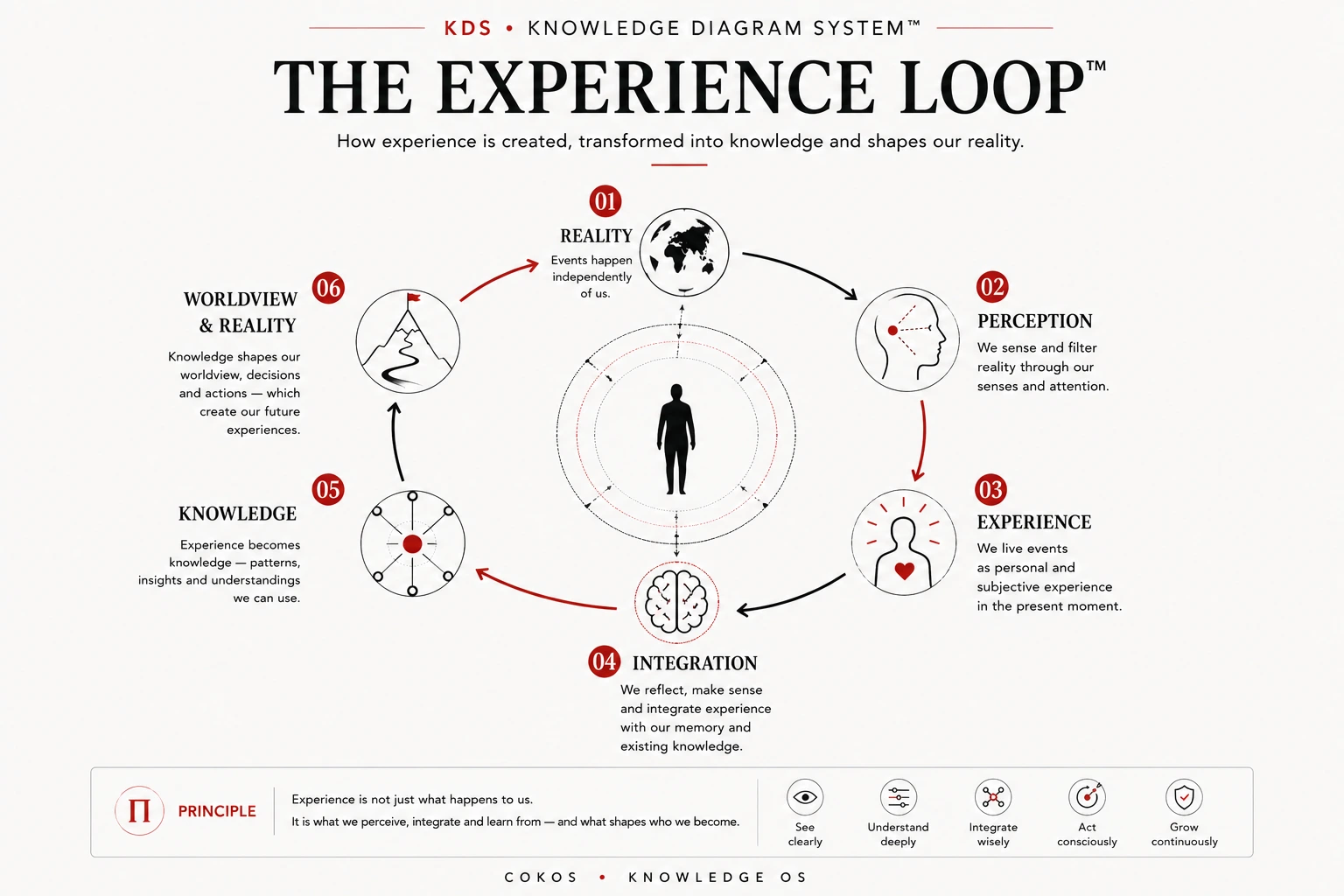
The loop can become a learning system or a self-confirming trap. A belief affects attention. Attention affects interpretation. Interpretation affects decisions. Decisions create results. Results may revise the belief—or be reinterpreted to protect it.
This recursive structure matters because experience does not merely record reality. It also helps create the conditions under which the next encounter will be perceived and interpreted.
How is experience formed?
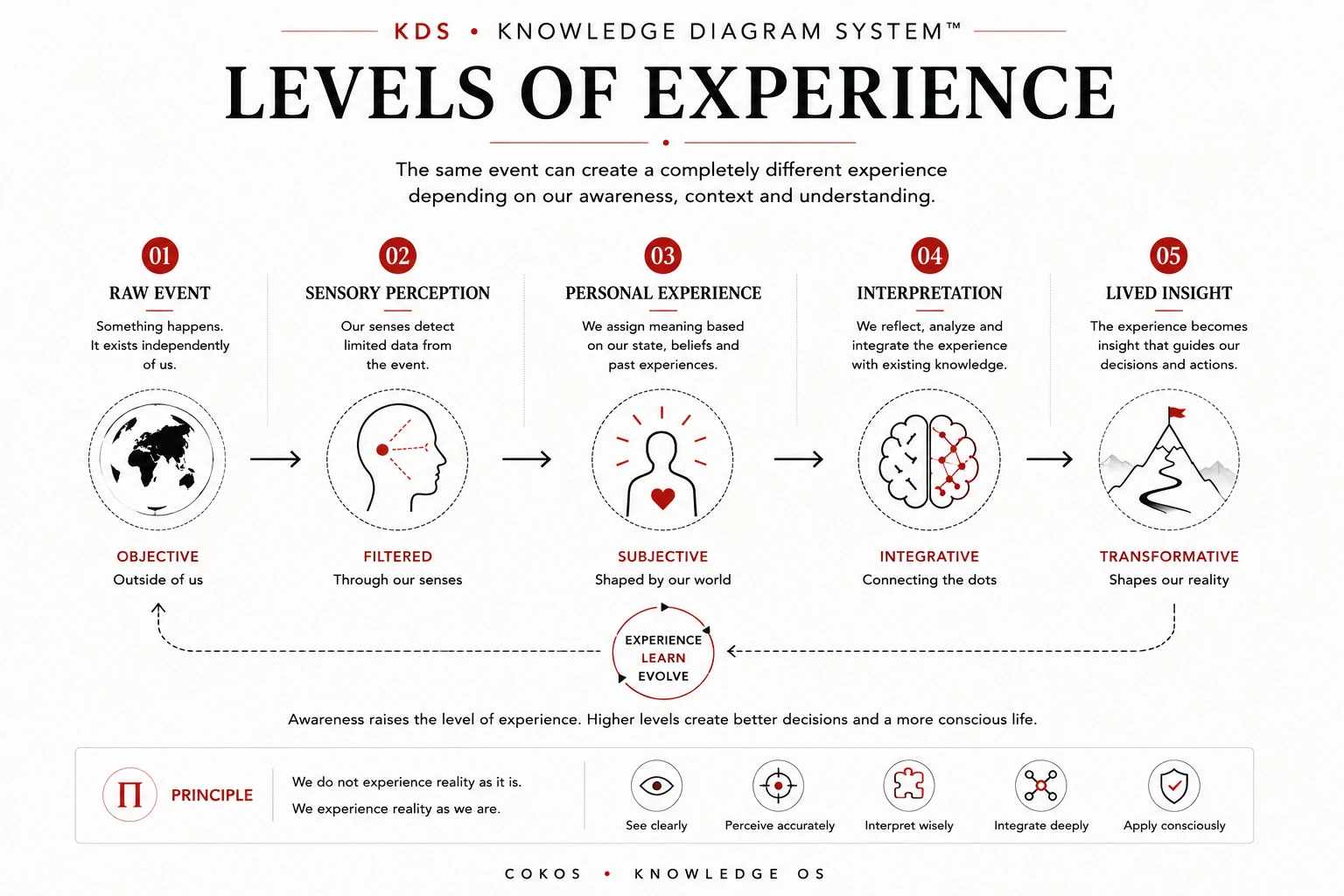
A useful model begins with reality, perception, subjective experience, interpretation, and integration. The order is not perfectly linear, because memory and expectation can influence perception before conscious reflection begins. Still, the sequence clarifies the main transformations.
1. Reality provides signals
Something exists or happens independently of our preferred explanation. A person speaks. A door closes. A plan fails. A body feels pain. A new possibility appears.
2. Perception selects
The senses and nervous system translate a narrow part of reality into usable signals. Attention determines which signals become central. Most available information never reaches conscious awareness.
3. Experience becomes personal
The event is felt from a first-person point of view. It acquires a tone: pleasant, painful, uncertain, meaningful, boring, threatening, beautiful, or confusing.
4. Interpretation creates meaning
The mind asks, often implicitly: What is this? Why did it happen? What does it mean for me? What is likely to happen next?
5. Integration carries it forward
The experience is connected with memory, values, concepts, and existing knowledge. It becomes part of a larger model that can influence future perception and action.
Types of experience
The word experience is used in several overlapping ways. Distinguishing them helps prevent confusion between immediate perception, accumulated practice, scientific observation, and personal meaning.
| Type | Meaning | Example |
|---|---|---|
| Sensory experience | What is directly presented through perception. | Seeing color, hearing a tone, feeling cold water. |
| Subjective experience | What it is like for a particular conscious subject. | The personal character of fear, pain, joy, or wonder. |
| Lived experience | Experience as shaped by biography, embodiment, identity, and social context. | Living through migration, caregiving, exclusion, or responsibility. |
| Practical experience | Knowledge and skill developed through repeated action and feedback. | Teaching, repairing, leading, designing, or negotiating. |
| Professional experience | Context-specific judgment and pattern recognition developed in a field. | An expert noticing a meaningful signal a beginner misses. |
| Empirical experience | Observation or experiment used to test claims about reality. | A measured result replicated under defined conditions. |
| Collective experience | Events and meanings shared by a group and preserved socially. | Historical memory, tradition, or a generational crisis. |
| Imagined experience | Mental simulation without the full external event. | Rehearsing a conversation or considering a moral dilemma. |
These types are not isolated. Professional experience combines sensation, memory, practical skill, social standards, and conceptual knowledge. Lived experience combines personal events with the cultural meanings available for interpreting them.
Experience in philosophy, psychology, and science
Experience in philosophy
Philosophy asks what perceptual experience is, how it relates us to a mind-independent world, why illusion and hallucination are possible, and whether experience can justify beliefs. Competing theories disagree about whether experience presents external objects directly, represents them through mental content, or must be understood in another way.
Experience in psychology
Psychology studies how attention, emotion, learning, memory, expectation, and social context shape experience and behavior. From this perspective, experience is not only what enters awareness; it also includes the changes in expectation, habit, and action that follow.
Experience in cognitive science
Predictive-processing approaches propose that perception depends partly on models that generate expectations about incoming sensory signals. This helps explain why prior knowledge can make perception efficient while also creating systematic errors.
Experience in empirical science
Science does not reject personal experience, but it distinguishes individual testimony from generalizable evidence. Measurement, controlled comparison, replication, and public methods are used to determine whether a pattern extends beyond one observer or one situation.
How does experience become knowledge?
Experience alone does not guarantee knowledge. A person can repeat the same situation many times without understanding it. Knowledge emerges when experience is examined, compared, organized, tested, and connected with other evidence.
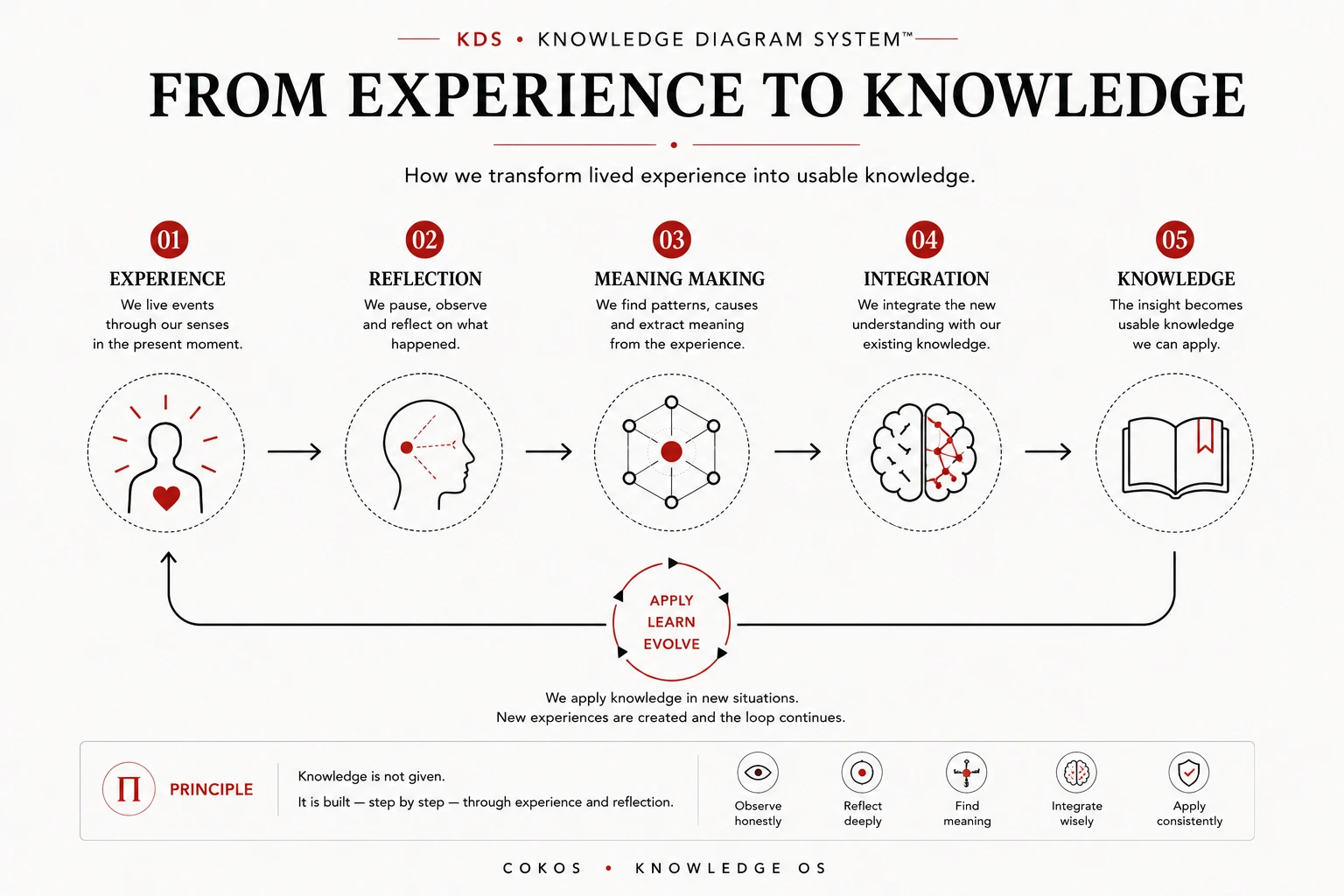
- Experience: something is lived.
- Reflection: attention returns to what happened.
- Meaning making: patterns, causes, and implications are considered.
- Integration: new understanding is connected with existing knowledge.
- Application: the model is tested in another situation.
A model becomes stronger when it explains more than one case, survives attempts to disconfirm it, and improves prediction or action. Continue with What Is Knowledge?
Experience, information, knowledge, skill, and wisdom
| Concept | Core question | Primary value | Main limitation |
|---|---|---|---|
| Information | What has been communicated? | Supplies data, descriptions, or claims. | May be false, incomplete, or unintegrated. |
| Experience | What was lived? | Provides direct contact, context, and consequence. | Limited by perspective and interpretation. |
| Knowledge | What can be responsibly believed? | Provides tested explanatory models. | Can become outdated or misapplied. |
| Skill | What can be reliably done? | Turns learning into competent performance. | May remain narrow or context-dependent. |
| Wisdom | What should be done here? | Applies knowledge with context, values, and consequence awareness. | Can be imitated rhetorically without genuine judgment. |
Why is experience subjective?
Subjectivity means that experience is lived from somewhere. Every experience belongs to a body, a moment, a history, a language, a culture, and a perspective. This does not mean reality is invented. It means access to reality is mediated.
Attention
We experience what is selected, not everything available.
Expectation
Prediction prepares the mind to notice some outcomes more readily than others.
Emotion
Emotion influences attention, learning, memory, judgment, and the perceived importance of events.
Memory
Past experience supplies patterns used to interpret the present.
Language
Concepts organize distinctions and make some features easier to notice.
Culture
Shared norms shape what seems normal, possible, admirable, shameful, or true.
The mature goal is not to become perspective-free. It is to become aware of perspective, compare it with others, and let evidence correct it. Read What Is Reality?
What distorts experience?
Experience can be distorted at every stage. Some limits are biological. Others are cognitive, emotional, social, or linguistic. Filters are necessary; without them the mind would be overwhelmed. The danger is forgetting that a filtered view is still a view.
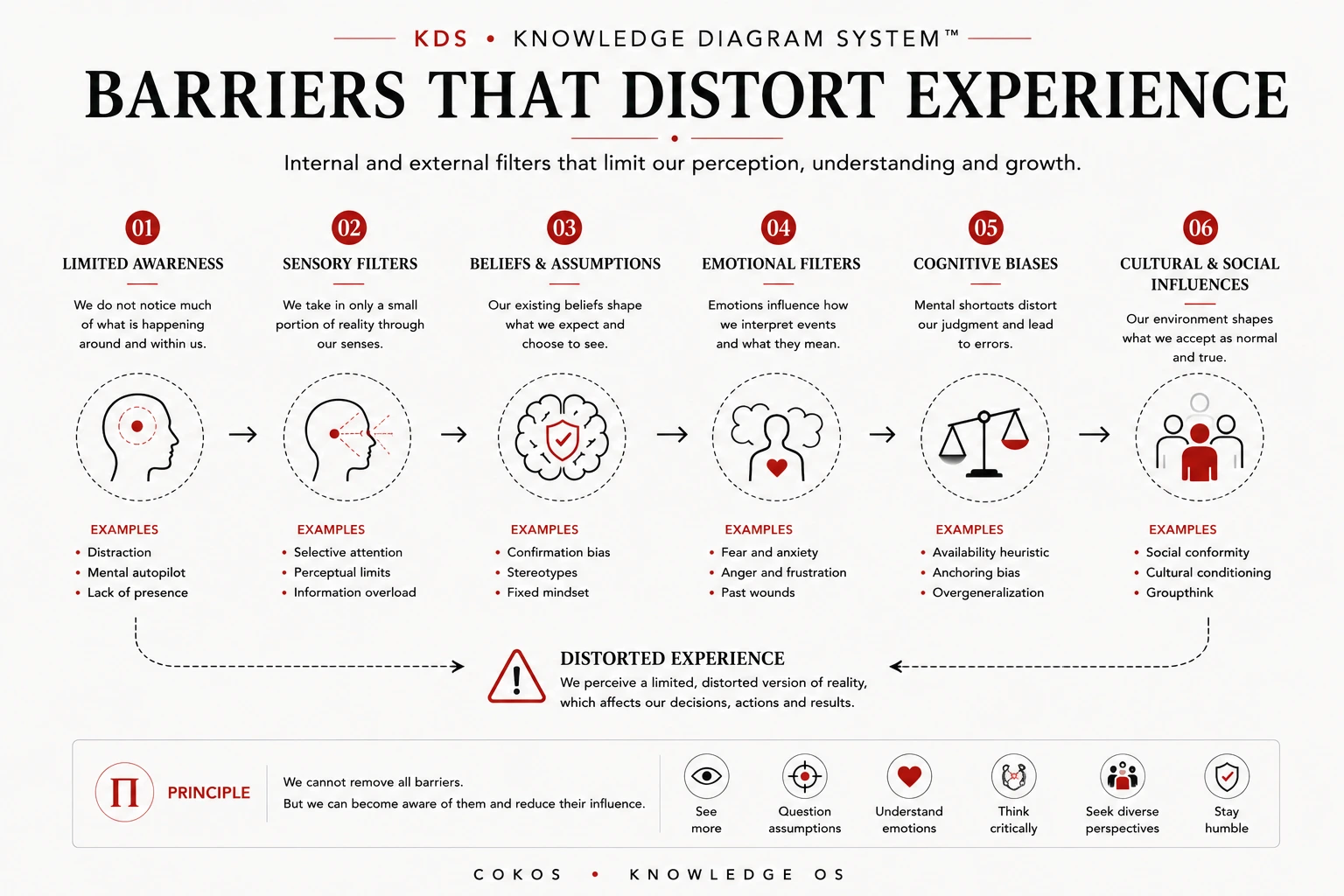
- Selective attention: noticing evidence that fits current concerns.
- Confirmation bias: interpreting ambiguity in favor of an existing belief.
- Emotional reasoning: treating a feeling as proof of an external fact.
- Overgeneralization: turning one case into a universal rule.
- Memory reconstruction: remembering a coherent story rather than an exact recording.
- Social conformity: accepting the group’s interpretation without independent examination.
- Language compression: reducing a complex experience to a label and mistaking the label for the whole.
The answer is disciplined humility: distinguish observation from interpretation, seek disconfirming evidence, compare perspectives, and revise conclusions when consequences contradict the model.
The Experience Depth Model
Some experiences remain on the surface. Others reorganize how a person understands self and world. The difference often lies in the depth of attention, reflection, analysis, integration, and transformation.
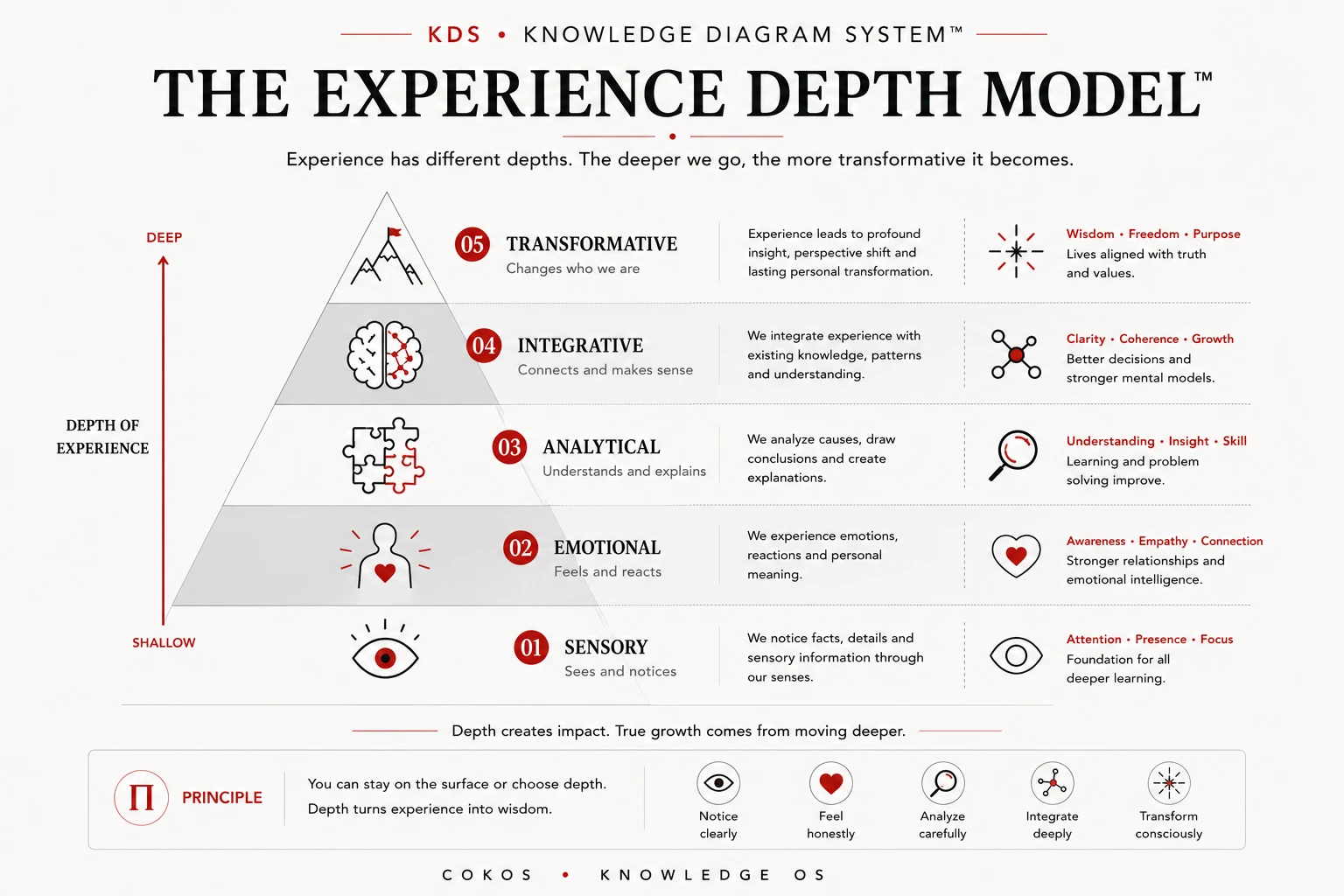
Depth should not be confused with intensity. A dramatic event can remain poorly understood. A quiet conversation can transform a person if it reveals a pattern that reorganizes how life is understood.
Experience, memory, and consciousness
Consciousness makes experience present from the first-person point of view. Memory allows experience to persist beyond the moment. Without consciousness, signals may be processed without becoming a lived world. Without memory, a moment may be felt but fail to become a durable source of learning or identity.
Memory is not a perfect archive. Research on consolidation and reconsolidation supports the view that memories can be transformed and updated rather than merely replayed. Each recall may be influenced by later knowledge, current emotion, prediction error, and social context.
This does not make memory useless. It means memory is adaptive rather than photographic. It preserves meaning, patterns, and action-guiding information, but it can also preserve distortion.
For the larger question of first-person experience, see Why Does Consciousness Exist? For the system that integrates perception, memory, models, and action, see What Is Mind?
How experience compounds over time
Experience accumulates, but development is not mere accumulation. Ten years of repeated activity can produce expertise, or one year of learning repeated ten times. The difference is whether attention, feedback, reflection, and model revision accompany repetition.
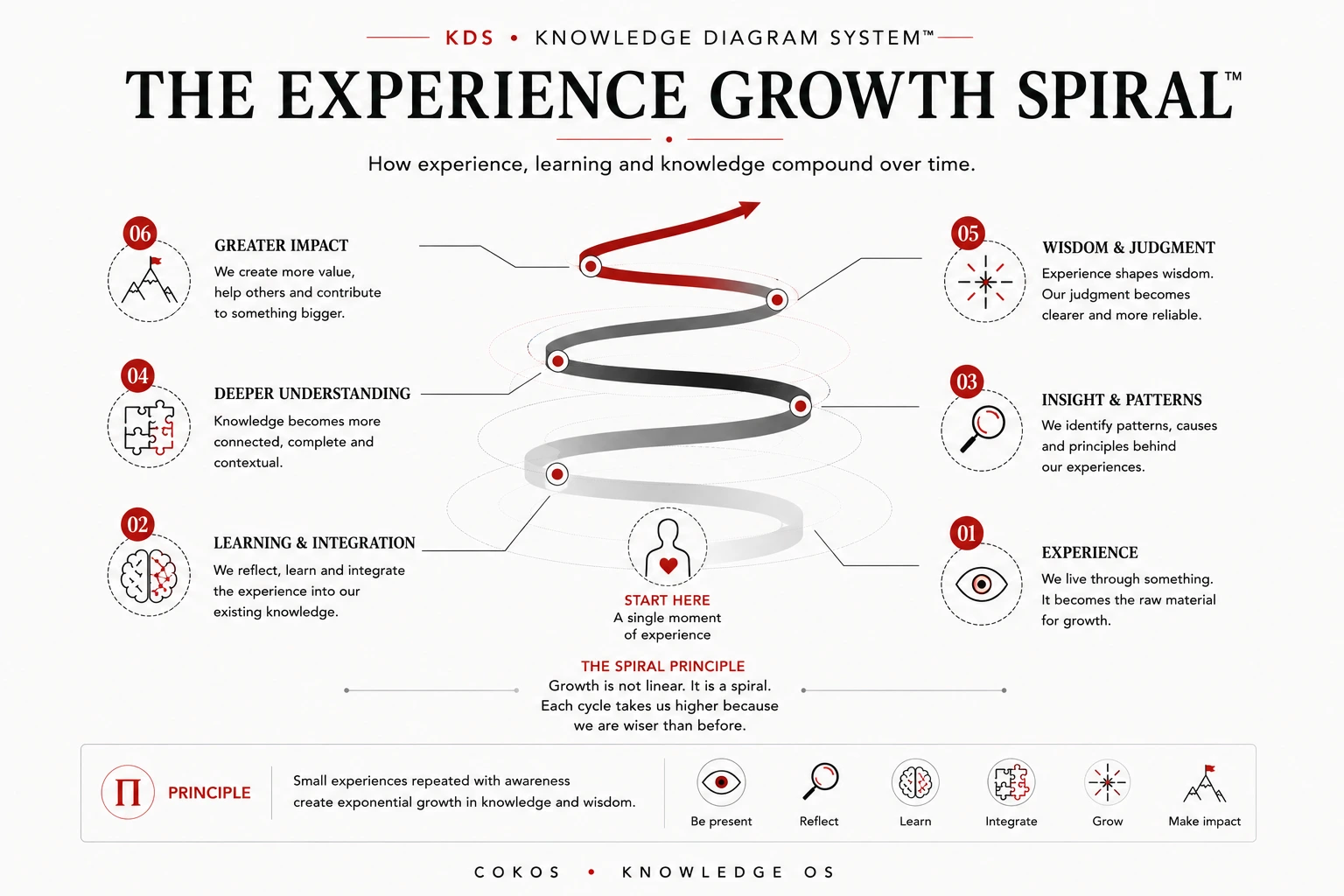
The spiral model explains why mature learning often feels like returning to the same question. Responsibility, trust, freedom, truth, identity, and meaning can reappear throughout life. The question is similar, but the person asking it has changed.
Experience compounds when each cycle contributes more accurate pattern recognition, better distinctions between signal and noise, greater awareness of context, more realistic expectations, more reliable judgment, and a stronger capacity to create value.
A practical framework for turning experience into knowledge
This framework can be used after an important event, decision, conflict, success, failure, or discovery. Its purpose is not to produce perfect certainty. It is to make the learning process explicit.
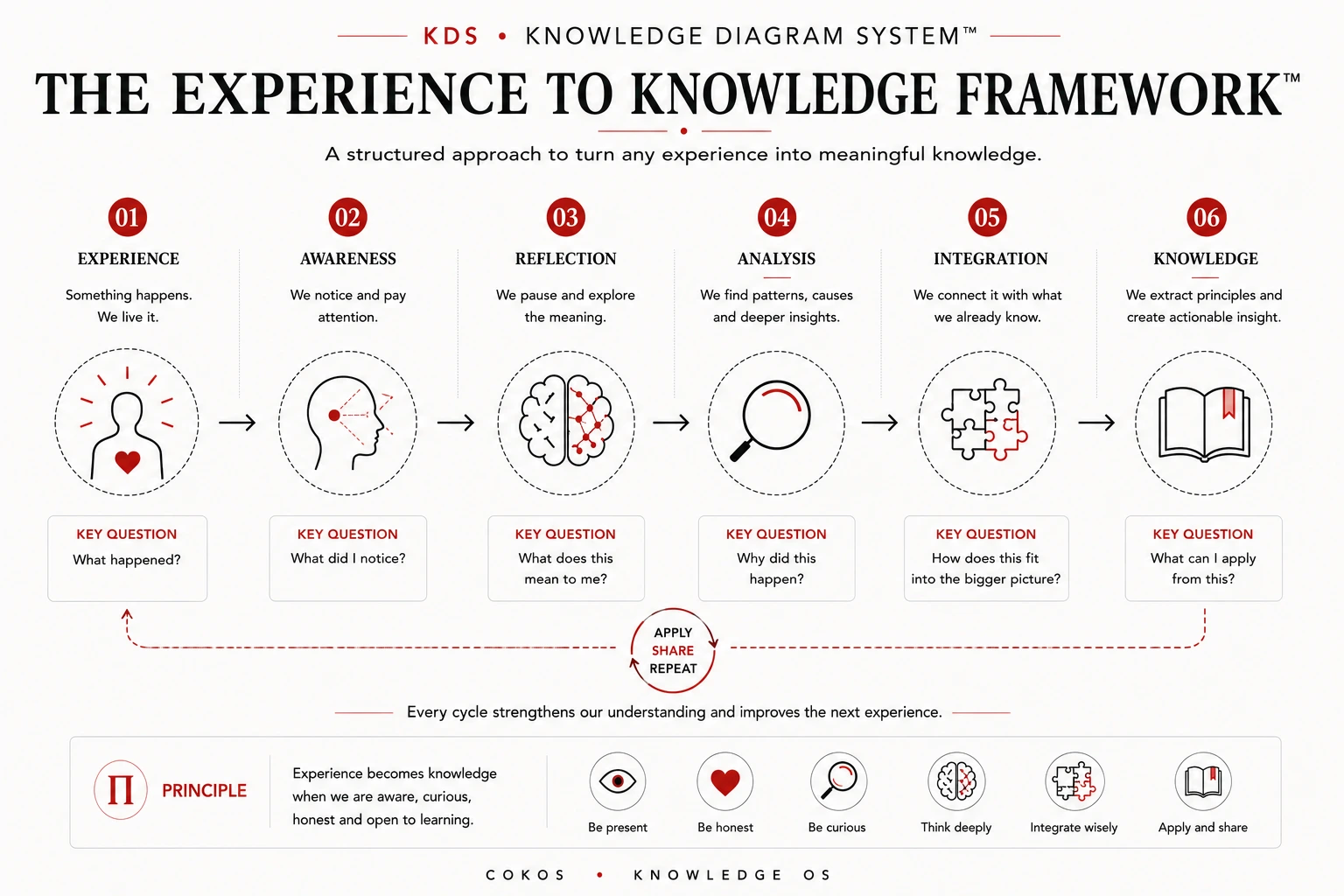
Six reflection questions
- What happened? Separate observable facts from conclusions.
- What did I notice? Identify signals that entered awareness and those that may have been missed.
- What did it mean to me? Name interpretation, emotion, and personal significance.
- Why might it have happened? Compare causes, patterns, and alternative explanations.
- How does this fit the larger picture? Connect the case with knowledge, values, and context.
- What can I apply? Form a testable principle and use it carefully in a new situation.
The final question matters. A conclusion that is never tested may remain a story. Application exposes the model to reality.
The Experience Principles
Experience becomes more valuable when a person brings a disciplined orientation to it. These principles do not guarantee immunity from error. They improve the probability that experience will become clearer understanding rather than accumulated confusion.
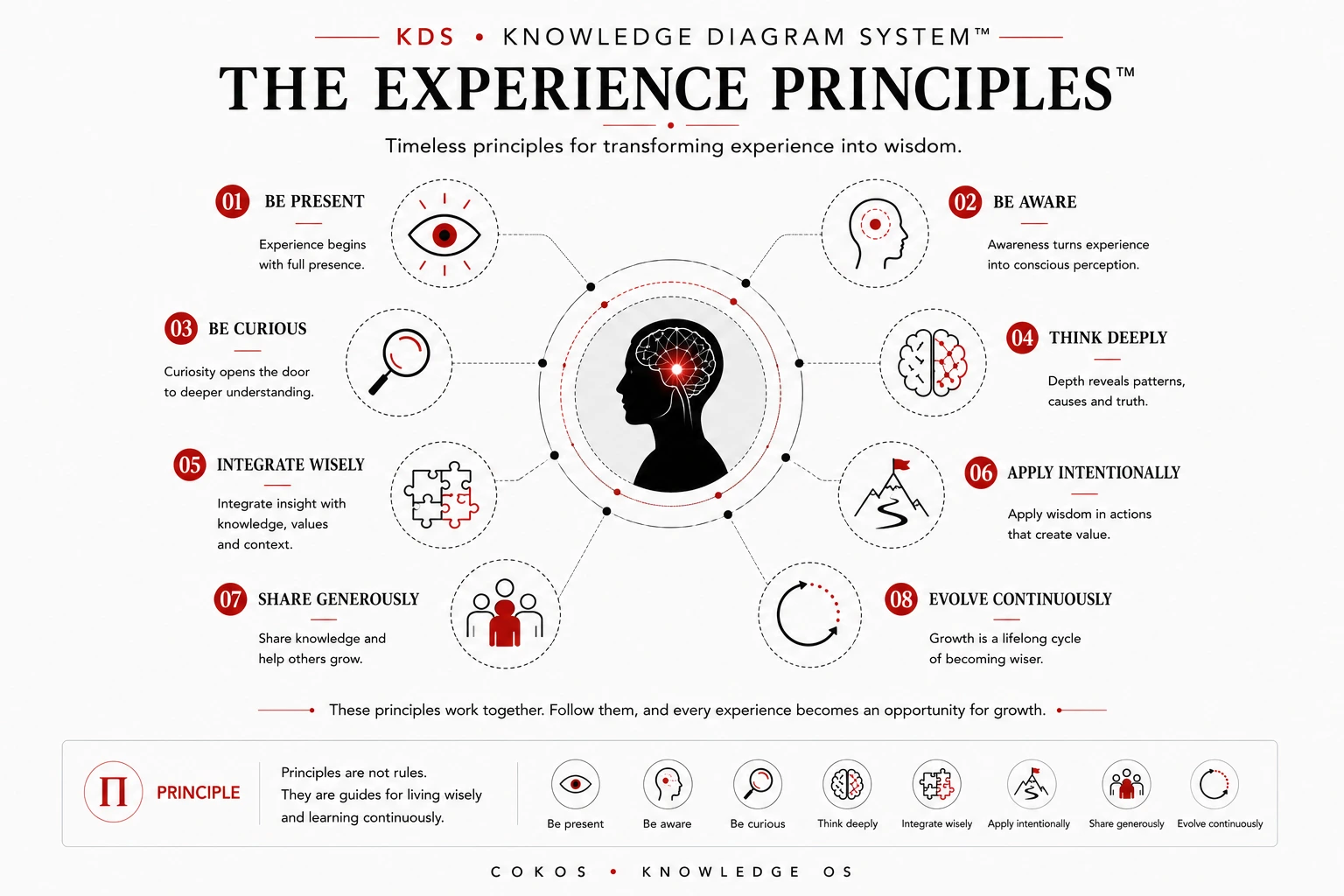
Be present
Attend to what is actually happening.
Be aware
Notice both the event and the internal response.
Be curious
Ask what else might explain the situation.
Think deeply
Look for causes, patterns, limits, and consequences.
Integrate wisely
Connect insight with wider knowledge, values, and context.
Apply intentionally
Use the lesson where it fits rather than turning it into a universal rule.
Share generously
Knowledge becomes socially valuable when it helps others learn.
Evolve continuously
Allow later evidence to revise earlier conclusions.
How experience shapes identity
Identity is partly the story through which a person connects memories, values, roles, commitments, abilities, and expectations. Experience supplies the material from which that story is built.
Repeated experiences can become self-statements:
- “I can handle difficult situations.”
- “People cannot be trusted.”
- “I always fail when attention is on me.”
- “I am responsible for what I choose.”
- “My life has a direction.”
These conclusions may contain truth, distortion, or both. Once integrated into identity, they influence which opportunities feel possible and which actions feel natural.
Identity is neither infinitely flexible nor permanently fixed. Past experience constrains the present, but new experience and new interpretation can revise the story. Read What Is Personal Identity?
How does experience become wisdom?
Knowledge asks what is likely true. Wisdom asks what should be done here, by this person, under these conditions, with these consequences.
Wisdom requires more than accumulation. It includes accurate perception, awareness of uncertainty, understanding of context, recognition of competing values, proportionate emotion, long-term consequence awareness, and humility about the limits of one’s model.
A person may have extensive experience and little wisdom if every outcome is interpreted to protect an unchanged worldview. Another person may gain deep wisdom from fewer events because each one is examined honestly and integrated carefully.
Experience in the Cokos Knowledge Graph
Within the Cokos Knowledge OS, experience is a central transformation node. It connects what exists with what is perceived, what is perceived with what is known, and what is known with what is chosen and created.
Perception→
Consciousness→
Experience→
Memory→
Knowledge→
Worldview→
Decision→
Identity
This is recursive rather than one-way. Memory changes perception. Worldview changes attention. Decisions alter the environment. Results become new experience.
Sources and further reading
The Cokos models are original syntheses. The following sources support key background claims about perception, prediction, emotion, memory, and the epistemology of experience:
- Crane, Tim, and Craig French. “The Problem of Perception.” Stanford Encyclopedia of Philosophy.
- Lyons, Jack. “Epistemological Problems of Perception.” Stanford Encyclopedia of Philosophy.
- Keller, Georg B., and Thomas D. Mrsic-Flogel. “Predictive Processing: A Canonical Cortical Computation.” Neuron (2018).
- Brosch, Tobias, et al. “The Impact of Emotion on Perception, Attention, Memory, and Decision-Making.” Swiss Medical Weekly (2013).
- Tyng, Chai M., et al. “The Influences of Emotion on Learning and Memory.” Frontiers in Psychology (2017).
- Nadel, Lynn, et al. “Memory Formation, Consolidation and Transformation.” Neuroscience & Biobehavioral Reviews (2012).
- Lane, Richard D., et al. “Memory Reconsolidation, Emotional Arousal, and the Process of Change.” Behavioral and Brain Sciences (2015).
Experience the questions through philosophical fantasy
An explanatory article can define experience. A story can create a new experience through which questions of time, reality, truth, memory, choice, and identity are felt rather than merely described.
Frequently asked questions about experience
What is experience in one sentence?
Experience is a lived and interpreted encounter with reality that changes memory, understanding, expectation, and future action.
What is the difference between an event and an experience?
An event happens in the world; an experience is how that event is perceived, felt, interpreted, remembered, and integrated.
What is lived experience?
Lived experience is the first-person way a situation is felt and understood from within a particular body, history, identity, and context.
What is subjective experience?
Subjective experience is the world as it appears to a particular conscious subject, including sensations, emotions, meanings, and thoughts.
What is personal experience?
Personal experience is the unique set of lived events and interpretations that belongs to an individual and influences that person’s worldview and identity.
What is practical experience?
Practical experience is knowledge and skill gained through action, feedback, correction, and real-world consequences.
What is professional experience?
Professional experience is field-specific pattern recognition, contextual judgment, and skill developed through sustained practice.
What is empirical experience?
Empirical experience comes from observation, measurement, or experiment and is used to test claims about reality.
What is collective experience?
Collective experience consists of events and meanings shared by a group and preserved through memory, institutions, language, and tradition.
How is experience different from information?
Information can be received without direct involvement. Experience includes perception, context, emotion, meaning, and consequences.
How is experience different from memory?
Experience is the lived encounter; memory preserves and reconstructs traces of that encounter.
How is experience different from knowledge?
Experience is a particular encounter. Knowledge is a more general and justified model built by comparing, testing, and integrating experience and evidence.
How is experience different from skill?
Experience is the broader history of encounters and learning. Skill is the specific ability to perform an action reliably.
How is experience different from wisdom?
Experience supplies cases, knowledge supplies models, and wisdom applies those models responsibly in context.
Why do two people experience the same event differently?
They differ in attention, expectation, memory, emotion, language, culture, beliefs, goals, and prior experience.
Can experience be changed after it happens?
The event cannot be changed, but later knowledge and reinterpretation can change the meaning, memory, and future influence of the experience.
Can we trust our experience?
Experience is valuable evidence, but not infallible. It should be compared with independent data, alternative explanations, and other perspectives.
Why does experience not always produce learning?
Learning requires attention, feedback, reflection, comparison, and model revision. Repetition alone may reinforce the same mistake.
Can someone have experience without expertise?
Yes. Expertise requires not only exposure but also feedback, deliberate learning, accurate models, and reliable performance.
What is transformative experience?
A transformative experience changes not only what a person knows, but how that person understands identity, possibility, value, or reality.
Is intense experience always deep experience?
No. Intensity concerns how strongly an event is felt; depth concerns how thoroughly it is understood and integrated.
Can imagined experience change behavior?
Yes. Mental simulation can shape emotion, expectation, and rehearsal, though it does not always test beliefs against external consequences.
Can artificial intelligence have experience?
AI can process data and learn patterns, but those abilities alone do not establish subjective experience or consciousness.
Do animals have experience?
Many animals likely have forms of subjective experience supported by perception, learning, memory, flexible behavior, and shared neurobiology, although richness varies by species.
How can I learn more from experience?
Separate facts from interpretation, notice emotion and expectation, compare explanations, seek feedback, form a testable principle, and apply it in a new context.
Does age automatically create wisdom?
No. Time creates more opportunities for experience, but wisdom depends on reflection, correction, integration, and responsible application.
What makes experience meaningful?
Meaning emerges when an experience is connected with values, relationships, identity, purpose, knowledge, or future action.
Conclusion: experience is a living bridge
Experience is not a passive archive of what happened. It is a living bridge between reality and the person who encounters it. Through perception and consciousness, reality becomes present. Through interpretation and memory, it acquires meaning. Through reflection and integration, it becomes knowledge. Through action, it returns to the world and creates new consequences.
We cannot remove every filter or escape every limitation. We can become more aware of them. We can separate observation from interpretation, compare perspectives, test our models, and allow consequences to correct what we believe.
We are shaped not only by what happens to us, but by what we notice, understand, integrate, and carry forward.