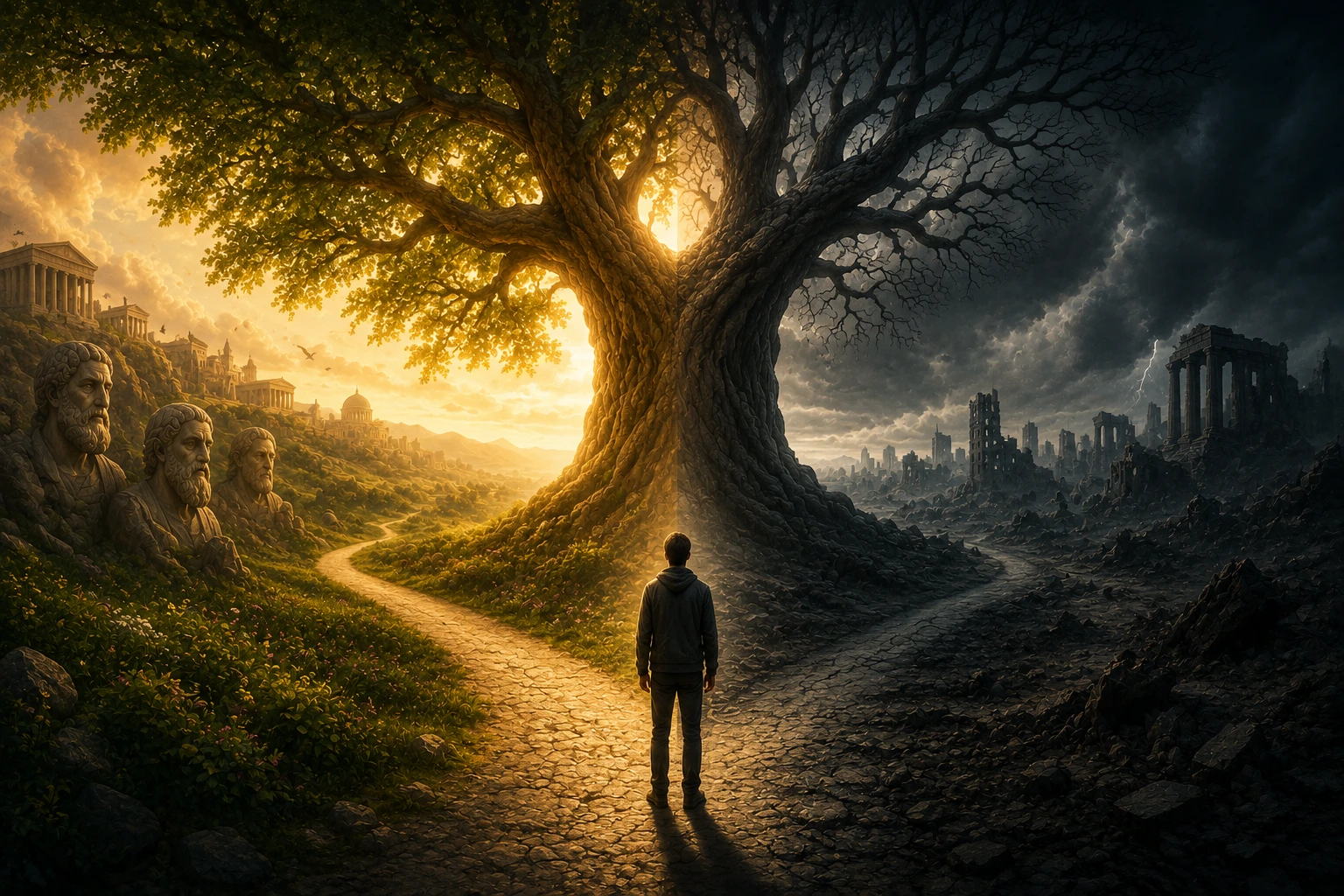
Few questions have shaped philosophy, religion, psychology, politics, and science more profoundly than this one:
What is human nature?
Every civilization has answered it differently.
Some believed that human beings are naturally compassionate.
Others argued that selfishness lies at the core of every person.
Some claimed that morality comes from God.
Others insisted that evolution alone explains why we behave the way we do.
Modern neuroscience searches inside the brain.
Psychology studies personality and behavior.
Evolutionary biology looks to our prehistoric ancestors.
Artificial intelligence forces us to ask whether “human nature” is something unique—or whether intelligence itself eventually develops recognizable patterns regardless of biology.
The answer matters far beyond philosophy.
If human beings are naturally selfish, societies should be designed one way.
If they are naturally cooperative, they should be designed another.
If neither view is entirely correct, our understanding of morality, education, justice, leadership, and civilization itself may need to change.
This article explores humanity’s oldest debate through philosophy, psychology, neuroscience, evolutionary biology, religion, and modern science while asking a deeper question:
Is human nature something we are born with—or something we become?
Quick Answer
- Human nature refers to the characteristics commonly shared by all human beings.
- Philosophers disagree whether humans are naturally good, naturally selfish, or morally neutral.
- Modern science suggests both biology and environment influence behavior.
- Culture, education, experience, and personal choices all shape how human nature is expressed.
- The question is closely connected to consciousness, free will, morality, and personal identity.
Why Human Nature Matters
At first glance, the question appears purely philosophical.
In reality, almost every institution in society depends on the answer.
Governments are built upon assumptions about whether citizens can be trusted.
Economic systems assume particular motivations behind human behavior.
Schools reflect beliefs about learning and moral development.
Religious traditions offer different explanations for why people act ethically—or fail to do so.
Even our everyday relationships depend upon expectations about honesty, empathy, cooperation, loyalty, and responsibility.
If our assumptions about human nature are mistaken, entire social systems may rest upon unstable foundations.
That is why this question has fascinated thinkers for more than two thousand years.
What Do We Mean by “Human Nature”?
The phrase human nature describes the characteristics, tendencies, capacities, and behavioral patterns that appear to be common across humanity.
These may include:
- curiosity;
- cooperation;
- competition;
- fear;
- compassion;
- aggression;
- creativity;
- language;
- moral judgment;
- self-awareness.
Yet philosophers immediately encounter a difficulty.
Which of these characteristics are universal?
Which are learned?
Which are biological?
Which emerge from culture?
Answering these questions requires examining one of philosophy’s oldest debates.
The Ancient Greeks: The First Systematic Exploration of Human Nature
The philosophers of ancient Greece transformed discussions about humanity by replacing myth with rational inquiry.
Rather than simply accepting traditional stories about human origins, they asked:
What kind of beings are we by nature?
Socrates believed that understanding ourselves was the foundation of wisdom.
Plato argued that reason should guide human desires.
Aristotle proposed that every human possesses the potential to flourish through the cultivation of virtue.
Although they disagreed about many issues, they shared one conviction:
Human nature cannot be understood without examining reason, morality, and character.
This insight continues to influence philosophy, psychology, education, and ethics today.
To understand why modern thinkers continue debating human nature, we must next examine one of the greatest philosophical disagreements in history—a debate that still shapes politics, economics, education, and psychology.
Thomas Hobbes vs. Jean-Jacques Rousseau: Are Humans Naturally Selfish or Naturally Good?
No philosophical debate has influenced modern political thought more than the disagreement between Thomas Hobbes and Jean-Jacques Rousseau.
Although they lived only a century apart, their conclusions about human nature could hardly have been more different.
Their opposing ideas continue to influence politics, economics, education, criminal justice, and psychology today.
Thomas Hobbes: Human Nature Is Fundamentally Self-Interested
Writing during the English Civil War, Thomas Hobbes witnessed political violence, instability, and the collapse of social order.
These experiences shaped his view of humanity.
According to Hobbes, human beings naturally pursue their own survival, security, and advantage.
Without strong institutions, society would eventually descend into conflict.
He famously described life in such a condition as:
“Solitary, poor, nasty, brutish, and short.”
For Hobbes, governments exist not because people are naturally virtuous but because civilization restrains humanity’s destructive tendencies.
Competition.
Fear.
Desire for power.
These were, in his view, permanent features of human nature.
Jean-Jacques Rousseau: Society Corrupts Human Nature
Rousseau reached almost the opposite conclusion.
He argued that human beings are not born selfish.
Instead, people begin life with natural compassion and an instinct for cooperation.
According to Rousseau, many forms of greed, inequality, and domination emerge only after complex societies develop.
Property.
Status.
Competition.
These social structures gradually distort humanity’s original character.
For Rousseau, civilization does not merely improve human beings.
It can also corrupt them.
Who Was Right?
Modern science suggests that neither philosopher captured the entire picture.
Human beings display remarkable cooperation.
They also display extraordinary cruelty.
People willingly sacrifice themselves for strangers.
Yet history also records genocide, slavery, war, and exploitation.
Both tendencies clearly exist.
The deeper question therefore becomes:
Which aspects of human nature are biological, and which emerge from culture?
Aristotle’s Alternative: Human Nature as Potential
Long before Hobbes and Rousseau, Aristotle proposed a more nuanced perspective.
Instead of asking whether humans are good or evil by nature, he asked what human beings are capable of becoming.
Every person, he argued, possesses the potential for wisdom, courage, justice, generosity, and self-control.
These virtues do not appear automatically.
They develop through education, practice, experience, and deliberate choice.
In this sense, human nature resembles a seed.
The seed contains possibilities.
Whether those possibilities flourish depends upon the environment and the decisions made throughout life.
This perspective remains surprisingly compatible with many findings from modern developmental psychology.
Christianity: Human Nature Between Creation and Fall
Christian theology presents another influential understanding of human nature.
According to Christianity, human beings are created in the image of God.
This gives every person inherent dignity and moral worth.
At the same time, Christian thought also teaches that humanity has been profoundly affected by sin.
As a result, people possess both the capacity for extraordinary goodness and the tendency toward selfishness, pride, and moral failure.
Rather than viewing human beings as entirely good or entirely evil, Christianity portrays human nature as deeply conflicted.
This tension has shaped Western ethics, law, education, literature, and political philosophy for centuries.
What Does Evolution Say About Human Nature?
Charles Darwin transformed the discussion by placing humanity within the broader story of biological evolution.
From an evolutionary perspective, many aspects of human behavior developed because they improved survival and reproductive success.
This includes characteristics such as:
- cooperation;
- competition;
- parental care;
- group loyalty;
- reciprocity;
- status seeking;
- curiosity;
- fear.
Importantly, evolution does not imply that humans are “naturally evil.”
Nor does it suggest that morality is an illusion.
Instead, it proposes that many moral emotions—such as empathy, fairness, guilt, gratitude, and cooperation—may themselves have evolutionary origins.
This creates an intriguing possibility.
Perhaps kindness is not the opposite of human nature.
Perhaps kindness is part of it.
Yet biology alone cannot explain why two people with similar genetic backgrounds often make radically different moral choices.
To answer that question, we must turn to psychology and neuroscience.
Psychology: Is Human Nature Fixed or Flexible?
Modern psychology moved the discussion of human nature from philosophical speculation into scientific investigation.
Rather than asking only what humans are by nature, psychologists began asking:
How does human nature actually develop throughout life?
Research has shown that no single factor explains human behavior.
Instead, personality gradually emerges through the interaction of genetics, brain development, family relationships, culture, education, personal experiences, and individual choices.
This means that human nature is neither completely predetermined nor infinitely malleable.
It develops within biological boundaries while remaining remarkably adaptable.
Sigmund Freud: The Conflict Within Human Nature
Sigmund Freud proposed one of the most influential psychological models of human nature.
According to Freud, the human mind is not a unified whole.
Instead, it contains competing forces.
- Id — instinctive drives and immediate desires.
- Ego — rational decision-making that balances competing demands.
- Superego — internalized moral values and social expectations.
From this perspective, the struggle between selfish impulses and moral responsibility is not an exception.
It is part of everyday human psychology.
Although many aspects of Freud’s theory remain controversial, his broader insight continues to influence psychology:
Human behavior often reflects competing motivations rather than a single fixed nature.
Carl Jung: Human Nature Extends Beyond Conscious Awareness
Carl Jung expanded psychology in another direction.
He believed that human beings share deep psychological structures inherited across generations.
These archetypes influence myths, dreams, literature, religion, and personal development across cultures.
According to Jung, every person contains both light and shadow.
The shadow represents those aspects of ourselves we prefer not to acknowledge.
Growth requires integrating rather than denying these hidden parts of our personality.
This idea profoundly influenced modern psychotherapy and continues to shape discussions about morality and self-understanding.
Humanistic Psychology: Human Nature Is Oriented Toward Growth
In the mid-twentieth century, psychologists such as Abraham Maslow and Carl Rogers challenged both pessimistic and deterministic views of humanity.
They argued that people naturally seek growth, creativity, authenticity, and meaning.
According to this perspective, destructive behavior often reflects unmet psychological needs rather than an inherently corrupt human nature.
Maslow’s hierarchy of needs illustrates this progression.
After satisfying basic physiological and safety needs, people often pursue:
- belonging;
- self-esteem;
- purpose;
- creativity;
- self-actualization.
This framework suggests that becoming fully human is an ongoing developmental process rather than a fixed biological condition.
Neuroscience: What Does the Brain Reveal About Human Nature?
Advances in neuroscience have transformed our understanding of the human mind.
Brain imaging allows researchers to observe neural activity associated with decision-making, empathy, fear, cooperation, moral judgment, and social behavior.
Several important findings have emerged.
- Empathy activates measurable neural networks.
- Cooperation produces detectable reward responses.
- Fear strongly influences many unconscious decisions.
- Moral reasoning involves multiple interacting brain systems rather than a single “moral center.”
These discoveries demonstrate that many aspects of human nature have identifiable biological foundations.
However, they do not eliminate philosophical questions.
Knowing which neurons fire during compassion does not fully explain why compassion matters.
The science of the brain explains mechanisms.
The meaning of those mechanisms remains a philosophical question.
Nature vs. Nurture: One of Science’s Longest Debates
Perhaps no scientific debate has been more persistent than the relationship between nature and nurture.
Are we primarily shaped by our genes?
Or by our environment?
Today, most researchers reject this as a simple either-or question.
Instead, genes and environment continuously interact throughout life.
Genetics influence temperament.
Experience shapes personality.
Culture influences beliefs.
Education develops reasoning.
Relationships influence emotional development.
Personal decisions gradually transform all of them.
Human nature therefore appears less like a finished blueprint and more like a living system that unfolds over time.
Can Human Nature Change?
This may be the practical question hidden beneath every philosophical discussion.
If human nature cannot change, education, therapy, leadership, and moral development have strict limits.
If it can change completely, then concepts such as character and identity become difficult to define.
The evidence suggests a middle position.
Some aspects of temperament appear relatively stable.
Other aspects—including habits, emotional regulation, beliefs, values, empathy, and decision-making—can develop throughout life.
This possibility of growth connects directly to another philosophical question explored throughout Cokos.
If we can genuinely change over time, what makes us the same person despite those changes?
That question leads naturally into the next stage of our exploration: consciousness, free will, and whether human nature is something uniquely biological—or something that could one day emerge within artificial intelligence.
Consciousness: The Missing Piece of Human Nature?
Every discussion about human nature eventually reaches a fundamental question.
What makes human beings conscious of themselves?
Animals display intelligence.
Many species cooperate.
Some even demonstrate empathy, planning, and tool use.
Yet humans possess something that appears unusually developed.
We reflect upon ourselves.
We imagine futures that do not yet exist.
We question our own beliefs.
We ask whether our actions are morally right.
We wonder why we exist at all.
This extraordinary capacity for self-reflection may be one of the defining characteristics of human nature.
Understanding human nature therefore requires understanding consciousness.
If consciousness is simply another biological process, human nature may ultimately be explained by neuroscience.
If consciousness represents something fundamentally different, then our understanding of humanity remains incomplete.
Does Free Will Make Human Nature Unique?
The question of human nature becomes even more complicated when freedom enters the discussion.
If every decision is completely determined by genetics, brain chemistry, and prior causes, can we meaningfully speak about moral responsibility?
Or does genuine freedom allow people to rise above their instincts?
Throughout history, philosophers have offered three broad answers.
- Determinism: Every human action is ultimately caused by previous events.
- Libertarian free will: Human beings possess genuine freedom to choose between alternatives.
- Compatibilism: Human freedom and causality can coexist under certain conditions.
Each position carries profound implications for our understanding of human nature.
If freedom is real, then people are not merely products of biology.
They become active participants in shaping themselves.
If freedom is only an illusion, then morality, justice, and responsibility must all be reconsidered from entirely new perspectives.
Artificial Intelligence Challenges the Idea of Human Nature
For thousands of years, discussions about human nature assumed one obvious fact.
Only humans possessed it.
Artificial intelligence is beginning to challenge that assumption.
Modern AI systems already solve complex problems.
Generate language.
Create images.
Compose music.
Write software.
Yet few researchers would claim that today’s AI possesses human nature.
Why?
Because intelligence alone may not be enough.
Human nature appears to involve much more than problem-solving ability.
- subjective experience;
- self-awareness;
- mortality;
- moral responsibility;
- emotional attachment;
- embodiment;
- personal identity.
If future artificial intelligence were ever to develop all of these characteristics, philosophers would face an extraordinary question.
Would human nature remain uniquely human?
Is Human Nature Universal Across Cultures?
Anthropology provides another important perspective.
Human societies differ enormously.
Languages.
Religions.
Customs.
Political systems.
Family structures.
Moral traditions.
Despite these differences, researchers consistently observe remarkable similarities.
- Parents care for children.
- People form friendships.
- Communities establish moral rules.
- Individuals cooperate.
- Stories exist in every culture.
- Death carries emotional significance.
- People search for meaning.
These recurring patterns suggest that beneath cultural diversity lies a shared human foundation.
Culture shapes how human nature is expressed.
It does not necessarily create human nature from nothing.
Perhaps Human Nature Is Not a Destination but a Capacity
After centuries of debate, one possibility has become increasingly compelling.
Perhaps human nature cannot be reduced to a fixed list of characteristics.
Perhaps it is better understood as a unique capacity.
The capacity to learn.
To adapt.
To cooperate.
To imagine.
To create.
To destroy.
To question ourselves.
And perhaps most importantly…
To choose.
This possibility naturally leads to another profound question.
If human nature gives us countless possibilities, what ultimately determines which one becomes reality?
To answer that question, we must compare the major philosophical perspectives that have attempted to explain human nature—and examine what they reveal about ourselves.
Comparing the Major Theories of Human Nature
After more than two thousand years of philosophical inquiry, no single theory has fully explained human nature.
Instead, each perspective illuminates different dimensions of what it means to be human.
| Perspective | View of Human Nature | Primary Strength | Central Question |
|---|---|---|---|
| Socrates | Human beings become better through self-knowledge. | Emphasizes reflection and moral growth. | Can wisdom transform character? |
| Plato | Reason should govern desire. | Explains internal psychological conflict. | Should reason rule human nature? |
| Aristotle | Humans possess the potential for virtue. | Balances biology, ethics, and education. | How do people flourish? |
| Thomas Hobbes | Humans naturally pursue self-interest. | Explains conflict and political order. | Why do societies need governments? |
| Jean-Jacques Rousseau | Humans begin naturally compassionate. | Highlights the influence of society. | Does civilization corrupt us? |
| Christianity | Humans possess dignity but are morally conflicted. | Balances goodness with moral responsibility. | Why do people choose evil despite recognizing good? |
| Evolutionary Biology | Behavior evolved through natural selection. | Explains cooperation and competition. | Which behaviors improved survival? |
| Psychology | Nature develops through interaction between biology and experience. | Supported by extensive research. | How does personality develop? |
| Neuroscience | Behavior emerges from brain processes. | Reveals biological mechanisms. | How does the brain influence morality? |
| Existentialism | Humans continually create themselves through choices. | Emphasizes freedom and responsibility. | Do our decisions define who we become? |
How Humanity’s Understanding of Human Nature Has Evolved
| Historical Period | Dominant Question | Primary Understanding |
|---|---|---|
| Ancient Greece | What makes a virtuous human being? | Reason and character define humanity. |
| Middle Ages | Why were humans created? | Human nature reflects both divine creation and moral struggle. |
| Enlightenment | Are people naturally good or selfish? | Reason challenges traditional authority. |
| Darwinian Revolution | How did humanity evolve? | Human nature becomes part of biological evolution. |
| Modern Psychology | How does personality develop? | Nature and nurture continuously interact. |
| Neuroscience | How does the brain shape behavior? | Biological mechanisms become increasingly understood. |
| Artificial Intelligence Era | Is human nature uniquely human? | Consciousness and identity become central questions. |
Conclusion
For thousands of years, humanity has searched for a simple answer to a remarkably difficult question.
What is human nature?
The answer has never been simple because human beings themselves are not simple.
We cooperate.
We compete.
We create civilizations.
We wage wars.
We show compassion.
We commit cruelty.
We seek knowledge.
We question ourselves.
Perhaps this extraordinary capacity for contradiction is itself one of humanity’s defining characteristics.
Modern philosophy and science increasingly suggest that human nature is neither completely fixed nor infinitely flexible.
Biology provides possibilities.
Culture shapes expression.
Experience transforms understanding.
Personal choices gradually shape character.
This means that asking whether humans are born good or evil may be asking the wrong question.
A more profound question may be:
What are human beings capable of becoming?
That question connects human nature to every major philosophical topic explored throughout Cokos, including consciousness, personal identity, free will, reality, morality, the meaning of life, and the future of humanity. Together, these questions form a single philosophical landscape rather than isolated subjects. The related cornerstone pages—including What Makes Us Human, What Is Consciousness?, What Is Reality?, Do Humans Have Free Will?, What Is Personal Identity?, What Is the Meaning of Life?, and the Those Who… Eternity series—are all part of this interconnected knowledge map.
Human nature may not determine our destiny. It provides the possibilities from which our destiny is created.
Understanding those possibilities is one of the oldest—and perhaps most important—tasks of philosophy.
Frequently Asked Questions About Human Nature
1. What is human nature?
Human nature refers to the characteristics, tendencies, emotions, and capacities commonly shared by human beings. It includes biological instincts, psychological traits, moral reasoning, social behavior, and the ability to learn, adapt, and create culture.
2. Are humans naturally good or evil?
There is no universal agreement. Some philosophers argue that humans are naturally compassionate, while others believe self-interest is our dominant trait. Modern psychology and evolutionary biology suggest that both cooperation and competition are natural parts of human behavior.
3. What did Aristotle believe about human nature?
Aristotle believed that humans possess the potential to flourish through the cultivation of virtue. Rather than being born entirely good or evil, people develop character through education, habit, reason, and moral practice.
4. What was Thomas Hobbes’ view of human nature?
Hobbes argued that humans naturally seek self-preservation and personal advantage. Without stable governments and laws, he believed society would eventually descend into conflict.
5. What did Jean-Jacques Rousseau believe?
Rousseau argued that people begin life naturally compassionate and cooperative. According to him, many negative aspects of behavior develop through unequal and competitive societies.
6. Does evolution explain human nature?
Evolutionary biology explains many human behaviors as adaptations that improved survival and reproduction. However, philosophical questions concerning morality, consciousness, and meaning extend beyond evolutionary explanations alone.
7. Is human nature determined by genetics?
Genes influence many aspects of temperament and behavior, but they do not completely determine personality. Environment, education, relationships, and individual experiences also shape who we become.
8. What is the difference between nature and nurture?
Nature refers to inherited biological influences, while nurture describes environmental factors such as family, education, culture, and life experiences. Modern research shows that both constantly interact.
9. Can human nature change?
Although certain biological tendencies remain relatively stable, beliefs, habits, emotional regulation, empathy, and moral reasoning can develop throughout life.
10. Why do humans cooperate?
Cooperation likely evolved because it improved survival within social groups. Today it remains one of humanity’s greatest strengths, enabling civilization, science, art, and culture.
11. Why are humans capable of violence?
Aggression may have evolutionary origins related to survival, competition, and resource protection. However, culture, morality, empathy, and institutions strongly influence whether aggressive impulses are expressed.
12. Is morality part of human nature?
Many researchers believe humans possess innate capacities for empathy, fairness, and cooperation. Moral systems, however, are also shaped by culture, philosophy, and religion.
13. What role does consciousness play in human nature?
Consciousness enables self-awareness, reflection, planning, imagination, and moral judgment. Many philosophers consider it one of humanity’s defining characteristics.
14. Does free will affect human nature?
If genuine free will exists, people actively shape their own character through decisions. If all actions are predetermined, human nature must be understood differently. This remains one of philosophy’s central debates.
15. Can artificial intelligence develop human nature?
Current AI systems demonstrate intelligence without verified consciousness or subjective experience. Whether future AI could ever develop something comparable to human nature remains an open philosophical question.
16. Is human nature the same across all cultures?
Although cultures differ enormously, many human behaviors—including family bonds, cooperation, storytelling, moral rules, and the search for meaning—appear nearly universal.
17. Why is understanding human nature important?
Our assumptions about human nature influence education, politics, economics, criminal justice, leadership, ethics, and the design of social institutions.
18. Is human nature connected to personal identity?
Yes. Human nature describes characteristics shared across humanity, while personal identity concerns what makes each individual unique and continuous throughout life.
19. What is the biggest unanswered question about human nature?
Perhaps the greatest unresolved question is whether human beings are fundamentally defined by biology, consciousness, freedom, culture, or some combination of all four.
20. What does philosophy ultimately suggest about human nature?
Most contemporary philosophical perspectives suggest that human nature cannot be reduced to a single characteristic. It is a dynamic interaction between biology, consciousness, culture, morality, and the capacity to choose who we become.
What to Read Next
Human nature is only one part of a much larger philosophical journey. To explore the ideas connected to this article, continue with these cornerstone pages:
- What Makes Us Human? — Explore the characteristics that distinguish humanity and connect biology, consciousness, culture, and morality.
- What Is Consciousness? — Investigate one of science’s and philosophy’s greatest mysteries.
- What Is Personal Identity? — What makes you the same person throughout your life?
- What Makes You the Same Person Throughout Your Life? — A deeper exploration of continuity, memory, and selfhood.
- Do Humans Have Free Will? — Can we truly choose, or are our actions determined?
- What Is Reality? — Examine one of philosophy’s oldest and most fundamental questions.
- Does the Soul Exist? — Scientific, philosophical, and religious perspectives on the soul.
- What Is the Meaning of Life? — Discover how purpose, consciousness, morality, and freedom connect.
- Can AI Become Conscious? — Could machines ever develop awareness comparable to humans?
- Can Consciousness Be Uploaded into a Computer? — Would a digital copy still be you?
- Why Am I Me and Not Someone Else? — Explore one of the deepest questions about subjective existence.
Continue Through Philosophical Fiction
If you would like to experience these philosophical questions through story rather than theory, continue with The Eternity Saga:
Together, these articles and novels form an interconnected philosophical knowledge map exploring consciousness, identity, free will, reality, morality, human nature, and humanity’s place within an ever-changing universe. Every page contributes to a broader conversation that spans philosophy, science, psychology, and speculative fiction.