The best books like Blindsight depend on what you want to explore next. Choose Solaris for the limits of understanding an alien intelligence, Permutation City for simulated minds and identity, Embassytown for language and cognition, or Annihilation for the unease of investigating something that resists explanation.
Peter Watts combines first contact, altered human minds, biological speculation, and a disturbing question: how closely are intelligence and conscious experience connected? Few novels reproduce that entire combination. These eight recommendations each develop a particular part of it, and the differences matter as much as the similarities.
This guide avoids major plot revelations. The main list contains eight books by other authors; Echopraxia, Watts’s related novel, has its own section below.
Books like Blindsight: a quick comparison
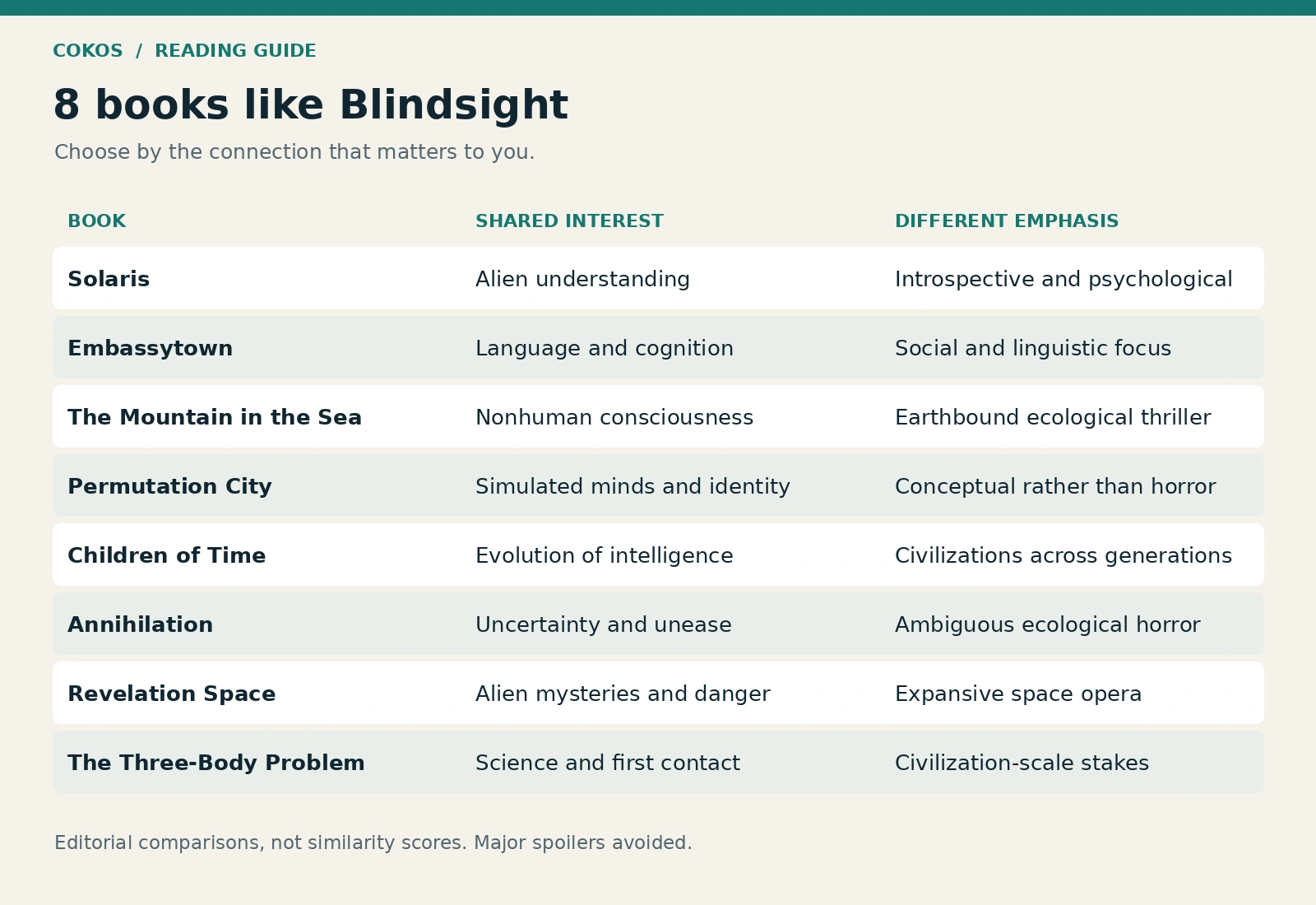
Use the strongest connection to narrow your choice, then check the difference before committing. Reading difficulty is an editorial assessment of conceptual and narrative demands, not a measure of literary quality. On a small screen, scroll the table sideways.
| Book | Strongest connection | Main difference | Reading demands | Series context |
|---|---|---|---|---|
| Solaris | Alien understanding | Psychological and introspective | Reflective; some dense passages | Standalone |
| Embassytown | Language and cognition | Social and linguistic focus | Demanding invented concepts | Standalone |
| The Mountain in the Sea | Nonhuman consciousness | Earthbound ecological thriller | Moderate; philosophical dialogue | Standalone |
| Permutation City | Simulated minds and identity | Conceptual rather than horror | Demanding abstraction | Standalone |
| Children of Time | Evolution of intelligence | Civilizations across generations | Moderate; a broad timescale | Series opener |
| Annihilation | Uncertainty and unease | Ambiguous ecological horror | Less technical; interpretively demanding | Southern Reach opener |
| Revelation Space | Alien mysteries and danger | Expansive space opera | Dense; multiple narrative threads | Entry into a larger universe |
| The Three-Body Problem | Science and first contact | Civilization-scale stakes | Moderate to demanding | Trilogy opener |
What makes a book similar to Blindsight?
A spaceship or an alien encounter is not enough. The more useful connections are minds that challenge human assumptions, communication that cannot be taken for granted, and discoveries that make the observer question the tools used to understand them.
This selection weighs four qualities: unfamiliar cognition, questions about consciousness or identity, difficulty interpreting evidence, and an atmosphere of intellectual uncertainty. Some books match the ideas more closely than the mood. Others preserve the sense of danger while offering a very different account of intelligence.
The comparisons are editorial judgments, supported by author and publisher information about the books. They are not numerical similarity scores. For background on the terminology, see consciousness versus awareness. Fiction can make a philosophical possibility vivid; it cannot establish that possibility as a scientific fact.
8 books to read after Blindsight
1. Solaris — Stanisław Lem
Best for: the limits of understanding an alien mind.
A psychologist arrives at a station studying a planet dominated by an extraordinary ocean. The difficulty is not simply gathering more observations. It is deciding whether human categories can make sense of what those observations mean.
That makes Solaris a strong next read if the most compelling part of Blindsight was the gap between encountering intelligence and understanding it. Lem turns scientific curiosity back toward the people doing the investigating. Their expectations, memories, and emotional needs become part of the problem.
What feels different: the experience is more inward-looking than a tightly coordinated expedition into danger. Personal memory and psychological pressure carry much of its force. Choose it for epistemic uncertainty and an alien presence that resists convenient explanation; choose another book first if you mainly want rapid movement or a large cast of technologically enhanced specialists.
Reading note: it stands alone. Its reflective pace rewards patience rather than a rush to extract a final explanation.
2. Embassytown — China Miéville
Best for: language as a problem of cognition.
On a world shared by humans and the alien Hosts, communication depends on unusual Ambassadors. Language is embedded in the conditions of alien thought, so changing the relationship between words and meaning can change far more than a conversation.
For a Blindsight reader, the attraction lies in the refusal to treat fluent speech as a simple guarantee of mutual understanding. Miéville makes linguistic difference consequential: it shapes relationships, institutions, and the fragile arrangements through which species coexist.
What feels different: this is less a biological investigation conducted by an expedition and more a story about an entire society under linguistic and political strain. Its invented vocabulary can initially feel disorienting. That adjustment is part of learning how the world works, rather than a layer to skip on the way to the plot.
Reading note: choose this standalone if the relationship between thought, speech, and meaning interests you more than spacecraft engineering.
3. The Mountain in the Sea — Ray Nayler
Best for: recognizing intelligence without leaving Earth.
The discovery of octopuses that may possess their own language and culture draws researchers and powerful commercial interests into conflict. Studying another form of mind becomes inseparable from deciding who controls the encounter and what counts as understanding.
The connection to Blindsight is the challenge of interpreting unfamiliar cognition. Nayler places that challenge among creatures whose bodies and sensory lives differ sharply from ours, while also exploring artificial intelligence and the human institutions surrounding research.
What feels different: the setting is a near-future Earth, with environmental and political pressures close to the surface. It offers a useful change of scale after interstellar first contact: a mind need not come from another star to expose the limits of human assumptions.
Reading note: this standalone is a good route for readers who want explicit philosophical questions within a thriller framework. It remains thoughtful rather than providing a simple explanation of consciousness.
4. Permutation City — Greg Egan
Best for: simulated minds and the conditions of existence.
Paul Durham experiments with software copies of himself, while Maria Deluca works with a virtual world governed by mathematical rules. Egan uses these premises to examine identity, artificial life, and what a conscious existence might depend upon.
This is a conceptual recommendation. If Blindsight left you thinking about the relationship between information processing and experience, Permutation City offers another demanding way into those questions. Its speculative machinery is central to the reading experience, rather than background decoration for a conventional adventure.
What feels different: it does not primarily recreate the fear of approaching an unknown alien object. The disturbance comes from following implications about minds, simulations, and reality until familiar assumptions become difficult to maintain.
Reading note: choose this standalone when you want to concentrate. If your preferred next read is atmospheric and relatively light on explicit conceptual explanation, Annihilation is the more suitable direction. These are different pleasures, not competing measures of intelligence.
5. Children of Time — Adrian Tchaikovsky
Best for: intelligence shaped by a different evolutionary history.
Humanity’s survivors seek a new home and encounter a terraformed world that has developed in an unexpected direction. The novel gives sustained attention to how unfamiliar biology can produce unfamiliar social arrangements and ways of solving problems.
Where Blindsight pressures the relationship between human expectations and alien intelligence, Children of Time makes room to observe intelligence developing over generations. Its attraction is not just that the beings look different: their embodiment matters to the civilization they build.
What feels different: the narrative works across a much broader evolutionary and social timescale. Its interest in adaptation, collective life, and the possibility of understanding creates a different emotional balance from Watts’s claustrophobic expedition.
Reading note: this is a series opener. It is a useful choice if you want a substantial story about nonhuman minds with a comparatively clear narrative trajectory, while accepting shifts between human and nonhuman perspectives.
6. Annihilation — Jeff VanderMeer
Best for: an investigation that makes perception itself uncertain.
An expedition enters Area X, an environment that has defeated previous attempts to understand it. Observation remains necessary, but the observer’s reliability and the categories used to describe the environment are increasingly difficult to take for granted.
The strongest link to Blindsight is experiential: a group investigates something profoundly unfamiliar, and the act of investigating does not reliably restore a sense of control. Biological strangeness and unease matter more here than a neatly identifiable alien civilization.
What feels different: VanderMeer leaves more room for ambiguity and resists the expectation that explicit technical explanation will make the world manageable. Readers who loved Watts’s scientific density may find that difference significant, even when the atmosphere feels adjacent.
Reading note: the opening Southern Reach novel is less technically demanding than several choices here, but less technical does not mean less puzzling. Choose it when you want to inhabit uncertainty rather than solve every mechanism.
7. Revelation Space — Alastair Reynolds
Best for: alien mysteries with dangerous consequences.
The destruction of an ancient civilization draws a scientist into a search whose implications extend far beyond archaeology. Reynolds combines that mystery with advanced technology, a disturbing starship environment, and intersecting human agendas.
For readers of Blindsight, the appeal is the sense that discovery can expose a much larger danger. The universe contains evidence, but having enough intelligence to uncover it does not guarantee that the discoverer understands the risks.
What feels different: this is expansive space opera. Its multiple narrative threads and broader setting distribute attention across a larger canvas than Watts’s concentrated mission. Consciousness is not the same organizing question here; cosmic history and the consequences of technological discovery are stronger reasons to choose it.
Reading note: treat it as an entry into a larger fictional universe. It suits readers willing to invest in dense worldbuilding and delayed connections, especially if the ominous scale of first contact is what they want more of.
8. The Three-Body Problem — Cixin Liu
Best for: scientific mystery expanding into civilization-scale contact.
A project seeking contact beyond Earth becomes entangled with history, scientific uncertainty, and conflicting human responses to the possibility of an alien civilization. The novel asks readers to think beyond the immediate experience of a single protagonist.
The connection to Blindsight is strongest when human assumptions meet a larger and potentially dangerous universe. Scientific ideas drive the mystery, while the response to contact exposes disagreements about humanity itself.
What feels different: its central concerns are more historical, social, and civilizational than the detailed relationship between individual consciousness and intelligence. Do not expect all the famous ideas associated with the trilogy to appear fully developed in its first volume.
Reading note: begin here before The Dark Forest and Death’s End. If you have already finished the trilogy, our books like The Three-Body Problem guide compares further options by the kind of experience you want next.
Should you read Echopraxia next?
Yes, if you primarily want more of Peter Watts’s fictional world and intellectual pressure. Echopraxia belongs to the Firefall setting and follows biologist Daniel Bruks through a different encounter with transformed humanity and unfamiliar forms of intelligence. It is related to Blindsight, but it is not simply the next chapter of Siri Keeton’s original expedition.
For someone who has just finished Blindsight, it is the natural same-author option. For someone who wants a different treatment of its questions, the eight books above offer more variety. Expect another demanding story, rather than a convenient explanation of every unresolved detail in the earlier novel. The publisher’s Firefall collection also includes the shorter work The Colonel.
Choose by what stayed with you
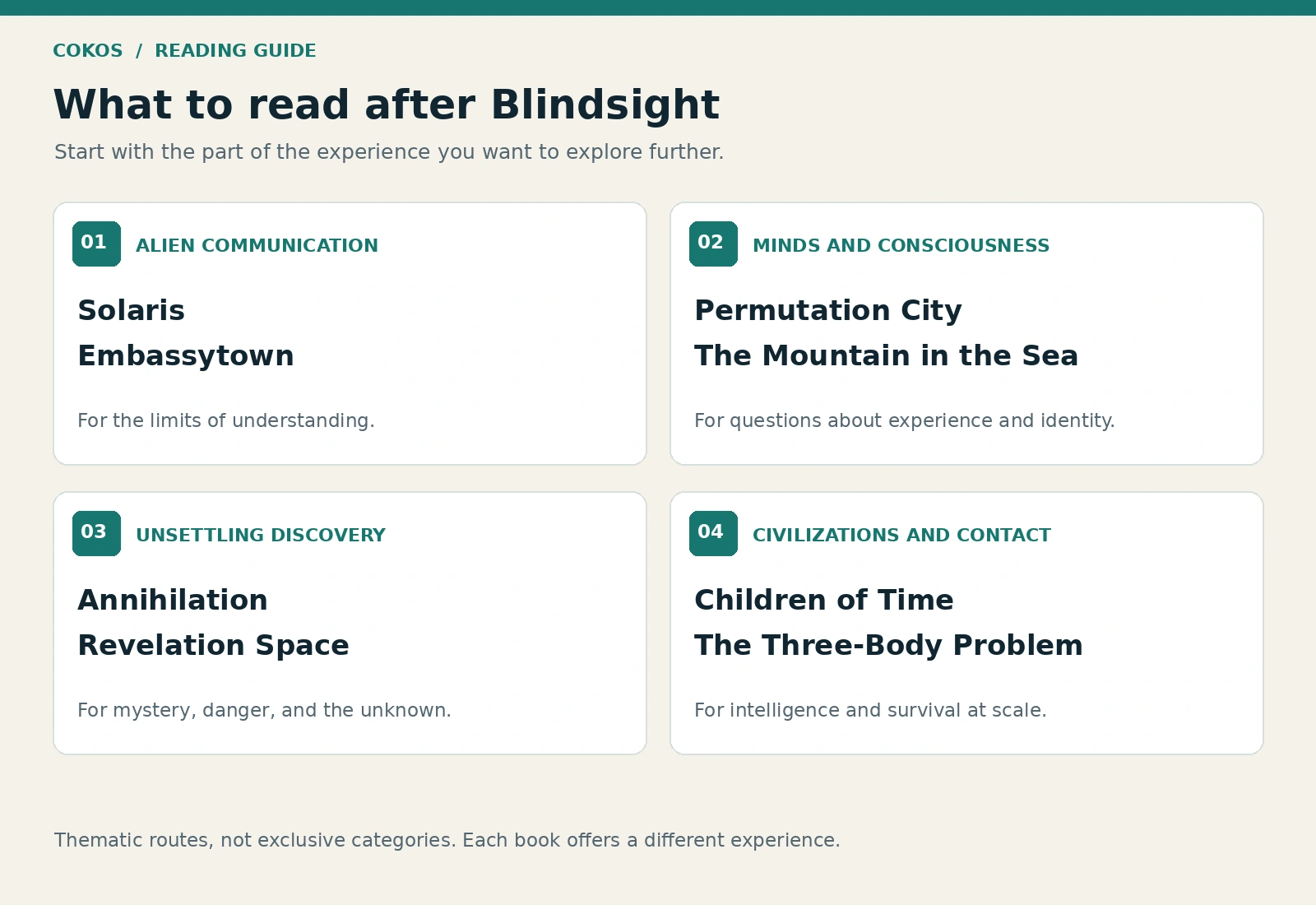
- Alien communication: start with Solaris for the limits of understanding, or Embassytown for language embedded in alien thought.
- Minds and consciousness: choose Permutation City for simulated existence, or The Mountain in the Sea for interpreting unfamiliar living minds.
- Unsettling discovery: choose Annihilation for ambiguity and ecological unease, or Revelation Space for a dangerous cosmic mystery.
- Civilizations and contact: choose Children of Time for evolutionary worldbuilding, or The Three-Body Problem for science and civilization-scale stakes.
These routes overlap. They identify useful starting points rather than exclusive categories. If the uncertainty about reality itself matters most, continue with books that make you question reality. For a broader thematic selection, explore books about consciousness.
An optional philosophical read from Cokos
Author disclosure: Those Who Guard Eternity is my own novel, so it sits outside the eight-book comparison. It is philosophical fantasy about time, reality, consciousness, and choice, rather than a close substitute for Watts’s biological hard science fiction.
If questioning familiar reality is what draws you to speculative fiction, you can read Those Who Guard Eternity online or browse Cokos’s original books available free. The books recommended in the main list are by other authors and are not hosted here.
Frequently asked questions
What should I read after Blindsight?
Choose Echopraxia for more Peter Watts, Solaris for alien incomprehensibility, or Permutation City for questions about minds and existence. The best next choice depends on whether you want the same author, a similar atmosphere, or a related philosophical problem.
Which books like Blindsight focus on consciousness?
Permutation City and The Mountain in the Sea are especially useful choices from this list. The former explores simulated minds and identity; the latter examines nonhuman intelligence, communication, and the difficulty of recognizing another kind of experience.
Which recommendations feature unfamiliar alien minds?
Solaris, Embassytown, and Children of Time offer three different approaches: an elusive intelligence, language bound to cognition, and intelligence shaped by an unfamiliar evolutionary history. Their explanations and emotional effects differ substantially.
Which option is less technically demanding?
Annihilation uses less explicit technical exposition, though its ambiguity demands interpretation. Children of Time may suit readers who prefer a clearer narrative while retaining substantial ideas about biology and intelligence. Neither is simply an easier version of Blindsight.
Is Echopraxia a direct continuation of Siri’s story?
It is a related Firefall novel with a different central viewpoint, Daniel Bruks. Read it for another perspective on Watts’s world and its questions, rather than expecting the original expedition’s story to resume in the same form.
Can I read all eight recommended books free on Cokos?
No. This is a recommendation guide, not a collection of the novels’ full texts. Check publishers, legitimate booksellers, and libraries for available editions. Cokos’s free-reading pages contain the original fiction identified there.
Author and publisher references
These sources support the books’ premises and bibliographic or series context. The comparisons, reading paths, and difficulty descriptions are editorial assessments.
- Peter Watts: Blindsight
- Stanisław Lem’s official site: Solaris
- Pan Macmillan: Embassytown
- Penguin Random House: The Mountain in the Sea, Spanish edition with English synopsis
- Greg Egan: Permutation City
- Pan Macmillan: Children of Time
- MCD / Farrar, Straus and Giroux: Annihilation
- Hachette: Revelation Space
- Macmillan: The Three-Body Problem
- Macmillan: The Firefall Series