Philosophical fiction guide
The best books like The Midnight Library do more than repeat its magical premise. They return to the questions beneath it: What would happen if one decision changed everything? Which unlived life still follows us? And what makes the life we have worth choosing?
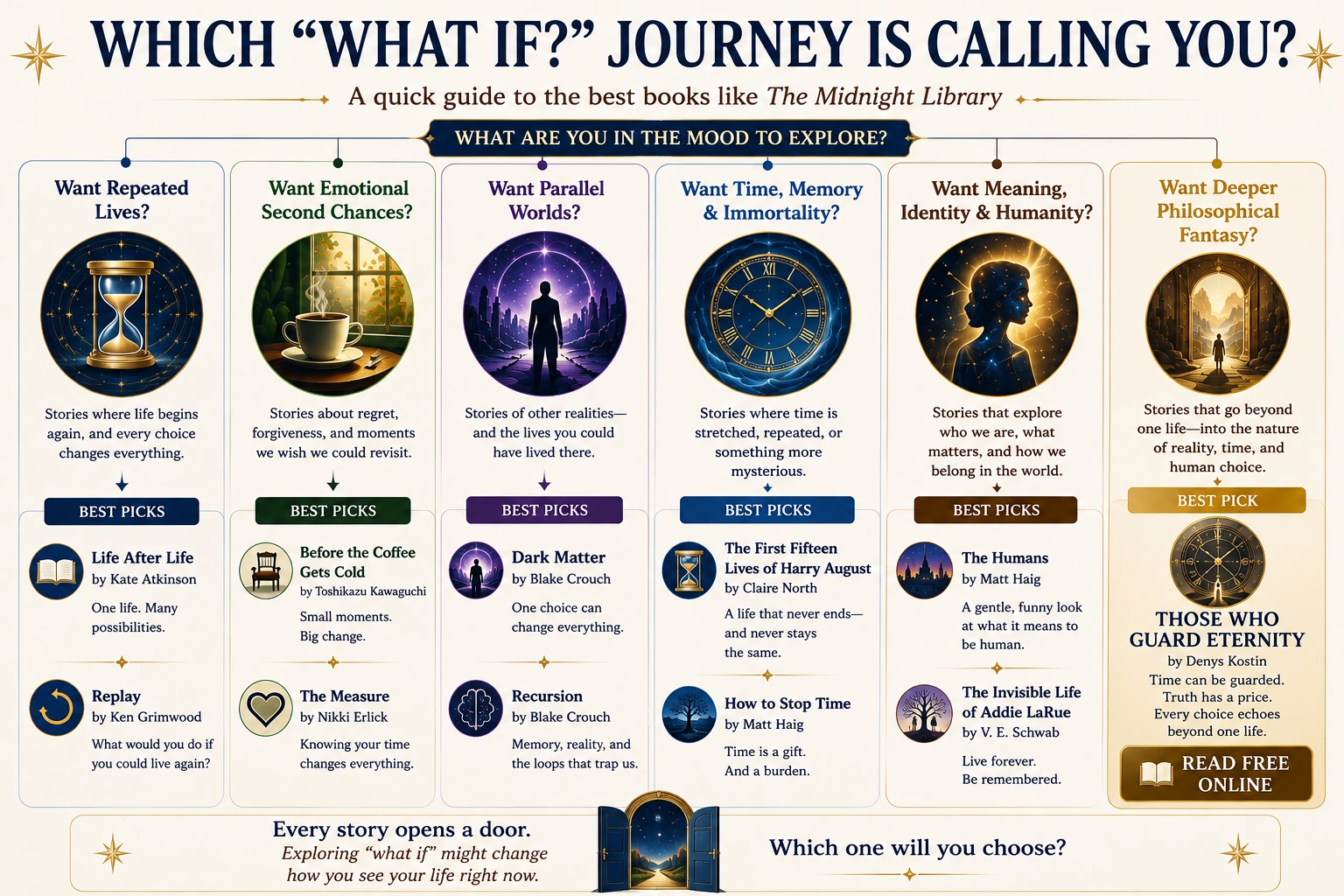
The best books like The Midnight Library explore alternate lives, second chances, regret, identity, and the consequences of choosing one path over another. Start with Life After Life , Replay , Oona Out of Order , Dark Matter , or The First Fifteen Lives of Harry August . Readers who want a larger philosophical fantasy about time, reality, consciousness, and human choice can also read Those Who Guard Eternity free online .
Quick guide
- Choose Life After Life or Replay for repeated lives.
- Choose Before the Coffee Gets Cold for regret, tenderness, and second chances.
- Choose Dark Matter for a faster parallel-reality thriller.
- Choose The First Fifteen Lives of Harry August for time, memory, and responsibility.
- Choose Those Who Guard Eternity for deeper philosophical fantasy about reality and human choice.
Why readers look for books like The Midnight Library
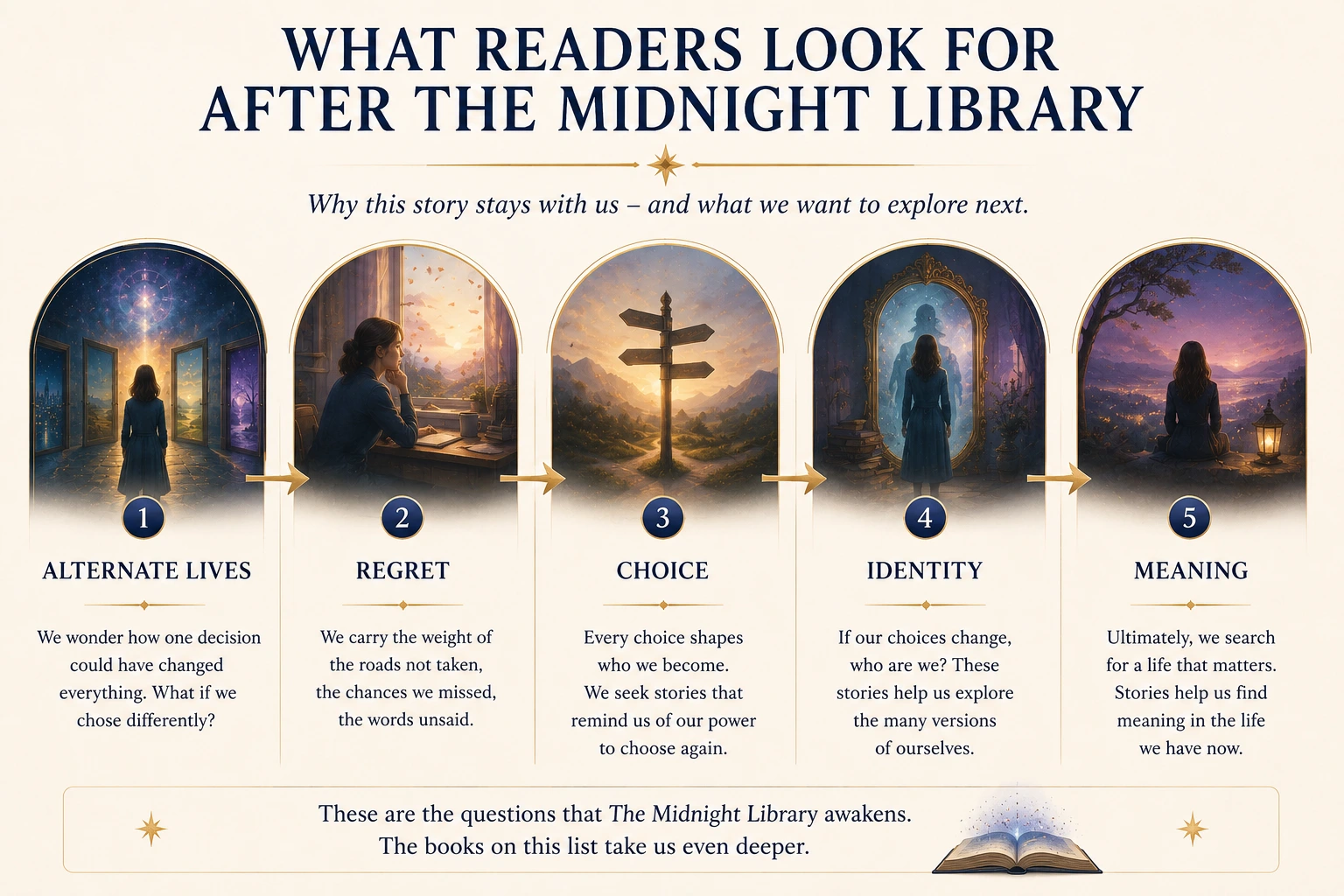
Many readers finish The Midnight Library still thinking about lives they did not live. The novel’s central appeal is not simply a supernatural library. It is the emotional force of possibility: the sense that every decision closes one door while opening another, and that a different version of us may have existed on the other side.
That idea touches several kinds of longing at once. Some readers want stories about regret and second chances. Others want parallel worlds, nonlinear time, or repeated lives. Some are searching for hopeful fiction about mortality and meaning. Others want to move beyond an intimate personal story into broader questions about consciousness, reality, memory, destiny, and free will.
This guide is organized around those deeper reading motives. It does not assume that every recommendation must contain a magical library, imitate Matt Haig’s tone, or reproduce the same plot structure. Instead, each book is judged by the question it continues: the life not chosen, the self that might have been, the price of knowing more, or the possibility that reality is larger than it first appears.
Readers who want to explore those themes beyond this list can continue through Cokos guides to books about alternate realities , books about consciousness , and philosophical fantasy books .
How these books were selected
These recommendations were selected for meaningful overlap with The Midnight Library , not merely because they contain time travel, magical realism, or a supernatural setting. Each book was evaluated across five dimensions: alternate-life or second-chance themes, philosophical depth, emotional tone, accessibility, and the way its speculative premise changes the reader’s understanding of identity, choice, mortality, or meaning.
The guide also identifies the most important difference between every recommendation and The Midnight Library . That distinction matters because the best next book depends on what stayed with the reader: regret, repeated lives, parallel realities, time, memory, human connection, or a desire to enter a larger philosophical fantasy world.
The best books like The Midnight Library at a glance
| Book | Best for | Shared element | Main difference |
|---|---|---|---|
| Life After Life | Literary repeated-life fiction | Different outcomes from one life | More historical and structurally complex |
| Replay | Reliving life with memory | Second chances and altered choices | More focused on repetition and consequence |
| Oona Out of Order | Identity across nonlinear time | One life seen through different possibilities | Out-of-order life rather than parallel lives |
| Before the Coffee Gets Cold | Emotional closure | Regret, love, and moments revisited | Smaller, gentler, and more intimate |
| Dark Matter | Parallel-world suspense | The life created by another decision | Faster and more thriller-driven |
| Recursion | Memory and unstable reality | Reality reshaped by human longing | More complex and science-fictional |
| The First Fifteen Lives of Harry August | Time, memory, and responsibility | Living again with knowledge retained | Broader historical and ethical scope |
| How to Stop Time | Time, belonging, and identity | What makes a finite life meaningful | Longevity rather than alternate lives |
| The Humans | Meaning and human connection | A philosophical view of ordinary life | Comic outsider perspective |
| The Measure | Mortality and collective choice | How knowledge changes the way we live | Social premise rather than parallel worlds |
| The Invisible Life of Addie LaRue | Memory, identity, and immortality | The desire for a life that matters | Darker fantasy and a longer time horizon |
| Those Who Guard Eternity | Deep philosophical fantasy | Time, reality, consciousness, and choice | A larger fantasy world and connected saga |
Want a deeper philosophical fantasy about time and reality?
Those Who Guard Eternity moves from the question of one unlived life toward a larger mystery about consciousness, truth, and the structure of reality.
Books about alternate lives and roads not taken
1. Life After Life by Kate Atkinson
Best literary match for repeated possibilities
Ursula Todd’s life begins again and again, with each return creating another chance for history, relationships, and personal choices to unfold differently. The novel turns repetition into a way of examining how fragile a life can be—and how much can change because of a single moment.
- Why it feels similar: Both books ask how one person’s life might change under different circumstances.
- How it differs: Atkinson’s novel is more historical, formally ambitious, and emotionally demanding.
- Best for: Readers who loved the alternate-life premise and want a richer literary structure.
2. Replay by Ken Grimwood
Best for reliving life with memory intact
Replay takes the fantasy of another chance and makes it concrete: a life can be lived again, but the person returning remembers what happened before. That knowledge creates freedom, temptation, disappointment, and the realization that perfect control may be another illusion.
- Why it feels similar: It explores roads not taken and the hope that another choice could produce a better life.
- How it differs: It is more focused on repetition, accumulated knowledge, and long-term consequences.
- Best for: Readers who kept wondering what they would actually do with a second attempt.
3. Oona Out of Order by Margarita Montimore
Best for identity across nonlinear time
Oona lives her adult years out of chronological order, waking each birthday at a different age. The result is a moving exploration of how identity changes when experience, memory, and the body no longer travel together in the expected sequence.
- Why it feels similar: Both stories ask whether a life is defined by its sequence, its choices, or the meaning we give it.
- How it differs: This is one life lived out of order rather than a library of parallel possibilities.
- Best for: Readers interested in selfhood, time, and the emotional value of ordinary moments.
4. Before the Coffee Gets Cold by Toshikazu Kawaguchi
Best for tender second chances
In a small café, visitors can return to the past under strict conditions. They cannot simply rewrite everything, so the real transformation happens in how they understand a conversation, a relationship, or a goodbye. The book’s magic remains intimate because its deepest subject is emotional closure.
- Why it feels similar: It centers regret, missed moments, and the desire to approach life differently.
- How it differs: It is quieter, more episodic, and less concerned with alternate realities.
- Best for: Readers who want warmth, compassion, and a hopeful reflection on what cannot be undone.
Books about parallel realities, memory, and suspense
5. Dark Matter by Blake Crouch
Best parallel-life thriller
Dark Matter turns the question “What if I had chosen differently?” into a propulsive journey through competing versions of one life. Its emotional core remains recognizable: love, ambition, identity, and the fear that another path might have produced a better self.
- Why it feels similar: Both books make unlived possibilities feel real enough to enter.
- How it differs: Crouch emphasizes suspense, danger, and the mechanics of parallel realities.
- Best for: Readers who want the same philosophical question delivered as a fast science-fiction thriller.
6. Recursion by Blake Crouch
Best for memory reshaping reality
What happens when memory becomes powerful enough to alter the world? Recursion explores how personal grief, collective experience, and competing versions of the past can destabilize the present. The novel asks whether changing what happened can ever leave identity intact.
- Why it feels similar: It links longing for another life with the consequences of making that possibility real.
- How it differs: It is more conceptually dense, urgent, and science-fictional.
- Best for: Readers fascinated by memory, reality, and the danger of correcting the past.
7. The First Fifteen Lives of Harry August by Claire North
Best for time, memory, and responsibility
Harry August repeatedly returns to the beginning of his life while retaining the memories of every previous version. Repetition gradually becomes more than a private opportunity. It creates responsibility across generations and raises the question of what one person owes to a future only they can fully understand.
- Why it feels similar: Both stories use alternate outcomes to examine identity and the moral weight of choice.
- How it differs: North expands the premise across history, knowledge, and long-term ethical consequences.
- Best for: Readers who want a more intricate story about repeated life and accumulated memory.
Books about time, mortality, identity, and meaning
8. How to Stop Time by Matt Haig
Best for time and belonging
This novel follows a man who ages extraordinarily slowly and must carry the distance of centuries through a constantly changing world. It replaces parallel lives with a single extended life, asking whether more time necessarily creates more meaning—or simply makes attachment harder.
- Why it feels similar: It shares Matt Haig’s interest in regret, connection, and how we decide a life matters.
- How it differs: Its speculative premise is longevity rather than alternate choices.
- Best for: Readers who want another accessible philosophical novel about time and human connection.
9. The Humans by Matt Haig
Best for rediscovering ordinary human life
Seen through the eyes of an outsider, human habits can look absurd, painful, and strangely beautiful. The Humans uses humor and distance to reconsider love, mortality, family, and the experiences people often overlook while waiting for a different life to begin.
- Why it feels similar: It asks what makes an imperfect human life worth choosing.
- How it differs: It uses an outsider perspective and comic science fiction rather than alternate lives.
- Best for: Readers who valued the hopeful, life-affirming side of The Midnight Library .
10. The Measure by Nikki Erlick
Best for mortality and collective choice
When people receive knowledge about the length of their lives, private decisions become a shared social crisis. The premise reveals how certainty can change relationships, institutions, courage, fear, and the meaning of a future that once seemed open.
- Why it feels similar: Both books examine how knowledge about possible futures changes the present.
- How it differs: The focus expands from one person’s regret to society-wide consequences.
- Best for: Readers interested in mortality, moral choice, and the value of uncertainty.
11. The Invisible Life of Addie LaRue by V. E. Schwab
Best fantasy about memory and being remembered
Addie’s extraordinary freedom comes with a devastating cost: she moves through time without being remembered. Her long life becomes a meditation on identity, art, intimacy, and the human desire to leave evidence that we were here.
- Why it feels similar: It explores the tension between an unlimited possibility and the need for one life to matter.
- How it differs: It is darker, more romantic, and more strongly rooted in fantasy.
- Best for: Readers drawn to immortality, memory, loneliness, and identity.
For readers who want deeper philosophical fantasy
Some readers finish The Midnight Library wanting to stay close to its emotional scale. Others want to follow its questions farther—beyond individual regret and into the nature of time, reality, consciousness, truth, memory, and human freedom.
12. Those Who Guard Eternity by Denys Kostin
Best for readers ready to go deeper into time and reality
Those Who Guard Eternity is a philosophical fantasy for readers who want speculative fiction to do more than reveal another version of one life. It opens a broader inquiry into time, hidden reality, consciousness, truth, memory, and the consequences of human choice.
The connection to The Midnight Library lies in the pressure of possibility. Choices do not exist in isolation. What we know changes what we can choose, and the desire to discover a deeper truth may carry a cost. Both books are interested in the relationship between freedom and understanding, but they approach it at different scales.
What it shares with The Midnight Library
- Life-changing choices and paths that cannot be treated as meaningless.
- Time as an active force rather than a neutral background.
- Identity shaped by memory, knowledge, and possibility.
- The question of whether truth makes a person freer—or less safe.
- A reality that may contain more than its visible surface.
How it is different
- It expands beyond one person’s alternate lives into a larger fantasy world.
- It places greater emphasis on consciousness, hidden structures, and the nature of time.
- Its mysteries connect to a broader saga rather than a single self-contained premise.
- It is best suited to readers who enjoy philosophical ideas alongside worldbuilding and cosmic uncertainty.
Read Those Who Guard Eternity free
Enter a world where time can be guarded, truth has a price, and every choice reaches further than one life.
No registration. No download. No locked chapters.
Choose your next path
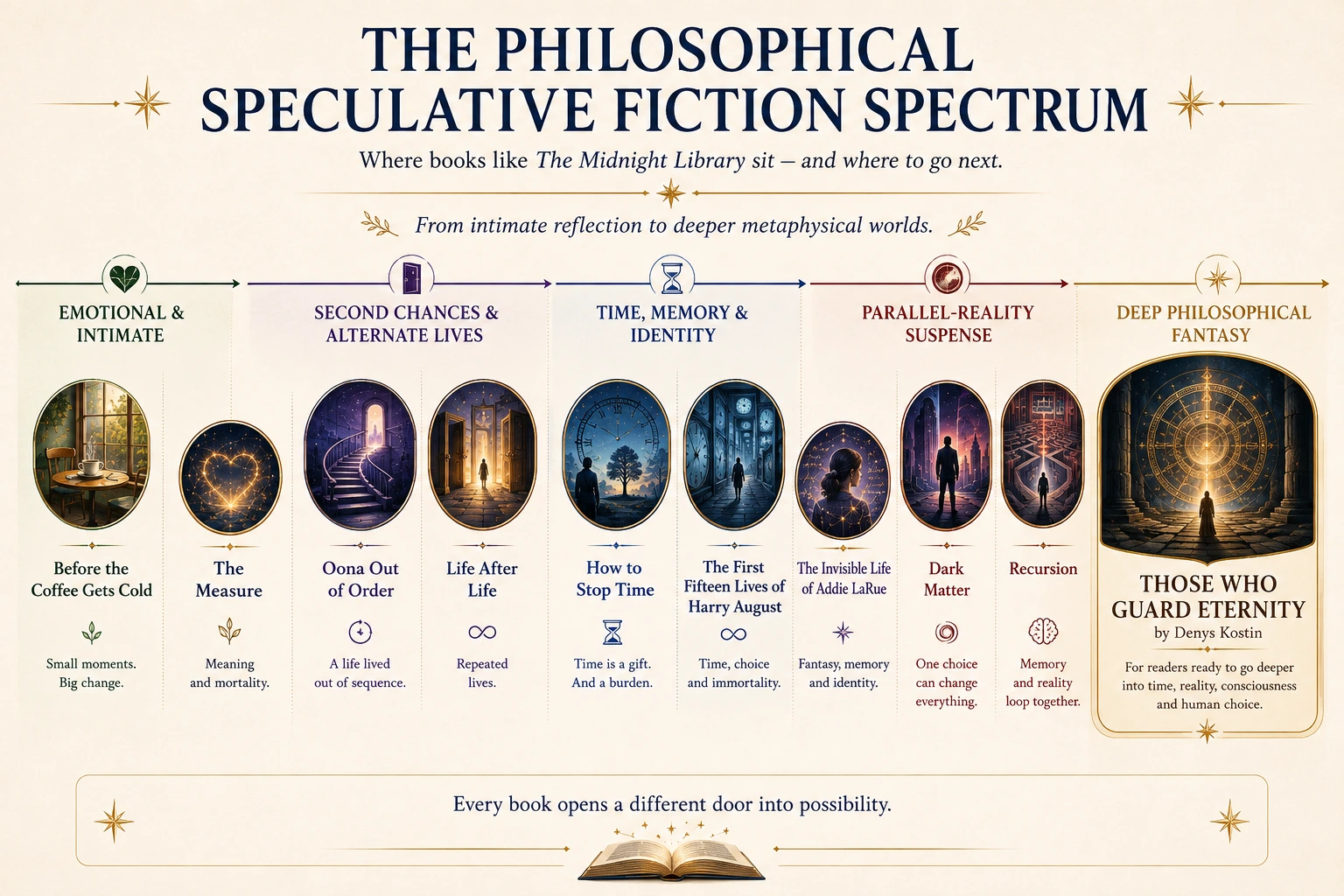
For repeated lives: choose Life After Life or Replay .
For intimate second chances: choose Before the Coffee Gets Cold .
For nonlinear identity: choose Oona Out of Order .
For parallel-world suspense: choose Dark Matter or Recursion .
For time, memory, and immortality: choose The First Fifteen Lives of Harry August , How to Stop Time , or The Invisible Life of Addie LaRue .
For mortality and meaning: choose The Humans or The Measure .
For deeper philosophical fantasy: begin Those Who Guard Eternity .
No single book is “the next Midnight Library ” for every reader, because different readers carry different questions away from it. The most useful recommendation is the one that matches the part of the story that stayed with you.
Frequently asked questions
What should I read after The Midnight Library ?
Choose according to what you loved most. Read Life After Life or Replay for repeated lives, Before the Coffee Gets Cold for emotional second chances, Dark Matter for parallel-world suspense, or Those Who Guard Eternity for deeper philosophical fantasy about time, reality, and human choice.
What book is most similar to The Midnight Library ?
Life After Life , Replay , and Oona Out of Order are among the closest thematic matches, but each emphasizes something different. Life After Life is more literary, Replay focuses on reliving a life with memory, and Oona Out of Order explores identity through nonlinear time.
Are there books like The Midnight Library about parallel lives?
Yes. Dark Matter explores parallel versions of one life through suspense, while Life After Life , Replay , and The First Fifteen Lives of Harry August examine repeated or alternative outcomes through different speculative structures.
Which books like The Midnight Library are more philosophical?
The Humans , The Measure , How to Stop Time , and Those Who Guard Eternity place strong emphasis on meaning, mortality, identity, freedom, and the nature of reality. They are good choices when the philosophical questions mattered more to you than the library setting itself.
Are there fantasy books like The Midnight Library ?
Yes. The Invisible Life of Addie LaRue combines fantasy with memory, identity, and immortality. Those Who Guard Eternity moves further into philosophical fantasy, connecting time and human choice to a larger mystery about consciousness and reality.
Is there a book like The Midnight Library that I can read free?
Yes. You can read Those Who Guard Eternity free on cokos.org/ . It is especially suited to readers who want to move from alternate-life questions into a broader philosophical fantasy about time, truth, consciousness, and choice.
The question behind every alternate-life story is not merely whether another life was possible. It is whether seeing that possibility changes the life we are living now. The books in this guide answer that question in different ways: through tenderness, repetition, suspense, mortality, memory, and metaphysical mystery.
When you are ready to move from the roads not taken toward the deeper structure of time and reality, Those Who Guard Eternity is waiting .