Philosophy of mind · Skepticism · Reality
You experience your own thoughts directly—but everything else reaches you through perception. Solipsism asks whether that gap makes your mind the only reality you can truly know.
Estimated reading time: 24–28 minutes
By Denys Kostin · Updated August 3, 2026

Solipsism is the philosophical position that only one’s own mind is certain to exist—or, in its strongest form, that only one’s own mind exists at all. It arises because you experience your own conscious experience directly, while the external world and other minds are known through perception, evidence and inference.
Solipsism is not simply selfishness, narcissism, loneliness or excessive introspection. It is a claim about what can be known, what exists, or both.
What Is Solipsism?
The word solipsism combines Latin roots that mean roughly “alone” and “self.” The name captures its central concern: what if the only reality you can establish with certainty is your own conscious experience?
At first, the idea can sound absurd. You see rooms, streets, trees and other people. Objects resist your wishes. Events surprise you. Conversations reveal information you did not know. The world appears to be filled with causes and perspectives that do not belong to you.
Yet every one of those things reaches you through experience. You do not stand outside consciousness and compare your perceptions with reality “as it is in itself.” You encounter colours, sounds, textures, memories, thoughts and emotions within awareness. Even the sentence “there is a world outside me” appears as a thought within your mind.
Solipsism in simple terms
You never encounter reality without experiencing it. Solipsism asks whether you can logically move from I experience a world to a world exists independently of my experience.
This creates two different claims that must not be confused:
- Only my experience is immediately certain.
- Only my mind actually exists.
The first is an epistemological claim about the limits of knowledge. The second is a metaphysical claim about reality itself. Much of the confusion surrounding solipsism comes from treating them as the same position.
What solipsism does not mean
Someone can be selfish without being a solipsist, and a person can study solipsism while caring deeply about others. Narcissism concerns exaggerated self-importance. Egocentrism concerns difficulty seeing beyond one’s own perspective. Social isolation concerns relationships and belonging. Solipsism is different: it asks whether anything beyond one’s own mind can be known—or whether anything beyond it exists.
Why Does Solipsism Seem Possible?
Solipsism begins with an asymmetry. You know your own pain by feeling it. You know your own thought by thinking it. You know your own visual experience by undergoing it. No observation is required before those states are present to you.
By contrast, you know a table through sight and touch. You know another person’s pain through their words, expression and behaviour. You know that yesterday occurred through memory and records. These beliefs may be extremely well justified, but they depend on evidence that appears within experience.
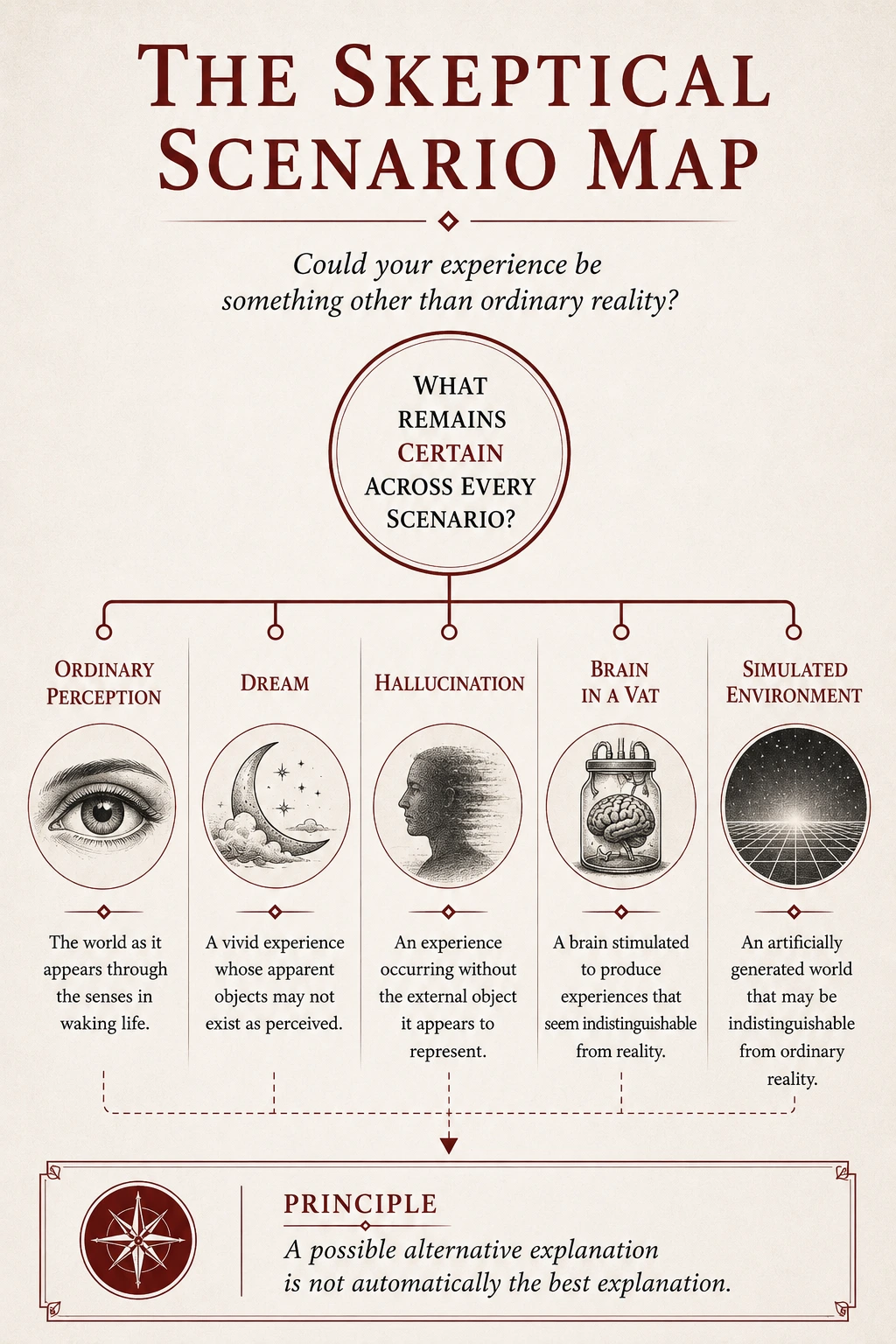
Dreams make this gap especially vivid. While dreaming, a world can appear to surround you. People speak. Places seem stable. Events feel urgent. Only later do you recognise that the apparent objects did not exist as they were experienced. Hallucinations, false memories and perceptual illusions show the same general lesson: an experience can be compelling without accurately representing its cause.
This does not prove that waking life is a dream. It establishes a more limited point: the vividness of an experience does not, by itself, guarantee that reality is exactly as the experience presents it.
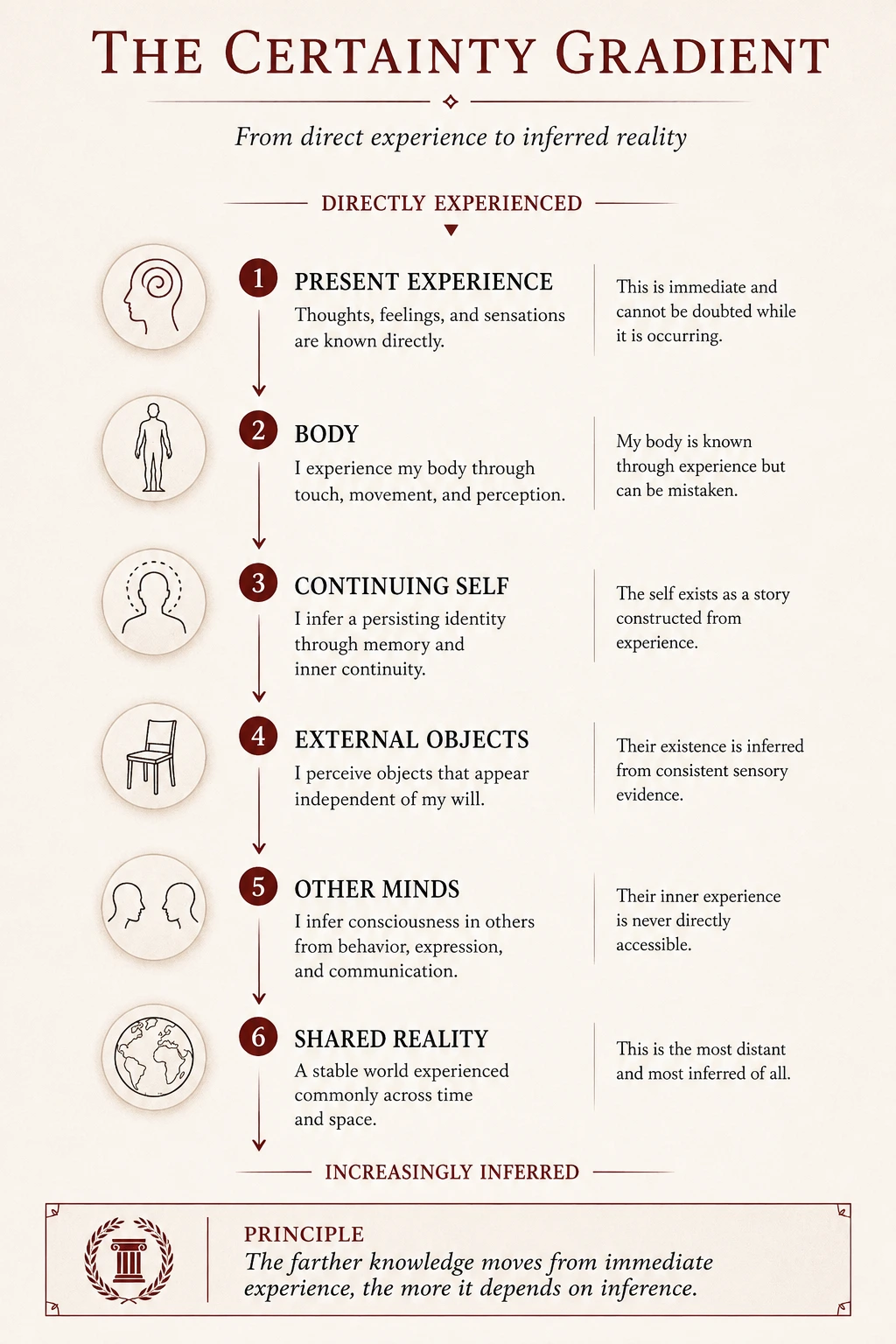
The gradient does not mean that shared reality is weakly supported. It means that different beliefs are justified in different ways. A present sensation may be undeniable while it occurs. A belief in other minds depends on an explanatory inference. Questions about why you remain the same person depend on memory and continuity, while belief in a continuing world depends on stable patterns across time, observers and evidence.
This distinction matters because certainty and rational confidence are not identical. You can lack absolute certainty while still having overwhelming reason to believe something is true.
The Three Forms of Solipsism
“Solipsism” is often used as though it names one doctrine. In practice, it describes several positions with very different levels of commitment.
Methodological solipsism
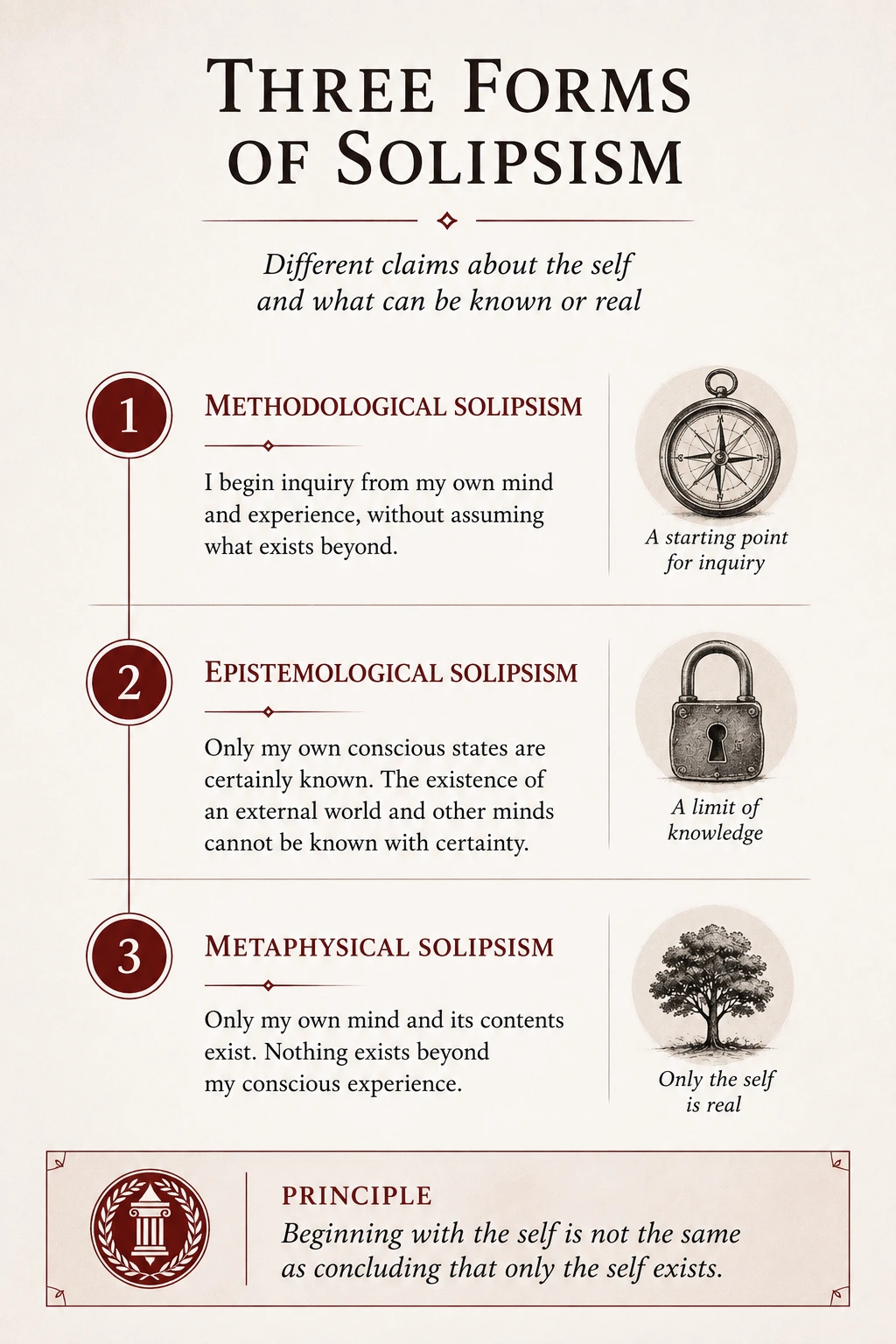
Methodological solipsism begins inquiry from the contents of an individual mind. It temporarily brackets assumptions about the external world so that beliefs can be examined from a controlled starting point. This is a method, not necessarily a conclusion.
A philosopher, cognitive scientist or thought experiment may focus on what is available from the first-person point of view without claiming that nothing else exists. Beginning with experience can help reveal which beliefs are immediate and which depend on interpretation.
Epistemological solipsism
Epistemological solipsism concerns knowledge. It holds that only one’s own conscious states can be known with certainty, while the external world and other minds cannot be established at the same level.
This position does not always deny that a world exists. It may instead argue that knowledge cannot cross the boundary between experience and whatever causes it. The challenge is not necessarily “there is no world,” but “how could I know a world exists independently of my experience?”
Metaphysical solipsism
Metaphysical solipsism makes the strongest claim: only one’s own mind and its contents exist. Other people, objects and events are not independent realities but appearances within a single consciousness.
This view goes far beyond ordinary skepticism. It does not merely question whether perception is accurate. It interprets the entire apparent world as dependent on one mind.
| Form | Central claim | What it doubts |
|---|---|---|
| Methodological | Inquiry begins from the individual mind. | Assumptions not yet justified. |
| Epistemological | Only mental experience is known with direct certainty. | Knowledge of an independent external world. |
| Metaphysical | Only one’s own mind exists. | The independent existence of everything else. |
Did Descartes Believe in Solipsism?
In Meditations on First Philosophy, René Descartes develops a method of radical doubt that begins by suspending trust in the senses. He asks whether waking life could be dreamlike and whether a powerful deceiver could manipulate every apparent perception and calculation.
Under that pressure, many familiar beliefs become uncertain. The body might not be as it appears. The room might be imagined. Memories might be false. Even apparently obvious reasoning might be distorted.
One fact seems to survive: if doubt is occurring, there must be thinking. The famous cogito—commonly expressed as “I think, therefore I am”—identifies the existence of the thinking subject as certain while thought is taking place.
That insight creates a solipsistic starting point, but Descartes did not intend to remain there. His larger project attempted to rebuild knowledge of God, the world and the distinction between mind and body. Whether his reconstruction succeeds is debated, but describing him simply as a metaphysical solipsist is misleading.
The importance of the Cartesian problem is not that Descartes proved only one mind exists. It is that he exposed how much of ordinary knowledge depends on moving beyond what is immediately present in thought.
The question remains alive even for people who reject Descartes’ answers: what kind of justification allows us to move from private experience to public reality?
Can You Prove That the External World Exists?
The phrase “external world” belongs to the broader question of what reality is: here it means a reality that exists independently of your present awareness. It includes physical objects, events and causes that continue whether or not you perceive them.
In ordinary life, belief in such a world seems unavoidable. You turn away from a cup and expect it to remain. You leave a building and later return to find it changed by events you did not witness. Other people report discoveries that surprise you. Instruments register processes beyond unaided perception. Reality repeatedly behaves as though it has structure independent of one observer.
Radical skepticism asks whether this evidence could itself be part of an experience generated in some other way.
The dream argument
Dreams show that a vivid environment can appear without its apparent objects existing as perceived. But a dream does not imply that no external reality exists. The sleeper, the brain and the physical conditions of sleep may still exist. The argument challenges the reliability of a particular experience, not necessarily the existence of every external cause.
The brain-in-a-vat scenario
Imagine a brain receiving artificial signals that perfectly reproduce ordinary life. From inside that experience, trees, rooms and conversations might seem real even though their apparent form is generated. The thought experiment asks whether experience alone could reveal the difference.
Even here, however, the scenario assumes an external system: a brain, equipment, causes and perhaps experimenters. It threatens our knowledge of the world’s nature more directly than it establishes metaphysical solipsism.
Simulation arguments
A simulated environment could contain stable laws, multiple minds and events independent of any single observer. Therefore simulation theory is not automatically solipsism. It may suggest that the world is different from what it seems, but it does not entail that only one consciousness exists.
Reality’s resistance
One of the strongest reasons to believe in an external world is its resistance to personal desire. You cannot normally make an obstacle disappear by deciding it is inconvenient. Predictions fail. Other people disagree. Events reveal information you did not possess. The world contains consequences that do not behave like obedient products of imagination.
This is not a deductive proof that eliminates every imaginable skeptical scenario. It is evidence that an independent world explains experience with extraordinary power and economy.
The related question—how do we know what is real?—is therefore not answered by certainty alone. It requires comparing explanations, evidence and the coherence of our beliefs.
The Problem of Other Minds
The external world is not the only challenge. Other minds create an even more intimate gap.
You experience your own pain directly. When another person is in pain, you observe a cry, a wound, a facial expression or a request for help. Their behaviour is public; their subjective feeling is not. No matter how closely you listen, you do not literally feel their pain from inside their point of view.
This creates the problem of other minds: how can you justify the belief that beings other than yourself possess consciousness?
How do we infer that other people are conscious?
The inference usually develops through several connected forms of evidence:
- You experience mental states that are connected with your body, speech and behaviour.
- Other humans have bodies and brains broadly similar to your own.
- They use language, respond flexibly and adapt to complex situations.
- Their actions reveal information and perspectives that are independent of yours.
- The best explanation is that they also possess conscious experience.
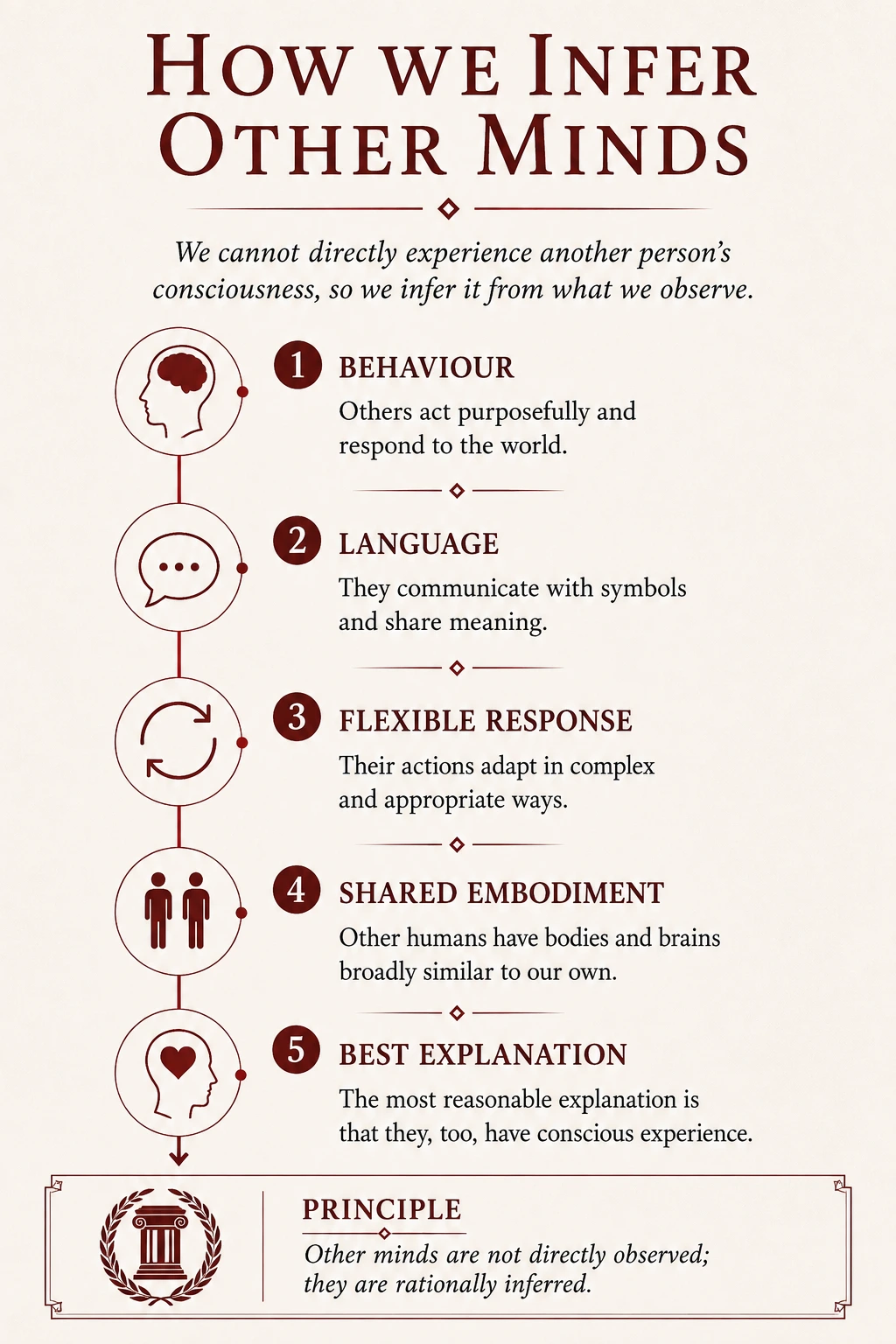
This is not weak reasoning. Much of knowledge depends on inference to causes we do not observe directly. We infer gravity from patterned effects, historical events from records, and distant objects from light. Direct access is not the only path to justified belief.
Philosophical zombies and artificial intelligence
A philosophical zombie is an imagined being that behaves exactly like a conscious person but has no inner experience. The idea is used to test whether behaviour and consciousness can be separated conceptually.
The possibility is difficult to rule out by observation alone, but it does not follow that real people are zombies. A scenario can be imaginable without being the most reasonable account of the evidence.
The same issue appears in debates about whether artificial intelligence can become conscious. Fluent language and adaptive behaviour may support an inference to mentality, but they do not provide direct access to subjective experience. Importantly, this epistemic gap is not unique to machines. It already exists between human beings.
Can Solipsism Be Disproved?
The answer depends on what “disproved” means.
If disproof requires eliminating every logically imaginable scenario with absolute certainty, solipsism is difficult to defeat. Any evidence offered against it appears within experience and can be reinterpreted by the solipsist as another appearance inside the one mind.
But that standard is so demanding that it threatens much more than belief in other minds. It would undermine memory, history, science, testimony and ordinary knowledge. Rational belief usually does not require the elimination of every conceivable alternative. It requires proportioning confidence to evidence and preferring explanations that account for more with fewer unsupported assumptions.
Absolute certainty may be impossible
The inability to eliminate a possibility does not make it an equally serious explanation. Solipsism gains force when “I cannot rule this out absolutely” is silently transformed into “this is just as plausible.” Those claims are not equivalent.
Inference to the best explanation
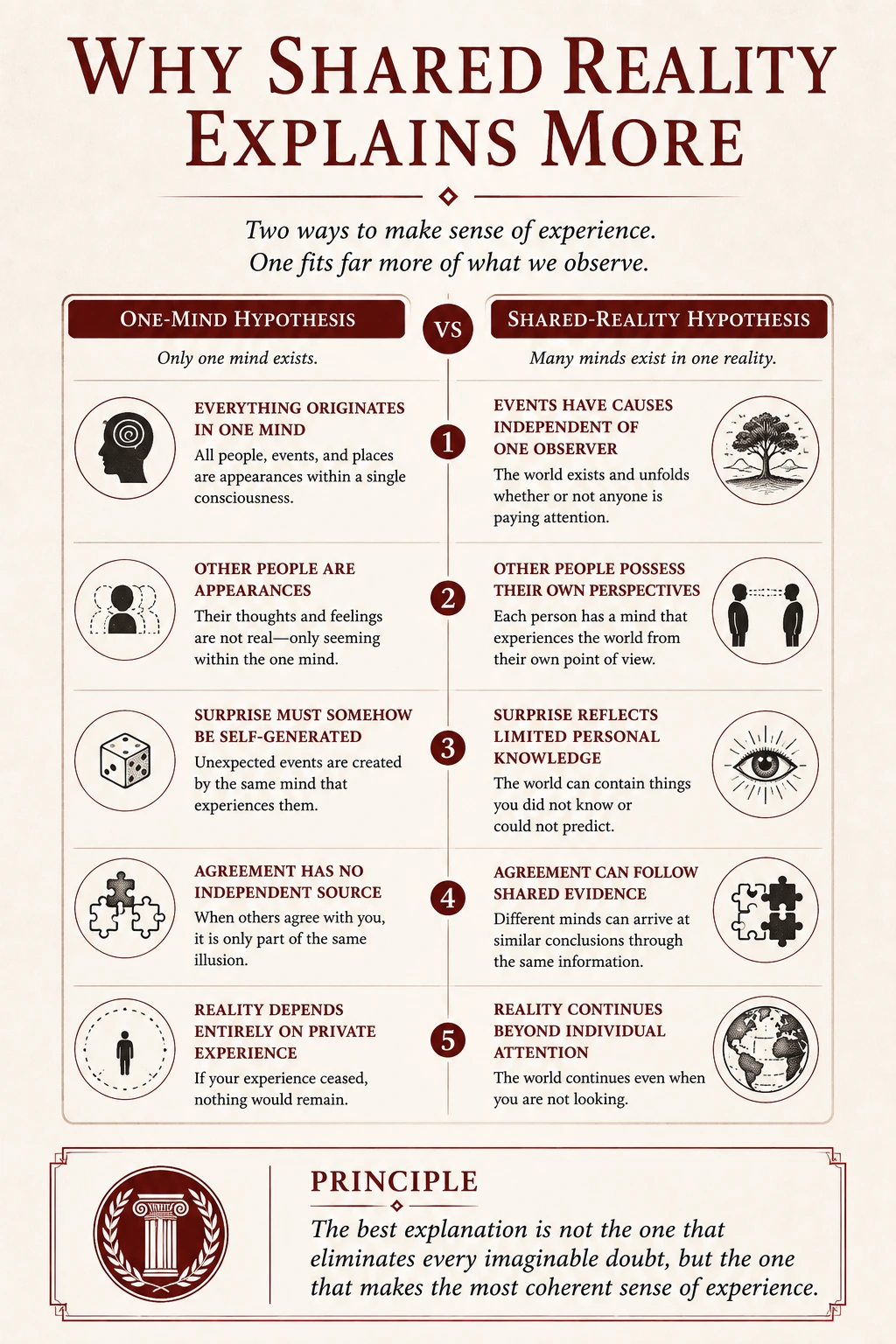
A shared external world explains why:
- events occur beyond your attention;
- other people know things you do not;
- predictions sometimes fail;
- different observers can compare evidence;
- mistakes can be corrected by independent checks;
- the world constrains desire and imagination;
- knowledge accumulates across generations.
The one-mind hypothesis can absorb any possible event, but that flexibility is not always a strength. An explanation that can accommodate everything without risk may explain very little. Shared reality makes more specific predictions: objects persist, causes remain stable, observers can disagree, and evidence can surprise everyone involved.
G. E. Moore and common-sense realism
The philosopher G. E. Moore famously defended knowledge of the external world by holding up a hand and arguing, in effect, that he knew it existed. The point was not that a gesture magically defeats skepticism. It was that everyday knowledge may be more secure than the abstract premises used to deny it.
A radical skeptic may reject that move as question-begging. A defender of common sense may reply that skepticism also relies on assumptions and that we have stronger reason to trust well-established ordinary knowledge than a chain of reasoning that abolishes it.
Language and shared meaning
Solipsism also faces a problem of meaning. Words such as private, public, mistake, evidence and appearance gain their function through contrasts. To call something an appearance normally distinguishes it from what appears. To call a belief mistaken normally presupposes a standard not created merely by the belief itself.
This does not produce a simple formal contradiction, but it raises a deep question: can the idea of a completely private reality preserve the conceptual structure needed to state solipsism meaningfully?
The practical inconsistency of solipsism
Even committed skeptics continue to avoid traffic, ask questions, learn from disagreement and distinguish discovery from invention. Their actions treat the world as independent and other people as sources of knowledge.
Practical inconsistency does not prove a theory false. It does reveal which assumptions make experience intelligible and action possible. Solipsism can be entertained intellectually; shared reality remains the framework within which inquiry, language and responsibility function.
Balanced conclusion: solipsism may be difficult to eliminate by the extreme standard of absolute logical certainty. But a shared world containing other minds provides a far stronger explanation of experience than the claim that one mind generates everything.
Solipsism, Idealism and Skepticism
Solipsism is often confused with neighbouring positions. The distinctions matter because not every philosophy that questions matter or certainty denies other minds.
| Position | Basic question or claim |
|---|---|
| Skepticism | Can our beliefs be justified, and how much certainty is possible? |
| Idealism | Is reality fundamentally mental or dependent on mind? |
| Solipsism | Is only my mind knowable—or is only my mind real? |
| Realism | Does a world exist independently of my experience? |
| Simulation theory | Could the experienced world be generated by an artificial system? |
Idealism does not necessarily imply solipsism. A philosophical idealist may hold that reality is fundamentally mental while affirming many minds, a universal mind or stable structures independent of any individual observer.
Skepticism is broader than solipsism. A skeptic can doubt whether certain beliefs are justified without claiming that only one mind exists. Realism is the most direct contrast: it holds that at least some reality exists independently of the experience or beliefs of an individual subject.
Simulation theory addresses the source or structure of the world, not necessarily the number of minds within it. A simulated reality could still be shared, causally stable and populated by conscious beings.
Why Solipsism Matters Beyond Philosophy
Solipsism is not only an abstract puzzle. It exposes a permanent feature of human life: no one can occupy another person’s point of view from the inside.
That distance can produce loneliness. You may be loved and still feel that no one fully reaches your experience. It can also produce arrogance: because your own feelings are immediate and another person’s are inferred, your pain may seem more real than theirs.
Ethical life begins by refusing to confuse inaccessible experience with nonexistent experience. You cannot directly feel another person’s fear, grief or hope. Yet behaviour, language, embodiment and shared vulnerability give powerful reasons to treat those states as real.
Trust has the same structure. Absolute certainty about another person’s intentions is unavailable, but relationships cannot wait for impossible proof. Trust develops through patterns, evidence, consistency and the willingness to recognise another centre of experience.
Scientific knowledge also depends on moving beyond a solitary point of view. Instruments extend perception. Other researchers repeat observations. Public methods allow claims to survive individual bias. The strength of science lies not in escaping experience entirely, but in organising many perspectives so that no single observer controls the conclusion.
This is why the questions of solipsism connect naturally with what consciousness is, the nature of mind, what knowledge means, and personal identity. Each begins from experience but reaches toward a reality larger than the isolated self.
What Solipsism Reveals About Being Human
Consciousness gives you a world, but it also places you at a unique point within it. Every colour, thought, memory and relationship is encountered through a perspective no one else can occupy exactly.
That privacy is not necessarily a prison. It is the starting condition from which knowledge, dialogue and empathy become possible. Certainty begins close to experience. Understanding grows when evidence allows us to reach beyond it.
Solipsism is therefore most valuable not as a final answer, but as a test. It asks whether your beliefs about reality and other people are merely automatic—or whether you can explain why they are justified.
The lasting lesson is epistemic humility: private access is limited, but evidence can still justify knowledge, dialogue and responsibility beyond the self.
We cannot inhabit another person’s consciousness, but civilisation depends on treating inaccessible experience as morally real.
Frequently Asked Questions About Solipsism
What is solipsism in simple terms?
Solipsism is the idea that your own mind is the only thing you can know with direct certainty. In its strongest version, it claims that only your mind exists and that the apparent world—including other people—is contained within your experience. Weaker forms do not deny the world; they question whether knowledge can extend beyond conscious experience.
Does solipsism mean that only I exist?
Only metaphysical solipsism makes that claim. Epistemological solipsism says that only your own conscious states are known with certainty, while methodological solipsism merely begins inquiry from the first-person point of view. These positions should not be treated as identical.
What is the difference between epistemological and metaphysical solipsism?
Epistemological solipsism concerns knowledge: it argues that you cannot know an external world or other minds with the same certainty as your own experience. Metaphysical solipsism concerns existence: it claims that nothing exists beyond your mind and its contents.
Can solipsism be disproved?
Solipsism is difficult to eliminate if proof requires absolute certainty, because any counterevidence can be reinterpreted as another experience within the one mind. However, shared reality is far better supported by explanatory evidence. It accounts for surprise, disagreement, independent discovery, persistent objects and the knowledge of other observers without assuming that one mind generates everything.
Did René Descartes believe in solipsism?
Descartes used radical doubt to identify what could survive skeptical challenges. His method begins from certainty about the thinking self, which creates a solipsistic starting point. But he did not simply conclude that only his mind existed. His philosophical project attempted to establish knowledge of God, the external world and other realities beyond the self.
Is solipsism the same as narcissism?
No. Narcissism concerns self-importance, admiration and patterns of relating to others. Solipsism is a philosophical position about knowledge or existence. A narcissistic person may take other people to be real but less important, while a solipsist questions whether other minds can be known or whether they exist independently.
Is simulation theory a form of solipsism?
Not necessarily. A simulated environment could still contain many minds, stable laws and events independent of any one observer. Simulation theory suggests that reality may be generated by an underlying system; solipsism claims that only one mind is knowable or real. The two ideas can overlap in some thought experiments, but they are not equivalent.
How do we know that other people are conscious?
We infer other minds from converging evidence: other people have bodies and brains like ours, use meaningful language, respond flexibly, express emotion, learn and reveal perspectives we did not create. Their conscious experience is not directly observed, but it is the most reasonable explanation of their behaviour and shared embodiment.
Can science prove that the external world exists?
Science normally assumes a stable world and tests models through observation, prediction and replication. It may not provide an absolute philosophical proof against every skeptical scenario, but it builds exceptionally strong evidence for a reality that behaves consistently across observers and continues independently of individual attention.
What is the opposite of solipsism?
There is no single exact opposite, but realism is the clearest contrast. Realism holds that at least some reality exists independently of an individual mind or experience. In discussions of other minds, the opposing view is that other people are genuine centres of consciousness rather than appearances within one mind.
Explore Reality Through Philosophical Fantasy
Solipsism treats reality as a problem of knowledge. Philosophical fantasy turns that problem into a lived world—one in which consciousness, memory, identity, time and responsibility can alter the fate of entire civilisations.
Discover Those Who Guard Eternity, a philosophical fantasy novel about what remains worth protecting when the boundaries of reality can no longer be taken for granted.
References and Further Reading
- Internet Encyclopedia of Philosophy: Solipsism and the Problem of Other Minds
- Stanford Encyclopedia of Philosophy: Other Minds
- Stanford Encyclopedia of Philosophy: Skepticism
- Stanford Encyclopedia of Philosophy: Idealism
- René Descartes, Meditations on First Philosophy
- G. E. Moore’s Proof of an External World — overview and analysis
About the author: Denys Kostin writes philosophical fantasy and essays about consciousness, reality, knowledge, identity and the future of civilisation.