Book Discovery · Philosophical Science Fiction
Finished Cixin Liu’s cosmic epic and found ordinary science fiction suddenly too small? This guide collects the best books like The Three-Body Problem for readers who want more than spaceships and spectacle. These novels explore first contact, cosmic civilizations, hard science, consciousness, reality, existential risk, memory, identity, and humanity’s uncertain place in the universe.
The quick answer: what should you read after The Three-Body Problem?
If you have completed only the first novel, continue with The Dark Forest and Death’s End. The trilogy is designed as an escalating argument: the first book reveals the crisis, the second develops the strategic logic of cosmic survival, and the third expands the consequences across radically larger scales of time and reality.
For a different author, choose according to what you loved most:
- For consciousness and hard first contact: Blindsight.
- For truly unknowable alien intelligence: Solaris.
- For civilizations, myth, and cosmic scope: Hyperion.
- For nonhuman evolution: Children of Time.
- For posthuman identity and digital minds: Diaspora.
- For a metaphysical journey through eternity, truth, memory, and responsibility: Those Who Guard Eternity.
The Three-Body Problem reading order
The main trilogy should be read in publication order:
- The Three-Body Problem — the discovery of the crisis, the historical foundations of contact, and humanity’s first confrontation with a civilization beyond Earth.
- The Dark Forest — the strategic logic of cosmic survival, the difficulty of trust, and the consequences of being visible in a hostile universe.
- Death’s End — the long future of humanity, radical technologies, civilizational choice, and the widening scale of the universe itself.
Readers who search for “what to read after The Three-Body Problem” sometimes mean the first novel rather than the full trilogy. If that is you, the best next book is not another author yet. Continue the sequence first, because many of the ideas associated with the series reach their full form only in books two and three.
Why readers search for books like The Three-Body Problem
Most readers are not simply looking for more aliens. They are looking for a particular reading experience: the feeling that a story has forced the universe to become larger than it was before.
The trilogy produces that effect through several overlapping elements:
- Scientific consequence: physics and technology change the structure of the story rather than serving as decoration.
- Civilization-scale thinking: decisions are measured not only in human lifetimes, but in centuries, planetary survival, and cosmic visibility.
- Existential risk: the threat is not merely personal defeat. It is the loss, transformation, or disappearance of civilization.
- The Fermi paradox: the apparent silence of the universe becomes a source of fear, strategy, and philosophical speculation.
- Perspective disruption: the reader must repeatedly abandon assumptions that felt natural only a few chapters earlier.
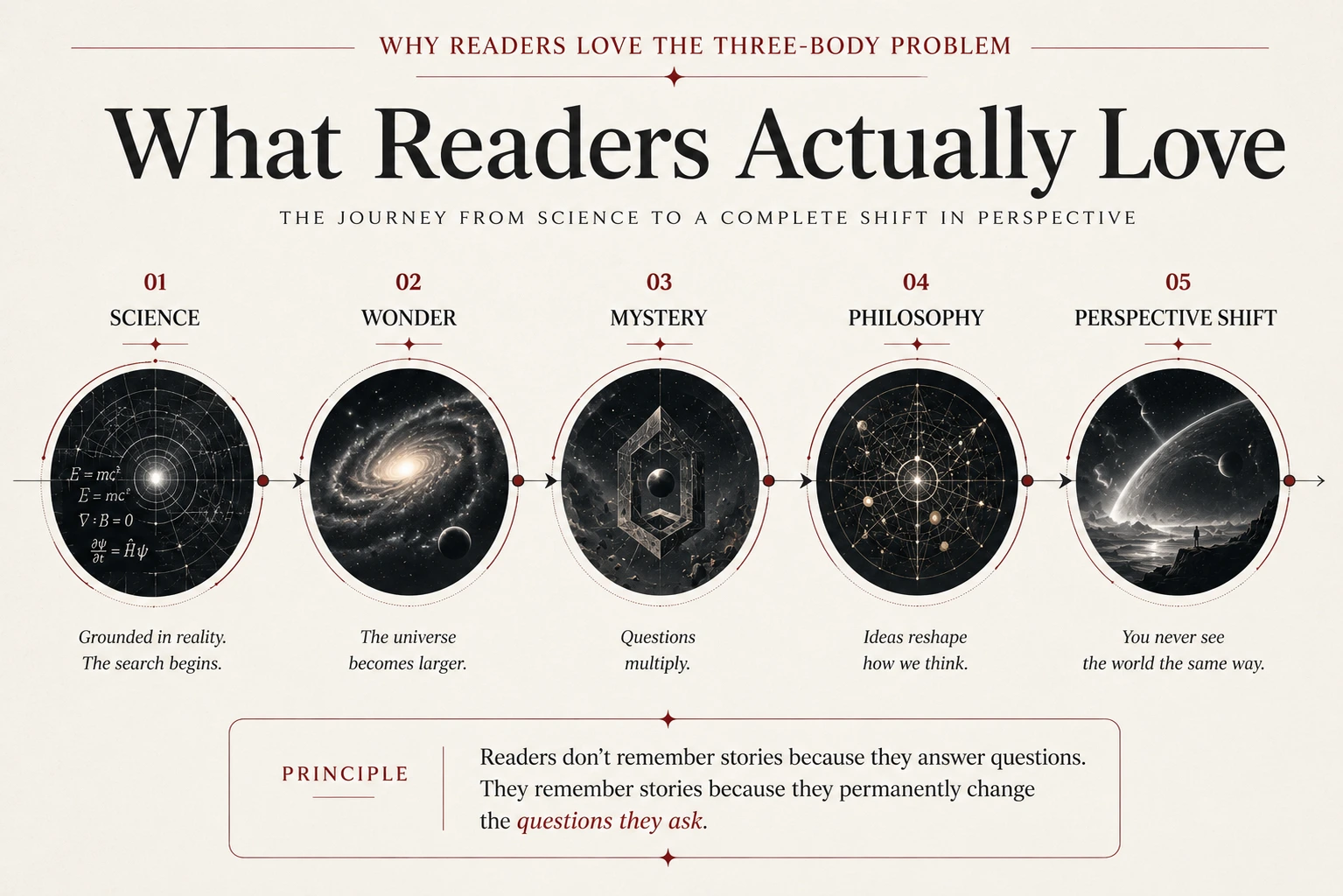
This is why the trilogy connects so naturally with deeper questions explored across Cokos: What is reality?, What is consciousness?, What is knowledge?, What is truth?, and What is mind?
Who is Cixin Liu, and why did his work change science fiction?
Cixin Liu is a Chinese science fiction author whose work brought a distinctive combination of large-scale scientific speculation, civilizational history, and existential strategy to a global audience. His fiction is often discussed in relation to hard science fiction because physical constraints, technology, astronomy, and engineering are central to the plot. Yet the lasting appeal of the trilogy is not technical complexity alone.
Liu’s fiction repeatedly shifts the unit of analysis. A scene may begin with one person, then expand to a nation, a planet, a civilization, or the structure of cosmic survival. Human motives remain important, but they operate inside systems vastly larger than any individual. That movement between intimate choice and cosmic consequence is one of the defining reasons readers search for books similar to The Three-Body Problem.
The trilogy also helped popularize discussions of the Dark Forest hypothesis, sophons, the strategic dangers of interstellar visibility, and civilization as a problem of survival under uncertainty. Even readers who disagree with its assumptions often find that the concepts remain mentally active long after the final page.
The Five Dimensions of Philosophical Science Fiction
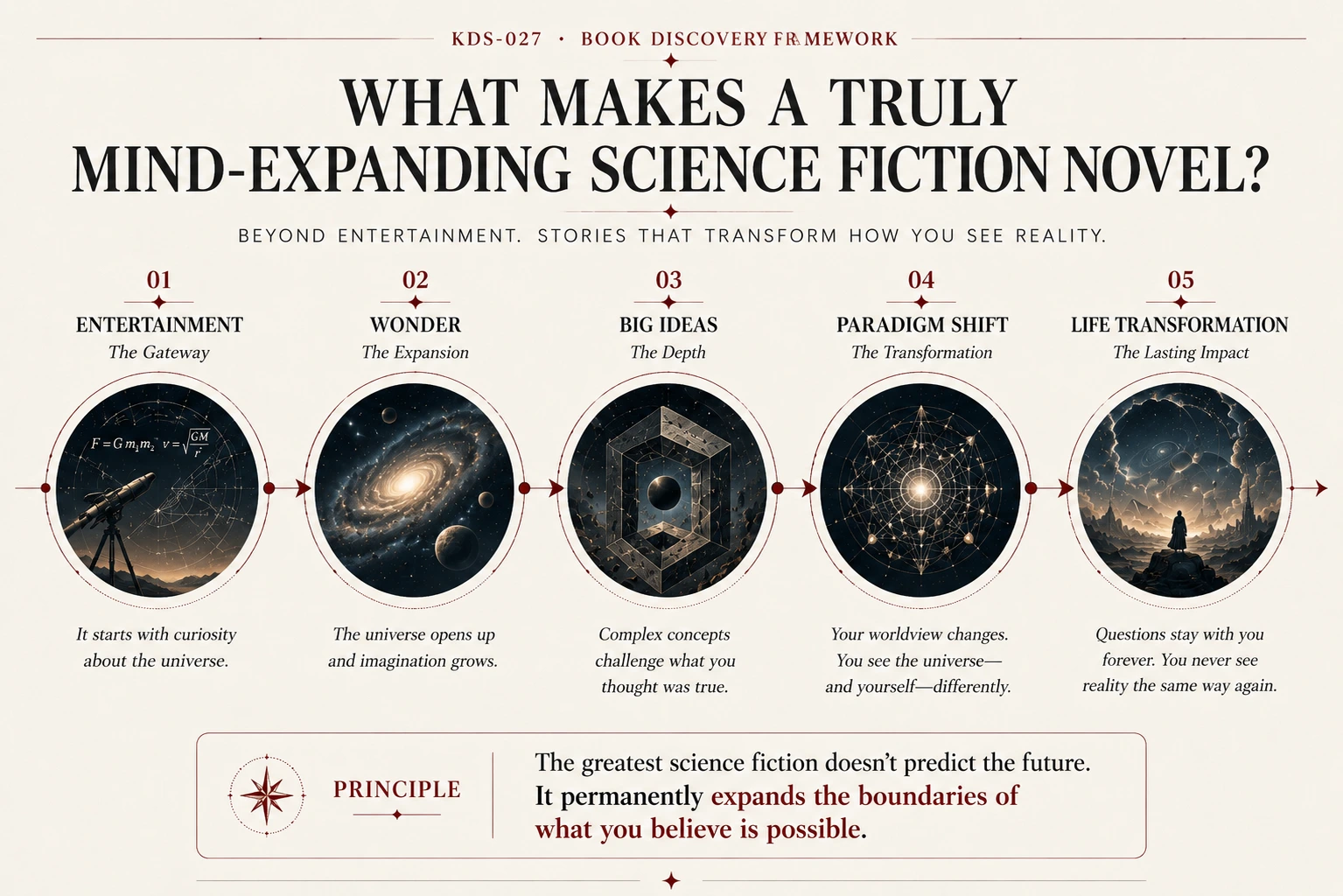
To compare these books fairly, this guide uses five dimensions. The goal is not to produce a universal literary ranking. It is to identify what kind of reader each book is most likely to satisfy.
- Science: How central are scientific ideas, physical constraints, or technological systems?
- Philosophy: How deeply does the novel examine knowledge, morality, identity, consciousness, reality, or meaning?
- Civilization: How strongly does the book think at the level of societies, species, institutions, or long-term history?
- Mystery: Does the unknown remain genuinely strange, difficult, or resistant to human categories?
- Perspective shift: How likely is the book to change the reader’s mental model after the story ends?
| Book | Science | Philosophy | Civilization | Mystery | Perspective shift |
|---|---|---|---|---|---|
| Blindsight | 5/5 | 5/5 | 3/5 | 5/5 | 5/5 |
| Solaris | 3/5 | 5/5 | 2/5 | 5/5 | 5/5 |
| Hyperion | 3/5 | 4/5 | 5/5 | 5/5 | 4/5 |
| Children of Time | 4/5 | 4/5 | 5/5 | 4/5 | 5/5 |
| Diaspora | 5/5 | 5/5 | 4/5 | 4/5 | 5/5 |
| Those Who Guard Eternity | 2/5 | 5/5 | 5/5 | 5/5 | 5/5 |
Editorial methodology: similarity here means thematic and intellectual fit, not identical plot, tone, or genre. Books were evaluated for scientific depth, civilization-scale thinking, first contact, consciousness, philosophical ambition, and their ability to change the reader’s perspective. The order reflects usefulness for readers of The Three-Body Problem, not an objective ranking of literary quality.
15 best books like The Three-Body Problem
1. The Dark Forest by Cixin Liu
Best direct continuation
Overview: The second novel takes the crisis established in the first book and transforms it into a strategic problem. Humanity knows that contact has occurred, but knowledge does not produce unity. Instead, the species must think under conditions of incomplete information, delayed action, internal conflict, and the possibility that the universe itself rewards silence.
Why Three-Body readers love it: This is where the trilogy’s most famous strategic concept becomes central. The novel moves from scientific mystery toward game theory, deterrence, deception, and the behavior of civilizations that cannot trust one another.
Major similarity: Ideas do not merely decorate the narrative. They determine what actions are possible.
Biggest difference: The first novel is about discovering the crisis. The Dark Forest is about understanding the logic created by that crisis.
Best reader profile: Readers fascinated by existential risk, strategy, the Fermi paradox, and civilization under pressure.
Reading difficulty: Moderate. The novel contains long strategic sections, but the payoff is substantial.
2. Death’s End by Cixin Liu
Best for maximum cosmic scale
Overview: The final book expands the trilogy beyond the immediate human–Trisolaran conflict. Technologies become stranger, time horizons become longer, and every apparent solution reveals a larger structure of risk.
Why Three-Body readers love it: The novel delivers the scale many readers associate with the trilogy as a whole. It forces the reader to think not only about survival, but about what civilizations preserve, sacrifice, misunderstand, and become.
Major similarity: Scientific speculation continually escalates into philosophical consequence.
Biggest difference: It is broader, more abstract, and more emotionally severe than the first two books.
Best reader profile: Readers who want the trilogy’s largest ideas about time, technology, dimensions, and the long future.
Reading difficulty: Moderate to high because the scale changes repeatedly.
3. Blindsight by Peter Watts
Closest match for consciousness and first contact
Overview: A crew travels to investigate an alien presence, but the central question is not whether the aliens are friendly. It is whether human beings understand intelligence at all. The novel explores the possibility that advanced cognition may operate without the kind of self-awareness humans value.
Why Three-Body readers love it: Like Liu’s trilogy, Blindsight begins with a scientific problem and follows it into existential territory. The alien is not simply culturally different. It threatens human assumptions about consciousness itself.
Major similarity: Hard science, first contact, strategic uncertainty, and a radical challenge to human exceptionalism.
Biggest difference: It is psychologically denser and much more concentrated on cognition than on civilization-wide history.
Best reader profile: Readers interested in neuroscience, evolution, consciousness, and genuinely nonhuman intelligence.
Memorable idea: Intelligence and consciousness may not be the same thing.
Reading difficulty: High. The prose and concepts demand attention.
Continue the theme with What Is Consciousness? and Can Consciousness Exist Outside the Brain?
4. Solaris by Stanisław Lem
Best for truly alien intelligence
Overview: Researchers study the ocean-covered world of Solaris, where the boundary between observation and interaction becomes impossible to define. The intelligence they encounter does not fit familiar categories of language, motive, personality, or civilization.
Why Three-Body readers love it: The book treats first contact as a limit of knowledge rather than a problem that can be solved through translation and diplomacy.
Major similarity: Human beings confront a reality that resists their intellectual tools.
Biggest difference: The scale is intimate and psychological rather than civilizational.
Best reader profile: Readers who value ambiguity, philosophy of knowledge, memory, and the limits of interpretation.
Memorable idea: Humanity may be unable to recognize intelligence when it does not resemble itself.
Reading difficulty: Moderate, but emotionally and philosophically demanding.
5. Hyperion by Dan Simmons
Best for cosmic civilization and literary scope
Overview: Several travelers journey toward the mysterious Shrike, each carrying a story that reveals another layer of a far-future civilization. Religion, artificial intelligence, political power, time, war, and personal grief converge.
Why Three-Body readers love it: The novel makes civilization feel old, layered, and structurally complex. Technology is embedded in culture, power, and history.
Major similarity: Civilization is treated as a dynamic system rather than a painted background.
Biggest difference: Hyperion is more literary, mythic, and character-centered.
Best reader profile: Readers who want cosmic scale without losing emotional variety.
Memorable idea: A civilization can be technologically advanced and still remain trapped inside mysteries it does not understand.
Reading difficulty: Moderate.
6. Children of Time by Adrian Tchaikovsky
Best for nonhuman evolution
Overview: The novel follows the development of a nonhuman intelligence across generations while another branch of humanity struggles with decline, memory, and survival.
Why Three-Body readers love it: It thinks at evolutionary and civilizational scale. It also asks how communication might work between species whose bodies, instincts, and social structures differ radically.
Major similarity: Long timescales, civilization-building, existential risk, and contact between unlike forms of intelligence.
Biggest difference: The emotional center is mutual understanding rather than deterrence.
Best reader profile: Readers fascinated by biology, evolution, and alternate paths to intelligence.
Memorable idea: Intelligence does not need to follow the human path to become complex, social, or meaningful.
Reading difficulty: Accessible to moderate.
7. Diaspora by Greg Egan
Best for posthuman identity
Overview: Humanity has diverged into multiple forms, including digital minds and radically altered beings. The novel explores existence beyond biological limits and pushes questions of identity, embodiment, physics, and survival into unfamiliar territory.
Why Three-Body readers love it: It repeatedly enlarges the conceptual scale of the story. Scientific possibility becomes a challenge to what counts as a person, a world, or a future.
Major similarity: Extreme scientific speculation produces civilization-level consequences.
Biggest difference: The book is more abstract, more posthuman, and less grounded in contemporary human society.
Best reader profile: Readers who enjoy difficult ideas and are comfortable with technical speculation.
Memorable idea: Identity may depend less on material continuity than on pattern, memory, and relation.
Reading difficulty: High.
Pair it with What Is Personal Identity? and Can Consciousness Be Uploaded into a Computer?
8. Anathem by Neal Stephenson
Best for philosophy of knowledge
Overview: In a world where communities of thinkers live apart from ordinary society, knowledge becomes both a civilizational resource and a source of tension. A growing mystery eventually forces intellectual traditions to confront a reality larger than their own categories.
Why Three-Body readers love it: The novel makes ideas part of the plot’s machinery. Mathematics, philosophy, language, and institutions determine how characters interpret danger.
Major similarity: Knowledge itself becomes a survival problem.
Biggest difference: It is more concerned with epistemology and intellectual institutions than with direct cosmic conflict.
Best reader profile: Readers who enjoy slow immersion, philosophical worldbuilding, and difficult concepts.
Memorable idea: Civilizations do not merely possess knowledge; they organize, protect, suppress, and reinterpret it.
Reading difficulty: High at the beginning, rewarding later.
9. Revelation Space by Alastair Reynolds
Best for ancient cosmic mystery
Overview: The remains of a vanished civilization point toward a larger pattern: intelligent species may not disappear by accident. Archaeology, advanced technology, and hidden danger converge across interstellar distances.
Why Three-Body readers love it: It treats the universe as a place shaped by old threats and incomplete evidence. The mystery is tied directly to whether new civilizations can survive long enough to understand what happened to earlier ones.
Major similarity: Cosmic silence becomes evidence of danger rather than emptiness.
Biggest difference: The book leans more toward space opera and technological archaeology.
Best reader profile: Readers who want darker worldbuilding, ancient artifacts, and extinction-scale stakes.
Reading difficulty: Moderate.
10. A Deepness in the Sky by Vernor Vinge
Best for strategic contact between civilizations
Overview: Multiple human groups converge around a newly discovered civilization. Curiosity, trade, political control, exploitation, and survival become inseparable.
Why Three-Body readers love it: Contact is treated as a systems problem. The outcome depends on institutions, technology, strategic deception, and the internal structure of competing societies.
Major similarity: Civilizations must reason about one another under uncertainty.
Biggest difference: It focuses more on governance, control, and social organization.
Best reader profile: Readers who enjoy long strategic narratives and detailed civilizations.
Memorable idea: Technology can become a tool of domination long before it becomes a tool of liberation.
Reading difficulty: Moderate to high.
11. The Dispossessed by Ursula K. Le Guin
Best for political philosophy
Overview: A physicist moves between two contrasting societies, each defined by its own ideals, limitations, freedoms, and forms of pressure.
Why Three-Body readers love it: It uses speculative fiction to test civilization itself. The central question is not which system is perfect, but how ideals become institutions and how institutions reshape the people who live within them.
Major similarity: Civilization is treated as a structure with consequences.
Biggest difference: The stakes are political and ethical rather than extraterrestrial.
Best reader profile: Readers who care more about freedom, responsibility, and social systems than hard science.
Memorable idea: No society escapes structure; it can only become more or less conscious of the structures it creates.
Reading difficulty: Moderate.
12. Permutation City by Greg Egan
Best for simulated reality
Overview: Digital copies of human minds exist inside computational environments, forcing the novel to ask what makes a person continuous and what gives a world reality.
Why Three-Body readers love it: It takes a difficult premise seriously and follows it beyond comfortable intuition.
Major similarity: A scientific concept becomes a philosophical crisis.
Biggest difference: Its central universe is computational rather than astronomical.
Best reader profile: Readers interested in digital consciousness, simulation, identity, and ontology.
Memorable idea: Reality may depend less on origin than on internal consistency and experience.
Reading difficulty: High.
Continue with What Is Reality?
13. Spin by Robert Charles Wilson
Best for emotional cosmic mystery
Overview: The stars disappear, Earth becomes enclosed by an unknown phenomenon, and humanity must understand both the physical event and what it means for the future.
Why Three-Body readers love it: A cosmic intervention forces civilization to reorganize its expectations, institutions, and sense of time.
Major similarity: The unknown event is both scientific and existential.
Biggest difference: The story remains close to a small group of characters and gives more space to emotional continuity.
Best reader profile: Readers who want large ideas without losing intimate human relationships.
Memorable idea: Cosmic scale becomes meaningful only when translated into the limited time of a human life.
Reading difficulty: Accessible.
14. Those Who Guard Eternity by Denys Kostin
Best metaphysical alternative
Overview: Those Who Guard Eternity explores a reality larger than inherited human assumptions. Its central concerns include eternity, consciousness, identity, truth, memory, knowledge, civilization, and moral responsibility.
Why Three-Body readers may love it: Readers who are drawn to stories that ask questions larger than one character or one lifetime may find a natural bridge here. The novel does not imitate Liu’s physics-centered approach. It extends the scale of inquiry in another direction: from survival to purpose, from contact to meaning, and from humanity’s future to humanity’s responsibility.
Major similarity: Both works place humanity inside a reality that does not revolve around human expectations.
Biggest difference: Those Who Guard Eternity is more metaphysical, philosophical, and existential.
Best reader profile: Readers who want cosmic questions to become questions about consciousness, truth, civilization, and what humanity should become.
Memorable idea: Eternity is not only something to survive or observe; it may be something conscious beings are responsible for guarding.
Reading difficulty: Moderate, especially for readers comfortable with philosophical fantasy.
Discover the philosophical fantasy of Those Who Guard Eternity →
15. Those Who Shape Eternity by Denys Kostin
Best for agency and civilization’s future
Overview: This continuation develops the question implied by its title: what happens when conscious beings move from encountering eternity to influencing its direction?
Why Three-Body readers may love it: The novel keeps civilization and long-term consequence at the center, but places more emphasis on agency, responsibility, and the moral cost of shaping the future.
Major similarity: Individual choices are connected to civilizational outcomes.
Biggest difference: The emphasis shifts from survival strategy toward existential responsibility.
Best reader profile: Readers who want speculative fiction to ask not only what the future will be, but who has the right to shape it.
Reading difficulty: Moderate.
Quick comparison: which book is most like The Three-Body Problem?
| Book | Closest shared quality | Main difference | Best for | Difficulty |
|---|---|---|---|---|
| Blindsight | First contact and difficult science | More focused on consciousness | Readers who want the hardest conceptual challenge | High |
| Solaris | Limits of understanding alien intelligence | More psychological and ambiguous | Readers who value mystery over explanation | Moderate |
| Hyperion | Civilization-scale future | More literary and character-driven | Readers who want ideas and emotional variety | Moderate |
| Children of Time | Nonhuman civilization and long timescales | More evolutionary and empathetic | Readers fascinated by alternate intelligence | Accessible–moderate |
| Revelation Space | Cosmic danger and vanished civilizations | More space opera and archaeology | Readers who want a darker interstellar mystery | Moderate |
| Those Who Guard Eternity | Reality, civilization, and humanity’s place in a larger order | More metaphysical and existential | Readers who want cosmic questions to become questions of meaning | Moderate |
If you liked a specific part of The Three-Body Problem, read this next
- If you liked sophons and the disruption of scientific certainty: read Blindsight or Permutation City.
- If you liked Dark Forest theory and strategic uncertainty: read Revelation Space or A Deepness in the Sky.
- If you liked first contact with a radically different intelligence: read Solaris or Children of Time.
- If you liked the rise and fall of civilizations: read Hyperion or The Dispossessed.
- If you liked questions about humanity’s long future: read Diaspora or Death’s End.
- If you liked the existential mystery more than the physics: read Those Who Guard Eternity.
Books like The Three-Body Problem but easier to read
Start with Spin, Children of Time, or Hyperion. They preserve large ideas and civilizational stakes while offering a more accessible narrative rhythm than Blindsight, Diaspora, or Anathem.
Books like The Three-Body Problem with AI
Choose Hyperion, Diaspora, or Permutation City. Each treats artificial or digital intelligence as more than a tool. AI becomes part of the structure of civilization, identity, power, or reality.
Books like The Three-Body Problem with cosmic horror
Blindsight, Revelation Space, and Solaris are the strongest choices. Their horror does not depend on monsters alone. It comes from the possibility that reality is stranger, less human, and less negotiable than expected.
Books like The Three-Body Problem with philosophy
Choose Solaris, The Dispossessed, Anathem, Permutation City, or Those Who Guard Eternity. These books place knowledge, identity, morality, consciousness, reality, or meaning near the center of the story.
Why Those Who Guard Eternity belongs on this list
A credible recommendation should not pretend that two books are identical. The better question is whether they satisfy the same deeper reading need.
Readers of The Three-Body Problem often want fiction that connects the individual human life to something much larger: the fate of civilizations, the structure of reality, the survival of intelligence, and the future of consciousness. Those Who Guard Eternity approaches that need from a different direction.
| The Three-Body Problem | Those Who Guard Eternity |
|---|---|
| Cosmic civilizations | Civilizations in relation to eternity |
| Physics and strategic survival | Philosophy, consciousness, and metaphysical responsibility |
| First contact | Encounter with a larger order of reality |
| Humanity’s future | Humanity’s purpose and possible transformation |
| Scientific mystery | Existential mystery |
The bridge between the books is not plot imitation. It is scale of inquiry. Both invite the reader to leave ordinary assumptions behind and ask what human beings are when placed inside a universe that does not revolve around them.
Why stories like The Three-Body Problem stay with us
The most memorable science fiction does not stay with us because it correctly predicts a gadget. It stays because it changes the questions we ask.
Before reading, the universe may feel like a large stage built around human concerns. After reading, humanity may feel like one temporary pattern inside a much older and less familiar reality. That shift is not merely emotional. It changes the reader’s mental model.
These novels achieve that transformation through five journeys:
- Cosmic scale: the reader moves beyond the horizon of ordinary life.
- Civilizations: individual choices are connected to systems, institutions, species, and history.
- Ideas and philosophy: concepts become forces that reshape the narrative.
- Consciousness: the reader is forced to ask what kind of mind is doing the observing.
- Existential impact: the story returns the reader to reality with altered assumptions.
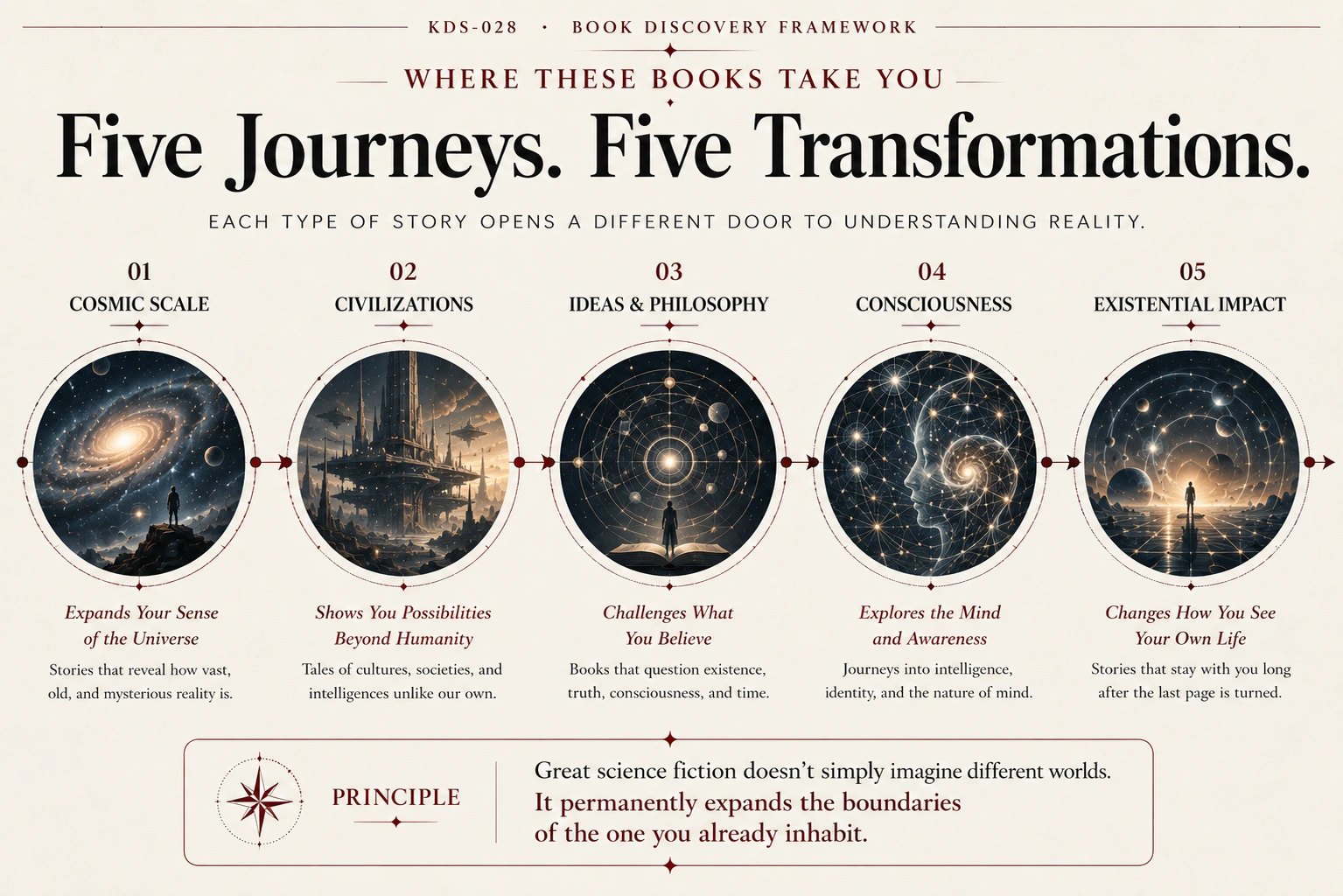
This is also why philosophical science fiction forms a natural bridge between literature and the broader Cokos knowledge system. A novel about contact can become a question about knowledge. A story about digital minds can become a question about personal identity. A civilization facing extinction can become a question about morality, free will, or meaning.
More Cokos reading paths for philosophical science fiction fans
Frequently asked questions
What should I read after The Three-Body Problem?
If you have read only the first novel, continue with The Dark Forest and Death’s End. For a different author, start with Blindsight, Solaris, Children of Time, Hyperion, or Those Who Guard Eternity, depending on whether you want more hard science, first contact, civilization-scale storytelling, or philosophical depth.
What books are most similar to The Three-Body Problem?
The closest thematic matches are Blindsight, Revelation Space, Children of Time, A Deepness in the Sky, and Spin. Each combines major scientific or civilizational ideas with events that change humanity’s understanding of its place in the universe.
Are there books like The Three-Body Problem but easier to read?
Yes. Try Spin, Children of Time, or Hyperion. They retain large ideas and cosmic stakes while offering a more accessible narrative rhythm than Blindsight, Diaspora, or Anathem.
Are there books like The Three-Body Problem but more philosophical?
Yes. Try Solaris, The Dispossessed, Anathem, Permutation City, or Those Who Guard Eternity. These books devote more attention to knowledge, consciousness, identity, reality, political systems, morality, or meaning.
Which science fiction books explore consciousness?
Blindsight, Permutation City, and Diaspora are especially strong choices. Cokos also explores the topic directly in What Is Consciousness?, Why Does Consciousness Exist?, and What Is Mind?.
Which books combine hard science with philosophy?
Blindsight, Diaspora, Anathem, Permutation City, and the Three-Body trilogy are among the clearest examples. Their scientific concepts directly produce philosophical questions rather than functioning as background detail.
Is The Three-Body Problem hard science fiction?
It is commonly described as hard science fiction because scientific ideas, physical constraints, and technological speculation play central roles in the plot. Its appeal also extends into philosophy, history, strategy, sociology, and questions about civilization.
Is The Three-Body Problem philosophical?
Yes. Although the trilogy is rooted in scientific speculation, it repeatedly raises philosophical questions about knowledge, trust, morality, survival, civilization, human nature, and the meaning of intelligence in a hostile universe.
Which books feature truly alien intelligence?
Solaris, Blindsight, and Children of Time are among the strongest choices. Each resists the idea that alien intelligence must think, communicate, or organize itself like humanity.
Which books explore the Fermi paradox or cosmic silence?
The Dark Forest, Revelation Space, and Blindsight are especially relevant. They treat silence not as a neutral absence, but as evidence that intelligent life may face severe constraints or dangers.
Is Those Who Guard Eternity similar to The Three-Body Problem?
They are not the same kind of novel, but they can appeal to the same reader. Both place humanity within a reality larger than ordinary experience and ask civilization-scale questions. The Three-Body Problem is more centered on physics, contact, and survival; Those Who Guard Eternity is more centered on eternity, consciousness, identity, truth, and responsibility.
What is the best book on this list for beginners?
Children of Time, Spin, and Hyperion are accessible starting points for readers who want large ideas alongside strong narrative momentum. Readers ready for denser conceptual fiction may prefer Blindsight, Diaspora, or Anathem.
Final recommendation
The right follow-up to The Three-Body Problem depends on what the trilogy awakened in you.
Choose Blindsight if you want consciousness challenged. Choose Solaris if you want the alien to remain truly alien. Choose Children of Time if you want to witness another kind of civilization emerge. Choose Hyperion if you want a vast future told through human lives. Choose Permutation City if you want reality itself placed under pressure.
And choose Those Who Guard Eternity if you want the journey to continue beyond survival—toward eternity, identity, consciousness, truth, and the question of what humanity is ultimately responsible for becoming.