Perception · Consciousness · Reality
Perception is the process through which the mind organizes and interprets sensory information, turning signals from the world and the body into meaningful experience. We do not receive a finished picture of reality. We receive patterns of light, vibration, pressure, chemistry, temperature, balance, and internal bodily signals—and a nervous system must make sense of them.

What Is Perception?
Perception is the organization and interpretation of sensory information into meaningful experience. Sensory receptors respond to forms of physical or chemical energy: light reaches the eyes, pressure changes reach the ears, molecules interact with smell and taste receptors, and mechanical stimulation reaches the skin. Yet none of these signals arrives labeled as tree, voice, danger, friend, or home.
The perceptual system has to transform stimulation into structured experience. It separates objects from backgrounds, estimates distance and movement, groups features, identifies patterns, integrates information across senses, and relates what is happening now to what has happened before. This is why perception is more than seeing. It includes hearing, touch, taste, smell, balance, proprioception, interoception, and the integration of multiple sensory channels.
OpenStax draws a useful introductory distinction: sensation begins when sensory receptors detect stimulation, whereas perception involves organizing and interpreting sensory information into conscious experience. That distinction matters because two people can receive similar sensory input yet interpret its significance differently.
Perception is also one of the central bridges between psychology and philosophy. Psychology asks how perceptual systems operate. Neuroscience asks how nervous systems encode and transform sensory signals. Philosophy asks what perceptual experience tells us about the world—and whether experience gives us direct access to reality or only a mind-dependent presentation of it.
Sensation vs Perception: What Is the Difference?
Sensation
Detection. Receptors respond to stimulation and transduce it into signals the nervous system can process.
Example: photoreceptors respond to light entering the eye.
Perception
Interpretation. The nervous system organizes sensory information into objects, events, relationships, and meaning.
Example: you experience a red apple sitting on a table.
The distinction is conceptually useful, but real perception is not a neat assembly line in which sensation ends and interpretation suddenly begins. Processing occurs across many levels, and attention, context, prior learning, action goals, and multisensory information can influence what becomes behaviorally relevant.
A person walking through a crowded station is exposed to thousands of potential signals. Most never become the center of awareness. A familiar voice, however, can suddenly become salient. The sensory environment did not need to change dramatically; what changed was which information mattered to the observer.
How Does Perception Work?
A simplified model begins with an external or bodily event and ends with an experienced world. Between those points are several transformations:
Stimulus → sensory receptors → neural signals → selection and organization → interpretation → conscious or behaviorally usable experience.
The first step is transduction: specialized receptors respond to particular forms of stimulation. Neural activity then travels through sensory pathways where information is transformed, compared, integrated, amplified, suppressed, or combined with activity from other systems. The result is not a literal miniature of the world stored inside the head. It is a distributed biological process that supports recognition, prediction, action, and experience.
This also explains why perception is selective. Organisms cannot process every potentially available detail with equal priority. Attention allocates limited processing resources toward information that is relevant to current goals or demands. Research on attention distinguishes stimulus-driven influences from goal-directed influences, while showing that the two interact rather than operating as completely isolated systems (Katsuki & Constantinidis).
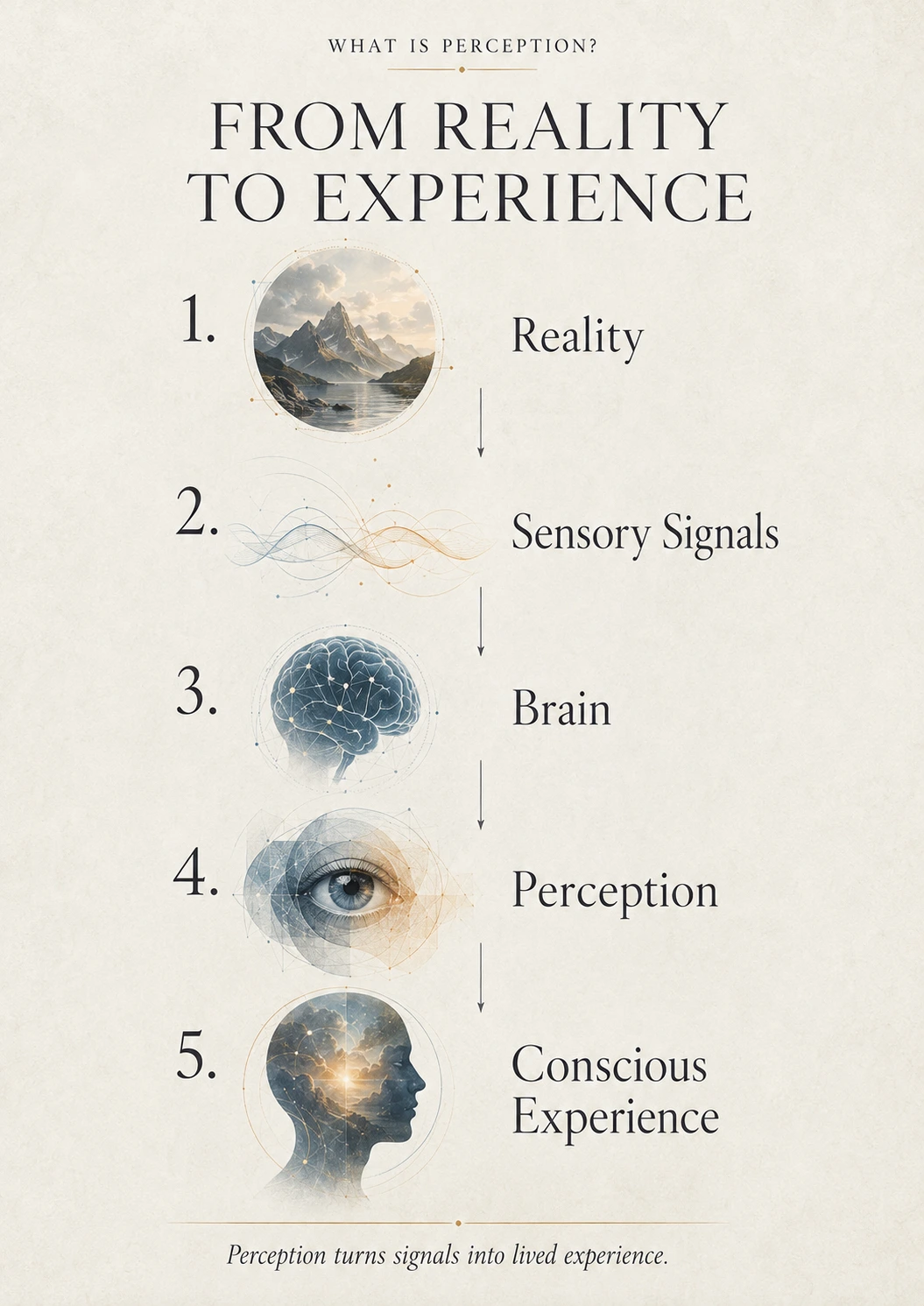
It is important not to turn this model into a stronger claim than the evidence supports. A diagram can show stages for clarity, but perception is not necessarily a single one-way pipeline. Feedback connections are widespread throughout the nervous system, and ongoing perception reflects interaction between incoming information and internal state.
Bottom-Up and Top-Down Processing
One of the most useful ways to understand perception is to distinguish bottom-up and top-down influences.
Bottom-up processing begins with features of incoming sensory information. A sudden movement, loud noise, sharp edge, or strong contrast can capture processing because of properties in the stimulus itself.
Top-down processing refers to influences from prior knowledge, goals, expectations, context, memory, and other higher-level processes. If you expect to find your keys on a crowded desk, that goal changes where you look and what features receive priority. If a sentence contains an ambiguous character, surrounding words can change how the character is interpreted.
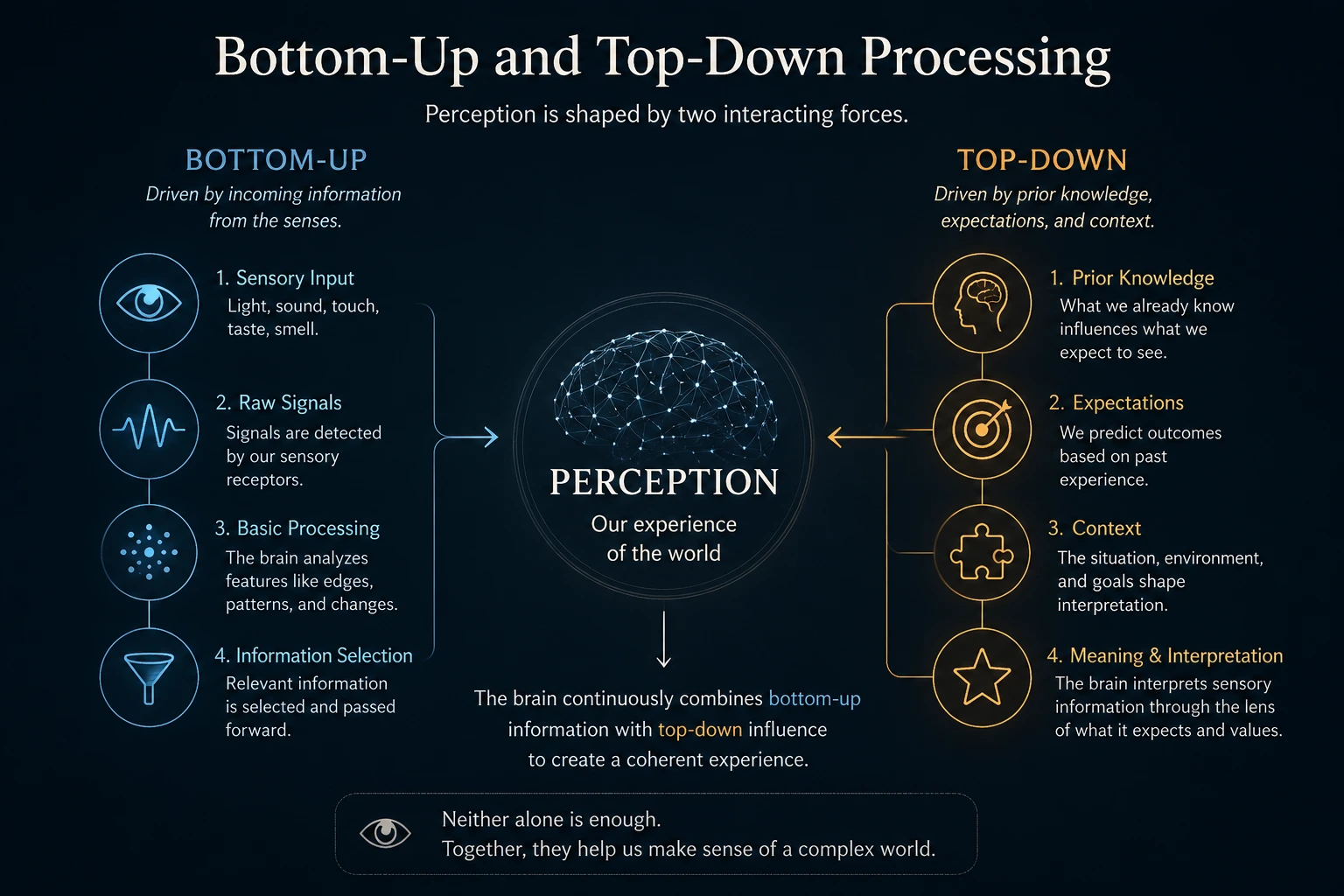
The most accurate lesson is not that perception is either bottom-up or top-down. It is that perception often depends on their interaction. Neurophysiological research has found evidence for integration between sensory information and top-down influences (Gordon et al.), while other work cautions that expectation and attention can affect different processing stages and should not be treated as interchangeable.
This nuance matters. Saying that expectations influence perception does not mean a person can simply believe any reality into existence. Incoming evidence constrains interpretation. The physical world pushes back.
Does the Brain Predict What It Is About to Perceive?
Predictive processing is an influential family of theories proposing that the brain uses internal models to anticipate sensory input and updates those models when predictions differ from incoming signals. In many formulations, perception depends partly on the comparison between expected and actual input.
This framework is attractive because perception has to operate under uncertainty. Sensory signals can be noisy, incomplete, ambiguous, or delayed. Using prior structure can help an organism infer what is most likely happening quickly enough to act.
But predictive processing should be described carefully. It is an active research framework, not a license to say that scientists have proven that the brain “hallucinates reality.” Reviews of the neurophysiological evidence note substantial support for predictive mechanisms while also examining where specific proposed mechanisms remain under debate (Walsh et al.; see also Keller & Mrsic-Flogel).
Why Can Perception Be Wrong?
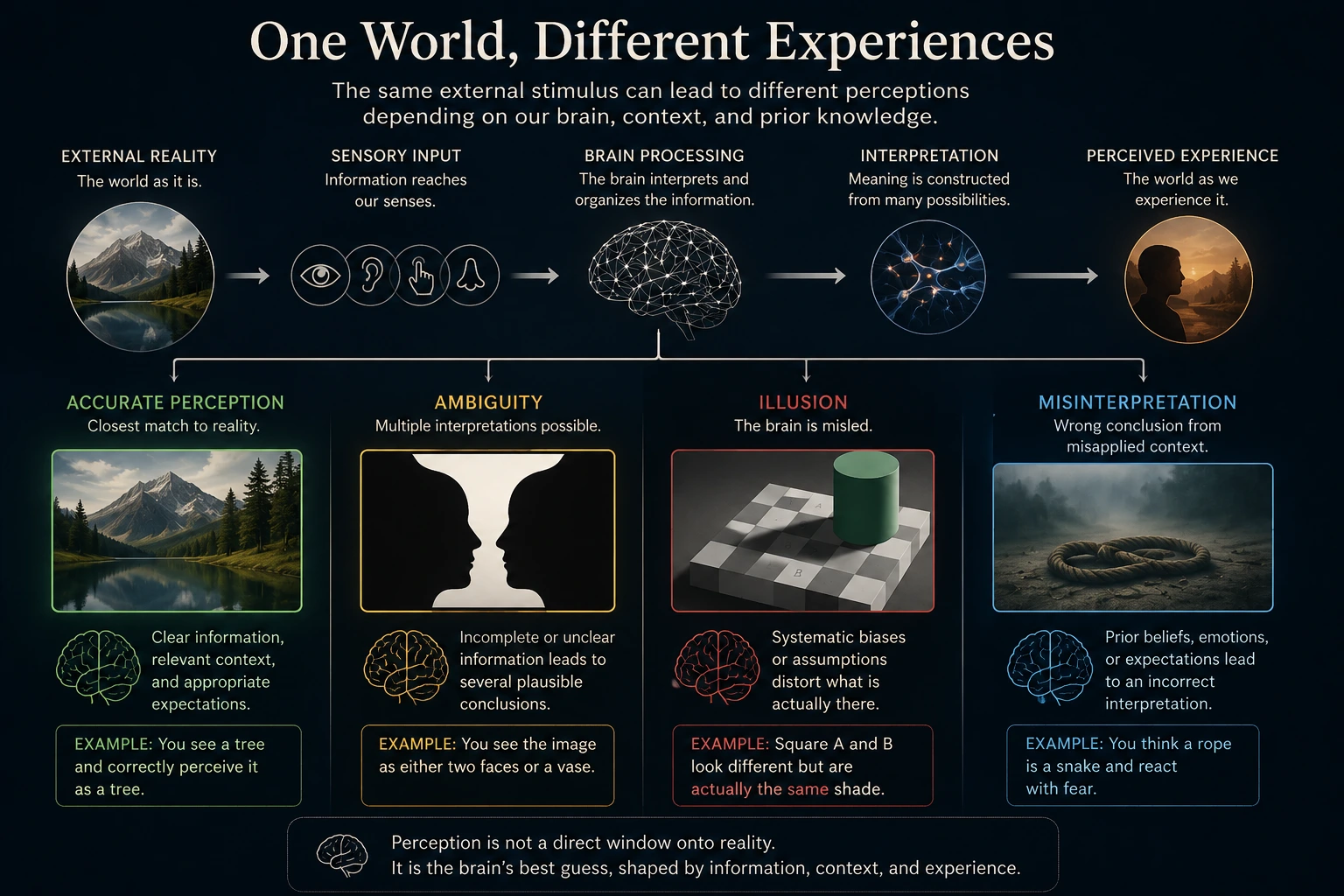
Perception is effective enough to guide movement, communication, tool use, social coordination, and survival. But it is not infallible. The same processes that let a nervous system make fast, useful inferences can produce systematic errors when information is ambiguous or context is misleading.
Illusions
An illusion occurs when a real stimulus is perceived in a way that differs from some measurable property of the stimulus. Visual illusions are especially useful scientifically because they reveal assumptions and organizational rules that usually help perception work.
Ambiguous stimuli
Some images or sounds support more than one plausible interpretation. The classic face-vase figure can alternate between two faces and a central vase even though the physical image remains unchanged. That shows that the mapping from sensory pattern to perceptual interpretation is not always one-to-one.
Misinterpretation
In uncertain conditions, prior experience can steer interpretation toward the wrong conclusion. A coiled rope glimpsed in poor light may initially be interpreted as a snake. This is not proof that perception is arbitrary. It is evidence that perceptual systems make inferences under constraints and can revise them when better information becomes available.
Hallucination
Hallucination raises a deeper philosophical problem because a person can have an experience that seems perceptual without the corresponding external object being present. Philosophers have long used illusion and hallucination to ask what perceptual experience itself can guarantee about the external world (see the Stanford Encyclopedia of Philosophy on the problem of perception).
Perception vs Reality: Do We Experience the World as It Is?
This is where a straightforward psychology question becomes a philosophical one.
It is reasonable to say that our experience of reality is constructed through perception. It is much stronger—and not established by that fact alone—to say that the external world itself is constructed by our minds.
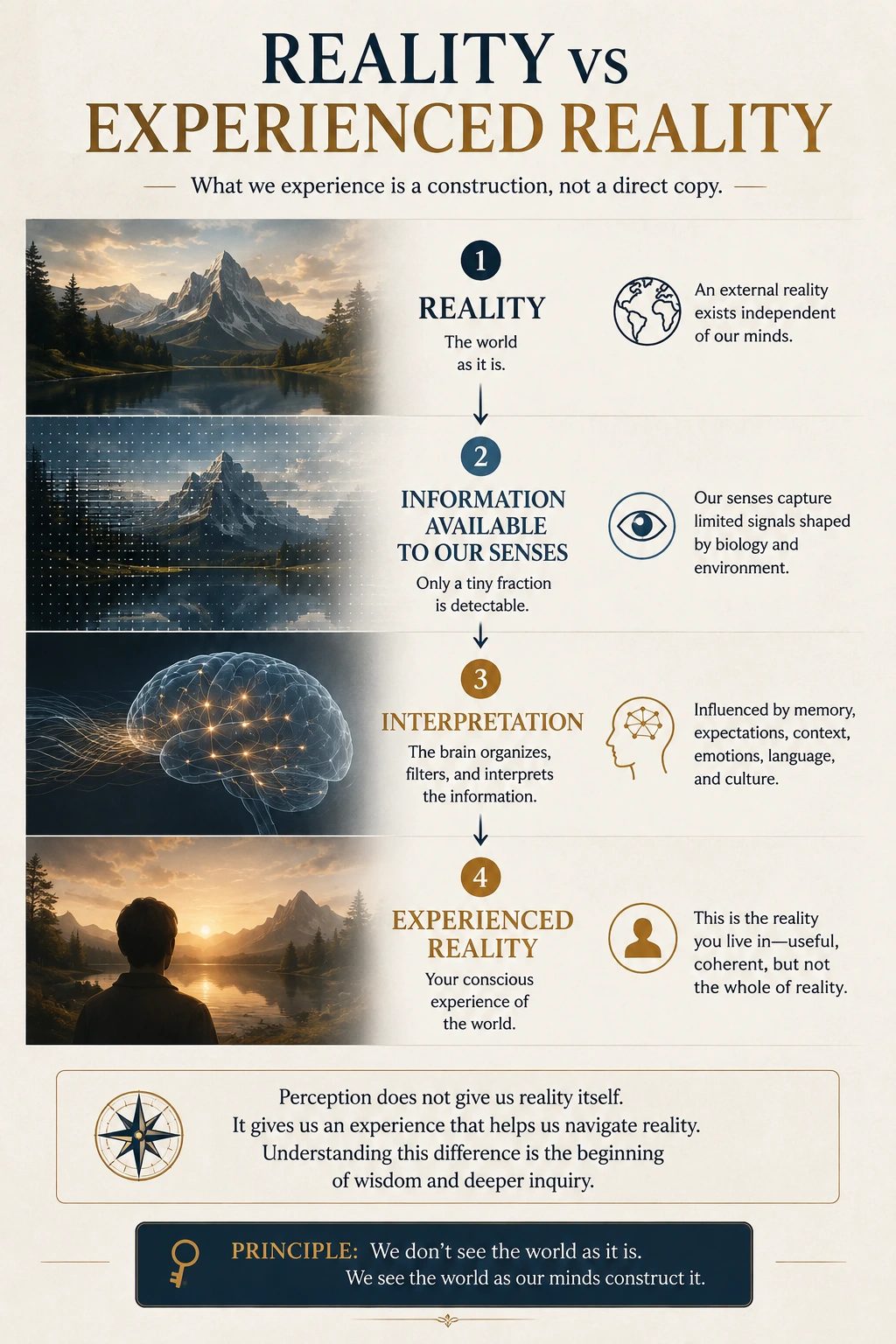
These statements should not be confused:
- External reality: whatever exists independently of a particular observer’s current experience.
- Available sensory information: the subset of physical or bodily information that can affect an organism’s receptors.
- Perceptual processing: the biological and cognitive operations that organize and interpret that information.
- Experienced reality: the meaningful world that appears in conscious life.
Your eyes do not register every wavelength of electromagnetic radiation. Your ears do not register every possible frequency. Attention does not preserve every detail that reaches sensory systems. Yet the experience that results normally feels immediate: you see the tree, hear the melody, and recognize the face—not the intermediate processing that makes those experiences possible.
This is one reason the question of reality cannot be separated completely from the question of how we know what is real. What we know empirically is deeply dependent on perceptual access, measurement, comparison, reasoning, and correction.
Why Do Different People Perceive the Same Thing Differently?
Differences in perception do not require different physical universes. They can arise because observers bring different bodies, positions, histories, expectations, goals, and attentional priorities to the same environment.
Position and access matter. Two witnesses may literally receive different visual or auditory information because they stand in different places.
Attention matters. One observer may notice a facial expression while another notices a change in tone of voice.
Knowledge matters. An experienced musician can hear structural features in a composition that a novice does not yet recognize. A radiologist may notice patterns in an image that are not meaningful to an untrained viewer.
Context matters. The same ambiguous signal can be interpreted differently depending on what surrounds it.
Memory and expectation matter. Previous experience can make some interpretations more available than others.
Emotion and bodily state can matter. Threat, fatigue, pain, arousal, and motivation can influence attention and appraisal, although such effects should not be reduced to the vague claim that emotions simply “create reality.”
The important distinction is between shared reality and different interpretations of available evidence. Human disagreement does not automatically prove that truth is subjective. Often it shows why evidence, perspective-taking, measurement, and revision are necessary.
Perception and Consciousness
Perception and consciousness overlap, but they are not simple synonyms.
Perceptual systems can process information that influences behavior without every stage becoming part of conscious awareness. Meanwhile, conscious experience includes more than immediate perception: memories, imagery, inner speech, emotion, and abstract thought can all become conscious.
Still, perception provides one of the clearest routes into the problem of consciousness. Neural systems can discriminate wavelengths, edges, frequencies, textures, and motion. But why should any of this processing be accompanied by the felt quality of color, sound, space, warmth, or presence?
That question connects perception to the hard problem of consciousness: explaining why and how physical processing is accompanied by subjective experience. It also connects to conscious experience itself—the first-person fact that there is something it is like to see a sky, hear a voice, or feel a surface.
Perception therefore has two faces. From the outside, it can be studied as information processing and behavior. From the inside, it is part of the lived field in which a world appears.
Perception, Memory, Identity, and the Self
Perception does not disappear the moment a stimulus ends. Some experiences are encoded into memory, and memory can later influence what is noticed, expected, and interpreted.
This produces a feedback loop:
Perception → experience → memory → identity and expectations → future perception.
Suppose someone repeatedly experiences a place as safe. Memories of that safety can influence expectations when returning. Someone with a very different history may enter the same place with different attentional priorities. The external setting is shared, but the meaning it acquires can differ.
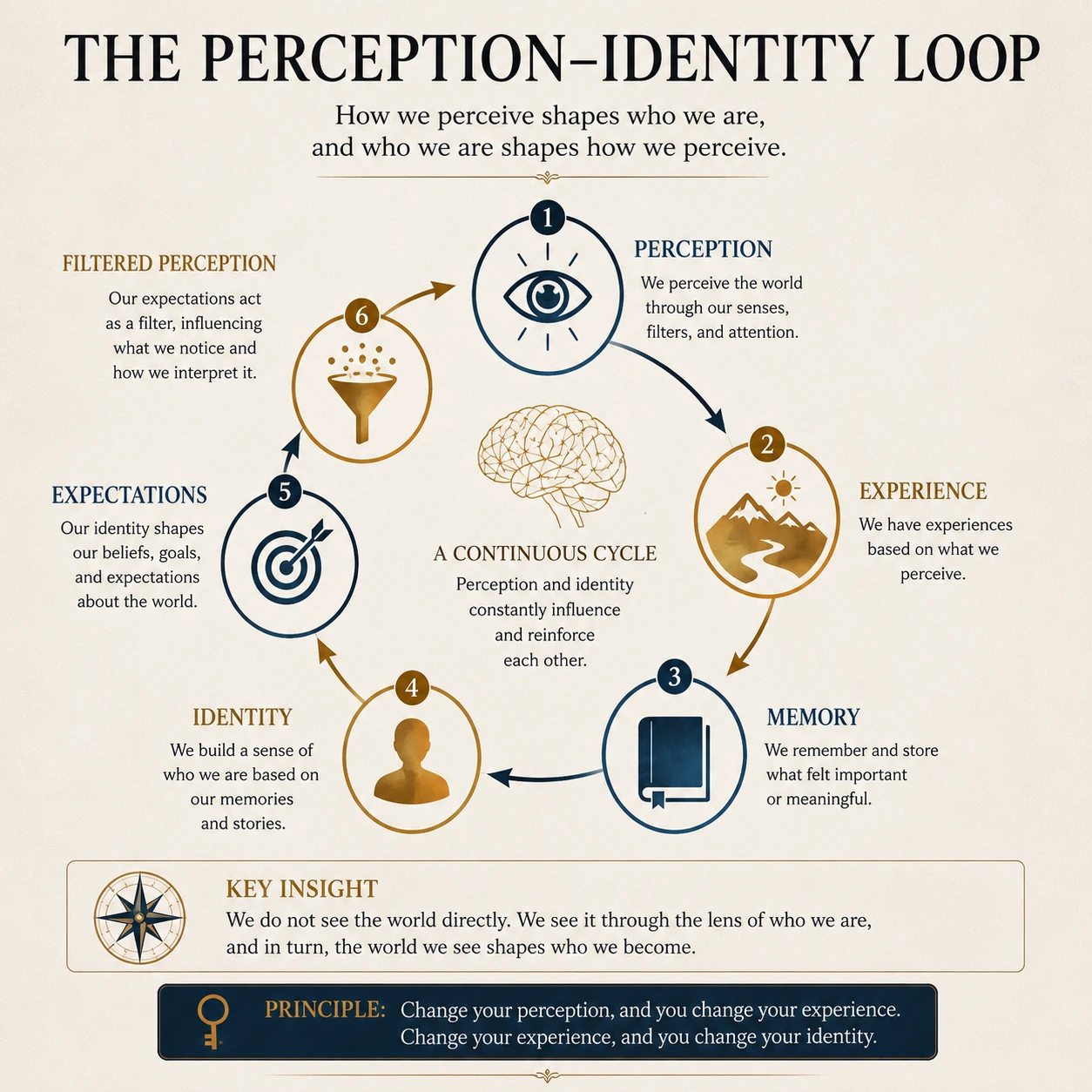
Identity is not reducible to perception. It also depends on social relationships, language, culture, memory, embodiment, commitments, roles, values, and narrative. But perception helps supply the experiences from which a sense of self is continually formed.
This is why the question “What do I perceive?” eventually touches the deeper questions “What is the self?” and “What is personal identity?”. If the self is partly continuous with memory and lived experience, then perception is one of the gates through which a life becomes autobiographical material.
Can We Trust Perception?
Yes—but not unconditionally.
The existence of illusions does not show that perception is generally useless. If perceptual systems were radically disconnected from environmental structure, coordinated action would quickly fail. We can catch objects, recognize people, navigate roads, build instruments, and compare observations because perception normally tracks enough regularity to support successful action.
At the same time, perception can be incomplete or mistaken. The rational response is not to abandon it but to supplement it.
- Look again from another angle.
- Gather more sensory information.
- Compare independent observers.
- Use instruments when human senses are insufficient.
- Separate observation from interpretation.
- Test predictions against what happens next.
- Revise beliefs when evidence repeatedly conflicts with them.
Science institutionalizes many of these corrections. Instruments extend sensory access; controlled experiments isolate variables; repeated measurements reduce dependence on a single observation; and public methods allow different observers to compare results.
Perceptual fallibility therefore leads not to radical skepticism but to better epistemology.
Can Artificial Intelligence Perceive?
Modern AI systems can process images, speech, video, spatial data, and other signals with extraordinary sophistication. Whether that counts as “perception” depends on what the word is intended to mean.
If perception means detecting, organizing, classifying, and using sensory-like input, machines can perform many perceptual functions. Computer-vision systems can identify objects; speech systems can discriminate patterns in sound; robots can integrate cameras, lidar, touch sensors, and proprioceptive data to guide action.
If perception means having a conscious perceptual experience, the question becomes much harder. Successful classification does not by itself establish that there is anything it feels like for the system to process an image. That question is part of the broader debate over whether AI can become conscious.
This distinction prevents a common category error: competence at processing information and subjective experience are not automatically the same thing.
What Does Perception Tell Us About Knowledge?
Much of what humans know about the physical world begins with perception. We see events, hear testimony, touch objects, read instruments, and observe patterns. Yet if perception itself involves interpretation, how can it justify beliefs about a world beyond experience?
This is a classic problem in epistemology. The Stanford Encyclopedia of Philosophy describes the central epistemological problem of perception as explaining how perceptual experience can provide knowledge or justified belief about an external world.
The problem does not mean perception provides no knowledge. Instead, it forces us to explain why some perceptual beliefs are justified and others are not. Conditions matter: good lighting is better than darkness, close inspection is better than a fleeting glimpse, calibrated instruments can outperform unaided senses, and converging independent evidence is stronger than a single ambiguous impression.
Perception therefore connects directly to what knowledge is, what truth is, and how humans can distinguish a convincing appearance from a well-supported belief.
The deeper insight is not that perception blocks us from reality. It is that access to reality is mediated, limited, and correctable.
The Strange Boundary Between the World and the Mind
Where does the world end and experience begin?
At first the answer seems obvious. The mountain is outside you; the experience of seeing the mountain is inside you. But perception complicates this boundary because the experience is causally connected to the mountain while also depending on the observer’s sensory system, attention, neural processing, memories, and expectations.
The world constrains perception. Perception organizes the information available from the world. Experience gives that organized information a first-person form. Memory preserves part of the experience. The self then carries those histories into the next encounter.
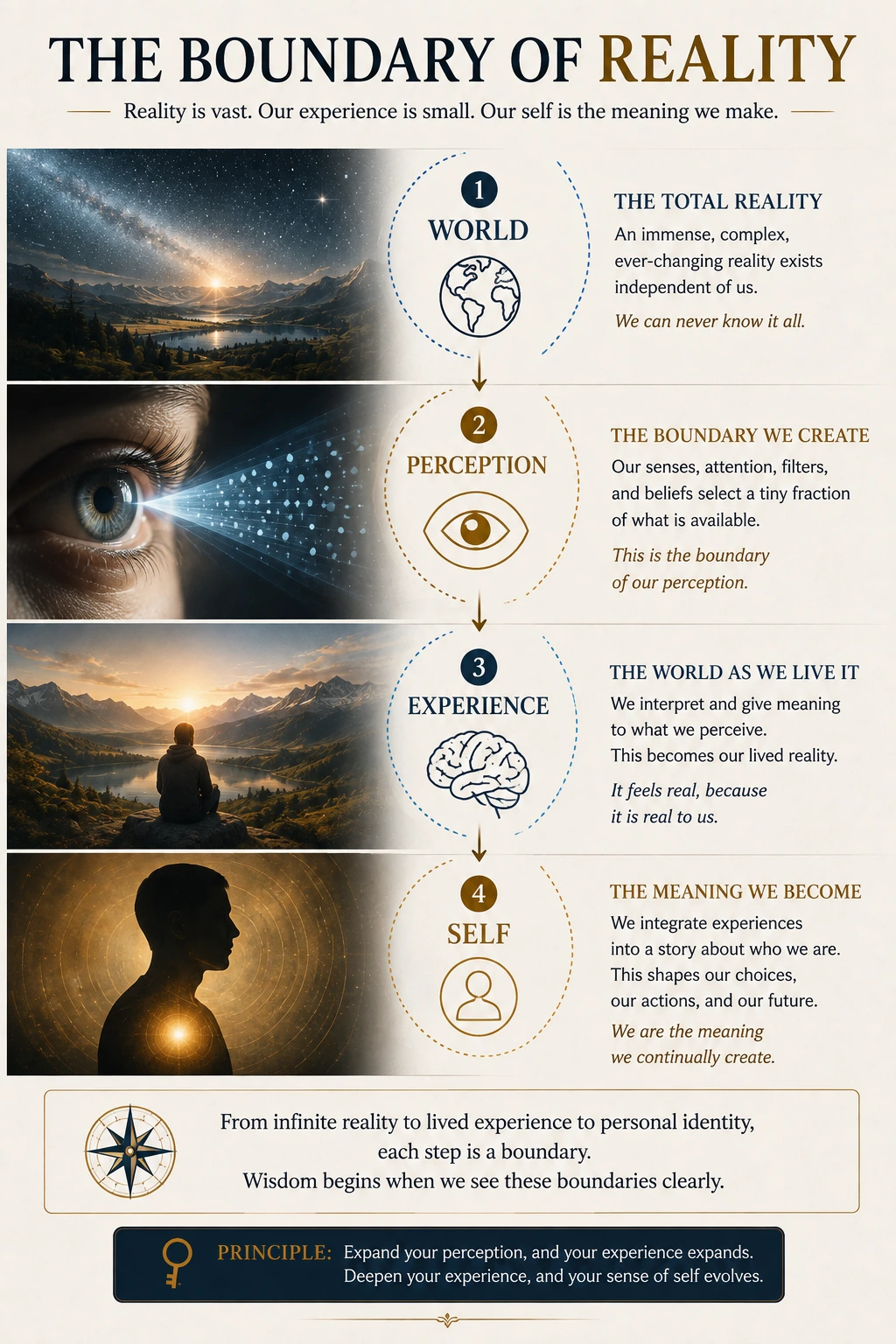
It would be an error to conclude that everything outside the mind is unknowable in principle. It would also be an error to assume that experience is a transparent copy of everything that exists. The more defensible position is modest: human access to reality is partial, perspective-bound, biologically mediated, and open to correction.
That modesty is not a weakness. It is one of the conditions of inquiry.
The Layers of Perception
The entire argument can be condensed into a set of layers. There is reality beyond the individual observer. There is information from that reality that can interact with sensory systems. Some of it is selected and organized. It becomes lived experience. Repeated experiences can then contribute to memory, expectation, and identity.
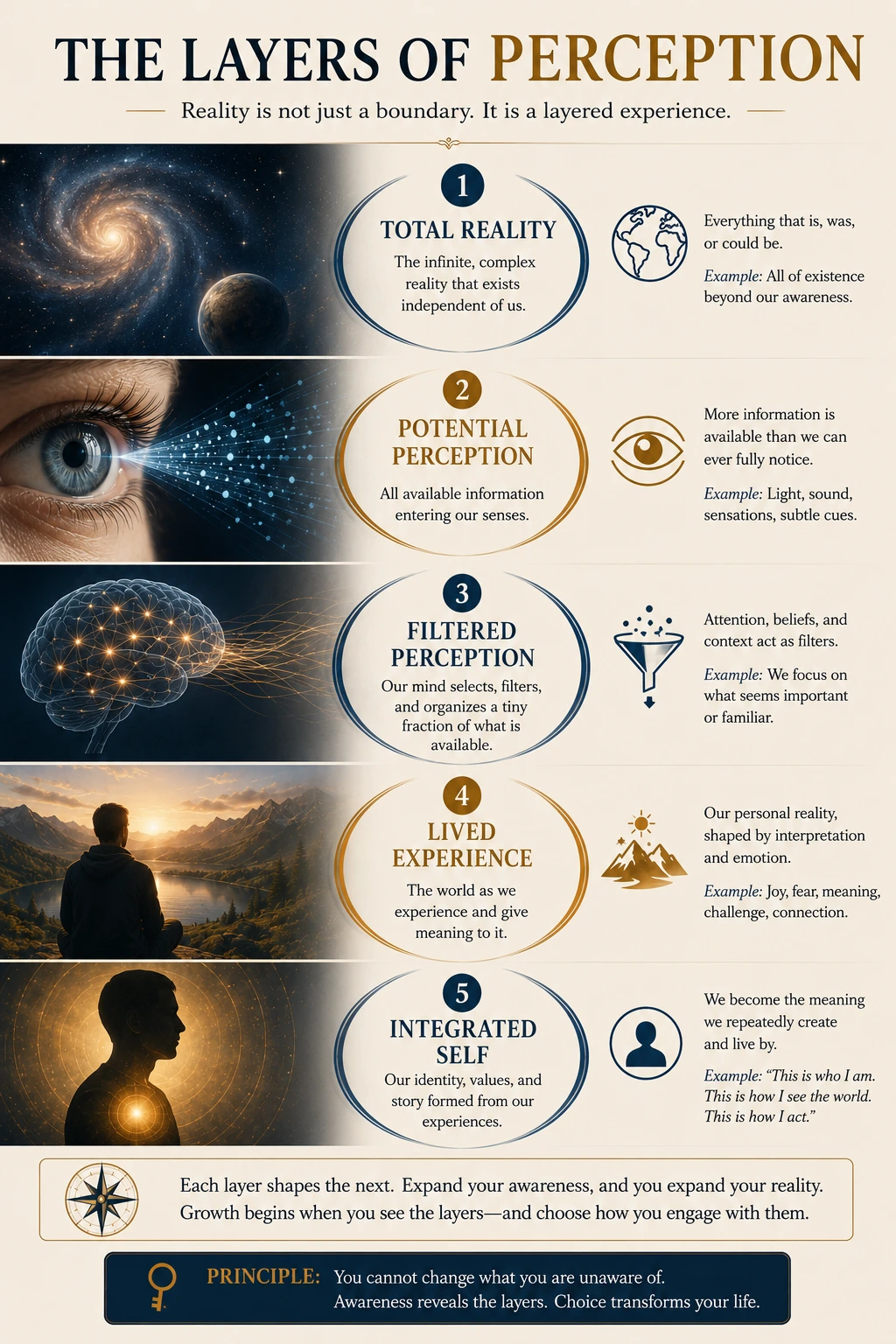
These layers should not be treated as rigid metaphysical compartments. They are a conceptual map. Its purpose is to separate questions that are often collapsed together:
- What exists?
- What information is available?
- What can a particular organism detect?
- What receives attention?
- How is it interpreted?
- What becomes conscious experience?
- What is remembered?
- How does experience influence future expectations and identity?
Once those questions are separated, a common confusion becomes easier to avoid: constructed experience is not the same thing as invented reality. Perception is constructive because nervous systems organize information. It remains constrained because there is something to organize, something that resists some interpretations and supports others.
From Perception to Philosophical Fiction
If perception gives us a usable but incomplete experience of reality, speculative fiction can ask what happens when the limits of that experience are challenged.
Those Who Guard Eternity explores reality, time, choice, responsibility, and forces that remain outside ordinary human awareness. The novel turns questions that philosophy asks abstractly into a world where characters must act before they fully understand the systems around them.
If the reality you perceive is only part of what exists, what would it mean to discover the rest?
Frequently Asked Questions About Perception
What is perception in simple terms?
Perception is how the brain and mind turn sensory information into meaningful experience. Sensation detects stimulation such as light, sound, pressure, or chemicals; perception organizes and interprets those signals so that we experience objects, events, people, space, and meaning.
What is the difference between sensation and perception?
Sensation refers to detecting stimulation through sensory receptors. Perception refers to organizing and interpreting sensory information. Seeing wavelengths of light involves sensory transduction; experiencing a red apple as a recognizable object involves perception.
Does the brain create perception?
The brain is essential to perception because neural systems transform, integrate, and interpret sensory information. However, saying the brain constructs perceptual experience does not mean it creates external reality. Perception depends both on incoming information and on processes such as attention, context, learning, and expectation.
Is perception the same as reality?
No. Reality refers to what exists, while perception refers to an organism’s experience and interpretation of information related to that reality. Perception can track the world accurately enough for effective action while still being selective, limited, and sometimes mistaken.
Why do people perceive the same thing differently?
People can differ in sensory access, position, attention, knowledge, expectations, memory, emotional state, and context. These differences can change which information is noticed and how ambiguous information is interpreted without requiring the external world itself to be different for each person.
Is perception always conscious?
No. Sensory information can be processed and influence behavior without every stage entering conscious awareness. Conscious perceptual experience is therefore one part of a larger set of sensory and neural processes.
Sources and Further Reading
- OpenStax Psychology 2e — Sensation versus Perception
- OpenStax Anatomy and Physiology 2e — Sensory Perception
- Stanford Encyclopedia of Philosophy — The Problem of Perception
- Stanford Encyclopedia of Philosophy — Epistemological Problems of Perception
- Keller & Mrsic-Flogel — Predictive Processing: A Canonical Cortical Computation
- Walsh et al. — Evaluating the Neurophysiological Evidence for Predictive Processing
- Katsuki & Constantinidis — Bottom-Up and Top-Down Attention
- Gordon et al. — Expectation and Attention Increase Integration of Top-Down and Bottom-Up Signals
Editorial note: This article distinguishes established findings about sensory and perceptual processing from broader philosophical interpretations about reality and subjective experience. Scientific models discussed here remain open to refinement as research develops.