Consciousness · Philosophy of mind · Subjective experience
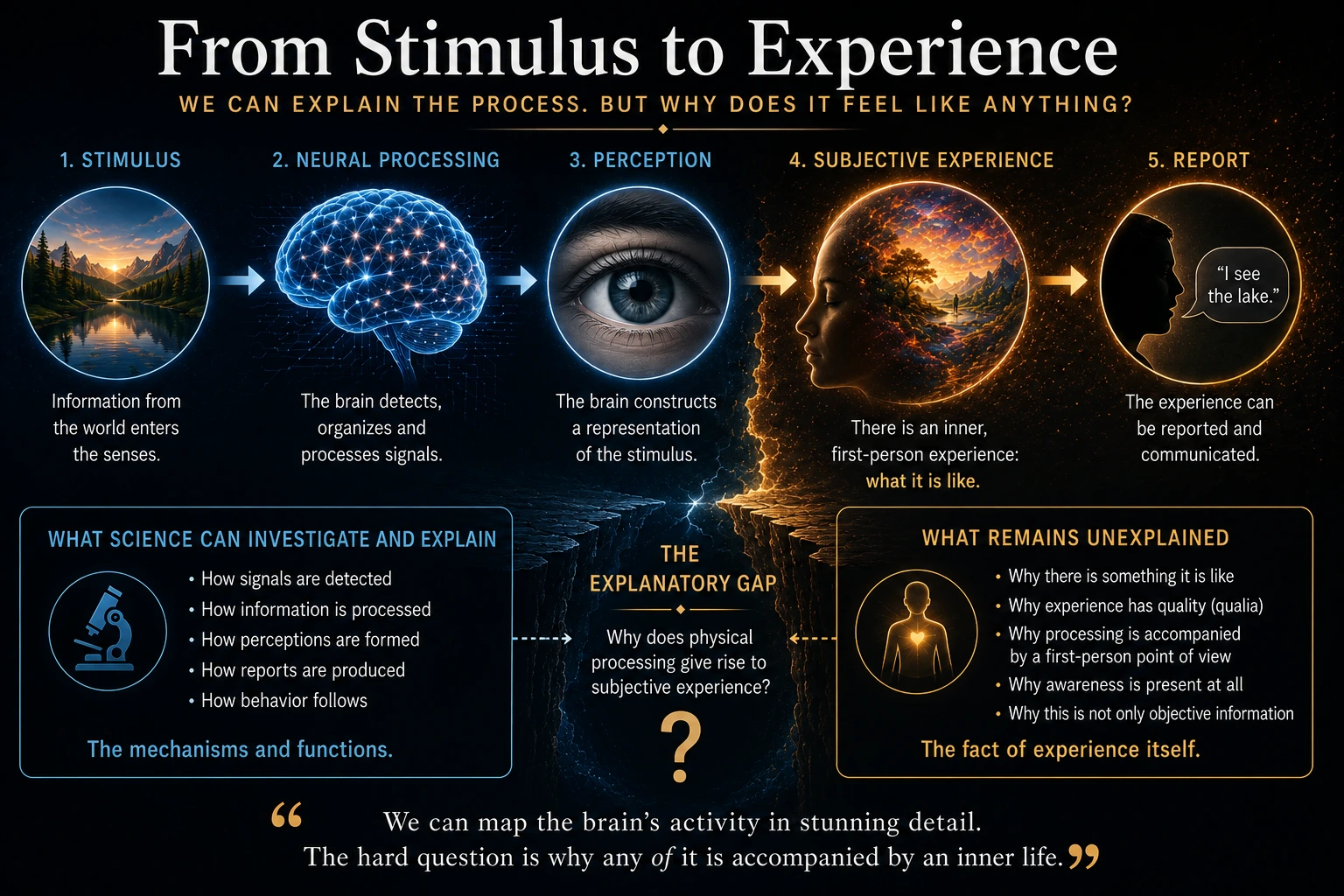
Science can trace signals, map brain activity and explain how people perceive, remember, decide and report. The deeper puzzle is why any of those processes are accompanied by an inner life at all.
The hard problem of consciousness is the challenge of explaining why physical processes in the brain are accompanied by subjective experience. Science can investigate how the brain detects information, directs attention, stores memories and produces behaviour. The harder question is why any of those processes feel like something from the inside—why there is an experience of colour, pain, thought, emotion or simply being alive.
Imagine that researchers could describe every physical event that occurs when you see a red apple. They could track light entering your eyes, signals moving through the retina, activity spreading through visual regions, attention selecting the object, memory identifying it and language preparing the sentence, “I see a red apple.” Even a perfect description of those mechanisms seems to leave one question open: why does that activity produce the particular felt appearance of red?
That question marks the boundary between explaining what a conscious system does and explaining why there is something it is like to be that system. It is called “hard” not because the other scientific questions are easy in practice, but because the kind of explanation required is disputed. We know how a functional explanation is supposed to work: identify mechanisms, inputs, transformations and outputs. We do not yet agree on what would count as a complete explanation of experience itself.
What Is the Hard Problem of Consciousness?
The modern phrase comes from philosopher David Chalmers, who distinguished between explaining cognitive functions and explaining phenomenal experience in his 1995 paper “Facing Up to the Problem of Consciousness”. The underlying mind–body puzzle is much older, but Chalmers gave the debate a memorable structure: some problems ask how mental systems perform functions, while the hard problem asks why performing those functions is accompanied by experience.
The simplest definition
The hard problem is the problem of connecting two kinds of description:
- Third-person description: neurons fire, networks exchange signals, information is integrated, behaviour changes and a person speaks.
- First-person reality: the person sees a colour, feels pain, hears music, remembers a childhood scene and experiences a continuing sense of self.
Both descriptions concern the same human being. The unresolved question is how—and whether—the first follows from the second in a fully explanatory way.
Why is it called “hard”?
“Hard” does not mean that perception, memory, attention or anaesthesia are simple research topics. They are extraordinarily difficult. They are called comparatively “easy” because researchers know the general form of the desired answer: a mechanism that performs a function. The hard problem appears different because a complete account of mechanisms may still seem compatible with the question, “But why is there experience?”
Important: philosophers disagree about whether the hard problem identifies an additional fact that science must explain. Some accept the problem as fundamental. Others argue that once cognition, behaviour, introspection and self-report are fully explained, no further mystery remains.
The Easy Problems Versus the Hard Problem
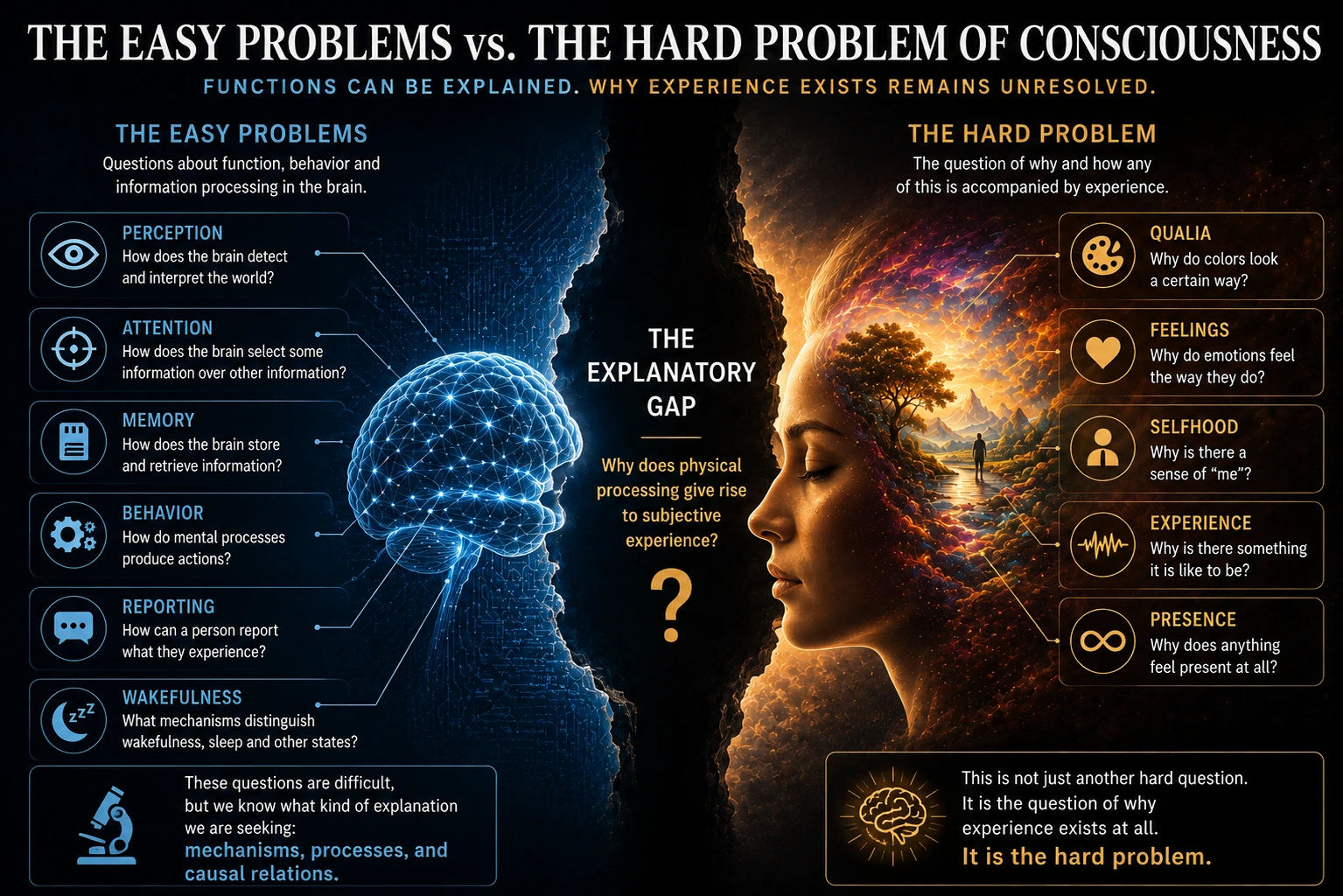
The so-called easy problems concern capacities and functions associated with consciousness. A scientific explanation can specify what information enters a system, how the system transforms it and what behaviour or report follows.
| Research problem | Question being investigated | What an explanation could identify |
|---|---|---|
| Perception | How does the brain identify colours, faces, sounds and objects? | Sensory pathways, computations, representations and error correction |
| Attention | How does a system select some information and ignore other information? | Competition, amplification, control networks and task demands |
| Memory | How is information encoded, stored and retrieved? | Plasticity, consolidation, retrieval cues and network dynamics |
| Behaviour | How do internal processes produce decisions and actions? | Causal pathways linking perception, valuation and motor output |
| Reporting | How can a person describe what they perceive or feel? | Access to information, language preparation and communication |
| Wakefulness | What distinguishes wakefulness, sleep, anaesthesia and disorders of consciousness? | Brainstem systems, cortical dynamics and large-scale connectivity |
Why functional explanations are scientifically tractable
A functional explanation can be tested. Researchers can alter an input, disrupt a brain region, measure a response and compare predictions. They can ask whether a mechanism is necessary, sufficient or merely correlated with a capacity. Progress may be slow, but the research programme has clear targets.
Why solving the functions may not solve experience
Suppose a theory eventually predicted every report a conscious person could make and every action they could perform. Would that prediction explain why seeing red has a felt quality, or would it only explain why the person says that it does? Chalmers argues that this gap survives functional explanation. Critics reply that the demand for something further may be created by misleading intuitions about introspection. The disagreement is not a minor technicality; it determines what a successful theory of consciousness must accomplish.
What Is Subjective Experience?
Subjective experience is the first-person character of consciousness: the fact that a mental state is present for someone. It includes sensory qualities, bodily feelings, emotions, thoughts, memories and the sense of occupying a point of view.
What does “what it is like” mean?
Philosopher Thomas Nagel made this expression central in his 1974 essay “What Is It Like to Be a Bat?” We may learn a great deal about echolocation, bat anatomy and bat behaviour. Yet those objective facts do not automatically give us the bat’s point of view. Imagining ourselves with wings and sonar is still imagining how we would feel, using the resources of a human mind.
The phrase does not require anything mystical. It points to a familiar fact: pain hurts; music sounds a certain way; grief has a felt weight; a remembered place can appear inwardly even when it is absent. A full theory of consciousness must clarify how those first-person facts relate to the physical organism.
Experience versus information
Information can be represented without proving that it is experienced. A camera registers wavelengths, a thermostat responds to temperature and a language system can classify descriptions. Those capacities do not by themselves establish an inner point of view. The hard problem begins when we ask what additional conditions—if any—turn information processing into felt experience.
For a broader foundation, see what conscious experience is and how it differs from mere responsiveness or information processing.
What Are Qualia?
Qualia are the felt qualities of particular experiences: how blue looks, how coffee tastes, how a headache hurts, how a violin sounds or how anxiety feels in the body. The term is used in several ways, and philosophers dispute whether qualia are intrinsic private properties, representational features, relations or a misleading way of describing ordinary mental processes.
The appearance of colour
A wavelength can be measured publicly. The experienced appearance of red is presented from a point of view.
The painfulness of pain
Nociception can trigger withdrawal and report. The unpleasant felt quality is the feature the hard problem highlights.
The character of music
Frequency, rhythm and neural responses can be analysed. Listening also has a lived, meaningful character.
The feeling of grief or joy
Emotions involve physiology, appraisal and behaviour, yet they are also experienced from within.
Can qualia be measured?
Researchers can measure reports, choices, physiological changes and neural activity associated with experience. These methods are essential. The philosophical caution is that a measure of what accompanies experience is not automatically identical to the experience it measures. The distinction resembles the difference between a temperature reading and the sensation of warmth, although the relationship between sensation and measurement is much more complex.
Why some philosophers reject qualia
Some theorists argue that the traditional picture of qualia—as private, ineffable mental objects—is confused. On this view, experience should be explained through representation, discrimination, attention, memory and the brain’s tendency to describe its own states in a particular way. The Stanford Encyclopedia of Philosophy overview of qualia documents how many different definitions and objections coexist. Therefore, the word should not be treated as if it named one universally accepted kind of entity.
What Is the Explanatory Gap?
The explanatory gap is the apparent distance between objective accounts of brain processes and subjective accounts of experience. The phrase is associated with philosopher Joseph Levine, but the underlying intuition appears throughout modern philosophy of mind.
Objective descriptions
Objective descriptions concern publicly measurable structures and events: neuronal firing, neurotransmitters, oscillations, connectivity, computational transformations, bodily responses and verbal reports. They reveal how the brain works and make prediction, diagnosis and intervention possible.
First-person reality
First-person descriptions concern how those states feel: the brightness of a colour, the unpleasantness of pain, the emotional force of music or the sense that there is an “I” present. They are not automatically infallible—people can misidentify causes, forget details and misunderstand their own minds—but the occurrence of experience is the phenomenon under investigation.
Correlation is not automatically a complete explanation
If a pattern of brain activity reliably accompanies pain, that discovery may help identify, predict and modify pain. It can reveal a crucial mechanism. Yet the hard-problem advocate asks whether it also explains why that activity has a painful quality. A correlation may be causally important without answering every explanatory question we can ask about it.
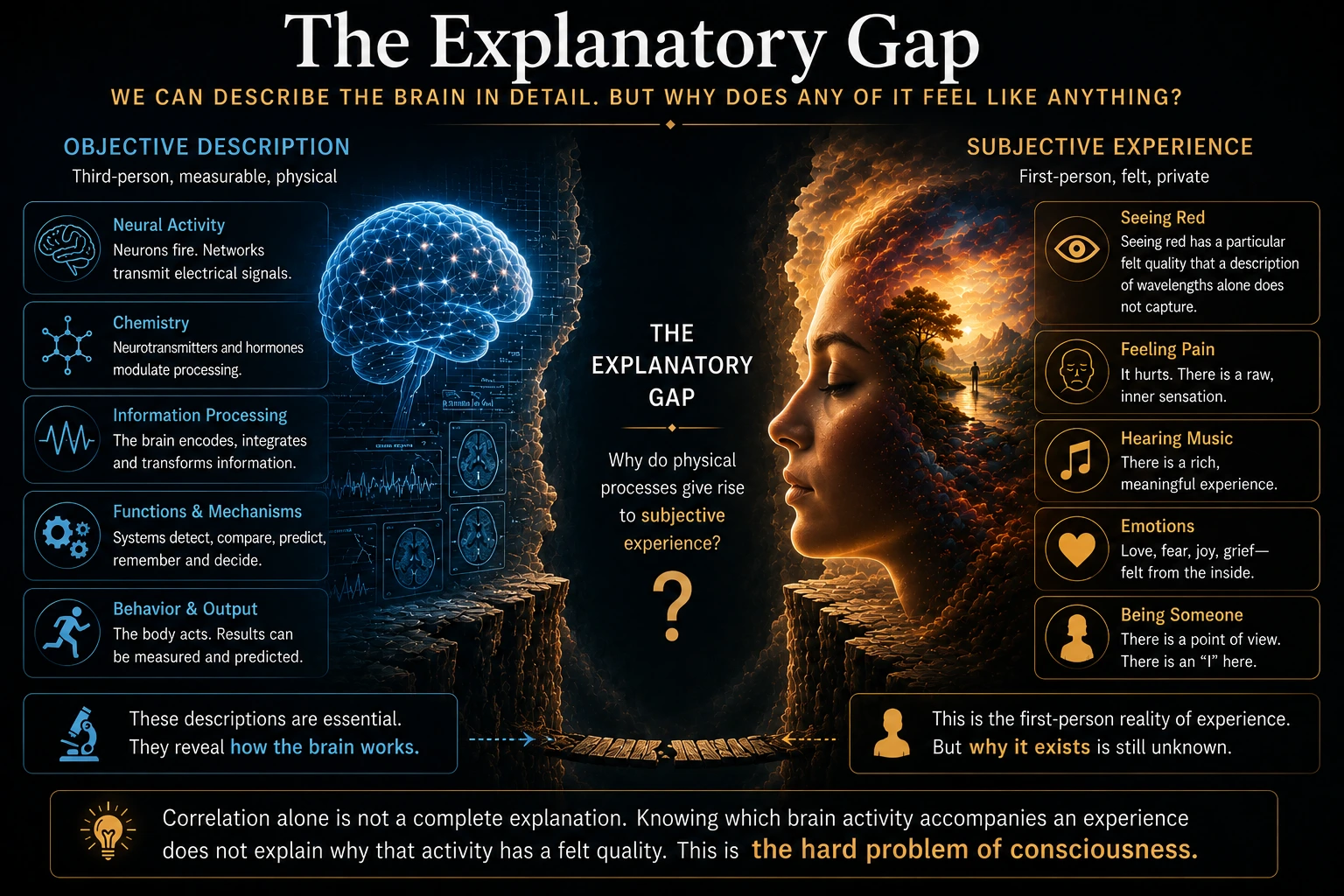
Mapping the brain in finer detail can reveal where and how conscious functions occur. The hard problem asks whether those discoveries also explain why there is something it is like for the system.
The Most Important Thought Experiments
Thought experiments do not prove that consciousness is nonphysical. Their purpose is to expose assumptions: what would a complete physical explanation include, and what do we believe might still be missing?
Mary and the black-and-white room
In Frank Jackson’s 1982 paper “Epiphenomenal Qualia”, Mary is imagined as knowing every physical fact about colour vision while living without colour. When she sees red for the first time, does she learn something new—what red looks like? If so, complete physical information may not include experiential knowledge. Physicalists have produced many replies, including the claim that Mary gains a new ability, representation or way of knowing rather than a new nonphysical fact.
The philosophical zombie
A philosophical zombie is imagined as physically and behaviourally identical to a conscious human but lacking experience. It still says “I am conscious” and reacts normally. If such a being is genuinely conceivable and metaphysically possible, some argue that physical facts do not necessitate phenomenal facts. Critics deny the inference from conceivability to possibility or argue that a perfect functional duplicate would necessarily be conscious.
The inverted spectrum
Could two people use colour words identically while their experiences are systematically reversed? If all behaviour remains the same, the scenario appears to separate qualitative experience from function. Opponents question whether a stable inversion is coherent once every perceptual relation, memory and comparison is included.
What is it like to be a bat?
Nagel’s bat illustrates a limit of objective translation. Complete knowledge of another creature’s physiology and behaviour may still fail to reproduce its point of view in us. The argument does not imply that scientific knowledge is useless; it asks whether objective knowledge and subjective acquaintance are the same kind of knowledge.
How to read these cases: each thought experiment has serious objections. Their value lies in clarifying what a theory claims, not in serving as laboratory evidence for a soul, dualism or any other specific conclusion.
Can Neuroscience Solve the Hard Problem?
Neuroscience is indispensable to the study of consciousness. It can investigate the conditions under which experience is present, altered or absent; identify brain activity associated with conscious access; and build increasingly precise models of perception, attention and report. None of this is diminished by philosophical debate.
What neuroscience can investigate
- differences among wakefulness, sleep, anaesthesia, coma and minimally conscious states;
- which neural events correlate with conscious rather than unconscious perception;
- how information becomes globally available for reasoning and report;
- how recurrent processing, integration and large-scale coordination relate to awareness;
- how brain injury or stimulation changes particular experiences;
- how confidence, attention and memory shape reports about experience.
Detection, mechanism and experience are different targets
| Level | Question | Possible achievement |
|---|---|---|
| Detection | Is consciousness likely to be present? | Infer awareness from behaviour, physiology or neural dynamics |
| Mechanism | How does a conscious capacity operate? | Explain perception, access, memory, control or reporting |
| Experience | Why does the mechanism feel like anything? | Provide the bridging explanation demanded by the hard problem |
The Stanford Encyclopedia overview of the neuroscience of consciousness distinguishes empirical work on neural correlates from the further question of what those correlates explain. That distinction does not imply that empirical research can never close the gap. It means that identifying a correlate, a mechanism and a philosophical explanation are not automatically the same achievement.
Why the answer remains disputed
Some researchers expect the mystery to shrink as theories integrate more evidence, much as biological explanations transformed older mysteries about life. Others believe even a perfect mechanism would leave the first-person fact untouched. A third group argues that the hard problem is generated by cognitive systems misrepresenting their own operations. The disagreement concerns not only the answer but also the standard by which an answer should be judged.
Is the Hard Problem a Real Problem?
There is no consensus. The debate often divides into two broad strategies: accept experience as a phenomenon requiring a distinctive explanation, or explain why we judge experience to have mysterious properties without adding those properties to the ontology of the world.
The case for treating experience as an additional explanatory target
Hard-problem advocates argue that consciousness is the most immediate datum available: theories are observed, measured and discussed within experience. An explanation that accounts for discrimination, behaviour and speech but says nothing about why those processes are felt appears incomplete. On this view, the demand for an explanation is not optional; it identifies the phenomenon that makes consciousness special.
The case for dissolving the problem
Functionalists and illusionists resist the assumption that experience contains ineffable properties beyond cognitive function. Daniel Dennett’s 2016 paper “Illusionism as the Obvious Default Theory of Consciousness” compares the project to explaining a convincing stage illusion. The task is not to locate a magical event but to explain the mechanisms that make observers judge that something magical occurred.
An illusionist need not deny that people see, feel, suffer or think. The view typically denies a particular philosophical interpretation of those states: that introspection reveals additional private phenomenal properties exactly as they seem. The goal is to explain why the brain represents its own activity as possessing those properties.
The illusion problem
Critics reply that calling phenomenal properties illusory may relocate rather than remove the difficulty. Why does the representation of experience itself seem present? What is the status of the apparent feeling? Illusionists answer that these questions can be decomposed into mechanisms of introspection, attention, memory, judgement and report. Whether that decomposition fully dissolves the hard problem is precisely what remains contested.
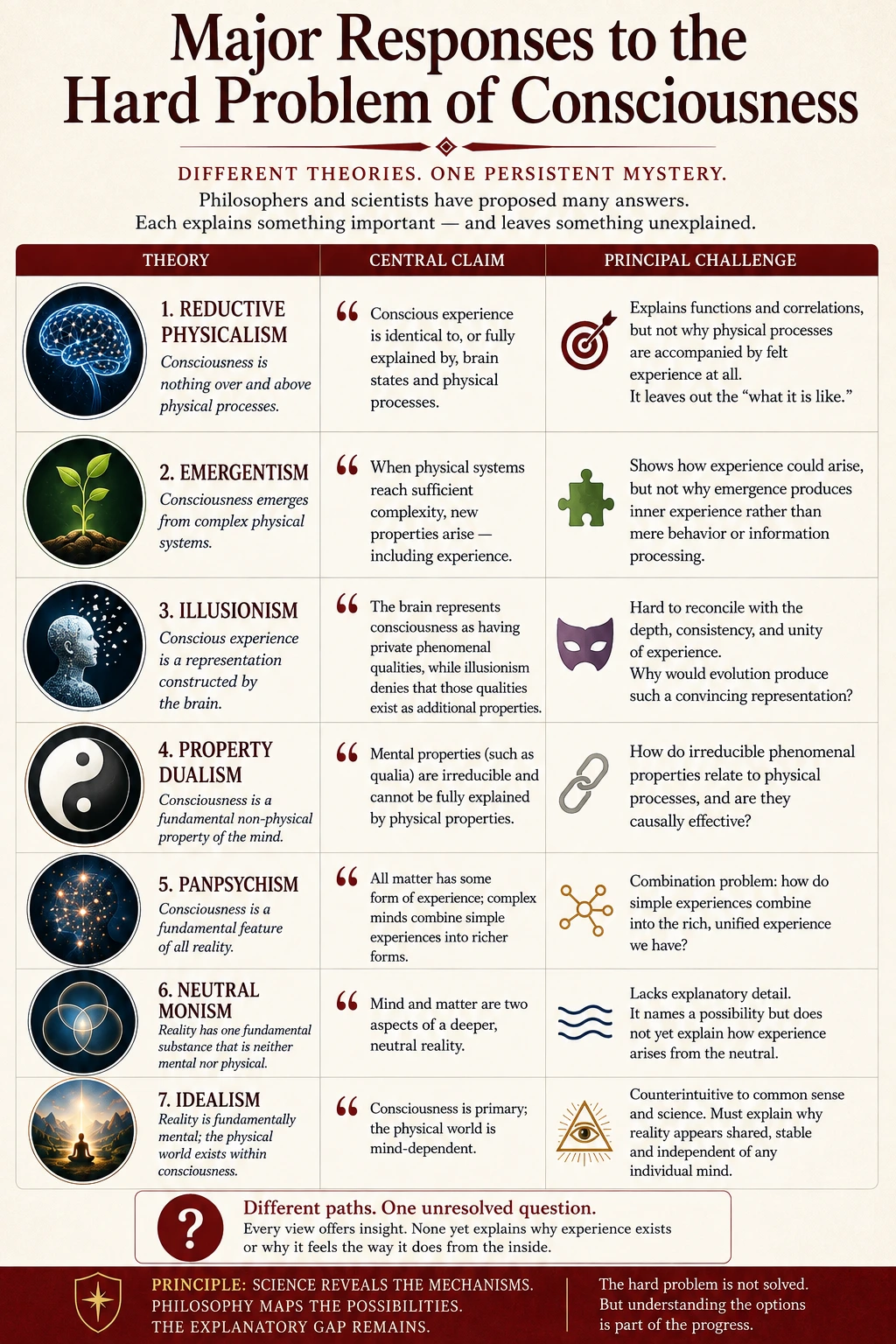
Major Proposed Responses to the Hard Problem
No single theory has achieved broad agreement. The following positions are families of views rather than rigid doctrines, and individual philosophers define them differently.
Reductive physicalism
Conscious experience is identical to, realised by or fully explainable in terms of physical processes. Its challenge is to show why the physical story appears not to entail the felt story.
Emergentism
Consciousness emerges when physical systems reach the right organisation or complexity. The challenge is turning “emergence” into a mechanism rather than a label for the transition.
Illusionism
The brain represents experience as having private phenomenal qualities, while illusionism denies that those qualities exist as additional properties. It must explain the depth and persistence of that representation.
Property dualism
Phenomenal properties are irreducible even if conscious beings are physical systems. The view must explain how phenomenal and physical properties relate and whether the phenomenal is causally effective.
Panpsychism
Experience, or a precursor of it, is fundamental and widespread. Its central challenge is the combination problem: how simple experiential features could compose a unified human subject.
Neutral monism
Mind and matter are two aspects or constructions from a more basic neutral reality. The position must specify the neutral basis and explain how mental and physical structures arise from it.
Idealism
Consciousness is fundamental and the physical world is mind-dependent. It must explain why reality appears shared, stable and independent of any individual mind.
Representational and higher-order views
Consciousness may depend on how states represent the world or how a system represents its own mental states. These theories explain important structures of awareness, though critics ask why the relevant representation is felt.
For authoritative background on two frequently discussed alternatives, see the Stanford Encyclopedia entries on panpsychism and neutral monism. These sources also show why labels can conceal important differences among versions of a theory.
No theory should be presented as proven. Physicalism remains influential in philosophy and science; panpsychism and idealism remain controversial; illusionism is often misunderstood; and “emergence” can mean several very different things. A careful article maps the options without turning disagreement into certainty.
Does Information Processing Create Consciousness?
Conscious systems process information, but the reverse inference is uncertain. Many nonconscious systems detect differences, transform inputs and control outputs. Therefore, information processing in the broadest sense cannot by itself be a sufficient criterion for consciousness.
Processing information versus experiencing it
A thermostat distinguishes temperatures. A camera stores visual data. A navigation system chooses routes. These systems perform functions that can be described informationally. Whether they experience anything depends on what additional theory of consciousness is true—perhaps integration, recurrent processing, global accessibility, self-models, biological organisation or something not yet identified.
Is complexity enough?
Complexity is often invoked because human consciousness depends on a highly organised brain. Yet complexity alone is not a complete theory. A system can be complicated in many ways. A successful account must specify which organisation matters, why it matters and how it relates to both conscious function and subjective experience.
Could information be fundamental?
Some proposals treat information as central to both physical structure and consciousness. This can provide a common language, but the word “information” has multiple meanings. Mathematical information, semantic content, causal differentiation and lived meaning should not be assumed to be identical. A theory must explain how the relevant kind of information becomes—or already is—experience.
This question connects with the broader issue of what the mind is: a collection of functions, an embodied process, an information pattern, a conscious point of view or some combination of these.
Could Artificial Intelligence Experience Anything?
Intelligence and consciousness are not synonyms. A system may solve problems, generate language, recognise images or imitate human conversation without that performance proving an inner experience. Conversely, a being might have experience without human-level reasoning or language.
Behavioural evidence matters—but may not settle the question
We infer consciousness in other humans through shared biology, behaviour and communication. With artificial systems, the biological analogy is weaker, so behavioural evidence carries a different weight. Fluent self-reports could reflect experience, learned language patterns or both. The hard problem makes the attribution difficult because we do not possess an agreed theory connecting physical organisation to experience.
Why confident attribution and confident denial are both risky
Declaring an AI conscious solely because it speaks convincingly confuses report with experience. Declaring that no artificial system could ever be conscious assumes that biology is necessary before that necessity has been demonstrated. A responsible position identifies criteria, uncertainty and the consequences of error.
Explore the dedicated analysis of whether AI can become conscious, including the difference between intelligence, self-report, agency and subjective awareness.
Would Mind Uploading Preserve Consciousness?
Mind uploading imagines reproducing the information or structure of a human mind in another medium. Even if a future system copied memories, personality, skills, preferences, speech and behaviour, the hard problem creates a further question: would the original person’s first-person perspective continue?
Copying structure is not obviously continuing experience
A digital reconstruction might insist that it is the original person. It might remember childhood, recognise loved ones and respond with the same humour. Those achievements would be remarkable. Yet functional similarity does not by itself decide whether the biological person experiences awakening as the copy or whether a new subject begins with inherited memories.
The duplicate problem
Suppose the original body remains alive after the scan. The biological person and the digital copy cannot both be numerically identical to one continuing individual if they immediately occupy different places and accumulate different experiences. The scenario suggests that psychological similarity, informational continuity and first-person continuity may come apart.
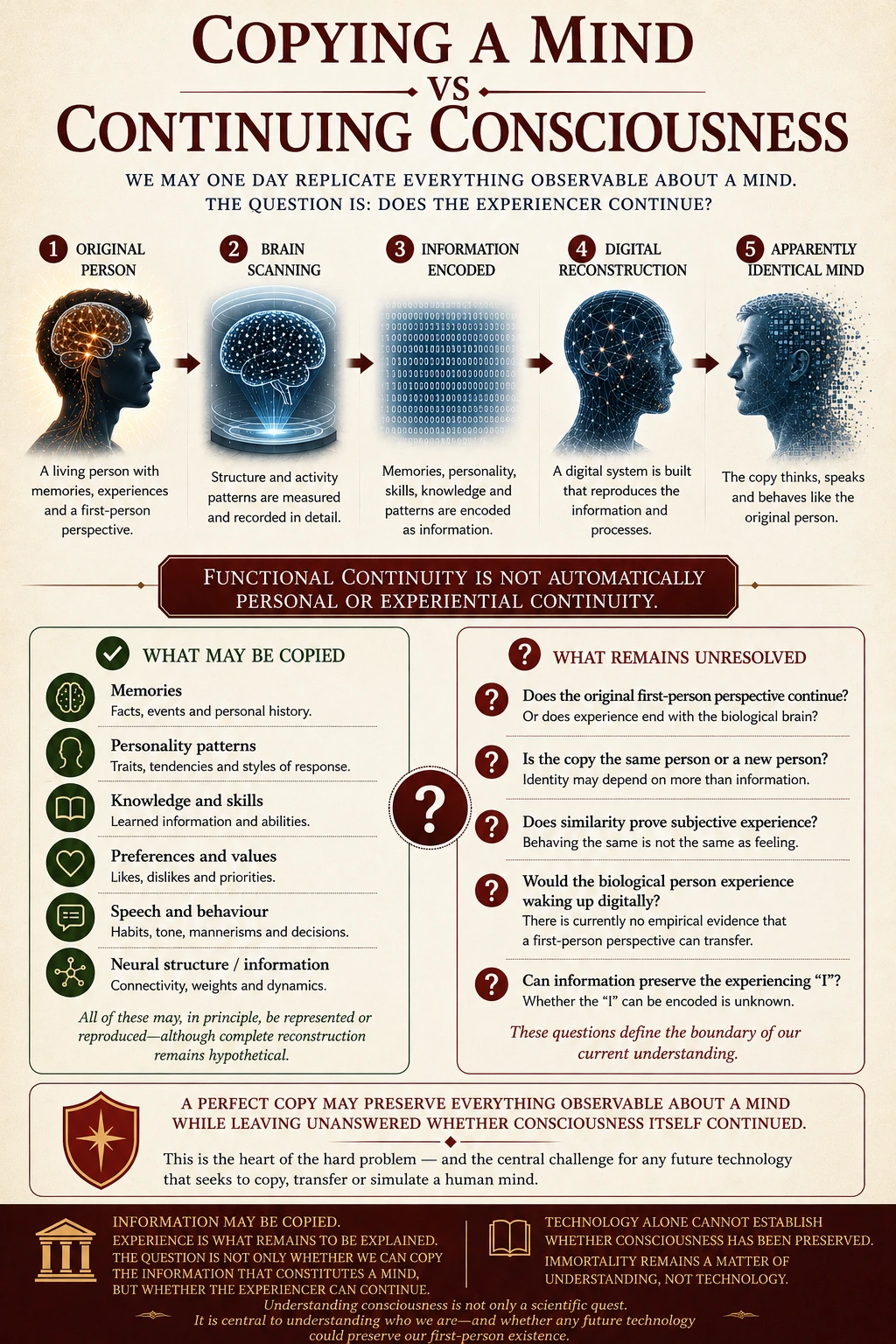
What an upload could establish—and what it could not
| Possible evidence | What it could support | What would remain uncertain |
|---|---|---|
| Accurate memories and knowledge | High informational fidelity | Whether the memories are experienced by the same subject |
| Matching personality and behaviour | Functional and psychological continuity | Whether similarity constitutes personal identity |
| Matching neural dynamics in another substrate | Structural or causal equivalence | Whether equivalent processing guarantees experience |
| The copy reports uninterrupted survival | Continuity within the copy’s narrative | Whether the original perspective transferred or a new one began |
Read the related exploration of whether consciousness can be uploaded into a computer. The crucial distinction is between copying information about a person and preserving the person’s experiencing point of view.
What Does the Hard Problem Mean for Personal Identity?
The hard problem changes the stakes of identity. If a person is only an information pattern, sufficiently accurate copying may appear to preserve them. If identity depends on a continuous subject of experience, a copy could preserve every observable trait while failing to preserve the original person.
Memory is important but may not be sufficient
Memories connect present decisions with a remembered past. Yet memories can be incomplete, altered or duplicated. If two systems share the same memories and then diverge, both may claim the same history. Memory supports psychological continuity but may not uniquely determine identity.
The body and causal continuity
Embodied theories emphasise the living organism and its uninterrupted causal history. Gradual biological change may preserve identity differently from destructive scanning followed by reconstruction. However, even continuous embodiment does not by itself explain why there is a first-person point of view.
The experiencing subject
The most difficult possibility is that identity includes the continuity of an experiencer that cannot be inferred from third-person similarity alone. This is not evidence for an immaterial soul. It is a statement of the unresolved issue: without a theory explaining how subjects arise and persist, we cannot confidently say what procedures would preserve one.
Continue with the nature of the self and what personal identity means.
Why the Hard Problem Matters
The debate is not only about abstract metaphysics. Different theories imply different approaches to medicine, animals, artificial systems, identity and mortality.
Medicine
Assessing consciousness in noncommunicative patients affects diagnosis, pain management and ethical decisions. Better functional measures matter even while philosophical uncertainty remains.
Animals
A theory of which structures support experience influences how we interpret animal pain, awareness and moral status.
Artificial intelligence
Mistaking fluent behaviour for experience could lead to false attribution; overlooking genuine experience could create moral harm.
Personal survival
Cryonics, neural replacement and mind uploading depend on what must continue for a person—not merely their information—to survive.
Reality
Theories of consciousness reshape the relationship among mind, matter and the world we experience. See also how we know what is real.
Meaning
Experience is where value, suffering, love, wonder and significance appear. Explaining consciousness therefore touches the foundation of what matters to conscious beings.
The hard problem may eventually be solved, dissolved or reformulated. Its enduring importance comes from forcing precision. What exactly are we trying to explain when we explain a mind: behaviour, cognition, access, self-representation, experience—or all of them together?
From philosophy to speculative worlds. The hard problem asks whether a complete description of a person would capture the person’s inner existence. That uncertainty becomes urgent in stories where memory can cross bodies, identity can be reconstructed and survival depends on deciding what part of a human being must be preserved.
Consciousness, Identity and Those Who Guard Eternity
The philosophical fantasy Those Who Guard Eternity explores consciousness, continuity, mortality and the choices people make when preserving humanity may require deciding what a human being truly is.
Enter a world where surviving is not the same as remaining yourself.
Discover Those Who Guard EternityFrequently Asked Questions
What is the hard problem of consciousness in simple terms?
It is the problem of explaining why physical activity in a brain produces a felt inner experience. Science can study how a brain processes information and controls behaviour. The hard problem asks why that processing is accompanied by seeing, hearing, feeling and being aware.
What is the difference between the easy and hard problems of consciousness?
The easy problems ask how conscious functions work, including perception, attention, memory and reporting. The hard problem asks why those functions feel like anything from the inside. “Easy” is comparative; the functional research problems remain scientifically difficult.
Who created the term “hard problem of consciousness”?
David Chalmers introduced the modern easy-versus-hard distinction in 1995. Earlier philosophers had already examined the relationship between physical processes and subjective experience, but Chalmers’s formulation gave the contemporary debate its best-known name.
What are qualia?
Qualia are the felt qualities of experiences, such as the appearance of red, the taste of sweetness or the painfulness of pain. Philosophers disagree about whether qualia are intrinsic private properties, representational features or a misleading theoretical category.
What is the explanatory gap?
The explanatory gap is the apparent gap between objective descriptions of brain activity and first-person descriptions of experience. It is the difficulty of seeing how facts about neural processes fully explain facts about what those processes feel like.
Can neuroscience solve the hard problem?
Neuroscience can make major progress on the mechanisms and conditions of consciousness. Whether that progress will also explain why mechanisms produce experience is disputed. Some expect the gap to close; others believe a new conceptual framework is required; still others think the problem should be dissolved.
Is the hard problem accepted by every philosopher?
No. Some philosophers treat it as the central problem of consciousness. Others argue that once cognition, introspection, behaviour and report are explained, no additional phenomenon remains. Illusionists argue that the sense of an extra mystery can itself be scientifically explained.
Could artificial intelligence have subjective experience?
It is not currently known. Intelligent behaviour and fluent language do not by themselves prove experience, but neither do they prove its absence. A justified answer requires a reliable theory connecting physical or computational organisation to consciousness.
Does mind uploading solve the problem of consciousness?
No. Mind uploading raises the problem sharply. A digital system might reproduce memories, personality and behaviour while leaving uncertain whether the original person’s first-person perspective continued or whether a new subject began.
Is consciousness physical or nonphysical?
There is no agreed answer. Physicalists identify consciousness with physical processes; property dualists treat phenomenal properties as irreducible; panpsychists regard experience as fundamental; idealists treat consciousness as primary; and other theories propose different relations between mind and matter.
Primary and Authoritative Sources
- David J. Chalmers, “Facing Up to the Problem of Consciousness”, Journal of Consciousness Studies 2(3), 1995.
- Thomas Nagel, “What Is It Like to Be a Bat?”, The Philosophical Review 83(4), 1974.
- Frank Jackson, “Epiphenomenal Qualia”, The Philosophical Quarterly 32(127), 1982.
- Daniel C. Dennett, “Illusionism as the Obvious Default Theory of Consciousness”, Journal of Consciousness Studies 23(11–12), 2016.
- Stanford Encyclopedia of Philosophy, “Consciousness”.
- Stanford Encyclopedia of Philosophy, “The Neuroscience of Consciousness”.
- Stanford Encyclopedia of Philosophy, “Qualia”.