The mind and consciousness overlap, but they are not identical. One describes a broad range of mental processes and capacities; the other points to the fact that some states are experienced from a first-person point of view.
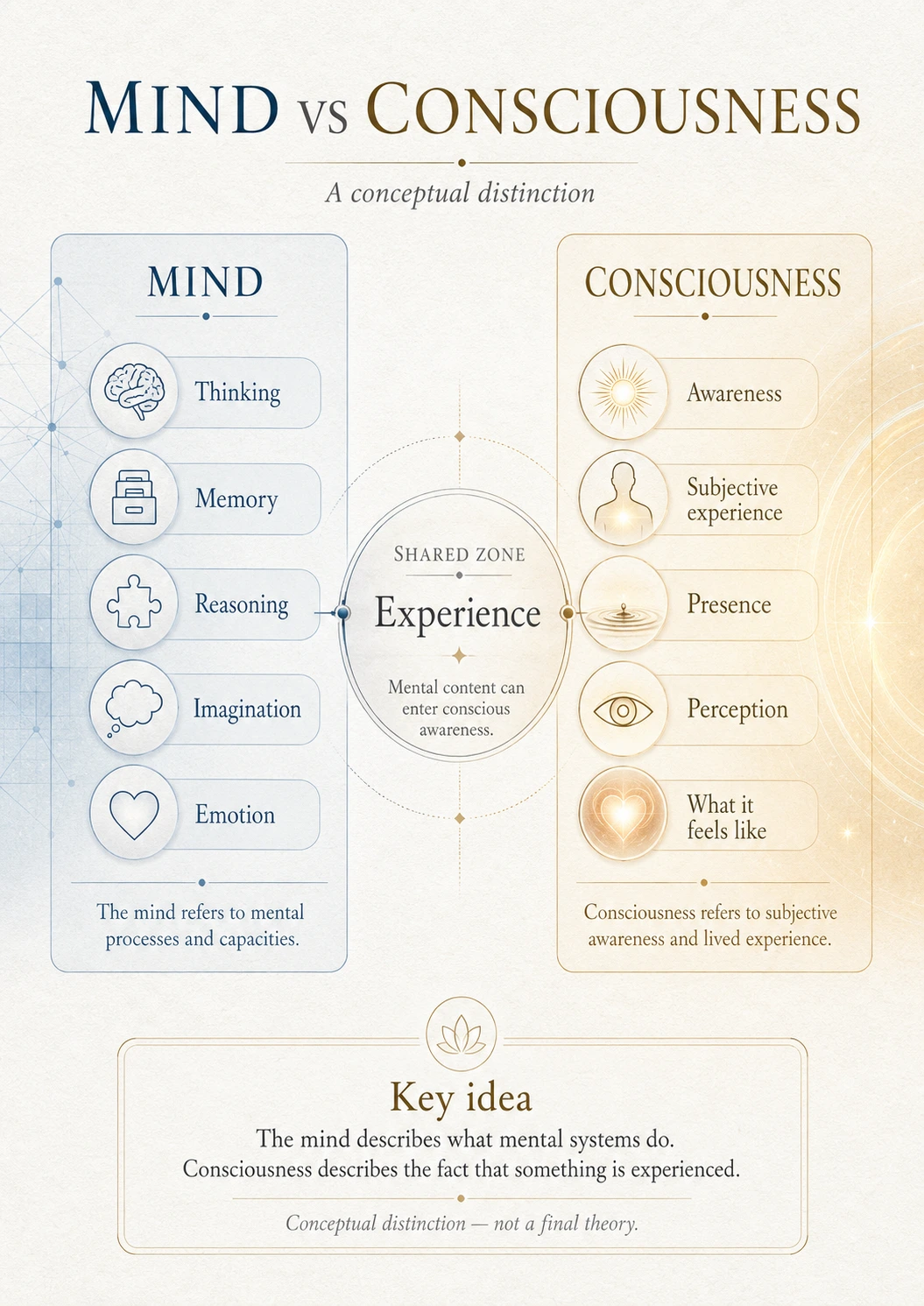
Mind vs consciousness, in one sentence: the mind is a broad term for mental processes and capacities such as perception, thought, memory, imagination, emotion and reasoning, while consciousness refers more specifically to awareness and subjective experience—the fact that there is something it is like to see, feel, think or perceive.
This is a useful distinction, not a universally accepted definition. Philosophy, psychology and neuroscience use both terms in multiple ways, and no single theory of consciousness has won general agreement.

Mind vs Consciousness: The Short Answer
In everyday language, mind and consciousness are often used as if they were interchangeable. They are closely related, but treating them as synonyms hides an important distinction.
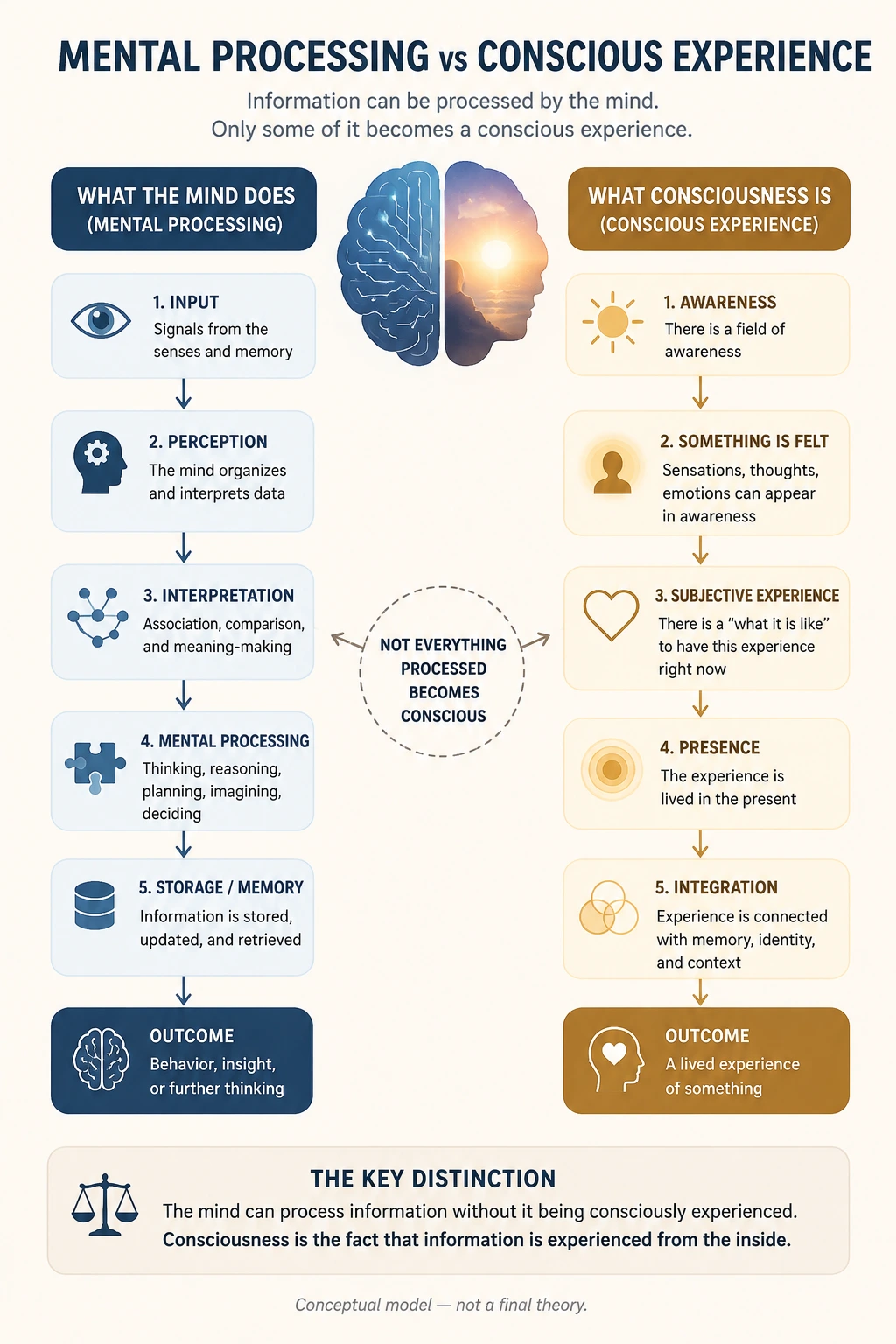
The mind is the broader category. It includes the capacities and processes by which an organism perceives, remembers, learns, imagines, evaluates, plans, feels and decides. Some of those processes may be part of what you are consciously experiencing right now. Others may influence behavior without entering current awareness.
Consciousness points to something narrower and stranger: experience itself. When red looks red to you, when pain hurts, when music sounds a certain way, or when a thought is present to you, there is a subjective aspect to the event. Philosophers often capture this with the phrase “what it is like” to have an experience. The Stanford Encyclopedia of Philosophy treats this first-person character as one central way of understanding consciousness.
A useful working distinction is therefore: the mind concerns what mental systems do; consciousness concerns the fact that some of what happens is experienced.
What Is the Mind?
The mind is best treated here as an umbrella term for mental life. It includes perception, memory, attention, imagination, emotion, reasoning, intention, learning, decision-making and other processes through which information is interpreted and behavior is organized.
This does not mean the mind is a separate physical object hidden somewhere inside the skull. “Mind” is a level of description: a way of talking about mental states, capacities and operations. A neuroscientist may describe patterns of neural activity; a psychologist may describe attention or working memory; a person may describe a fear, plan or memory. These descriptions can refer to the same organism from different explanatory levels.
It is also useful not to reduce the mind to whatever happens to be conscious at a given moment. You can recognize a familiar word, adjust posture, retrieve associations or respond emotionally before all the relevant processing becomes the focus of awareness. Research on nonconscious processing supports the more cautious claim that some perceptual and cognitive processing can influence behavior without conscious awareness, while the scope and limits remain actively debated; see van Gaal et al. (2012) and the more recent review by Stockart et al. (2025).
For a fuller treatment of the term itself, see What Is the Mind?
What Is Consciousness?
Consciousness is harder to define because the word covers several related ideas. It can mean being awake rather than unconscious, having access to information, being aware of a particular stimulus, being aware of oneself, or having phenomenal experience.
For the purpose of comparing mind and consciousness, the most useful sense is subjective experience: the presence of a first-person point of view. A visual system can process wavelengths, but the philosophical problem of consciousness asks why and how some processing is accompanied by the experience of color. A nervous system can register tissue damage, but conscious pain includes what the pain feels like.
This is why consciousness is not simply another name for information processing. Contemporary neuroscience has multiple competing frameworks—including global workspace, higher-order, predictive-processing/re-entry approaches and integrated information theory—and a major review in Nature Reviews Neuroscience emphasizes that these theories differ in what they attempt to explain and in their empirical commitments. There is still no settled theory that closes the problem.
See What Is Consciousness? and What Is Conscious Experience? for the broader conceptual background.
Mind vs Consciousness: The Key Differences
The distinction becomes clearer when the two concepts are compared directly.
| Question | Mind | Consciousness |
|---|---|---|
| What does the term describe? | A broad range of mental processes, states and capacities. | Awareness and subjective experience. |
| Does it include thinking? | Yes. Thinking is one mental process. | Thoughts can become part of conscious experience. |
| Does it include memory? | Yes, including memory processes not currently in awareness. | A memory is conscious when it is experienced or accessed consciously. |
| Must everything it does be conscious? | No. Some mental processing can occur outside current awareness. | In the phenomenal sense used here, consciousness is the presence of experience. |
| Is it identical to the brain? | No. “Mind” describes mental functions and states rather than the organ itself. | No. Consciousness depends on brain activity in humans, but explaining that dependence is a major scientific and philosophical problem. |
| How is it studied? | Behavior, reports, cognitive models, neuroscience and computational approaches. | First-person reports plus behavioral, neural and computational measures designed to identify correlates and mechanisms of conscious experience. |
The key is not to turn the distinction into two separate substances. The terms can identify different aspects of the same living system. The question is how those aspects relate.
Can the Mind Work Without Conscious Awareness?
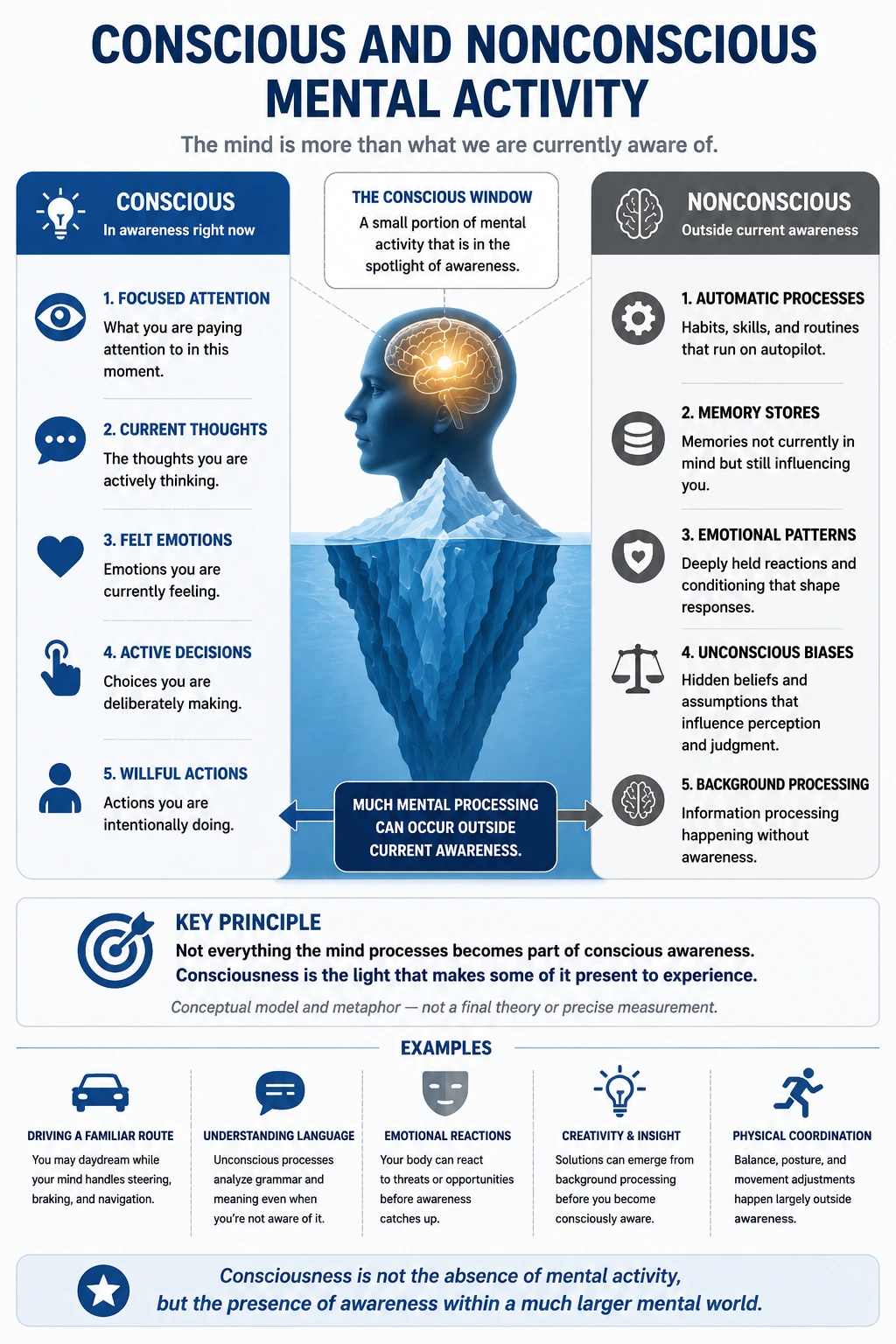
Yes—in a limited and carefully qualified sense. Human cognition includes processes whose effects can be detected even when the person does not report awareness of the relevant information. Studies have examined nonconscious perception, priming, automatic skills and some forms of cognitive control.
A review of consciousness in cognitive control and decision-making concluded that unconscious information can influence perceptual, cognitive-control and decision-related processes, while also finding important limits in duration, flexibility and strategic use compared with conscious processing. More recent work on unconscious processing has stressed that its exact scope remains contentious because conclusions depend heavily on how awareness is measured.
That caution matters. Popular claims such as “90% of the mind is unconscious” sound precise but are not supported by a universal measurement. A better statement is simply that not all mental processing becomes part of current conscious awareness.
Consider driving a familiar route. You can maintain lane position, respond to repeated features of the road and execute well-practiced movements while your focal attention shifts. This does not mean the whole task is unconscious. It means that skilled behavior can contain layers of processing that are not all represented in awareness at the same level or at the same time.
Can Consciousness Exist Without Thought?
If by thought we mean explicit verbal reasoning or inner speech, then consciousness appears to be broader than thought. A person may be consciously aware of a color, a sound, bodily warmth, pain, balance, movement or the simple presence of a scene without narrating it in words.
This helps separate three concepts that are often collapsed: consciousness, thought and inner monologue are not synonyms. Thought can be conscious, but conscious experience can also be sensory, emotional, spatial or nonverbal.
The distinction also explains why asking whether someone “has thoughts” does not by itself settle whether they are conscious. Consciousness concerns whether experience is present, while thought concerns particular kinds of mental content or processing.
Brain vs Mind vs Consciousness
The comparison becomes clearer if we add a third term: the brain.
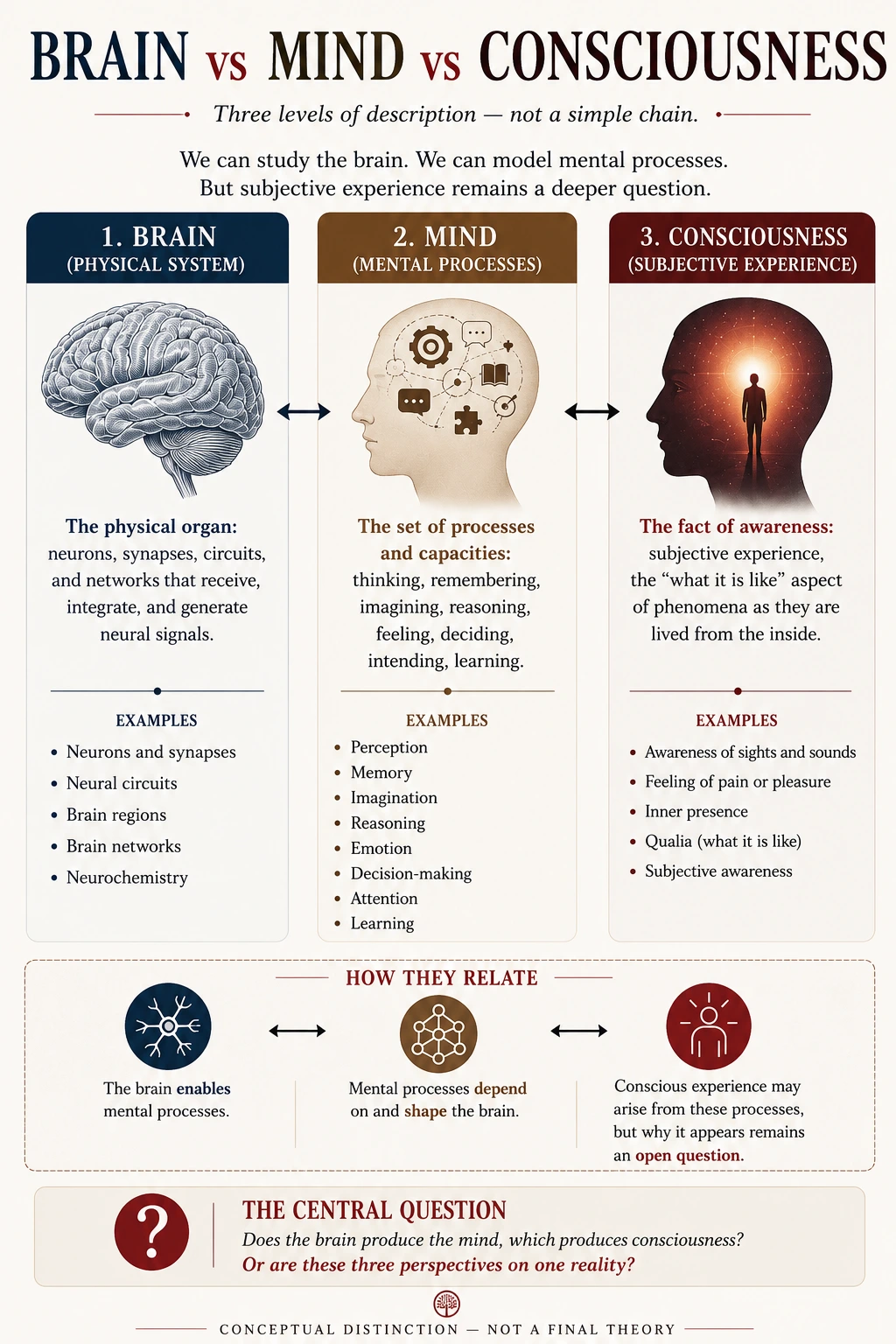
The brain is a physical organ made of neurons, synapses, circuits, networks and supporting cells. It can be investigated with anatomy, electrophysiology, neuroimaging, stimulation and other biological methods.
The mind describes mental states, processes and capacities: remembering a face, comparing two possibilities, imagining tomorrow, focusing attention or making a decision.
Consciousness describes the fact that at least some mental states are experienced from the inside.
These are not necessarily three separate things arranged in a simple chain. In humans, conscious experience depends on brain activity, and neuroscience has made substantial progress identifying neural conditions associated with conscious and unconscious states. But identifying correlations and mechanisms is not automatically the same as explaining why particular physical processes are accompanied by subjective experience. The Stanford Encyclopedia of Philosophy’s overview of the neuroscience of consciousness frames this as a continuing bridge problem between neural data, models and experience.
This is also why the question Can Consciousness Exist Outside the Brain? must be treated as an open philosophical question rather than answered by definition alone.
Why Consciousness Creates a Different Problem
Suppose we eventually mapped every neural event involved in seeing a red apple. We might know which signals reach the retina, how visual features are encoded, which networks support attention, how the object is categorized and how the memory of “apple” is retrieved.
A further question remains: why is any of that processing accompanied by the experience of redness at all?
This gap between functional explanation and subjective experience is closely related to what is often called the hard problem of consciousness. It does not imply that science cannot explain consciousness. It identifies the particular thing a successful explanation must account for: not only discrimination, reporting and behavior, but the existence and character of experience.
The current scientific landscape reinforces the need for caution. In 2025, a large adversarial collaboration published in Nature directly tested predictions from global neuronal workspace theory and integrated information theory. The results supported some predictions and challenged key claims of both rather than declaring a single winner. That is a useful reminder that consciousness research is an active field, not a solved chapter.
For the deeper existential question, see Why Does Consciousness Exist?
Is Consciousness Just One Function of the Mind?
One possible answer is yes: consciousness may be one capacity generated by a larger mental system. On this view, perception, memory, attention and decision-making can be studied as mental functions, while consciousness emerges when information is made available, integrated, represented in a higher-order way, recurrently processed or organized according to some other mechanism.
But that is not the only view. Some theories begin from properties of experience itself and ask what kind of physical organization could support them. Others treat consciousness as closely tied to access, self-representation or global availability. The major theories do not even agree on which properties are fundamental.
So it is safer to say that consciousness is deeply related to mental processing, but the nature of that relationship remains theoretically contested.
Where Does Intelligence Fit?
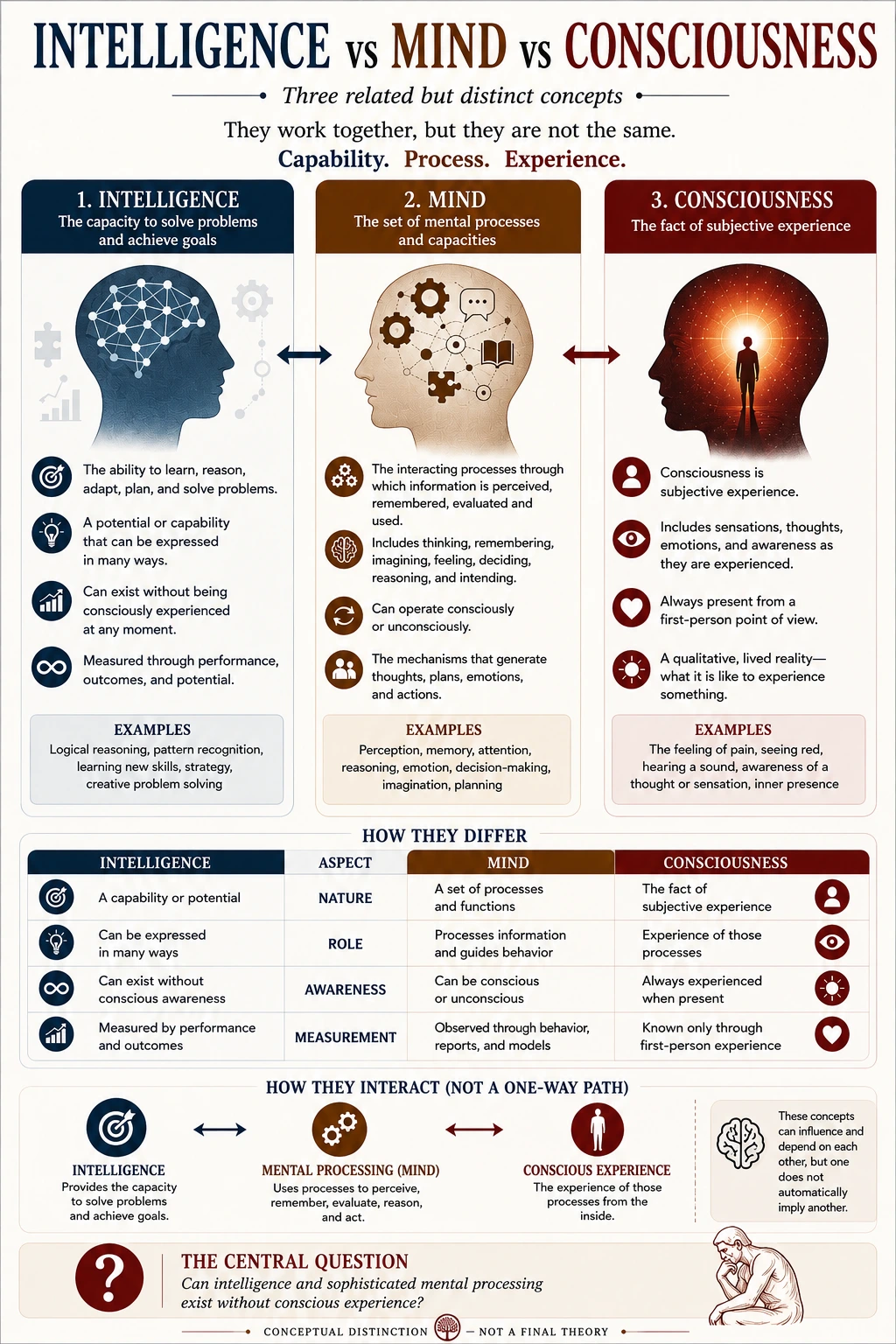
Intelligence, mind and consciousness answer three different kinds of questions.
Intelligence concerns capability: can a system learn, reason, adapt, plan, recognize patterns or solve problems? Mind concerns the processes and states through which information is represented and used. Consciousness concerns whether any of those states are experienced subjectively.
That means intelligent performance does not, by definition, prove consciousness. A system could display impressive problem-solving ability while leaving open the question of whether anything is experienced from the inside. Conversely, conscious experience is not equivalent to high intelligence: pain, color or a simple sensation can be conscious without requiring sophisticated reasoning.
This distinction matters increasingly in discussions of artificial intelligence. Before asking whether machines are conscious, it helps to separate behavioral competence from subjective experience. For the broader concept, see What Is Intelligence?
Could AI Have a Mind Without Consciousness?
This question depends partly on how broadly we use the word mind. If mind means a set of information-processing capacities—reasoning, planning, memory-like functions, language use and problem-solving—then it is possible to describe some artificial systems in mind-like functional terms.
But that does not answer whether the system is conscious. Producing a coherent answer about pain is not the same as feeling pain. Describing red is not the same as having a visual experience of red. Modeling a point of view is not sufficient evidence that a first-person point of view exists.
We therefore need to distinguish at least two questions: What can the system do? and Is there something it is like to be that system? The first can be tested behaviorally. The second is much harder because consciousness is known directly only from the first-person case, while other minds are inferred from behavior, structure and causal organization.
For a dedicated treatment, see Can AI Become Conscious?
What Does the Self Have to Do With Consciousness?
The distinction between mind and consciousness leads naturally to the problem of the self.
Your mind contains memories, beliefs, plans, emotions and models of who you are. Consciousness is the field in which some of those contents are experienced. But what is the “you” to whom they appear?
Self-consciousness is not identical to consciousness in general. You can be aware of a sound without explicitly thinking about yourself. Self-consciousness adds a reflexive dimension: awareness of oneself as oneself. The Stanford Encyclopedia of Philosophy treats this as a distinctive form of consciousness rather than a synonym for all experience.
This distinction matters for personal identity. If memories, beliefs and mental contents change throughout life, what makes you the same person? And if a perfect copy preserved all of your information, would it preserve your consciousness—or merely reproduce your mental structure?
Explore those questions further in What Is the Self? and What Is Personal Identity?
Why the Difference Matters
The difference between mind and consciousness is not just a problem of terminology. It changes how we frame some of the hardest questions about humans and machines.
It changes the AI question
If intelligence and mental processing are not identical to consciousness, then increasing capability alone cannot settle whether an artificial system has experience.
It changes the identity question
If a person is partly defined by memories, dispositions and mental patterns, we still need to ask whether preserving those patterns would preserve the same conscious subject.
It changes the question of death and continuity
A complete informational description of a mind may not automatically tell us what happens to first-person experience. This is why questions about mind uploading, copying and continuity are philosophically difficult. See Can Consciousness Be Uploaded Into a Computer?
It changes the question of reality
Whatever reality ultimately is, every observation, measurement, theory and doubt becomes meaningful to us through conscious experience. That does not mean consciousness creates the external world. It means our access to any world is mediated through experience and cognition. The related epistemic question is explored in How Do We Know What Is Real?
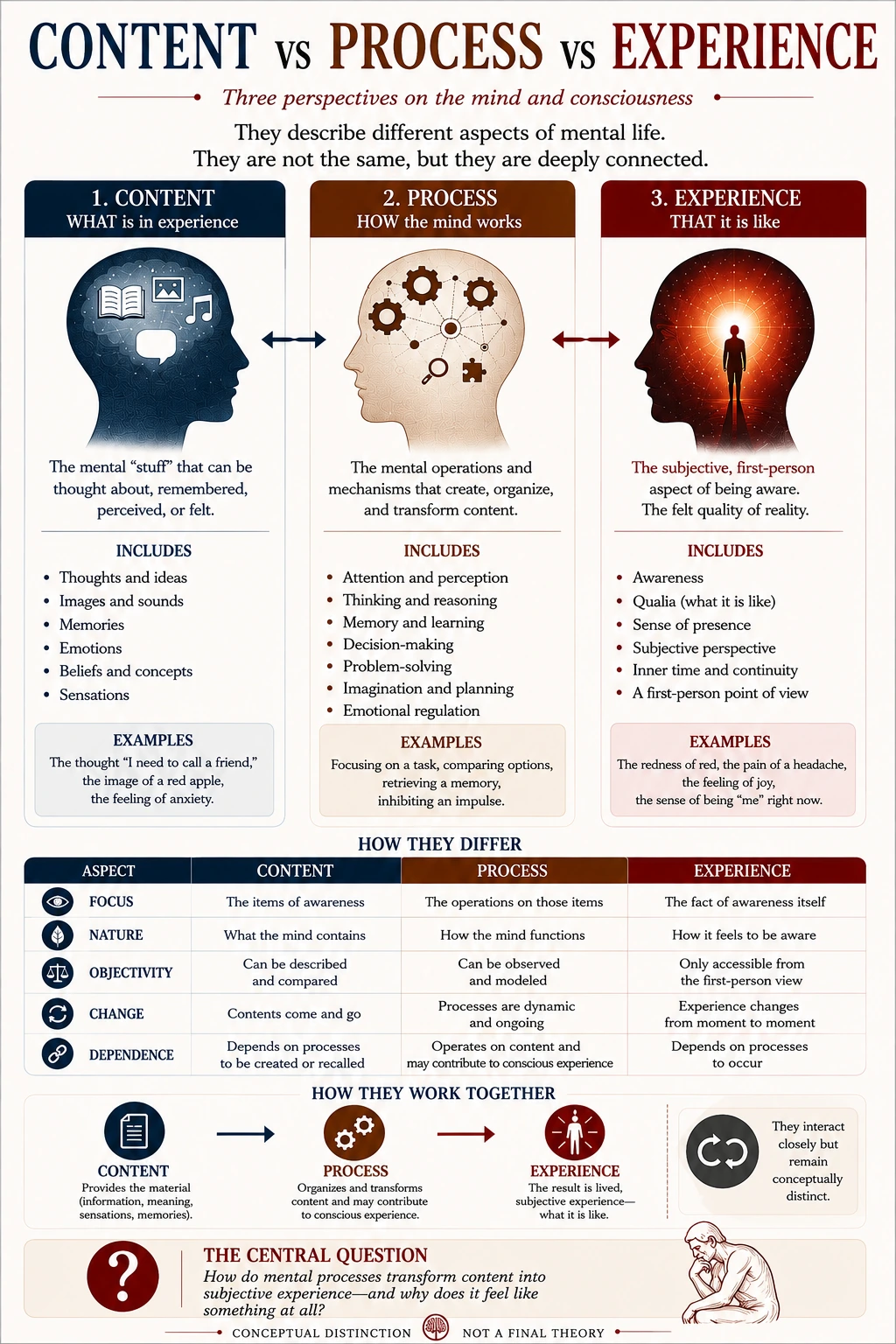
A Better Way to Think About Mind and Consciousness: Content, Process, Experience
A useful synthesis is to separate three layers that are often blended together.
Content is what is represented or experienced: a memory, image, sound, concept, pain, belief or sensation.
Process is what the mind does with content: attends, compares, retrieves, predicts, remembers, evaluates, reasons, imagines or decides.
Experience is the first-person fact that some content and processing are present to a subject in a felt way.
Take a simple memory. The image of a childhood room is content. Retrieving and reconstructing that memory is process. The fact that the remembered scene appears to you now—with a particular vividness, emotional tone and point of view—is conscious experience.
This framework does not solve consciousness. It does something more modest and useful: it prevents us from treating mental information, mental operations and subjective experience as though they were automatically the same phenomenon.
The Question Science Has Not Yet Closed
Science can investigate the mechanisms that distinguish conscious from nonconscious processing. It can compare brain states, manipulate attention, measure reports, record neural activity and test competing theories.
What remains unsettled is how these findings fit into a complete explanation of subjective experience. Why should a particular physical or computational organization be accompanied by a felt point of view? Why should information processing be like anything from the inside?
There may eventually be a theory that makes the connection seem inevitable. Or the conceptual framework itself may need to change. For now, the most defensible position is neither to declare consciousness scientifically inexplicable nor to pretend that the explanatory problem has already disappeared.
The central distinction: the mind gives us a language for mental capacities and processes. Consciousness forces us to ask why some of those processes are experienced at all.
When the Question Becomes a Story
Questions about mind and consciousness become even stranger when memory, identity and continuity are stretched beyond one ordinary lifetime. Those Who Guard Eternity explores those questions through speculative fiction rather than presenting them as solved philosophical propositions.
If this is the territory you enjoy exploring, you can also browse books about consciousness.
Frequently Asked Questions
Is mind the same as consciousness?
No. In the working distinction used here, the mind is the broader set of mental states, processes and capacities, while consciousness refers to awareness and subjective experience. Different theories use the terms differently, so the boundary is not universally fixed.
What is the difference between mind and consciousness?
The mind includes processes such as perception, memory, reasoning, emotion, imagination and decision-making. Consciousness is the fact that some states are experienced from a first-person point of view. A mental process can therefore influence behavior without necessarily being part of current awareness.
What is the difference between brain, mind and consciousness?
The brain is the physical organ and neural system. The mind describes mental functions and states. Consciousness describes subjective experience. They are deeply related, but treating the three terms as synonyms obscures different explanatory questions.
Can you have a mind without consciousness?
That depends on how “mind” is defined. Some mental processing can occur outside current awareness, so the mind is broader than conscious experience. Whether an entire system could possess a mind while having no consciousness at all is a deeper philosophical question.
Can consciousness exist without thought?
Consciousness does not appear to require continuous verbal or conceptual thought. Sensory awareness, pain, emotion and nonverbal perception can all be conscious experiences. Thought is one possible content or process within consciousness, not consciousness itself.
Is awareness the same as consciousness?
The terms overlap, but they can be used differently. Awareness often refers to access to a particular stimulus, state or fact, while consciousness may refer more broadly to the presence of subjective experience. Researchers distinguish several forms of consciousness and awareness.
Can AI have a mind but not consciousness?
Possibly, if “mind” is used functionally for capacities such as reasoning, memory-like processing and planning. Those capabilities alone do not establish subjective experience. Whether artificial systems can become conscious remains unresolved.
Does consciousness create the self?
There is no settled answer. Consciousness provides a first-person perspective, while the self also involves memory, body representation, identity, narrative and social cognition. Self-consciousness is better understood as a particular form of consciousness rather than consciousness as a whole.
Conclusion
The difference between mind and consciousness can be stated simply without pretending the underlying problem is simple. The mind is the broad domain of mental processes and capacities. Consciousness is the presence of subjective experience.
Some mental processing can occur without current awareness. Conscious experience can occur without elaborate verbal thought. The brain provides the biological system on which human mental life and consciousness depend, but the exact explanatory relationship between brain activity and first-person experience remains contested.
That leaves us with a question that is both scientific and philosophical: how does a system that processes information become a system for which anything is experienced at all?
Sources and Further Reading
- Stanford Encyclopedia of Philosophy — Consciousness
- Stanford Encyclopedia of Philosophy — The Neuroscience of Consciousness
- Seth & Bayne (2022), “Theories of consciousness,” Nature Reviews Neuroscience
- Cogitate Consortium et al. (2025), adversarial testing of GNWT and IIT, Nature
- van Gaal et al. (2012), “The role of consciousness in cognitive control and decision making,” PubMed
- Stockart et al. (2025), “Studying unconscious processing: Contention and consensus,” PubMed
Definitions in this article are working distinctions intended to clarify the comparison. They should not be read as a claim that philosophy or neuroscience has reached a final theory of consciousness.