Awareness is one of the most familiar facts of life and one of the hardest to define precisely. You are aware of these words, perhaps of a sound in the room, a thought passing through your mind, or the position of your body. Yet the moment we ask what is awareness?, a simple experience opens into questions about consciousness, attention, perception, the self, and even reality itself.

In simple terms: in this article, awareness means that something is consciously present in experience—a sight, sound, sensation, emotion, thought, memory, or other content that is present to you. The term overlaps with consciousness, attention, and perception, but these words are not interchangeable in every scientific or philosophical theory.
That qualification matters. There is no single definition of awareness accepted across philosophy, psychology, neuroscience, and everyday language. Researchers also disagree about exactly how awareness relates to attention and conscious perception. Rather than hiding that disagreement, a useful explanation should make the boundaries clear.
What Is Awareness?
Awareness can be understood as the presence of something within subjective experience. When you see blue, feel cold, hear music, remember a face, notice anxiety, or become conscious of a thought, there is something that is present for you.
This does not mean that awareness contains everything happening in your brain or body. The nervous system is continuously processing information that never becomes part of what you consciously notice. Nor does awareness necessarily mean that you are carefully analyzing an experience. A sensation may simply be present before you form a judgment about it.
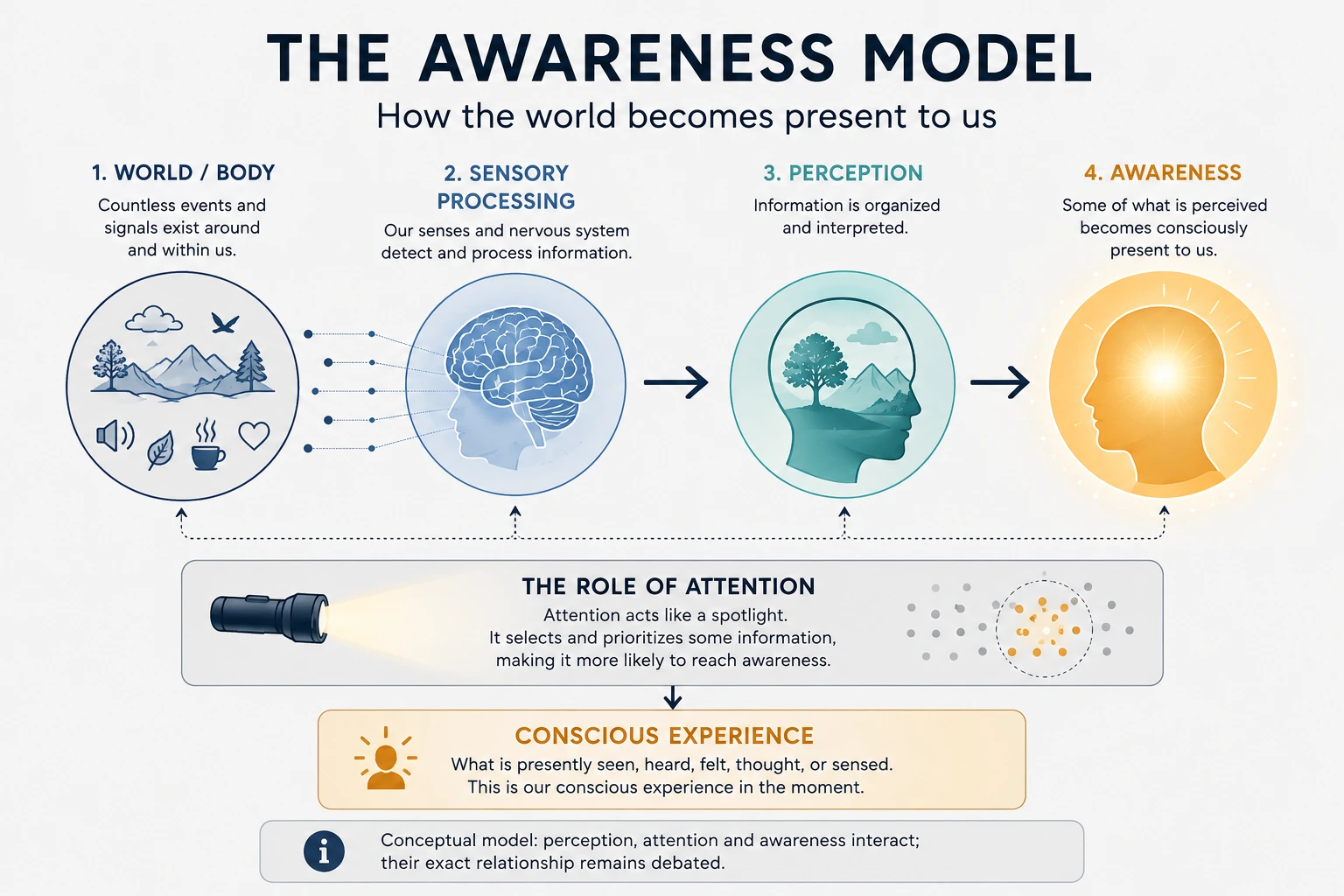
A useful working distinction is:
- sensory processing concerns the detection and transformation of signals;
- perception concerns how information is organized and interpreted;
- attention concerns selection and prioritization;
- awareness concerns what is consciously present in experience.
These are explanatory distinctions, not four sealed boxes in the brain. They interact, overlap, and are defined differently by different theories.
Is Awareness the Same as Consciousness?
Awareness and consciousness often overlap, but they are not always used to mean exactly the same thing. In ordinary conversation, saying “I was conscious of the noise” and “I was aware of the noise” may communicate almost the same idea. In research, however, consciousness can refer to several different things.
One distinction separates a state of consciousness from the contents of consciousness. Being awake rather than deeply anesthetized concerns the overall state or level. Being aware of a red light, a headache, or a memory concerns what is present within experience.
That is one reason awareness is sometimes treated as a useful word for the contents that are consciously experienced. Other researchers use consciousness and awareness more interchangeably. There is no vocabulary rule that resolves every debate.
For a broader foundation, see What Is Consciousness? and What Is Conscious Experience?.
What Is the Difference Between Attention and Awareness?
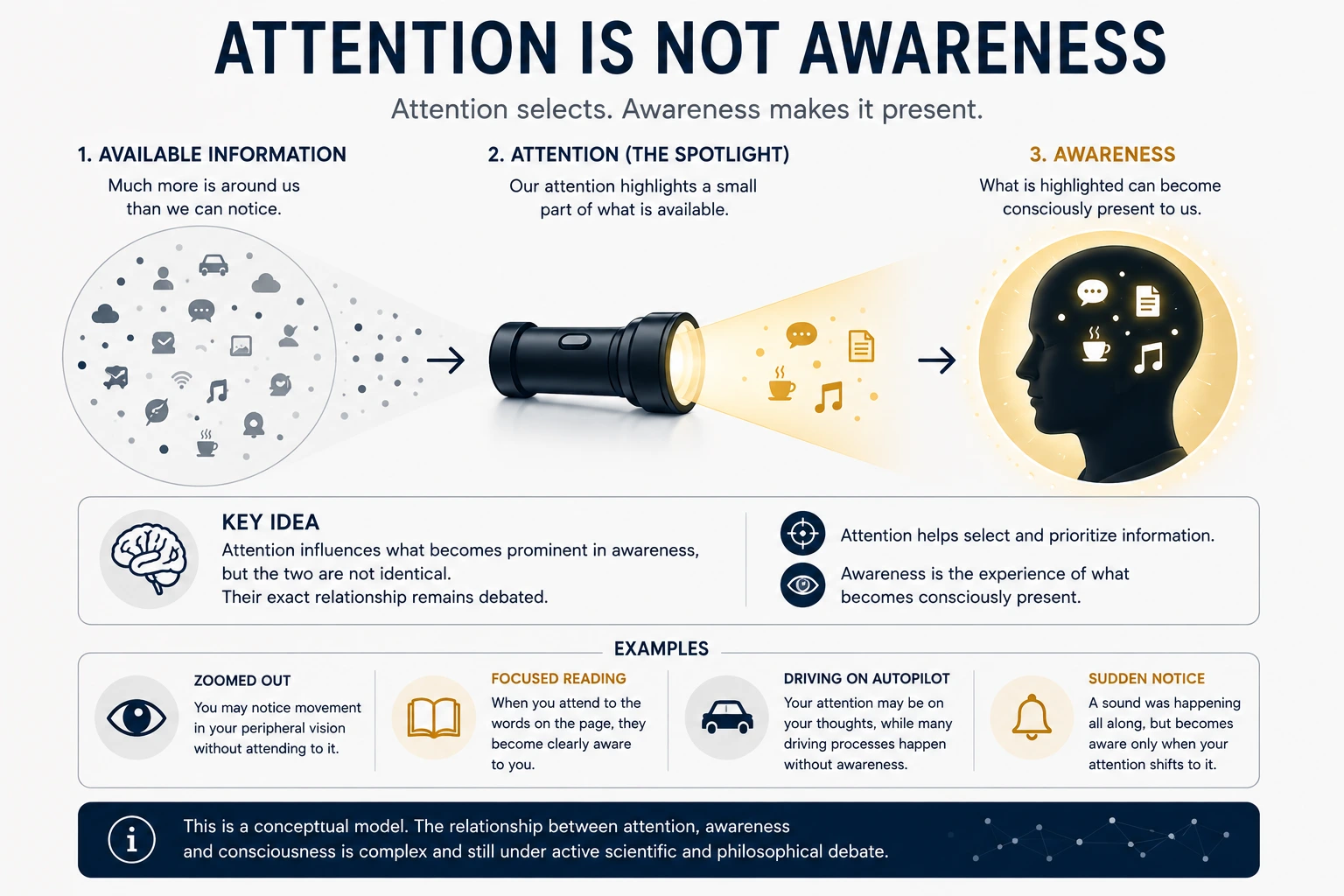
Attention helps select and prioritize information; awareness refers here to what becomes consciously present. That distinction sounds straightforward, but the relationship between the two is one of the most actively debated areas in consciousness research.
When you focus on a sentence, attention privileges some information over competing sights, sounds, memories, and bodily signals. What you attend to often becomes clearer and more prominent in awareness. But “often” is important. A substantial research literature has investigated whether attention and consciousness can dissociate, and reviews describe continuing disagreement over how separable they really are.
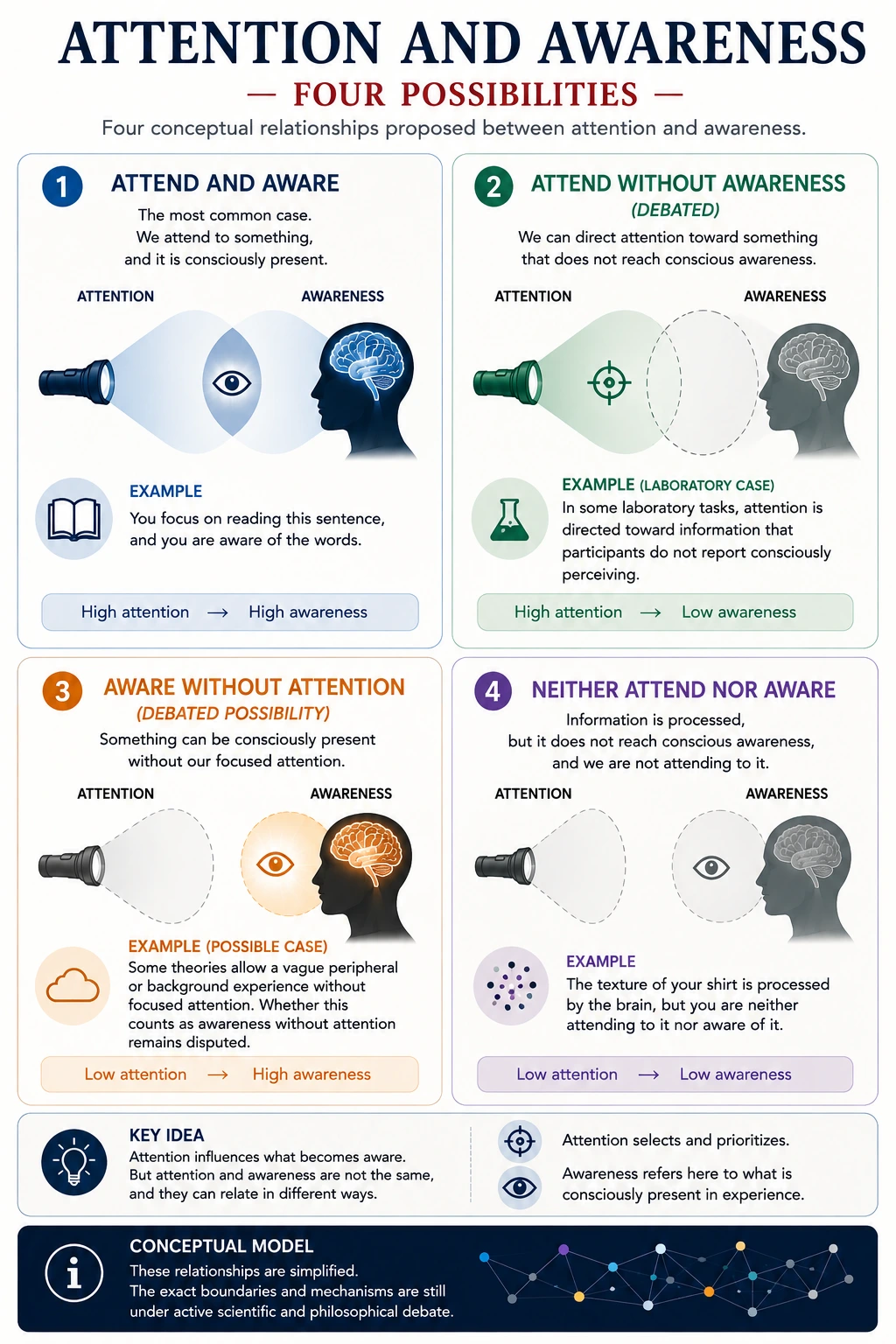
For example, experimental work has examined cases in which attention appears to be directed toward stimuli that participants do not report consciously seeing, and cases in which people report some conscious content without strong focused attention. The interpretation of such experiments depends on how attention and awareness are measured.
A review in Philosophical Transactions of the Royal Society B describes “conscious perception” and “perceptual awareness” as the subjective experience of sensory content and reviews competing accounts of their relation to attention. Other neuroscientific reviews likewise report growing evidence for partially distinct mechanisms while emphasizing unresolved questions.
Why attention matters so much
Attention is limited and selective. At any moment, far more information is available than can dominate conscious thought. Attention helps determine which signals receive priority for deeper processing, working memory, decision-making, and action.
That makes attention one of the most important influences on awareness without forcing us to say that attention creates awareness or that nothing can ever be consciously present without focused attention.
What Is the Difference Between Perception and Awareness?
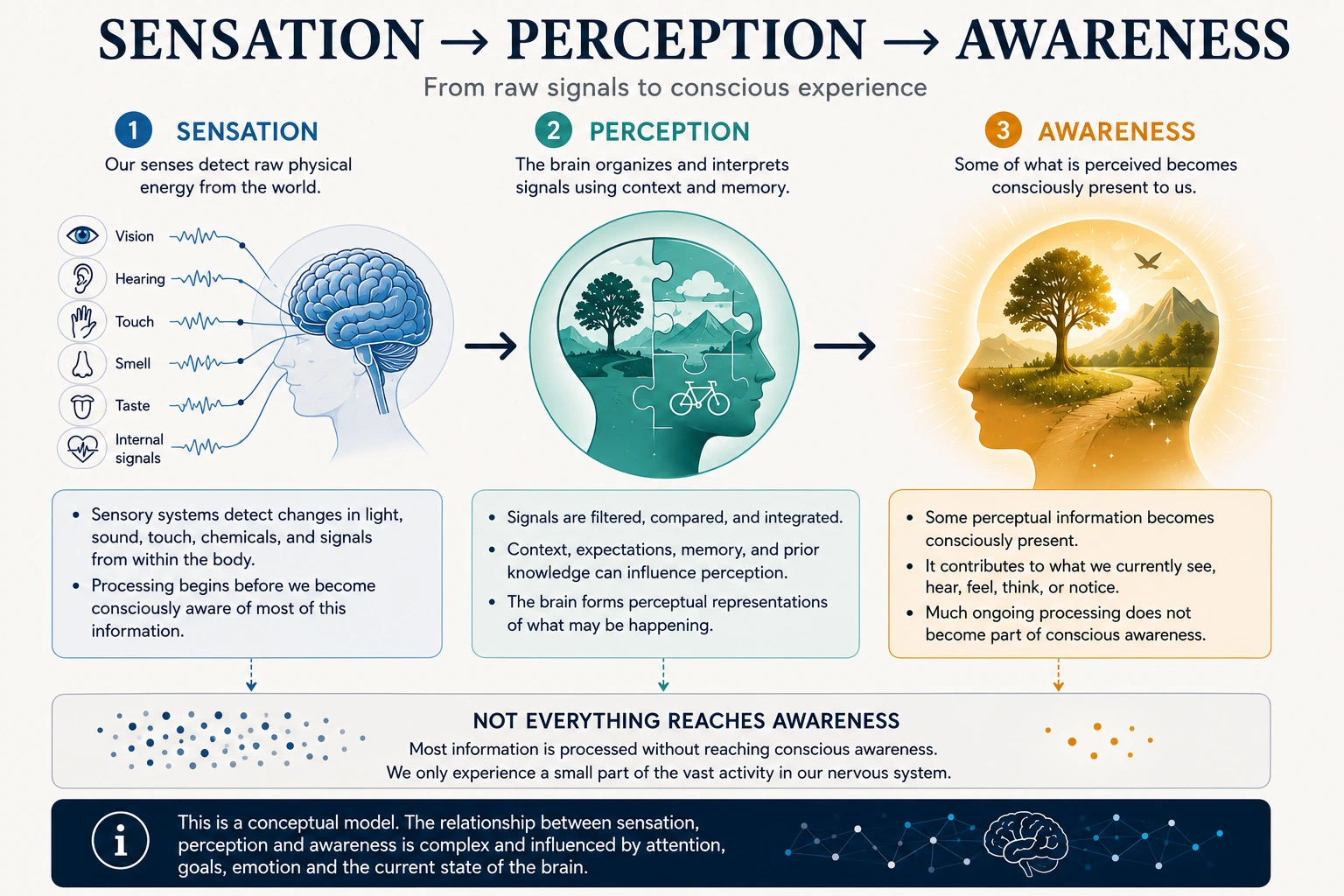
Perception is the organization and interpretation of information; awareness is the consciously experienced presence of some content.
Your visual system does not receive a ready-made picture of the world. It receives changing patterns of light. Your auditory system receives pressure variations, not “music” as such. Neural systems transform, compare, integrate, and contextualize those signals. What you finally experience is structured: a face, a melody, distance, motion, danger, familiarity.
This is why perception is more than raw sensation. Context, expectations, memory, goals, and prior knowledge can influence what is perceived. Yet much perceptual processing may occur without becoming something you can report or notice consciously.
For a deeper treatment of how the brain turns sensory signals into experienced objects and events, read What Is Perception?.
Can You Perceive Something Without Being Aware of It?
There is strong evidence that the nervous system can process information that people do not consciously report. Researchers study phenomena involving masked stimuli, unattended information, priming, rapid visual presentation, and other forms of nonconscious processing.
But the word perceive can create confusion. If perception is defined broadly as sensory information being organized and used, then perception without awareness is relatively easy to describe. If perception is defined as an experienced percept, then awareness is already built into the definition.
The safest conclusion is therefore: substantial sensory and cognitive processing can occur without conscious awareness. Exactly when such processing should be called “perception” depends on the theoretical framework.
Can You Be Aware Without Paying Attention?
Possibly—but this is disputed.
Some theories allow a weak, peripheral, or background form of experience without focused attention. Imagine being absorbed in conversation while still having a vague sense of the surrounding room. Other theories argue that some form of attention is necessary for content to become consciously experienced in the first place.
A review indexed by PubMed describes the debate directly: one family of views treats attention and consciousness as separable, while another sees them as necessarily linked. The disagreement is not merely semantic; it shapes experimental design and theories of consciousness.
This is why simple slogans such as “attention is the gate to awareness” should be treated as metaphors, not settled laws of the mind.
What Is Conscious Awareness?
The phrase conscious awareness may sound redundant, yet researchers often use it to distinguish consciously experienced information from processing that occurs without reportable awareness.
When a stimulus is consciously present, there is something it is like to encounter it: the redness of a color, the sharpness of pain, the familiarity of a face, the feeling of embarrassment, or the sudden recognition of a solution.
This first-person presence is what makes awareness philosophically difficult. A system can detect a signal and respond to it. But detection and response do not automatically tell us whether anything is being experienced from the inside.
That distinction takes us from ordinary psychology into the deeper problem explored in The Hard Problem of Consciousness.
What Is Self-Awareness?
Self-awareness is awareness in which the self becomes part of what is represented, experienced, or reflected upon. You may notice your body, recognize your emotional state, think about your motives, evaluate your own actions, or reflect on the story you tell about who you are.
Self-awareness is not a single all-or-nothing ability. A 2024 review of the cognitive neuroscience of self-awareness describes it as multidimensional and examines multiple neurocognitive mechanisms rather than reducing it to one mental switch.
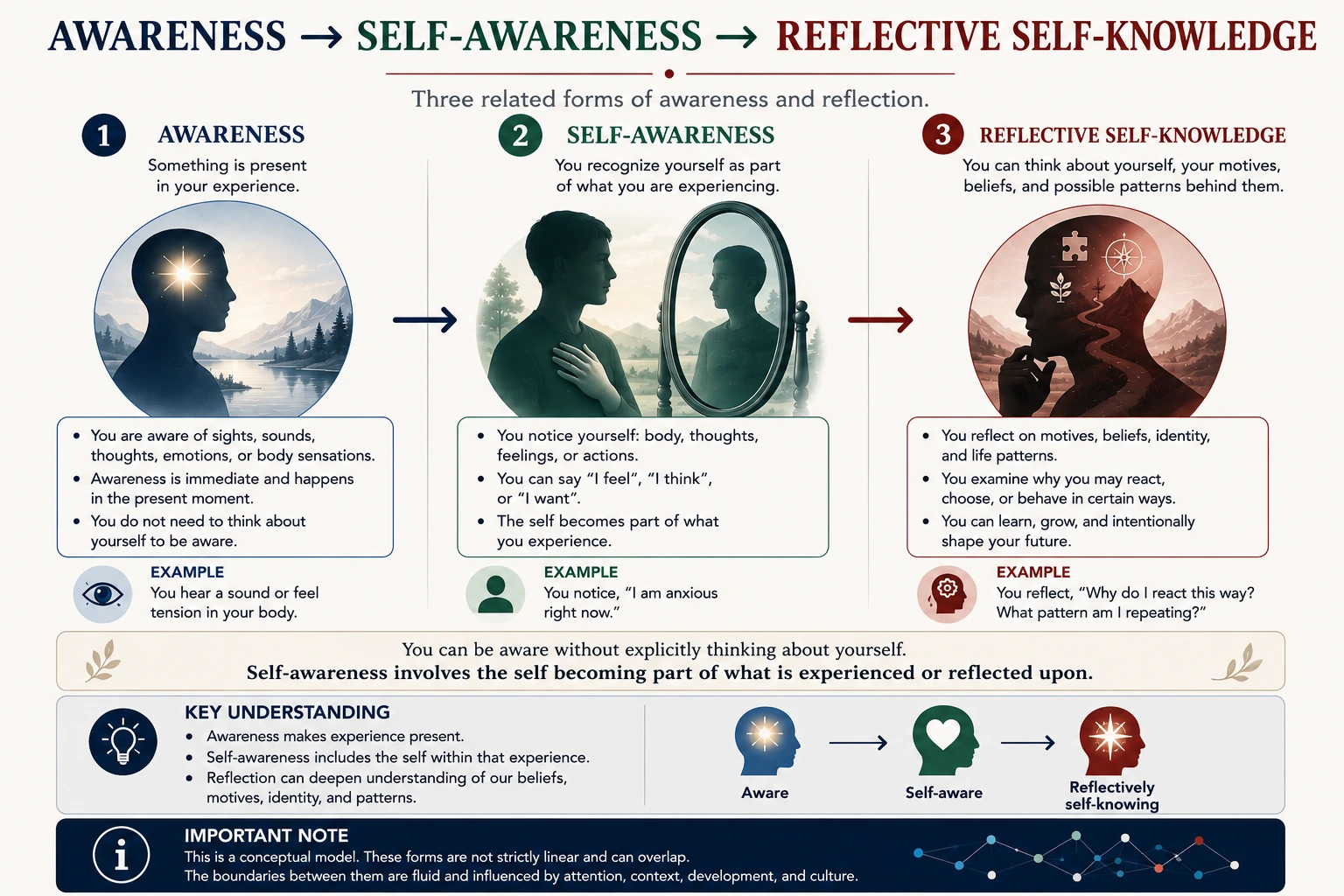
That distinction matters because you can be aware without explicitly thinking about yourself. You can hear thunder, feel warmth, or see a bird without making your own identity the object of thought. Self-awareness adds another layer: I am the one having this experience, I am anxious, I believe this, I chose that.
For the identity questions that follow, see What Is the Self? and What Is Personal Identity?.
Does Awareness Require a Self?
This question depends on what we mean by self.
If “self” means a detailed autobiographical identity—your name, history, plans, social roles, and beliefs—then awareness does not obviously require all of that to be explicitly present. A simple sensory experience need not contain a biography.
If “self” means only a minimal first-person organization of experience—experience happening from a perspective—then some theories treat that minimal selfhood as deeply connected with consciousness.
Philosophers and cognitive scientists therefore distinguish several notions: bodily self, perspectival self, narrative self, reflective self, and personal identity across time. The question is not simply whether “the self exists,” but which kind of self is necessary for which kind of awareness.
Does Awareness Come From the Brain?
In humans, changes in brain state reliably track changes in conscious state and content. Brain injury, anesthesia, sleep, seizures, stimulation, drugs, and neurological disease can all alter what a person experiences or whether they can respond. Neuroscience therefore investigates the neural mechanisms and large-scale networks associated with consciousness and conscious awareness.
What such research does not yet provide is a generally accepted explanation of why particular physical processes should be accompanied by subjective experience at all.
This distinction is crucial. Finding neural activity that systematically accompanies seeing red is different from explaining why that activity should have a first-person quality—why there is something it is like to see red.
For the broader question of why experience exists, see Why Does Consciousness Exist?.
Why Does Awareness Feel Like Something?
A camera reacts to light. A thermostat reacts to temperature. A computer can classify images, transform language, and respond to complex inputs. Humans also process information—but our processing is accompanied by experience.
There is pain rather than merely damage detection. Color rather than merely wavelength discrimination. Anxiety rather than merely physiological arousal. A thought can be present to us as a thought.
Philosophers often discuss this first-person character through concepts such as phenomenal consciousness and qualia. The central explanatory question is how objective physical processes relate to subjective experience.
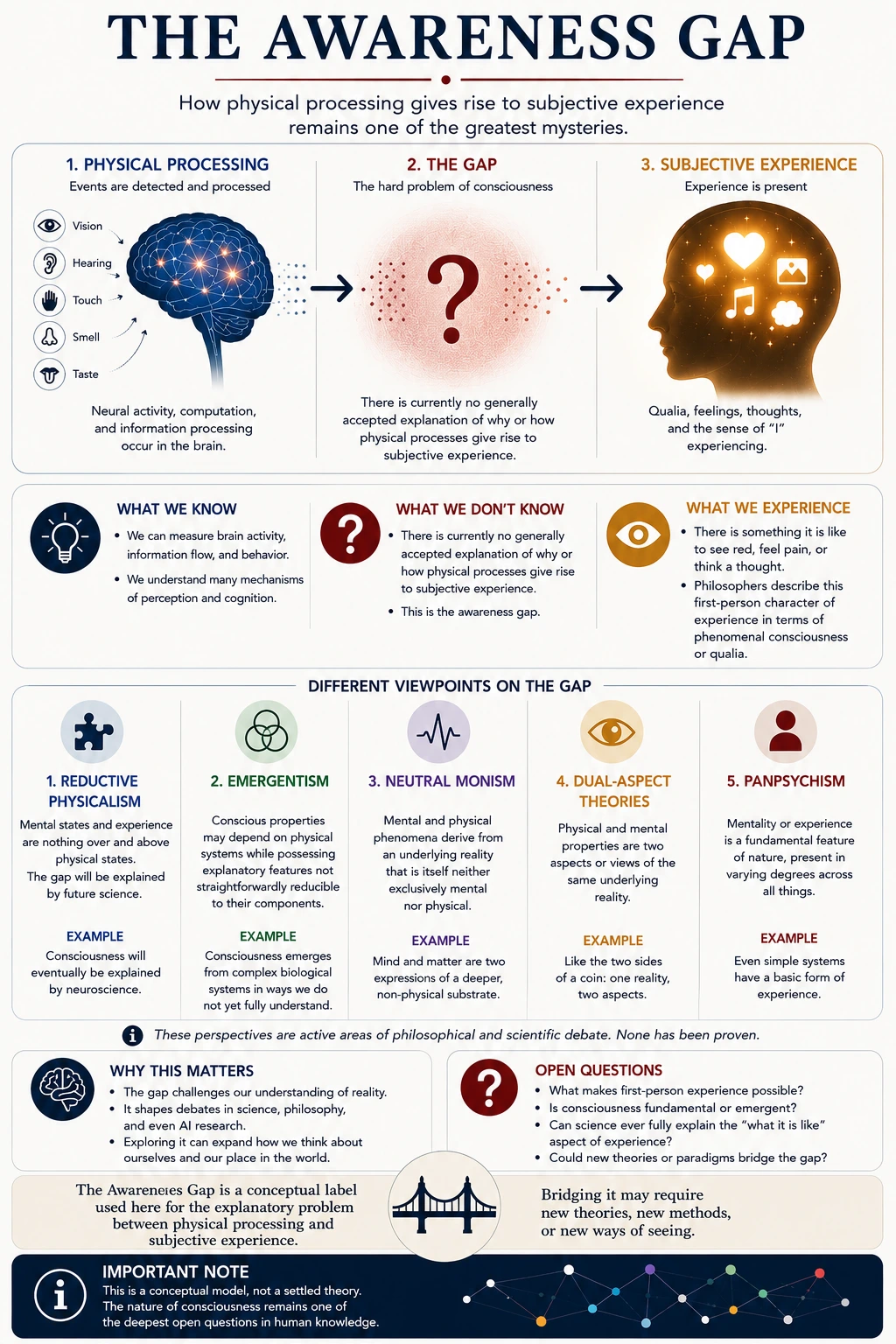
Our diagram calls this the Awareness Gap. That name is an explanatory label for this article, not a new scientific theory. It points toward the same family of problems addressed by debates over the explanatory gap and the hard problem of consciousness.
Different philosophical approaches answer the problem differently. Reductive physicalists expect mental states to be explainable in physical terms. Emergentist approaches emphasize higher-level properties dependent on physical systems. Neutral monism and dual-aspect theories propose different relationships between mental and physical descriptions. Panpsychist views treat mentality or experience as fundamental or widespread in nature. None of these positions has become a universally accepted solution.
Could Artificial Intelligence Be Aware?
Sophisticated behavior does not by itself settle whether an artificial system has subjective experience.
An AI system can process language, detect patterns, answer questions, describe emotions, and even produce statements about its own “thoughts.” Those abilities are evidence of information-processing capacities. They are not, by themselves, a direct window into first-person experience.
This creates a version of the same problem we face with other minds: behavior is public; experience, if present, would be private.
At present there is no generally accepted behavioral or computational test that can simply read off subjective awareness from a machine’s performance. Claims about machine consciousness therefore require careful separation between observable capabilities and assumptions about experience.
For the dedicated discussion, read Can AI Become Conscious?.
How Do We Know Another Being Is Aware?
You have direct access to your own experience in a way you do not have direct access to mine. You can tell me that you are in pain, I can observe your behavior and physiology, and we can compare our shared biology—but I do not literally experience your pain from your point of view.
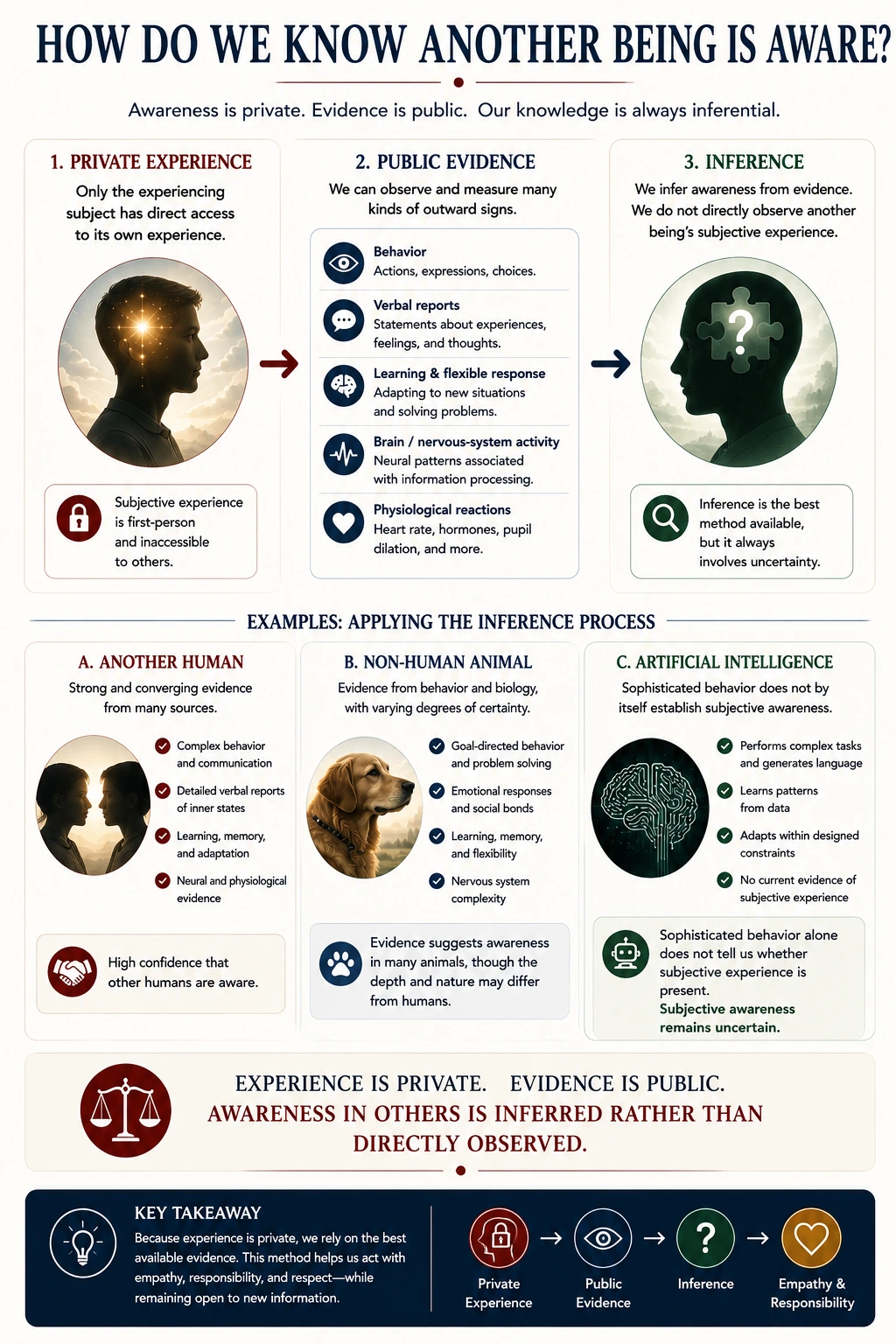
So how do we know that other beings are aware? We infer it from converging evidence:
- behavior and flexible action;
- communication and, in humans, detailed verbal report;
- learning, memory, and adaptive response;
- brain or nervous-system activity;
- physiological reactions;
- similarities and differences in biological organization.
Other humans
The evidence is unusually strong because humans share similar nervous systems, bodies, behavior, language, and reports of inner experience. We do not prove another person’s awareness mathematically; we have powerful converging reasons to accept it.
Non-human animals
The evidence varies across species and across dimensions of consciousness. A widely cited framework argues against placing animals on one simple ladder from “less” to “more” conscious and instead considers dimensions such as perceptual richness, evaluative richness, temporal integration, and self-consciousness. That is a more careful approach than assuming every species must fit one linear hierarchy.
Artificial intelligence
AI creates greater uncertainty because similarity of output does not imply similarity of underlying mechanism. A machine may produce highly human-like language without that fact alone establishing whether there is anything it is like to be that system.
Principle: experience is private. Evidence is public. Awareness in others is inferred rather than directly observed.
How Awareness Changes the Question of Reality
Awareness seems at first to be only one topic among many: something the brain does, something psychology studies, something philosophers debate. But the question becomes stranger when we notice that everything we know about reality is encountered through experience.
This does not prove that reality is created by consciousness. The external world may exist entirely independently of any individual observer. The point is epistemic: our access to the world is mediated by perception, thought, memory, instruments, language, and conscious experience.
That is why awareness quickly connects with questions such as:
- How do we distinguish perception from reality?
- Could our experience systematically misrepresent the world?
- What makes evidence trustworthy?
- Is the self something discovered in experience or partly constructed through it?
- What, if anything, remains when experience changes radically?
These questions connect directly with How Do We Know What Is Real?, What Is Reality?, and What Is Mind?.
The Cokos Awareness Chain: From Signal to Meaning
The Cokos Awareness Chain is a conceptual synthesis for organizing the questions explored in this article. It is not a claim that the brain follows a single five-step neurological pathway.
Signals → Perception → Awareness → Self-reference → Meaning
- Signals: changes in the world and body provide information that sensory systems can detect.
- Perception: information is organized and interpreted in relation to context, memory, expectations, and ongoing goals.
- Awareness: some content becomes consciously present—something is seen, heard, felt, thought, remembered, or noticed.
- Self-reference: some experiences are related to the experiencing self: I feel this; I think this; this matters to me.
- Meaning: experience can be integrated with memory, values, identity, goals, and wider beliefs about reality.
The chain is useful because it separates questions that are often collapsed together. Explaining how a system detects a signal is not automatically the same as explaining perception; explaining perception is not automatically the same as explaining subjective awareness; and awareness does not by itself settle how a person constructs identity or meaning.
What Awareness Tells Us About Being Human
Awareness is not merely useful because it helps us navigate the world. It is the field in which fear hurts, beauty matters, memories return, choices become meaningful, and questions arise at all.
Once we become aware of our own awareness, the problem deepens. We ask who is experiencing. We ask what makes us the same person through time. We ask whether mind is entirely reducible to matter. We ask whether death ends experience, whether identity could survive radical change, and whether consciousness is an accidental feature of one species or something more fundamental.
Science can constrain these questions, expose bad assumptions, and reveal mechanisms we once mistook for mysteries. Philosophy can clarify concepts and arguments. Yet there remain questions where evidence, interpretation, and worldview meet.
That boundary—between what we can explain and what remains genuinely open—is not a reason to abandon rigor. It is a reason to become more precise about what we know, what we infer, and what we merely imagine.
When Philosophy Becomes a Story
Philosophy asks what consciousness, identity, reality, mortality, and time mean. Speculative fiction can ask a different kind of question: what would happen to human beings if our deepest assumptions about those things turned out to be wrong?
A thought experiment becomes a life. An argument becomes a choice. A theory of identity becomes a person forced to decide whether they are still the same person. The abstract question of eternity becomes a world in which time, mortality, memory, responsibility, and meaning have consequences.
The questions continue in fiction
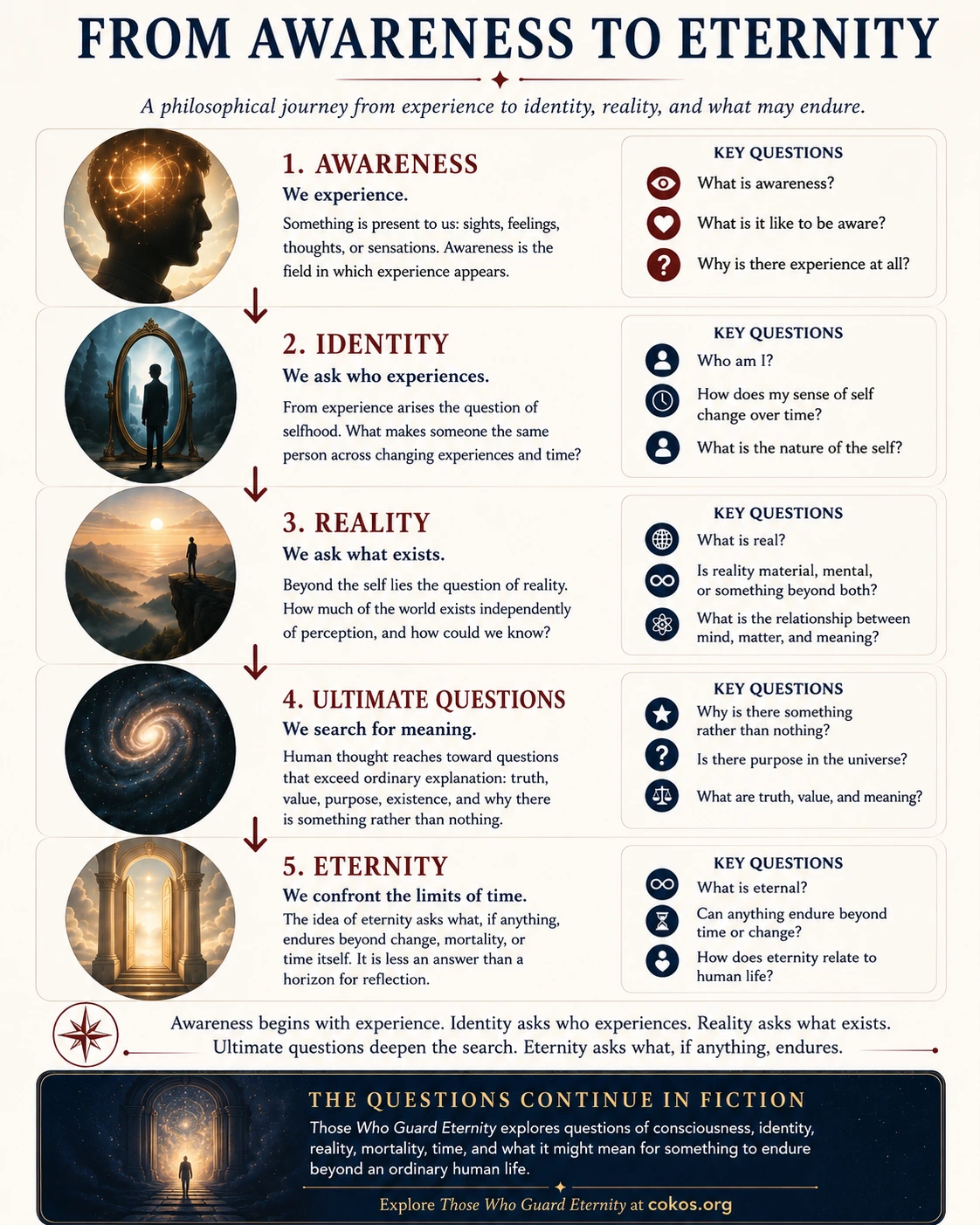
Those Who Guard Eternity explores questions of consciousness, identity, reality, mortality, time, and what it might mean for something to endure beyond an ordinary human life.
If these are the questions that brought you here, the book is not a replacement for philosophy or science. It is another way to enter the problem: through characters, consequences, choices, and a world built around the questions themselves.
You can also browse books about consciousness or learn more about the author.
Frequently Asked Questions About Awareness
What is awareness in simple terms?
Awareness means that something is consciously present in your experience. It might be a sight, sound, bodily sensation, emotion, memory, or thought. The exact definition varies across philosophy, psychology, and neuroscience, so awareness should not automatically be treated as identical to attention, perception, or every meaning of consciousness.
What is the difference between awareness and consciousness?
The words often overlap. One useful distinction is that consciousness can refer to an overall conscious state as well as its contents, while awareness often refers to particular content being consciously present. Different theories use the terminology differently, so there is no single universally accepted boundary.
Is awareness the same as attention?
No. Attention concerns selecting or prioritizing information, while awareness refers here to what is consciously present. Attention strongly influences awareness, but research continues to debate whether the two processes can fully dissociate and whether some form of attention is necessary for conscious perception.
What is the difference between perception and awareness?
Perception involves organizing and interpreting sensory information. Awareness concerns whether some content is consciously experienced. Considerable sensory and cognitive processing can happen without reportable awareness, although researchers differ over exactly which unconscious processes should be called perception.
Can perception happen without awareness?
Yes, if perception is used broadly to include sensory information being organized and influencing behavior. Experiments show extensive processing of stimuli that participants do not consciously report. If perception is defined as a consciously experienced percept, however, awareness is already part of the definition.
Can you be conscious without being self-aware?
Yes in the ordinary sense. You can consciously see, hear, or feel something without explicitly reflecting on yourself. Self-awareness adds self-related content: noticing your body, emotion, thought, action, motives, or identity as part of experience.
Does awareness require a brain?
All well-established human cases of awareness are deeply associated with functioning biological nervous systems, and changes in brain function can strongly alter conscious experience. Whether awareness is possible in radically different physical systems is an open philosophical and scientific question rather than something current evidence conclusively resolves.
Can artificial intelligence have awareness?
It is not currently possible to infer subjective awareness from sophisticated AI behavior alone. A system’s ability to generate language, solve problems, or describe internal states demonstrates capabilities, but these observations do not by themselves establish first-person experience.
Why is awareness difficult to explain?
Science can investigate information processing, behavior, reports, and neural activity. The deeper difficulty is explaining why or how some physical processes are accompanied by subjective experience—why there is something it is like to see, feel, or think. This is closely related to the philosophical hard problem of consciousness.
References and Further Reading
- Pitts MA, Lutsyshyna LA, Hillyard SA. The relationship between attention and consciousness: an expanded taxonomy and implications for “no-report” paradigms. Philosophical Transactions of the Royal Society B.
- Maier A, Tsuchiya N. Growing evidence for separate neural mechanisms for attention and consciousness. Attention, Perception, & Psychophysics.
- Noah S, Mangun GR. Recent evidence that attention is necessary, but not sufficient, for conscious perception. Annals of the New York Academy of Sciences.
- Mograbi DC, Morris RG. The cognitive neuroscience of self-awareness. Review.
- Birch J, Schnell AK, Clayton NS. Dimensions of Animal Consciousness. Trends in Cognitive Sciences.
Editorial note: The terms awareness, consciousness, attention, and perception are used differently across disciplines. This article distinguishes them for explanation while explicitly marking areas of active scientific and philosophical disagreement.