Mind, consciousness and artificial intelligence
Intelligence is the capacity to learn, recognize patterns, reason, solve unfamiliar problems, adapt to changing conditions and use knowledge in pursuit of goals. Yet this practical definition leaves a deeper question unresolved: does genuine intelligence require consciousness, understanding or wisdom?
Reading time: approximately 20 minutes · Reviewed and expanded: August 2026
What Is Intelligence?
There is no single definition accepted by every psychologist, neuroscientist, philosopher and computer scientist. The American Psychological Association describes intelligence through abilities such as deriving information, learning from experience, adapting to the environment, understanding and using thought and reason effectively. That definition captures a family of capacities rather than one isolated skill.
A useful working definition is:
Intelligence is the capacity to acquire and organize information, learn from experience, recognize meaningful patterns, reason about alternatives, adapt to change and act effectively in relation to goals.
This definition is broad on purpose. It includes abstract reasoning, but it also includes practical adaptation. Someone may recite thousands of facts yet fail to apply them in a new situation. Another person may know less but learn faster, detect the relevant pattern and adjust more successfully.
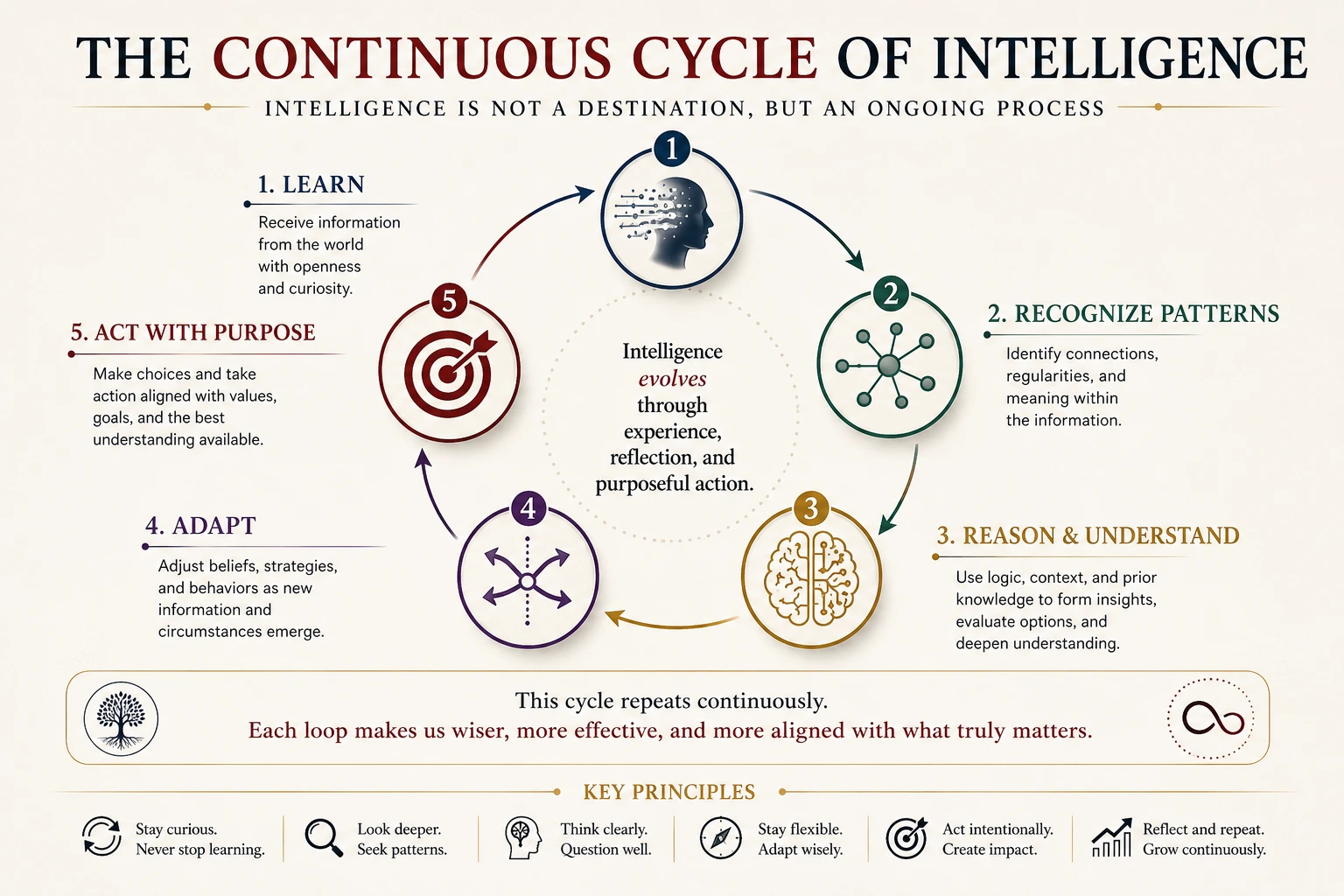
Intelligence is therefore not simply knowledge stored in the mind. It is also the way a person or system uses evidence, corrects mistakes, transfers learning and changes strategy. It becomes visible most clearly when familiar routines stop working.
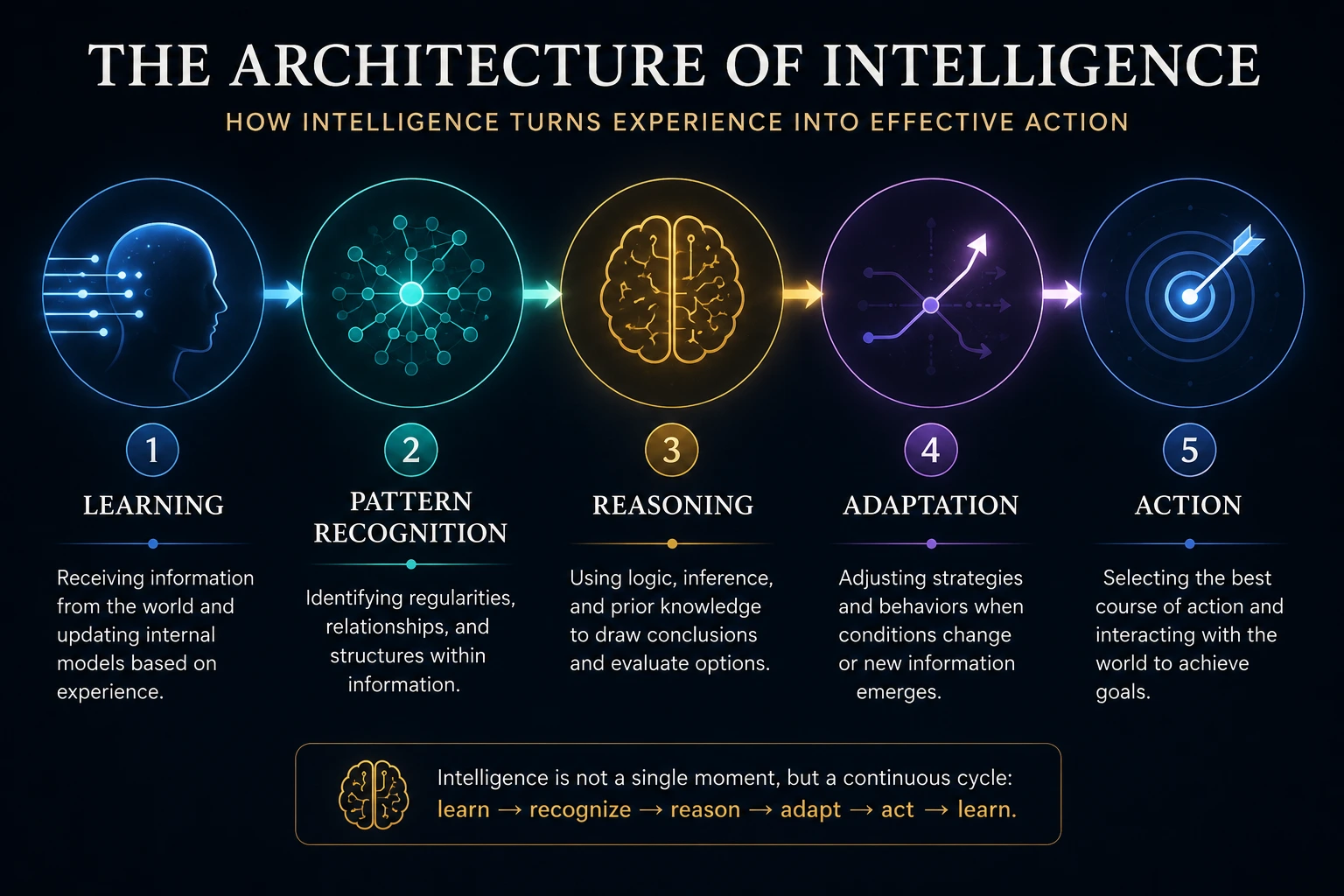
Nor is intelligence one flash of brilliance. It is a repeated process: encounter information, identify structure, form a model, test a response, observe the result and update. The network account of intelligence, for example, describes cognitive abilities as developing through increasingly connected facts and procedures rather than as a perfectly static substance.
Intelligence in Psychology and Philosophy
Psychology usually approaches intelligence as a measurable pattern of cognitive performance. Researchers ask why people who perform well on one reasoning task often perform well on others, how stable these differences are, what predicts achievement and which mental processes contribute to performance.
That research has produced models of general and specific abilities. The broad statistical factor known as g reflects common variance across multiple cognitive tests. However, researchers disagree about what this factor represents. It may indicate a general underlying capacity, overlapping executive processes, mutually reinforcing cognitive networks or some combination of these. A review of process overlap theory shows why observing a general factor does not automatically settle its psychological cause.
Historically, Charles Spearman argued for a general factor behind correlated test performance, while Raymond Cattell distinguished fluid reasoning from crystallized knowledge. Robert Sternberg later emphasized analytical, creative and practical aspects of intelligence. Howard Gardner proposed multiple intelligences, an influential educational idea that remains debated as a psychometric theory.
Philosophy asks a different set of questions. What counts as real understanding? Is successful behaviour sufficient for intelligence? Does a system need intentions, self-awareness or experience? Can intelligence exist without meaning, and can it choose ends rather than merely optimize means?
These perspectives complement each other. Psychology can compare performance and identify reliable patterns. Philosophy examines the assumptions hidden inside words such as “reason,” “understand,” “goal” and “mind.” A complete account of intelligence needs both: evidence about what intelligent systems do and conceptual clarity about what those achievements mean.
What Are the Core Characteristics of Intelligence?
Learning from experience
An intelligent system does not merely repeat a response. It updates. When an expectation fails, it can revise its model, retain what mattered and approach the next situation differently. Learning is more than exposure; it requires a change in representation, prediction or behaviour.
Recognizing patterns
Pattern recognition allows a mind or machine to detect regularities in language, faces, environments, social behaviour and sequences of events. But not every similarity matters. Intelligence includes separating meaningful structure from coincidence, noise or misleading analogy.
Reasoning and inference
Reasoning connects what is known to what is not yet known. It includes deduction from rules, induction from examples, analogy between cases and practical judgment under uncertainty. Strong reasoning also includes recognizing when the available evidence is insufficient and when confidence should be reduced.
Solving unfamiliar problems
Memorized performance can look intelligent until conditions change. Transfer is the harder test: can prior knowledge be reorganized for a problem that is not identical to the training example? Fluid intelligence research treats performance on novel, effortful tasks as a broad cognitive dimension, while also recognizing that no single task captures the whole construct.
Adapting to change
Adaptation means altering expectations, strategies or behaviour when the environment no longer rewards the old approach. Expertise without flexibility can become a liability. The APA’s definition of adaptive intelligence emphasizes applying knowledge to novel situations and learning through interaction with the environment.
Goal-directed action
Intelligence helps compare alternatives and select actions likely to produce a result. Yet success depends on the goal being defined. A system may optimize a narrow target while damaging everything the target was meant to serve. This is where the distinction between intelligence and wisdom becomes essential.
Metacognition and error correction
Human intelligence is strengthened by the ability to examine one’s own thinking. Metacognition includes noticing uncertainty, checking assumptions, recognizing bias and changing methods. A fast answer is not always an intelligent answer; sometimes intelligence appears as deliberate hesitation.
Is There More Than One Kind of Intelligence?
Psychometric research finds that performance across different cognitive tasks is often positively correlated. This recurring pattern supports the use of a general cognitive factor, but it does not mean every ability is identical. Modern models also distinguish broader and narrower abilities such as fluid reasoning, acquired knowledge, visual processing, working memory and processing speed.
The influential Cattell–Horn–Carroll family of models organizes cognitive abilities into layers rather than treating intelligence as one undifferentiated score. A recent review of Carroll’s three-stratum theory also cautions that these frameworks should be understood as a family of related theories, not one final map accepted without dispute.
Outside conventional psychometrics, people discuss practical, creative, social and emotional intelligence. These labels can be useful when they identify real demands that standard tests underrepresent. They become misleading when every desirable trait is renamed “intelligence” without clear evidence or measurement.
Emotional intelligence, for example, concerns perceiving, understanding and using emotional information. Social intelligence concerns interpreting people, intentions and norms. Practical intelligence concerns navigating ambiguous situations where rules are incomplete. Creative intelligence concerns generating or recognizing possibilities that are not obvious from established routines.
The most careful conclusion is that intelligence has both shared and specialized dimensions. People can differ substantially in profiles of ability, and performance depends on the interaction between cognitive capacity, knowledge, motivation, opportunity and context.
Intelligence vs Knowledge
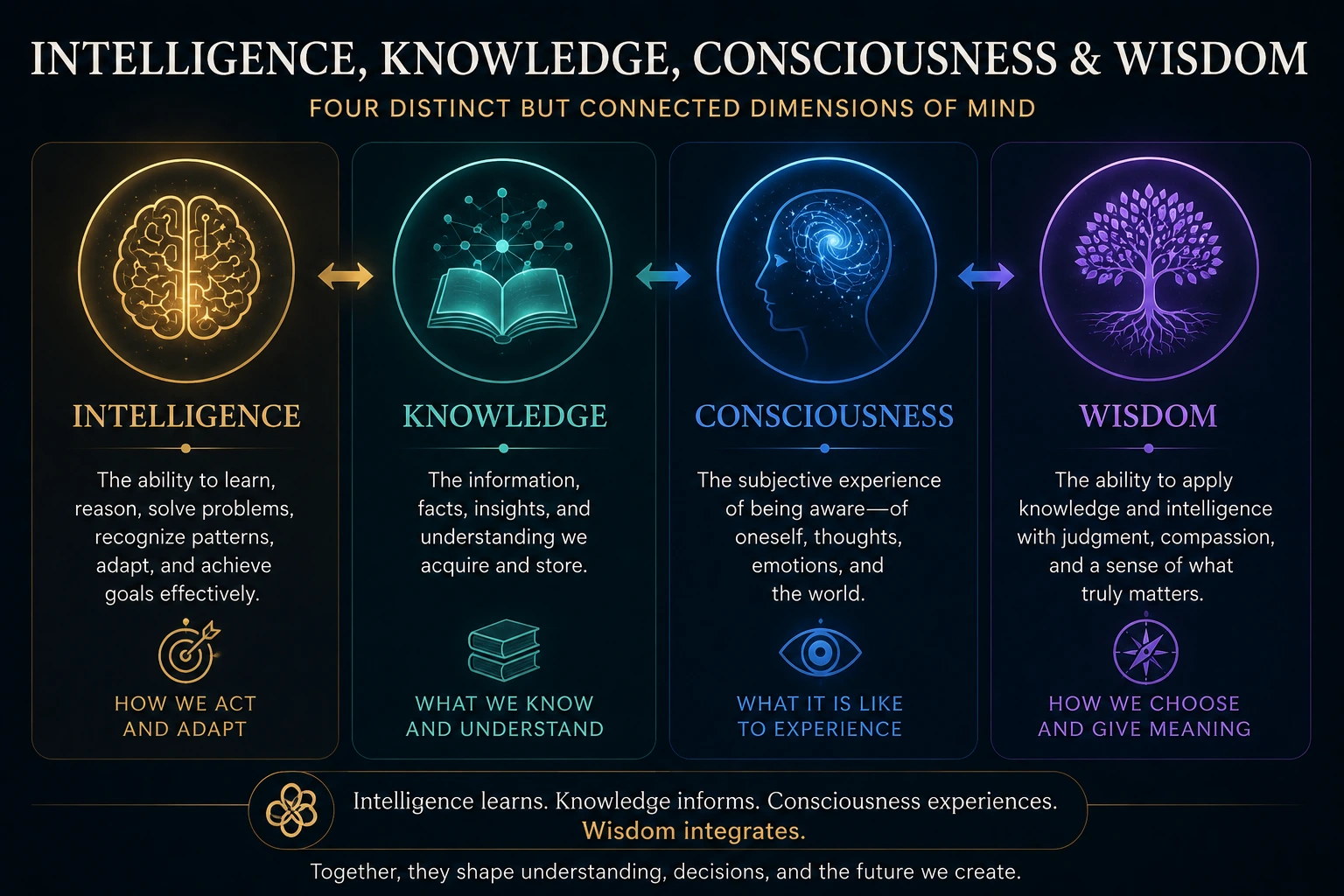
Knowledge is the information, concepts, relationships and understanding a person or system has acquired. Intelligence is the capacity to acquire, test, reorganize and apply that knowledge effectively.
Knowledge gives intelligence material to work with. Intelligence helps determine which facts are relevant, how they connect, whether they remain reliable and what should be done with them. The distinction explains why expertise is powerful but not infallible: experts know more, yet they can still misread a novel situation when old patterns are applied too rigidly.
Crystallized ability grows through accumulated knowledge and experience. Fluid reasoning is more closely associated with solving unfamiliar problems. In real life, the two interact continuously. Knowledge improves reasoning because it supplies richer models; reasoning improves knowledge because it helps evaluate sources, detect contradiction and revise beliefs.
A knowledgeable person may know many historical facts. An intelligent response requires recognizing which facts apply to the present case, identifying misleading analogies and updating the conclusion when circumstances differ.
For a deeper exploration, see What Is Knowledge?
Knowledge also depends on what we accept as real and true. Related guides include What Is Reality?, What Is Truth? and How Do We Know What Is Real?
Intelligence vs Mind
The mind is broader than intelligence. It includes perception, memory, emotion, imagination, attention, desire, identity and conscious experience. Intelligence is one capacity expressed through this wider mental system.
A mind can contain fear, longing, pain or imagination without those states being intelligent in themselves. Intelligence concerns how information is learned, connected, evaluated and used. The mind is the larger field in which those processes occur.
This distinction also prevents a common error in AI discussions. A system may perform an intelligent task without possessing every property ordinarily associated with a mind. Competence in language, planning or perception does not by itself establish emotion, selfhood, desire or experience.
Intelligence vs Consciousness
Intelligence and consciousness are often confused because adult humans normally possess both. But they answer different questions.
Intelligence asks: Can the system learn, predict, reason, adapt and achieve goals?
Consciousness asks: Is there something it is like to be that system? Does it have subjective experience?
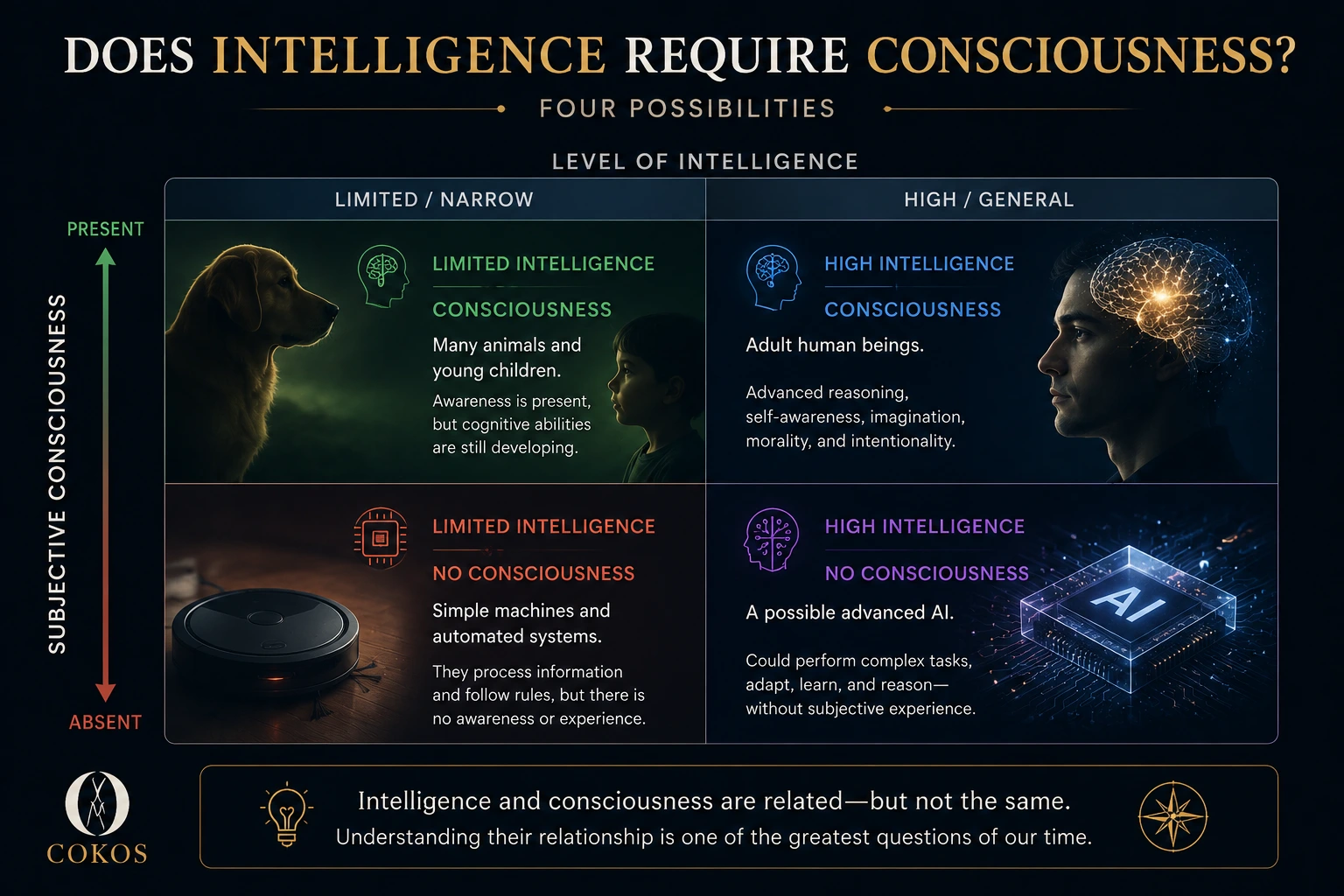
A highly capable system might solve complex problems without feeling anything. Conversely, a conscious creature might have vivid experience while possessing limited abstract reasoning. The concepts can overlap without being identical.
Consciousness is also not a synonym for attention. Some information influences behaviour without entering awareness, and conscious attention can be present while reasoning is poor. The philosophical literature therefore separates access to information, wakefulness, self-awareness and phenomenal experience rather than treating “consciousness” as one simple switch.
Explore the related questions in What Is Consciousness?, What Is Conscious Experience? and The Hard Problem of Consciousness.
Does Intelligence Require Consciousness?
For narrow intelligent functions, probably not. Many useful cognitive operations occur without conscious attention. Human perception, motor control and pattern completion rely heavily on processes that never become explicit experience. Machines can classify, optimize and predict without evidence that they feel anything.
The harder question concerns general intelligence: can a system understand unfamiliar situations, integrate values, form aims and respond flexibly without consciousness?
The functional view
On a functional account, a system is intelligent if it reliably learns, reasons and acts effectively. Conscious experience may be unnecessary if the same functions can be implemented through nonconscious mechanisms. This approach is attractive because it allows intelligence to be evaluated through observable performance.
The understanding view
Others argue that correct output is not sufficient. A system may manipulate symbols successfully without grounding them in experience or attaching meaning to them. The Chinese Room argument is a famous attempt to show why rule-governed symbol processing may not amount to understanding, although the argument remains heavily debated.
The embodiment view
A third position emphasizes that intelligence developed in organisms acting through bodies. Perception, movement, emotion and survival needs may not be optional additions; they may help create the categories through which the world becomes meaningful. On this account, intelligence detached from lived interaction could be powerful yet fundamentally different from human understanding.
The most defensible conclusion is limited: intelligent performance does not by itself prove consciousness. Whether fully general, self-directed and meaning-sensitive intelligence can exist without subjective experience remains unresolved.
What Is Human Intelligence?
Human intelligence is not merely a brain performing abstract calculation. It is embodied, emotional, social, cultural and historical. Human beings learn through bodies, relationships, language, imitation, conflict, cooperation and shared traditions.
Research linking intelligence to the brain does not identify one isolated “intelligence centre.” Studies instead implicate distributed networks and patterns of connectivity. Reviews of human intelligence and brain networks and later work on whole-brain connectivity support the view that cognitive performance depends on coordinated systems rather than a single region.
Several features are especially important:
- Language: symbols allow knowledge to be compressed, transmitted and recombined across generations.
- Metacognition: people can examine their own thinking and notice uncertainty, error or bias.
- Counterfactual imagination: humans can model futures that do not yet exist and compare them with the present.
- Cumulative culture: individuals inherit tools, concepts and institutions created by countless other minds.
- Emotion and motivation: reasoning is guided by what matters, not only by what is logically possible.
- Moral and existential reflection: humans ask not only what can be done, but what should be done and what makes a life meaningful.
Emotion is particularly important. It is tempting to contrast emotion with intelligence, but emotions assign urgency, value and relevance. They can distort judgment, yet a system with no preferences, concern or motivation would also lack reasons to choose one future over another.
Human intelligence is therefore inseparable from finite life. We reason while tired, vulnerable, social, dependent and aware that time is limited. These constraints can produce error, but they also shape care, meaning and responsibility.
Related explorations include What Is Human Nature?, What Makes Us Human?, What Is Experience? and What Is the Self?
Because intelligent decisions are made by persons over time, the topic also connects with What Is Personal Identity?, What Makes You the Same Person Throughout Your Life? and Books About Memory.
What Is Artificial Intelligence?
Artificial intelligence refers to machine-based systems that infer from inputs how to generate outputs such as predictions, content, recommendations or decisions. The OECD definition of an AI system emphasizes inference, explicit or implicit objectives, outputs that influence physical or virtual environments and varying levels of autonomy and adaptiveness.
This is a functional definition. It describes what AI systems do without assuming that they possess human-like awareness. It also covers a wide range of technologies rather than one unified artificial mind.
Some systems are narrowly optimized for one task. Others work across language, vision, coding or planning. Generative models can produce novel combinations of learned patterns, while agentic systems can execute sequences of actions. None of this, by itself, establishes consciousness or selfhood.
Alan Turing shifted attention from hidden essence to observable performance by asking whether a machine could sustain behaviour indistinguishable from human conversation. John Searle later challenged the idea that successful symbol manipulation necessarily produces understanding. Their disagreement still frames much of the modern debate.
Can AI truly be intelligent?
By functional standards, many AI systems already display forms of intelligence. They recognize patterns, predict outcomes, produce language and solve some problems better or faster than humans. Denying every form of machine intelligence would make the definition artificially dependent on biology.
But high performance is not the same as demonstrated understanding. Current systems can generate fluent explanations while making confident errors, failing under small changes in context or relying on correlations that are not grounded in lived experience. Their goals are usually assigned through training objectives, prompts, system architecture or human institutions.
It is therefore reasonable to say that AI can exhibit functional intelligence while remaining uncertain about whether it possesses understanding, consciousness or intrinsic goals.
Why fluent language can mislead us
Humans naturally interpret coherent language as evidence of a mind. In ordinary life, this is usually a good inference because language comes from other conscious people. With AI, the same cue can be generated by statistical systems trained to predict and transform language. Fluency is evidence of linguistic competence; it is not direct evidence of subjective experience.
What would count as stronger evidence?
No single behaviour would settle machine consciousness. Stronger evidence might require stable self-models, robust cross-context integration, independently formed goals, consistent reports linked to internal processing, and a theory explaining why the architecture should produce experience. Even then, the problem would remain partly inferential because consciousness is directly accessible only from the first-person point of view.
For the consciousness question specifically, see Can AI Become Conscious?
Human Intelligence vs Artificial Intelligence
| Dimension | Human intelligence | Artificial intelligence |
|---|---|---|
| Learning | Embodied, social and shaped by lived experience | Data-, architecture- and objective-dependent |
| Generalization | Broad and flexible, though inconsistent | Often powerful within learned patterns; variable outside them |
| Emotion | Integral to motivation, value and judgment | Can model emotional language; felt emotion is unproven |
| Consciousness | Present in ordinary human experience | Not demonstrated |
| Goals | Biological, social, personal and cultural | Designed, prompted, selected or optimized |
| Meaning | Grounded in embodied life and relationships | Derived from learned patterns and human-defined contexts |
| Speed and scale | Limited | Extremely high for some computations |
| Memory | Selective, reconstructive and emotionally shaped | Potentially large, externalized and system-dependent |
| Responsibility | Embedded in moral and legal relationships | Usually remains with designers, deployers and institutions |
The comparison is not permanent. AI systems will continue to change, and human capacities can be augmented by tools. The enduring point is conceptual: performing an intelligent task is not automatically the same as having a human mind.
Human and artificial intelligence are also increasingly interdependent. Search engines, recommendation systems, writing tools and decision-support systems shape what people notice and remember. The relevant question is no longer only “Which is more intelligent?” It is also “What kinds of combined systems are we building, and who remains accountable for their consequences?”
Intelligence vs Wisdom
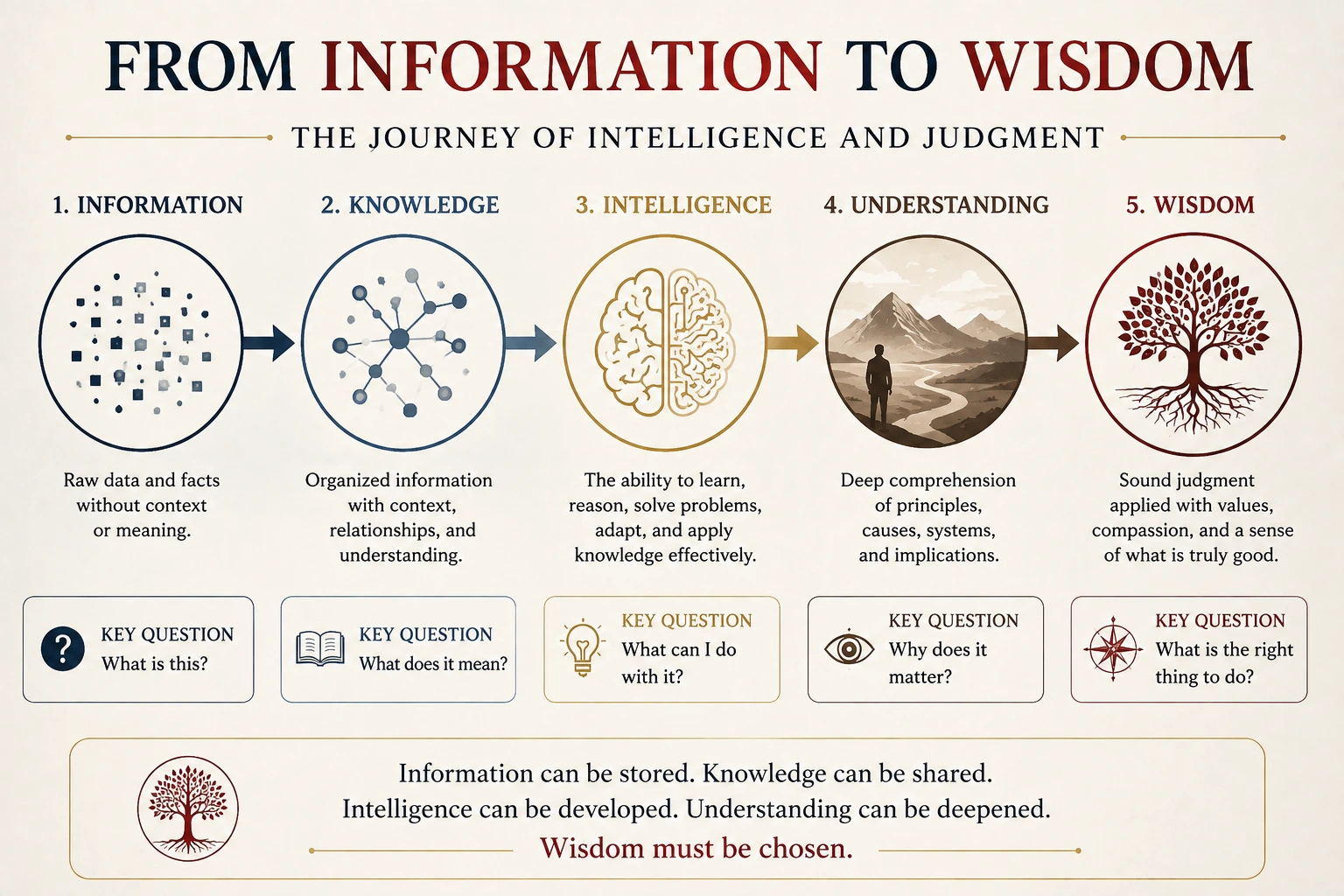
Intelligence helps determine how to achieve a goal. Wisdom asks whether the goal is worth achieving, what consequences matter and how competing values should be balanced.
An intelligent person can design a powerful tool. A wise person also considers who may be harmed, what dependencies the tool creates and whether the immediate benefit undermines a larger good.
This distinction matters because intelligence increases capability, not moral direction. Greater intelligence can improve medicine, cooperation and understanding. It can also improve manipulation, exploitation and destruction.
Wisdom therefore integrates knowledge and intelligence with judgment, compassion, responsibility and a sense of proportion. It is sensitive not only to immediate success but also to second-order effects: how today’s solution changes tomorrow’s incentives, institutions and possibilities.
Wisdom is not the same as caution. Sometimes the wise decision is bold. The difference is that wise action sees more of the system, acknowledges uncertainty and takes responsibility for consequences that narrow optimization would ignore.
These questions connect with What Is Morality?, What Is Truth? and What Is the Meaning of Life?
Questions about agency and responsibility also lead to Do Humans Have Free Will? and What Is Personal Identity?
Can Intelligence Be Measured?
Intelligence tests can measure selected cognitive abilities, including verbal reasoning, working memory, spatial reasoning, processing speed and pattern recognition. Scores across tasks are often correlated, which is one reason psychologists use the concept of general cognitive ability.
Well-designed tests can predict meaningful outcomes, including aspects of academic and occupational performance. That does not make them complete measures of a person. A test score is evidence about performance under standardized conditions, not a summary of dignity, character, imagination or potential.
IQ is therefore not identical to intelligence as a whole. Tests sample a defined set of abilities. They do not directly measure wisdom, morality, consciousness, motivation, curiosity or every form of creativity and practical competence.
Interpretation also requires context. Performance can be affected by language, education, culture, health, anxiety, sleep, familiarity with testing and access to opportunity. Comparing scores without considering measurement quality and population norms can produce false precision.
Another limitation is that intelligence tests are designed to rank or compare performance, while everyday intelligence often involves selecting the right problem. A person can solve a difficult task efficiently and still fail to notice that the task should not be pursued.
Work associated with Daniel Kahneman also reminds us that capable reasoning coexists with systematic bias. Intelligence does not guarantee consistently rational judgment, especially when attention is limited, incentives are distorted or intuitive shortcuts dominate.
Is Intelligence Fixed, or Can It Change?
Cognitive abilities show meaningful stability, especially across adulthood, but stability is not complete immutability. A 2024 meta-analytic review of cognitive stability found that cognitive abilities can be highly stable while still changing in level across development and aging.
Education can also influence measured cognitive ability. A large meta-analysis covering more than 600,000 participants found consistent evidence that additional education was associated with gains on intelligence-test performance, though estimates varied across designs and outcomes. The study concluded that education is among the most reliable interventions identified for improving cognitive abilities. See Ritchie and Tucker-Drob’s meta-analysis.
This does not mean intelligence is infinitely malleable. Genetic differences, development, health and environment all matter. Nor does improvement on one practiced task guarantee broad transfer to unrelated abilities.
Still, people can become more knowledgeable, strategically flexible and effective at reasoning within domains they understand. Sleep, physical health, stress, motivation, feedback quality and deliberate practice can all influence whether available cognitive capacity is expressed.
The practical lesson is neither “intelligence is fixed” nor “anyone can become anything.” It is that intelligent performance emerges from capacity interacting with education, habits, context, tools and opportunity.
Is Intelligence the Same as Understanding?
No. Intelligence and understanding overlap, but they are not interchangeable.
Information processing transforms inputs into outputs. Competence produces useful answers or actions. Understanding involves grasping relationships, causes, implications and meaning.
A system may correctly answer many questions through learned statistical structure while lacking the kind of grounded comprehension humans associate with experience. Conversely, a person may deeply understand a narrow subject without being exceptionally fast across unrelated cognitive tasks.
Understanding is also connected to explanation. To understand a mechanism is not merely to predict what will happen, but to know why changing one part should affect another. Yet explanation itself can be imitated, so fluent causal language is not conclusive proof of inner comprehension.
The distinction matters because modern AI invites psychological language. We say a model “knows,” “thinks” or “understands.” Sometimes this is useful shorthand. It should not be confused with evidence that the system has human-like experience.
Why Intelligence Is Not Enough
Intelligence can help a being predict, adapt, invent, persuade and survive. It cannot, by itself, decide what deserves protection, which future should be created or what one owes to other conscious beings.
A civilization can become technically brilliant while remaining morally confused. An organization can optimize every metric while destroying the purpose the metrics were meant to serve. An individual can become highly effective at pursuing a life that does not feel worth living.
That is why the deepest question is not simply whether intelligence can become more powerful. It is whether intelligence can remain connected to truth, responsibility and wisdom as its power grows.
Key Takeaways
- Intelligence is best understood as an adaptive process, not a storehouse of facts.
- Knowledge provides information; intelligence applies and revises it.
- Consciousness and intelligence are related but distinct concepts.
- Current AI demonstrates functional intelligence without proving subjective experience.
- IQ measures selected cognitive abilities, not the whole person.
- Wisdom determines how intelligence should be used and which goals deserve pursuit.
Frequently Asked Questions
What is the simplest definition of intelligence?
Intelligence is the ability to learn from experience, recognize patterns, reason, solve problems, adapt to new conditions and apply knowledge effectively. The definition includes both cognitive performance and successful adjustment when familiar rules no longer work.
What are the main characteristics of intelligence?
Core characteristics include learning, pattern recognition, reasoning, memory, knowledge transfer, planning, error correction and adaptation. No single characteristic is sufficient by itself; intelligence appears through the way these capacities work together across different situations.
Is intelligence the same as knowledge?
No. Knowledge is what a person or system has learned. Intelligence is the ability to acquire, evaluate, reorganize and apply knowledge. Someone can know many facts without using them well, while another person may reason effectively from limited information.
Is intelligence the same as consciousness?
No. Intelligence concerns effective learning, reasoning and adaptation. Consciousness concerns subjective experience—whether there is something it feels like to be the system. A system may display intelligent behaviour without proving that it has experience.
Can intelligence exist without consciousness?
Narrow intelligent functions can exist without evidence of consciousness. Machines already classify, predict and optimize. Whether fully general, self-directed and meaning-sensitive intelligence can exist without subjective awareness remains an open philosophical and scientific question.
Can artificial intelligence truly understand?
AI can display impressive competence and functional intelligence, but whether that competence amounts to grounded understanding is unresolved. Fluent explanation, problem-solving and prediction are evidence of capability, not direct evidence of conscious comprehension.
What makes human intelligence different from AI?
Human intelligence is embodied, conscious, emotional, social and culturally developed. AI depends on engineered architectures, training data and objectives. AI may exceed humans in speed and scale while lacking demonstrated experience, intrinsic motivation or moral responsibility.
Is IQ the same as intelligence?
No. IQ tests measure selected cognitive abilities under standardized conditions. They can be useful and predictive, but they do not capture every form of creativity, practical judgment, motivation, wisdom, morality or the full complexity of a person’s mind.
Can intelligence increase over time?
Some cognitive abilities and forms of performance can improve through education, practice, health, better strategies and experience. Broad abilities also show substantial stability, so change is possible but not unlimited or uniform across every skill.
Is wisdom a form of intelligence?
Wisdom uses intelligence and knowledge but adds judgment, values, responsibility and attention to long-term consequences. Intelligence can optimize a chosen goal; wisdom helps decide whether the goal is worthy and how its pursuit affects others.
Final Answer
Intelligence is the capacity to learn, reason, recognize patterns, adapt and act effectively. Human intelligence is shaped by consciousness, emotion, embodiment, culture and values. Artificial systems can reproduce many intelligent functions, but intelligent performance alone does not prove subjective experience or genuine understanding.
The future may depend less on whether intelligence can become more powerful than on whether power can remain connected to wisdom.
Sources and Further Reading
- American Psychological Association: Intelligence
- APA Dictionary of Psychology: Intelligence
- Sternberg, R. J. “Intelligence.”
- Colom et al. “Human Intelligence and Brain Networks.”
- Conway et al. “Individual Differences in Attention and Intelligence.”
- McGrew. “Carroll’s Three-Stratum Cognitive Ability Theory at 30 Years.”
- Breit et al. “The Stability of Cognitive Abilities.”
- Ritchie and Tucker-Drob. “How Much Does Education Improve Intelligence?”
- OECD.AI: Definition of an AI System
- Stanford Encyclopedia of Philosophy: Artificial Intelligence
- Stanford Encyclopedia of Philosophy: Consciousness
- Stanford Encyclopedia of Philosophy: The Chinese Room Argument